Press Release from Charter Commission

I received the following press release and information from the Saratoga Springs Charter Commission:

*********************************************************************

Charter Review Commission ironing out final details

Now in its ninth month, the Saratoga Springs Charter Review Commission discussed remaining structural elements to its proposed new charter that will go before voters on May 30.

“We are getting very close.  I know citizens want to see the final product as soon as possible,” said Bob Turner, Commission Chair. “While we have the main provisions of the charter, there are a number of important details we have to get right.”

The proposed charter has a seven-member city council and a city manager form of government. The Commission’s current goal is to instill a system of checks and balances and professional government in the document, which would dictate a new direction for government functions over the next decade.

The Commission went line by line through a model charter provided by its legal counsel, Bob Batson, Government Lawyer in Residence at Albany Law School. Commission members also carefully examined council-manager language in the Oneonta and Canandaigua charters in order to tailor responsibilities that best fit the Spa City’s needs.

“We want to use the best research available,” said Laura Chodos, Commission member. “Our decisions are also informed by what we heard in dozens interviews conducted since June. “Our goal is to minimize the politics of administration and partisan bickering,” said Beth Wurtmann, Commission member.

Major decisions made by the Commission this week include:

  • Approval of a preamble
  • Duties of the city manager
  • Appointment and responsibilities of the city attorney
  • Decision for seven-member council to be elected to ‘at-large’ seats

At its next meeting on February 23, 7pm, City Hall, the Commission will develop the role of the ‘dynamic mayor,’ in the proposed council-manager form of government, as well as recommendations for a beginning salary structure for manager, mayor and council.
There will be a public comment period, and citizens are encouraged to learn more about the Commission at www.saratogacharter.org.

Media Contacts: Beth Wurtmann (518)321-4607 and Minita Sanghvi (336) 210-3258 

Additional details of the Charter:

Duties of the city manager developed by the Commission in its proposed charter include:

  • Serves at the pleasure of the City Council and can be fired at any time by a majority vote of the city council.
  • Works for the city council and will attend all meetings; sees that the Council’s laws are implemented fairly, and provide staff support to mayor and council.
  • Serves as chief administrative officer of the city with the power to direct and supervise the administration of all departments, direct collective bargaining, and submit the budget to the city council.  He or she will also administer the annual performance evaluation review process, which currently doesn’t happen.
  • Provides long-term planning including assisting the council in developing long term goals for the city and a plan for economic development and fiscal planning.
  • Prepares and submit the annual budget and capital program to the city council and implement the final budget approved by the council

New preamble:  A preamble embodies the fundamental values and the philosophy on which the charter is based and the aims and objectives the polity is striving to achieve. Since 2001, preambles have become more important as a guide for constitutional interpretation.  The proposed preamble is closely modeled after the US Constitution.  “We, the People of the City of Saratoga Springs, in order to secure the benefits of efficient self-government and to promote our common welfare, do ordain and establish this charter for the government of our City, pursuant to authority granted by the Constitution and laws of the State of New York.”

Revised language on the County Supervisor:  Under the current charter, county supervisors are required to attend city council meetings.  Interviews with the 2001 charter review committee revealed this provision was adopted in part because of a feud between then city council members and the county supervisors over water and sewer rates.  Current county supervisors Matt Veitch and Peter Martin suggested removing the language on compulsory attendance.  The new language reads, “Supervisors may attend meetings of the Council and may report to and seek advice from the Council on matters affecting City residents and taxpayers that are coming before the County Board of Supervisors.”  The Commission also drafted language that prohibits individuals from serving as a County Supervisor and City Council member simultaneously.

Revised date for capital budget submission: To the second Monday in July.  Under the current charter, the Mayor submits the capital budget on September 15 and the Finance Commissioner submits the comprehensive budget in early October.  Commissioner Michele Madigan had suggested in June that the budget timeline is too compressed and provides scant time to review and work the capital budget into the Comprehensive Budget. The Charter Review Commission also discussed the importance of giving the City Council a strong internal audit function.  An internal audit acts like the state comptroller or federal General Accountability Office to detect fraud, waste, abuse, and mistakes.
Understanding the Presidential Election


For those struggling to understand the November election, there will be an interesting talk by Chris Arnade at 6:30PM Thursday in Gannett Auditorium on the Skidmore Campus. Arnade has a PhD in physics from John Hopkins and worked for 20 years as a trader on Wall Street. He left Wall Street in 2012 to focus on photography. Below is a link to an interview with him in the Atlantic and further information about his talk at Skidmore.

https://www.theatlantic.com/business/archive/2016/11/donald-trump-voter-respect/507350/

American Carnage: Why Trump Supporters Are Not Idiots

A conversation with photojournalist Chris Arnade

Thu, February 16 @ 6:30pm, Gannett Auditorium

Photojournalist Chris Arnade captures the often forgotten, misunderstood American communities that litter the country and proved decisive for Donald Trump’s victory.  During the course of 2016, Chris drove 57,821 miles back and forth across the country trying to understand the root of Trump’s support. His conclusion: many voters feel years of angst over being forgotten and betrayed by the establishment, and it’s time to start listening to them.

In his wide-ranging talk, Chris will discuss reasons for a divided America. He worries about ever-present race issues, the education gap, and failures to address addiction. Firmly opposed to Trump, this PhD in Physics and Wall Street trader of 20 years hopes to help his seething country embrace empathy.

Beyond his own projects, Chris is a regular contributor to The Guardian and has been featured in The Wall Street JournalThe Washington PostThe AtlanticQuartz and the Columbia Review of Journalism.

This event is hosted by The Skidmore News with support from MDOCS.


John Franck Comments on Special Election for Charter Change

The Charter Commission has decided to put their charter proposal on the ballot in a special election to be held May 30 instead of waiting for the regularly scheduled November election.  The county Board of Elections is in charge of running regularly scheduled elections but it will be the Accounts Department that will be in charge of conducting this special election so I emailed Commissioner of Accounts John Franck to ask him if he would talk with me.  He was kind enough to call me back.

Commissioner Franck pointed out the city has never held a special election so there are many unknowns. The Charter Commission is requesting $37,000 to cover the expense of the election.  This amount will be necessary to cover the basics that are routinely paid for by the county when they run regularly scheduled elections. These expenses include such things as paying inspectors, printing ballots, legal advertising, and printing copies of the proposition for polling places. It does not cover any expenses incurred by the Accounts Department to do the job the county usually performs. Commissioner Franck estimated it could cost another $5,000 to $10,000 in overtime for his staff.

Adding to the challenge is that May is an especially busy month for his office.  This is the month when they must finish assessments and hold the annually scheduled grievance day so adding the carrying out of a special election to the department’s workload will be a challenge.

In addition Commissioner Franck was skeptical about the need to have a May 30 special election particularly given his expectation that there will be a lower turnout than there would be for a regular election.

Nevertheless the Commissioner was positive and constructive in discussing the responsibilities that his department will take on. If it has to be done it will be done properly.


Joe Ogden Clarifies His Leave

Joseph Ogden, previous deputy mayor, has reached out to me in an effort to clear up a misunderstanding noted on in the comments section of a recent posting. He wanted readers to know that he did in fact take FMLA leave last year, for approximately one month as was his right to do so, for the birth of his son, Jude. He does not believe that Commissioner Madigan’s comments violate any provision of HIPPA whatsoever, and would also like to note that, in his experience, the city does not in any way discriminate against men or women who take or attempt to take FMLA leave.

Commissioner Madigan Announces Appointment of Temporary Deputy

[JK: Press Release Received Today]

MEDIA ANNOUNCEMENT

February 6, 2017

Commissioner of Finance, Michele Madigan Telephone:  (518) 587-3550 ext 2577 Email:  michele.madigan@saratoga-springs.org

Commissioner of Finance Michele Madigan Announces the Appointment of Susan Dugan-Armstrong as Acting Deputy Commissioner of Finance

Saratoga Springs, NY – Finance Commissioner Michele Madigan announced today the appointment of Susan Dugan-Armstrong as Acting Deputy Commissioner of Finance, filling in for Deputy Commissioner of Finance Lynn Bachner while she is on leave. Susan has served most recently as the City’s Website Content Coordinator and was responsible for the design and implementation of the City’s Smartphone Application “Saratoga Mobile”.

Susan was the owner and CEO of a successful local computer company for over 7 years, which was voted best computer store by the Saratogian in 2010.  As the owner of a small business Susan managed the company finances, produced yearly budgets, prepared federal, state and local tax statements, ensured sales tax payments, and managed the company payroll ensuring compliance with payment and reporting requirements.

Susan’s experience also includes working for Farm Credit Bank in the Accounting Department and for Knolls Atomics power Lab as a Security Specialists for 8 years.

Susan holds degrees in Business and Nursing, having graduated at the top of her class from Mildred Elley Nursing School in 1997.  She has taught Adult Continuing Education cooking classes at Saratoga Springs High School on and off over the last 10 years.

Commissioner Madigan stated  “Susan has been working for the City for several months now, so I have had the opportunity first hand to understand the depth of her skills as it pertains to position of Deputy Commissioner of Finance, which manages both the Finance and the Information Technology Departments of the City”. Madigan also stated “We were very fortunate to have such a capable person already on staff when Deputy Commissioner Bachner went on leave. Her knowledge of the City, business, and technology allows her to add value from the moment she takes on her new role. Her professionalism, skills, and knowledge will benefit the City overall,” said Commissioner Madigan.


Michele Madigan

Commissioner of Finance

City of Saratoga Springs

474 Broadway

Saratoga Springs, NY 12866

518-587-3550 ext. 2557


SUCCESS Speaks Out Against May Vote on Charter

The City Council will be deciding on whether to approve the charter commission’s requests for funding at its regularly scheduled meeting this Tuesday, February 7, at 7PM in city hall. I anticipate that the Council will consider separately the commission’s request for general operating funds and its request for $37,000 to put their proposed charter change on the ballot for a special election on May 30.

I have received a press release from SUCCESS which is opposing the May 30 scheduling of a special election and supports keeping the commission form of government that currently exists in the city. Below is their press release and a description of their organization they sent me.”


SUCCESS Overview

SUCCESS was founded in 2006 to support Saratoga Springs’ Commission form of government. Our primary goals are to alert, inform, and energize voters around charter change issues.

SUCCESS is a non-partisan citizen’s organization that opposes attempts to abandon Saratoga Springs’ Commission form of government that we feel has contributed to Saratoga Springs becoming the most successful city in upstate New York.

SUCCESS members include Democrats, Republicans, Conservatives, and members of the Independence Party as well as those who are unaffiliated.

SUCCESS led the last two campaigns to defeat charter change proposals in 2006 and 2012. The organization has recently been reactivated to be sure residents are informed about the latest plan to hold a referendum on May 30th to attempt again to replace the Commission form of government with imitations of structures used in other cities which we feel do not offer the transparency, accountability of and accessibility to elected officials that we enjoy under our current charter.


Press Release

News Contact: Richard Sellers, sellersrichard@gmail.com, 518-859-9218

SUCCESS: Saratogians United to Continue the Charter Essential for Saratoga’s Success

The Charter Commission has formally announced its plan to schedule a referendum to change Saratoga Springs’ form of government in a Special Election on May 30th, instead of putting the issue on the ballot at the regularly scheduled November election.

The Charter Commission has not yet made many critical decisions about the plan that is to go before voters.

SUCCESS is stating its formal opposition to this needless special election. SUCCESS is a non-partisan Saratoga Springs citizen’s organization that supports the Commission form of government. Our members led the last two campaigns to defeat charter change proposals in 2006 and 2012.

After the 3-day Memorial Day holiday, we are concerned that many Saratogians will not be aware that there is an election, and the turnout could be very low. This is not a fair way to decide on the very constitution of our city.

Note that the Charter Commission is claiming the turnout will be high. We leave it to voters’ common sense to make their own judgment about the turnout and decide for themselves how likely it is that an early summer special election will get a higher turnout than the regularly scheduled November election.

We feel the Charter Commission is pushing for the first special election in our city’s history because the lower turnout will give them a better chance to win approval for the new charter they are proposing.  Voters resoundingly rejected previous charter change proposals and supported the Commission form of government twice in less than 11 years.

In 2006, Saratogians defeated a Strong Mayor proposal in all 25 voting districts by 62-38%.

In 2012, Saratogians defeated a City Manager proposal in 23 of the 25 voting districts by a 58-42% margin.

Note that Pat Kane led both the 2006 and 2012 campaigns and was appointed vice chair of the current 2017 Charter Commission to try again to push through a change of government.

SUCCESS Board

Remigia Foy, Chair

Bonnie Sellers, Vice Chair

Jim Brophy, Treasurer

Jane Weihe, Secretary

Republican Senator Comes Out For Striking Workers at Momentive

At a press conference on Januray 31st, area legislators spoke in support of the Momentive workers on strike.

There was little surprise that Neil Breslin, a Democratic state senator who represents Albany, spoke.  Nor was it surprising that Democratic Assembly representatives Carrie Woerner (Round Lake) whose district includes Saratoga Springs, and John McDonald (Cohoes) were there. Bravo to them for standing with the Momentive workers.

The big surprise to me, though, was the presence of Kathy Marchione, the Republican Senator whose district includes our own city.   Senator Marchione told those present, “The strike is hurting many of our families in the community, and it is hurting our community at large.  That’s why it is so important that the company return to the negotiating table and bargain in good faith.” Well, good for you Senator Marchione!


More Problems With The UDO Process

Maureen Curtin is a real trooper to whom we all owe our appreciation.  For years she has worked to help protect neighborhoods in our city from the pressures to build projects that threaten their character.

The Unified Development Ordinance is an extremely ambitious undertaking that is supposed to incorporate the city’s zoning ordinances, plus design review, and pretty much everything else associated with regulating development into one grand document.

The original contract to develop the UDO , as Maureen notes below, called for a technical advisory committee made up of representatives from the city’s departments, representatives of the land use boards and the city’s planning department to both monitor and contribute to the document’s development.  As Maureen describes, this part of the process has been badly abused.  Instead of having an on-going role, this committee has only recently (after over a year) been created.  Maureen does an excellent job of describing the dubious character of what has emerged.

Most troubling in this UDO process has been the development of something called a “diagnostic” that was supposed to lay out what issues needed to be addressed.  The original document that Behan Planning submitted to the Planning Department was rejected and the Planning Department then rewrote it.

To give you a flavor of what they came up with I will identify a couple of items.  Of particular interest is that these items came out of some mysterious ether.  Comments  that had been submitted and the outcome of the one community event that was held were posted on the UDO website. None of the following items were identified as problems in the public process.

The “diagnostic”  calls for an end to specific footage height limits for structures.  They want to change the height requirements from being measured in feet to floors.  This, they say, is to address the problem of buildings being too uniform in height.  Aesthetically, they think it would be better if there were variations.  Now I am sure, dear reader, that this has been a sore point for you.  You probably are appalled as you walk through the city at the boring uniformity of building heights (my attempt at humor).  Apparently, the drafters of the diagnostic were not concerned about the kind of abuse that some developers might exercise when they design their “floors.”

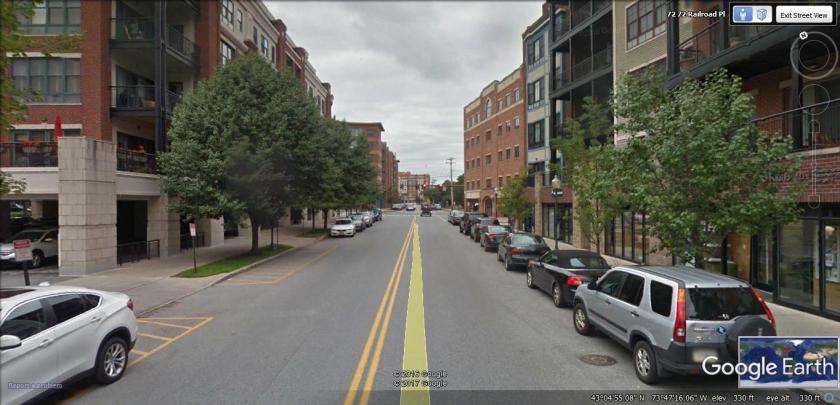
There is indeed a problem with building heights.  A central theme in today’s urban planning has to do with human scale.  In the case of building heights this has to do with avoiding the canyon effect when a narrow street is wedged between very tall buildings. There is little sunlight and the street is extremely pedestrian unfriendly.  Most planners understand the need for proportionality between the width of the street and sidewalks and the height of the buildings.

Compare Railroad Place with Broadway.  Railroad Place is a poster child for bad streetscapes.  You would think that high on the list of concerns for the “diagnostic” would be this height problem rather than the need for uneven roof lines.

railroadplacestreetview
Railroad Place
broadway-streetscape
Broadway Downtown

The diagnostic also wants to dispense with the current minimum lot size in our zoning laws and replace it with some sort of average for some sort of so far undefined “neighborhood.”  Again, no one brought this up as a problem in any of the submitted comments or the community meeting.

Here is  yet another hitherto unknown problem.  There is currently no transitional building height between zoning areas.  At the risk of sounding cynical, where will the transition buildings that will be higher than one zone and lower than the other be built?  Might this be used as a wedge to build large buildings in our neighborhoods adjacent to downtown?

Continuing to sound cranky, I would guess that the development community quietly asserted itself in the crafting of the “diagnostic” by the planning staff.

Here is Maureen Curtin’s email:

February 1, 2017

To: Members of the Unified Development Ordinance (UDO) Technical Review Advisory Committee (TRAC)

From: Maureen Curtin, On Behalf of Residential Homeowners and Neighborhoods

Re: Understanding the purpose of the TRAC

We do not understand the purpose of the UDO Technical Review Advisory Committee (TRAC) that was set up by the Mayor’s office. The voting members of this TRAC include six members of the Mayor’s staff and three members from the Land Use Boards, who the mayor appoints, for a total of nine votes.

The chair of TRAC is Bradley Birge, the director of the Planning Department for Saratoga Spring. Three of his staff members serve as voting members: Kate Maynard, Susan Barden and Tina Carton. The Deputy Mayor and City Attorney are voting members. All six of these people work in the Mayor’s Department.

It would be one thing to state that the Mayor’s Office is setting up an internal committee to address the UDO, but that does not appear to be what is being portrayed. The TRAC committee’s purpose and responsibilities in their By-Laws state (See link above for UDO Agenda for link to the TRAC By-Laws):

“The TRAC provides the technical input to carry out the continuing, cooperative and comprehensive planning process for the UDO. The TRAC provides technical review and guidance on draft regulations. The members of the TRAC will participate as representatives from and technical experts of their department and/or Land Use Boards; and as a whole the TRAC shall serve as the technical advisor to the City Council and the Contractor.”

“The Technical Review Advisory Committee will review consultant draft documents as well as public comments and then provide advice to the consultant. If the TRAC cannot reach agreement on a particular issue or if a significant policy change is being considered, the committee will request direction from City Council as the legislative body to pursue.”

“Each [TRAC] Member shall vote on all agenda items….” “…if a quorum is present, an agenda item must be approved by a majority of the Committee Members present at the meeting.”

Since six of the nine votes are from the Mayor’s Office, what is the purpose of a vote? It could hardly be considered democratic.

We appreciate the Mayor’s Office trying to move the UDO process forward.

We appreciate the meetings discussing the proposals being open to the public and the public being able to make comments.

However, voting on issues when the votes are stacked, and presenting these votes and decisions to the other city council members and the public as anything other than internal agreements by the Mayor’s Office is simply unfair and misleading. Thank You.

cc: Mayor Yepsen,TRAC members for whom email addresses are available: Vince DeLeonardis, Megan Kelly, Brad Birge, Kate Maynard, Susan Barden, and Tina Carton,Michael Allen, Behan Planning, City Council Members

Residential Homeowners

Saratogaspringspolitics.com

The next TRAC UDO meeting will be held on February 7, 2017. The Agenda is provided at the link below. The meeting will be held from 4-6 PM in the Music Hall of City Hall. The public is welcome to attend and may speak for two minutes each at the opening of the meeting.


http://www.saratoga-springs.org/AgendaCenter/ViewFile/Agenda/02072017-1625?html=true