[I received the following from an independent reliable source.]
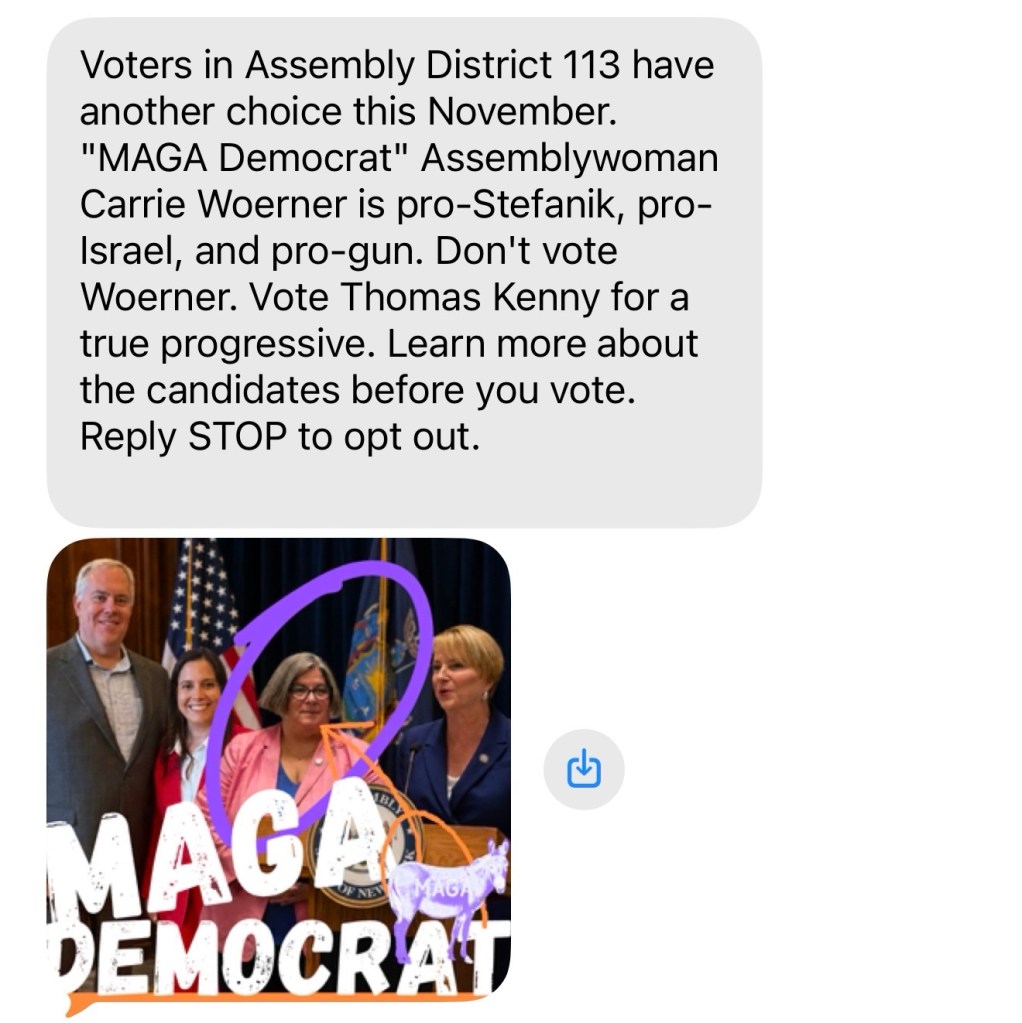
On September 4, 2026, voters in the 113th Assembly District received a mass text message attacking Assemblywoman Carrie Woerner. The message branded Woerner “MAGA” and paired a doctored photo of her with Rep. Elise Stefanik, Senator Dan Stec and Assemblywoman Mary Beth Walsh.
The text described Woerner as pro-gun, pro-Israel and pro-Stefanik. It then urged recipients to vote for Thomas Kenny, who is running against Woerner on the Working Families Party and “No Kings” lines.
Kenny, 22, has faced questions about his candidacy all year. He was a Conservative Party member until February, when he switched his registration to the Working Families Party just ahead of a legal deadline and petitioned onto its line unopposed. Kenny has denied that he is running as a spoiler.
No “Paid for by,” no reported spending
The message carried no “Paid for by” line. New York Election Law § 14-106 requires political communications, including paid text messages, to name the committee that paid for them.
Kenny’s own filings don’t answer the question either. As of October 24, his campaign had reported no expenses and no outside donations. The only money on record is $5,500 Kenny says he put in himself.
Mass texts to thousands of voters aren’t free. Someone paid for this one, and it doesn’t show up on Kenny’s books.
What the image metadata shows
The image attached to the text carried a wealth of embedded metadata. It lists the image’s creator as Brandon Acres, working within a design team labeled “Allen1572’s Team.”
That name matters, because Brandon Acres works for Allen Caruso, the Republican running against Woerner.
Who is Brandon Acres?
Acres is one of the best-paid people on Caruso’s campaign. According to New York Focus, he collected nearly $8,000 as a campaign worker. Caruso’s campaign then paid $100,000 for professional services to Anderson Strategies, a new company Acres launched. In total, that’s more than $100,000.
The relationship goes beyond consulting. Politico reported that Acres is Caruso’s longtime business partner, and a 2016 Facebook post by Caruso’s mother described Acres as her son’s boyfriend at the time. Acres did not respond to New York Focus’s questions.
Not the first trail back to Caruso’s team
The text isn’t the first Kenny material traced to Acres. New York Focus found that four graphics on Kenny’s campaign website came from a Canva account in Acres’s name, the same account behind five graphics on Caruso’s website.
The two sites share a second digital fingerprint. The Squarespace account that built Kenny’s website was created on February 5, 2025, at 1:29:34 a.m. An account tied to Acres, who is listed as an author on Caruso’s site, has a creation timestamp matching to the second.
Then there’s Venmo. Earlier this week, Kenny’s account listed just four “friends.” One was Everett Noakes, whom New York Focus identified as Caruso’s campaign manager, and two were members of Noakes’s family. Those connections vanished from Kenny’s profile after reporters asked about them.
The Times Union found the same Venmo link and reports that Noakes now sits on the Saratoga County Conservative Committee.
A candidate isolated from his own party
As noted in a previous post, Politico’s October 16 report laid out a long list of concerns about Caruso, from driving under the influence to allegations of domestic incidents to tens of thousands of dollars in debts and judgments. The Times Union summarized the article as documenting at least 15 lawsuits, arrests and unpaid judgments.
Days later, Caruso’s campaign released a recording a staffer had made in March of a phone call with Joseph Suhrada, then chairman of the Saratoga County Republican Party. On the recording, Suhrada uses racist and homophobic slurs while discussing a March Madness fundraiser. Suhrada claimed he was quoting a line from the 1994 film Cobb, but resigned as chairman on October 22.
Caruso hasn’t escaped criticism either. He sat on the recording for roughly seven months, and Suhrada says Caruso kept asking the county party for money and support during that time. The audio surfaced only after the Politico story ran.
State law prohibits public funds from being used in support of other candidates.
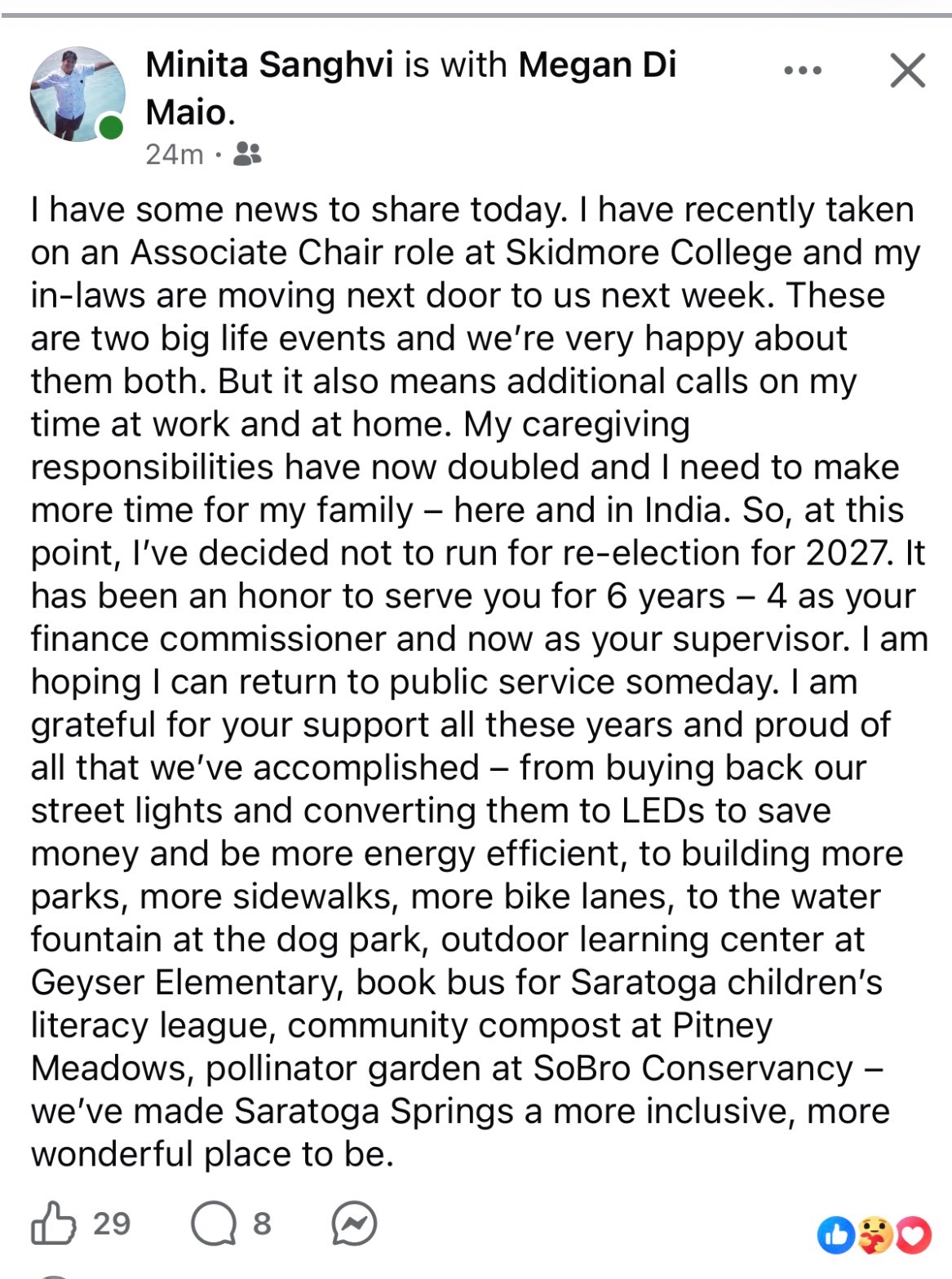
Minita Sanghvi Announces on Facebook that She Will Not Be Running For Office In 2027
Screenshot
On The Theme of “What Was He Thinking?”, We Have Allen Caruso’s Campaign For the Assembly Against Carrie Woerner
According to the website Politico:
“Allen Caruso, a Republican running to represent an upstate assembly district, describes himself as a “business owner who has created jobs and met payroll.”
But a turbulent history of legal troubles — including evictions, arrests, traffic violations and hundreds of thousands of dollars in debt — suggest otherwise.
Caruso and his businesses have been defendants in at least 15 lawsuits, at least eight of which resulted in still-unpaid judgments against him and his companies. He’s delinquent on at least 13 traffic tickets, tax liens, court judgments and bills totaling more than $350,000.”
Before he announced his campaign for the Assembly, I had never heard of Mr. Caruso, but now, when I see his name, and if I ever meet him, he will forever be defined by this unflattering article. When he decided to run for office, did he not think that the media and his opponent might research his past and expose his problematic history?
Joe Suhrada Resigns As Chair of Saratoga County Republican Party
Apparently, for unknown reasons to this blogger, months ago, Assembly candidate Allen Caruso recorded remarks by Joe Suhrada, who serves both as chair of the Saratoga County Republican Party and as the Saratoga Republican Commissioner of Elections, that included racist and homophobic references. Senator James Tedisco, Assembly Members Mary Beth Walsh and Matt Simpson issued a joint letter condemning Suhrada’s remarks and calling for him to step aside.
Suhrada resigned as Saratoga County Republican Chair but declined to resign as Board of Elections Commissioner. Election Commissioners are appointed by the Saratoga County Board of Supervisors, but according to the Board Chair, Phil Barrett, disciplinary action against Election Commissioners can only be taken by the Governor.
I contacted Mr. Suhrada, who offered the following.
I was quoting the “Cobb” film, in private not using the term in my own voice or expressing any personal belief [JK: Suhara is referring to the 1994 bio pick “Ty Cobb.” Cobb was a notorious racist and bigot and the film is an unflinching portrait starring Tommy Lee Jones]. It is not a word I use or that is part of my natural vocabulary. I wouldn’t weaponize either hateful term or call a person either. I certainly didn’t or wouldn’t direct it at anyone. At the time I wondered at the absurdity of the character as that sort of early-times hillbilly racism is antiquated and to be mocked and parodied. The filmmaker tackled it in this manner.
But I no longer watch sports of any sort. I also think “practically” that political fundraisers should be broadly general so that more people can partake instead of subcultural themes. I’ve seen bourbon and cigar events, horse racing events, and black tie soirées – none of which would interest me. I digress.
My context was that not everyone likes basketball fundraisers (sports doesn’t appeal to everyone) and I relayed the quote of the movie and I mockingly explained the movie as Cobb was this character who loved only baseball and hates all other sports. (Perhaps his hate of that sport was rooted in racism or maybe it wasn’t. I suspect he just didn’t like other sports and justified it as racially upsetting to anger people.) The filmmaker makes one think. Cobb was an absurd caricature and emblematic somewhat of that era.
I regret the reference to the nineteenth century character and he film which fell into obscurity. It certainly isn’t “The Godfather” which has organized crime, gratuitous violence, murder and gangland thematics which seem to be widely loved and accepted as a cultural norm to recite. Not to mention it portrayed Italian people in a very dark light which played on Mobster stereotypes. But it’s the number one quoted movie of all times. So for that I apologize to anyone who think I would hurt them using words. “Keep your friends close, but your enemies closer!”
But when you repeat a line from cinema and slip into a film, poetic or lyrical quote one can get into trouble, obviously. John Lennon also comes to mind with a song he released around 1972 that I can’t even mention the title of. Who can cover the song today? There are thousands of hurtful things in art but I’m loath to censor artists in private settings. Put them into a contextual framework and discuss them if you want to grow. I have generally tended to give testimony to a script or work of poetry or prose in authentic form. The words are there to shock and upset you.
Try reading the poetry of Jim Morrison in public if you will- Not acceptable anymore and I’m aware of that. I have never believed in censoring artists but this is now a different era (I’ve always been explained I’m a theoretical 1950’s liberal in some respects.) But- There is no latitude to not do so.
So in retrospect when I was talking I assume now he [Caruso] was trying to get a snippet of me speaking off-color or seemingly distastefully to use at a later time…I should obviously learn not to quote them all verbatim in private. Lesson learned. He repeatedly asked for higher levels of support from me as the months progressed and I could not oblige and it made him upset.
Last thing I say: if is he truly interpreted my recitation of this character as me being some racist and homophobe then why did he laugh? And why would I even endorse a gay man if I’m a homophobic bigot? Why continue to associate with me and why didn’t he denounce me in March instead of waiting until he decided to launch a takedown/takeover of the GOP with consultants? Because he knew that wasn’t true.
So he captured my private recitation of the film out of context to be used at a later date. And that’s what politics has become now, unfortunately for all of us.
Over Minita Sanghvi’s two two-year terms as Saratoga Springs Commissioner of Finance, I cataloged her extreme failure to manage the city’s finances. Calling it “management” is a misnomer. Sanghvi had little interest in the arcane, demanding numbers of public finance. Readers may recall that her automatic email response told anyone trying to contact her that the job was only part-time and that they should contact her deputy with questions.
Emblematic of her profound carelessness and disinterest in the legal and fiscal implications of her actions was her vote to approve a contract requiring the city to increase the number of firefighters per shift to seventeen. This added millions of dollars to the city’s payroll and included no sunset clause. This meant the city had to carry this burden indefinitely.
At the time, she suggested delaying the vote until the incoming Public Safety Commissioner could determine how the city would fund the additional overtime. Consistent with her careless and unconsidered approach to the city’s finances, she ignored her own warning and voted to approve the agreement. Even more stunning was her recent Facebook post where she admitted:
“I should have asked the Mayor to wait on that agreement and should have provided the city a financial impact statement as they do at the county (But this is something I have learned from my time as County Supervisor).”
It’s hard to believe that in four years as Finance Commissioner, it never occurred to her that a financial impact study might be a good idea before the city committed itself to hundreds of thousands of dollars in additional recurring costs.
This one vote that she was a part of is a major factor in the fiscal crisis the city now faces.
Sound Bites Are No Replacement For Knowledge and Analysis
After reading remarks about the budget made on Facebook by Sanghvi, where, among other pieces of misinformation, Sanghvi falsely claimed that “one of the biggest items [in the budget] is a new police station”, current Finance Commissioner JoAnne Kiernan replied to correct the record. Kiernan cc’d an extensive list of Saratogians including City Democratic Chair Ron Kim, the Council, and the press. Her email graphically documents Sanghvi’s role in eroding the city’s fiscal condition. The gap between Sanghvi’s commentary and the reality of the city’s finances is so extreme that I have taken the liberty of looking at Sanghvi’s psychology. The full text of their exchanges is at the bottom of this blog. Kiernan’s clarity is striking. It’s not very long and well worth the time to read it.
At the risk of oversimplifying Kiernan’s writings, they boil down to two simple facts.
First, the city’s “unassigned fund balance” is basically its financial reserves. Don’t confuse these with ongoing profit, like a business might use freely. Some years the city produces no excess of income over expenses. The money is for emergencies or special purchases.
Most centrally, the city cannot chronically run a deficit, where expenses exceed income, and it draws on the fund balance to fill the gap. With sharp inflation and other factors, including municipalities’ requirements to pay retirement premiums and health insurance costs over the last two years, the chickens have come home to roost for many of the cities and towns around us that, like Sanghvi, ignored the laws of spiraling deficits.
During her four years, even during the relatively fat years, Sanghvi ran deficits every year, always pointing to the strong fund balances (built up by her predecessors) to paper over her unsustainable budgets.
So what was Sanghvi’s response to Kiernan’s carefully crafted analysis?
From: Supervisor Minita Sanghvi <sanghviminita@gmail.com> Sent: Thursday, October 8, 2026 5:28 PM To: JoAnne Kiernan <Joanne.Kiernan@saratogaspringsny.gov> Are you seriously telling me with a straight face that the police station WILL NOT increase our debt service load in future years? It will seriously impact our finances in the future and YOU KNOW THAT!
THE 2025 AUD [JK:SIC} VERY CLEARLY STATES THAT THE CITY HAD 11.88 MILLION IN UNASSIGNED FUND BALANCE. THAT’S 18.7% OF THE BUDGET. Well within the city finance policy of 10% to 25%. That you then decided to continue using that fund balance all through 2026 and are NOW blaming me for your decisions you made this year is regrettable.
Finally, raising taxes by 18% when you were left with an 18.7% fund balance requires some accountability to our public.
I’m not getting into a cat-fight with your smear campaigns. So I am not going to continue this conversation beyond this email.
Bless all your hearts!
Minita
There are several things worth noting about what Sanghvi has written here, aside from its extreme brevity compared with Kiernan’s lengthy, thoughtful email.
First, the fund balance amount is irrelevant. It is not a boundless piggy bank out of the Aladdin myth. The central question is: how do we craft a budget that can bring expenses in line with revenues? The concept could not be simpler or more critical. You don’t need an accounting degree or to be a CPA to understand this fundamental issue. Sanghvi also conveniently ignores that the 2026 budget JoAnne had to work with this year was created by Sanghvi.
The other glaring fact is that as Kiernan points out, “there is absolutely no money allocated for a new police station in either the 2027 capital budget or the 2027 general fund budget. None. To suggest otherwise is simply false.”
And finally, there is Sanghvi’s dismissive remark that, in her mind, engaging in a dialogue about city finances is nothing more than a “cat fight”!
Understanding Minita Sanghvi
I expect the following will offend some readers, but Ms. Sanghvi’s behavior is so extreme that it deserves attention.
Sanghvi has missed more City Council meetings than any of her colleagues, and she has done so chronically. As noted earlier, she knows little about the finances of the city she was responsible for and she does not welcome comments from the public while frequently making rude and disrespectful comments to her colleagues at the Council table and attacking them through her reliable scribe at the Times Union, Wendy Liberatore.
Her closing remark in her email to Commissioner Kiernan captures the quintessence of a certain kind of personality.
“I’m not getting into a cat-fight with your smear campaigns. So I am not going to continue this conversation beyond this email.“
When one, as in Ms. Sanghvi, is privileged, they have no need to defend themselves and reply to critics, especially when there is a lurking fear that the person they are dealing with is far more informed than they are. Their defense is simply to announce that they are done with this, whatever “this” may be.
There is a certain irony, as pointed out by Mike Brandi, that Sanghvi, who views herself as a champion of political correctness, slips into sexism by referring to the exchange as a “cat fight.”
Are you seriously telling me with a straight face that the police station WILL NOT increase our debt service load in future years? It will seriously impact our finances in the future and YOU KNOW THAT!
THE 2025 AUD VERY CLEARLY STATES THAT THE CITY HAD 11.88 MILLION IN UNASSIGNED FUND BALANCE. THAT’S 18.7% OF THE BUDGET. Well within the city finance policy of 10% to 25%. That you then decided to continue using that fund balance all through 2026 and are NOW blaming me for your decisions you made this year is regrettable.
Finally, raising taxes by 18% when you were left with an 18.7% fund balance requires some accountability to our public.
I’m not getting into a cat-fight with your smear campaigns. So I am not going to continue this conversation beyond this email.
I read your October 8 post regarding the proposed 18% tax increase with disbelief. You state that you “come with receipts,” yet what you presented to the public was a selective version of the City’s finances that conveniently leaves out the decisions and financial consequences that occurred during your four years as Finance Commissioner.
If you are going to put numbers in front of the public, then you owe taxpayers the entire story, not just the portions that support your narrative.
Let me begin by correcting the most obvious misrepresentation: there is absolutely no money allocated for a new police station in either the 2027 capital budget or the 2027 general fund budget. None. To suggest otherwise is simply false.
The financial problems facing the City today did not begin when I took office. I inherited them.
For four consecutive years, the City spent more than it took in and relied on fund balance to cover the difference. There was no meaningful plan to reverse that course. Fund balance is not a recurring source of revenue. It is a financial cushion that is supposed to protect the City from emergencies and unexpected circumstances, not an account that can be repeatedly drained to make an unsustainable budget appear balanced.
The consequences of that approach are now catching up with us.
The 2026 budget appropriated approximately $1.3 million of fund balance, yet the City’s projected year-end deficit is now expected to be more than $4 million. That is more than $3 million greater than the deficit that was projected in the 2026 adopted budget. After 2026, the City will be dangerously close to the minimum fund balance level we should maintain.
That is not a small budgeting error. It is the result of a structural problem that was allowed to continue for four years.
While the 2026 budget may have reasonably reflected certain revenues, the operating expenses were grossly underfunded. The budget did not accurately reflect what it actually costs to operate the City.
Overtime is a perfect example. The 2026 budgeted overtime was not even at the level of 2022, when the City had approximately 30 fewer employees and was not yet obligated to maintain the 17-person minimum staffing requirement on Fire Department trucks.
Since taking office, I have required quarterly overtime and comp time presentations from departments so we can determine what overtime is contractual, what is emergency, and what is discretionary. Approximately 90% of the overtime is contractual or emergency, and more than $1 million is directly related to staffing shortages in the Fire Department.
These are not numbers being manufactured to justify a tax increase. They are the actual costs the City is obligated to pay.
Which brings me to the December 19, 2023 agreement requiring minimum staffing of 17 firefighters.
Under Mayor Ron Kim, the City Council unanimously approved that agreement with the Fire unions. There was no adequate financial impact analysis demonstrating how the City would absorb the additional recurring costs.
What makes this particularly troubling is that you recognized the financial implications at the time.
You were quoted at that meeting as saying that the City budgeted approximately $400,000 for overtime and $375,000 in Fire Department compensatory time, and that the agreement would add another $502,000. You suggested delaying the vote until the incoming Public Safety Commissioner could determine how the additional overtime would be funded.
And yet you voted for the agreement.
You were also recently quoted as saying:
“I should have asked for the mayor to wait on the agreement and should have provided the city a financial impact statement as they do at the county. But this is something I have learned from my time as County Supervisor.”
That statement is difficult to reconcile with your role as the City’s Chief Financial Officer.
You should not have needed to learn after the fact that the City needed a financial impact analysis before committing itself to hundreds of thousands of dollars in additional recurring costs. That should have been part of the job before the vote, not something acknowledged afterward.
And to be absolutely clear, I do not blame the firefighters or the union for this agreement. They negotiated for their members. The elected officials were responsible for determining whether the City could afford what was being negotiated and whether the agreement was financially sustainable.
The responsibility belongs to those who voted for it without adequately addressing how it would be funded.
Your comments regarding the debt service fund are also misleading.
The increase in debt service has nothing to do with a proposed police station. Again, there is no funding for a police station in either the 2027 capital budget or the 2027 general fund budget.
The increase is related to a Bond Anticipation Note issued in 2026. Based on the advice of our fiscal advisors, because the City’s 2026 capital requests were relatively low compared with prior years, the fiscally responsible approach was to issue a BAN in 2026 and combine the 2026 and 2027 capital projects when the City goes to bond in 2027. The proceeds of that bond will then be used to repay the BAN.
That is a financing strategy based on the City’s capital program and advice from fiscal professionals. It is not a hidden police station.
What concerns me most about your post is the attempt to portray the City’s current financial challenges as though they were created by the people who are now being forced to address them.
They were not.
For four years, the City relied on fund balance to support its operations. Recurring expenses continued to grow faster than recurring revenues, which you have had pointed out many times during your tenure of Finance Commissioner. Necessary expenses were underbudgeted. And there was no credible plan to correct the structural imbalance.
Cutting repairs and maintenance or reducing training does not solve that problem. It simply ties the hands of City employees and pushes necessary costs into the future. That is not fiscal reform. It is another form of kicking the can down the road.
I did not create the deficit. I did not create the contractual obligations. I did not create the depleted fund balance.
I inherited them and I inherited the responsibility to finally deal with them.
That means looking honestly at every recurring expense, reviewing contracts and purchasing, examining overtime and staffing, evaluating capital projects and debt, identifying savings, and making difficult decisions about the City’s future.
It also means being honest with taxpayers about what happens if we do nothing. The status quo is continued deficit spending, continued depletion of fund balance, continued underbudgeting of recurring expenses, and eventually having even fewer options available to the City.
I will not continue that cycle.
I will not use fund balance to make an unsustainable budget look balanced. I will not underbudget known expenses and hope the bills somehow disappear. And I will not leave the next administration with an even larger financial hole because making difficult decisions today is politically uncomfortable.
You had four years as Finance Commissioner to address these issues. You now have the opportunity to explain to taxpayers why those decisions were made and why the City was left in the financial position it is in today.
But what you cannot do is rewrite that history and blame the people who are now trying to fix it.
You say you have the receipts.
So do I.
And the full set of receipts tells a very different story.
I received the following invitation for the community from Skidmore professor Bob Turner:
I wanted to invite you to attend a great event we are hosting at Skidmore on October 7.. Please pass on to any interested. Thanks,
Bob
Making Congress Work Again: A Bipartisan Discussion with Former Members of Congress, Wednesday, October 7th, 7-8:30, Gannett Auditorium in Palamountain Hall. The two former members of Congress will discuss their views on whether Congress is broken, and what solutions might make a difference. There will be a long Q&A period where the public can ask questions. The talk is open to the public.
We are having great pair of former members of Congress coming, see attached bios:
The event is part of Congress to Campus, a flagship program of the Former Members of Congress that brings bipartisan teams of former U.S. Representatives and Senators to colleges and universities across the country. The program gives students a unique opportunity to engage directly with those who have served in Congress, offering candid insights into the inner workings of American democracy.
The Former Members of Congress- Congress to Campus Program sends a former Republican and Democratic member of Congress to meet with young people to bring today’s issues to the forefront and showcase the benefits of healthy partisanship and civility within disagreement.
On September 2, 2026, I met with Saratoga Springs Commissioner of Public Works BK Keramati to discuss a document regarding what appeared to be excessive overtime accrued by one of his employees during the second quarter of this year. The document was from a FOIL request. What was deeply disturbing was that it became apparent during the meeting that the Commissioner had not bothered to read the document beforehand, let alone familiarize himself with the issues it raised. As it turned out, his lack of knowledge about his department did not end there.
Context
As has become clear, gross mismanagement during the four-year tenure of Finance Commissioner Minita Sanghvi squandered the city’s financial resources and left us in dire circumstances.
To begin addressing this crisis, Finance Commissioner JoAnne Kiernan asked her colleagues on the Council to prepare presentations documenting the causes of each department’s past overtime use and the actions each Commissioner had taken to minimize it.
The presentations were done at the pre-agenda on 07/20/2026 in great detail and again at the Council meeting on 07/21/2026. As noted in a previous post, only one Commissioner failed to prepare for the meeting: the Commissioner of Public Works, BK Keramati.
At the time, Kiernan observed that one of Keramati’s employees had generated 189 hours of overtime during the second quarter. Keramati was unable to explain to Kiernan the specific circumstances behind the large amount of overtime accrued by this employee. He ruminated on the many possibilities and then agreed to get back to her about the employee.
Blogger FOILs For Documents
I inquired with contacts at City Hall, and the response was consistent. 189 hours of overtime was a lot of overtime to accumulate, particularly in the second quarter of the year when winter storms would not be being dealt with. So I Foiled for any documents related to the Department of Public Works (DPW) employee who was granted all that overtime during the second quarter of 2026.
Apparently, DPW tried to deny me the records. I was initially contacted by the city’s FOIL officer, who told me she had been informed by DPW that no employee had received 189 hours of overtime. She told me that she was aware of the exchange between Kiernan and Keramati at the meeting and would pursue the issue further. As it turned out, the employee referred to in the meeting had racked up 190.25 hours of overtime, not 189.
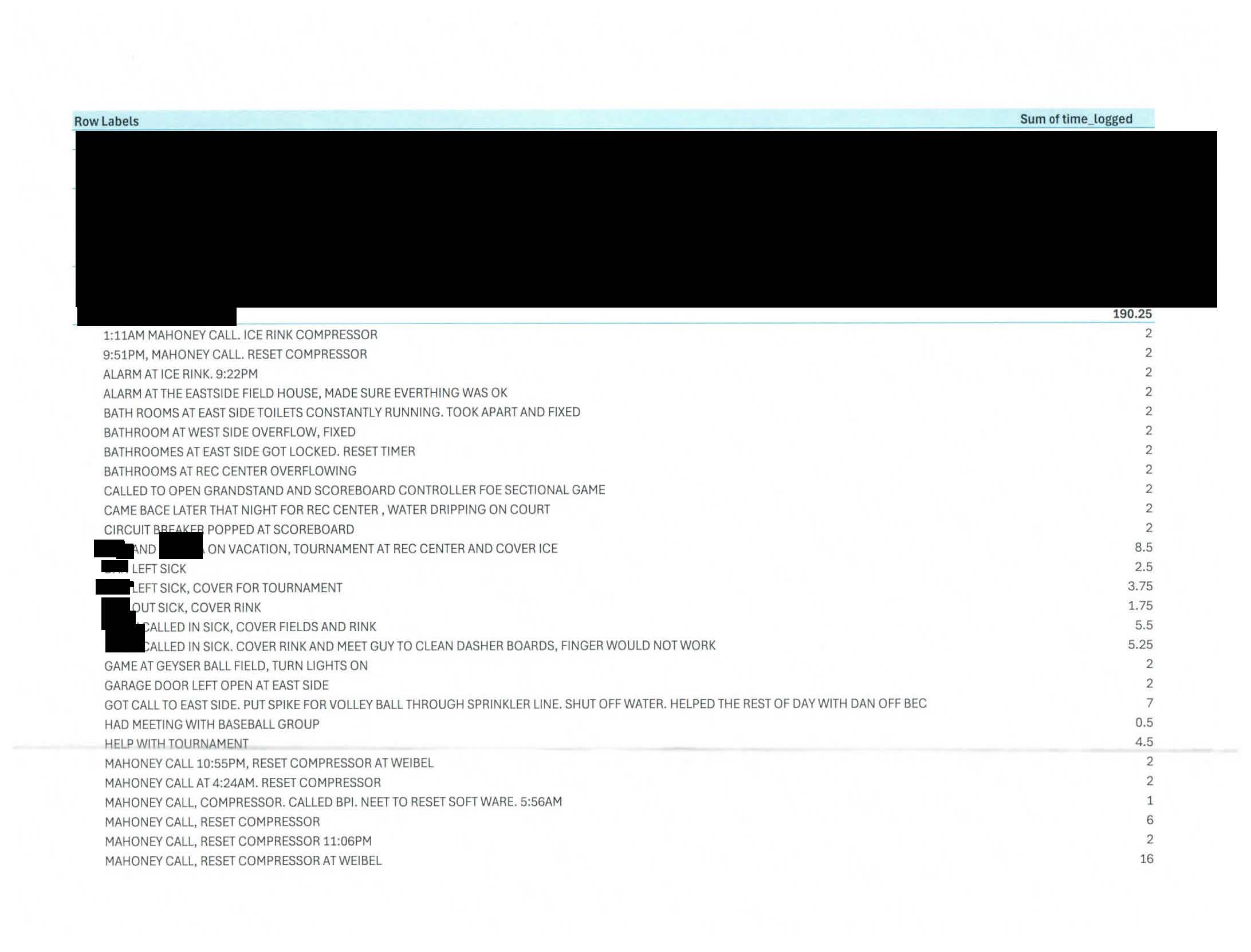
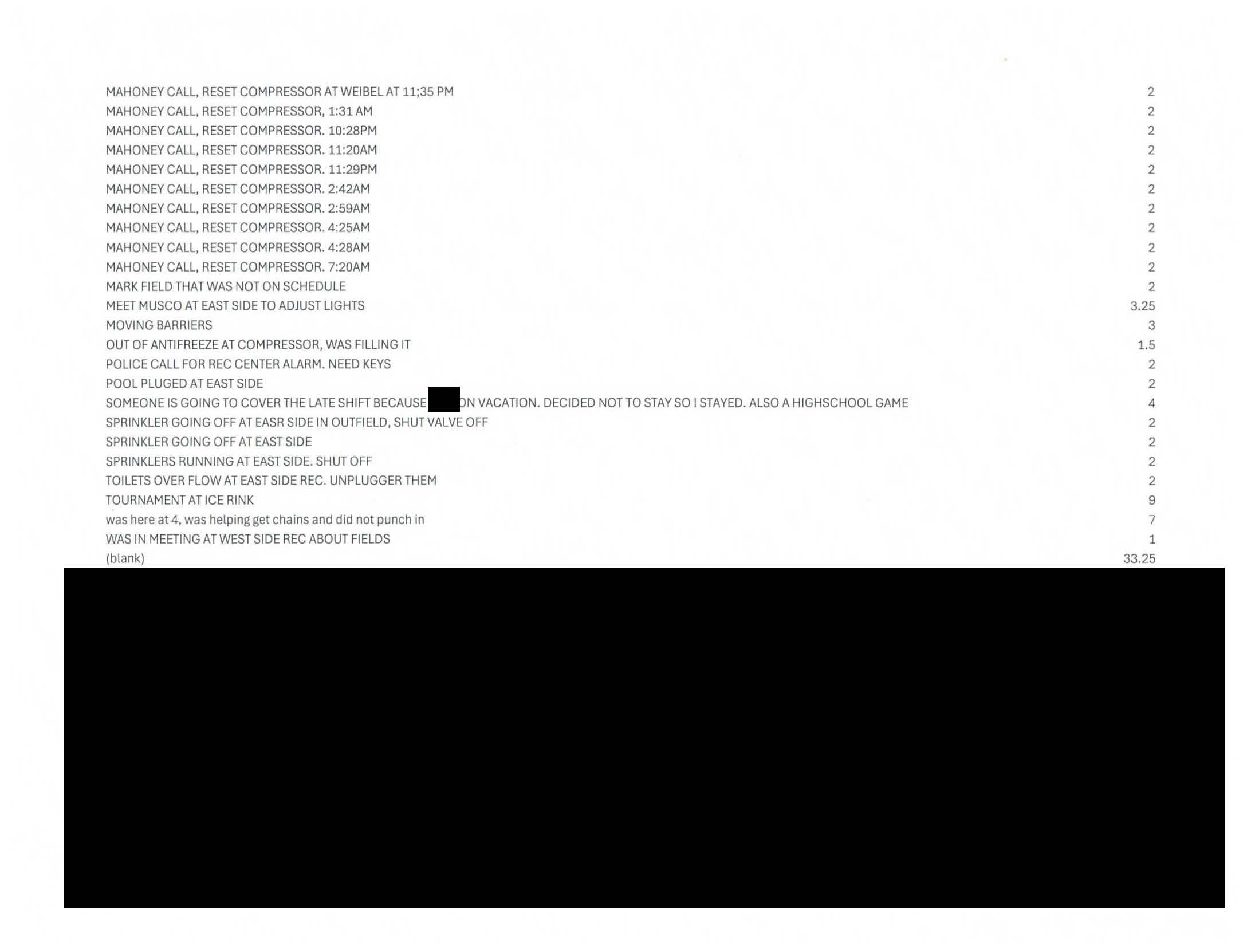
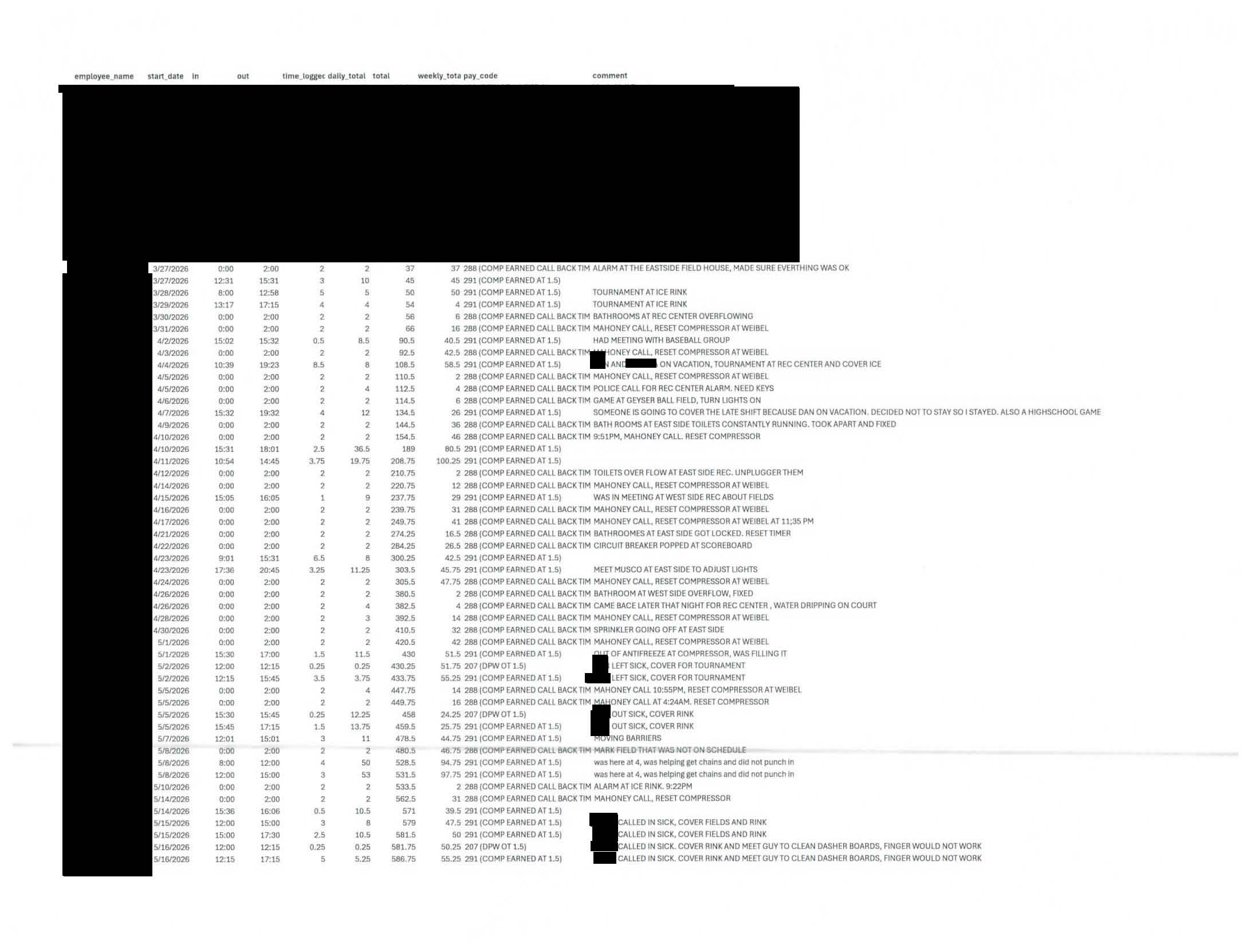
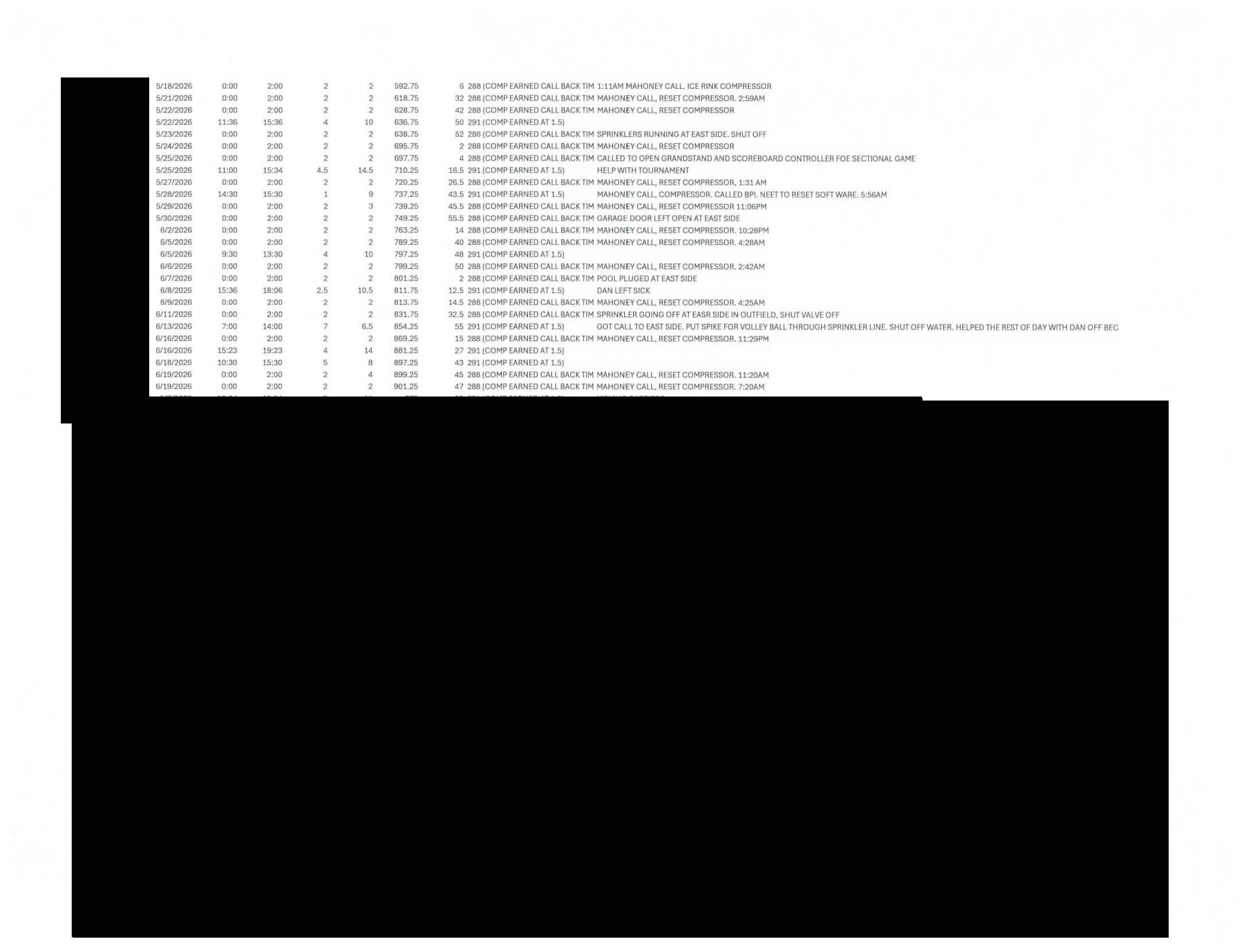
On August 26, 2026, I received a response to my FOIL. This was the document.
Now, the first thing a keen observer will notice is that the first two pages do not match the second two pages. They have different font sizes. The two pages with large type lack dates or other information that would allow their data to be logically linked to the other two pages. It makes it impossible to read the reports properly.
The next thing that leaps out at the reader is that an alarm was triggered 16 times, warning (“Mahoney Call, Reset Compressor”) that the compressor that makes the ice for the city rink needed to be reset outside regular hours. This required someone to go to the rink and address the malfunctioning machine.
The union contract requires that the city pay an employee who works overtime at least 1.5 times their regular pay for a minimum of two hours, no matter how brief the call is. This seems reasonable. If you are going to get someone up in the middle of the night, they should be compensated for the inconvenience. In this case, the employee is a supervisor and is paid at least $128.68 for the call.
According to the records released under this FOIL, the DPW has spent at least $2,058.88 on resetting this malfunctioning compressor. Bear in mind that we only have the records for the second quarter. The city may have spent even more during the period before and after the second quarter.
The Meeting
I contacted Commissioner Keramati and asked to meet with him to discuss these records and his department’s overtime. On Wednesday, September 2, 2026, I met with Commissioner Keramati in his office. I was surprised that he was alone. I expected a posse.
I asked Keramati if I could record our conversation for accuracy, and he told me, “Absolutely not.”
Before I could ask anything further, Keramati wanted to know why I was focusing on this one individual in his department for overtime when employees in all the other departments were also generating overtime.
Trying to be diplomatic, I offered that I had looked into overtime issues across all departments. What I didn’t say to him was that Kiernan had asked all the departments to provide an analysis of their overtime and that with the exception of himself, at both a public pre-agenda meeting and full Council meeting, there had been extensive discussions, including charts and graphs from his other colleagues on the Council documenting which positions were generating overtime, why they were generating overtime, and what possible steps might be taken to reduce it. He was the only one on the Council who had not prepared for these meetings.
I broached the issue of the inconsistencies between the pages I received in the FOIL. Keramati then began an extended speculation as to what relationship the pages might have. I thought at this point he might bring someone into the meeting who was familiar with the report, but he didn’t. Eventually I observed, “BK, you don’t know,” and he good-naturedly agreed.
I asked him whether, putting aside the snow-plowing season, an employee in DPW generating 190.25 hours of overtime in a quarter was an anomaly. He again speculated about all the crises that can hit DPW and generate overtime. I offered, “Then you don’t know.” He admitted he was merely speculating.
Given that Commissioner Kiernan had asked him to provide her with a report analyzing overtime in his department, his apparent failure to do so was troubling, and his lack of knowledge of the report that was the purpose of our meeting seemed very odd.
I asked him whether the problem compressor had been properly repaired or replaced. He acknowledged that there had been problems with the compressor at the ice rink but didn’t know its status. As it is now September and the city spent over $2,000 in the second quarter (which ended in June), it would seem to this blogger that the head of DPW should know the status of this critical piece of equipment.
A Troubling Experience
Commissioner Keramati seemed strangely removed from the fiscal crisis the city faces in general but, more particularly, uninterested and uninformed about overtime in his own department.
I was struck by how uninterested he was in the report on the individual’s 190.25 hours of overtime, as it was clear he had not studied it before our meeting. It was also disturbing that he seemed unconcerned regarding the status of the compressor that might be bleeding the city money.
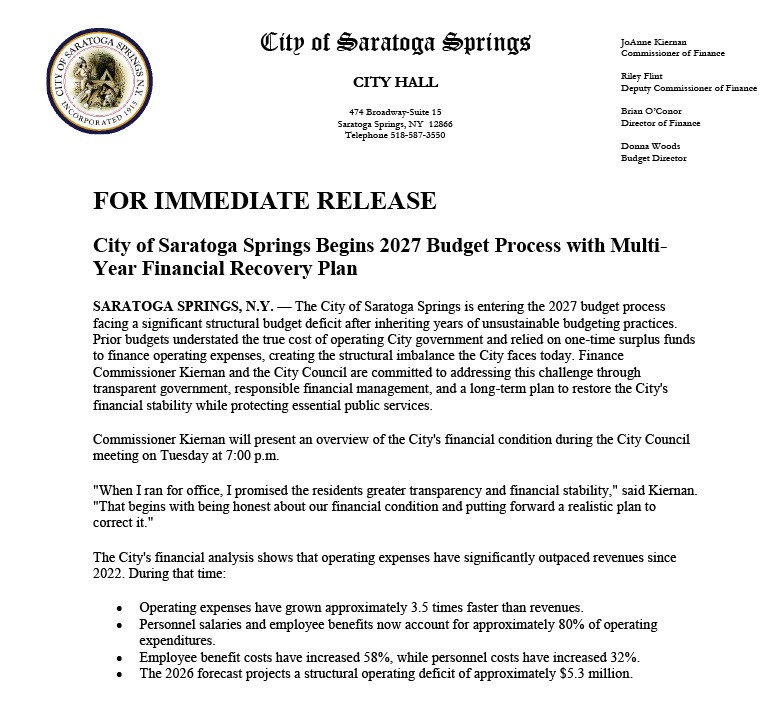
Former Saratoga Springs Commissioner of Finance Minita Sanghvi has posted a defense on her personal Facebook page of her management of the city’s finances during her two years in office. The city has found that she ran deficits in every budget she crafted during her four years in office, including the current budget under which the city is operating, which shows an approximately $5 million deficit.
Sanghvi cites all the increases in costs during her terms as contributing to the city’s financial problems, and they are considerable. It is true that retirement costs, health insurance, etc. have all been increasing, contributing to financial stress in many local municipalities, including Saratoga. Sanghvi does, however, make one stunning admission of culpability on her part alone: her failure to plan how the city would pay for major expenses incurred on her watch and with her support. Consistent with her chronic mismanagement, she seems unaware of the gravity of her admission. In her piece, she writes:
Now here is the thing about fire-fighters overtime. The mayor signed an agreement with the fire-fighters union about making sure there were 4 people on a firetruck. There are several studies that show that this is safer for fire-fighters. But it is also important to note that in Saratoga Springs a mayor can sign ANY agreement with unions on their pay, benefits, etc. without getting a financial impact statement from the Finance department. I should have asked the mayor to wait on that agreement and should have provided the city a financial impact statement as they do at the county. (But this is something I have learned from my time as County Supervisor) [JK:Emphasis added]
So, what is a “financial impact study?” It is a fancy phrase for whether something is affordable. It is beyond stunning that Sanghvi would make this statement, because it speaks to the folly of all her budgets that included many additional items for the city’s operations, which she approved and voted for, for which she apparently did not bother to conduct “impact statements.”
She Was Warned
In a post way back on October 5, 2022, I warned in this blog that the SAFER grant to hire the sixteen firefighters that the city had applied for was a time bomb. I wrote to Sanghvi repeatedly, asking what the plan was for paying for these additional firefighters after the grant ended, and never received a reply.
When Mayor Kim brought the contract with the firefighters’ union, referred to in the above quote, before the Council for adoption, he cavalierly noted that the city’s labor attorney had warned him to include a sunset clause in the agreement, which he dismissed. The contract, which Sanghvi voted for, would require the city to spend approximately an additional $2,000,000.00 a year to cover the cost of these firefighters once the federal grant ended. Sanghvi now admits as Finance Commissioner she should have planned for this. It is truly amazing that in four years as Finance Commissioner this never occurred to her. Since it is in the contract without a sunset clause, we are perpetually locked into paying this money. It is a major factor in the city’s current fiscal crisis.
Her Statement
I have made it a policy not to respond to attacks. But I am tired of the people trying to reframe my record as finance commissioner. HERE ARE SOME FACTS:
We submitted the Annual Financial Report to the State Comptroller on time all 4 years.
My team and the city maintained AA+ credit rating all 4 years.
All budgets were presented on time and adopted on time (unlike many other municipalities around) without exceeding the tax cap.
And the city had a “no designation” for its fiscal stress score (which means that the city was not under fiscal stress).
AND we collected 12 years’ worth of delinquent taxes that the new administration stalled as soon as they took office.
I was the most transparent Finance Commissioner providing information on our revenues (which were good) and our rising expenses and overtime (which were major constraints). I did this at every meeting and especially during budget season.
Here is what happened – Our economy jumped back after 2020. But so did inflation.
An ambulance that cost $180,000 in 2019 was costing $587,000 in 2026.
Other costs went up –
Liability Insurance went up 188% increasing from $834,732 in 2022 to $2,408,693 to 2026
There was an 86% increase in retirement costs from $4,441,742 from 2022 to $9,951,409 to 2026
Health Insurance costs increased 27% from $7,823,776 to $9,951,409
This is all published data from the city budgets that I have presented. Almost every budget season we talked about the rising costs and beseeched the departments to cut costs and stop hiring new people.
During this time the public safety budget went up over $10 million. And yet, they were constantly going over budget because of overtime. Now here is the thing about fire-fighters overtime. The mayor signed an agreement with the fire-fighters union about making sure there were 4 people on a firetruck. There are several studies that show that this is safer for fire-fighters. But it is also important to note that in Saratoga Springs a mayor can sign ANY agreement with unions on their pay, benefits, etc. without getting a financial impact statement from the Finance department. I should have asked the mayor to wait on that agreement and should have provided the city a financial impact statement as they do at the county. (But this is something I have learned from my time as County Supervisor)
We tried our best to plan better so we were better financially prepared for the future. We created the strategic budget and forecasting group and we tried to get better forecasts for future expenses and revenues. We worked with different departments to help them better understand the financial issues. I also requested both mayors that I served with to help create a strategic plan for the city so we were all working towards the same vision.
Inflation and rising costs are hitting many cities around the country. Closer to home, Schenectady, Albany and many other cities are going through the exact same issue. So, trying to blame me for something that is happening everywhere is just petty politics.
[JK: I received the following from Tim Coll, Commissioner of Public Safety.]
Open Letter to Times Union Reporter Wendy Liberatore
When I first ran for office several years ago, I promised to correct the record when necessary, and I will do so yet again.
On August 18, 2026, Times Union reporter Wendy Liberatore mischaracterized a proposed capital plan in the City of Saratoga Springs. Rather than waiting for the presentation on August 19, 2026, she concluded that the City was committing $14 million to a new police facility amid a $5 million deficit.
In fact, as I pointed out during the public hearing, this was a needs assessment in which all City departments submitted their capital needs. It was also pointed out that only approximately $2.7 million of the capital projects presented may potentially be funded. The remaining requests represented identified capital needs.
Yes, Liberatore is correct that the City is facing a fiscal crisis. Former Finance Commissioner Minita Sanghvi left the City with a significant financial mess, and this Council is now focused on correcting those problems while moving the City forward.
I also pointed out during the public hearing that a new joint venture with DPW was initiated and that the City has issued an RFP to retain a commercial broker to assist with the sale of certain City properties and potentially acquire another. If this works out, we may be able to address some of our infrastructure needs without any cost to the taxpayers.
Liberatore’s history of careless reporting and advancing a false narrative critical of our police department needs to stop. Our officers deserve fair, accurate, and responsible coverage, just like everyone else.
The public deserves accurate reporting, not conclusions drawn before all of the facts are presented. I encourage Ms. Liberatore to watch the entire meeting and review the facts before continuing to report on these issues.
The facts matter, and I will continue to correct the record when it is misstated.
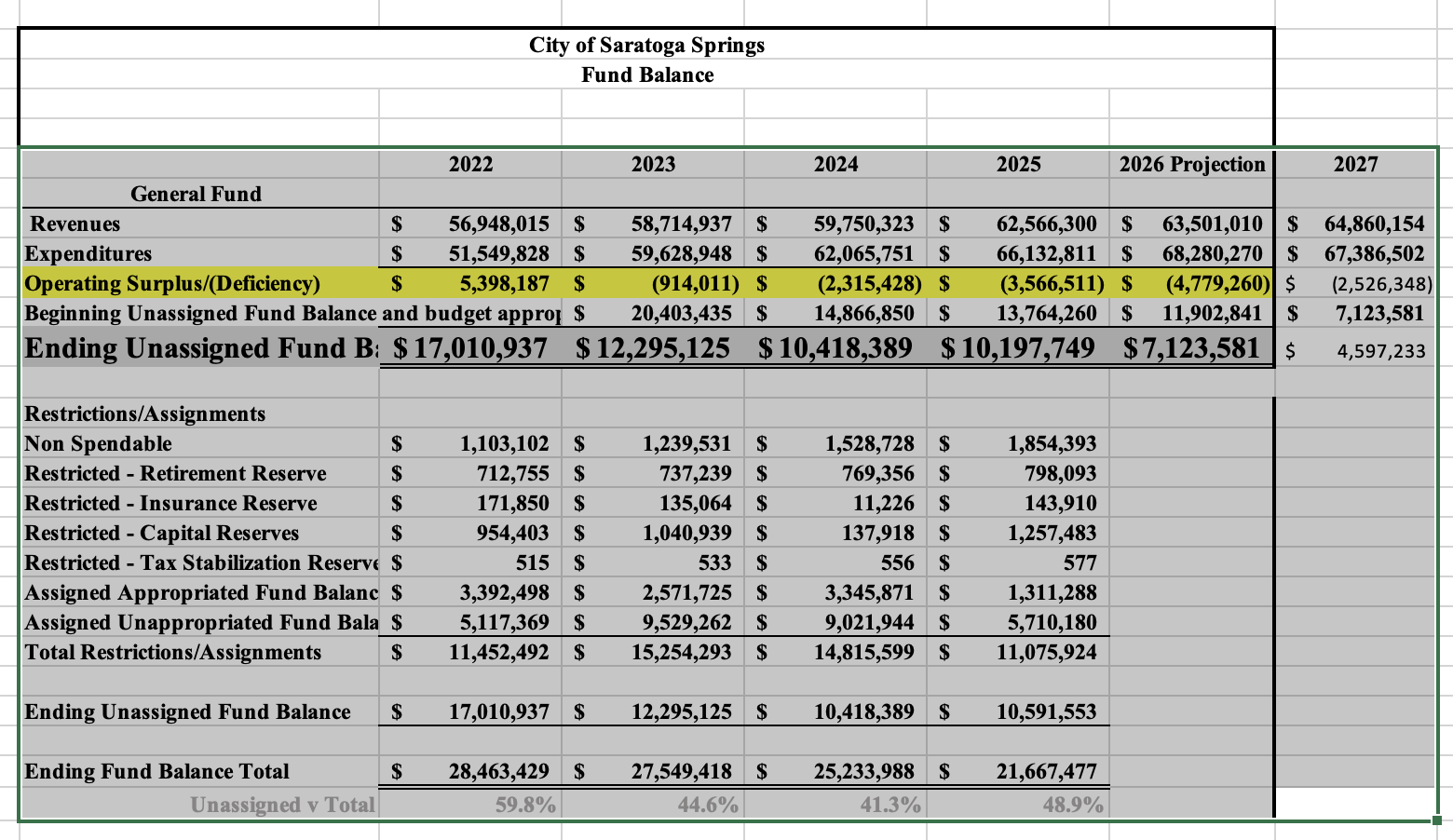
I feel for the last four years I have been like Cassandra, warning that former Saratoga Springs Finance Commissioner Minita Sanghvi’s budgets were thrown together with little understanding of the city’s spending, let alone planning for the future. I warned in this blog that this would lead to a budget deficit that would challenge this community. Well, the numbers are out, and they are even worse than I anticipated, leaving the city in a major financial hole that will require a lot of pain to fill.
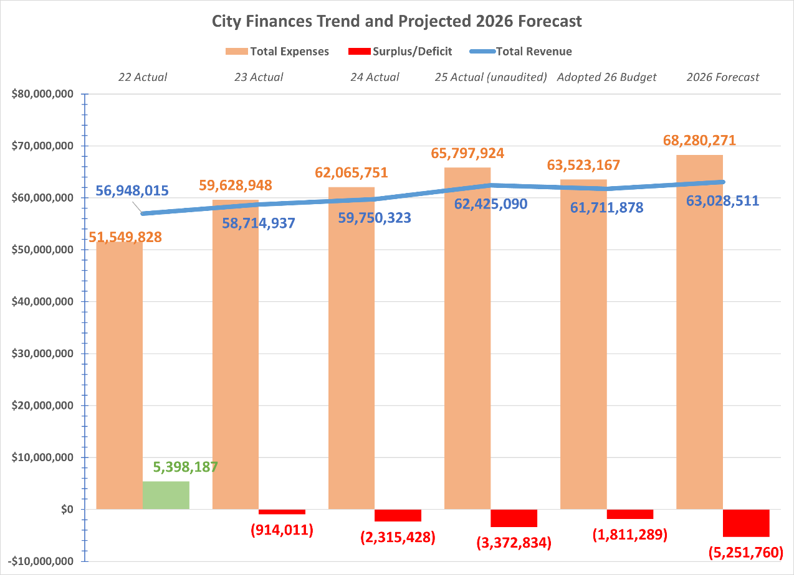
The following graph, prepared by the Finance Department in order to educate the public on the seriousness we face, is from a city release. Each tan column represents the actual spending each year. The blue line represents how much income the city took in each year. The red and green columns represent how much the city overspent/underspent each year. It is important to note that in the first column for the year 2022, the budget was prepared not by Commissioner Sanghvi but by her predecessor, Michele Madigan. Not coincidentally, that (the green column in the lower left) was the only year that the city actually operated within its budget, leaving a fund balance (reserve) for Commissioner Sanghvi of a whopping seventeen million dollars which Sanghvi has recklessly squandered.
There is still a significant amount of time before this fiscal year is over, so it is an inexact art to project what it will cost the city to operate for the balance of the year and how deep in the red we will be. Regrettably, there is little doubt much of our fund balance will have been exhausted to fill Sanghvi’s budget holes. The city’s policies and procedures require that the city fund balance represent at least 10% and no more than 25% of the city budget; the city will have little in the way of resources to fill what will be a widening gap next year.
The city of Saratoga Springs is in a serious fiscal crisis. Four years of fantasy budgets by the previous Commissioner of Finance, Minita Sanghvi, have continuously underestimated expenditures and overestimated revenues while drawing down the city’s reserves to cover the deficits her budgets created. Sanghvi repeatedly voted for labor contracts, grants, and dubious vanity projects, proposed by predecessors to the current members of our Council, without any plan for how the city was going to cover the costs incurred by these votes along with the other predictable budget increases in insurance, etc.
Incoming Commissioner of Finance JoAnne Kiernan inherited a total financial mess. As reported previously in this blog, the city’s outside auditor found the books in such disarray that he could not perform his audit. Commissioner Kiernan and her crew faced the task of straightening out the records from 2025 so they could be audited while trying to manage her department’s regular record-keeping and begin the planning for 2027, the first budget she would be responsible for.
Kiernan realized that, in addition to fixing the previous mess and maintaining regular operations, something needed to be done as soon as possible to get control of the city’s deficit spending.
To that end, she asked each of her colleagues on the Council to prepare an analysis of the size of their overtime to date and a further analysis regarding why the overtime was required. She asked that they present their findings at the pre-agenda meeting on July 20.
As the videos below will document, each of the departments complied with her request with the exception of the Commissioner of the Department of Public Works, BK Keramati, who never submitted any report prior to the meeting and came completely unprepared.
Most blog readers may not want to get so deep in the weeds, but I have provided videos of three of the Council members’ detailed presentations of how overtime has been used in their departments.
As the Public Safety Department has the most staff and must function 24/7, its presentation by Assistant Police Chief Frederick Warfield (Chief McIntosh is on military leave) was extensive, including detailed spreadsheets drilling down on who gets overtime and why. Warfield also explained steps his department has taken to reduce overtime. Similarly, Fire Chief Joe Dolan gave a detailed report on overtime in his department.
As the Finance and Accounts departments are relatively small, their presentations were briefer but highly informative.
In contrast, Department of Public Works Commissioner BK Keramati had not prepared, as is apparent in the short video below. When Kiernan asked him about employees who had huge overtime for the second quarter of this year, including someone with 189 hours in overtime (that calculates to almost five weeks out of eight for the quarter), he failed to answer.
The Silent BK Keramati
As readers may recall, the previous month, Keramati denounced the charter changes proposed by Mayor Safford’s Charter Commission, then turned around and voted for all of them. At the time, I emailed Commissioner Keramati several times and attended a Council meeting asking the Commissioner to share with the public why he had suddenly changed his position on the charter proposals. He never answered.
At the pre-agenda meeting, Commissioner Kiernan asked Keramati to explain what appeared to be extreme cases of overtime in his department, including an employee who had earned 189 hours during the second quarter (almost five weeks of overtime over eight weeks and outside of snow season). He said he did not know.
Keramati’s lack of a response prompted me to once again attend a regular Council meeting the following evening. As Keramati had previously been asked about the 189 hours of overtime, I courteously asked him during public comment if he could explain this.
As with the previous question about his changed vote, he declined to answer.
Readers may recall that Keramati’s campaign focused on his opponent’s alleged failure to be transparent to the public.
Commissioner Keramati reminds me very much of former Finance Commissioner Sanghvi, who also simply ignored questions that she did not like while routinely claiming her commitment to transparency.
As will become increasingly clear to the public, the city is facing a large deficit. It requires not only good management within the Commissioners’ departments but a willingness to engage publicly and candidly about their departments’ expenses.
Keramati’s behavior is extremely disturbing. It is the kind of unwillingness to engage in difficult discussions that brought us to the current crisis. Commissioner Keramati needs to rise to the occasion and be open to the public about his actions.
An Unprepared Keramati
Commissioner Kiernan Introduces Discussion and Documents The Use Of Overtime In Her Office
In her presentation, Kiernan displays a chart documenting that Sanghvi’s budget arbitrarily set overtime without considering the pattern of need during the previous three years. Kiernan goes on to detail overtime in her own department.
The Police Presentation by Frederick Warfield.
Fire Chief Dolen Presentation
Commissioner Troisi Presents Overtime For Accounts
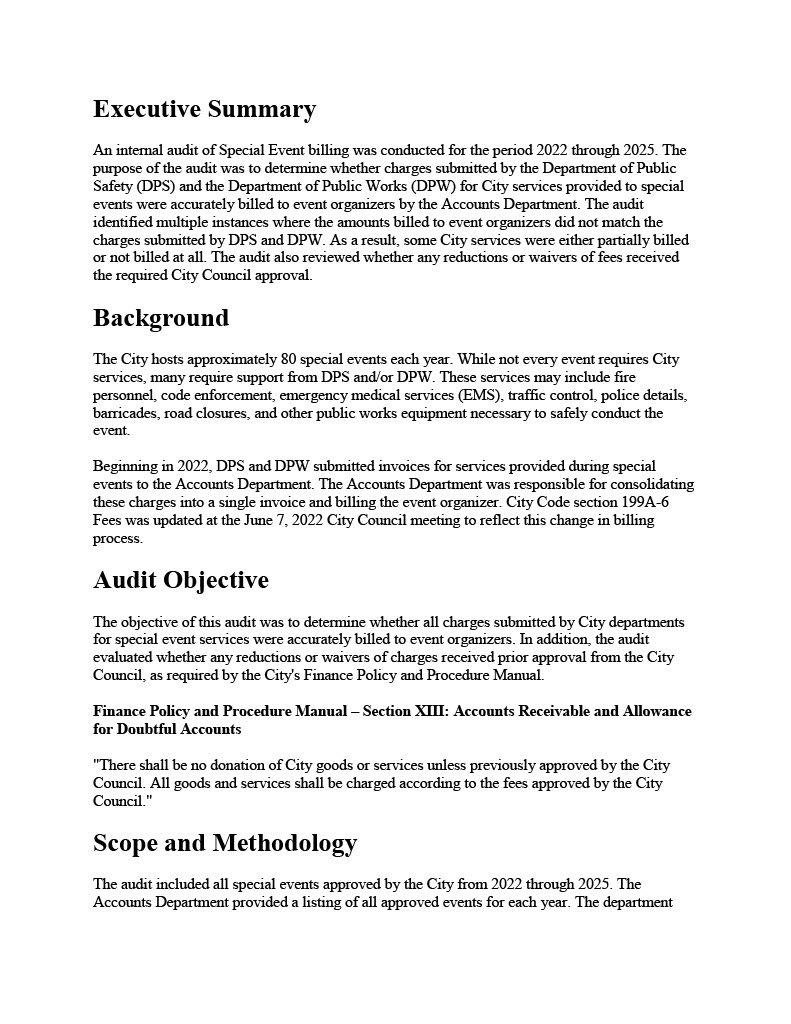
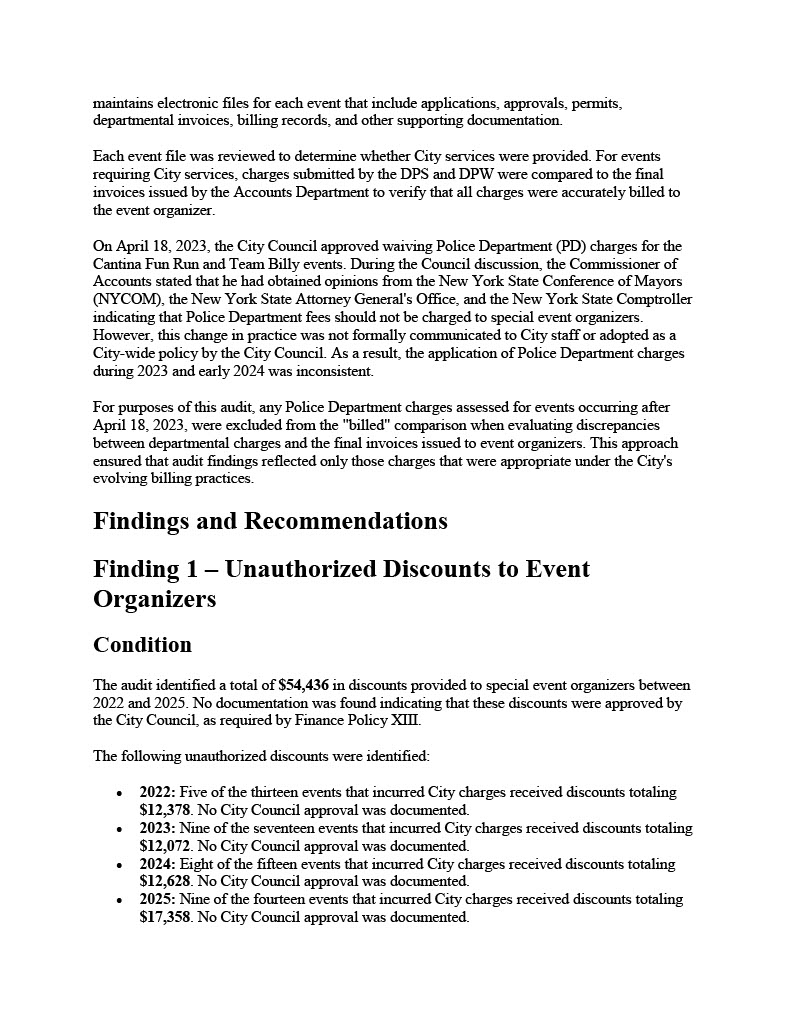
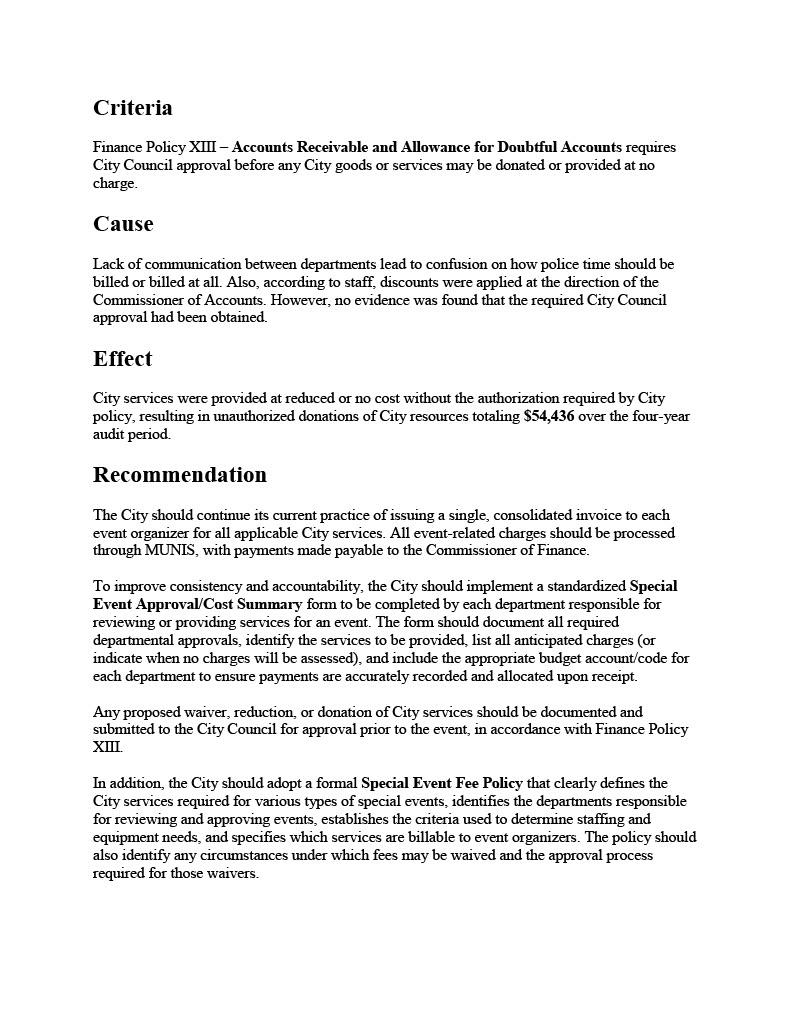
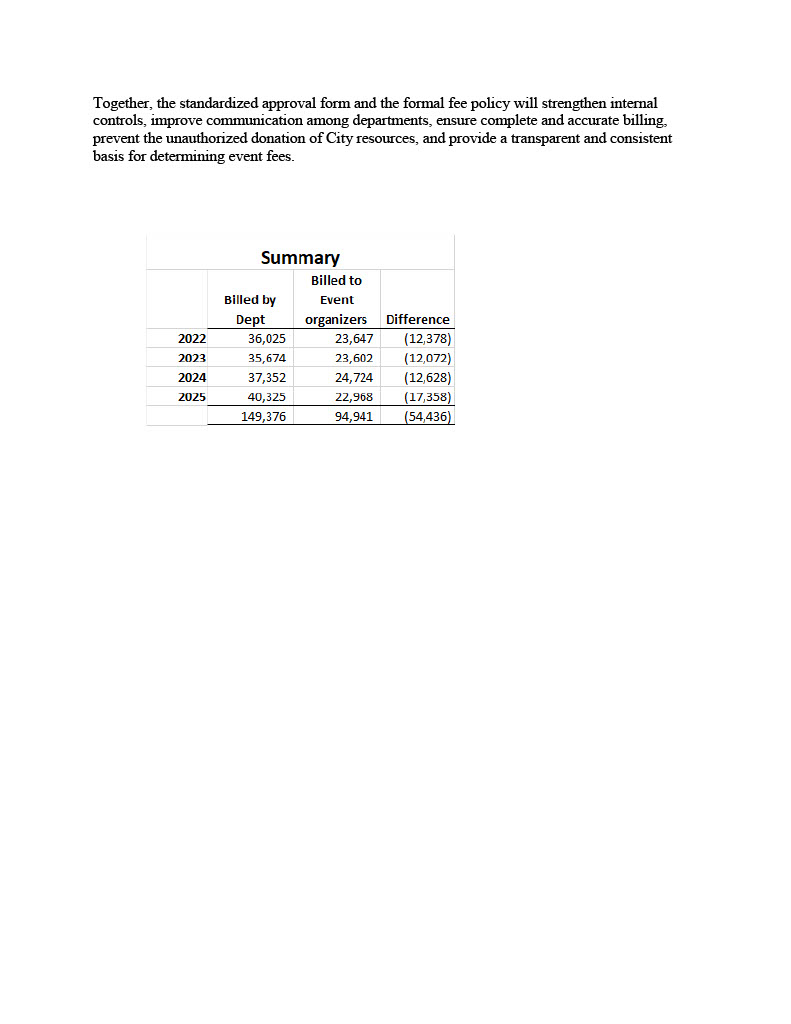
At a time when the city is facing severe financial challenges, a recent audit has revealed that former Saratoga Springs Accounts Commissioner Dillon Moran arbitrarily and illegally waived $54,000 in special events fees owed to the city.
The city hosts around 80 special events each year. Many of these events require the support of the Department of Public Safety and/or the Department of Public Works for road closures, emergency medical services, traffic control, etc.
In 2022, Commissioner Dillon Moran received approval from the City Council to consolidate the bills generated by city departments assisting local organizations’ special events (Chowderfest, 5K Run, etc.). In the past, each department had billed organizations directly. No one at the time had any idea how far Moran would go in improperly exploiting this opportunity to elevate himself as the czar of special events.
Many of us had heard that Moran was routinely violating city regulations by discounting or waiving the fees required by the city for work to facilitate special events. Now, an audit has revealed the extent of his largess with public money.
The city policy could not be clearer.
“There shall be no donation of City goods or services unless previously approved by the City Council (JK:emphasis added). All goods and services shall be charged according the the fees approved by the City Council.”
-Finance Policy and Procedure Manual – Section XIII: Accounts Receivable and Allowance for Doubtful Accounts
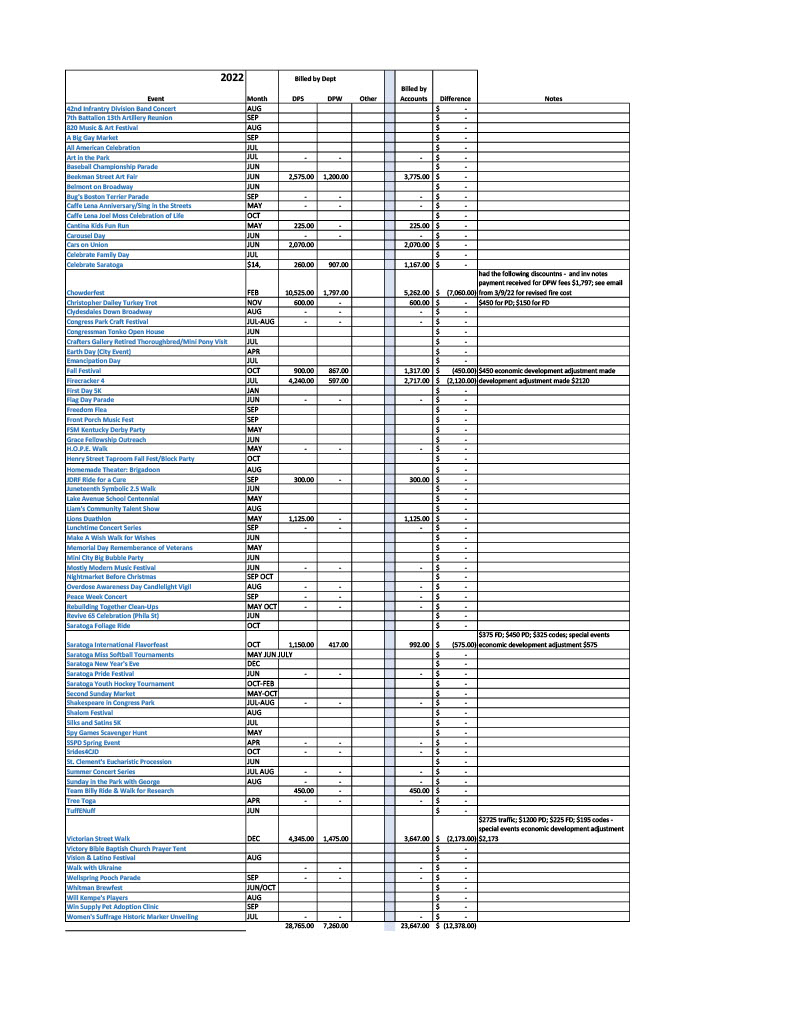
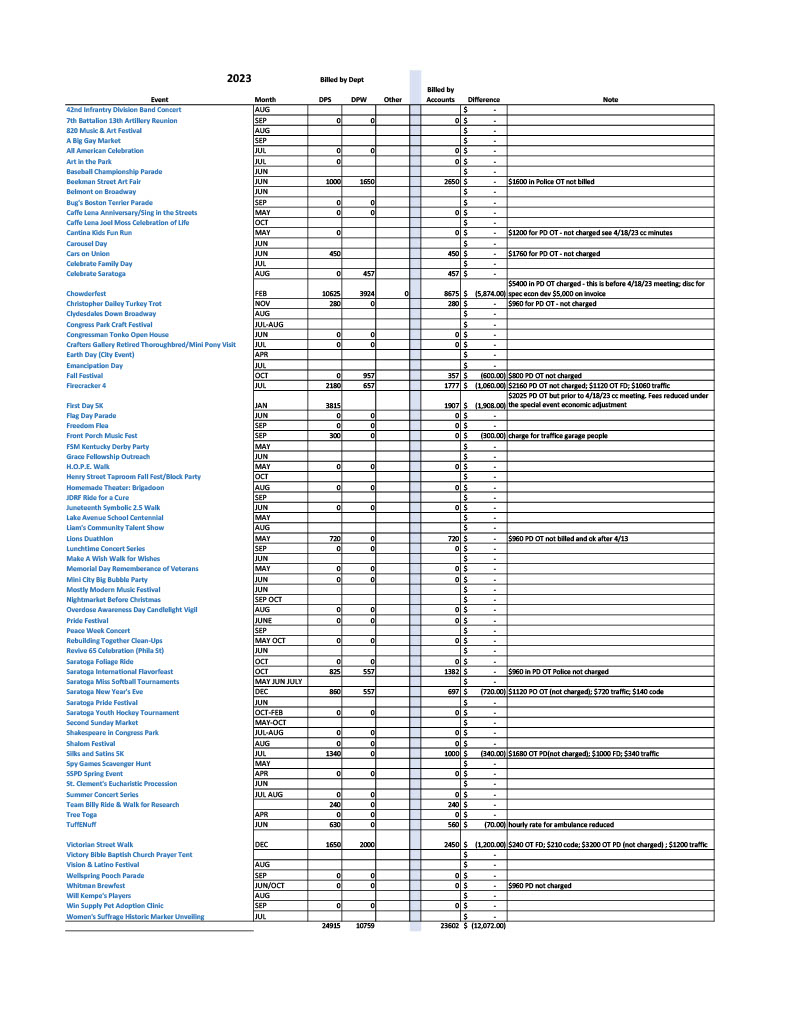
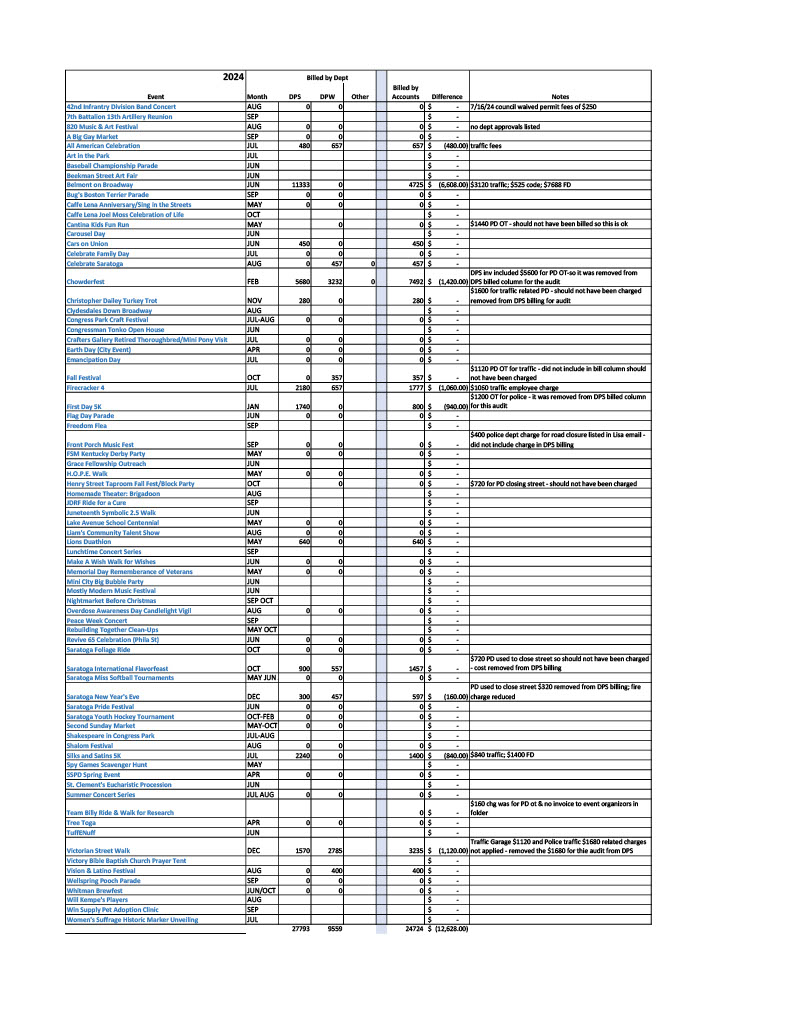
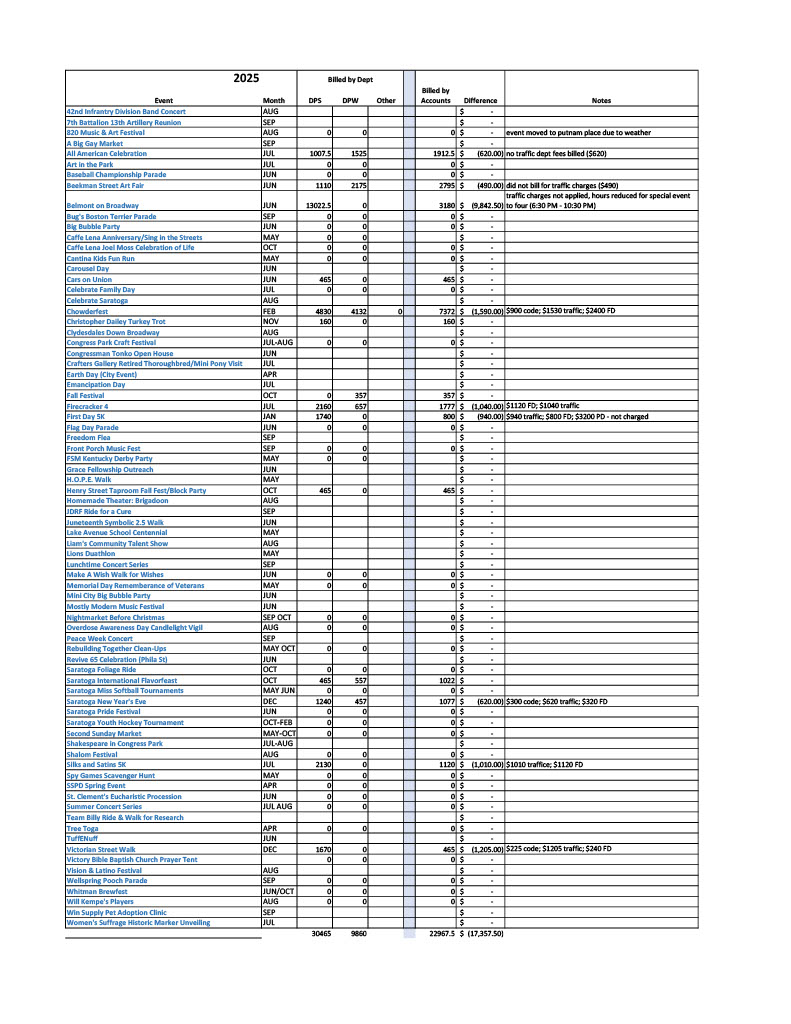
So any deviation from paying for work done by the city required special resolutions by the Council approving the change. As the spreadsheet documents below, Moran, without any authority and hidden from the general public, routinely bypassed the Council and waived or discounted the bills to organizations favored by him.
He Just Made Stuff Up
There are no records of how Moran arrived at his policy or how he determined the size of the discounts he gave out. He assumed rather royal authority.
As part of the audit, there are spreadsheets below listing all the special events, the cost to the city for these events, and how much Moran discounted or waived charges.
In the spreadsheet for the year 2022 below, under notes for events, the only explanation for waivers was occasionally the euphemism “economic development adjustment.” There is nothing in the city’s policies and procedures about an “economic development adjustment.” Moran just created this fig leaf to create the appearance that there was some sort of reason for his beneficence.
At the April 18, 2023, Council meeting, Commissioner Moran advised the Council that he had learned from the New York State Conference of Mayors, the New York State Attorney General’s office, and the New York State Comptroller that Police Departments cannot charge for police time. It was unclear at the time whether the civilians (non-police) employed by the city to handle traffic management and code enforcement would be included in these opinions.
Regrettably, Moran made no effort to memorialize this discovery in the city’s Policy and Procedures Manual, nor did he explore the issue of charging for the services of civilians working in the Public Safety Department. Revisiting these policies would have prompted a thorough review of his practices, which he probably wanted to avoid.
Commissioner Kiernan’s Rigorous Methodology
This audit was prepared by the Finance Department. Its thoroughness and prudence reflect the impressive talents of Finance Commissioner JoAnne Kiernan.
To be especially careful in determining how much Moran gave away, she excluded all Police and non-Police traffic related costs incurred after April 18, 2023.
I would add that while Moran has made much of the police exception to defend his discounts, he has scrupulously avoided the obvious impropriety involved in waiving Department of Public Works fees. Unlike for police, there is nothing in state law that precludes paying the kind of bills submitted by the Department of Public Works.
Taking Care of His Friends
The greatest beneficiary of Moran’s generosity was Todd Shimkus and the Chamber of Commerce events.
Todd Shimkus is the President of the Saratoga Chamber of Commerce. According to the Chamber’s 990 form, Shimkus makes $240,000.00. Shimkus was a generous donor to Moran and attended his fundraising events.
As an example of Moran’s generosity to his friend Shimkus, look at the spreadsheet for the celebration “Belmont on Broadway,” an event put on by the Chamber in 2022 (before the revelation of police exclusion). The Department of Public Safety billed $11,333.00 for the event. Shimkus’ organization was billed only $4,725.00. The note on the event reads, “$3,120 traffic; $525.00 code; $7,688.00 FD (JK: Fire Department).” The city had to “eat” the other $6,608.00.
Blaming The Messenger
After four years of improper discounts and waivers, Finance Commissioner Kiernan and Accounts Commissioner Jessica Troisi have had the unenviable problem of dealing with the outrage of the individuals and organizations who were the beneficiaries of Moran’s “generosity” who now have to pay the real costs to the city.
Moran, Kim, Golub, and Sanghvi’s profligate spending during their tenures has created a major financial crisis for the city. Commissioner Kiernan has been burdened with trying to untangle the mess that has been used to hide this train wreck. This city is so lucky to have someone of Kiernan’s skills and dedication as its Commissioner of Finance. To offer some sense of the chaos Kiernan inherited, consider that the city’s outside auditor has been unable to audit our books for 2025 because the record-keeping was not properly maintained under former Finance Commissioner Minita Sanghvi. As a measure of the breakdown in finance under Sanghvi, it is the end of July, and the outside auditor has still been unable to audit the 2025 books.
Kiernan inherited a budget for 2026 (Sanghvi’s budget for this year) which wildly underestimated expenses and wildly inflated expected income. The full scope of the looming crisis will only be determined once Kiernan has been able to properly balance Sanghvi’s accounts and address the many errors in record keeping.
Dealing With The Anger
Commissioner Kiernan and Commissioner of Accounts Jessica Troisi have been the targets of anger as organizations are outraged at the bills that now reflect the true cost of providing support services for special events.
We are very lucky to have Kiernan and Troisi as our Commissioners, and I hope that people will come to appreciate what they are doing to straighten out the mess they inherited.
Civility vs Accountability
This city has suffered from several years of the worst partisan behavior at the Council table. A number of Council members in previous administrations attacked their colleagues at every opportunity in the most toxic and ugly manner, often over actions that never existed.
In contrast, the current Council has placed a premium on comity. In the past, the worst violators of decorum seemed more interested in scoring political points than in properly managing the city. The difference in the civil behavior at the Council table now is striking and welcome.
What Dillon Moran did regarding the fee waiver was a clear abuse of his authority. The city’s code makes crystal clear that the Council as a body determines what groups planning special events should pay, not the Commissioner of Accounts.
I believe that a violation of trust as extensive as Moran’s in this matter needs some kind of disciplinary action. The idea that a public official should give away city resources at their personal whim to ingratiate themselves with certain groups and individuals deserves some kind of disciplinary action, especially in light of the other dubious activities that have plagued the Department of Accounts under the former Commissioner.
To their credit, most of the members of the Council are reluctant to censure Moran. He is no longer in a position of authority. Such an action could be interpreted as mean-spirited and a return to the bad old days.
I sympathize with their concerns, but to simply ignore such an extreme violation of public trust only empowers more such behavior in the future. I encourage the Council to find an appropriate action to assure the public that this kind of behavior will not be tolerated