Mayor Ron Kim: His Gross Mishandling Of A Court Case Raises Grave Concerns

I do not offer this lightly. In a truly disturbing series of events, Saratoga Springs Mayor Ron Kim has committed a number of acts that raise serious doubts about his competence and ethics as an attorney in his role as both Mayor and his claim to be the city’s Attorney.

Excellent stories on this have appeared in the Daily Gazette and in the Foothills Business Daily Review.

On January 20, 2022, there was a scheduled evidentiary hearing in City Court over a local contractor, Jeffrey Dumont’s, failure to secure a building permit prior to work he performed on a local building he owns. The matter, City v Church Street Trust, was to be heard by Judge Jeffery Wait in City Court.

Earlier on that day, Mayor Kim appeared in Judge Francine Vero’s court attempting to act as the city’s Attorney in another code violation hearing. Judge Vero ruled that only a duly appointed City Attorney or other attorney authorized by the City Council could represent the city. She advised him that, in his role as Mayor, he could request an adjournment by citing the fact that the city did not have a duly authorized attorney. He protested her decision and she advised him to provide her with a legal basis for his challenge.

Returning to his office, at 11:52AM Kim sent an email to the City Court clerk, claiming that the “opposing counsel” in the Dumont case had consented to an adjournment.

The problem was that in the numerous hearings on this case, Mr. Dumont had never been represented by counsel. Further, the email included no cc to any alleged representative attorney for Mr. Dumont.

This prompted the City Court clerk to call Mayor Kim’s office and inquire as to the identity of Mr. Dumont’s attorney.

The person who answered the call told the clerk that Mr. Dumont had no attorney. The new story, the clerk was told, was that Mayor Kim had contacted Mr. Dumont and asked if he would agree to an adjournment. Allegedly Mr. Dumont had agreed and Mayor Kim then told him it was unnecessary for Mr. Dumont to appear at the hearing.

This prompted the court to contact Mr. Dumont to advise him that there had been a misunderstanding, that the case had not been adjourned, and that he would need to appear.

When the court convened that afternoon, Mr. Dumont appeared, but no one representing the city was present.

Mr. Dumont told the court that he had received a call from “some guy named Ron.” Mr. Dumont could not recall whether the person had given a last name. Dumont told the court that he assumed the caller was an attorney representing the city. Mr. Dumont told Judge Wait that the person he spoke to told him he did not have to appear in court.

Citing the numerous improprieties exercised by the city, the absence of an attorney to represent the city, and the fact that Mr. Dumont had been in compliance since November 2021, Judge Wait ruled that “the conviction for failure to obtain a building permit is vacated and the information is dismissed.”

Parsing Out The Mess

As part of preparing this post, I consulted a number of experienced attorneys. This analysis draws heavily from my conversations with them.

The Call

It was improper for Mayor Kim to have contacted Mr. Dumont, the defendant in the case. Professional ethics required that only the “city attorney” who is a public officer authorized to represent the city or an attorney hired by the City Council for the purpose of representing the city in this matter, had the professional authority to directly contact the defendant.

Just as disturbing, Mayor Kim had no authority to tell the defendant that he did not have to show up in court. While it is fairly common for a judge to adjourn a case at the request of both parties, it is not a given. More centrally, the only person with the authority to grant an adjournment is the court.

The attorneys I spoke with were stunned that Mayor Kim would presume to tell the defendant that he did not have to show up for his hearing.

This very likely was a breach of the New York Bar’s Professional Standards.

The Email

The email from Mayor Kim’s secretary to Judge Wait alleged that the Mayor’s office had consulted the attorney representing the defendant and that both parties had agreed to request an adjournment. In his decision, Judge Wait flatly characterized this as “untrue” because the defendant had no attorney representing him.

It cannot be stressed enough how serious sending a false statement to a judge is.

Mayor Kim blamed the error on his secretary who sent the email. He admits the error should have been corrected. He told the Daily Gazette, “I did not correct that because I didn’t actually see the email until later. That was a mistake but there [were] no misrepresentations.”

“…there [were] no misrepresentations…” How can Mayor Kim reconcile his statements that there was an error but that there were no misrepresentations?

First of all, there was no lawyer representing Mr. Dumont. How could that possibly not be a misrepresentation?

Second, where did his secretary come up with the idea that an attorney representing Mr. Dumont existed? After all, this was no simple typo. It begs credibility that the secretary was the sole author of this email.

Third, and most seriously, the letter came out of his office and both Mayor Kim and his Deputy, Angela Rella, who is also an attorney, were cc’d.

The attorneys I spoke with were flabbergasted by Mayor Kim’s response. He appears to believe that he can simply blame the error on his secretary and that he and Ms. Rella have no culpability in the matter.

Any correspondence coming out of an attorney’s office is his/her responsibility. Period…end of story.

All three of the attorneys I talked with basically told me that had an error been made by anyone in their office, they would have dropped everything to advise the court of the error and to apologize.

I cannot emphasize how egregious Mayor Kim and his deputy Angela Rella’s failure to take responsibility for this gross mistake is.

I have FOIL’d the city for all correspondence between the city and the court regarding this case. I suspect that Kim and Rella never acknowledged to the court their error let alone apologized.

This was an extremely grave violation of the New York State Bar’s Professional Standards.

The Court Does Not Work For The Mayor

The Mayor asserted to the Daily Gazette that he was going to appeal the dismissal of the case “on the premise the court hadn’t contacted his office to inform him that the evidentiary hearing on the permit dispute would take place on January 20. By not contacting him, the court denied the city the right to appear for the court matter.”

This argument is beyond strange. Why did he send an email to the court asking for an adjournment if he did not know there was going to be a hearing? Why did he call the defendant and tell him not to show up for the hearing that day if he didn’t know that a hearing was to take place? Did the Mayor believe that he had the authority to adjourn the hearing or that it was the court’s responsibility to contact him (the mayor) to tell him that the case was still on? How could Mayor Kim, who is a practicing attorney, believe that it was not his responsibility to check with the court to see if the judge had indeed granted the adjournment?

It borders on the comic that he complained to the Times Union that he was “right downstairs” but Judge Wait proceeded anyway. Of course, the judge proceeded anyway. He never granted the adjournment.

Nobody sprung this case on the city.

Did the Mayor think that telling this to the media would exonerate him with a public unaware of the legal issues and procedures?

As background, the court works with the city through the office of the City Attorney. The court routinely sends its calendar to the office of the City Attorney and not to the Mayor.

If Mayor Kim wanted to know what cases were pending on January 20, 2022, he should have consulted the secretary (the city has no Attorney) in the City Attorney’s office to check the calendar.

The Mayor Does Not Determine Whether A Case Will Be Adjourned

Dubious as even his call to the defendant was, Kim had no right to tell Mr. Dumont he did not have to appear in court. If, as alleged by Mayor Kim, Mr. Dumont had agreed to an adjournment, it still required an appeal to the court to accept their request. While requests by two parties in a case for an adjournment is routinely approved, the privilege to adjourn a hearing lies solely with the judge. Kim had not been notified that the judge had granted an adjournment when he told Mr. Dumont not to bother to show up in court.

I think it is fair to speculate that Kim went to these extremes to avoid appearing in court because of his earlier experience that day before Judge Vero.

The Mayor Didn’t Listen

Mayor Kim had been advised by Judge Vero that while he could not prosecute the code violation, he could as Mayor, request an adjournment.

Why didn’t the Mayor take Judge Vero’s advice and appear in Judge Wait’s court simply as the Mayor, lacking a City Attorney, requesting an adjournment until such time as the city secured someone to represent the city?

The result of his not appearing was that the case was dismissed. The seriousness of losing this case lies firmly at the Mayor’s feet.

Mayor Claims He has Appeared In Court Before

Mayor Kim told the Daily Gazette that he had appeared in court before, implying that he had some sort of history of handling city cases. In fact court cases involving the city have been routinely adjourned since Mayor Kim took office because the city has no one to represent it. The appearance before Judge Vero when she informed him he could not act as the City Attorney in her court was his one and only appearance.

The Mayor Claims He Can Appoint Himself To Be City Attorney

Mayor Kim has claimed to the local media that he can appoint himself as the “City Attorney.”

This is a link to multiple documents that demonstrate that he is not allowed to do this.

This is just one of the opinions cited in the attachments:

It’s Vince DeLeonardis and Tony Izzo’s Fault

In the Daily Gazette article Mayor Kim blamed the city’s previous attorneys who handled these cases for the mishaps in the Dumont case. “For instance,” the Gazette reported, “Kim complained that the city doesn’t have an existing file on Dumont. The new mayor said he had to do research just to find his [Dumont’s] phone number.”

Pardon this snarky observation, “Wow!” There is a comprehensive file on the Dumont case ,and it can be found in the Code Enforcement Office. The idea that there is no file is such an extraordinary accusation. The Code Enforcement Office has been the repository for these kinds of cases through multiple administrations. The code enforcement officers need these records to do their jobs.

As an aside, without a City Attorney, Code Enforcement is now very limited in their ability to take action against code violators in the city as they cannot take these violations to court.

Adjourn, Adjourn, Adjourn

Kim complained to the Gazette:

“If it had been resolved in November, it would never have hit our calendar. That’s one of the problems with the former city attorneys — that they will just adjourn, adjourn, adjourn. That costs the city money. It’s not fair to taxpayers, and clearly the judge didn’t like it.”

Mayor Ron Kim January 29, 2022 Daily Gazette

Ironically, every case that has come before the court since Mayor Kim took office has been adjourned because the city has no City Attorney.

Who Leaked The Document To A Local New Site

The decision to dismiss a criminal hearing triggers the sealing of that case. The case in effect does not exist for anyone doing a search.

Copies of the decision went to the defendant, the City Attorney’s office, and the Mayor’s office.

The Foothills Daily Business Review ran a story in which they directly quoted from the document so someone provided it to them.

I spoke to the City Attorney’s office and was told I would need to FOIL for it.

I did some more investigation in light of the fact that in the past, either the City Attorney or the Assistant City Attorney reviewed documents before they were released to make sure they were covered by FOIL. The process of reviewing a FOIL can involve redacting (blacking out) sections of a FOIL’d document. Currently, the responsibility has been assigned to the Human Resources Department. Another reason why the city should not go so long without an attorney.

So the document did not come from the City Attorney’s Office.

I contacted Jeffery Dumont, the defendant in the proceedings. He told me that he knew nothing about the article in the Foothills Business Daily Review (FBDR). (I sent him a link).

So it appears that the document was provided to the FBDR from someone in the Mayor’s office.

I also did some further research about what kind of protections existed on a decision that is sealed.

According to New York State Law, only the defendant has the right to release such a document. Any other party would be subject to a suit for releasing it.

I don’t think it unfair to speculate that the Mayor released the opinion. He may have thought that he would get ahead of the events that would reflect badly on him. There is also the reasonable chance, given his history, that he was unaware that providing it would subject him and the city to liability.

No Playing Off Judges

When the Mayor’s Office contacted Judge Wait, they had an obligation to advise him about Judge Vero’s ruling that the Mayor could not represent the city in court.

Again, I was told by the lawyers I spoke to that this was another violation of New York State Bar Professional Standards.

Conclusion

As should be apparent, Saratoga Springs is in desperate need of a City Attorney.

It seems regrettably necessary to ask, what competent attorney would take the job of City Attorney in this kind of administration?
A City Council Hearing on a Civilian Review Board Without a Proposal To Respond To

The agenda for today’s (February 1, 2022) City Council meeting includes a public hearing on a Civilian Review Board. The problem is that the agenda has no link to the document that would be the subject of the hearing. Previous administrations always had a link to such documents. Maybe it is somewhere on the city’s website, but I have been unable to locate it.

I texted Commissioner of Public Safety, James Montagnino, inquiring where the proposal for a CRB is but got no response.

The hearing was set back in early January. I was surprised at the time that the document did not accompany this action.

What is the point of attending a hearing when a citizen has not had the opportunity to educate themselves on the proposal?

It would be helpful to know who is responsible for the failure to make the proposal available. Was it the person responsible for posting the agenda on the city’s website? Does the proposal even exist?

It’s great that the new members of the Council are touting the need for transparency but they need to educate themselves on the procedures that make transparency possible.

It will be interesting to see how the members of the City Council respond to this tonight.

Ron Kim’s Last Financial Report For 2021 Campaign

On January 3, 2022, Ron Kim finally posted his last financial report on contributions received for his campaign along with some expenses and loans. The report was due at the New York State Board of Elections on November 29 and was the subject of a complaint for late filing brought by two lawyers.

The negative numbers at the bottom are expenses he incurred.

One thing that is odd is that he ran ads on the WNYT (channel 13) evening news. These ads are very expensive and I cannot find any expenditures for that kind of money.

Here is the list.

EntityNameFirstNameLastNameAmount
HsinpangWang100
JennyTang100
JulieCuneo100
SarahGoodwin250
MariaDailey100
RodgerShay300
CathyMasie500
ElliottMasie500
WilliamMcTygue250
15
25
25
50
JanetSt. Clair250
MarthaStrohl100
MaryBuszuwski100
SarahBurger250
SethRosner100
ThomasMcTygue200
25
50
JonWeilbaker1000
JosephSeeman100
25
50
MarciaHopple50
PhyllisAldrich100
25
MikeRusso100
AmyDurland150
30
30
OtisMaxwell75
25
25
25
GradyAronstamm100
JeanHayes150
JohnEllis50
PatriciaTuz30
25
25
25
25
30
30
DouglasMeyer50
ElliottMasie150
EugeneSalerni150
GaryMcCarthy150
HeatherCrocker30
JosephSeeman75
KenGrey100
MicheleAmbrosino100
PeterMartin100
RobertMains150
SandraMcTygue125
ThomasMcTygue125
WilliamMcTygue200
Carusone & Carusone75
Friends of Jim Montagnino 2021200
30
30
BahramKeramati30
KerryConley150
PeterLoyola150
SethRosner150
SharonBoyd300
PatriciaMorrison75
25
CarolineWoerner150
AlOrmsby75
LisaAronson75
SusanCohen150
30
New York Thoroughbred Horsemen’s Assoc150
JeffAltimari300
30
Friendly Fuel Stops Inc.250
Saratoga Hospitality & Bakery1000
Nelson For Senate100
ActBlue-39.81
ActBlue-98.9
Fasig-Tipton-500
Jonah Cohen-625
Yepsen & Pikulski-1625
Adirondack Trust-35
Super Source Media LLC-561.75
Adirondack Trust-25
Bergmann Zwerlding Direct-1363.32
Jonah Cohen-625
ActBlue-179.43
Adirondack Trust-25
Bergmann Zwerlding Direct-2000
RonaldKim4500
RonaldKim4700
RonaldKim3500

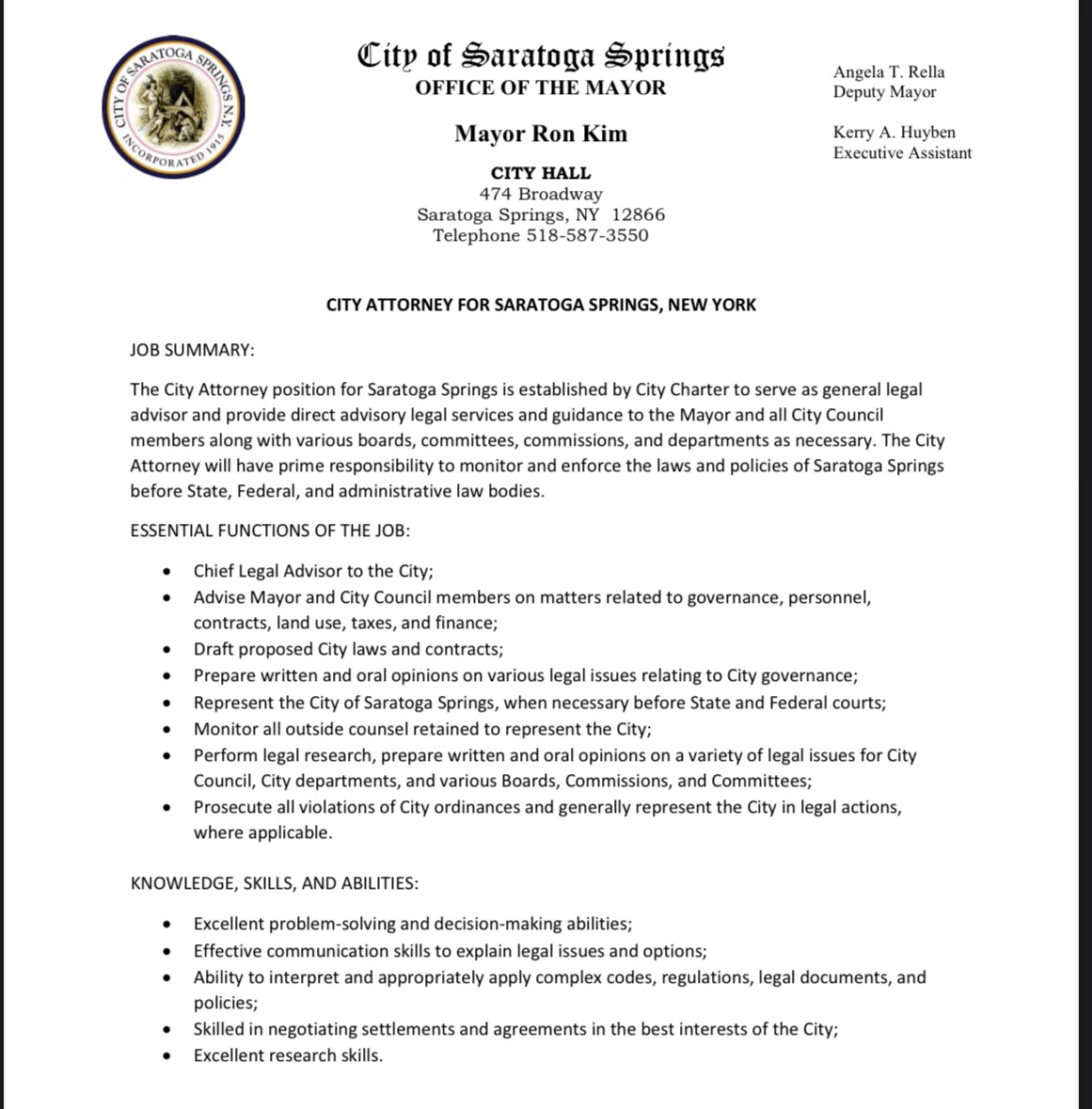
Mayor Kim: Bypasses City Council With Job Posting

This is a copy of the job description for a Saratoga Springs City Attorney placed on the Saratoga County Bar Association Website

Mayor Ron Kim has posted the position of City Attorney on the Saratoga County Bar Association website (see above). This ad is quite troubling in a number of ways.

The Residency Issue

The job description contains no residency requirement.

As recently as the January 18, 2022, City Council meeting, Mayor Kim has continued to insist that the City Attorney is not a public officer. It is on this basis that he has claimed that they are not subject to a residency requirement. In support of his assertion at that meeting, he declared that our city attorneys do not take an oath of office. He stated:

“So we [JK: We?] think it’s very clear the City Attorney is not a public officer. The criteria that this case goes through so to set that out [sic]. They don’t take an oath like a district attorney.”

Mayor Kim, January 18, 2022 Council Meeting.

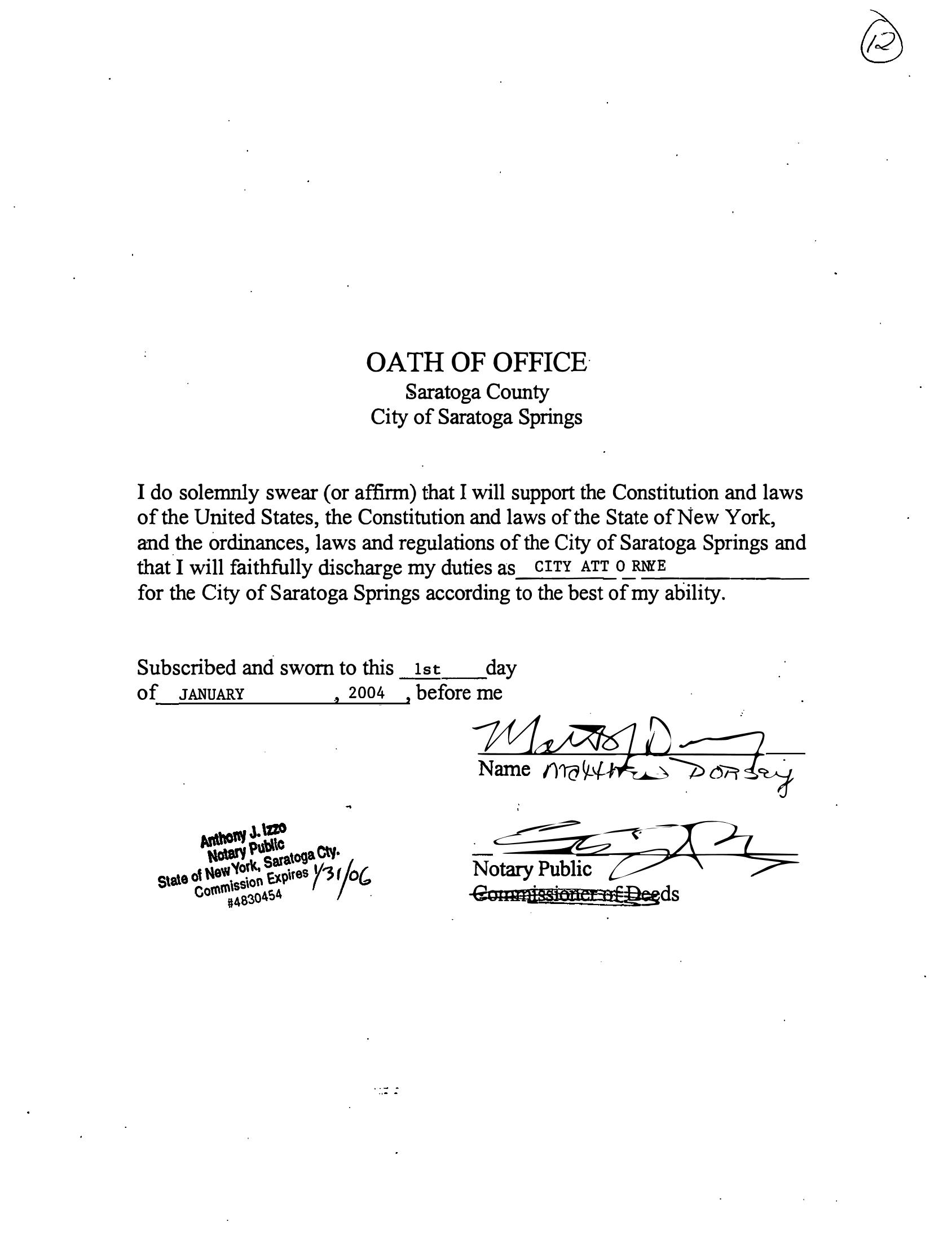
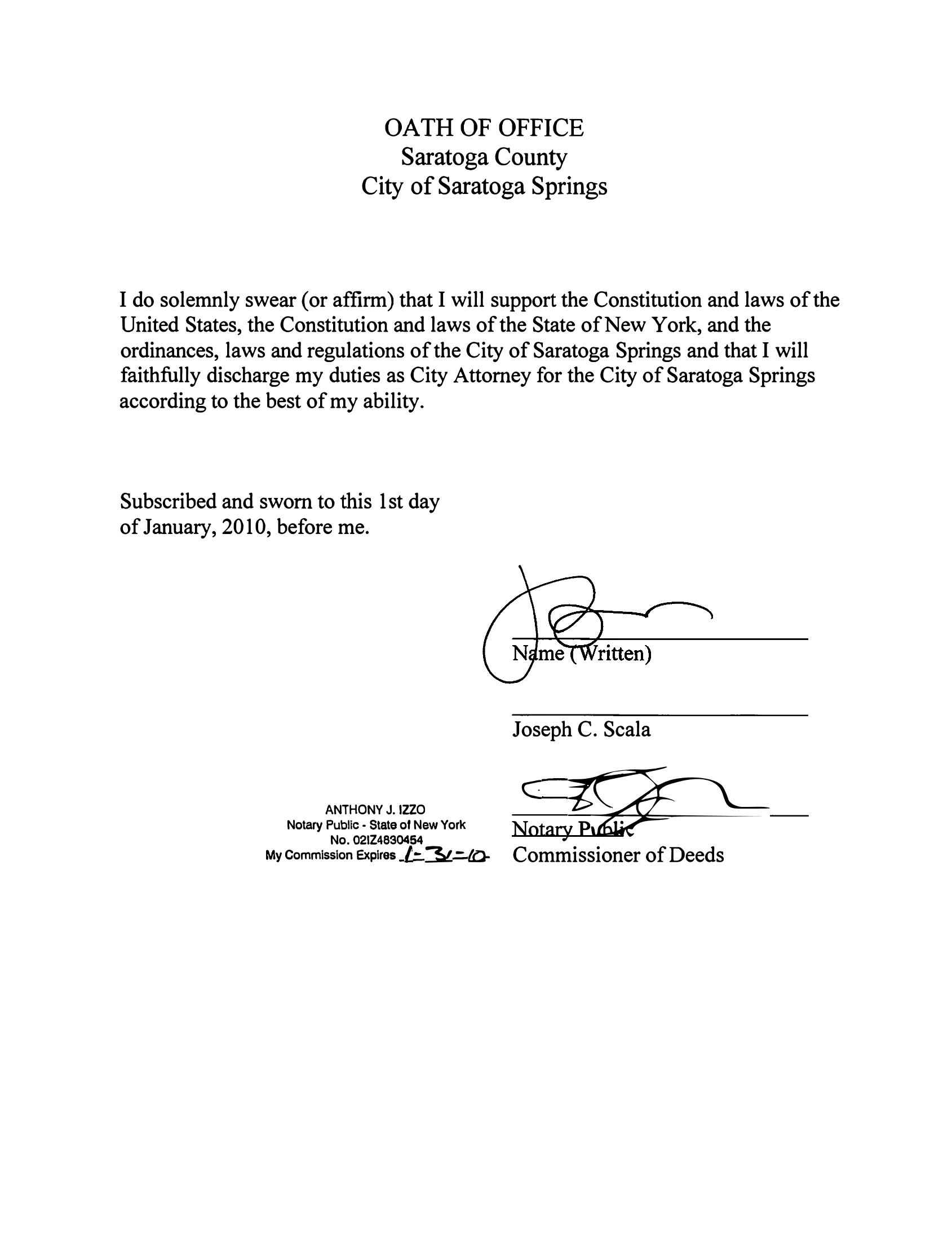
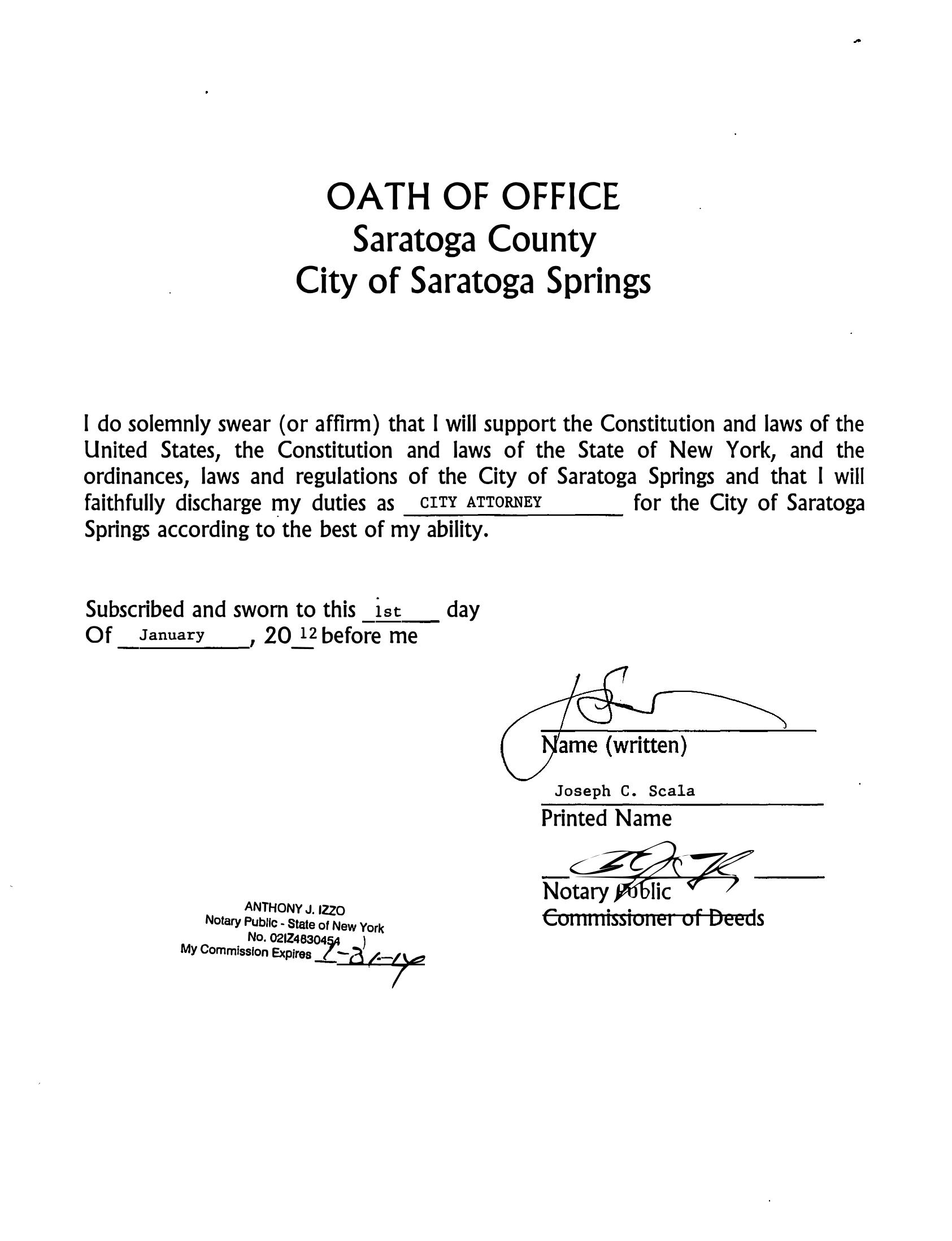
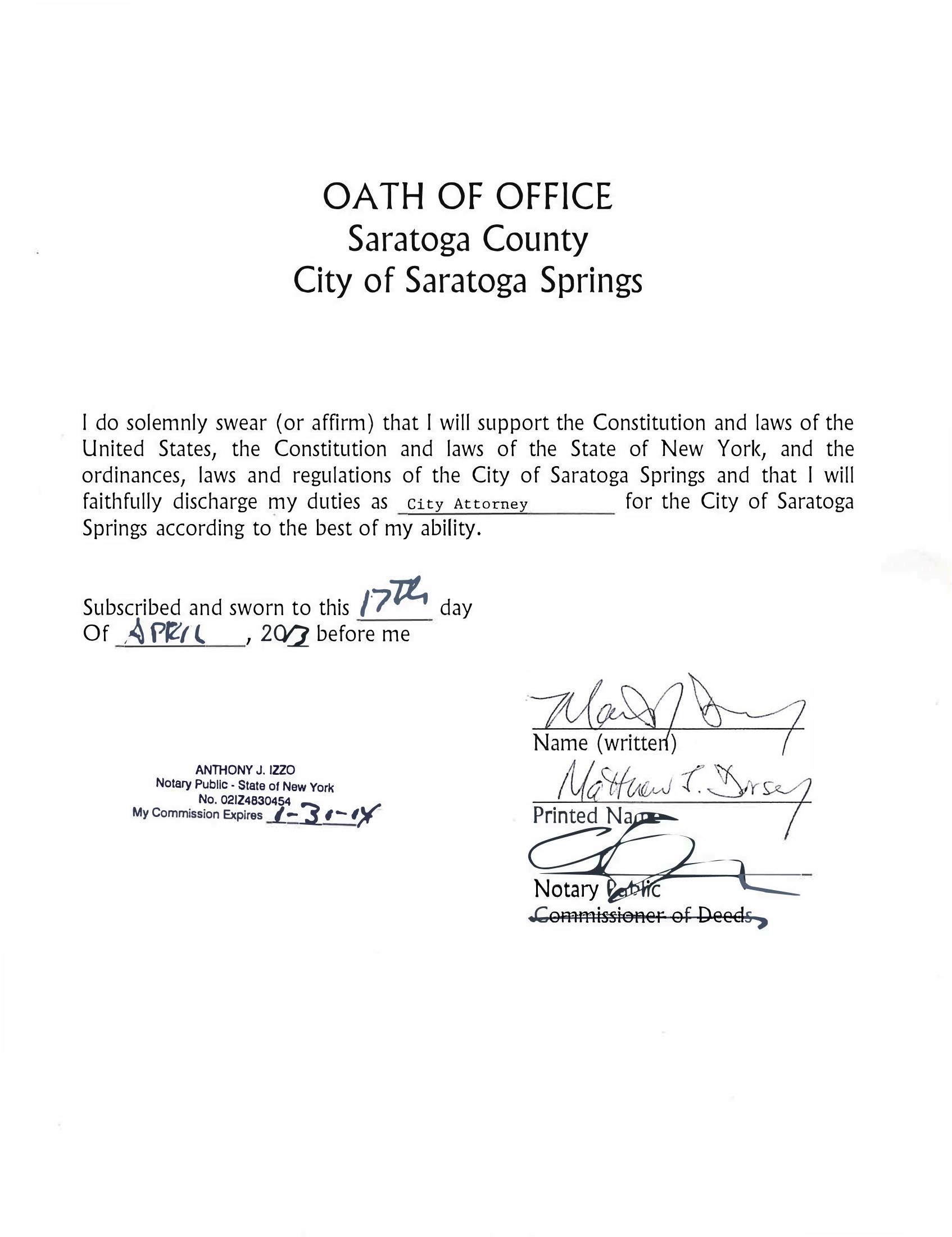
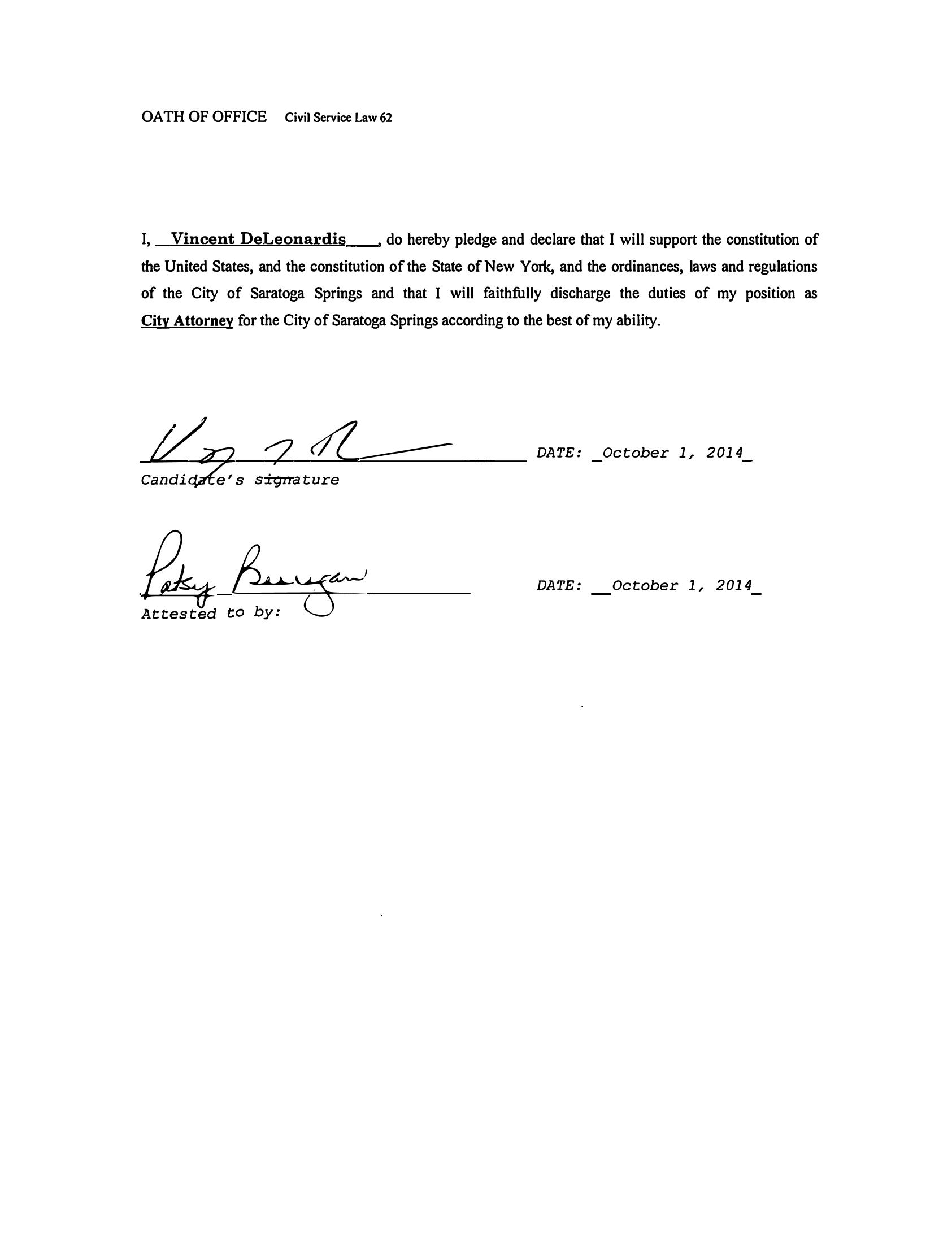
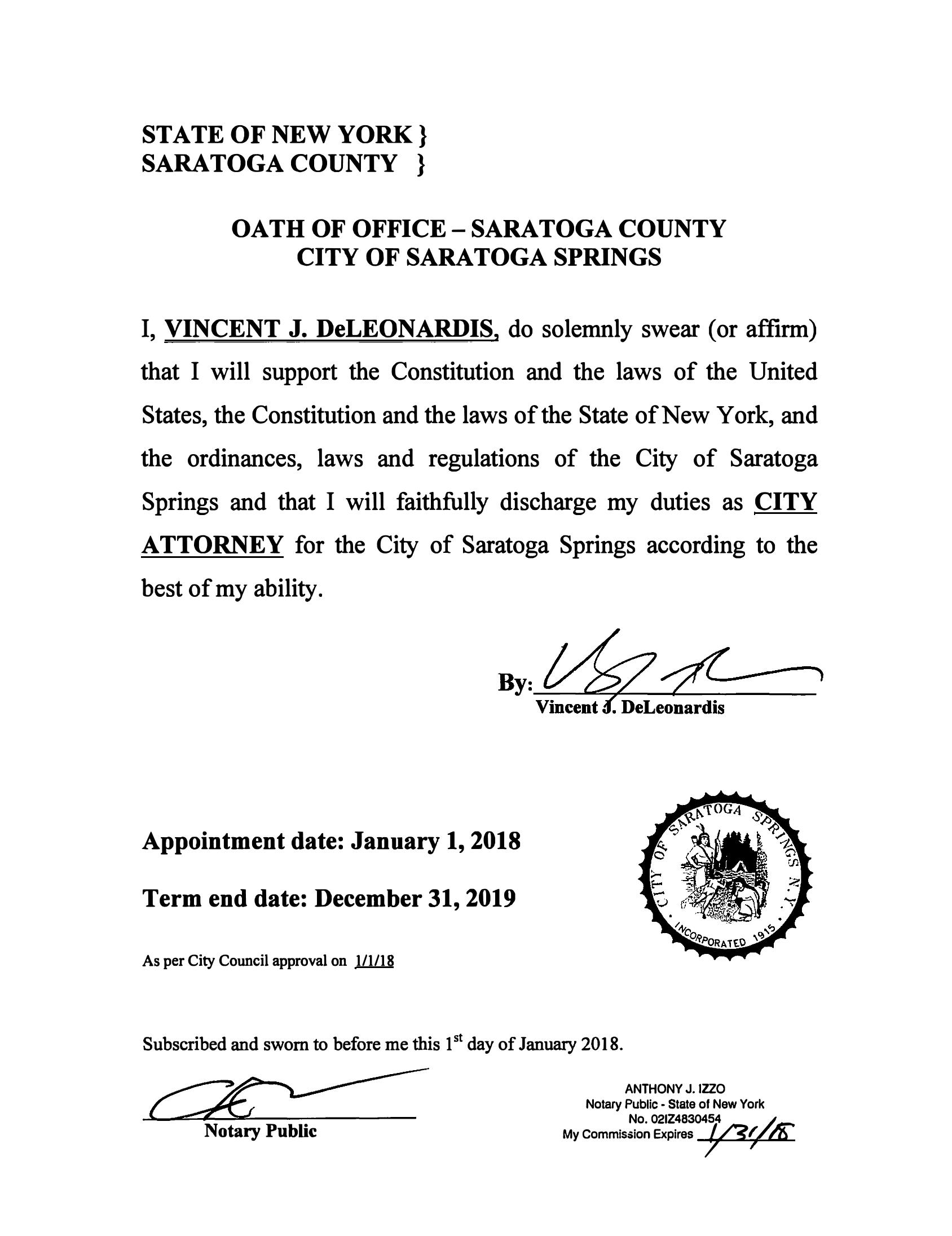
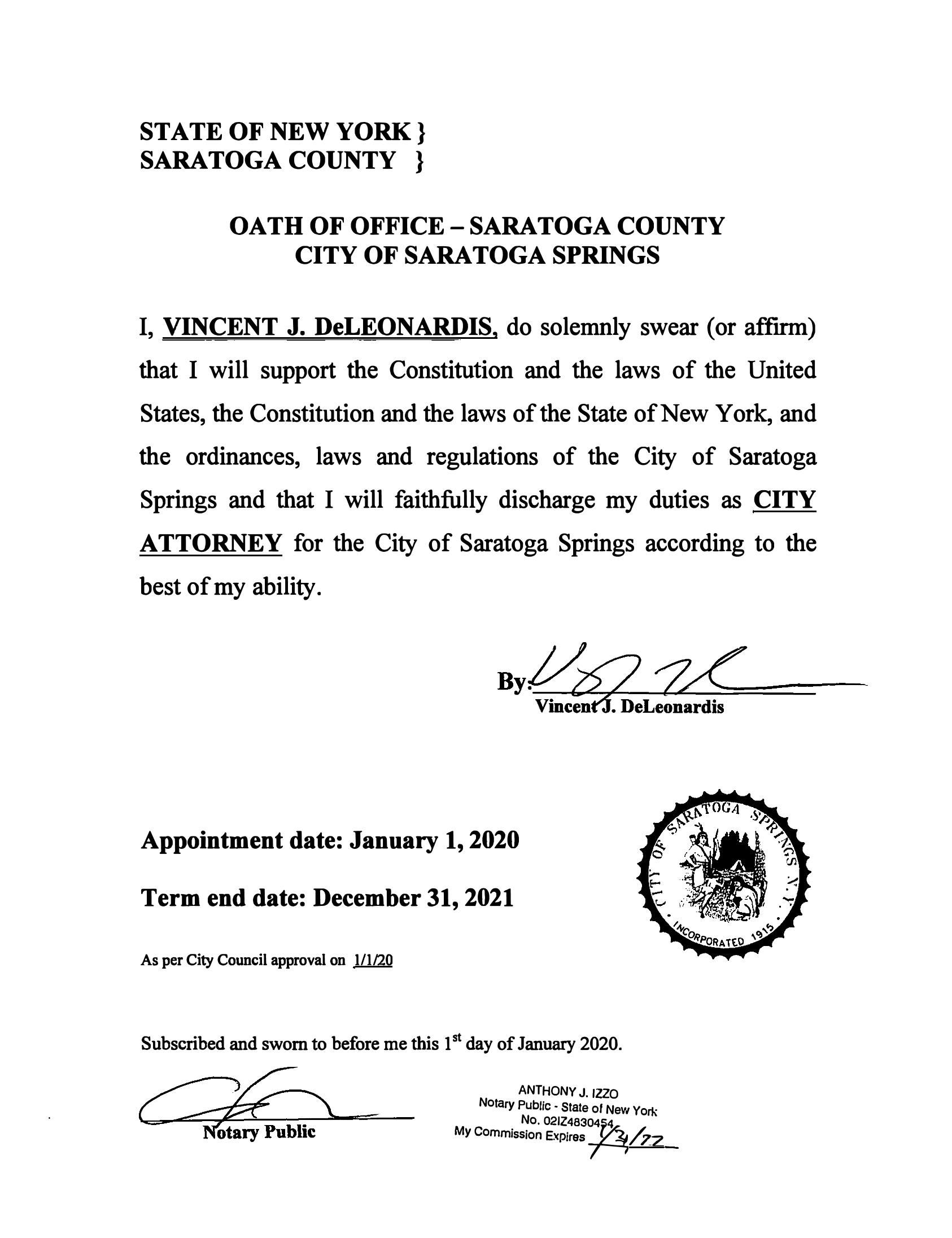
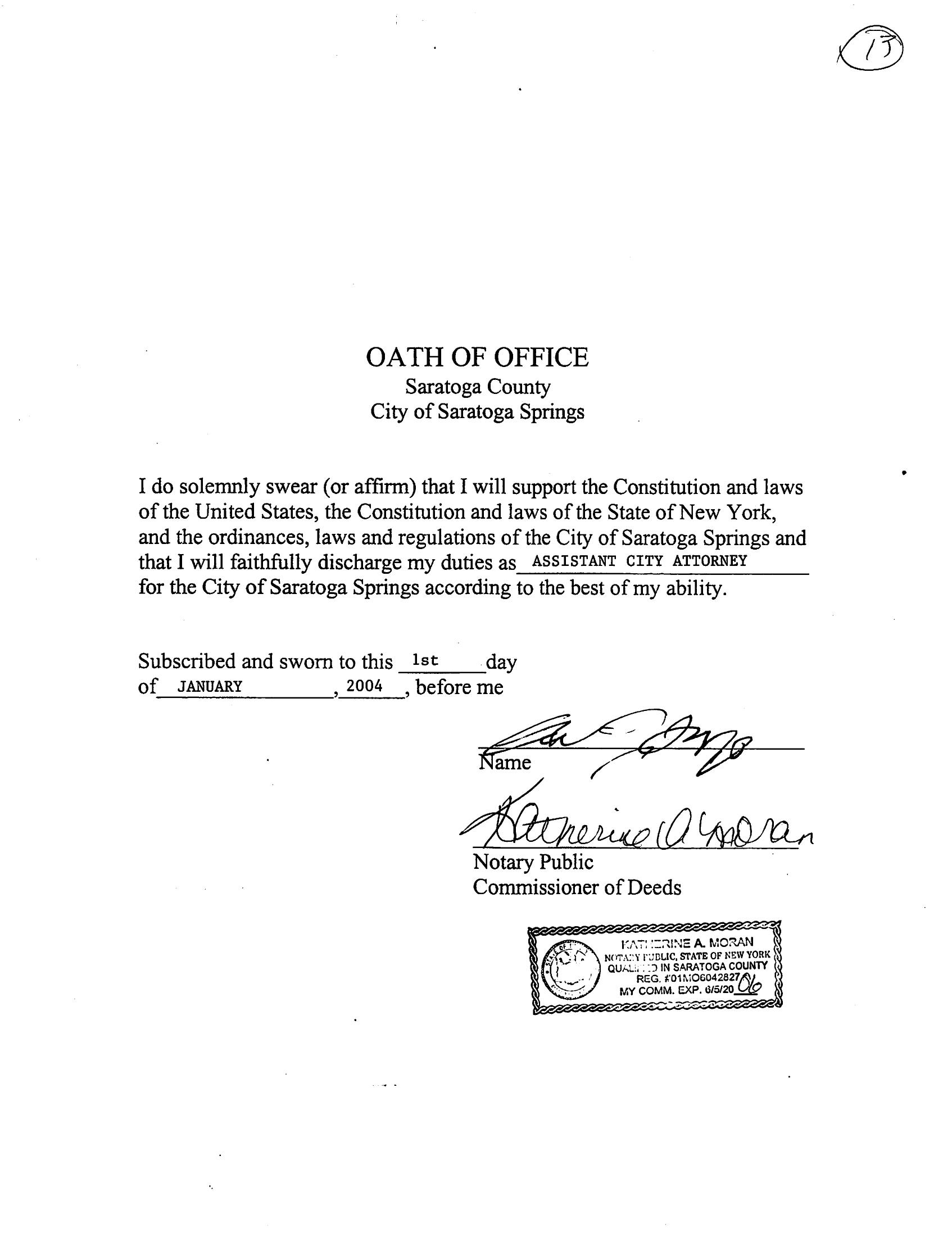
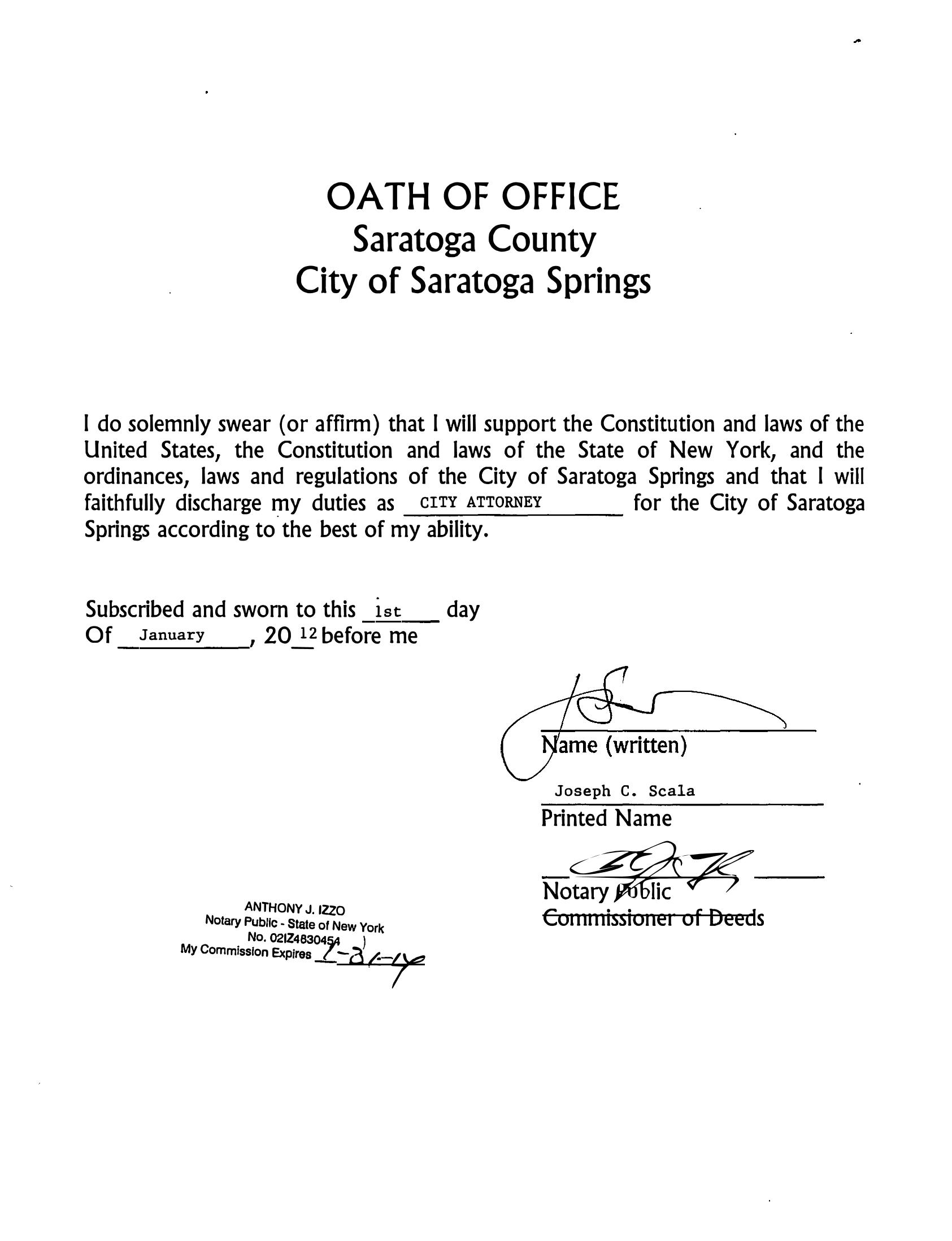
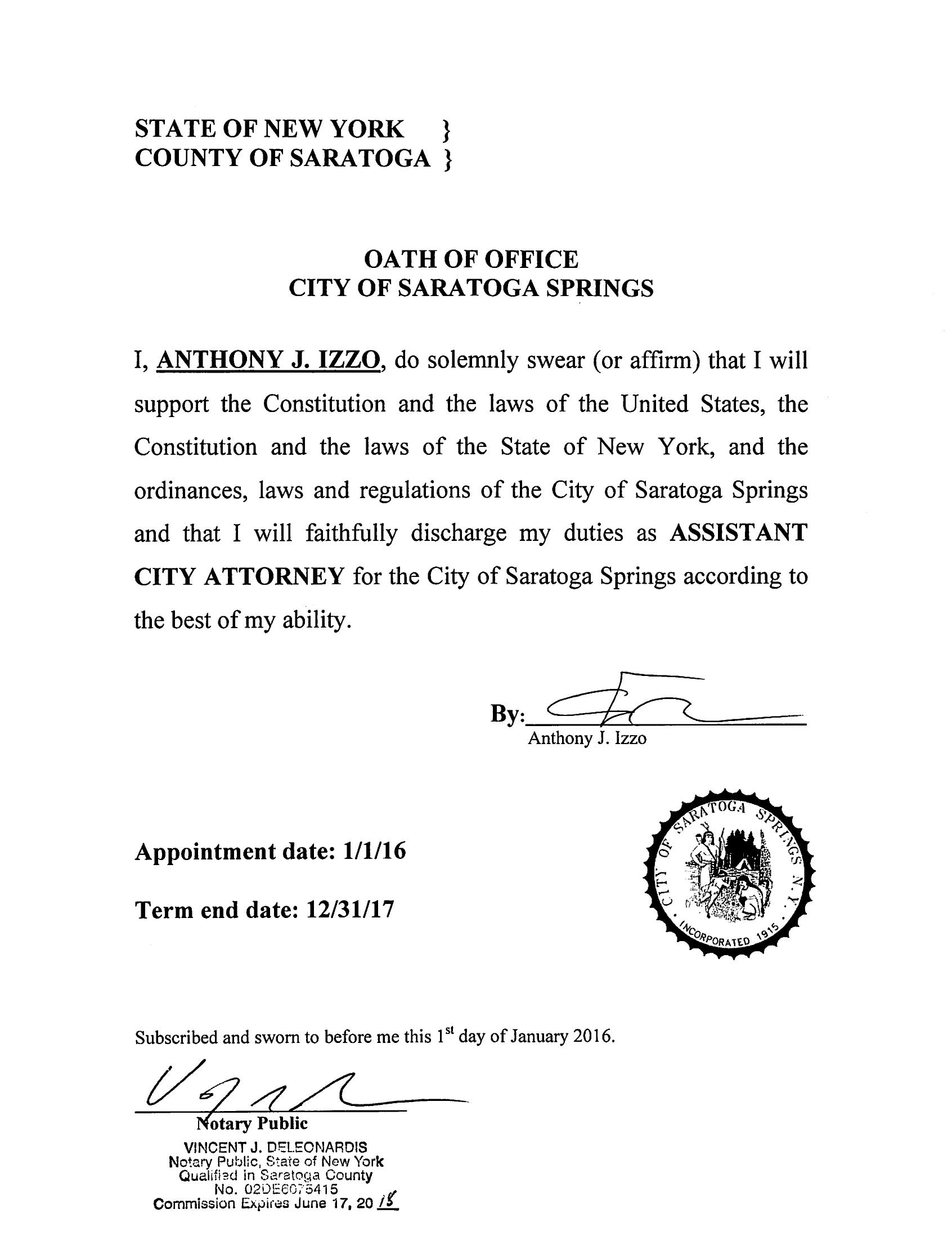
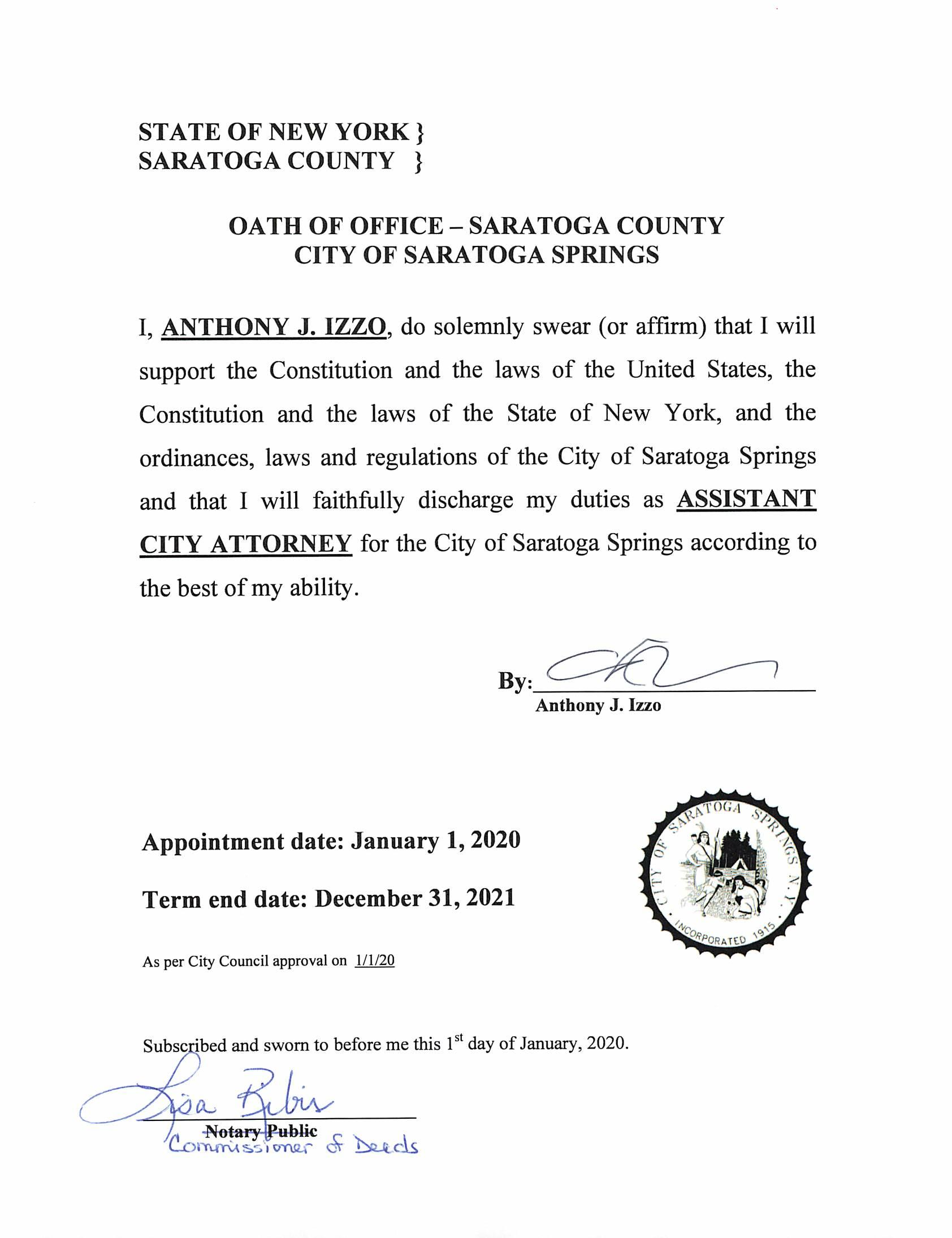
Unfortunately for Mayor Kim, the facts do not bear him out. At the bottom of this post, the reader will find the oaths of office taken by all the City Attorneys in Saratoga Springs for the last twenty years.

Evidence shows beyond a doubt that the position is a “public officer”. To allow a non-resident to hold the position would require action by the City Council either requesting the NY State Legislature to pass a Home Rule law (the preferred method) or adopting a local law allowing the city to waive the residency requirement.

Even if the exception were to be established, state law would still require that candidates would need to be a resident of the county, so one way or the other, a proper job description would have to address a residency requirement. Without Council action (which could take from weeks to months) the job at this point requires the applicant to be a city resident.

The Lack of Council Action Regarding the City Attorney Position’s Terms of Employment

As readers may recall, Mayor Kim drafted a resolution for the last City Council meeting proposing terms of employment for the City Attorney position. These included a reduction in hours for the position and a salary range. Previously the City Attorney was a full-time position requiring forty hours and the city employed an Assistant City Attorney to work up to 29 hours. Kim’s resolution proposed only a single City Attorney who would work “an average of thirty hours a week.” [JK: The concept of “average” for calculating a salary is problematic and I am deeply troubled by the radical reduction of in-house counsel time but that will have to wait for a separate post.]

That resolution was withdrawn before the Council meeting. Nevertheless, the terms of employment now appear in the job posting for a City Attorney even though they were never approved by the City Council as required. The Mayor is not authorized to make these offers of terms of employment on his own. It would seem to be improper and unfair to applicants to offer them conditions of employment before those terms have been appropriately authorized by the Council.

One has to wonder what his Democratic colleagues on the Council think of this. But then, they have no one to turn to for legal advice…….

The Documents

Note: The attorneys serve two-year terms unless they are filling out a term that a previous attorney had vacated. In browsing these oaths the reader will find multiple entries for the same attorney in some cases because they were required to take an oath for each new term.

More Analysis of the Jamaica Miles Story

Brian Lee of the Daily Gazette has written an excellent story on the decision by Judge Francine Vero to dismiss the charges against Jamaica Miles. The stories in the Daily Gazette are behind a paywall although I believe non-subscribers get to view a few stories online each month.

I want to urge the readers of this blog again to subscribe to the Daily Gazette which is the only reliable coverage of Saratoga Springs these days. Without the resource of a rigorous newspaper, our democracy will be seriously jeopardized.

According to all media accounts Ms. Miles and her lawyer Kevin Luibrand asserted that Ms. Miles was singled out and treated differently than the other persons charged in actions related to the July 14 Black Lives Matter protest in Saratoga Springs because she is black.

The history of this business is more complicated, however. As indicated in the Gazette article, 13 other persons, 3 white and 8 black, were charged for their actions at the protest. Those who had no criminal history were given “adjournments in contemplation of dismissal” (ACOD). This allowed for the dismissal of charges if the defendants committed no other illegal acts in a specified period of time. Ms. Miles was also offered an ACOD but refused this in an earlier court appearance.

Judge Vero noted that there had not been a “one size fits all” approach in dealing with cases resulting from the demonstration. She stated that “each defendant received an individual, independent analysis to determine their level of culpability and each defendant received a plea offer that was appropriate given their culpability and criminal history.”

It was apparent that Judge Vero was again looking for an ACOD for Ms. Miles at a later court appearance, but the Assistant DA declined to agree to it noting that Ms. Miles had previously rejected that solution. The DA did offer to reduce the false imprisonment charge down to disorderly conduct.

Judge Vero affirmed in her decision that there was in fact “evidence of guilt of Disorderly Conduct”.

It is perfectly understandable that Judge Vero was intent on finding a resolution that would not result in a conviction that would be inconsistent with the other cases. The judge noted that Ms. Miles had no previous criminal convictions. She has four children who she needs. to support.

The Gazette article noted that Mark Emanation, executive director for the Capital District Area Labor Federation, gave testimony to Ms. Miles’ volunteer work including her current tenure on the Schenectady School Board. He testified that Ms. Miles volunteers for mass food distributions for the hungry.

While Judge Vero observed that the video evidence clearly documents Ms. Miles’ disorderly conduct, she also wrote: “There would be no purpose in imposing a jail sentence upon a 47-year-old woman who has never been arrested before, particularly for an offense when there is no harm.”

Judge Vero also commented regarding problems with the prosecution’s case. The prosecution alleged that Ms. Miles was a leader of the demonstration without providing supporting evidence. She also observed that the victim in the case did not testify nor did the victim submit a written statement opposing the dismissal of the case.

So it is not surprising or unusual that a judge, having been thwarted in her attempt to resolve the case with an ACOD, would choose to dismiss the case.

Notwithstanding the allegations by Ms. Miles and her attorney, there is no indication that Judge Vero supported that race was a factor in the original arrest and prosecution.

District Attorney Karen Heggen’s Response

The Gazette reported that:

[District Attorney Karen] Heggen criticized the judge’s decision and suggested it sent a dangerous message that people who don’t have criminal records and perform good acts in the community get a pass to break the law.

Daily Gazette January 25, 2022

Times Union Watch

The Times Union story was a study in contrast to the Gazette coverage. The TU basically focused on Jamaica Miles’ allegations that she was singled out by the police and DA because of racism.

A cursory reading of the TU article would lead one to believe that Ms. Miles’ charges were dismissed because she was innocent of violating the law.

Conspicuously missing from the TU article were the central tenants of Judge Vero’s decision: that video evidence confirmed Ms. Miles’ disorderly conduct and that the charges were dismissed for a variety of reasons including Ms. Miles’ personal history. Judge Vero also noted the time and resources that would have had to have gone into a jury trial particularly during Covid. Her opinion notes, “If the misdemeanor proceeds to trial a significant amount of the Court’s time and the time of the…jurors will be spent…in the process of summoning jurors, selecting a jury, instructing the jurors and waiting for them to deliberate…As a consequence…other Court matters will not be timely heard…”

Charges Against Jamaica Miles of BLM dismissed “In the interest of justice”

Jamaica Miles was charged with “Unlawful Imprisonment” and with disorderly conduct growing out of an incident during the July 14, 2021, Black Lives Matter demonstration in Saratoga Springs.

Judge Francine Vero issued a verdict on the charges on January 24, 2022.

While her opinion acknowledged that, “There is little question the defendant’s [Miles] actions constitute disorderly conduct,” she dismissed all the charges “in the interest of justice.”

The opinion is so well written that for the details I refer you to the opinion.

The City Attorney Ordeal Continues

As reported in my previous blog, I recently received an email from the Department of State (DOS) definitively affirming that, contrary to Mayor Ron Kim’s many assertions, the City Attorney is a public official and therefore subject to a residency requirement. We reported earlier that the residency requirement could be waived by the passage by the NY State Legislature of a Home Rule bill as had been done many times for many municipalities throughout the state.

Foothills Business Daily followed up with the New York State DOS and spoke with someone in the DOS press office.

That office did not dispute their department’s earlier determination that, contrary to Mayor Kim’s assertions, the City Attorney is a public officer. The office, according to the story, “seemed” to agree with Mayor Kim, though, that the residency requirement could also be changed through the passage of a local law. They hedged on this, recommending that the New York State Attorney General should be contacted for further clarification of its opinions on this issue

All of this prompted me to do more research.

I knew that recently the city of Mechanicville similarly wanted to remove the residency requirement for their City Attorney. They enlisted the help of Assemblywoman Carrie Woerner and Senator Daphne Jordan to get the state legislature to pass a Home Rule bill that would exempt the city from the requirement. The bill was passed just seven months ago on June 11, 2021. As noted in an earlier post, Section 3 has many similar additions exempting the residency requirement for other municipalities.

It was interesting to me that Mechanicville chose not to take the seemingly simpler route of passing a local law. What I found in my research, consistent with the caution shown by the DOS press secretary, was that the history of the Public Officers Law on residency is marked by conflicting opinions and court cases. Attorneys that I spoke with offered that the conservative approach was to opt for the state legislative solution Mechanicville chose rather than a local law.

The Path Forward

As people may recall, Mayor Kim originally crafted a resolution that was submitted for the pre-agenda meeting of the City Council regarding the City Attorney. The resolution included a whereas clause that incorrectly asserted that the City Attorney was not a Public Officer. Apparently, Mayor Kim simply assumed that if he asserted that the City Attorney was not a public officer, there was no need to even address the residency obstacle.

While Mayor Kim has steadfastly held to his position that the City Attorney is not a public officer, at Tuesday night’s meeting he allowed for its possibility and offered that a local law could circumvent the problem.

A local law is different from a simple resolution. I don’t understand all of the distinctions except that it requires a public hearing and must be registered with the state upon adoption.

I can only say that had the Mayor enjoyed the assistance of the two attorneys who he chose not to reappoint, he might have avoided the torturous and prolonged process he has followed and Saratoga Springs might now have a City Attorney.

I know he believes he is saving money by personally providing legal counsel to the city. One might hope that this experience would humble him to acknowledge that whatever his background as a bankruptcy attorney, it is not sufficient when it comes to municipal law. He would be better served by focusing on his role as Mayor and relying on an attorney with expertise in municipal law.

State Opinion Counters Kim; More Legal Missteps and Misstatements At Council Meeting

At Tuesday (January 18, 2022) night’s Saratoga Springs City Council meeting, Mayor Kim dug his heels in on the City Attorney issue. Even in the light of overwhelming evidence to the contrary, he continued to insist that the position is not a “public officer” and therefore not subject to a residency requirement, offering yet more odd rationales for his opinion. Kim’s pursuit of this issue seems to be related to his desire to appoint a resident of Middle Grove to be the City Attorney. This person has since indicated she is no longer interested in the position making it strange that Kim is doubling down on this issue.

Even more troubling, though, was watching him gain support from his three Democratic colleagues on the Council for a vote that violated the Open Meetings Law and another vote that potentially violated the City Charter.

A Promise Not Kept

Readers following this blog may remember that Mayor Kim promised to answer two questions I put to him regarding how he determined that the City Attorney is not a public officer:

Who at NYSCOM provided you with the opinion that the city attorney is not a public officer?

Could you cite the actual language in section 3 of the NY State Public Officers Law supporting your position.

At Tuesday night’s meeting, he answered neither question.

Instead, he oddly offered a new piece of evidence he thought supported his claim: the case of Fischer vs Mechanicville.

That evening I looked up the case. It turned out that the case went back to 1916 when Mechanicville was transitioning from a village to a city. There has been considerable legislation and case law over the subsequent one hundred and five years since this decision. It is troubling that now this is the only specific the Mayor is offering to support his claim.

Mayor Kim then went on to assert that among other things he believed the City Council had the authority to ignore state laws such as the Public Officers Law and draft their own local law. He stated:

“even if we were hemmed in by this Public Officers Law it is very clear that we as a city council have the authority to enact a local law that would vary this [sic]. There are, as I said, several attorney general opinions on this dating back to the 1970s that sort of resolve this issue. In other words, every city council has to wrestle with whether or not they have the authority to change certain laws as opposed to whether or not only the legislature could do it. It’s very clear we could do it. So we think it’s very clear the City Attorney is not a public officer. The criteria that this case goes through so to set that out [sic]. They don’t take an oath like a district attorney.”

If in fact there were opinions issued by Attorney Generals in the 1970s, Kim never cites one that would allow the City Council to ignore state law and declare that the City Attorney is not a public officer.

In fact in 1997 the NY State Attorney General issued this opinion:

“While there is a lack of uniformity in judicial decisions as to whether municipal attorneys are public officers, in our view, a municipal attorney who is the head of the municipality’s law department, serves as the chief legal officer of the municipality, and is responsible for offering advice to municipal officials and defending and commencing actions on behalf of the municipality is a public officer.”  [my emphasis].

Here is a link to a video of his remarks.

Kim’s claim that our City Attorneys don’t take oaths is simply not true. One wonders what source he relied on for this assertion.

I contacted the previous City Attorney Vince DeLeonardis, Sarah Burger, and current City Court Judge Jeff Wait. Mr. DeLeonardis told me he had taken the oath when originally hired by Joanne Yepsen and then at the beginning of each term during Mayor Kelly’s tenure. Judge Wait told me he had taken the oath twice when serving as City Attorney under Ken Klotz for two terms. Ms. Burger served under Mayor Yepsen and took the oath.

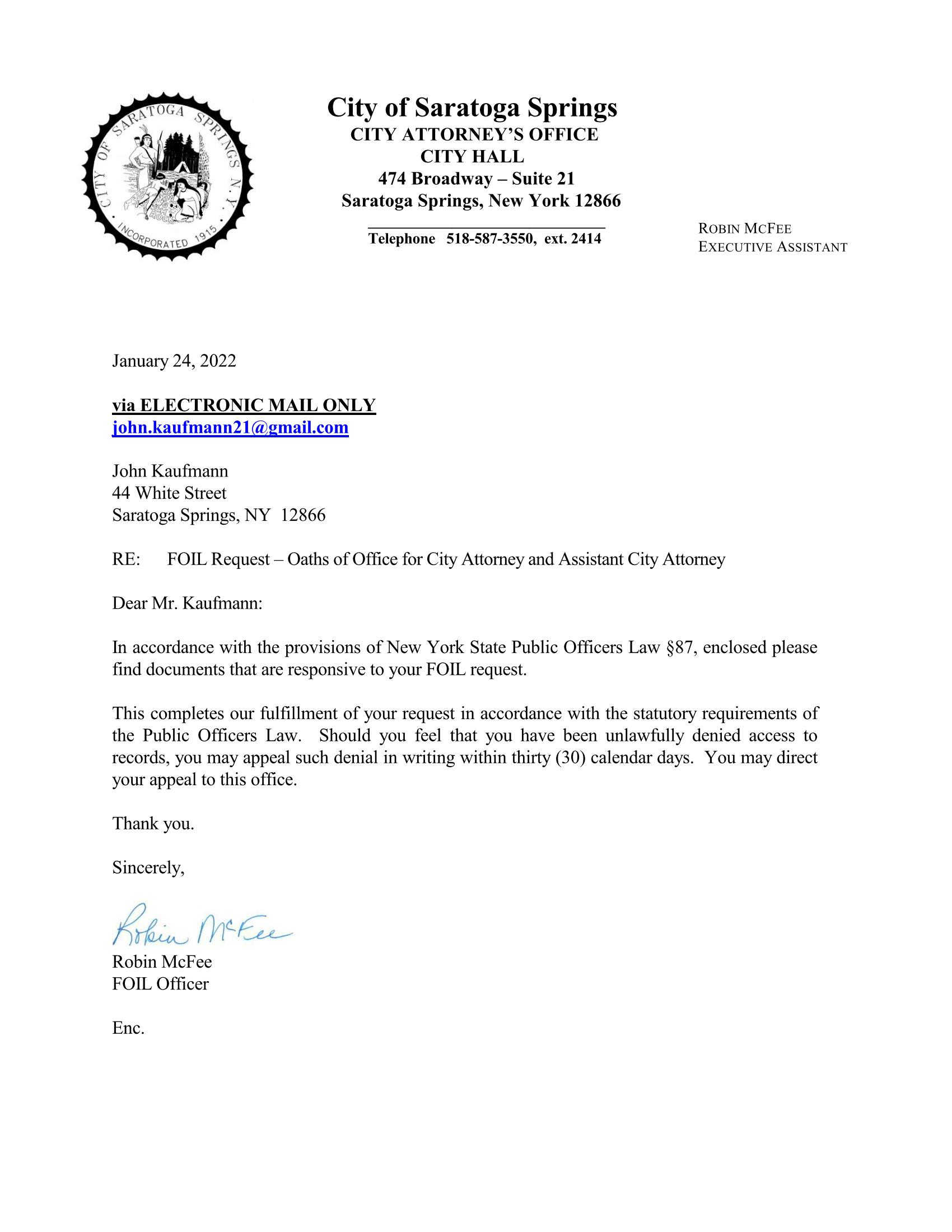
As far as I can determine, every City Attorney has taken the oath. I have FOILed for copies of these oaths covering the last thirty years.

The NY Department of State Weighs In

Following the City Council meeting, I wrote to the New York Department of State’s Office of Local Government.

My email was brief. I asked whether the City Attorney position was considered a public office. I received the following response:

Hello John:

Thank you for your email. 

Yes, a city attorney would be considered a public officer.

Ebony Mapp, AICP

Local Government Specialist

NYS Department of State

Local Government Services

One Commerce Plaza
99 Washington Avenue, 10th Floor

Albany, NY 12231

O: 518-992-6463

Eebony.mapp@dos.ny.gov

Whttps://dos.ny.gov/

A Violation of the Open Meetings Law

Mayor Kim’s doubling down on the City Attorney’s residency requirement was not the only troubling part of Tuesday’s City Council meeting, however. If a public body is to conduct business in private in an executive session, the NY State Open Meetings Law (OML)requires a statement identifying the specific subject that will be discussed prior to the executive session. Before going into the executive session at Tuesday’s meeting, Mayor Kim instead just read a list of all the possible subjects that New York allows to be covered in the executive session. Conspicuously missing was a statement by Mayor Kim as to the subject of that night’s session as required under the OML. He and all three of his Democratic colleagues on the Council voted for this illegal resolution. Commissioner of Public Works Skip Scirocco was not present.

A Violation of the City Charter

Title 3. Item E of the City Charter requires that “The Mayor shall submit in writing to the Council and the public a State of the City Message on or before the first regularly scheduled Council meeting in February each year.” This would require Mayor Kim to deliver, in writing, the State of the City message no later than the next City Council meeting on February 1.

Mayor Kim acknowledged this part of the City Charter at Tuesday’s meeting but noting the COVID threat and his desire to have the public physically present at the event, he offered a resolution allowing the event to occur any time prior to March 19. He received unanimous support again from his three Democratic colleagues on the Council.

I know this change in the State of the City Message may seem a petty issue to many, but the Mayor and the Council do not enjoy the privilege of cavalierly ignoring the provisions in our charter. This is simply not healthy. A thoughtful lawyer (or simply a thoughtful person) could find a better solution for this. For instance, the charter does not require a public event. It only requires that the mayor “submit in writing to the Council and the public a State of the City message ….” The Mayor therefore could have provided such a document within the time restrictions of the charter and then organized some later event for him and the members of the Council to convene with the public to review the city’s “state.” Why have he and his fellow Council members taken this action which they were clearly not authorized to do?

The City’s Business Requires A City Attorney

It appears unlikely that the City Attorney position will be filled this month. Mayor Kim has told the media that as he and his deputy, Angela Rella, are attorneys so there is no rush. He and Ms. Rella are handling the city’s legal matters.

I am not sure what exactly they have been doing, but I do know that they have not been representing the city in court. The City Attorney handles matters involving code enforcement violations and parking issues in city court. It is my understanding that those matters have had to be adjourned.

Citing the fact that he is a lawyer, Mayor Kim has also told the media that he doesn’t need a City Attorney “looking over his shoulder” in dealing with municipal matters.

I do not think it is unfair to observe that the mishandling of issues at Tuesday’s City Council meeting does not inspire confidence in Mr. Kim’s and Ms. Rella’s legal advice to the Council.

The Wider Implications

The management of this city and its Council should involve a fastidious adherence to the laws and rigorous acknowledgment of facts. These are the essential guardrails of democracy. People will make mistakes. It is the nature of being human but those should hopefully be rare and they should be acknowledged so they do not become endemic.

Mayor Kim has been openly contemptuous of the previous city administration, but he should acknowledge the rigorousness of how it did the city’s business. This was because Mayor Kelly and attorneys Vince DeLeonardis and Tony Izzo crossed their t’s and dotted their i’s when preparing for Council meetings. In a litigious age, without that fastidiousness bad things can happen.

Consider that Mayor Kim sought to employ as City Attorney someone who was legally ineligible because she did not live in the city. Had he succeeded in doing this, it potentially would have put the city at risk in any legal proceedings this person was involved in.

I am sure that Mayor Kim has nothing but the best intentions in serving the city. At $14,500.00 he is not doing it for the money. Unfortunately for him, after the City Attorney fiasco, it will make finding a skilled lawyer to serve the city that much harder. I worry about his plan to reduce the hours of the City Attorney (more about that in a later post). Hopefully he will find the right person who will help him, the Council, and the city move forward.

Mayor Kim Pulls City Attorney Resolution from City Council Agenda

A revised agenda for Tuesday night’s City Council meeting has been posted on the city’s website. The problematic resolution on the proposed City Attorney that had been an item on Mayor’s Kim’s agenda has been pulled. Instead, there is now an item on his agenda called “Announcement: City Attorney.”

Mayor Kim Agrees To Answer Blogger’s Questions About City Attorney

Mayor Ron Kim will be submitting a resolution for Council action on Tuesday, January 18, 2022, regarding the hiring of a City Attorney. The resolution has multiple problems but all of them pale before the fact that it asserts that the City Attorney is not a public officer as defined in the New York State Public Officers Statute.

Here is the relevant text. The full resolution can be found at the bottom of this post.

The purpose of this clause appears to be an attempt to circumvent the New York State Public Officers Law which would require that the City Attorney reside in the municipality in which they would serve. Mayor Kim has previously announced that he plans to hire an attorney who, like him, specializes in bankruptcy law but who does not live in Saratoga Springs.

On January 15, 2022, I wrote to Mayor Kim and copied the other members of the Council:

Mayor Kim:

In the resolution regarding a City Attorney that will come before the Council Tuesday, you claim “the City Attorney is not a local officer as defined by New York Public Officers Law 3.”  I am familiar with section 3 and I do not find the language that would support your determination.

You also allege that someone from NYSCOM told you that the city attorney is not a public officer.

If, as I believe, the city attorney is a public officer, and you were to hire someone who does not reside in Saratoga Springs, you would potentially create numerous liabilities for our city. 

 As you have stated that transparency is of utmost importance to you, I hope you will respond to the following questions:

  1. Could you provide a written opinion to me, your colleagues on the Council, and the public identifying the specific language in section 3 upon which you based your determination that the City Attorney is not a local public officer?
  2. Could you identify who at NYSCOM told you the city attorney is not a public officer?  If there is some kind of documentation such as an email, could you please provide it?

Thank you for your attention to this matter.

John Kaufmann


Mayor Kim responded later that day:

“This information will be provided at the City Council meeting.”


I responded:   

“Great.  I look forward to it”


On January 16, 2022, I followed up with this email:

Mayor Kim:

This is a follow-up to our earlier email exchange regarding your proposal for a City Attorney.  I was very pleased to learn from you that you would be addressing my two questions at Tuesday night’s Council meeting.
As background for you and the other Council members, I am including references supporting my contention that the City Attorney is a public officer.
Item #1
From an opinion from the New York State Attorney General:

“While there is a lack of uniformity in judicial decisions as to whether municipal attorneys are public officers, in our view, a municipal attorney who is the head of the municipality’s law department, serves as the chief legal officer of the municipality, and is responsible for offering advice to municipal officials and defending and commencing actions on behalf of the municipality is a public officer.”

Item #2

The following is from the Public Officers Law 3.  Note, you cited this section in your resolution claiming that the City Attorney is not a public officer.  The section includes some seventy exemptions made to the requirement that a particular, local position requires local residency.  These were all home rule bills.

11. In the city of Salamanca the provisions of this section requiring a person to be a resident of the political subdivision or municipal corporation of the state for which he shall be chosen or within which his official functions are required to be exercised, shall not prevent a person regularly admitted to practice as an attorney or counsellor in the courts of record of this state from holding the office of city attorney or city justice of the city of Salamanca, if such person resides in the county in which such city is located. 

The simple logic here is that Salamanca would not have had to be granted an exemption for its city attorney regarding his/her residency were this position not a public office.

Item #3

The individual becoming the City Attorney has always taken the same oath of office as the members of the City Council.  This is because, in order to take public office, Public Officers Law requires this oath to be taken. (see item #4)

Item #4

The following text is from the Comptroller’s office addressing who is a public officer:

Public officers are eligible for membership in NYSLRS. This applies regardless of whether individuals are elected or appointed as public officers. You must give them the opportunity to join NYSLRS.

A public officer is a person either elected or appointed to a governmental position with the following general characteristics:

  • 1. The position is authorized by statute, resolution or charter to exercise part of the sovereign power of the governmental entity.
  • 2. The duties of the position involve the exercise of discretion on behalf of the governmental entity. If the duties of the position are routine, subordinate, advisory, or directed, then the position is more likely to be a position of employment, rather than a public office.
  • 3. The State or local enactment creating the position refers to it as an “office.”
  • 4. The position has a fixed or definite term.
  • 5. The person holding the position files an oath of office. [my emphasis]
  • 6. The compensation for the position does not depend on the number of hours worked.
  • 7. Incumbents of the position may be compensated either through the employer’s payroll system or by voucher.
  • 8. Incumbents of the position generally must reside in the jurisdiction they are serving.

Section 10 of the Public Officer’s Law requires every public officer to take and file an oath or affirmation prior to the discharge of any of their official duties. Public officers are authorized to act in their capacity as an officer for their established term. Any public officer who is re-appointed should take and file an oath or affirmation at the beginning of each new term. In addition, these oaths of office shall be provided to the Office of the State Comptroller if requested as part of an employee/independent contractor review.

Some positions considered public offices are members of planning boards, Town or Village Justice, County Attorney and District Attorney. Other positions that may be considered public offices are Town, Village, and City Attorney. [my emphasis]—————————————I

I have spoken to a number of attorneys who have extensive knowledge of municipal-related law and every one of them was unequivocal that the City Attorney is a public officer.


I am always willing to acknowledge points that I have missed.  It all seems clear to me, but your answer to my questions in the previous email would be helpful in better understanding how you arrived at your determination that the City Attorney is not a public officer.

************************************************************

[JK: The best solution to resolving this issue would be to table the resolution and seek an opinion from the New York State Comptroller’s office.]


Resolution