During the worst of the COVID crisis, the New York State Liquor Authority eased its restrictions to allow restaurants to add outdoor dining. Saratoga Springs amended the city code to authorize a committee made up of the Battalion Chief of the Fire Department, the Director of Risk and Safety, the City Attorney, and the Department of Public Works Business Manager to oversee the temporary expansion of restaurant dining into areas that are the public property of the city (sidewalks, streets, etc.).
Accounts Commissioner Dillon Moran has put a resolution on the agenda for the Tuesday, March 1, 2022, City Council meeting which would eliminate that committee and instead give him sole authority to control eating and drinking establishments’ expansion on to city land.
Forget Transparency
Moran’s plan to take over this process only became public on Friday night when the pre-agenda was posted on the city’s website as is required by city procedure.
When I saw this proposal, I began calling around for reactions. It became regrettably clear that none of the principal players in city government, let alone the public, had any idea this was in the works. To say that people were upset when they learned of Moran’s proposal would be an understatement.
It Just Ain’t That Simple
In his campaign, Commissioner Moran promised to “streamline” the process for the permitting of outdoor dining in the city. Commissioner Moran seems disturbingly unconcerned, however, about the logistical and safety concerns that need to be addressed in this process, let alone issues that may arise with the New York State Liquor Authority with licensing requirements
It is particularly troubling that in January he announced on a WNYT newscast that he planned to block off certain downtown streets on Thursday through Sunday nights, May to September, without first consulting with the Public Safety and Public Works Departments as to the feasibility of this plan. It should be noted that Moran does not have the authority to shut down city streets or to make them one way.
Look, I am all for making our city as vibrant and as tourist friendly as possible but to do so effectively means recognizing the complexity of designing and executing a successful plan including taking into consideration the effects the plan may have on the adjacent retail businesses. It also involves recognizing that this cannot succeed as a one man show but rather success depends on being able to work cooperatively with other departments and individuals.
Moran’s ham-fisted push for total control may very possibly have the opposite effect of streamlining change. Announcing that you are “in charge” when you lack the true authority to implement something as major as redesigning downtown streets may create major obstacles rather than overcome them.
Mayor Ron Kim has initiated an appeal of Judge Jeffrey Wait’s decision in the case of City v Church Street Trust (Jeffery Dumont). This was the case in which Mayor Kim failed to appear before Judge Wait who reversed Jeffery Dumont’s earlier guilty plea and dismissed the compliance issues. It is not clear what the city can gain from this appeal, and there is an alternative to this costly litigation which Kim apparently is not considering.
There Is a Simple Solution
Mr. Dumont was in Judge Wait’s court because he had proceeded with construction without the required city building permit. Mr. Dumont still does not have the required permit and has yet to get the approval he needs from the Design Review Commission. My understanding is that the most that could come out of a successful court appeal of this case, however, would be to require that it be sent back to Judge Wait’s court to be reviewed again.
If the goal of the city is to require Mr. Dumont to come into compliance with the city’s building requirements, that does not require expensive litigation. Instead, the city’s Code Enforcement Department (which is under the Mayor) can simply cite Dumont again for whatever outstanding issues remain.
What then is the purpose of expending tax dollars on this appeal?
The only additional advantage that a court appeal could have would be to reinstate Mr. Dumont’s original guilty plea. I wonder who cares that Mr. Dumont, a seventy- plus-year-old contractor has a record of being found guilty in a code enforcement matter? The goal after all is to get him to comply.
This is clearly a waste of taxpayer money.
Shouldn’t The Mayor Seek City Council Approval to Spend Money on This Appeal?
Mayor Kim has employed the law firm Miller Manix to appeal Judge Wait’s decision. This law firm is on retainer to the city but a reasonable reading of their contract indicates that the scope of their work is limited to representing the land-use boards. The Dumont case does not involve a project before the land use boards. It is a code enforcement case.
This is the language in the contract with Miller Mannix. Would code enforcement fit here?
STATEMENT OF SPECIFICATIONS:Land Use Board Legal Counsel
The applicant shall advise and represent the City land use boards (inc. Planning Board, Zoning Board of Appeals, and Design Review Commission) [JK: Emphasis Added] and render legal services relating to applications before such boards, as well as general counsel on an as-needed basis, as requested by the Mayor, or his/her designee.
LEGAL SERVICES
The applicant shall provide the following legal services on an “as-needed” or “on-call” basis for this project, and shall be provided at the direction of the Mayor, or his/her designee, including but not limited to:
A. Occasional attendance at land use board meetings and workshops.
B. Preparation of draft land use board decisions and/or resolutions.
C. Provision of legal advice on applications before the City land use boards.
D. Provision of guidance to the City land use boards for compliance with the New York State Environmental Quality Review Act (SEQRA).
E. Litigation pursued or defended at the direction of the Mayor.
F. General counsel.
The applicant assumes full responsibility for the provision of the products
Contract of City with Miller Mannix
The heading of the agreement clearly states: “Land Use Board Legal Counsel”. The specifications state that Miller Manix will “advise and represent the City land use boards…” All the legal services listed, A-F, should be viewed in that context.
The specifications also include, though, this vague language: “as well as general counsel on an as-needed basis, as requested by the Mayor…”
I think it could be argued that this vague language allows the Mayor to utilize the attorneys’ services beyond land use board issues, but I think a reasonable person would agree that this is a stretch given that this provision is embedded in an agreement to engage Land Use Board Legal Counsel. Code enforcement is not within the purview of the land use boards.
There is, I think, a reasonable argument to be made that the existing Miller Mannix contract does not cover the Mayor’s request to pursue this appeal. In that case, the Mayor needs to seek approval from the Council to hire outside counsel according the City Charter. The conservative and transparent approach that would show respect for the other Council members and the public would be to have a public discussion of this move and to seek Council approval for the appeal. This seems especially apt given real questions as to whether an appeal is worth the cost.
Unfortunately to date, Mayor Kim’s colleagues at the Council table seem unwilling to challenge him on pretty much anything.
An Email To The Mayor
I have written to the Mayor asking him why he is pursuing this appeal when other less expensive solutions are available to him. I will post his response to this site when I receive it.
An Email to Finance Commissioner Minita Sanghvi
I have written to Finance Commissioner Sanghvi asking what the estimated cost for the Miller Mannix appeal would be. Her reply:
“Hello, Thank you for your inquiry. As you know it’s the weekend and City hall is closed. I will speak to the people involved on Monday and we’ll get back to you next week. Thank you, Minita”
Mike Brandi, the chair of the Saratoga Springs Republican Committee has submitted a complaint to the Saratoga Springs Police Department. The complaint focuses on what appears to be a forged signature on a petition that Ron Kim circulated. Here is a link to the Daily Gazette article.
In a conversation with Mr. Brandi, Brandi expressed ambivalence about the controversy.
“This business with criminally targeting people circulating petitions is not healthy for our democracy,” Mr. Brandi told me. “We identified Mayor Kim’s flawed petition last year. Even the most cursory inspection of the signature in question raises doubts that the hand that signed it was the same as the hand that signed the registration card at the Board of Elections. Still, we did not want to and do not want to create an atmosphere of fear for people generous enough to volunteer their time and take part in the democratic process by circulating petitions.”
“On the other hand, the recent and gratuitous charge against Tracey LaBelle was the last straw. Ms. LaBelle properly witnessed every signature on all her petitions. The fact that there were some people who signed her petition using block letters that did not match the script on their registration cards did not constitute ‘forgery’ and Ms. Tuz had to have known this.”
“At this point, the police have our complaint against Mayor Kim and we trust them to investigate fairly.”
The Documents
In contrast to City Democratic Committee Chair Pat Tuz, Mr. Brandi has made both his claim and his documentation available to the media and the public.
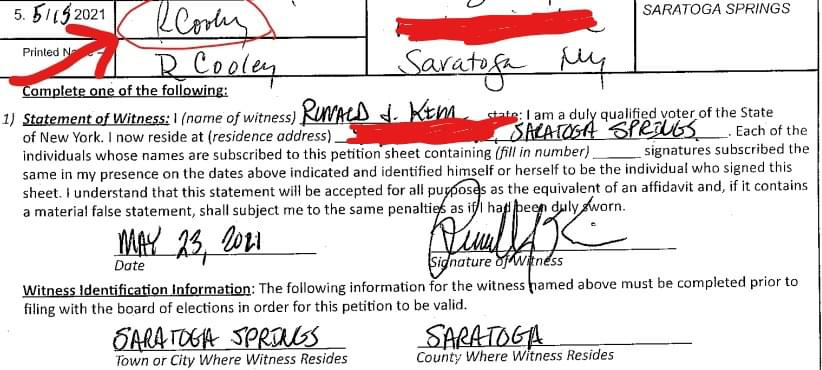
The arrow below points to the signature on the petition.
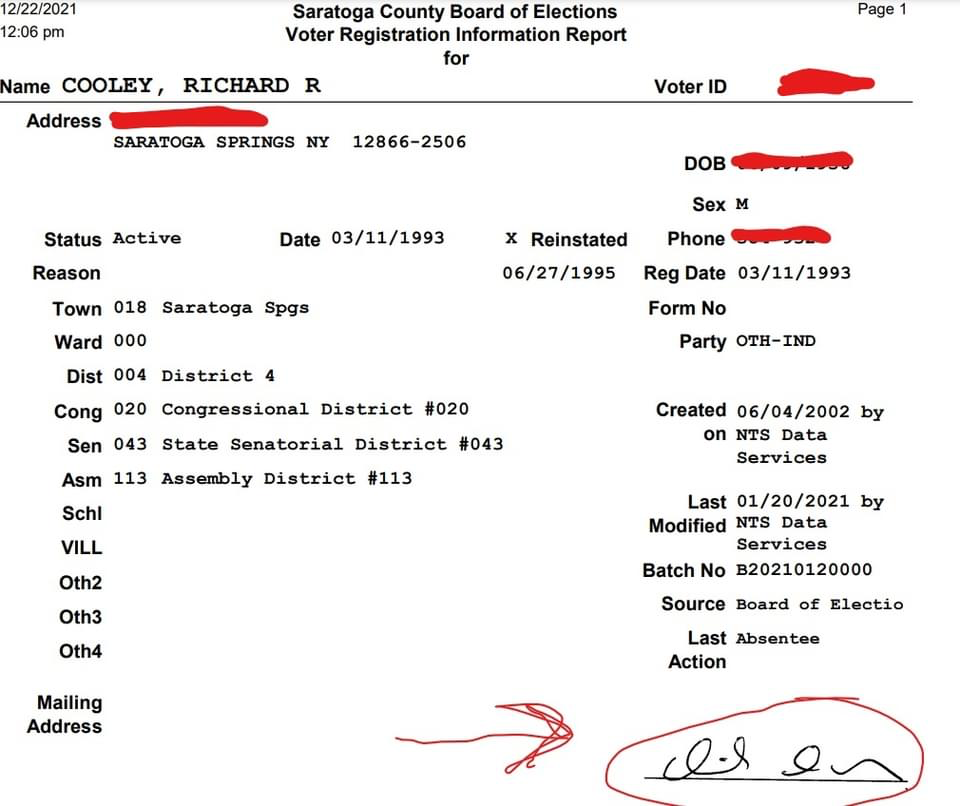
Below is the registration card from the Saratoga County Board of Elections. The signature to compare can be seen at the bottom right. It simply begs credibility that the person who signed the petition is the same person who signed the registration card.
The Signatory
Making things more challenging for Mayor Kim is the fact that the person who signed his petition was a neighbor so it would seem likely that Mayor Kim had to know the person was signing someone else’s name.
As Mayor Kim is not only an attorney but a veteran campaigner (he served as Commissioner of Public Safety for two terms and has run for numerous other offices) it is not unfair to hold him to a high standard when it comes to campaign petitions.
The law requires that the person circulating a campaign petition must affirm that they observed every person who signed the petition. It is a crime to sign the “witness” statement at the bottom of the petition knowing that it contains something false.
Mayor Kim’s Bizarre Response
In the spirit of fairness, I sent Mayor Kim an email to his City Hall email address inviting him to respond to the controversy. In my email, I assured him that anything he sent me would be posted without interference or editing. In contrast to Ms. Tuz, I sent him images of the petition and the registration card so he would be properly prepared.
He responded by advising me, “This email is inappropriate for a City supported resource.”
I do not know why that would be the case. Reporters commonly write to public officials regarding newsworthy issues that are not directly related to their city duties.
Still, I simply wrote back asking how I could contact him on this matter. I never heard back from him.
I hope readers of this blog will appreciate my frustration over his response. He and his colleagues go on at great length about transparency and accountability. In spite of the civility of my inquiries and the serious nature of the issues I am inquiring about, they rarely acknowledge let alone respond to my emails.
Here is the text of my email to Kim:
To: Mayor Ron Kim
From: John Kaufmann
Date: February 24, 2022 3:45 PM
Subject: Petitions and Signatures
Mayor Kim:
I have come into possession of the two documents attached. One is the voter registration card of Mr. R Cooley and the other is the petition you witnessed which includes a Mr. Cooley’s alleged signature. As you will observe, the two do not match. Mr. Cooley’s address indicates that he is a neighbor of yours.
As an attorney and an experienced politician, I am sure you are aware that you must observe each person actually signing your petition in order to properly witness the document.
In fairness to you, I would like to offer you the opportunity to respond to this issue on my website. Whatever you submit to me would be posted on my site without editing.
As you have championed the importance of transparency, I would expect that you would take full advantage of my offer in order to inform the citizens of our city about the facts behind what appears to be a violation of New York State law.
I look forward to hearing from you.
John Kaufmann’s Email
Later that afternoon, I received a blank email from Mayor Kim. I wrote back advising him of this. I then received the following email:
Sorry, still learning how to use my I-Phone email application. This email is inappropriate for a City supported resource.
Ron Kim
So I wrote back to him asking how I could contact him about this matter. He never responded.
Apparently, there is no way of contacting him on matters he would prefer to avoid.
The Complaint
On May 23, 2021, Ronald J. Kim of Xx Martin Avenue, Saratoga Springs, New York, executed a certification certifying under penalty of perjury that certain signatures on a petition labeled “Sheet No. 75” had been made by the purported signatories “in my presence on the dates above indicated and identified himself or herself to be the individual who signed this sheet.” Signature 5 on sheet 75 is recorded as being “R Cooley” residing at Xx Martin Avenue, Saratoga Springs, New York. Signature number 4 on sheet 75 is recorded as being “SD Cooley,” also of XX Martin Avenue, Saratoga Springs, New York. However, the signatures for SD Cooley and R Cooley appear to be very similar and potentially were made by the same person.
The registration information for “R. Cooley” of XX Martin Avenue corresponds to Richard R. Cooley. Mr. Cooley’s signature on file with the Saratoga County Board of Elections does not match the signature applied to sheet 75.
The above facts give rise to a suspicion that Mr. Cooley was not the one who signed sheet 75. If Mr. Cooley did not sign sheet 75, Mr. Kim’s certification of sheet 75 is rendered false. Mr. Kim’s false certification of sheet 75 may be punishable as a misdemeanor under Election Law Section 17-122 and/or Penal Law Section 210.45.
Saratoga Springs Democratic Committee chair Pat Tuz has gone to the press regarding a criminal complaint she has filed against Tracey LaBelle, the unsuccessful Republican candidate for Commissioner of Public Safety in last November’s election.
To be the subject of a criminal complaint is devastating. For a hardened politico, I guess it comes with the territory, but for ordinary people running for the first time for public office, reading about yourself as an alleged criminal in the media is more than humiliating. There is also the cost of a lawyer to respond no matter how innocent you may be and the potential problems it may cause regarding your employment.
Decent and humane people do not make frivolous complaints. Before resorting to public denunciations and submitting complaints to the police, they make sure that their charges fully merit the impact their action may have on someone’s life.
Ms. Tuz regrettably has previously shown herself to be capable of the worst kind of cynical spin. Last fall she filed a complaint with the New York State Board of Elections claiming that a flyer sent out in support of Republican-endorsed Mayoral candidate Heidi Owen West contained lies and that the labeling on the flyer indicating it was paid for by the Republican State Committee did not have enough contrast to stand out properly. Readers, there was no way the New York State Board of Elections was going to do anything with these frivolous allegations. Cynically and unethically, the allegations were made just before the election. Ms. Tuz had to know that nothing would come of her complaints but that the Times Union would give full-throated coverage to her accusations. This winter I “symbolically” wrote to Ms. Tuz asking if she had gotten a response from the NYSBOE about her complaint. I say “symbolically” because 1) I knew that they would simply ignore such dubious claims and 2) I knew she would not have the courtesy to respond to me.
If anyone out there wants to bet that the NYSBOE took her claim seriously and responded, I am willing to give good odds and accept the wager.
Now it appears she has made an even more cynical and vicious accusation.
The story in the Gazette regarding her recent accusations against LaBelle is full of odd contradictions.
Brian Lee is an excellent reporter so I will assume that the confusion in the article is rooted in the poverty of Ms. Tuz’s allegations.
According to the February 17, 2022, edition of the Daily Gazette (DG), “The complaint accuses LaBelle of submitting a dozen forged nomination petitions to the Board of Elections.”
In the same article, however, Tuz states, “The forgeries and filing of the false documents are the real crimes here and we’d like to know who’s responsible.” This is an odd statement to make. Ms. Tuz has just accused Ms. LaBelle of submitting the forged documents to the Board of Elections so why is she now wondering who did this?
In an odd admission Tuz told the Daily Gazette, “She wasn’t necessarily suggesting that either Republicans [LaBelle or Guerra] forged the documents themselves but ‘the question remains…who is doing the forging?’…”
In the article, Ms. Tuz randomly uses unspecific terms like “forged Documents,” “false documents,” and “forged signatures” without offering any concrete examples.
Does this have the feel of a political stunt at the expense of Ms. LaBelle?
There is also the issue of criminal intent. Normally criminal charges involve establishing that the perpetrator of a crime knew what they were doing was against the law and did so willfully. As we lack the details of the complaint, we have no idea how Ms. Tuz determined that Ms. LaBelle willfully did something illegal.
Here is a link to the Gazette story. I challenge the reader to determine exactly what criminal statute Ms. LaBelle allegedly violated based upon the story.
Where Are The Documents?
So, to clarify exactly what the nature of Ms. Tuz’s accusation is I contacted the police asking for a copy of the complaint. I was informed that it was not available to the public.
I then emailed Chairperson Tuz and asked if she would send me a copy of the complaint she filed and her supporting documents. I pointed out that, if she had proof that Ms. LaBelle had committed a crime, the documents would only add credibility to her allegations. Ms. Tuz never responded to my request.
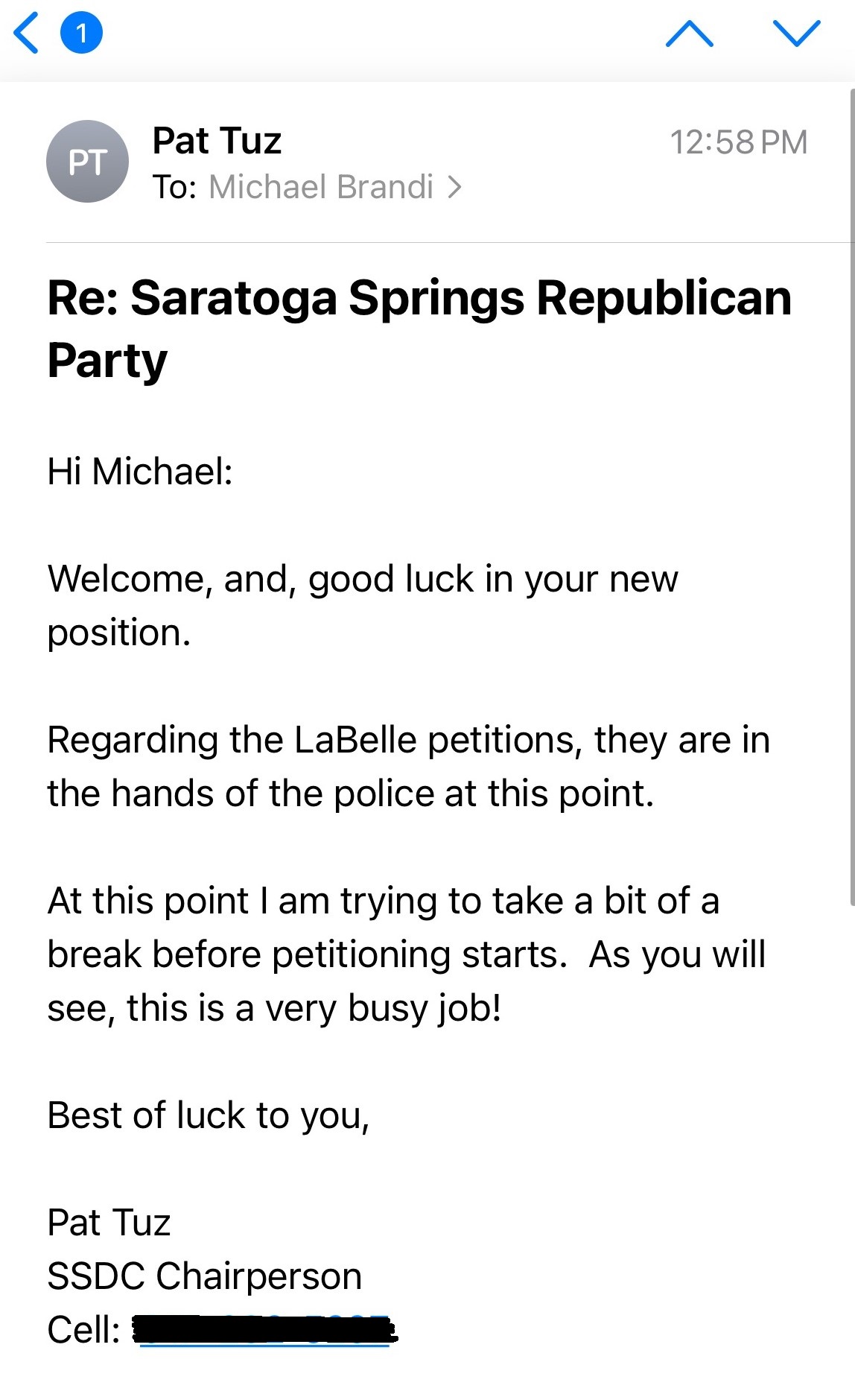
I subsequently learned that Mike Brandi had made a similar request. Mr. Brandi will be replacing Chris Obstarczyk as the chair of the Saratoga Springs Republican Committee.
He received the following text from her:
I am sorry, but if you have time to make a criminal complaint against someone and then promote the story to the area newspapers, maybe you could find the time to provide the actual documents to the public supporting your claim.
Tuz’s unwillingness to provide her documents raises serious questions of credibility. Given the gravity of her complaint, her flippant attitude (she is taking a break) is particularly callous.
Some Thoughts On Signatures
In the DG article, Ms. Tuz is quoted as saying, “there is ‘clear evidence of forgeries in the in the allegations against LaBelle.'” She continues, “There are a number of signatures there that are sided (sic) and have the same type of block letters and they don’t match. It just doesn’t look good.”
It’s challenging to parse this statement out. I am not quite sure what she means by “sided.” Best I can figure, Ms. Tuz is referencing that some signatures on petitions were entered using block letters and do not match the script form of their signature that is registered at the Board of Elections.
I checked with the Board of Elections and was told that if such block-lettered signatures were challenged after they were submitted to the Board, they would be considered invalid if the signature registered at the Board of Elections was done in script.
Let’s be clear what the definition of forgery is: “the act of falsely making, altering, or imitating (as a document or signature) with intent to defraud.”[www.merriam-webster.com]
Because someone registered at the Board of Elections using script as their signature and then signed a petition using block letters, does not mean they are guilty of forgery nor that the person circulating the petition committed a crime by signing that they witnessed the signature.
To give the reader some idea of just how dubious Ms. Tuz’s claims are, consider this post from the Saratoga Democrats’ website last year before the election. Here Ms. Tuz claims that somehow this block lettered signature imperiled the integrity of the local election.
The signature on the left is the one registered with the Saratoga County Board of Elections while the one on the right is the signature that the Democrats alleged to be a forgery.
Ms. Tuz never checked with the signatory to find out if he had actually signed the petition using block letters rather than script which is exactly what he did. Instead, she simply exploited the difference to smear Ms. LaBelle by accusing her of somehow forging the signature.
What’s With the Timing of Tuz’s Complaint?
Ms. Tuz says she made the complaint about LaBelle back in November. Why one might inquire, did she wait until now to go to the press? After all, LaBelle lost the election. The petitions had been submitted to the Board of Elections back in March of 2021, almost a full year ago. Tuz didn’t make an issue about it during last fall’s campaigns. Why now?
I can only speculate that the self-inflicted wounds that Mayor Kim has visited upon himself, combined with the collateral damage he is doing to his Democratic colleagues on the Council, is taking a toll. So to change the narrative, Ms. Tuz has cynically victimized Tracey LaBelle. It just doesn’t get much uglier.
What I continue to fail to understand is how little Ms. Tuz apparently values her reputation. Granted, many people will read the articles she spawns and be manipulated but there are many thoughtful people out there who will share my condemnation of her behavior. Apparently, she just doesn’t care.
Addendum: Some Background on Petitioning and Challenges
For those of you who are unfamiliar with the candidate petitioning process, a little background information might be helpful in evaluating the claims the Democrats have been making.
In New York State campaign workers must collect a certain number of signatures of registered voters on a petition in order to get a candidate on a ballot for an election. There is a rule of thumb among political operatives that it is best to gather twice as many signatures as the minimum required on a petition to make sure the candidate has enough valid signatures to get on the ballot.
This is because most people circulating petitions are well-meaning volunteers and there are so many ways that signatures can be declared invalid.
Among the reasons are:
The signatory has signed another petition for the same office (and maybe even for the same candidate).
The signatory put down the wrong address. Yup, people get confused and sometimes mailing addresses are different from their actual residence address.
The signatory does not reside in the correct district.
The signatory is in the wrong party. For instance, a registered Democrat cannot sign a Republican petition.
The signatory is not registered to vote.
The signatory allowed someone else to sign their name. There are many reasons why this might happen such as they were out of town and asked their spouse to sign for them. This is actually an example of forgery.
I am sure there are others but these are some of the major ones. Most of these are innocent mistakes stemming from confusion on the part of the signer. It is amazing how many people think they are registered to vote or think they are registered to vote in a particular party and aren’t or have already signed another petition but have forgotten and sign again.
The fact is that inexperienced people (and even experienced people) going out to petition don’t catch all these mistakes.
There is a difference between the errors of a novice circulating petitions and someone who knowingly forges names.
On the other hand, the petitioner must sign the form affirming that they have observed the signing of every signature. Too many inexperienced people carrying petitions fail to take this requirement with the seriousness that it deserves and allow someone to sign for another, usually a spouse or partner living at the same address. In the past, these kinds of errors have usually been isolated and committed without malice. No one pursued the issue with a criminal complaint. We are living in different times.
Traditionally, the opposing party would look at the petitions of the other party to see if they could disqualify enough signatures to knock a candidate off the ballot. They would first check how many signatures the candidate had. If the petitions had a huge margin above the requirement, the opposing party might randomly go through the petitions just to see if there were any glaring patterns of problems. If not, even though there might be some errors, they would not see the point of taking any further action.
Ms. Tuz is breaking new ground. Instead of challenging signatures following their delivery to the Board of Elections as tradition has dictated in order to disqualify an opponent, Ms. Tuz has weaponized the process. Her new goal is to file complaints months after the petitions have been filed, not to have any material impact on who gets on the ballot, but to use any errors to cynically file complaints during the heat of the campaign that she knows will never be answered.
I cannot think of a more bitter relationship in Saratoga Spring politics than the enmity that existed between Tom McTygue (D) and Skip Scirocco (R). In 2007 Scirocco defeated McTygue to become the Commissioner of Public Works. That began his fourteen years (so far) as Commissioner. He also defeated Tom McTygue’s brother, Bill, in an equally acrimonious campaign. To say that there was no love lost between Tom and Skip would be an extreme understatement.
Yet at the final meeting of the previous administration in December, Commissioner Scirocco announced that the upcoming twentieth anniversary of the carousel in Congress Park would be marked by a ceremony honoring McTygue for his role in establishing the ride in our park. The carousel will be named for Tom McTygue and a plaque will be installed acknowledging McTygue’s role in its creation.
Scirocco told the Council that he had contacted McTygue who expressed appreciation for the honor.
At the time when McTygue announced his plans for the carousel to be placed in Congress Park, it produced an extreme, negative response from preservationists and many others in the community who thought the Olmstead designed park was not the appropriate site for the carousel.
For those of us who were around during the years of conflict between the McTygues and Scirocco, Scirocco’s gesture and McTygue’s response was a welcome and reassuring change from partisan acrimony.
Commissioner Michele Madigan and Mayor Scott Johnson
Similarly, the relationship between Commissioner Madigan (D) and Mayor Johnson(R) was not warm and fuzzy. Mayor Johnson, who never lost his cool, demonstrated an unfortunate skill in pressing Commissioner Madigan’s buttons.
All the more pleasantly surprising when Commissioner Madigan, as one of her last gestures in office, proposed naming the city’s Recreation Center after Johnson.
As with the carousel, there was a great deal of pushback when Johnson advocated placing the proposed center near Jefferson Terrace. The more affluent neighbors strongly opposed it. Then Public Works Commissioner Tom McTygue wanted to build it out near the Weibel Avenue ice rink and landfill.
Johnson was insistent that it be constructed in the neighborhood by the Jefferson Terrace Housing Project. He emphasized the need for it to be accessible to children walking and on bikes. His perseverance paid off and the project has been an enormous success. Here is a link to a Gazette story about Johnson and the center.
On January 5, 2022, the Supreme Court, Appellate Division, Third Judicial District convened to hear oral arguments in an appeal by the neighbors of Saratoga Hospital over the city’s zoning of the land for the hospital’s expansion.
Consistent with Mayor Kim’s running City Attorney debacle, no one appeared for the city to defend it in the lawsuit. Not to be represented in this court was highly unusual.
Mayor Kim, who is an attorney, had not bothered to meet with the two departing City Attorneys prior to his taking office to find out what outstanding legal actions were before the city.
Had he done so, the city could have hired counsel to represent it.
With City Attorney DeLeonardis leaving office on December 31, and the hearing scheduled for January 5, and no new City Attorney identified to take over, it became obvious that it was simply no longer practical for the city to be able to be represented by counsel. DeLeonardis then advised the court that no one would be available to represent the city and that the city would have to rely on their written arguments to the court.
It is impossible to know whether, if the city had been properly represented at the hearing, the outcome of the decision would have been different.
In any case, given Mayor Kim’s hostile attitude toward DeLeonardis and Mayor Meg Kelly, it is probably unlikely he would have seen that the city was represented or worse yet, would have represented the city himself. The Daily Gazette February 19, 2022 edition reported:
In a news statement Friday, Mayor Ron Kim targeted former Mayor Meg Kelly and former city attorney Vincent DeLeonardis for trying to “ram this rezoning through without taking a hard look at the environmental impacts.”
Kim, whose tenure started Jan. 1, went on to call it a “lack of transparency and stomach-churning duplicity of the former administration and city attorney.”
Daily Gazette February 19, 2022
I am not sure what Mayor Kim means that there was a lack of transparency. This project was the subject of many meetings of the Planning Board and the City Council during which there was much public participation.
People can disagree over the merits of the hospital expansion but I do not know what he is referring to when he accuses the council of “stomach-churning duplicity.”
The neighbors of Saratoga Hospital, represented by attorney Claudia Braymer, have won a partial victory in their lawsuit to block the hospital from building a medical office building adjacent to the hospital.
The Supreme Court, Appellate Division, Third Judicial Department made the following rulings:
The neighbors asserted that the decision by the city to rezone the hospital parcel was an instance of spot zoning. The court rejected the claim.
The neighbors asserted that the members of the council had received donations from people associated with the hospital and therefore there was a conflict of interest. The court rejected the claim.
The neighbors asserted that the designation of the parcel as OMB-2 (Medical Office Building) was inconsistent with the comprehensive plan. The court rejected the claim.
The neighbors asserted that the city’s response to State Environmental Quality Review Act (SEQRA) was flawed. The court agreed with the neighbors on this claim.
The city had argued that it was required to bring its zoning into compliance with the city’s comprehensive plan. Which is what it did. This rezoning action was not a response from an application by the hospital. As such, the city was not responding to any particular plan for what might be constructed there. Without a plan, the city argued, any determinations of the impact would be hypothetical. The city argued that when an actual site plan would be submitted to the city it would then be feasible and appropriate to do a further SEQRA review.
The court’s decision noted that as the hospital had submitted detailed plans back in 2015 in a failed application to the city for a Planned Unit Development (PUD), and as the hospital had sent a letter to the neighbors describing a medical building as their planned use for the parcel, there was enough information to undertake a full SEQRA review.
The court found that the failure to consider the impact of a medical building was an example of an unpermitted SEQRA “segmentation.” Roughly, segmentation is where a developer seeks a review of only part of the full build out for his project. As an example, a developer submits a plan for a mall that includes only one structure when they actually plan to build more structures on the site over time.
At this point the hospital has the option to ask the City Council to rezone its parcels to OMBD-2 in a process that would have the City Council (or the Planning Board) do the SEQRA review. In this case, all of the plans and environmental impacts which were nearing completion in the pending site plan review by the Planning Board are known. As such, the process would be considerably shorter than would otherwise be the case.
The hospital’s real problem is that the culture of the current Council is hostile to the hospital. During their campaign, last fall, the slate of Democrats who have taken office sought support from the neighbors opposed to the hospital expansion.
If twenty percent of the owners of properties adjacent to the hospital sign a protest petition, it would require a supermajority of the council to approve the hospital’s expansion. It is hard to imagine four of the current members of the Council supporting such a vote.
In his campaign, Commissioner Moran trumpeted his claim that he would not do reassessments. Here are just two of his campaign mailings, but the promise is on every one of his mailers.
It now appears clear that Commissioner Moran is going to carry out major reassessments of properties throughout the city.
According to the February 15, 2022 edition of the Foothills Business Daily,
Hundreds, maybe up to 1,000, residences are undervalued on the tax rolls in Saratoga Springs, and the city has contracted with a company to help find and rectify the discrepancies, says Commissioner of Accounts Dillon Moran.
FBD
“Rectify The Discrepancies”: When is Reassessing not Reassessing?
So apparently there are a large but unknown number of structures that have either been built or have had major work done on them such as new additions or other improvements, whose assessed value has not been updated in the city’s tax roles.
At their last meeting (2/15/22) the Council approved a contract with GAR Associates to go through the city’s records regarding, I assume, building permits to determine which properties need to be reassessed.
Moran says the trouble has arisen over years as the Accounts Department has only one full-time assessor and one clerk. As such, some residential properties have been developed on what was undeveloped land, or the homes have received major upgrades, but the assessments [my emphasis] have not been adjusted to reflect the increase in value.
FBD
Now I am not opposed to making sure that properties are properly assessed in order for our real property taxes to be fair, but Moran promised “No re-assessment”.
The Ethics Of Promises
Commissioner Moran has a history of reckless campaigning with a disregard for the facts. Readers may remember that he forged a NY State Health Department document in a previous campaign to try to smear his opponent.
I will be generous and assume ignorance rather than malice in this case of his promise not to do reassessments. In his desire to use this as a hot button campaign issue he simply saw no need to actually research whether the city in fact needed to carry out extensive reassessments.
Moran, asked by FBD to explain the discrepancy between his campaign promise not to do reassessments and his current plan told FBD:
“I’m comfortable making the fairness argument,” he said, adding, “Everybody has the ability to grieve” their new tax bills if their home value changes. Also, the changes only apply moving forward. The city cannot ask for taxes that should have been levied in the past.
FBD
Maybe he should have considered the “fairness argument” before making “NO ASSESSMENT” the center of his campaign.
Saratoga Springs Mayor Ron Kim has appointed Tony Izzo as an “interim” City Attorney. Tony was the city’s Assistant City Attorney for over 30 years before Kim decided not to reappoint him when he took office in January. While I am happy that Tony will be returning to city hall, this is yet another chapter in the continuing debacle as Kim struggles to permanently fill the City Attorney’s position.
The resolution establishing the terms of Tony’s appointment has him working from twenty to twenty-nine hours a week
If you are familiar with Tony’s history, you know he will regularly be working more than those contractual hours. The city of Saratoga Springs has no more loyal supporter than Tony Izzo.
Interestingly, Tony had been making $1,100.00 a week during Meg Kelly’s administration. The terms of employment are the same under Kim, but now Tony will be making $1,800.00 a week. I am glad for Tony. I feel pretty confident that the increase was not rooted in a demand from Tony for more money. His salary will be less than what Kim advertised for a permanent part time city attorney.
In his announcement of Tony’s appointment, Mayor Kim stated, “As we continue our search for a city attorney, Tony has agreed to step in as an interim attorney.”
Asked if he [Mayor Kim] is having trouble finding an attorney to take the job, he said there has been no trouble at all.
“We’ve actually been spending a lot of time interviewing people,” he said.
Foothills Business Daily
Mayor Kim’s remarks seem a bit disingenuous. After his well-covered fiasco before Judge Wait and his reported intransigence in accepting the clear evidence that the City Attorney is a public officer subject to a residency requirement, it is likely that the Mayor is having more trouble finding a City Attorney than he will publicly acknowledge. After all, he has had since November to find one.
A very reliable source has told me that Mayor Kim had a candidate who initially agreed to the appointment but who backed out two days before Tuesday’s Council meeting.
In his remarks, Mayor Kim emphasized the temporary nature of Tony’s appointment noting that he is continuing his search for a City Attorney. After Tony generously agreed to step in to assist the Mayor and the city it was particularly ungracious of Kim to infer that Tony Izzo does not embody the qualities of a City Attorney that the Mayor is looking for.
Mayor Kim is not one to admit error. For all his protestations that he was wronged by Judge Wait and that he plans to appeal Judge Wait’s decision, the fact that neither Judge Francine Vero nor Judge Jeffery Wait will allow him to appear in their court as the attorney representing the city may have influenced his decision to hire Tony.
I am grateful to Tony for his willingness to take on the job. Having served the city for more than thirty-five years, he will bring with him an institutional history that this new council desperately needs. I just hope that the Mayor will seek his counsel and listen to him.
Commissioners Moran, Sanghvi, Montagnino: They see no problem
In the February 14, 2022, edition of the Foothills Business Daily (FBD), with the exception of Public Works Commissioner Scirocco who is out due to illness, Mayor Kim’s other colleagues have come out in support of Mayor Kim stating that they see no conflict of interest in his being both Mayor and City Attorney. Further, they found no problem in relying on him for the city’s legal needs.
Three city council members reached in time for this publication do not see a problem with the mayor in his dual role.
Foothills Business Daily
Commissioner Minita Sanghvi told FBD that she has observed no “improper behavior.”
Commissioner Dillon Moran assured the FBD that “he had gotten the legal counsel he needed.”
[Commissioner] Montagnino said there may be times when the mayor would be in a conflict of interest as mayor and city attorney. That would keep him from acting as counsel in a specific situation, “but that’s not a blanket disqualification.”
FBD
Conflict of Interest?
Here is a definition of “conflict of interest” from a website called Indeed (they regularly advertise on public radio):
Conflicts of interest have many forms, from financial to personal. They can occur any time someone in a position of power could be motivated to abuse their position to earn money, make connections, build a reputation or otherwise promote their personal goals.
Indeed
It would seem that this would cover the mayor’s dual role.
Alice In Wonderland
Mayor Kim appointed himself as the city attorney. He then provided legal advice to the members of the Council in his capacity as the City Attorney confirming for them that he could be and had become their City Attorney. (Having trouble with that syllogism?)
A rigorous and responsible City Council would have sought an independent opinion regarding the dual role. Unfortunately, we do not have that kind of council.
What Is Most Troubling Is Not His Conflict Of Interest
In an example of magical thinking, Mayor Kim continues to assert that he never lied to Judge Wait.
Mayor Kim told FoothillsBusinessDaily.com last week that he did not lie to the judge. He believed the case had been adjourned. He was in City Hall and could have shown up in court within minutes if called, he said last week.
Foothills Business Daily
So Mayor Kim sent an email to Judge Wait that stated that he and the attorney representing the defendant had agreed to seek an adjournment.
It has been established that the defendant had no lawyer. Simple logic tells us that he could not have reached an agreement with a lawyer who did not exist. Therefore, the statement to Judge Wait that he and a non-existent lawyer had reached an agreement is demonstrably false.
It is also rudimentary that only a judge can grant an adjournment. As my FOIL for the email is languishing in city hall (it has been more than two weeks) I do not know if the email sent by Mayor Kim requested an adjournment or worse, maybe instructed Judge Wait to adjourn the case. Amazingly though, Ron Kim, a lawyer as he likes to repeatedly tell us, felt no responsibility to check with the court to see if the judge had granted the adjournment before he told the defendant not to show up and decided himself to skip the hearing.
What the record shows is that Judge Wait never granted an adjournment and that the defendant and Mayor Kim were required to appear in court even if only to ask for an adjournment.
Nevertheless, Mayor Kim still insists that it was Judge Wait’s fault that he did not appear in court.
Scary!
Which brings me to my central point: What is truly scary is that Commissioners Montagnino, Sanghvi, and Moran believed they, and the city, could rely on Attorney Ron Kim for sound legal advice.
The City Council has again violated the open meeting law. The City Council has a pre-agenda meeting on the Monday before the Council meetings. They are required to provide access to the public for any meeting at which there is a quorum.
The city website indicated the Monday morning meeting would take place on zoom, but there was no link nor any information on how to acquire a link. Jane Weihe emailed the deputy mayor asking how the public can access the meeting.
Deputy mayor Angela Rella responded with an email that contained a link.
Jane wrote back to her and asked, “how is the general public made aware of how to access the meeting?”