An article in the Albany Business Review offers some clarification regarding the Bonacio – Tom Lewis Connection. ABR Review Article
Mr. Lewis referenced that someone else was building his home and not Bonacio. I now have the correct spelling for the name and more information. David Trojanski of Trojanski Builders was apparently who Mr. Lewis was referring to. He and his five employees have “merged” with Bonacio Construction.
It is important to note that the building permit for the lot names Bonacio Construction as the builder for the project.
The article has some interesting history. Bonacio construction was formed in 1988 and, according to Mr. Bonacio, currently has over 100 employees.
As further proof for how small this world is. Mr. Trojanski moved to the area in 1998 to work for Belmonte Builders. Belmonte is another large developer in the area. Two years ago Trojanski left Belmonte Builders to set up his own company. The landlord for his new office was Sonny Bonacio.
Sonny Bonacio built William Moore’s home at 75 South Franklin last year. Mr. Moore is the chair of the Zoning Board of Appeals. Bonacio is currently building a home for Tom Lewis. Mr. Lewis chairs the Saratoga County Planning Board and is a member of the Saratoga Springs Planning Board.
During the Zoning Board of Appeals deliberations over Moore Hall, Mr. Moore never disclosed this relationship even though Mr. Bonacio had just completed his home in February, 2015.
Now I have no idea how generous Mr. Bonacio has been when he built these homes. Anyone who has built a home knows that there are always unanticipated issues and that the costs for construction easily rise. It may very well be that Mr. Bonacio has shown no favoritism to these men. The problem is that no one but the parties involved can know the truth.
What I do know is that it is unfair of either Mr. Moore or Mr. Lewis to ask the public to simply trust them regarding the relationship. I would argue that the appropriate way to deal with this situation and to avoid even the appearance of impropriety would be for them to recuse themselves when Mr. Bonacio comes before them. It is interesting that it doesn’t seem to have occurred to either of these men that the pubic might question their ability to be objective in assessing projects by the builder who they have hired to construct their homes.
In fact, the city’s Ethics Board only addresses direct, financial conflicts of interest. So for example, Tom Lewis did recuse himself when his property came before the Planning Board. On the other hand, the current ethical standards for our city fully allows Mr. Lewis to participate in decisions regarding Sonny Bonacio even while Mr. Bonacio is in the process of building his home.
Tom Lewis
I called Tom Lewis. Mr. Lewis is the chief of staff for Senator Kathy Marcione (for many years he chaired the Saratoga Springs Republican Party) and reached him at her office. I went over the confusion I had about the ownership of the home/lot at 60 Franklin Street. This is where a custom home is being built for him. I explained that according to the records of the City Planning Department, Sonny Bonacio is the owner of the lot. According to the assessor’s office, Joseph Boff is the owner. According to the Times Union Mr. Lewis is the owner having purchased the lot from Boff for $343,750.00.
Mr. Lewis said he would answer my questions but first wanted to know why I was inquiring. I told him that given how often Mr. Bonacio comes before the Planning Board, the fact that Mr. Bonacio was building a house for him raised issues about the nature of his relationship with Mr. Bonacio. He said that he consistently disclosed his relationship to Sonny Bonacio and asserted that he was “an ethical person.” I noted that I attended the meeting at which the Planning Board issued its favorable opinion regarding Moore Hall. I reminded him that during that meeting he never disclosed the fact that Mr. Bonacio was building his house and voted in favor of Mr. Bonacio. He said he could not remember the details of the meeting.
He also said that someone named Tichansky (I never got the spelling) was building the house. I pointed out to him that there was a Bonacio Construction sign prominently in front of the construction site. He then offered that the builder had some sort of agreement with Bonacio.
William Moore
William Moore, Zoning Board of Appeals Chair, purchased the lot for his home at 75 South Franklin sometime in July of 2014 for $70,000.00. Sonny Bonacio began construction of the house in September of 2014 and the Moores moved in in February, 2015.
Notice Of Violation
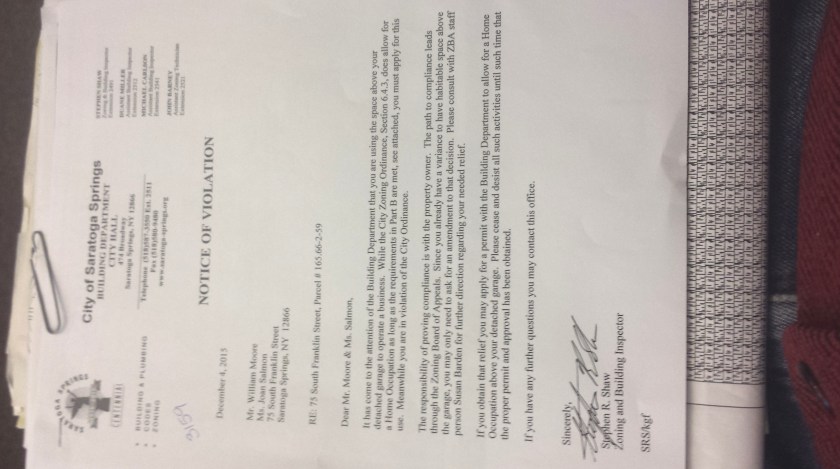
In looking at the land records for the house, I discovered that a zoning violation complaint had been made against Mr. Moore regarding the use of the second floor of the garage as an office for his business. He is a real estate appraiser. The language of the variance states that “the board further imposes conditions below on the habitable space requested by the applicant to ensure no overnight stays, or kitchen, or bath facilities.” The complainant documented that plumbing for water and sewage had been incorporated into the garage. It would appear that a bathroom is different from a “bath.” My sense is that the language had to do with preventing the space from being used as a living quarters so the existence of a bathroom that would require plumbing in and of itself does not seem to be a violation.
The building inspector then cited Mr. Moore for violating the regulations for offices. According to Mr. Moore, he met all the normal requirements for the home office in terms of such things as square footage, etc. but because an employee worked in the office and it was a detached structure he was in violation. He described the violation as technical and has submitted to the Zoning Board of Appeals an application to amend his current variance regarding this.
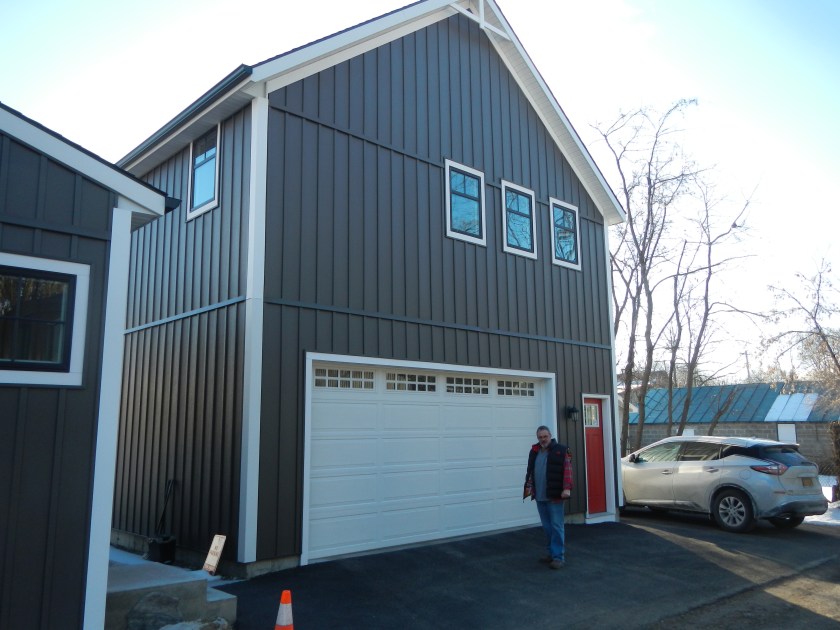
I ran into Mr. Moore outside his home when I went to photograph it. He asked me why I was photographing his home. I explained to him that I was photographing it because Sonny Bonacio had built it and because Sonny Bonacio regularly appears before him as the Zoning Board of Appeals chair. I must say that he was very gracious to me and did not appear at all defensive. He also did not appear initially to understand why I thought there was a problem. After explaining the issue to him he responded by saying he “got” what I was saying. I noted that I felt that there was a need for the city to establish alternate board members to serve on these boards in these situations and he told me that he not only agreed about the need for alternates but that he had advocated for this in the past. I do not believe that Mr. Moore actually agreed that he should have recused himself.
There is a certain irony that Sandra Lewis, Tom Lewis’ wife, went before the ZBA seeking a variance for their home which was to be built by Sonny Bonacio. Mr. Moore, along with the ZBA Board, voted to approve the variance. Granted, it had been four months since Bonacio finished Mr. Moore’s home. For me, this makes little difference. Even after a developer has built your house, the issue remains. How easy it is to dismiss the issue of impartiality… that is until you are the one opposing that developer and the person he built the house for is enthusiastically promoting the project from their seat on the board. Mr. Moore was one of the most vocal supporters of Mr. Bonacio’s Moore Hall Project. He also attempted to limit the lawyer representing the residents to two minutes.
The world of real estate and the Saratoga Springs land use boards is a small club. Reform of our land use boards is long overdue.
View Of FIeld Where Project Will GoRendering of Proposed Building
[Note that they did not show the very large parking lot for the project]
Aerial View Of Site
At Tuesday night’s City Council meeting Saratoga Hospital did an update of its proposal to build doctors’ offices behind Birch Run. Procedurally it was a continuation of the public hearing regarding their application to rezone the property from residential to institutional.
This is a link to the presentation here. The presentation starts at 2:20.
Their attorney, Matt Jones, presented a revised plan that involved a very modest downsizing of the project. The hospital had intended to build an initial structure and then add to it at a later date. The original structure was to be 75,000 square feet. The second phase was to bring the total to 88,500 square feet. Mr. Jones told the Council that the hospital had dropped plans for the expansion. There is a formula for how many parking spaces are required based on the square footage of this kind of project so the number of spaces was also very modestly reduced from approximately 300 cars to approximately 275 cars (this number included the potential bonus that the Planning Board can award).
The CEO of the hospital, Angelo Carbone, spoke to the Council about the critical need for office space for the doctors who will be associated with the hospital. He argued that they had settled on this site primarily for its proximity to the hospital because a prime concern was being close enough so that the doctors could walk from their offices to the hospital.
He noted that they had been quite aware of the resistance that this new building would generate and following the release of their plans they had been in regular communication with the affected neighborhood and were trying to address the neighbors’ concerns.
This last point was of particular interest to me. The new Comprehensive Plan includes changing the area in question from residential to institutional. The thing that I had been wondering about is how was this change incorporated into the city’s Comprehensive Plan without major controversy?
To put this in context imagine how you would feel if you had purchased a home in residential area with green space adjacent to it. You knew that the green space was zoned for residential so you expected that the lovely fields behind your home would someday have homes on them. Then one day you learned that the local hospital planned to build a major facility right by your home with a parking lot with two hundred and seventy-five spaces. There would be bright security lighting. There would be additional traffic. Of course, there would also be an enormous facility where the fields you had enjoyed had been.
One of the clearest presentations of the neighbors’ concerns was by Jennifer Leidig. You can find her comments here at 36:30.
How then to explain the fact that the incorporation of this change in the city’s Comprehensive Plan had somehow escaped you and the rest of the public’s attention?
The Comprehensive Plan had a torturous life. Scott Johnson had appointed half of its members. Among them were Charles Waite (president of Adirondack Trust), Sonny Bonacio (developer), and Todd Shimkus (Chamber of Commerce). The division in the make up of the committee was most evident in the divide over the issue of development in the city’s green belt. Agreement on this issue was basically impossible. It produced a rancorous process. The city had originally hired a consultant to work with the committee who appearedto use her position whenever possible to promote the development community’s interests. Those of you who have sat through these kinds of meetings are familiar with this kind of scenario.
On November 17, 2014, the committee held it’s second to last meeting. This was the last meeting at which any business was actually transacted. As it happens, this was the meeting in which Kevin Ronayne, VP for operations/facilities at Saratoga Hospital spoke to the committee during the public comment period regarding the hospital’s expansion plans. Bear in mind that this committee had been meeting for many, many months.
Strangely, there are no minutes for this meeting. I have laboriously scanned through the video but I could find no discussion of whether the area should be designated institutional. In fact, I could find no specific vote on this.
It is possible that at a previous meeting this issue was discussed. One of the people who served on the committee thinks there was some kind of discussion at some point of revising a map that authorized the change.
What is indisputable is that if there was any discussion it did not explore the gravity of the proposed change nor was there any input from the residents of the neighborhood that would be affected by this new land use designation. Whether or not you agree that the hospital should be allowed to build its facility there was something terribly wrong that this very controversial change could be slipped into the Comprehensive Plan without a public discussion of the issue.
I spoke to Matt Jones about what the hospital was planning in terms of visually buffering the project. He indicated that the hospital was planning to build a large berm and placing trees on it. I asked if this would totally hide the proposed building. He said it would.
As an interesting historical note, the land in question was part of Gideon Putnam’s original farm.
Matt Jones was elected chair of the Saratoga County Chamber of Commerce for 2016. Mr. Jones has represented the Saratoga Springs City Center before the land use boards. He and Michael Toohey seem to dominate the legal work for the land use boards.
The “chair elect” for 2016 will be David Collins. This means he will assume the chairmanship in 2017. Mr. Collins is with D.A. Collins which is one of the largest construction firms in the area. His company played a leadership role in establishing Saratoga PAC.
The Chamber board has twenty-eight members.
Here is what appears to be their press release from the Sartogian
Here is another article by Jenny Grey in today’s Saratogian in which the Council members outline their goals for the year. I thought it was telling that John Franck did not return calls for the story. One of the more interesting items in the story was Commissioner Mathiesen’s statement that he hopes to convince at least one of three other members of the Council to support Commissioner Scirocco and his effort to protect the greenbelt from commercial development such as proposed by Saratoga National Golf Course.
Jenny Grey had an excellent article in Wednesday’s Saratogian on the committee reviewing the High Rock RFP proposals. It is interesting that while the number of articles in the Saratogian covering local issues has decreased, Ms. Grey from time to time is given considerable space to write long articles by current news standards. Her pieces are also well written. Ironically, I think that in some ways the coverage of local politics has actually improved since the blood letting at the Saratogian.
Her piece does not include who appointed the members, though, so here’s that additional information.
Joseph Ogden – appointed by Joanne Yepsen. Mr. Ogden is the Mayor’s deputy.
Bill Sprengnether – Appointed by John Franck. Mr. Sprengnether is a landscape architect. In looking at his web site his portfolio has a number of public outdoor related projects that have a distinctly “green” character. One of them is Hudson Crossing which is a park just North of Schuylerville. He has posted on the Citizens For High Rock Face Book page so I assume he is active with the group.
Rod Sutton – appointed by Skip Scirocco. Rod Sutton is a principal with the insurance agency Sutton and Tarantino. The Sutton family has a long history in Saratoga Springs. Mr. Sutton is a past chairman of the Chamber of Commerce and for years was a major player in the local Republican Party.
Larry Novick – appointed by Michele Madigan. Mr. Novick is director of business development for Sonny Bonacio. He is the numbers/financial player in Bonaio’s operation. There is a good interview with him at the Albany Business Review http://www.bizjournals.com/albany/print-edition/2015/09/18/built-with-math-not-hammers.html When the city was trying to work out the deal for the Collamer Building and the land for the EMT facility, Bonacio provided Novick to work out the numbers.
Fire Chief Bob Williams – Apponted by Chris Mathiesen. Williams is the third generation in his family to serve the city as a fire fighter. He has been with the department for over twenty-five years.
The City of Saratoga Springs has begun an ambitious process to create a Unified Development Ordinance. In effect our zoning ordinances are being completely rewritten as well as most of the processes involved in land use decisions. Here is a link to the UDO site. I am very troubled by the way this is being done. I will be writing more on this but to provide some sense of the potential problems, below is the text from one of the “comments” posted on the website for this project. Interestingly the comments that are posted are anonymous.
I emailed the “contact us” option on the UDO site asking why all the comments were anonymous. Amusingly, I received an anonymous response. Regrettably I did not find the answer satisfactory. I have asked for permission to post it here on this site.
It is quite apparent that the following “comment” posted on the site is from the Chamber of Commerce and I assume it was written by Todd Shimkus. I think a review of these comments exposes the mischief that this UDO poses to the city’s Comprehensive Plan. The following comment also suggests that the mayor may have played a role in weakening the language of the Comprehensive Plan. I have written the Mayor asking whether the comment accurately reflects her role.
The emphasis is mine.
Nov. 4
Thank you for meeting with several members of our Executive Board to help explain the UDO process to us. We appreciated your guidance as to how the Saratoga County Chamber of Commerce can best play a productive role in this process. The volunteer members from our Executive Board who were in attendance at this meeting were: Valerie Muratori, Matt Jones, Brian Straughter, David Collins and Theresa Agresta.
In general, the Comprehensive Plan is 80 pages long with a two-page vision statement, four guiding principles, a dozen or more goals and well over 200 recommended actions. In a letter to Mark Torpey, the Chair of the Saratoga Springs Planning Board, on July 22, 2015, I wrote that this is the type of “plan” where everyone can find a line or word somewhere in the vision statement, or a guiding principle, or a goal and/or a recommended action to suggest that the City can or cannot do something and we’d all be correct.
With this in mind, the following is a list of issues, opportunities and challenges we’d like to share with you for your consideration as you move forward with the UDO process:
The opening line of the Future Land Use section states: “If the City is to be successful, it must have increased flexibility to accommodate the rapidly changing needs of business, commerce and our residents.” We trust that this statement provides you with the clearest direction possible to avoid changes to the zoning code that would increase regulatory oversight and impede the flexibility in making land use decisions that are now afforded to our land use boards. The comprehensive plan says “must have increased flexibility.”
Through the Mayor’s office, there was one effort made to find common ground that resulted in the use of some specific words in various recommended actions that we believe specifically indicates a clear preference to create flexibility including
:
“Update” the open space plan not implement.
“Review and update” the City’s Historic Preservation plan not implement.
Adopt “reasonable” guidelines that “encourage” restoration not require.
“Review” guidelines for stream buffers not establish.
“Encourage” the development of residential and commercial buildings that exceed minimum state level energy efficiency not require or establish or implement.
Ensure an adequate size and width for public right of ways “wherever feasible.”
“Consider” establishing a Generic Environmental Impact Statement to address citywide traffic impacts not establish or implement.
“Evaluate” form-based zoning not establish or implement.
“Consider” establishing dedicated funds for affordable housing not create.
There are a number of interesting things about these comments.
It was clearly an attempt to weaken the Comprehensive Plan.
If these comments are to be believed, the Chamber received the support from Mayor Yepsen to incorporate this language. I have confirmed that this language was in the adopted plan. I have sent this text to the Mayor asking that she comment on what happened. When I receive her response I will post it.
Even though the Chamber got these changes in, they still opposed the final document. As the readers may recall, Todd Shimkus along with the other Scott Johnson appointments blocked the adoption of a final plan by the Comp Plan Committee.
There is a certain lawyerly absurdity to these changes. They are reminiscent of the City’s resolution “opposing” casino gambling. That resolution opposed the New York State amendment to the constitution that authorized table gaming. The language did not actually oppose table gaming expansion for Saratoga Springs. In this case they think they are somehow weakening the Comprehensive Plan through making the wording vaguer. How about the language:“’Update’ the open space plan not ‘implement it’.” This language change does not prohibit the implementation of an updated plan so why bother with this word game? Don’t these people have anything better to do with their time? In fact, this is an example of how strong a presence they are in city hall continually searching for any crack in the city’s defenses.
Later in the same text, they warn of the threat posed by the Conservation District (Greenbelt) to the economic health of the city:
We would suggest and advise you and the City to carefully consider the language of the Conservation Development District, the Country Overlay, and the section entitled “Legitimate Public Interest in Protecting the Greenbelt.” Given recent court rulings relative to the COD and the fact that some of these sections were written by one person on the committee without the assistance of legal counsel, we remain concerned that the limits imposed by these sections and other recommend actions relative to this land area may individually and/or collectively be far too limiting (my emphasis). The language in this section is also not at all consistent with the language in the opening of the Future Land Use section which says the City “must have increased flexibility.”
The Chamber also has ambitious plans for South Broadway. They want to get rid of the idea that the entrance to the city should be rural in character. In particular they want to weaken the requirements and leave it to the land use boards to work with developers. It is no surprise that they would like the Planning Board to work all this out. As repeatedly documented on this blog, the Planning Board is completely controlled by the friends of the developers. Heaven help this city if the future of Route 9 South of the city is put in the hands of the Planning Board. Here is the Chamber on the city’s Southern gateway:
We remain very concerned that some of the language included in the comprehensive plan if interpreted the wrong way could make it even more difficult to revitalize South Broadway.
Specialty Mixed Use Park – (SP) This area was created to allow for the revitalization of this specific area along South Broadway which is already substantially commercial and where improvements are being made to the Saratoga Honda dealership and the replacement of the Weathervane Restaurant with a Homewood Suites. The insertion within this definition of the words “rural character” by the City Council is inconsistent with the current land use within that gateway area on that specific side of the road. We trust that a flexible view of how the rural character can be protected by the continued preservation of the State Park lands across the street from this commercial district is warranted and practical.
Specialty Mixed Use Gateway- (SG) This area needs the flexibility suggested in the opening lines of the Future Land Use section. This gateway into our community is currently an eyesore with abandoned properties that don’t help us to create a welcoming and vibrant first-impression to those coming into our City. We ask that you talk with developers specifically about the best way to change the zoning in this area to alter the current rules and regulations that have consistently prohibited projects from being proposed and financed. While the plan may suggest exactly where buildings should be placed, their heights, and the location of landscaping in this area, we prefer that our land use boards be given the flexibility to focus on performance standards that will encourage developers to consider and secure financing for projects that use architectural best practices and materials that will guarantee quality projects.
The important issue here is that the usual suspects view the adoption of the Unified Development Ordinance as an opportunity to weaken the Comprehensive Plan. The way that the ordinance is being crafted regrettably provides a real opportunity for their efforts. In the coming days I will be going over this in more detail.
Getting on the ballot as a presidential candidate is an arduous process designed by the two major parties to try keep outsiders at bay.
On December 29 local Bernie Sanders supporters are kicking off a petition drive to get Sanders on the ballot for the NY State Democratic primary and soliciting support. They will be convening at the Saratoga Springs Library from 7:00 to 8:45. If you would like to help, here is a link to their web site. They are requesting that people RSVP. There will be petitions to sign or you can volunteer.
In early September I wrote to Mayor Yepsen regarding Saratoga National Golf Course’s apparent violation of the terms of their site plan agreement. They were required to have no more than three “special” events each year that exceeded their parking lot capacity. They were also required to maintain two “nature” trails for the public to use.
On October 4th, not having had a response, I wrote again asking that her office respond.
I subsequently received a letter from Joseph Ogden, her deputy dated October 14th. In his letter he offered an interpretation of “special” events that, to my mind, basically made the limit unenforceable. He did, however, offer that the Mayor’s office would look into rewriting the language to clear up any confusion. He also promised that the Mayor’s office would contact Saratoga National Golf Course to determine how they were enforcing the limit. In addition he promised that the Planning Department would meet with P.L.A.N. which was charged with enforcing the trail easements to determine if there was a problem.
I waited some time to allow the Mayor’s office to address these issues. On November 15th, having heard nothing I sent the following email:
Some time ago, I received a letter from your deputy regarding the potential violations of the agreement with Saratoga National Golf Course. The letter indicated that your office would be seeking from SNGC how they were implementing the requirement that limited them to only three “special events” per year. The letter also indicated that your office would be meeting with Saratoga PLAN to determine whether the West Trail complied with the agreement. Have you had a response from SNGC and PLAN regarding these matters and if so, what did your office determine?
Unfortunately, this email produced no response.
Today, more than a month later, I sent a follow-up:
From: John Kaufmann
Sent: Sunday, December 20, 2015 5:08 PM
To: Joanne Yepsen
Subject: Saratoga National Golf Course
As your office will recall, on October 14th you sent me a letter in which you indicated that you would be reviewing Saratoga National Golf Course’s compliance with its site plan agreement with the city. Mr. Ogden’s letter promised that your office would be contacting Saratoga National Golf Course to determine how they were complying with the limit on “special” events. It also promised that the planning staff would be meeting with Saratoga PLAN to determine whether the western “nature” trail had been properly implemented and maintained at SNGC.
On November 15th I followed up with an email to you asking for the results of your office’s investigation into this matter. To date I have heard nothing. I would very much appreciate it if you would respond with the results of your contacts with the golf course and with PLAN.
Thank you
Hopefully, Mayor Yepsen will respond and I will share whatever I receive.



 Saratoga Springs Politics