Lost in all the other events at last night’s City Council meeting was the Mayor’s announcement of the hiring of a new deputy to replace former deputy Joe Ogden who left to take a job as budget director at SUNY. His replacement will be Megan Kelly (or maybe Kelley?) No, not that Megan Kelly, but no further information is available at this time. I’ve asked the Mayor to email me a profile of her new assistant and will publish this information when I receive it.
Mayor to Media: “I’ve Done Nothing Wrong!”
The Mayor has appeared on local TV Channels 6 and 10 vigorously challenging the decision reached by the Ethics Board that she violated the city’s ethics code.
She argues that the standard used by the Ethics Board that it was improper to enter into talks with the hospital while the hospital was seeking the Council’s approval for a zoning change was so restrictive that it will make it problematic for people to serve on our city’s boards. I would note that last year she commended this same board, whose members she appointed, for the revised ethics codes they had submitted to the city.
She also asserts that the fact that she later recused herself from considering the hospital’s application made her earlier meetings with the hospital over contracting for work moot.
Here is the link to channel 6: http://cbs6albany.com/news/local/saratoga-springs-mayor-censured
Here is the link to channel 10: http://news10.com/2016/07/20/saratoga-mayor-fires-back-after-board-determines-she-violated-citys-code-of-ethics/
Harris Beach Law Firm Defense of Mayor Yepsen to Ethics Board
Mayor Yepsen has forwarded to me a copy of the letter her attorneys from the Harris Beach Law Firm submitted to the Ethics Board in her defense. Apparently she chose to have her attorneys submit this document rather than meet with the Ethics Board. Harris Beach Law Firm has represented the city in the past.
At Tuesday night’s council meeting, Mayor Yepsen told the Council that she planned to submit the invoice from Harris Beach for the city to pay. Commissioner Madigan responded by asserting that bills of this nature must be approved prior to the provision of service.
The Ethics Board members are appointed by the Mayor. In their opinion they noted that prior to making their decision they had reviewed this document.
June 10, 2016
HAND DELIVERY
Board of Ethics
City of Saratoga Springs
Board of Ethics
474 Broadway – Room 9
Saratoga Springs, NY 12866-2296
Attention: Chairman Justin Hogan
Re: Joanne Yepsen – Reconsideration of Board’s March 24, 2016 Findings Contained in Inquiry Opinion #6-2016
PERSONAL AND CONFIDENTIAL
Dear Chairman Hogan:
Thank you for your correspondence dated May 26, 2016 allowing us the opportunity to provide a written submission in-lieu of a hearing by the close of business on June 10, 2016.
BACKGROUND
As the Board of Ethics (“Board”) is aware, Ms. Yepsen contacted the Board on January 14, 2016 requesting an advisory opinion as to whether she, as part-time Mayor of the City of Saratoga Springs (“City”), would have to recuse herself from voting on an application for a zoning change submitted to the City Council by Saratoga Hospital (“Hospital”) dated August 20, 2015. Ms. Yepsen sought the advisory opinion due to the fact that she had been communicating with an entity related to the Hospital regarding a potential engagement for grant writing services with her consulting firm, Critical Needs Now. Specifically, on October 14, 2015 Ms. Yepsen had a conversation over lunch with Amy Raimo, the Executive Director of the Saratoga Hospital Foundation (“Foundation”), followed by email correspondence with Ms. Raimo through January 16, 2016.
On January 19, 2016 the Board issued Ms. Yepsen Advisory Opinion 2-2016 determining that (i) the Foundation was an inseparable part of the Hospital, (ii) the Hospital was “doing business with the City” by submitting a zoning amendment to various boards and officials of the City, including the City Council and (iii) voting on the zoning amendment at a City Council meeting would be contrary to Section 13-3 (I) of the City’s Code of Ethics (“Code”).
At the January 19, 2016 City Council meeting, Ms. Yepsen, following the advice of the Board, announced she was recusing herself from the items on the agenda relating to the Hospital’s zoning amendment and stated her reasons for doing so.
On March 24, 2016 the Board issued Inquiry Opinion #6-2016 to Ms. Yepsen responding to a letter of inquiry dated February 1, 2016 submitted by Michele Madigan, Commissioner of Finance. Commissioner Madigan’s inquiry requested an opinion as to whether Ms. Yepsen’s discussions with the Foundation, in and of themselves, constituted a violation of the City’s Code of Ethics. The Board determined that any efforts to solicit or negotiate for outside employment with one who does business with the City (within the meaning of §13-3 (I) of the Code of Ethics) constitutes a violation of such section, including Ms. Yepsen’s discussions with the Foundation. The Board reasoned that §13-3 (I) of the Code does not allow either for the consideration of intent or for any quantitative analysis, that there is neither a threshold for the amount of the contract or the extent to which the negotiations have progressed. The Board further stated that this section becomes relevant even upon minimal efforts to solicit or negotiate for work under the stated circumstances. Lastly, the Board reiterated its determinations from Advisory Opinion 2-2016 that (i) a zoning amendment application to various boards and officials, including the City Council was “doing business with the City” and (ii) that the Foundation would be considered the Saratoga Hospital because the Foundation was an inseparable part of the Hospital.
CODE §13-3(I)
Section 13-3(I) provides that:
No officer or employee shall:
- engage in work for an outside employer or business who does business with the City;
- solicit work for an outside employer or business who does business with the City;
- negotiate for work for an outside employer or business who does business with the City;
- promise to accept work for an outside employer or business who does business with the City.
which,
- creates an implied conflict; or
- impairs the proper discharge of his official duties; or
- results in personal gain.
ADVISORY OPINION #2-2016
With respect to the Board’s determination in Advisory Opinion 2-2016, we agree that voting on the Hospital’s August 20, 2015 application for a zoning amendment could reasonably give rise to the perception that Ms. Yepsen confronted some form of divided loyalty given (i) the close relationship between the Hospital and the Foundation and (ii) her discussions with the Foundation regarding the possible engagement of Critical Needs Now. We also agree that it is the intent of §13-3(I) of the Code to prevent conflicts of interest whether actual or perceived. Therefore, we recognize that an official act by Ms. Yepsen on the amendment would be contrary to §13-3(I) of the Code in that it would create an appearance of a conflict. Thus, we do not disagree with the Board’s determination that Ms. Yepsen should recuse herself, which she did, from voting on the Hospital’s zoning amendment. It is a well settled ethical principal that disclosure, recusal and abstention is the appropriate course of action to cure any actual or perceived conflicts of interest because it removes the governmental employee from the official action, which may have been influenced by personal interests[1].
INQUIRY OPINION #6-2016
- The Board’s Interpretation of Code §13-3(I) is Misplaced as a Matter of Law and Equity
With respect to Inquiry Opinion #6-2016, we disagree with the Board’s interpretation of §13-3(I) of the Code as it relates to whether Ms. Yepsen’s discussions with the Foundation while the Hospital had a zoning amendment pending resulted in a per se Code violation. We believe the Board’s interpretation of §13-3 (I) is misplaced under these circumstances and is not aligned with the general ethical standards established under Article 18 of the General Municipal Law (“GML”).
As set forth in its Inquiry Opinion #6-2016, in contrast to the treatment afforded under the GML as well as the Public Officers Law (“POL”), the Board took a very literal reading of this section thereby establishing a strict liability standard with no minimum thresholds. Such an interpretation creates an absolute prohibition that results in a per se violation of the Code as opposed to creation of an ethical standard that would trigger disclosure, recusal and abstention. Given the Code’s definition of “officers and employee”[2] and the provision of §13-3 (I) as interpreted by the Board, any part-time employee or volunteer board member would either have to resign or incur a Code violation if their outside employer or client sought a permit, variance, zoning amendment or other item from the board or body on which such officer or employee serves. For example, a volunteer planning board member that is engaged in work for XYZ Corporation as either an employee of XYZ Corporation or has XYZ Corporation as a client would automatically be in violation of the Code upon XYZ Corporation’s submission for a subdivision, special use permit, or other action by the planning board. In order for such planning board member not to incur a Code violation, the member would be forced to resign prior to XYZ Corporation’s submission of its application or XYZ Corporation would have to forego seeking a subdivision, special use permit or other action by the planning board. This result is unreasonable and certainly cannot be the intent of §13-3 (I) given the City’s need for civic minded individuals to volunteer or work part-time on numerous boards and commissions of the City. Without the ability to cure an actual or perceived conflict of interest through disclosure, recusal and abstention, it would effectively make all but a handful of citizens ineligible to sit on boards of the City.
Applying the Board’s same standard of interpretation to Section 13-3(P)(1) of the Code would make the City’s Code more stringent than Article 18 of the GML by prohibiting “any financial interest in a business relationship, financial instrument, contract with the City, or an interest in a bank or trust company, that is prohibited by §801 of the General Municipal Law of the State of New York,” without providing for the exceptions allowed in GML §802. Regarding this prohibited interest, the Code does not state that the City officers and employees must adhere to the provisions of Article 18 of the GML, rather a literal reading of paragraph (P)(1) creates an absolute prohibition to any financial interest in a business relationship prohibited by §801 as opposed to a disclosable interest defined in (P)(2). This creates a very strict standard without any exceptions. Again, this result is unreasonable and cannot be the intent of the City. Such an interpretation by the Board of these paragraphs (I) and (P)(1) would lead to many unintended violations of the Code that could not be cured, which would make any action in which there was a violation null and void, and subject the City officer or employee to penalties pursuant to (P)(3) that incorporates by reference §805 of the GML.
The New York State Legislature recognized that conflicts of interest of municipal officers and employees are not uncommon due to the multitude of interactions between governmental entities and the private sector. A goal of the enactment of Article 18 of the GML was to establish “a formula of conduct which is not only clear but reasonable, one which will permit governmental employees to share the normal benefits of the democratic society and economy they serve. If government is to attract and hold competent administrators, public service must not require a complete divesting of all proprietary interest. Real conflict must be rooted out, without condemning the inconsequential.”[3] Article 18 prohibits a municipal officer or employee from having a direct or indirect financial interest in a contract with a municipality where such municipal officer or employee has the power to negotiate, prepare, authorize or approve such contract.[4] A “Contract” is defined as any claim, account or demand against or agreement with a municipality, express or implied.[5] Thus, almost any business relationship with a municipality will result in a contract.[6] However, by recognizing that conflicts of interest of municipal officers and employees are not uncommon due to the multitude of interactions between governmental entities and the private sector, the Legislature provided exceptions to the prohibition.[7] Conflicts that fall within an exception are still conflicts of interest, but they are not prohibited conflicts and they can be cured by disclosure[8]. Therefore, just because you have an interest in a municipal contract does not necessarily mean that your interest is prohibited.
In the instant case, applications for and the granting of building permits, licenses, zoning changes, variances or site plan approvals have consistently been determined to not constitute a “contract” with the municipality[9]. Therefore, it is clear that Ms. Yepsen does not have a conflict of interest under Article 18 since the Hospital’s zoning application is not even considered a contract (i.e., business relationship with the City). Secondly, even if such zoning application were to be considered a contract with the City, Ms. Yepsen would still not have the required direct or indirect financial interest in the amendment. Additionally, even assuming for argument sake that Ms. Yepsen had a financial interest in the zoning amendment before the City due to being a direct employee of the Hospital, provided (i) Ms. Yepsen’s remuneration for such employment with the Hospital was not directly affected as a result of the zoning amendment and (ii) her duties at the Hospital did not directly involve the preparation or performance of the zoning amendment, Ms. Yepsen would still not have a conflict of interest that is prohibited under Article 18. Under those circumstances, Ms. Yepsen would have a conflict of interest that could be cured by disclosure pursuant to GML §803. Common law requires recusal in addition to the statutorily mandated disclosure under §803 of the GML.[10]
A similar statutory provision involving the POL is interpreted and treated in a similar fashion as the provisions under Article 18 of the GML. Section 74 of the POL establishes a rule with respect to conflicts in subdivision (2) and then sets forth eight standards of conduct in subdivision (3). The rule in subdivision (2) states “[N]o officer or employee should have any interest, financial or otherwise, direct or indirect, or engage in any business or transaction or professional activity or incur any obligation of any nature, which is in substantial conflict with the proper discharge of his duties in the public interest” Paragraph (f) of subdivision (3) established a standard of conduct that states “[n]o officer or employee of a state agency….should not by his conduct give reasonable basis for the impression that any person can improperly influence him or unduly enjoy his favor in the performance of his official duties, or that he is affected by kinship, rank, position or influence of any party or person.” State personnel who had been faced with substantial conflicts between their personal interests and their public duties were not deemed to be in violation of §74 of the POL where disclosure, recusal and abstentions were made. Similarly, in instances where State personnel were involved in personal matters that could reasonably be perceived as creating an undue influence on their official duties contrary to the standard of conduct contained in POL §74(3)(f), disclosure, recusal and abstention was the cure. The occurrence of the circumstances that gave rise to the perception of an undue influence on the individual’s official duties did not, in of itself, result in a violation of the State’s Code of Ethics.[11]
Applying the Board’s literal interpretation to §13-3(I) as well as §13-3(P)(1) creates unreasonably strict prohibitions that fail to recognize the goal and intent of Article 18 of the GML; the enabling legislation by which the City’s Code was enacted, which requires such Code be consistent with its provisions[12]. The Board, when revising the Code, recognized that its provisions must be implemented in accordance with the “NYS General Municipal Law”[13] and within the context of the “NYS Public Officers Law and the NYS Ethics legislation”[14]. The Code explicitly provides in §13-1 that the Code was enacted pursuant to §806 of the GML and that the “rules shall serve as a guide for official conduct of officers and employees of the City of Saratoga Springs”. Moreover, the Code explicitly states that it “…shall not conflict with [ ] any prohibition of Article 18 of the General Municipal Law.”[15] The Board’s strict interpretation of §13-3(I) as an absolute prohibition opposed to a standard of conduct conflicts with the standard ethical principles established under Article 18 of the GML as well as §74 of the POL. Conflicts under analogous provisions of the POL have not been interpreted by the courts or the New York State Joint Commission on Public Ethics (“JCOPE”) as per se violations of the State’s Code of Ethics where the individuals disclosed, recused and abstained.[16] Lastly, the wording of the Code, taken in its entirety, establishes that §13-3(I) is a standard of conduct that can be cured rather than a strict prohibition. To illustrate, §13-3 is entitled Standards of Conduct, which contains sixteen standards of conduct enumerated in paragraphs (A) through (P) of which paragraph (P)(1) explicitly addresses prohibited interests. Under the same §13-3 entitled Standards of Conduct, paragraph Q explicitly provides for recusal. Therefore, it is reasonable to conclude the Code requires recusal whenever a City officer or employee runs afoul to the Standards of Conduct, which is consistent with the GML, POL and common law.
Based upon the foregoing, we are seeking the Board’s reconsideration of its interpretation of §13-3(I) of the Code in light of the provisions of Article 18 of the GML and the interpretations of such as provided by the courts, Attorney General and the Comptroller, as well as the interpretations of §74 of the POL by the courts and JCOPE. An interpretation of §13-3(I) by the Board consistent with the interpretations given under Article 18 of the GML and §74 of the POL will help eliminate unintended consequences and protect innocent public officers from unwarranted assaults on their integrity, while still protecting the public from municipal contracts influenced by avaricious officers.[17]
- No Violation of §13-3(I) By Ms. Yepsen as a Matter of Law
In the event the Board maintains its current interpretation of §13-3(I) of the Code as a strict liability provision, Ms. Yepsen did not violate such section by engaging in discussions with the Foundation. In order for such discussions to result in a violation of §13-3(I), the Foundation would have to be “doing business” with the City. Although we do not disagree with the Board’s determination that the Foundation was doing business with the City for purposes of its opinion with respect to the need to recuse, we do, however, disagree with the Board’s determination when it comes to determining a violation under a strict liability provision such as the way the Board interprets §13-3(I). First, the Foundation, as a separate legal entity, was not the applicant for the zoning amendment. Secondly, even if the Foundation was the applicant, the Board’s determination that submitting a zoning application is “doing business” with the City is misplaced given common law, which provides that approvals of zoning, licenses, permits etc. are not contracts (i.e. business relationships) as opposed to the purchase and sales of goods, services and real estate, leases, construction contracts, vouchers as well as designations of bank accounts and official newspapers for publication[18]. Lastly, in order for there to be a violation of §13-3(I), assuming the Foundation was determined to be “doing business” with the City, such discussions would have to either (i) create an implied conflict, (ii) impair the proper discharge of Ms. Yepsen’s duties as Mayor, or (iii) result in personal gain. First, since the engagement between the Foundation and Critical Needs Now was never consummated, there was never any personal gain realized by Ms. Yepsen. Secondly, as addressed above, common law clearly regards disclosure and recusal as a cure to any appearance of or actual conflict of interest[19], which Ms. Yepsen did do in this case. Any potential for a conflict was eliminated when Ms. Yepsen recused herself from taking official action on the zoning application. Third, Ms. Yepsen’s official duties as Mayor of the City were not impaired solely by recusing herself from taking action on the Hospital’s zoning application.[20] It would be unreasonable to interpret this clause as applying to a single duty on a single matter given that recusal is the appropriate course of action for all public officials when faced with a potential for conflicting interest. The Mayor has numerous public duties and matters she is charged with undertaking as a public official, all of which have not been impaired by recusing herself in this instance. Furthermore, it was not Ms. Yepsen’s recusal from voting on the Saratoga Hospital expansion that caused the inability of the City Council to vote. The City Council could not vote to approve the necessary zoning amendment because neighbors near Morgan Street sent a petition asking the Hospital not to build on the parcel at issue. This petition resulted in the Council needing a supermajority to vote, which it lacked due to the recusals of Ms. Yepsen and John Franck, Commissioner of Accounts.
Lastly, the Board’s interpretation of §13-3(I) assumes Ms. Yepsen “solicited work” or “negotiated for” work from the Foundation. The terms “solicit” and “negotiate” are not defined in the Code, the City Code, GML §800 or the General Construction Law. Based upon a reasonable interpretation of these terms, however, Ms. Yepsen’s single lunch meeting with Ms. Raimo and her few, sporadic, subsequent e-mail correspondence do not amount to “soliciting for” or “negotiating for” work from the Foundation[21], especially when interpreting such terms within the context of a strict liability provision as created by the Board in its interpretation of Section 13-3(I). Although the email correspondence indicates an exploration of the services provided by Critical Needs Now and the potential needs of the Foundation, such correspondence clearly demonstrates that there was never a negotiation over any terms or conditions for employment nor did Ms. Yepsen ask the Foundation for work.
CONCLUSION
Based upon the foregoing, we are hereby requesting that the Board reconsider its interpretation of §13-3 (I) of the Code to be consistent with the GML, POL and common law in that such section does not create a strict liability prohibition without exceptions. In the alternative, if the Board determines that the correct and appropriate interpretation of §13-3(I) is a strict prohibition without any exceptions as a matter of law, then the Board’s determinations thereunder should be applied in the same strict technical fashion. For example, as a matter of law, the Foundation was not technically the applicant of the zoning amendment. Therefore, the Foundation cannot be determined as doing business with the City with respect to such zoning amendment by the Hospital. Secondly, as a matter of law the zoning application by the Hospital is not considered a contract with the City. Therefore, since the application is not a contract as defined by GML §800, the Hospital cannot have a business relationship with the City as a result of such application. Without a business relationship, it is unreasonable for the Board to determine that the application for zoning is “doing business” with the City, especially since the Code does not define “doing business”.
A reasonable interpretation of §13-3(I) in light of the body of authoritative guidance cited herein, clearly establishes Ms. Yepsen did not violate the City’s Code of Ethics solely by engaging in a dialogue with the Foundation over potential work unrelated to the Hospital’s application for zoning, especially given the fact she recused herself from taking any action on the Hospital’s application to avoid even the appearance of a conflict.
I also respectfully request the opportunity to meet with the Board’s counsel to discuss this submission prior to the next scheduled Board meeting. Thank you for your time and attention to this matter. If you have any questions or would like to discuss further, please contact me.
Sincerely,
Robert J. Ryan
RJR:hr
cc: Ms. Joanne Yepsen (via E-mail)
Tony Izzo, Assistant City Attorney (via hand delivery)
[1] Lexjac, LLC v. Beckerman (2d Dept. 2010) 72 AD3d 748.
[2] Section 13-2 of the City’s Code of Ethics defines “Officer” or “Employee” of the City as “[A]n officer or employee…..whether paid or unpaid, including without limitation,…..volunteers, interns and members of any advisory and/or decision-making board, body, council, commission, agency, departments, districts, administration, bureau or committee of the City of Saratoga Springs.”
[3] L.1964, C.946 §1.
[4] GML §800 and 801
[5] GML §800
[6] 1996 Ops St Comp No. 96-14; 1984 Ops St Comp No. 84-12: 1989 Ops St. Comp No. 89-32; 1988 Ops St. Comp No. 88-23; 1988 Ops St. Comp No. 88-44; 1998 Ops St. Comp No. 98-5
[7] GML §802
[8] GML§§801, 802 and 803.
[9] Friedhaber v Town Bd. Of Town of Sheldon, 851 NYS 2d 58 (citing NY Op. Attorney General No. 74-106, NYS Comptroller Opinion No. 83-114); NYS Comptroller Opinion Nos. 91-48, 97-12, 88-68, 85-60 and 01-14.
[10] Zagoreos v. Conklin, 109 AD2d 281. Tuxedo V. Town Bd. Of Town of Tuxedo, 69 AD2d 320. NYS Comptroller Opinion Nos. 97-9; 82-200 and 92-31.
[11] NYS Ethics Commission Op. 95-29 (1995).
[12] GML §806. NYS Comptroller Opinion Nos. 82-189 and 80-234.
[13] Board of Ethics Minutes May 5, 2014
[14] Board of Ethics Minutes July 10, 2014
[15] City of Saratoga Springs Code § 13-1 [setting forth the purpose of the Code of Ethics]
[16] NYS Ethics Commission Op. 95-29 (1995).
[17] L.1964 C.946 – the trinity of purposes.
[18] 1996 Ops St Comp No. 96-14; 1984 Ops St Comp No. 84-12: 1989 Ops St. Comp No. 89-32; 1988 Ops St. Comp No. 88-23; 1988 Ops St. Comp No. 88-44; 1998 Ops St. Comp No. 98-5. Friedhaber v Town Bd. Of Town of Sheldon, 851 NYS 2d 58 (citing NY Op. Attorney General No. 74-106, NYS Comptroller Opinion No. 83-114); NYS Comptroller Opinion Nos. 91-48, 97-12, 88-68, 85-60 and 01-14.
[19] Stettine v Suffolk County, 105 AD2d 109 [2nd Dep’t 1984]
[20] NYS Ethics Commission Op. 95-29 (1995).
[21] Black’s Law Dictionary (10th ed. 2014) [Solicitation is defined as the “act or an instance of requesting or seeking to obtain something”. The term “negotiate” is described as “to bring about by discussion or bargaining.”]
Council Votes to Censure Mayor
At tonight’s City Council meeting four City Council members, with the Mayor abstaining, voted to accept the city’s Ethics Board findings that Mayor Yepsen had violated the city’s ethics code when she solicited business from Saratoga Hospital while they had business pending before the Council. In a second 3-2 vote Commissioners Madigan, Mathiesen, and Scirocco voted to approve a resolution brought forward by Commissioner Scirocco to censure the Mayor and ask the New York State Attorney General and the Joint Commission on Public Ethics to review the actions of the Mayor.
I will be posting more details tomorrow.
Correction On Council Resolution Re Ethics Board
Michelle Madigan is offering a resolution to accept the Ethics Board’s Advisory Opinion.
The resolution to censure is being offered by Skip Scirocco.
Ethics Board Finds Mayor Violated Code Of Ethics In Soliciting Business From Hospital; Scirocco Offers Censure Resolution
Ethics Board Finding
This is a link to the PDF: Board_of_Ethics_Inquiry_Finding__6-2016 Yepsen
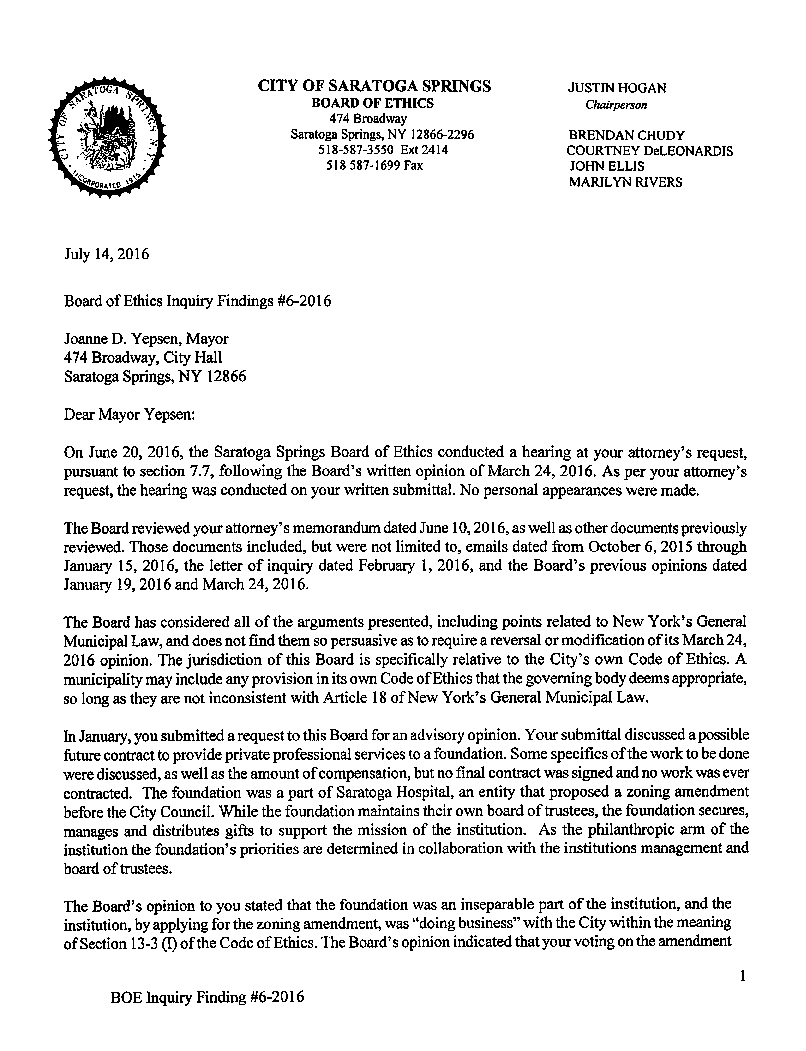

The Ethics Board has released a letter to Mayor Joanne Yepsen formally notifying her of their advisory opinion regarding her dealings with Saratoga Hospital while they had business pending before the Council. Apparently the Board drafted their original opinion on March 24th. According to the document posted on the city’s website, Yepsen declined to meet with the Ethics Board but instead had her attorney send a response to the board. Her attorney’s memorandum was dated June 10th. On June 20th the Ethics Board held a “hearing” (their term/euphemism since this session occurred in executive session and there is no public record of their deliberations). Why the delay? What was the Mayor’s defense? None of this was made available as part of the decision/letter.
The decision cited section 13-3(I) of the city’s ethics code:
“Outside Employer of Business. Officers shall not engage in, solicit, negotiate for or promise to accept work for an outside employer or business who does business with the city which creates an implied conflict with or impairs the proper discharge of his official duties or results in personal gain.”
The decision asserts that the statute does not allow for mitigating circumstances.
It then states that “as a matter of law”, Mayor Yepsen violated the city’s ethics code.
Resolution to Censure
Link To PDF of Resolution: Resolution_re_Ethics_Board_Findings_D3_071916


Commissioner Scirocco has placed on his agenda for tomorrow night a resolution to censure Mayor Yepsen and to refer the matter to the New York State Attorney General’s Public Integrity Bureau and the New York State Joint Commission on Public Ethics.
New Stop Work Order Issued For Murphy Lane Barn: A Further Source of Embarrassment For ZBA
Zoning Board of Appeals In Action

Some six months after the original stop work order for 39 Murphy Lane, the building inspector has issued a revised version. This was prompted when the attorney for the building owner, Jean D’Agostino, challenged the original order and asked that Steven Shaw, the building inspector explain it at a ZBA meeting. Chairman Moore cut off the attorney and rather than make Mr. Shaw explain the order, directed that a revised order be crafted. That after six months the ZBA finally crafted a stop work order of substance that they hope will stand up under court scrutiny graphically shows how ineptly this entire process has been handled.
There are a number of things that are interesting and instructive about the “new” revised version.
The most interesting one involves the building inspector’s role in approving the basement for this building. In the original application approved by the ZBA, the barn was supposed to sit on a slab. Subsequent to the approval of the original application, according to Mr. Shaw’s new stop work order, the applicant submitted a revised plan that was for a crawl space. Mr. Shaw states that the change was “deemed minor.” In spite of the fact that the slab was in the application approved by the ZBA, Mr. Shaw had the latitude to ok the change. The logic was that the new crawl space was presumed to have no effect regarding the variances granted. Subsequently, the applicant decided to scrap the idea of a crawl space. Instead the applicant jacked up the barn and poured a full basement. Mr. Shaw then characterized the pouring of this full basement when they only had approval for a slab as “minor” because it “was not anticipated to affect the variances as approved.” Mr. Shaw goes on to state, “As is our typical protocol [JK:My emphasis], you were allowed to proceed with the foundation pour on 12/22/15 under the condition that revised plans be submitted to show that the change was acceptable to your engineer.” The letter from the engineer was not sent until three and a half months later.
The telling sentence was:
“The change was minor in nature as it was not anticipated to affect the variances as approved”
In fact, the approval of the full, raised basement would make compromising the variances inevitable.
As Shaw’s new order documents, there were a cascade of changes that this “typical protocol” precipitated.
Because the raised foundation was well above the original level of the building and therefore of the ground, in order to meet New York State code, fill had to be brought in to adjust the landscape of the property:
“Fill had been brought in and a once level site is now much higher than the alley and adjoining properties “[my emphasis added]. This fill was the result of the foundation change and a requirement of the NYS Residential Code 401.3 to have adequate drainage away from the foundation walls.”
Because the floor would be placed on top of the foundation, it significantly raised the height of the first floor from the height in the original plan approved by the ZBA.
Because the first floor was much higher now than the ground, the building now needed steps to be built in order to get into the building and thus caused “ further principle building coverage than the existing variance allows.”
So this “minor” change “as is our typical protocol” led inexorably to more zoning violations that would require more variances.
It is not clear precisely when Mr. Shaw approved the full basement. What the public should understand is that the barn, that was supposed to be rehabbed and not demolished, still existed after the basement was poured. It had been jacked up and stood suspended over that basement.
Had Mr. Shaw insisted that the applicant seek approval from the ZBA to amend the plan there might still have been time to save the barn.
It should also be noted that the stop work order was not issued until after the applicant had demolished the barn and begun constructing a totally new house. It was only after the neighbors descended on city hall to protest the demolition that a stop work order was issued. It remains a matter of conjecture as to whether this project would have been fully constructed had the neighbors not acted.
It is easy to point all this out in hindsight. The planning department is woefully understaffed. This city has a major problem with code enforcement. The root of the problem is that while the demands of the planning department have grown exponentially, the resources to run this critically important department have not.
There is also the human side of enforcement. People like Mr. Shaw want to see our codes followed but they are also sensitive to the financial burden that excessively rigid applications of rules can have.
Under normal circumstances on a property appropriately zoned for a house, changing from a slab to a raised basement would have no adverse impact on the neighborhood in which the structure was located.
Mr. Shaw and the members of his staff are under great pressure. Many frustrated families and builders want their plans approved as soon as possible. Delays cost money.
The first moral of this story is not that Mr. Shaw made a mistake in allowing for changes that were at odds with the plans approved by the ZBA. The moral is that Mr. Shaw is not given the time and resources to make it easier to more thoroughly consider the many, many changes thrown in front of him.
The second moral is the indifference of the ZBA to the repeated violations of zoning that they countenance. Given that “do it and ask for forgiveness later” is routinely sustained without penalty, it is little wonder that situations like Murphy Lane occur. The torturous history of 39 Murphy Lane is as much the ZBA’s fault as it is the applicant’s.
To begin with, this project, which only passed by a four to three majority should never have been approved. Attempting to convert a very small barn (more like a large shed) into a three bedroom home on a piece of property that was approximately one third the required minimum lot size was wrong. The fact that it was being built on a narrow alley only reinforced how inappropriate the project was.
In its application to the ZBA the applicant not only described the project as a rehab of a barn, she explicitly stated that were they to tear down the barn it would have an adverse effect on the neighborhood. Readers, this is what the owner asserted in her application that was approved by the ZBA. The applicant is a realtor and not some naïve homeowner. For the owner to then demolish the building without going back to the ZBA and then attempt to build a new home there is simply stunning.
In spite of all of this, given the extreme bias of the ZBA to developers, they then spent months trying to help this applicant complete this project.
Readers, this meant that the neighbors ended up having to spend those same months researching and going to meetings. Why should this have been necessary? The ZBA should have told the applicant, you have grossly misrepresented this project (as the neighbors asserted to the ZBA many times during the public input period of the meetings) . Instead of spending hours and hours at meetings exploring how the applicant might save this project, the ZBA should have told her (as the ZBA attorney, Tony Izzo recommended) come back with your best plan that comes closest to the application we approved. At that point, if the applicant’s best plan was inadequate, they should have told her that no additional variances will be granted effectively killing her project.
Here are links to the original stop work order and the new, revised order.
Original Stop Work Order: StopWorkOrder1a
New Stop Work Order: StopOrder2
Below is a detailed review of the new stop order.
Per the instructions of the Zoning Board at their May meeting, Steven Shaw, the city building inspector issued a revised stop work order.
It is important to note that the original stop work order was dated January 21st, 2016. This document simply states:
“The scope of work you are performing at 39 Murphy Lane is outside the scope of your permit.”
It advises Ms Jean D’Agostino, the owner, that she is to submit a revised set of plans to the engineer’s office and get approval from the Zoning Board of Appeals for them.
Ms. D’Agostino then emails back asking why the stop order and, in an email dated January 22, Shaw informs her that the changes have increased the height of the building and “increased the non-conformance.” He also notes that the” additional steps in the setback will need to be addressed by the ZBA…”
A number of things are interesting about these documents. First of all there is no reference in the first stop order to the application submitted by Ms D’Agostino that this was supposed to be a rehab and that the application explicitly ruled out removing the original building. This is rather surprising because the building had indeed been removed from the site which contributed to the opposition by the neighbors.
It is also worth noting that the first stop work order makes no reference that the approved plan was for the barn to be on a slab and that the applicant had dug a full basement.
The new stop work order is dated July 8th. This is almost six months after the original stop work order.
This one is far more comprehensive. It now includes the fact that the construction had not conformed with the plans as pictured and as described in the application.
The new stop work order notes that the plans submitted in August which included a crawl space rather than the slab as stated in the original application presented to the ZBA was “deemed minor.” It goes on to note that the applicant putting in a full basement without seeking approval for the revision was also considered minor as it “was not anticipated to affect the variances as approved.” [JK: Note the artful wording here in light of later events]. Mr. Shaw goes on to state, “As is our typical protocol, you were allowed to proceed with the foundation pour on 12/22/15 under the conditions that revised plans be submitted to show that the change was acceptable to your engineer.” Shaw then observes that he did not get these plans until three and a half months after they had been requested and approximately four and a half months after the stop work order.
Shaw then states that between the time of the foundation pour inspection by Shaw and the issuance of the stop work order, “… the project had become significantly different from the approvals…” “Fill had been brought in and a once level site is now much higher than the alley and adjoining properties. This fill was the result of the foundation change and a requirement of the NYS Residential Code 401.3 to have adequate drainage away from the foundation walls. An assessment should be done to ensure that this requirement is not being exceeded and thus creating a runoff problem in the alley and adjoining properties. You may even qualify for that section’s exeption.”
Shaw states that the first floor is much higher than it was originally [when it was still a barn on a slab} and much higher than depicted in the applicants plans. It requires the addition of a set of steps to be built which expand the footprint. The new construction requires more coverage in the setback not considered by the ZBA requiring additional variances.
He finishes by stating that the ZBA’s decision on March 23,rd 2015 “clearly does not authorize either ‘tearing down the barn and starting new’ or a ‘removal of the existing barn’ [JK: as stated in their application] and then emphasizes the scope of the changes.
A New Look For The Blog
As you all can see, this blog has a new look. I was helped by Kate Austin-Avon of Advokate, LLC
She was great to work with and we have some plans to further strengthen the site.
I welcome any suggestions and feedback the readers of this blog might have.
Jumel Place Neighbors Tell Their Story
One of the rewarding things about doing this blog is the ability to print long pieces that drill down into issues. It is also the pleasure of exposing institutions that heretofore were able to act badly with impunity because the sunlight never shone on them. Sandy Cohen has written a long piece detailing the July 11 meeting of the Zoning Board of Appeals that dealt with John Witt’s Downton Walk project. I admire Ms. Cohen and her neighbors tremendously. They knew that the chances of receiving justice from the ZBA were remote but their loyalty to their neighborhood and their friends was such that they truly fought the good fight. Here is their story in their words:
A Letter to All Our Supporters
From the Neighbors of Downton Walk
With thanks to AQUA for the following song:
“It’s time to turn off the light.
This has been such a beautiful night.
We’ve served you a lot of delights
And some really wonderful sights.
My friend this is the end.
So long I’ll see you soon again.
Bye-bye, kissing you hi.
Someday we will be back together.
Chorus:
(Goodbye to the circus.
We hope you enjoyed the show.
Now it’s nearly at the end.
But we will be back you know . . .)
It will be back, you know
It will be back, you know.
You have given us all of the best.
You are beating inside our chest.
Staying with us as time has gone by.
Gave us hope when tide was high.
My friend, this is the end.
So long I’ll see you soon again.
Bye-bye, kissing you hi.
Someday we will be back together.
Chorus
The band played on
From dusk ‘til dawn.
And time is almost gone.
The beat goes on.
It’s almost done,
This music marathon.
It will be back, you know.
It will be back, you know.
Chorus (repeat)
We will be back, you know.
We will be back, you know.”
Step right up Ladies & Gentlemen . . . the circus has been in town . . .
And, for the past four months, that’s exactly what it has felt like! In as much as this was the first time for most of us participating in a run-in with the Zoning Board of Appeals, we have no idea if what we’ve all experienced is the norm; but if it hadn’t been so disturbing, it might have been entertaining.
All the elements were there: Ringmaster, troupe, clowns, dancing bears, and audience . . . Monday evening, July 11 was no exception – and possibly the most amazing performance thus far.
For possibly the first time ever, we were first on the agenda, so we missed out on the shenanigans of others. But they granted that position to Builder John Witt’s Downton Walk Proposal for 27 Jumel Place.
Ringmaster Bill Moore made sure to attend this one after his absence two weeks prior. No alternates this time around. This was going to be the end of public comment and the final vote – come hell or high water.
At this point, there were very few illusions that this resolution would be voted down.
Once public comment was open, our Attorney, Jonathan Tingley, took the mic to advise the Board that he received an email that morning advising him that Margaret Roohan and her husband had stepped up back in March, trying to purchase the Jumel lot that was still an active listing on the market. The Roohans were offering full price – well in excess of $100,000 more – for the land than John Witt had listed in his Land Development chart.
Sadly, however, the seller had to turn down the offer, as, reportedly, he no longer had access to a 48-hour contract addendum requiring Witt to either meet the offer or walk away. He also had received a threat from the Witt’s counsel that there would be extensive and costly litigation, should he decide to cancel the contract and accept the other offer. Both Tingley and our group knew there was no chance that this new builder nor we would get any sympathy from the Board, but the information was paving the way for proof of the contention that there was a much better and more feasible way available for using the land – one that hewed closely to the existing UR-3 zoning requirements and required fewer, if any, variances. Witt’s plans clearly are not the lowest variances, as required by law, as we understand the Roohans had planned to subdivide the lot to build four duplexes, a totally acceptable alternative under our ordinances.
Had our group known this earlier, we might have had time to do some sketches proving how it could be done. Witt had already rejected the possibility of subdivision of the land, which we still feel was the key mistake on his part. In essence, the Roohans were willing to pay 31% more and build 43% less on the same land. So, the feasibility argument should have been clear to the Board. The land could have been divided creatively and any variances would have affected only the new community internally and likely would have minimal effect on the surrounding homeowners.
Speaking in Witt’s favor were only individuals on his payroll: Tim Monahan, his Realtor, who claimed that Witt actually did pay a higher price for the land after the Roohan offer and he claimed the difference was not $114,000. Yet the price Witt has given on his land development cost was $370,000 – versus the $484,000 offer from Roohan, which, in our book, shows a difference of $114,000. He also advised the Board that the seller had been told that they would have to reimburse Witt for all costs to date, if his offer wasn’t accepted. Shortly thereafter, Libby Coreno, Witt’s Attorney, insisted that the land would revert to commercial and or other different uses that had been previously granted and not UR-3 if this application were not approved. This, however, is not the way our Zoning Ordinance reads. She also took her usual umbrage with one of Tingley’s statements: this time she insisted that she never used the term “Slam Dunk,” which he really never attributed to her, but, apparently, that is how she heard it. She heart-rendingly adjured the Board to recognize that only Witt has expended money on this property; and only Witt has spent his time dealing with this project for the last three years. (Cue the violins; and we really suppressed our desire to write: “Enter Dancing Bears” before this paragraph!)
Volunteer speaker after speaker, on our side of the eight-foot fence (no pun intended but entirely accurate) pleaded with the Board to listen and really hear what the neighbors were saying. Themes ranged from Kira Cohen offering 10 Significant Changes between this year’s application and those prior. (We noted an additional change to bolster our previous blog article, reworked, and added more information to what was previously printed, including that 10th point that the zoning actually had already reverted to UR-3.)
But the fact that it read differently didn’t faze Adam McNeill. He interrupted Cohen’s speech, as he did to Sam Brewton in the prior meeting, to question if this was the same letter (blog article) that they had received the during the last week. As she was speaking on her mother’s behalf and had not studied the previous letter, she couldn’t tell them exactly how they differed, but; thankfully, he allowed her to continue.
Cohen was followed by Maureen Curtin, who addressed the five criteria the Board had to consider before voting. As she elaborately deconstructed each point, Curtin spoke of the only neighbor who still came to speak for Witt in the last meeting – the next-door neighbor, on the lot’s west border, who said he did it only because he got Witt to agree to move the 8-foot stone wall/fence to 30”, rather than the 18” from the this man’s window, where it had originally been placed on the drawings. She also countered Coreno’s words, pointing out that, while Witt had been investing his money in that lot and this protracted review, the neighbors were trying to protect the money they have invested in their homes. For many of them, this is the largest investment they will ever make in their lives. Curtin reviewed previously offered information that five homes in today’s local market would bring in almost the same revenue as seven homes would have brought three years ago, when the project was first approved. This means that Witt could subdivide and build fewer homes, still making very close to the same money he would have made in 2013, which was his burden of proof. Curtin’s information proved that, if they were seriously considering these issues, the board’s vote on financial feasibility must be “no”. (They did stare well and looked like they might be listening.)
Anne Proulx, a lifelong Jumel Place neighbor, spoke next, recalling Witt’s visiting in her foyer several years ago — asking her to sign a petition in his favor – long before he had any drawings to show or was imparting any critical information about the size and breadth of the project. Happy at the prospect of demolishment of the unsightly building, she had signed for him but was now at the meeting to retract that endorsement, saying she was appalled at the magnitude of the planned development, something Witt had omitted mentioning during his visit. “It’s far too ambitious; bring it down,” she pled.
Blogger John Kaufmann was next in the center ring. He came to support the neighbors, speaking about why these people and much of the populace are upset with the lack of consideration they get in meetings such as these. He explained how zoning is supposed to be used to keep neighborhoods consistent by making only “reasonable and modest adjustments.” Kaufmann told them they had taken considerable license with this project in the past, and now it is just not consistent with the other homes in the neighborhood. He called out the Board for their “developer friendly” stance and admonished them to listen to the people they are supposed to represent.
Neighbor Gerald Mattison employed an interesting analogy, bringing a ream of paper to the microphone. Each of the 500 pieces of paper represented a signature on the change.org petition (which actually had reached 508 at last count) as well as close to 50 neighbors who had signed a paper petition in our favor, several of whom had originally been on Witt’s side but had subsequently withdrawn their support.
Since the dozens of neighbors opposing this project do not receive equal time and table position as the applicant does in presenting to the Board; nor do we receive answers to questions we ask about our legitimate concerns – the Board refuses “to “banter” with the public” – we question whether we, the neighbors, who will be most gravely and forever affected, were heard or treated fairly.
We presented on July 11, and previously at the June 20 meeting, legitimate and significant changes regarding this application, in comparison to that in 2013/14. But we question whether every Board member examined our presentations and gave them time and consideration equal to what they gave the applicant before making this important and lasting decision. We believe not.
Once the public comment session was closed, the Board debated the required State Environment Quality Review (SEQR). That’s when one could see where the divisions were. Those who were destined to vote in our favor were seeing the comparison to the actual modern zoning of the land vs those who could not let go of its last non-conforming use. They went so far as to ask the attorney which they should be considering. And, regardless of the attorney telling them that the lot is UR-3, they continued to assume that, if this application were rejected, it would revert to non-conforming use and not to true modern zoning (which is the actual requirement).
This writer, who served as an armchair quarterback – not in the room but watching, live in real time and listening closely – was hoarse by the end of the evening, from screaming out facts to them. It certainly would be nice if some members of the board would take at least some time to familiarize themselves with the finer points and implications of our city’s zoning ordinances.
Just before the vote however, Coreno interrupted to remind them, and have it written into the record, that the previous SEQR had been given a neg-dec (negative declaration, meaning there were no environmental issues) and the applicant expected the same this time around. This was after the public comment session was closed, but she was allowed to speak, because it was only procedural. After the requisite “neg-dec” was achieved on the SEQR (with a 5 yes, 1 no, and 1 abstention vote) the Board turned their attention to discussion and vote on the application itself. There was little pretense on where anyone stood. The votes were known before they were cast.
The only two who supported our side were Susan Steer and James Helicke, both of whom had been fair throughout the past several months. They fought hard in this meeting and really did try to make the others see their side. Helicke pointed out that the Board has lost sight of the substantiality of the variances being requested, ignoring the impact of the effect of those variances. He went so far to say that the whole purpose of this application was to circumvent the city’s subdivision regulations. He continued, saying that the Board had given very little consideration to the character of the neighborhood and the resultant detriment to the neighborhood this project would bring. He pointed out that the original approval spoke of providing housing for those who wished to downsize, which is certainly not what is going to be built there.
(Although Witt has stated in meetings that the largest units will be around 3,000 square feet, his drawings and charts show that the largest footprint – first-floor measurement only – is more than 2,700 square feet. Once you add the roof overhangs, the first floor measures more than 2,900 square feet. The drawings indicate that these will be 2-1/2 to 3-story condos. It boggles the mind how much larger than 3,000 square feet that single structure will grow during construction. We would add that five of the seven homes start out with footprints larger than 2,000 square feet. And these measurements do not include the garages.)
Helicke was countered by McNeill, who actually admitted that much of the financial information they had been given had been — using his word — “obfuscated.” (Look it up; you’re gonna love it!) But he said he felt that only about 1/15 of their consideration had been financially based. He also reminded everyone that the Planning Board gave this project a unanimous approval. So, that’s another Board that might need an eye cast at it.
Steer concurred with what Helicke said and weighed in explaining that the condos proposed are not at all in character with the residential homes in the neighborhood. She also pointed out the change in pricing and the conflicting revenue information the Board had been given. She suggested that those who planned to vote in favor of the resolution think long and hard before doing so. Steer pointed out that the 2013 resolution mentioned how well the homes conformed to the neighborhood and explained that these new plans do not conform, being much larger than most of the homes already in the area. She was able to put herself in the shoes of the residents saying that she would be seriously upset if she lived in this neighborhood and would never impose on a neighborhood in this manner.
Members of the Board admitted that at the heart of the resolution was the “blight” of the building standing there now and dearth of applications that had come before. So Witt’s was the only proposal that had made it to the approval stage. Is that the measure by which we decide what is best for our neighborhoods? (If the building is such a blight – which we agree it is – why can’t the city condemn it and require the current owner to remove it? An empty lot would be much less of an eyesore.)
The end result was 5-2. Those favoring this overblown project were Bill Moore, Keith Kaplan, Adam McNeill, Skip Carlson, and Gary Hasbrouck. Those opposed were Susan Steer and James Helicke. Based on the previous discussion, the outcome was pretty much based on this being the better of the evils that had been proposed before, NOT the highest and best use of the land with minimum variances. (The two proposals they had seen were a Montessori school and a mixed-use development, both of which voluntarily pulled their own proposals from consideration.) So Witt’s is the only proposal that has made it to the approval stage. There had been no other housing applications to compare it to.
McNeill had already patted them all on the back for the “standard of care” they showed with their “two-page resolution” – as if space means quality. It’s important to note that part of their statement even gave approval to an extra swimming pool that was not included in the earlier 2014 application. We were left with insult added to injury, remembering that both Hasbrouck and McNeill had nerve enough to state that they would have expected, and the group against the application had “conveniently not submitted,” plans proving that subdivision would have worked financially with fewer and easier variances! They even implied that it might actually have made a difference to them.
ARE YOU KIDDING US? We’ve already spent upwards of $10,000 of our own money fighting this . . . Do you really think the citizens aren’t expending enough blood and treasure just to discern our rights and be listened to? Keep in mind that Keith Kaplan referred to the Board as “Finders of Facts”. Yet we “civilians” were the ones who had spent literally thousands of hours of our own time, away from our careers, reading, researching, writing, speaking, doing their math for them, and providing them with salient information. We went into this endeavor seeing the ZBA as an arm of the people of this City, put there to protect our zoning codes and to help developers find the best way to hew to and work within our ordinances. But, instead of realizing we were trying to help them see the reality of the situation and find a way to extract themselves from a mess the previous Board had gotten into by approving such an application, the majority of this Board decided to treat us as adversaries, squelching us at every turn. We had even gone to the expense of filing a legal appeal to give them something that would allow them to get out from under the Doctrine of Precedence to which they were otherwise bound, because it would bring into play the larger question of a Use Variance that would have trumped the entire application. Instead, they killed that. And then they expect us to hire architects and contractors to prove to an administrative board that four structures would take up less land than seven? That the sale of five homes at today’s selling prices could generate almost the same money as seven would have brought in 2013? And that eight homes (in four duplexes) would bring in more money than seven? “Elementary, my dear Watson.”
If this was something so important to them, why didn’t they take the time to ask the Planning Department to take a run at placing five homes on that lot and see how it would turn out, relative to lot lines and variances? That would certainly be considered due diligence – especially when we had already pointed out that the numbers Witt presented to them on the seven homes in 2016 required the total revenue to increase by more than $2 million dollars to make up for only $397,740 in extra land development costs in 2016. (Here’s the math we had already given them: their 2013 average minimum selling price of $640,000 increased to $930,000 in 2016 = an additional $290,000 x 7 homes = $2,030,000 added revenue.) We DID show them this math, and apparently they didn’t recognize the hint that the applicant’s “proof” pricing was somewhat overstated along with the obfuscation. The resolution, instead, said that the applicant’s financial presentation had “proportional consistency.” Makes one wonder what inconsistency looks like, doesn’t it?
And this is from a Board that was on the verge of approving a project of seven condos — a 600% area variance — about which they had zero accurate knowledge regarding lot coverage or permeability — on a single lot in a single-family/two-family neighborhood. These are the people who are vested with upholding and protection of our zoning ordinances. And they reward our trust by allowing a developer to circumvent and subvert our subdivision codes and set a precedent for every developer that follows to say, “But you allowed Witt to do it. I don’t want to apply for a subdivision. I just want to increase the number of structures on my lot.”
What our Zoning Board of Appeals did on July 11, whether they see it that way or not, could be considered Spot Zoning, and it is considered unequal treatment. It has been defined as “making unjustified exceptions for a parcel or parcels within a district.” Whether you want to see it as I still see it: allowing condominiums (which are defined in city and state ordinances as multifamily, regardless of the opinion of the ZBA) in a UR-3 single family/two-family district; or if you see it, as two ZBA members choose to see it: throwing away our subdivision codes and allowing a developer to increase by 600% the structures allowed on one lot, it is spot zoning, and it sets a dangerous precedent for every developer to come.
The ironic postscript is that our group and all of our supporters were actually working in Mr. Witt’s best interests whether or not he can see that. He has stated that he won’t start building until all the condos are sold. Sonny Bonacio, who has extreme experience in this area, has already advised the Board that condos selling for $600,000 or higher (which will be the price of the majority of Witt’s units) can take years to sell. What happens if Bonacio is right? If Witt goes ahead and builds the first units that sell in a timely manner, he has to pay the balance of the condo dues on those that remain unbuilt and unsold. If he waits until they are all sold, the worst-case scenario is he’ll lose the initial buyers who likely won’t want to wait for several years.
What we do know is that, prior to the June 20 meeting, Witt did sign a note for that one neighbor previously mentioned, promising to build the fence a bit farther inside the Downton Walk lot line, so that the gentleman would actually have enough space to maintain the exterior of his home, so he could actually see out of the window, and so he could open the door of his home wide enough to move furniture in and out. That was a lovely gesture . . . but it will likely be worthless after all the condos are sold. Witt will be gone. His signature will be worth nothing. Instead, the neighbor will have to deal with seven condo owners and, not inconceivably, litigation, if any issue comes up about moving that fence at a later date – unless, of course, Witt legally deeds an easement to the neighbor before he closes on any of his sales.
All that said, Downton Walk, with its 600% variance in number of buildings, 53++% more building coverage, 90% and 74% closer setbacks, and 33% higher fences likely will be built.
Although the music has stopped, and this tent has folded, the Saratoga Neighbors For Zoning Enforcement is not going away. Perhaps, eventually, if they see and hear from enough of us the ZBA will realize we are trying to help them, we mean business and we deserve some attention.
Now that the circus has pulled out, we are the people who live in this neighborhood, and we are the people who will suffer any negative effects because of the decision of five members of this Zoning Board of Appeals.
But, you were with us, show after show, and we want to say thank you for all your support during this most trying time. You cannot imagine how good it felt to watch the petition signature list grow, to read your comments – on the petition and in the Facebook groups. It was awesome to see so many of you at the meetings speaking on our behalf and on behalf of all the citizens of Saratoga who have been wronged by this decision and the orientation of the Board. The “Thank You” includes John Kauffman for giving us blog space and The Saratogian whose reporters did check in with us periodically and also gave us some space to vent. As difficult as it still was, it made our fight so much easier, and we can never thank you enough.
Let’s hope for better luck next time. Because the greater fight still goes on. We will be in touch.
“It will be back, you know . . .
We will be back, you know.”
P.S. We wanted to stop. We really did. But, then we listened again to the reading of the resolution and they got to those dreaded pools that we’ve been harping on for two weeks. This is what happened:
Even though there is a swimming pool that has been added since 2013, the Board found that, because no variance had been requested for the additional pool, it (I guess, magically) causes no significant change. Forget lot coverage. Forget permeability. Oh yeah, sorry, they already forgot about that . . . In the meeting on June 20, the developer noted that no measurements for any of the four pools have been included in those lot coverage and permeability figures anyway. At that meeting Keith Kaplan actually made an effort to put limits on allowances for pools, possibly eliminating this one, since the developer is already being granted 52% more coverage variance than allowed. But, for some reason, in the final cut of the resolution, no limits on pools were included. This means we don’t even know how much higher than the excessive 52% lot coverage will be. And remember, the Planning Board also gave these plans – with that missing information – a unanimous approval.
But, the resolution actually reads that, because the previous Board approved the original application (without footprint, lot coverage, or permeability information for any of the pools), five members of this Board saw no reason to ask for such information this time around. We’ll repeat their exact words, “Since no additional variances are being requested for pools, the Board concludes it [the extra pool] causes no significant change.” This means that when they saw a mistake, and they were given the opportunity to correct it, they simply ignored it – although they did make formal note of that in their resolution – and moved on. Please keep in mind that the neighbors saw these issues and pointed them out, time and time again, throughout the process – verbally and in writing. And, no, the Board is not expecting any future variances to be filed to fix this pool issue. The pools have all been approved.
Its pains us that, even when there was a dot of light in the darkness – that, perhaps we had been heard at least about the pools and the Board looked like it was about to set some limits – it came to naught. Once again, the developer was denied nothing.
Notice of Interesting Conference From Michele Madigan
City of Saratoga Springs, NYSTEC, IgniteU NY MEDIA ANNOUNCEMENT: July 12, 2016 Contact: Commissioner of Finance, Michele Madigan: michele.madigan@saratoga_springs.org : (518) 526-9377 NYSTEC, contact Jana Behe: behe@nystec.com
IgniteU NY, contact Evan DeGennaro:edegennaro@nystec.com
Announcing the Smart City Forum and Showcase at Saratoga Springs City Center IgniteU NY, established last year by technology consulting firm NYSTEC to help foster entrepreneurship and innovation in Upstate New York, will host the Smart City Forum and Showcase at the Saratoga City Center on Thursday, July 14, 2016, from 11:30 am to 7:00 pm. The event will bring together entrepreneurs and leaders in business, education, and government to discuss the changing landscape of information connectivity and data gathering, as well as highlight innovative approaches for cities to operate more efficiently, attract and support businesses, and improve overall quality of life. Speakers will discuss how smart solutions can make cities more entrepreneurial, vibrant, and sustainable. Enterprise presenters include Cisco Systems, EMC, and Pitney Bowes. A scheduled broadband panel will include Calix, eX2, Hudson Valley Wireless, FirstLight Fiber, and PrimeLink. The evening startup showcase will feature presentations from ParqMi and Apcera. The Smart City Forum and Showcase is part of the Saratoga Smart City Project, spearheaded by City of Saratoga Springs Commissioner of Finance Michele Madigan. The goal of the project is to help leverage existing broadband infrastructure and funding streams to foster sustainable economic growth and enhance the quality of life for all Saratogians. Together with NYSTEC, the project is led by the Smart City Commission, made up of representatives from the Saratoga region. “This is important not only to our economic viability, but also to the health, safety, and welfare of our citizens and visitors,” Madigan said. The Smart City Forum and Showcase is free and open to the public. For registration information, including a luncheon and evening cocktail reception, visit www.igniteuny.com/smartcity/
About NYSTEC With offices in Rome, Albany, and New York City, NYSTEC is a not-for-profit company offering specialized information technology consulting services. Acting as a trusted and unbiased technology advisor to government agencies and other institutions, NYSTEC helps organizations with their IT strategies, solutions, acquisitions, and security across numerous industries, including government and public safety, healthcare and human services, and education.
For more information about NYSTEC, contact Jana Behe: behe@nystec.com For more information about IgniteU NY, contact Evan DeGennaro:edegennaro@nystec.com
Michele Madigan
Commissioner of Finance
City of Saratoga Springs
474 Broadway
Saratoga Springs, NY 12866
518-587-3550 ext. 2557
 Saratoga Springs Politics