In its February 23 editorial titled “Don’t Rush Spa City Vote” the Times Union came out against holding a special election for the vote on a new city charter. This follows an editorial some weeks ago from the Gazette Newspaper opposing the special election as well.
I received this story from Art Gonick. Quite the scoop Art!
Seeking Republican Endorsement
By Arthur Gonick SARATOGA SPRINGS – Sources within the Saratoga Springs City Republican Committee, as well as other reliable sources, have confirmed that Mark Baker, longtime President of the Saratoga Springs City Center, has met with the committee on Wednesday evening to ask for their endorsement for Saratoga Springs’ Mayor.
If he runs, Mr. Baker would presumably face 2-term incumbent Democratic Mayor Joanne Yepsen.
Also seeking support at the meeting was Don Braim, a former SSPD member seeking the office of Commissioner of Public Safety.
Committee sources estimate that official party endorsements are about a month away, to allow candidates to be vetted properly.
Mr. Baker was called twice for comment, but did not immediately return phone calls.
A Mark Baker candidacy would be formidable. As City Center President, he oversaw the economic engine of the city, leading it through a heralded expansion, and helped secure passage by the City Council of provisions that will build a multilevel parking structure adjacent to the City Center.
Mr. Baker continues to keep an office at the City Center, to work on effectuating the garage’s construction. He now may help cut the ribbon on the garage as the City’s leader.
Many of you may recall the notorious “virtual” barn rehab on Murphy Lane that was initially approved by the ZBA and then halted. The landowner had assured the ZBA that they had no intention of tearing the barn down when they got a series of variances and then tore it down. The issue is still in the courts.
Now we have another example of the same kind of abuse for a new structure within a stone’s throw of the barn. Here again we have an applicant leaving out key information before the ZBA and then, after getting approval, proceeding to change their plan without going back to the ZBA. Of particular note in this case was that a member of the board actually raised the question about stipulating in the approval a limit to insure that there were no problems. Consistent with the ZBA, a majority dismissed this concern. This decision has had serious consequences for the garage’s neighbors.
The owners of 66 White Street submitted an application for a variance for a garage to the Zoning Board of Appeals to be built as an accessory building on their lot.
In the course of discussing the application at the December 19th meeting, board member Cheryl Grey asked, “Do we have to state the second story is [not] supposed to be finished into a habitable space with a bath or shower?”
She is then assured by Chairman William Moore that this is unnecessary because the garage is not to be habitable. Other members of the ZBA chimed in with similar sentiments. No action was taken to stipulate any limits.
Fast forward to the construction of the garage.The contractor starts digging conduits from the house to the garage for plumbing, sewer, and power. This was not included in the plan submitted to the ZBA upon which the variance was granted. A neighbor, observing this, contacts the building inspector’s office. The building inspector comes out and is told by the contractor that the utilities are for a bathroom [the very convenience the board member was concerned about] that may be built in the future. The building inspector cites the contractor for doing work without a plumbing permit and requires him to provide plans for this future bathroom. He issues a stop work order.
The contractor then applies for the plumbing permit and provides the plans for the bathroom and the stop work order is lifted.
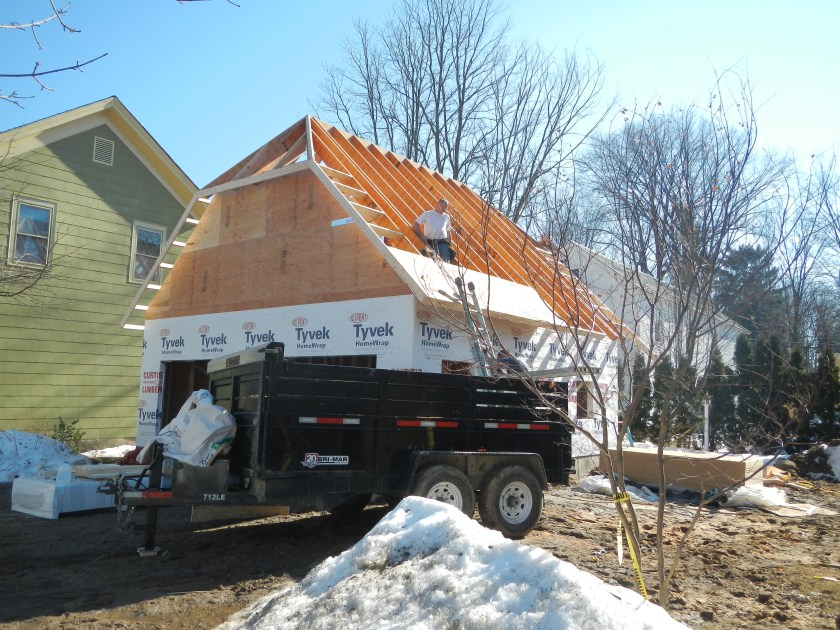
These are pictures of the garage under construction. One might ask, why are they putting a bathroom into a garage that is not supposed to be “habitable” and that is only a few feet from the house? Consider the size of the second floor of this garage. Do you think the owner might have greater plans for this building? With this bathroom might they create a summer rental?
The neighbors complained to the Mayor’s office. The building department is under the Mayor’s authority. Steve Shaw, the building inspector, responds to the Mayor’s office’s inquiry arguing that his approval of the utilities and the bathroom is appropriate.
The following is Mr. Shaw’s response to the Mayor’s office along with a critique provided by a neighbor with considerable technical knowledge of development issues:
[Shaw] There has been much discussion about the right of a homeowner to put a bathroom into an accessory structure on their property. I would maintain that the relevant points of this issue hinge on two things, HABITABLE/LIVING SPACE and USE.
[analysis] Look, we like our neighbors and we don’t want to create problems yet we are now forced to intervene to be sure this garage does not become living (inhabited) space which is not allowed per the zoning code.
I respectfully disagree in terms of the initial relevant points. This problem started with an application that failed to disclose to the zoning board the full intent of use and failed to show the planned water, sewer, and other infrastructure that was installed (without permits) minutes after the building inspector left the site after approving the foundation to be backfilled.
How can the project be issued plumbing permits after plumbing was installed without a permit and after the fact that the project plans hid/did not include this intention? Why was forgiveness granted rather than fines and revocation of permits? Further the project plans did not show plumbing and when the ZBA discussed the proposed stipulation that no plumbing/no sewer be permitted, the ZBA determined that no such stipulation was needed as to be building habitable space “would be building illegally . . .they are not asking for habitable space.” (ZBA chairman). A bathroom is clearly only needed for occupied space. This project should be re-presented to the ZBA as the project did not follow the plans submitted.
The city zoning ordinance provides a definition for a garage: Definitions
Garage: An accessory building or portion of a principal building used for the storage of motor vehicles of the occupants of the premises.
Cars and lawnmowers do not need a bathroom. Bathrooms are available in the house—in the occupied space.
[Shaw] An ACCESSORY STRUCTURE (RESIDENTIAL)is defined in our City Zoning Ordinance as “an unfinished and uninhabitable space in a detached structure” which includes private garages. There is no definition in our City Zoning Ordinance for finished or unfinished space. Whereas a finished condition for a garage bay might be untaped/unpainted sheetrock, a three season sunroom might not be considered finished without taping, painting and insulation. Neither of these situations even addresses the question of conditioning. Therefore I believe the consideration of finished space to be situational and subject to my interpretation.
The Zoning Ordinance is not silent however, on habitable living space. HABITABLE/LIVING SPACE is defined as “a space in a building suitable for living, sleeping, cooking, bathing, washing and sanitation purposes.” The key word in this definition is the word “and” which means that space is not considered habitable living space without all of those components. No single or limited combination of these components would constitute habitable space.
[analysis] The key word in this definition is “suitable”. In other words, is the space suitable for habitation? What makes it uninhabitable? If a group of people are on a second story with access from stairs that meet the code, in a space that is insulated, with a space heater/window air conditioner and a bathroom not inhabiting the space? What must they not be doing to be sure they are not inhabiting the space? Is watching a ball game? Falling asleep on couches? Spending the night . . the weekend? Air BNB?
Further, the zoning does inform the question of use and occupancy: As defined in zoning ordinance, the words “used” or “occupied,” as applied to any land or building, shall be construed to include the words “intended or designed to be used or occupied.” Clearly, the plan for the space was to be suitable for occupancy.
Clearly, the insulation of the space, attempt to bring in water, sewer, electric, and gas/heat are all indicative of intent to inhabit the space.
[Shaw] Also crucial in the determination for the allowance of a bathroom is the definition of USE. It is clear that a bathroom falls under the definition of USE- ACCESSORY in our City Zoning Ordinance as “a use customarily intended to be incidental and clearly subordinate to the principal uses or buildings on a lot.” As I see no inclusion or exclusion of a bathroom in any structure defined in our ordinance, I can only presume that a bathroom is allowed anywhere that it is deemed to be an appropriate accessory use to an allowable principal or permitted use.
[Analysis] It is inappropriate to segregate this one sub-use that is associated normally with a principal use and consider it simply as an accessory use. I respectfully disagree as a bathroom is a key element of a principal use for a residential property. Is a dining room an accessory use? What about a living room? Can this accessory use of a garage also include a living room? A bedroom? This is a slippery slope.
[Shaw] Furthermore, the question of use is significant in the determination because the addition of a bathroom does not change the use of a structure. If the addition were to cause a use change which effected the allowed density or character of a neighborhood, or was not deemed appropriate as an accessory use, then it would not be allowed.
[Analysis] A bathroom is only required when one inhabits the space. Clearly, there is a bathroom a few steps away in the house. Again, this is a slippery slope as the addition of uses including a bathroom supports increased activity which does in fact affect the character of the neighborhood. When does habitation begin—when one uses the bathroom . . . when 8 guests are over in the garage watching television and using the bathroom . . . when visitors need a place to sleep and they sleep upstairs . . . when visitors stay for a weekend .. . when a relative moves in for a month . . . .
[Shaw] In the case of 66 White St., the private garage is a permitted use and therefore a bathroom would be allowed at the garage bay level as an accessory use. It is wholly reasonable and logical that a bathroom in an accessory structure such as a garage would be convenient if not necessary for anyone who would be spending a significant amount of time in the garage bay or yard. However, I would not find it reasonable for such a use at the second floor of this structure as it is not logical for a bathroom to be an accessory use to an uninhabitable, unconditioned, unfinished storage space. If this space had the appropriate approvals for such a use then it would be logical to allow one. [Analysis] Disagree that a bathroom is needed for convenience or necessity. Let’s be serious. The house is ten steps away. So, we have a lesson here on how what starts out as a garage becomes connected to water and sewer, morphs into increasing use of the space for gatherings, morphs into a second principal use on the same lot and then into another illegal dwelling units in the city. And then, when that happens, the applicant comes to the city to ask forgiveness. When has the city caused to tear down an occupied dwelling unit or evicted residents in a building that met all of the building code that was inhabited without proper permits?
[Shaw] I hope this determination is helpful in clearing up any confusion about the inclusion of bathrooms in an accessory building. There are still parts which are open to interpretation and those would be determined by the Zoning & Building Inspector on a case by case basis.
[Analysis] Respectfully disagree. Are the neighbors being asked to be the code enforcers when the problem could be and should be nipped in the bud by not allowing water and sewer to a garage? This is the proverbial nose of the camel. If you let even the nose of the camel in the tent as the old Bedouin saying goes, before you know it, you have the whole camel in there and good luck getting it out! Who will be responsible when the camel is in the tent? This project should go back to the ZBA as the project failed to follow the plans submitted.
So we have two examples of the applicants submitting proposals to the ZBA and then going forward with other plans. In the case of the “barn” on Murphy Lane the applicant has filed an article 78 to overturn the ZBA stop work action. Very recently the court declined to dismiss the suit and now lengthy and expensive litigation with an unknown outcome are in our future.
Bear in mind that these are just the two examples from my neighborhood. One has to assume that there are many more out there that simply went forward because the neighbors assumed they had no choice.
You would think that this would cause the ZBA to set up a public meeting with the planning staff to ask how has all of this happened and what actions can we take to minimize these problems in the future? You would think….
Here is more detail about last night’s City Council meeting.
During the public comment period, Bob Turner who chairs the Charter Commission indicated that his group was now looking at moving the referendum to June. I understand that the Jewish holiday Shavuot begins at sundown on the current date proposed for the referendum. I am not sure if this was the reason for the change or the fact that the current date immediately follows the Memorial Day weekend.
He also told the council that they have found a way to reduce the cost of the election by $9,500.00 and plan to apply for a grant that would cover $25,000.00 of the election’s cost.
Turner stated that he expected that the interest by the citizens in the referendum would be so great that the number of voters would exceed those in a November general election.
Michele Madigan presented two motions for funding the request from the Charter Commission. One was to pay for the administrative and programmatic expenses of the Commission which was for $46,000.00. This passed unanimously. She then moved that the council provide $37,000.00 for the special election.
What followed was a fairly contentious discussion. Part of the problem was that the discussion was allowed to veer off the question of whether to fund the special election/referendum to whether the current form of government should be changed.
The Mayor spoke briefly supporting the resolution. She praised the Commission for its work and pointed out to the members of the council that all of them were involved in appointing commission members. This drew a sharp response since the Mayor appointed eleven members while the other council members were only allowed one appointment each.
Commissioner Mathiesen said that he supported the special election but that it would be fine to have it in November if that’s how things turned out. He then gave a lengthy statement about the need to change the form of our government.
John Franck then gave a very long and very animated statement in which he vigorously opposed the May vote. He took special exception to statements made in the public comment period by members of the Charter Commission. He interpreted their plans to educate the public as condescending. He asserted that it was unfair to have a special election and saw the effort as a way of suppressing the vote. With this he announced that if the Charter Commission were to go forward with the special election he would vigorously oppose the ballot measure no matter what was in it. On the other hand, he told the council that if the referendum was held in November he would withdraw himself from advocating for or opposing whatever charter they came up with.
Skip Scirocco offered a “triple” no on funding a special election. He spent some time expressing his frustration over the efforts to change the government from the current commission form in light of the success of the city and the fact that the last two attempts were soundly rejected by the voters.
Michele Madigan expressed her frustration with the charter commission. She noted that they still have not come up with a finished document. She told the council that she had discussed the municipal law issue with an attorney as to whether the council could be compelled to pay for a special election. She said there were cases that would support not funding the special election.
The final vote was Yepsen and Mathiesen for funding the special election and Madigan, Franck, and Scirocco opposed. The motion failed. During his discussion John Franck repeatedly referred to the expectation that this decision would end up in court.
The remarks made in the public comment period and the entire Council discussion and vote can be seen as always on the city website. The discussion and vote on funding the special election occurred during Commissioner Madigan’s agenda.
The Charter Commission has decided to drop the idea of having city council members represent districts (aka wards)in their proposed new charter.
I have been an advocate of wards. For many of you who are concerned about some of the decisions of our council and our land use boards, the only way of changing this is to elect people who represent a different set of values. The reality is that it is very difficult to find people willing and able to run for office.
Having people run who would represent their neighborhoods is an important way of addressing this problem. To begin with the problem of having to campaign citywide would be addressed. Currently, if you run citywide you have to raise a great deal of money to do mailings, TV, and other media to simply get the attention of the voters. The need for money plays into the hands of groups such as the Saratoga PAC. In addition, many people who would be terrific on the council have difficulty soliciting money from people. The need for money would be greatly minimized by a ward system.
The other important vehicle for reaching people is to go to door.Running to represent just a district rather than the entire city makes this much more doable.
The other important factor is that it makes it easier for constituents to approach their representative on the council. Having someone who is part of the local neighborhood as a Council member would make them far more accessible and responsive.
In a ward system the council would potentially also be far more responsive to land use issues. As documented on this blog we have had incident after incident where the city’s building inspectors and the land use boards have failed to defend neighborhoods from the abuse of zoning laws by irresponsible players. I have been frustrated by the failure of the council to address the failures of our land use boards and staff.
Not only would a neighborhood representative be motivated to bring these issues to the city council table but the other council members, representing other neighborhoods, would be more sympathetic to this kind of issue.
I contacted Bob Turner as to why the Charter Commission had decided not to go for wards/districts. He was kind enough to respond. As he notes his response was dashed off so it is not very polished but it is a thoughtful response.
What were the arguments that won in terms of discarding the districts option?
In looking at the other charters, what was the predominant way by which council members were elected?
Hi John,
I will take your questions in reverse order. I apologize, it is late and I still have to walk my dogs and do the dishes so my reply is not as polished as I might like. I am teaching all day tomorrow.
At large is by far the most common form for selecting city council members.
Municipal Form of Government, 2006 Trends in Structure, Responsibility, and Composition
How are your council members selected? (Check only one.)
66.0 a. All at large
17.3 b. All by ward/district
16.7 c. Combination of at large and ward/district.
Larger cities are more likely to have districts. Smaller cities at large. Saratoga Springs is small in this category. The percents are different because the one below is a survey of larger cities. Almost all cities over 250,000 have districts. See below
Breakdown of Types of City Council Elections by City Size
Small (25,000-69,999)
Medium (70,000-199,999)
Large (200,000 And Up)
At-Large
48.9%
43.7%
16.4%
Mixed-System
25.0%
25.4%
38.2%
District
26.1%
31.0%
45.5%
Svara, James H. Two Decades of Continuity and Change in American City Councils. Washington, DC: National League of Cities, 2003.
The shift from at-large to district elections or vice versa is on the most common changes adopted by charter review committee.
See Table 5/7 PROPOSED CHANGES IN STRUCTURE OR FORM OF GOVERNMENT
I would predict that if our proposed charter passes, that in 10 years the charter review committee will be considering districts. And also that if we had put in districts now, the committee would be considering at large.
What was the commission’s thinking
I think the commission had very different views on the districts versus at large question. I think it was probably one of the most discussed issues with many people changing their minds repeatedly. I know I changed my mind several times and the 11-2 vote probably overstates the consensus on the issue. Ultimately, the commission’s primary goal was to increase the number of people who run for office. We feel that making the city council more representative of the city as a whole will be a major benefit. Our candidate survey showed that the commission form of government has the effect of shutting out many people who feel they do not have the experience/education or time to serve as a commissioner, especially women. Our survey data showed clearly that switching to a traditional city council where members serve as part time legislators would dramatically increase the number of people feel qualified and who can be recruited. Combined with increasing the number of city council seats from 4 to 6 (not including the mayor), these two changes alone will increase the diversity of voices and perspectives on the city council even with the at large elections.
We also spoke with several “party insiders” who said that what they would try to do is to recruit a “balanced ticket” with candidates from different parts of the city (i.e. East, West, and South) to build support for the party’s ticket across the city.
Others concerns ranged from 1. districts would foster NIMBYism and East Side-West side divides; 2. How would the districts be drawn to prevent gerrymandering 3. Are there “natural” political communities in Saratoga Springs that would form the basis for districts? 4. Would they shut out a quality candidate from running because there is already someone from that district. 5. Trying to explain a hybrid or blended system, which we had originally proposed, was too difficult given some of the other changes.
Every member of the commission went out and spoke to their network of friends and acquaintances about districts. Ultimately, almost all we heard back was negative about districts. You were the sole champion of districts. A lot of the opposition was very vehement. I had thought that districts would be very popular, but there were really no one outside of our committee and you who seemed very excited.
Finally, the other crucial point we heard from two of the city managers was that a city manager can help prevent a politically vocal part of the city from getting more resources than a less vocal part. I can’t remember if it was Jason Molina or Mark Ryckman, but they talked about how a one city council member was asking for more money to pave the roads in his district. The city manager had done a study of pavement quality which gave a # to every street in the city. The ones in his district were an 82, but only a 71 in an other part of the city. The goal for the city was to have all roads at an 80 so the data helped solve the problem.
Bob
Bob Turner
Associate Professor of Political Science and Environmental Studies and Sciences
Director, Environmental Studies and Sciences Program
Commissioners Madigan, Scirocco, and Franck voted against spending $37,000.00 for a special election for a vote on a charter change as requested by the Charter Commission. Mayor Yepsen and Commissioner Mathiesen voted for the funding.
Honors Forum Policy Debate: Inequality and Race. 5:30pm on Wednesday, February 22 Gannett Auditorium.
Here’s a great opportunity to hear a debate on inequality and race by two top tier liberal and conservative policy intellectuals featuring Richard V. Reeves, Senior Fellow in Economic Studies and Co-Director of the Center for Families and Children at the Brookings Institution, v. Jason Riley, Senior Fellow at the Manhattan Institute and a columnist for the Wall Street Journal.
Charter Review Commission ironing out final details
Now in its ninth month, the Saratoga Springs Charter Review Commission discussed remaining structural elements to its proposed new charter that will go before voters on May 30.
“We are getting very close. I know citizens want to see the final product as soon as possible,” said Bob Turner, Commission Chair. “While we have the main provisions of the charter, there are a number of important details we have to get right.”
The proposed charter has a seven-member city council and a city manager form of government. The Commission’s current goal is to instill a system of checks and balances and professional government in the document, which would dictate a new direction for government functions over the next decade.
The Commission went line by line through a model charter provided by its legal counsel, Bob Batson, Government Lawyer in Residence at Albany Law School. Commission members also carefully examined council-manager language in the Oneonta and Canandaigua charters in order to tailor responsibilities that best fit the Spa City’s needs.
“We want to use the best research available,” said Laura Chodos, Commission member. “Our decisions are also informed by what we heard in dozens interviews conducted since June. “Our goal is to minimize the politics of administration and partisan bickering,” said Beth Wurtmann, Commission member.
Major decisions made by the Commission this week include:
Approval of a preamble
Duties of the city manager
Appointment and responsibilities of the city attorney
Decision for seven-member council to be elected to ‘at-large’ seats
At its next meeting on February 23, 7pm, City Hall, the Commission will develop the role of the ‘dynamic mayor,’ in the proposed council-manager form of government, as well as recommendations for a beginning salary structure for manager, mayor and council.
There will be a public comment period, and citizens are encouraged to learn more about the Commission at www.saratogacharter.org.
Media Contacts: Beth Wurtmann (518)321-4607 and Minita Sanghvi (336) 210-3258
Additional details of the Charter:
Duties of the city manager developed by the Commission in its proposed charter include:
Serves at the pleasure of the City Council and can be fired at any time by a majority vote of the city council.
Works for the city council and will attend all meetings; sees that the Council’s laws are implemented fairly, and provide staff support to mayor and council.
Serves as chief administrative officer of the city with the power to direct and supervise the administration of all departments, direct collective bargaining, and submit the budget to the city council. He or she will also administer the annual performance evaluation review process, which currently doesn’t happen.
Provides long-term planning including assisting the council in developing long term goals for the city and a plan for economic development and fiscal planning.
Prepares and submit the annual budget and capital program to the city council and implement the final budget approved by the council
New preamble: A preamble embodies the fundamental values and the philosophy on which the charter is based and the aims and objectives the polity is striving to achieve. Since 2001, preambles have become more important as a guide for constitutional interpretation. The proposed preamble is closely modeled after the US Constitution. “We, the People of the City of Saratoga Springs, in order to secure the benefits of efficient self-government and to promote our common welfare, do ordain and establish this charter for the government of our City, pursuant to authority granted by the Constitution and laws of the State of New York.”
Revised language on the County Supervisor: Under the current charter, county supervisors are required to attend city council meetings. Interviews with the 2001 charter review committee revealed this provision was adopted in part because of a feud between then city council members and the county supervisors over water and sewer rates. Current county supervisors Matt Veitch and Peter Martin suggested removing the language on compulsory attendance. The new language reads, “Supervisors may attend meetings of the Council and may report to and seek advice from the Council on matters affecting City residents and taxpayers that are coming before the County Board of Supervisors.” The Commission also drafted language that prohibits individuals from serving as a County Supervisor and City Council member simultaneously.
Revised date for capital budget submission: To the second Monday in July. Under the current charter, the Mayor submits the capital budget on September 15 and the Finance Commissioner submits the comprehensive budget in early October. Commissioner Michele Madigan had suggested in June that the budget timeline is too compressed and provides scant time to review and work the capital budget into the Comprehensive Budget. The Charter Review Commission also discussed the importance of giving the City Council a strong internal audit function. An internal audit acts like the state comptroller or federal General Accountability Office to detect fraud, waste, abuse, and mistakes.
For those struggling to understand the November election, there will be an interesting talk by Chris Arnade at 6:30PM Thursday in Gannett Auditorium on the Skidmore Campus. Arnade has a PhD in physics from John Hopkins and worked for 20 years as a trader on Wall Street. He left Wall Street in 2012 to focus on photography. Below is a link to an interview with him in the Atlantic and further information about his talk at Skidmore.
American Carnage: Why Trump Supporters Are Not Idiots
A conversation with photojournalist Chris Arnade
Thu, February 16 @ 6:30pm, Gannett Auditorium
Photojournalist Chris Arnade captures the often forgotten, misunderstood American communities that litter the country and proved decisive for Donald Trump’s victory. During the course of 2016, Chris drove 57,821 miles back and forth across the country trying to understand the root of Trump’s support. His conclusion: many voters feel years of angst over being forgotten and betrayed by the establishment, and it’s time to start listening to them.
In his wide-ranging talk, Chris will discuss reasons for a divided America. He worries about ever-present race issues, the education gap, and failures to address addiction. Firmly opposed to Trump, this PhD in Physics and Wall Street trader of 20 years hopes to help his seething country embrace empathy.
Beyond his own projects, Chris is a regular contributor to The Guardian and has been featured in The Wall Street Journal, The Washington Post, The Atlantic, Quartz and the Columbia Review of Journalism.
This event is hosted by The Skidmore News with support from MDOCS.
The Charter Commission has decided to put their charter proposal on the ballot in a special election to be held May 30 instead of waiting for the regularly scheduled November election. The county Board of Elections is in charge of running regularly scheduled elections but it will be the Accounts Department that will be in charge of conducting this special election so I emailed Commissioner of Accounts John Franck to ask him if he would talk with me. He was kind enough to call me back.
Commissioner Franck pointed out the city has never held a special election so there are many unknowns. The Charter Commission is requesting $37,000 to cover the expense of the election. This amount will be necessary to cover the basics that are routinely paid for by the county when they run regularly scheduled elections. These expenses include such things as paying inspectors, printing ballots, legal advertising, and printing copies of the proposition for polling places. It does not cover any expenses incurred by the Accounts Department to do the job the county usually performs. Commissioner Franck estimated it could cost another $5,000 to $10,000 in overtime for his staff.
Adding to the challenge is that May is an especially busy month for his office. This is the month when they must finish assessments and hold the annually scheduled grievance day so adding the carrying out of a special election to the department’s workload will be a challenge.
In addition Commissioner Franck was skeptical about the need to have a May 30 special election particularly given his expectation that there will be a lower turnout than there would be for a regular election.
Nevertheless the Commissioner was positive and constructive in discussing the responsibilities that his department will take on. If it has to be done it will be done properly.

 Saratoga Springs Politics