Moore Hall Application For Variances: Fatally Flawed

Next Monday night, November 23, the Zoning Board of Appeals is slated to address the application by Sonny Bonacio to convert Moore Hall into 53 “micro” apartments.  As many of you know, the City Council is scheduled to meet with the developer and the community in the neighborhood of Moore Hall on Saturday, December 5.  While it is hard to believe that the ZBA would proceed before the Council could make its own assessment of the situation, given the makeup of our land use boards it would not be altogether that surprising.  I have not been to a ZBA meeting but the experience at the city’s Planning Board does not breed confidence.  Scott Johnson’s long tenure as Mayor gave him the opportunity to appoint most of the members of these boards and he was none too subtle about placing the most reliable representatives of the real estate/construction/finance industry on them.

Still, the extraordinary mobilization opposing the project and its high profile due to the many signs on the East Side, the coverage in the local media, and the decision of the City Council to involve itself should pressure the ZBA to act more cautiously.

Of course, the real issue is the utter poverty of the proposal itself.  One of the central criteria the ZBA must use in deciding whether to grant the applicant its variances is whether the project would have a negative impact on the neighborhoods that it abuts.

The two variances Bonacio is seeking  are over parking and density.  City code requires that the developer allocate 1.5 parking spaces per unit and the dimensions of the parcel limit the number of units to 18. The developer seeks to reduce the required parking spaces to 1 space per unit and to increase the number of total units to 53.

In a meeting several of us had with Sonny Bonacio he made it clear that he will not budge on his proposal.  Sonny was charming but firm.  He argued that the inherent structure of the building makes any other design impractical and that the cost to do the conversion precludes reducing the number of units.

The central problem for the ZBA is that as a “non-conforming” property, most of the code requirements that insure a safe, attractive, and efficient project cannot be assumed.  The simple question then is, “how can one assess the impact of this project on the adjacent neighborhoods if many of the key elements of this project are unknown?”

Let’s consider some of these:

Parking

The variance being sought assumes that the parking lot currently contains 53 parking spaces.  This number does not stand up under the most cavalier review.  The fiction of this number is based on the fact that as a non-conforming parcel, the existing physical characteristics are grandfathered.  Therefore, the fact that this parking lot violates the city’s building codes does not necessarily mean that it must be modified.  [The following itemized problems with the lot have been documented in previous posts so you may want to skip these]

  1. None of the parking spaces meet the current code requirements for size dimensions. The purpose of this code is to minimize damage to cars that must navigate these parking spaces and to insure that in the event that someone must escape from a car in an emergency, egress from the vehicle will be easy.
  2. The driving lane between the rows of cars is required under city code to be 24’ wide. This is to insure that emergency vehicles can easily and quickly access the full lot and be able to operate the equipment in their vehicles quickly and easily. None of the lanes meets this code and one is less than 16’ in width.
  3. None of the parking spaces are currently designed for a handicapped car. The lot will require at least one such space and very possibly two.
  4. The lot is exposed to the elements so snow removal will be required. The design of the lot will have to address this and may require during the winter that certain areas be reserved to address this need.

This raises some fundamental issues about the quality and nature of this proposal.  One must surely ask, would it be appropriate to go forward with a project assuming such a lot?  I would go further and ask, would it even be ethical?

It is very possible that the issue of safety and liability may override the freedom of “non-conforming” characteristics.   Were this to happen, and it is reasonable to assume that it will, then the currently requested variance would be inadequate since the number of on site parking spaces would have to be reduced.  It begs reason that the Zoning Board of Appeals would consider the variance on parking before the actual final need could be determined.  There is also the issue of the density variance as it relates to parking which will be addressed later in this post.

Impact on Neighborhood

The current city code requires a setback of a total of 45 feet on both sides of a parcel.  The minimum for any individual side is 20 feet.  So, for example, one end might have a 20 foot setback and the other would have a 25 foot setback.  Setbacks are a very important element in our city code because they very much impact how the infrastructure of a project will affect the surrounding neighborhoods.  This is particularly acute when it comes to parking lots.  If you casually walk our city you will see that there is almost always a green buffer between the parking lots and the sidewalks or roads.  This is because eliminating this buffer makes for a very ugly and overwhelming wall of cars and concrete.

In the case of the Moore Hall project, the proposal does not include any setbacks.  In fact this raises serious questions about the safety of the property that abuts North Lane.  The cars will extend directly to the edge of the alley.  There will be no buffer.  As for the White Street side, the cars will press cheek by jowl against the sidewalk there.

There is also the issue of trash.  Fifty-three apartments will generate a great deal of trash.  How will it be managed?  Where will the storage bins be located?  How large will they be?  How will they be maintained?  It is important to note that the footprint of the building itself exceeds the city code.  It covers much of the parcel so there will be very little space to put trash receptacles.  Given that the only vehicular access will be in the rear of the building on North  Lane, the receptacles will have to be somehow placed there.  Most people are familiar with how residents of multi unit facilities like the one proposed can be careless in dealing with trash containers.  Will trash prove to be both an eye sore and a nose sore?  Given the fact that no code requirements must be met, this is also an unresolved issue.

There is of course the issue of the inconvenience for neighbors that the use of their street as an overload parking facility for this facility will entail.  I noticed only last week that much of the parking on White Street had been taken up by the annual leaf clean up event.

The Central Issue: Too BIG!

Central to all these issues is the variance on density.  This is not some tweak from the existing limit of 18 units.  The applicant wants to build an additional 35 units which would be  approximately triple the limit established by zoning.   Most of the problems identified above are directly related to the applicant’s effort to, in effect, jam fifty-three units in a parcel that the city’s standards would limit to 18.

To make this project work, if we accept Mr. Bonacio’s word, he must badly overcharge for the space the units would provide.  The rents the applicant claims they will charge (there is nothing that would require the applicant to hold to these numbers) per cubic foot (they will have 7.5’ ceilings) will not only greatly exceed the existing rentals in the neighborhood but would exceed the rental fees for other space the applicant currently rents in the city.  In fact, the Saratogian recently ran a story about rentals he is building in Glens Falls that will offer much higher quality space for the same or less money.

No one would quibble with the creativeness that Sonny Bonacio has shown in coming up with this plan.  The problem is that to make it work it grossly overreaches the capacity of both the building and the neighborhood.

It would be shocking if the ZBA were to approve these variances and their approval would set a dangerous precedent for other proposals that may come before them. This episode should be a teachable moment for this community about how important the appointments to our land use boards are.  Many of us believe that the city charter should be amended to require that the Mayor’s appointments should require the approval of the City Council.  These appointments should be a matter of a very public process in which the community gets to weigh in on the appointments to insure that the personal interests of land use board members do not conflict with their public duties.


News Articles Appear On Moore Hall

Several Articles Have Appeared In Local Newspapers:

Here is a link to the Saratogian article: Link To Saratogian

This article Is From The Gazette

Saratoga Springs neighbors oppose plan for ‘Pink Palace’

The former Moore Hall in Saratoga Springs, also known as the "Pink Palace," is pictured.

Photographer: Erica Miller
The former Moore Hall in Saratoga Springs, also known as the “Pink Palace,” is pictured.

    — Neighbors are petitioning against a plan to convert the former Moore Hall dormitory into workforce housing as the proposal heads to the city’s Zoning Board of Appeals for a possible decision next week.

Bonacio Construction of Saratoga Springs is seeking zoning approval to renovate the building and convert the empty and deteriorating former Skidmore College property, commonly known as the “Pink Palace” for its colored stone exterior, into 53 apartments.

Bonacio will appear before the ZBA Monday night to continue a previous public hearing on requested minimum parking and minimum lot size variances. The board could make a decision that night, but isn’t required to do so.

Residents in the Union Avenue and White Street neighborhood are expected to turn out in force. Some 258 people had signed an online petition as of Wednesday afternoon and lawn signs saying “No Moore, No Way,” have popped up around the area.

“The community is eager to see this property revitalized, but the current proposal varies so extremely from the zoning regulations that it will introduce pedestrian and vehicle safety issues as well as strain the already limited street parking,” opponents said in a statement this week.

Moore Hall, which sits near the corner of Union Avenue and Circular Street, was built by Skidmore in 1957, when the college campus was located there.

The college used the building as a 135-room dorm until 2006, when it was sold to a developer who proposed tearing the building down and replacing it with three new condominium buildings. Those plans, however, never went forward, and Moore Hall has remained vacant until Bonacio Construction bought an option on it this year.

Bonacio Construction contends that the existing 54 parking spaces will be adequate for 53 apartments, though city zoning requires two parking spots per apartment. The developer also says there’s a need for affordable apartments near downtown.

Bonacio Construction President Sonny Bonacio did not respond to a request for comment Wednesday.

Opponents in the neighborhood have also gone to the City Council, which is taking an interest despite the application pending before an appointed land use board.

“I don’t think it is appropriate for the City Council to interfere, but I’ve been contacted by a relatively large number of individuals who are concerned about the Moore Hall situation,” said Public Safety Commissioner Chris Mathiesen during Tuesday’s council meeting.

In the past month, the city Planning Board has given a favorable advisory opinion to the ZBA. Mayor Joanne Yepsen noted that even if the ZBA approves them, the plans would need a site plan review from the Planning Board and approval from the city’s Design Review Commission before any renovations could begin.

The zoning board meeting will begin at 7 p.m. Monday at City Hall.

Bon Soir From Paris

JaneAndJohnInCafe

I figured that since I survived my trek across Saratoga National Golf Course that Jane and I could handle Paris.

Paris is rather subdued.  The number of people at Jane’s favorite restaurant was way down and the waiter attributed it to the recent attacks.  Can you think of a better place to play the hero by just showing up than France?

More Moore Hall Developments: Neighbors Score Victories at Tuesday Night’s City Council Meeting

At the Tuesday night City Council meeting, Commissioner Mathiesen laid out the general issues regarding the Moore Hall project.  He recommended that the Council have a workshop to seek input from the neighbors and the developer.  Interestingly, it was John Franck who offered that it be done in the neighborhood.  He noted that during administration of Val Keehn, the Council had a number of meetings in different neighborhoods in the city.  There was no opposition to having the meeting, and it was tentatively scheduled for the morning of the first Saturday in December .  That would be December 5th.  Some discussion was had over where to meet in the neighborhood and it was suggested that the Council contact Empire State College about a meeting space.

The Zoning Board of Appeals has the Moore Hall project on their agenda for next Monday night.  One would think that they would put off action until the City Council meets with the community.  Only time will tell.

In an important development, the planning staff has determined that the project requires site plan review and approval by the Design Review Board.   The attorney for Bonacio/Higgins, Michael Toohey, had told the Planning Board that because it was a non-conforming structure, it was not subject to site plan review or DRC review.  Apparently his position did not prevail.

The City Council discussion is worth checking out.  Commissioner Mathiesen made a strong argument for the need for the Council to hear the concerns of the neighbors about this important high profile piece of property.  Here is a link to the discussion from the City website.

Link To Council Meeting Video

Select the Public Safety part of the meeting on the left and move the timer to the 19 minute point.


Moore Hall Update

At Monday’s City Council agenda meeting Commissioner Chris Mathiesen announced he was putting on his Tuesday night agenda a proposal to have a special workshop on the Moore Hall conversion.  He was supported by Michele Madigan.  Madigan noted that the Zoning Board of Appeals would be meeting on the following Monday to review the project so it would be important to have the event as soon as possible.  Mayor Yepsen and Commissioner Franck were not at the meeting.  Skip Scirocco offered no opposition.

I want to thank the many people who apparently emailed the Council members over the weekend urging support for Commissioner Mathiesen.

All of the original signs (48) opposing the Moore Hall conversion were picked up within days so the group has printed another batch.  A drive through the neighborhoods is quite an eye opener.

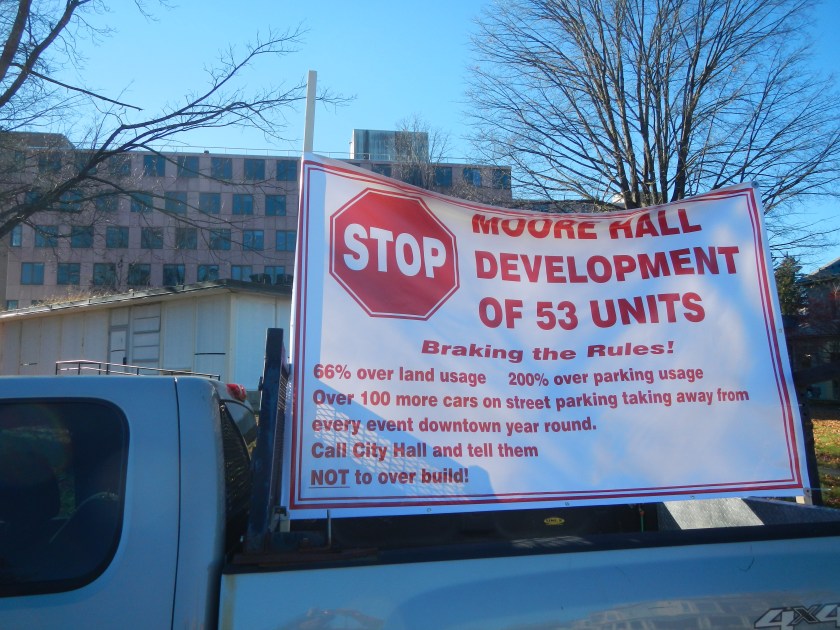
A banner has been positioned in front of Moore Hall.

Banner

The petition drive continues.  If you want to sign the on-line petition you can do so here.

 Petition Link


Great Article By Dennis Yusko of the Times Union Regarding Saratoga PAC and Chamber of Commerce Director, Todd Shimkus

From Dennis Yusko

Saratoga Springs

A bruising election season may not have changed the makeup of the City Council, but it appears to have created a wedge of distrust among business leaders that formed a political action committee and City Council members who were targeted for defeat.

Formed in June, the Saratoga PAC raised more than $56,000 in campaign contributions and endorsed five contested candidates for election. Despite touting their views at public events and on websites, only one of its favored candidates won.

“We were obviously disappointed by the results, but not at all surprised,” said Robert Manz, chairman of Saratoga PAC and COO of D.A. Collins construction company. He said the PAC was “transitioning” to advocacy on a set of issues.

But it’s unclear how much backing PAC members will receive from the five-member City Council after a political season in which some the PAC worked to defeat — Mayor Joanne Yepsen and Public Safety Commissioner Christian Mathiesen — not only survived, but won by larger margins than two years ago. Mathiesen, a Democrat who has led the police and fire departments for four years, said Friday that the PAC had “overplayed its hand” in the campaign.

This is a TU+ story. Click for more information.

“The people who make up the PAC already have an awful lot of influence in city government,” Mathiesen said. “The results show that Saratogians don’t want an entity like that to have too much power.”

One issue that has arisen in the wake of the elections is what role Todd Shimkus, the president of the Saratoga County Chamber of Commerce, played in Saratoga PAC. The chamber claims hundreds of members who pay annual dues, and this year received $375,000 in taxpayer money from Saratoga County, up from $346,500 in 2014. Some chamber members accuse Shimkus of planning strategy for Saratoga PAC and writing blogs on its website.

One member, who asked to remain anonymous for fear of repercussions, discovered Shimkus’ name as an author of blogs in the domain history of the PAC’s website. Shimkus’ name was removed from the WordPress index shortly after a news website, Saratoga Grid, reported its presence. The chamber member said Shimkus had come out very strongly for projects without discussing them among members.

Shimkus, 48, directed questions about his involvement with the PAC to Manz. He said the person who created the PAC’s website accidently included Shimkus’ email address and forgot to delete it, but Shimkus did not write any of the PAC’s mailings or website postings. He said the PAC’s “media vendors” would be identified in its next filing with the Board of Elections.

Saratoga PAC joined the chamber when it formed, and its board members work for companies that are members, Manz said. He said Shimkus offered advice and counsel to the PAC whenever asked. “The chamber helped us as a startup to make some connections,” Manz said. “Todd Shimkus connected us with some people to help get a website established.”

Neither Shimkus nor Manz would address if chamber resources were used. Shimkus did not provide input on endorsing candidates, Manz said.

Shimkus worked with political PACs while employed by the Adirondack Regional Chamber and North Central Massachusetts Chamber, according to Manz and news reports. Shimkus succeeded Joseph Dalton as president of the Saratoga chamberfive years ago.

Mathiesen, a dentist who has been a chamber member for 35 years, said it made a mistake when it hired Shimkus as its director. “I think he is a divisive part of this community, and I have been very disappointed with some of the stances he has taken and his attempt to mischaracterize my position on a variety of issues,” Mathiesen said.

Shimkus said the chamber’s history of success in promoting the area “suggests that divisive is not a word that appropriately captures the great work we do.”

“The chamber is a visible and vocal advocate for our members and the communities we serve,” Shimkus said. “We support initiatives and efforts that we believe will grow our economy and improve our quality of life.”

Yepsen said Friday that while the chamber is responsible for many events that create a positive economic climate, “helping to create the Saratoga PAC does not fall in line with this mission.”

Among those serving on the Saratoga PAC board are Manz, developer Sonny BonacioGary Dake, the president of Stewart’s Shops, and Cindy Hollowood, owner of the Holiday Inn. The PAC is registered as an independent expenditure committee, and, as such, can accept unlimited contributions and spend without limits. The PAC spent more than $16,000 in contributions through early October, according to the state Board of Elections.

Manz said it will now work to support issues: Improving infrastructure, revitalizing South Broadway, making streets safer, reducing panhandling and building support for a destination resort at Saratoga National Golf Club.

Codes? Those are for little people

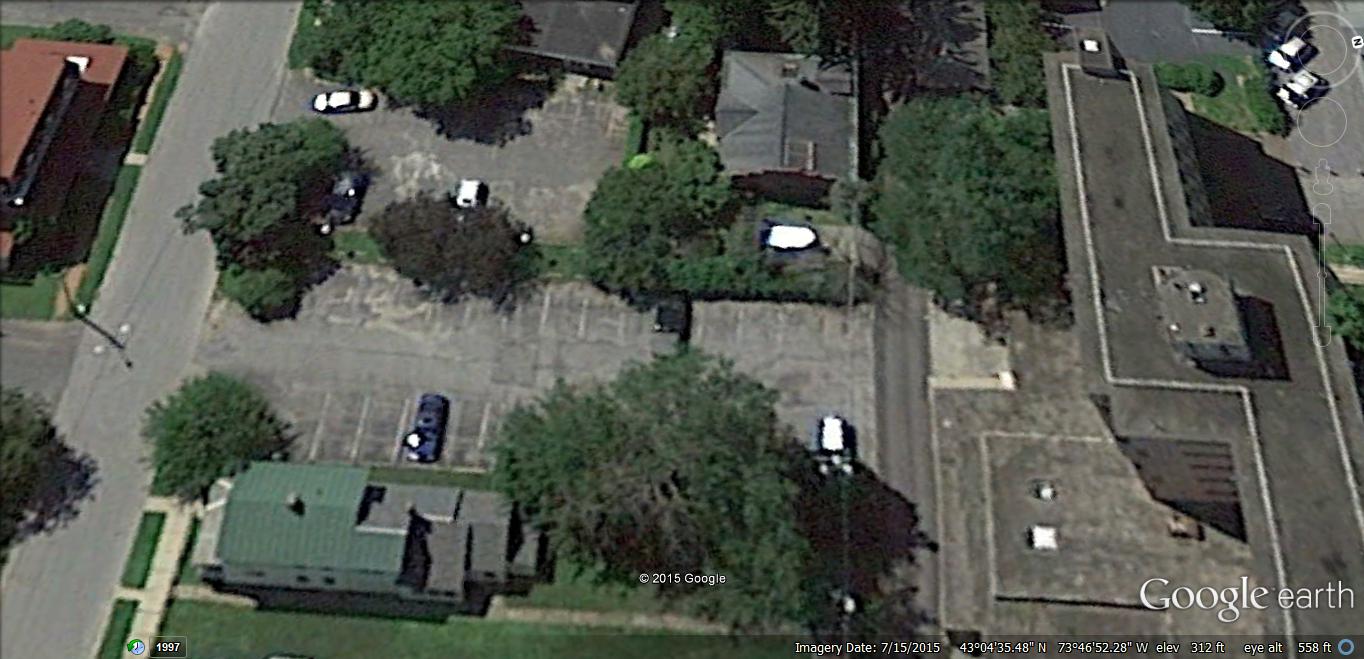
Moore Hall Parking 2

Note the difference in the size of the driving lanes between the parking lot in the upper right and the Moore Hall parking lots in the lower left.  One has generous room for emergency vehicles to operate and the other does not.  (Double click on picture for better view)

Moore Parking

Between the use of the legal loophole for “non-conforming” parcels and the variances being sought by Sonny Bonacio for the conversion of Moore Hall, the project is a study in how to get around the city’s housing codes and zoning standards.

This is not a matter of a few tweaks, this project requires radically dispensing of a host of code standards as will be documented below.

The advocates for this project offer that it is being done in order to provide affordable housing.  This raises a fundamental question about our city’s policy regarding this critical need.  If we are going to dispense with many of our community’s housing standards in order to create such projects, then this should be addressed directly as a matter of established city policy.  Do we want to allow for lower parking standards?  Do we want to allow for large structures with copious tiny units that have different height requirements?   Do we, as a community, decide that the neighbors of such projects must accept that their streets will be designated as the parking for these projects?

Most critically, will we allow for parking lots that have lower standards for the safety of the people that use them and for the neighbors who live by these lots?

A Little Background

Northstar Development bought Moore Hall from Skidmore College to develop luxury condominiums.  The developer was seeking to change the zoning from Educational-Institutional to Urban-Residential four in order to implement their plan.  Since the plan complied with all zoning standards, it met with no opposition from the neighborhood and the rezoning sailed through the City Council.  Unfortunately, there was no expiration date established for the rezoning should the developer fail to successfully complete the project.  With the collapse of the market in 2007 the project died.  Unfortunately, the building remained and it was now a “non-conforming” unit so as long as a developer did not change the footprint, a developer was allowed to ignore most of the code requirements.  The new applicant today is  seeking major variances of the city’s codes for what it cannot achieve as a  “non conforming”

So the current project violates the following codes:

  1.  The parking lot violates multiple standards.  Only 6 of the existing 53 spaces meet the set back requirements of the current code.  Forty-Seven of the spaces are located partially or completely in the set back area.  This is not just a matter of safety (which it is) but setbacks are meant to maintain the aesthetics of the area.  Parking cars up against a neighbor’s property or against the street is a serious eye sore.
  2.  Six of the spaces adjoin North Alley. As they currently exist these infringe on the alley making them a potential safety hazard in general and  in particular a problem for large emergency vehicles.
  3.  The driving lanes between the parked cars are much too narrow.  The city requires that the lanes have a width of 24’.  None of the lanes meet this standard and one is only 15’ 7’’ wide.  That is only sixty-five percent of the standard.  This is a serious danger.  The standard is meant to insure that emergency vehicles can quickly and easily access an area.  The failure to address this is of grave concern.
  4. Making parking spaces too narrow make getting into and out of cars problematic and become an easy source of damage to adjoining vehicles.
  5.  The ceilings in the building do not meet the city’s height requirement.  They are seven and a half feet and may be even lower due to the mechanicals that will be required to heat and cool the building.
  6.   The current code does not allow a structure to exceed twenty-five percent of the parcel.  This project would exceed that standard by over twenty-six percent.
  7. The current code would require that no more than eighteen units be allowed.  This project would exceed that limit by thirty-five units.  That would mean that they would build almost three times the number of units allowed by the code.
  8.  The current proposal does not address the requirement for handicapped parking.  They claim there are fifty-three spaces but as everyone knows, a handicapped parking space is much larger than a regular space.  This is even more problematic given that the spaces the applicant claims to exist are under sized.
  9. The city requires that there be 1.5 parking spaces for every unit.  This would mean that for 53 units there would need to be 80 spaces.  They are short of the required number by 27 according to their calculations which are problematic—see above.
  10. How would the applicant address the snow removal for their parking lots?  Not addressed.
  11. How would the applicant address where trash would be put and how it would be removed?  Not answered.

This project cynically sells itself as “affordable” but in fact when looked at by dollar/space ratio a unit will cost more than some units at the applicant’s project called  Market Center.  Bear in mind that in addition to the size issue, the Market Center apartments come with balconies, reserved car spaces, and washer/dryers.

This project would set a very bad precedent if it were to go forward as is.  Its utter indifference to a neighborhood and the safety of potential tenants if backed by the city’s land use boards would establish a new standard and not one to be proud of.

Moore Hall: Making An Important Issue The Attention It Deserves And What You Can Do

As many of you know who have read my blog, I am not enamored of our land use boards.  Heavily dominated by past Mayor Scott Johnson’s appointments, they are mostly representatives of the real estate and construction industries.  The idea that these boards are made up of impartial people who carefully consider all arguments is an illusion quickly dispelled by those who suffer through their meetings.

In that context, the people concerned about Moore Hall are organizing to bring the members of the City Council to the neighborhood where the building is located to bring this issue before a public forum for a serious discussion.  Hopefully, this will not only be a lively and fairer discussion but it is hoped that it will make it more difficult for the Zoning Board Of Appeals to simply do the bidding of an influential developer.

Commissioner Chris Mathiesen will be bringing this to the agenda meeting on Monday (tomorrow) morning and will also be discussing it on his agenda at Tuesday night’s City Council meeting. 

It would be great to use this type of event as a precedent for future projects.  Consider that today it is the neighborhood around Moore Hall; tomorrow it might be your neighborhood.  Whether you agree with the concerns of the neighbors in this case, I hope you will support the need for them to get a proper hearing.

Please contact the Mayor and members of the Council (preferably today) to urge them to support Commissioner Mathiesen.

This is a link that will allow you to email the members of the council or call them.  Link To Email Or Call Council

Old And New Friends

RonAndBird

I am finally back from Louisiana and away from a hotel that basically made it impossible to properly update my blog.

I thought people would enjoy this picture from the trip.  We were fishing in a bayou about twenty-five miles from the mainland when a bird alighted on my foot.  We think it was a yellow bellied sapsucker.  It proceeded to perch on all three of us in the boat at different times.  My friend, Ron Boutin is an avid bird watcher and thinks it was a young bird.  It was probably using us to rest.

I have a number of pieces to write and will be working on them this weekend.  Stay tuned.


Excellent Analysis By Russ Pittenger of Moore Hall #2

[Due To My Technical Limitations In Louisiana a Fragment of the Original Post Was Lost.   This is the complete version]

MOORE HALL REDEVELOPMENT
ISSUES AND CONCERNS
I have reviewed the submission requesting the Area Variance for the redevelopment of Moore Hall.  I was initially struck by the degree of relief requested in context with the incompatibility of the proposal with the existing Historic District.  In addition, I am frankly alarmed by potential safety concerns regarding the ZBA and Planning Board’s possible re-affirmation of the existing substandard parking layout.  Please consider the following observations.
1.  The area relief requested for 53 units to comply with the requirements of the UR-4 zone is 102,807 SF.  The existing land square footage of 56,192 allows only 18 units while the applicant requests an additional 35 units.  The relief requested is 182% of the base area, or an increase by a factor of nearly three times.  A request of this magnitude is unwarranted and would dramatically effect the neighborhood character.
2.  The existing parking lot layout is substandard and should not be reused without bringing the layout up to code.  It does not comply with current City regulations, nor industry standards.  Only six of the 53 parking spaces existing/proposed respects the setbacks.   Forty one of the 47 spaces in the two lots are located partially or completely within the 20/25 FT property line setback,(87%).  In addition, the 6 non-compliant spaces accessed from the alley are substandard in size and would encroach upon the travel way.  Use of these substandard spaces would impede emergency vehicle access and present a concern for health and safety of both the proposed tenants and the neighborhood residents, not only jeopardizing personal safety but also protection of property.
3.  The existing building does not meet current building set back requirements.  The 20 ft minimum is encroached on by as much as 19′-4″ in one location, (96%), 14′, 8′ and 13′ in others.
4.  In addition, all of the parking spaces in the lots are accessed by driving lanes of varying substandard widths.  All of the spaces.  The city requirement is for the applicant to provide an access lane of 24 Ft.  The existing/proposed lot has lane widths that vary from 15′-7″, (65%!) 17, and 19′-3″  feet. These parking lanes widths are deficient and inadequate for safe vehicle maneuvering.  Any large sedan, SUV or full size pickup would find the lot difficult to maneuver into, or out of, even if a space was available.  These maneuverings would be inconvenient at best and possibly dangerous at worst.  Large vehicles would need to park on the street, thus further exacerbating the street parking issue.
5.  Pedestrian safety in the area of the proposed project is a concern.  There are three schools within one block, with students ranging in age from toddler through high schooler and adult.  The existing crosswalks at Union Avenue and Regent are dangerous to use as the instruction to yield to pedestrians are commonly disregarded by drivers, especially at night.  Adding an additional 100 vehicles to this equation will not improve a currently difficult situation.
6.  The existing parking layout is outmoded and frankly, unsafe.  Firefighters and EMS personnel cannot properly access the parking lot in the event of a car fire, vehicular accident or if a resident in the lot is stricken by a health emergency.  Approval of this project will certainly impact the ability for rapid response teams to serve the project.  The liability of perpetuating this substandard condition rests with not only the applicant but the approval boards and the City as well.
7.  The existing building also exceeds the required lot coverage.  Required: maximum 25%.  Existing/proposed:  31.4%, overage percent of deficit:  26.5.
8.  The density of the proposal, the sheer number of additional people, would severely upset the balance of the neighborhood, nearly doubling the population on the block as a result of a single property.  The units are designed as one and two bedroom.  Singles, couples, young families and retirees would be the likely renters, raising the potential resident population to well above 70, perhaps over 100.  How many of these tenants would have children? How many dogs would be added to the street? Twenty?  Forty?
9.  Inadequate numbers of on-site parking spaces would adversely impact the neighboring residential properties.  Once the project lot fills up, the thirty or more additional cars would logically seek the next closest parking spaces on the street.  While car counts by the applicant indicate that on-street  parking  is available within 400, 800 or 1600 feet, the inconvenience to existing residents would be potentially profound.  That a single family homeowner would then be forced to double park to unload groceries and then drive around the block to find a space to park during the racing season is accepted.  But to have that become the new, year-round normal condition is simply untenable.  Retired persons, the infirmed and young families with children who find themselves unable to park in front of their own home in inclement weather would have an unacceptable burden placed upon their day-to-day existence, all to facilitate the desires of a single, absentee owner.
10.  Fair is fair!  If this project were approved, with all it’s numerous existing limitations, the ZBA would then be forced by precedence to allow any and all other properties in the city to expand their density to three times the allowed number or face a legal challenge.
11.  Contrary to the applicant’s opinion, this project must be reviewed by the Planning Board.  The current existing condition does not provide Handicapped spaces as required by code at a ratio of 1 per 25 cars, (or portion of 25).  The proposed unit count of 53 requires 80 spaces at 1.5/unit and four of those spaces would be required to be signed and striped for H/C use.  Adding striped loading lanes for the H/C spaces would further reduce the number of parking spaces provided on site by at least two.
12.  All night long lighting for security would adversely effect the residential character of neighboring properties.
13.  The sheer density of the project would increase traffic, hours of activity and ambient noise.  The commercial apartment-complex character of this proposal would have an adverse, disruptive effect upon the neighborhood character, ultimately impinging upon the rights of the adjoining residents to enjoy their homes in the reasonable manner they have come to know and should be able to expect.  Zoning should protect neighborhood character.
14.  Snow removal operations were addressed in an off-handed remark by the applicant as “the snow would be transported off site”, although this may be easier said than done.  The lots still need to be plowed, the snow piled up, all the cars moved to the street, pay loaders brought in, dump trucks backed, loaded and the snow hauled away, etc.  The site is so restrictive, so tight that there is no place to pile the snow, park the loader nor maneuver the loading operation without impacting the neighborhood with a commercial operation.
15.  Trash removal, dumpster location and garbage truck access has not been addressed. No location for daily waste removal has been provided nor demonstration that the improvements do not adversely effect the neighboring properties nor impede upon the alley fire lane.  Clear and open access for fire fighting equipment must be maintained. Also a plan for service vehicles, deliveries, and employee parking should be provided.
16.  The interior ceiling heights of 7.5 FT do not meet code and I understand those clearances will be further reduced by mechanical systems added during the retrofit.
17.  The existing building is an incongruous eyesore and detracts from the entrance to our city.  This is an historic district and precious gateway that must be protected and enhanced despite efforts by many who act as if the Comp Plan is flawed, but then wrap themselves in it as if it were a flag when the situation suits them.  The ‘City in the Country’ slogan was intended to preserve and protect green space, not meant to encourage high rise housing within the city, despite assertions to the contrary by the applicants and even some board members.
18.  The determination that this project is a Type-2 action under SEQRA is inconsistent with other projects of this scale and scope, leaving the review board’s decisions open to legal challenge.  The 2006 zone change recognized the potential impacts of an 18 unit conversion and deemed the action at that time to be a Type -1.
19.  It is disingenuous for the applicant to tout both the previous use as a dormitory in one breath and then to stand firm on the 2006 zone change to UR-4 in the next.  It can’t be both.  Like a border bandit, the applicant’s attorney strikes and then recedes across the boundary when the argument suits his purpose.  As a dormitory, the building was located upon a campus, amid other college buildings.  Parking was controlled by the college, was by permit only and very few of the students owned cars.  In addition, the building was all but empty during summer months when school was out and the track was open.  In the mid fifties, any development was good development.  But it is no longer the fifties…we should be looking toward the next sixty years, not reinforcing and preserving the mistakes of the past.  In addition, we all recognize that the zone change to UR-4 was only done to facilitate the building’s demolition and the site redevelopment into more human-scale buildings.  That was the project that was approved and prompted the zone change.  That the condominium market is currently soft is regrettable, but neither the city regulations nor the Eastside residents should be forced to capitulate to favor a particular application.  This proposal doesn’t merely bend the rules, it shatters them well beyond the breaking point in a desperate attempt to shove this square peg into a round hole.
20.  The UR-4 zone is intended for multi-family.  The number of units allowed is determined by lot size, square footage.  While the term ‘multi-family’ clearly means more than one, it shouldn’t be construed to mean ‘unlimited’.  I ask the review boards to reject this proposal.
Respectfully submitted,
Russell Pittenger, Landscape Architect and concerned neighbor