So Exactly What is the Asking Price for Moore Hall?

At the Saturday meeting, members of the City Council worried publically that if the Bonacio proposal for Moore Hall were not approved, the cost of demolishing it could mean that the building would stand indefinitely as a rotting hulk.  This prompted me to wonder just how much has Norstar been asking for the Pink Palace?

The result of my attempt to find out is in the email below that I have sent to the members of the City Council and to the Zoning Board of Appeals:

We know that Norstar Development  paid Skidmore College $1,250,000.00 for Moore Hall.  What we do not know is what price they have been offering to sell it for during the last ten years.  We also are in the dark as to how much Bonacio Construction has offered for the property.

At Saturday’s neighborhood meeting with the City Council a number of commissioners expressed concern that the costs associated with the demolition of Moore Hall might make an alternative to the plan Bonacio was offering prohibitive.  The fear of course, encouraged by Norstar and Bonacio Construction, is that if they are not allowed their variances, Moore Hall will sit idle and deteriorating forever.  Given the fact that nothing has been done to the building in ten years, this narrative has an easy appeal.  Unfortunately, this scenario has never been soberly scrutinized.  As public figures who manage complex offices, the members of the City Council should know better than most the risks of drawing conclusions based on assumptions.

Following Saturday’s meeting I began making inquiries about how much Norstar Development is asking for the Moore Hall parcel.  I was amazed to find that there are no available records stating an asking price.  An internet search produced a resolution by the State University of New York to authorization the purchase the property for about two and a half million dollars back in 2011.  Subsequent searches, however,  failed to reveal why the sale did not go through.

I spoke to several local realtors and asked if the property had ever been listed locally.  The answer was that neither of them had ever seen an offering for it.  Both noted that they follow the local market closely and neither could recall any offering of the property let alone a price.

I then spoke to a friend who is a major developer.  He told me that it would not be offered under a local listing for a variety of reasons.  He told me that the closest thing to a listing for a parcel like Moore Hall would be by one of the national real estate firms that specialize in large, multi-family buildings.  He also had never seen any offering of the property.

He explained that with a building like Moore Hall a developer would use his contacts and his knowledge of the industry to periodically check for interest when the developer felt the market conditions were favorable.

So the reality is that we really do not know what Norstar has been asking for the property.  My friend noted that Moore Hall sits in one of the prime locations in Saratoga Springs making it a very desirable piece of land.  It is not at all unusual in the real estate industry, he told me, for an owner of such a parcel to hold the property for years in light of its potential.   Much depends on what the carrying cost and taxes are.

It is also very important to note that we have no idea what Bonacio Construction has offered Norstar as part of their agreement.

My friend offered the obvious: If Norstar is holding the property and paying the carrying costs and paying the taxes it is because they believe that at some point they can sell it or develop it.  The only way to get an honest sense of if viable alternatives might exist for the property would be to press Norstar on how much they have been asking for the land and to document how rigorously they have marketed it.   Lacking that information any assumptions about the potential for plans other than what Bonacio is offering to do with the parcel are simply blind guesses.

While it is to the developer’s advantage to promote the narrative that Bonacio Constructions proposal is the last hope for development of the property, the process would be better served if the members of the Council refrained from offering credibility to what can only be conjecture.


Big Community Turn Out For City Council Moore Hall Meeting

[CouncilMembers

[From left to right: Franck, Madigan, Yepsen, Scirocco, Mathiesen]

TonyIzzo

[City Assistant Attorney, Tony Izzo]

SiteVisit

[Council Members “inspect” site]

Neighbors

NeighborSpeaks

[Community Turns Out In Force and Addresses Council]

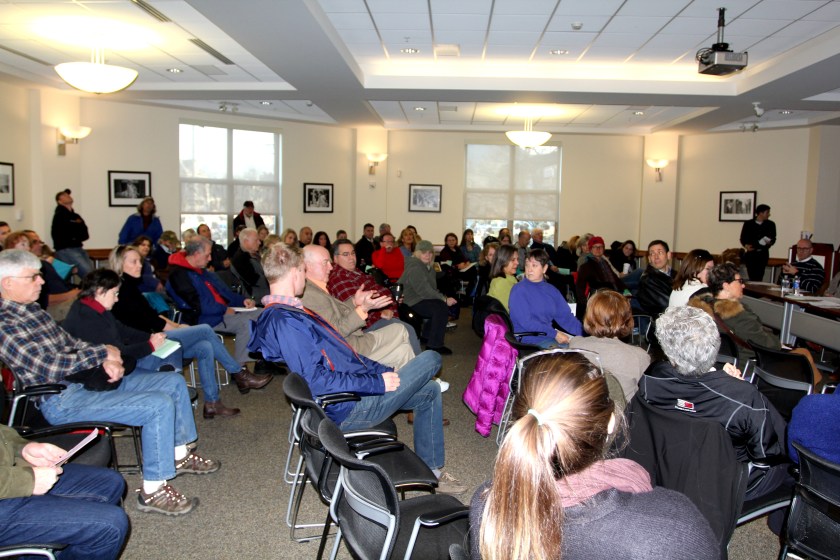
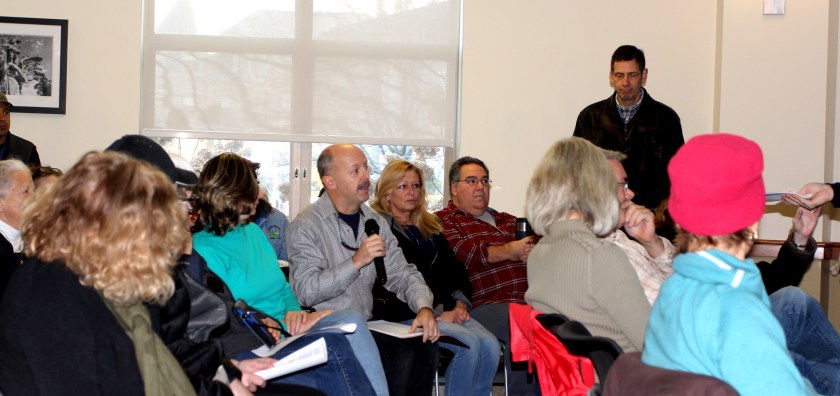
The City Council convened the meeting at the Empire State College auditorium on Saturday morning to hear neighbor’s concerns about Sonny Bonacio’s plans to re-purpose Moore Hall.  After the pledge of allegiance, it was announced that Council members would be leaving to visit the Moore Hall site and that the people attending the meeting could not join them because only the Council had permission to go onto the site.   This was unfortunate because there are many problems with the site that a number of particularly well informed members of the audience could have pointed out to them.

When the Council members returned, the Mayor explained that the meeting would follow the normal procedures.  The attendees would be allowed two minutes each to address the council.  Assistant City Attorney Tony Izzo then explained that the land use boards were independent bodies created by the Council.  He noted that the Council could dissolve these bodies but the City Council cannot use its authority to dictate to these boards.  In answer to a question, he acknowledged that there was precedent for a City Council to sue its own boards to overturn a decision.

Over the next forty minutes many spoke to the Council.  It was really a rather Jimmy Stewart “Mr. Smith Goes To Washington” experience.   Every speaker expressed their concerns thoughtfully and with dignity and sincerity.

This blog has already gone through the issues that concern the neighbors about this development so I will not repeat them.  What was important at this meeting was that the attendees fully understood that the Council could not overrule the Zoning Board of Appeals.  What the Council was asked to do by a number of speakers was to use its status as the elected representatives of this city to urge the ZBA not to grant the waivers on the basis of the arguments put forth at the meeting.

Before going over the statements made by the Council following the public comment period, a little history is in order.  Apparently on Friday (the day before this meeting) the City Attorney who works under the Mayor contacted members of the Council advising them that they should refrain from making statements at the neighborhood meeting about the Moore Hall proposal because of potential litigation that might follow a  ZBA decision.

The timing of this advice seems rather odd.  Commissioner Mathiesen had discussed having this meeting in the neighborhood at the Council agenda meeting last Monday and at the Tuesday night City Council meeting.  Concerns about the degree to which the Council could comment at the neighborhood meeting never arose. Commissioner Mathiesen discussed reservations he had about the Moore Hall Project at both Council meetings and nothing was said about the risk the city might face by him expressing his opinions. In fact, in light of the many controversies, especially over land use issues, commonly discussed at Council meetings this seems especially odd.  It was fully assumed that the Council would not only hear from the neighbors but would engage in a discussion about the Moore hall proposal at Saturday’s meeting.  If the Council would in effect have a gag rule imposed then everyone deserved to know this prior to attending the event.

As it turned out, the Council did discuss the project.  I think their willingness to enter into a discussion can be understood by a comment by Commissioner Madigan when she said “I never expected to see this many people at this meeting.”  Given the size of the crowd and the substance of their many comments, it would have been hard to imagine Mayor Yepsen being able to credibly simply thank people for coming and close the meeting.

What They Said

Mayor Yepsen made one significant admission.  She agreed that the proposed units cannot be characterized as “affordable housing.”

In an interesting development, she reported that the planning office (in response to correspondence from the neighborhood group)  is now requiring the applicant to secure yet a third variance from the Zoning Board of Appeals having to do with the many problems with their plan for the parking lot.

Other than that she said nothing to acknowledge that she had any specific problems with the project only noting that there were “may things to look into.”  Mainly she congratulated the attendees for coming out and she spoke about her plans to bring affordable housing to the city.

Commissioner Franck recalled that he was on the City Council when it approved the change in the zoning for the parcel in 2006.  He said that his support had been primarily motivated by the applicant’s promise to remove the Pink Palace from the site.  He said he had been quite skeptical about the financial viability of the original proposal.   The significant issue here is that it confirmed that the approval of the zoning change was based on the assumption that Moore Hall would be demolished.

Commissioner Scirocco was refreshing in that he made clear that he thought the project was inappropriate and he shared the neighbors’ concerns.  He said that while the Council could not require the ZBA to deny the project that he would communicate his concerns to them.   He received a warm round of applause.

Commissioner Madigan praised the crowd for their attendance and for their thoughtful remarks.  She reminded the crowd that they needed to bring their concerns to the ZBA.  She made no reference to any specific problems with the project.

Commissioner Mathiesen  noted that the Council had no authority over the Zoning Board of Appeals.  He discussed the challenges that would attend the cost of demolition.  He noted that he had serious concerns about many aspects of the project.

Originally, I held little hope that the Zoning Board of Appeals would deny the variances being requested by Sonny Bonacio.  After all, the ZBA is dominated by the real estate industry.  I feel cautiously hopeful now.  The combination of the clearly demonstrated broad opposition to the project, the very poor job the applicant has done in the design for the project, the extreme scale of the variances they are asking for, and the great job done by members of the community to research and document the flaws in the project, has created an overall case that makes it very hard for even the ZBA to approve this proposal.

Wonder Who Saratoga PAC’s #1 Target Was?

PACs must report to the New York State Board of Elections how they allocated their money in support of candidates (Who they do not coordinate with…wink wink).

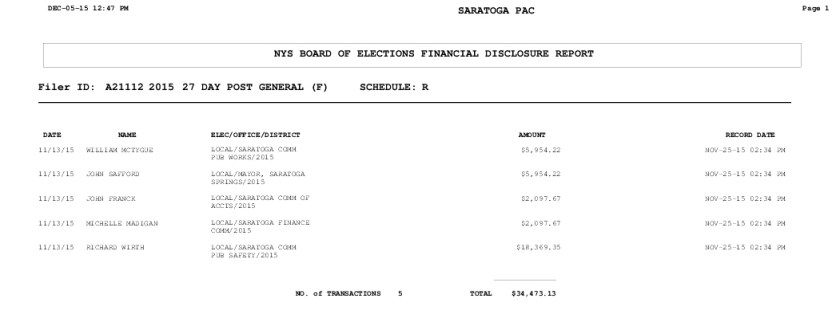
This is a copy of the Saratoga PAC’s report to the NYSBE for the 2015 elections.

SaratogaPac

The image is hard to read so here are the key numbers.

Candidate                                                           Spent

Michele Madigan                                             $2,097.67

John Franck                                                        $2,097.67

Bill McTygue                                                       $5,954.22

John Safford                                                      $5,954.22

Rick Wirth                                                            $18,369.35


John Franck had no opponent and Michele Madigan had a very weak opponent.  They received the least support.

Bill McTygue and John Safford received more support but still pretty modest.  Joanne Yepsen did everything she could to support the Casino expansion without being too obvious and she has been very protective of Saratoga National Golf Course. The PAC also might have felt she was likely to win. These are the only explanations I can think of for the PAC’s tepid support for her opponent. As for the Public Works race,  Skip is, after all, a Republican, he went to their fundraiser and again was going to be the likely winner which may explain the modest support for his opponent.

Not surprisingly, the number #1 target of the PAC was Commissioner Chris Mathiesen.  They gave Rick Worth a whopping $18,369.35.  Mathiesen along with Scirocco have been the two elected officials who have steadfastly protected the greenbelt.

Congratulations to Chris Mathiesen for being the #1 PAC target and for winning the election.


Moore Hall Future #2?

I received another email from Sonny Bonacio.  He indicated that his team was “regrouping” to come up with some new solutions in response to the criticisms offered at the last Zoning Board of Appeals meeting.

As Yogi Berra wisely observed: “It ain’t over ’til its over.”

Moore Hall Project Future?

I had been corresponding with Sonny Bonacio on whether he would be attending the Saturday morning meeting.  This morning I received an email from him saying his company’s proposal for Moore Hall had been pulled from Monday night’s Zoning Board of Appeals meeting.  He indicated that he was unsure when they would be back in front of the board in the future.

I understood from the last ZBA meeting that two of the members would not be attending the Monday night meeting so I thought board itself might delay a vote.  Still, Sonny’s indication that there were no current plans to go back before the ZBA could imply that he may scrap the project.

City Council To Venture Out To Meet On Moore Hall Project

The City Council will be meeting on Saturday morning at 10:00 at Empire State College’s auditorium at 2 Union Avenue.  The subject of the meeting will be the Bonacio proposal for Moore Hall.  The City Council invited Sonny Bonacio to attend but as of the Tuesday night he had declined.  I had heard that he was concerned about the attorney that had represented the neighbors being at the event.  I sent him an email advising him that the attorney would not be there but based on his response, I do not expect him to attend.  I am intrigued by his decision not to attend a City Council meeting that will be discussing his project. 

It should be an interesting meeting.   It is common knowledge that the current land use boards are dominated by the real estate industry as a result of Scott Johnson’s appointments during his two terms.  Even though the City Council members are mostly Democrats, it very much remains to be seen how they will respond to what is a potential abuse by the Zoning Board of Appeals were they to grant the variances sought by Sonny.


Skidmore Students Very Interesting Study of 2015 Election

Bob Turner is a professor in the political science department.  Last night he and his students presented the result of their finding on the 2015 city elections.  It is well worth reviewing.

Among the highlights of their findings are the decline in the Republican enrollment in our city.  Based on their data, it appears that the independents and Democrats were both the beneficiaries of this development.

It also appears that the two main issues of concern to the voters in the district were taxes and protecting the city’s greenbelt.  They also found that across the spectrum politically, there was hostility to the increasing role of money in elections.  This relates to the establishment of the super PAC and the failure of most of their endorsed candidates to win office.

There is a whole lot more in the study which is linked to here.

They have broken it up into several parts so you need to access them all.  Also Dr. Turner indicated that they would try to provide a link to the video of last night’s presentation.

New York Times On Decline of Golf Courses And Their Agressive Strategies To Survive: Saratoga National Golf Course?

The article below was taken from the business section of the November 25th edition of the New York Times.  Due to the NYT policies you may or may not be able to view the full article with photographs so I have pasted most of it below.  Here is a link to the NYT story.  NYT Article

The gist of the story is that in absolute numbers there has been a decline in the number of golfers in the USA.  It documents the fact that many courses are closing and that those that survive are diversifying.  They are adding swimming pools, fitness centers, retail, hotels, etc.  If this sounds familiar it is because this appears to be the path of our own Saratoga National Golf Course.  This is the same project that originally promised the city how modest it would be and how well it would fit in with the low intensity character of our greenbelt.  Clearly a very large camel’s nose has gotten into our city’s tent and the very large body is not far behind unless the community acts to defend its conservation district.

Golf Courses Forced To Reach Into Bag Of Tricks

By NICK MADIGAN NOV. 24, 2015

NOV. 24, 2015

BOCA RATON, Fla. — Weeds, crabgrass and fallen palm fronds cover the wildly overgrown greens of what was once the Mizner Trail Golf Club, its decrepit state emblematic of the fate of hundreds of golf courses around the country, many of them derisively known as “rabbit patches” or “goat farms.”

A short drive away, however, perspiring construction workers in yellow vests swarmed on a recent afternoon over the emerging structure of a 150,000-square-foot activities center, part of a $50 million renovation of the 44-year-old Boca West Country Club, home to some 6,000 residents, where fairways are newly planted and houses sell for as much as $5 million.

With the winter golf season beginning in Florida — the nation’s leader in golf courses with more than 1,000 — the extremes of failure and success point to a nationwide upheaval in the sport. It was booming when players like Tiger Woods reigned, but has since been roiled by changing tastes and economics, an aging population of players, and the vagaries of the millennial generation’s evolving pastimes.

There are about four million fewer players in the United States than there were a decade ago, according to the National Golf Foundation. Almost 650 18-hole golf courses have closed since 2006, the group says. In 2013 alone, 158 golf courses closed and just 14 opened, the eighth consecutive year that closures outpaced openings. Between 130 and 160 courses are closing every 12 months, a trend that the foundation predicts will continue “for the next few years.”

Dozens of private and public golf courses here in South Florida, and hundreds around the country, are in transition. Some courses have sought bankruptcy protection, while others have slipped into foreclosure. Many are under construction, with single-family homes and condominiums going up on land once dotted only with pin flags, sand traps and water hazards. Others have gone to seed as they await resolution of legal and zoning disputes.

Many clubs have survived by lowering sign-up fees and other costs, reducing the number of playable holes, and offering family-friendly amenities and activities that go far beyond hitting a ball with a 9-iron.

“Some courses are adapting, others are just not,” said Paul H. Chipok, a lawyer in Orlando who specializes in land-use and environmental issues. “It costs $100,000 a month to operate an 18-hole golf course — mowing the grass, fertilizing, regular maintenance. And that’s not including capital improvements. You need a lot of green fees to cover that.”

At private courses, members may be willing to pay more if necessary “because they expect a certain level of service,” Mr. Chipok said. “But courses that are open to the general public may not have the money to keep up their maintenance, and with less maintenance, the courses look worse and so they have to charge less to play on them. It’s a vicious cycle. This is the correction phase we’re going through now.”

Lesley Deutch, a senior vice president in the Boca Raton office of John Burns Real Estate Consulting, said the “old model” of private golf clubs with high initiation fees and “very exclusive” memberships is in decline.

“I don’t think the industry is over,” she said. “I think it’s just changing.”

In South Florida, where buildable land is fast disappearing, developers see golf courses as wasted space. Vast swaths of land that were once pristine courses in the middle of residential communities are becoming highly exploitable territory — prime opportunities for profits much greater than what fairways and putting greens can provide. As a result, the fallout of the downturn in the sport has been felt most keenly by residents of communities where the holes are no longer being played, primarily because the value of their homes often drops markedly once the course has closed.

“There are big issues, and they’re being fought and litigated,” said Steven M. Ekovich, a broker based in Tampa, Fla., who represents sellers of golf courses. “Homeowners paid a 20 or 30 percent premium for a golf-course lot, and suddenly a developer comes in and wants to build in front of them. There are big fights over that.”

A faded cart warning sign along the road leading to what once was the Mizner Trail Golf Course. Credit Ryan Stone for The New York Times

A few miles south of here, in Tamarac, the owner of the Woodmont Country Club, Mark Schmidt, faced stern opposition from some of the club’s homeowners to his plan for the course, which involved reducing the 36 holes to 18, putting up a four-and-a-half-acre commercial center, and building 152 single-family homes — in addition to the 1,900 houses already there. The plan was ultimately approved last year, but city officials have since balked at the owner’s proposal to build a 120-room hotel on the site.

“There’s always resistance,” said Mr. Schmidt, who bought the Woodmont property 10 years ago. “The cost of operating a golf course today is very difficult, so the land is being put to better use. As much as some people lost their views, others have gained better views. No point in allowing the land to remain fallow.”e Global Marketplace since 1968

Like other golf club owners who foresee an upside in expanding their offerings, Mr. Schmidt said he was building a new clubhouse and fitness center, as well as a new swimming pool. “Without these adjustments, golf would be in desperate trouble,” he said of the industry in general. “This is an absolute necessity.”

City officials in Tamarac have been dealing for years with turmoil on golf courses, particularly after the closures of the Monterey and Sabal Palm clubs. Three city commissioners were charged with receiving bribes from developers who sought to build houses on the properties, and there were numerous complaints that interlopers on motorcycles and all-terrain vehicles were racing around the weed-covered greens. Developers were eventually permitted to build hundreds of homes on the two former golf courses.

To prevent similar headaches on another property in Tamarac, the 275-acre Colony West Golf Club, the city itself bought the course in a 2011 short sale for $3.3 million. “We wanted to control the real estate,” Michael C. Cernech, the city manager, said of the championship course, which opened in 1971 as host to the PGA Tour’s Jackie Gleason Classic, now known as the Honda Classic. Under a five-year contract, management of the course was turned over in 2013 to the Virginia-based firm Billy Casper Golf, which runs about 140 courses nationwide.

Michelle F. Tanzer, a Boca Raton lawyer who represents resort developers and owners and sits on the board of the National Club Association, has helped country clubs adapt to what she said is growing demand for fitness facilities, resort-style pools, water parks and improved dining choices in places where previously only golf was the norm. The golf industry, she said, is “doing much better than it’s looked since 2009.”

The Boca West Country Club’s heavy investment in its facilities, Ms. Tanzer said, “is a perfect example of adapting” to the changing economics of golf. “They’re spending a fortune on making the place family-friendly,” she said. “It’s a home run.”

At Boca West, where it costs new members $70,000 to sign up, Jay DiPietro, the club’s 78-year-old president and general manager, suggested that the troubles besetting some of his competitors could be blamed on poor management and on their focus on “the business of selling houses.” But he operates on a different principle, he said.

“We’re in the people-pleasing business,” he said. “These people paid a lot to be here.”

Construction is taking place at Boca West in Boca Raton, home to some 6,000 residents, where fairways are newly planted and houses sell for as much as $5 million. Credit Ryan Stone for The New York Times

In any case, Mr. DiPietro said, the golf industry was vastly over-supplied with courses. “It was just waiting for a recession to knock the hell out of it,” he said. “The recession separated the boys from the men.”

Oliver K. Hedge, who appraises golf course properties for the real estate brokerage firm Cushman & Wakefield, said the golf industry had “made great strides” in shaking off underperforming courses in the last few years.

“A lot of clubs that have closed really should have closed,” Mr. Hedge said. “Florida is a good microcosm of the nation because we’re so dense with golf courses.”

Many of the closures, he said, have involved public and semi-private courses, the latter a reference to clubs that have an active membership program but that let non-members play for a fee.

In 2009, under what Mr. Hedge called “the prior economy model,” the Marsh Landing Country Club, a private course 300 miles north of here in Ponte Vedra Beach, Fla., charged a $100,000 initiation fee, 90 percent of it refundable upon resignation. Dues were $6,612 a year. Today, that same membership costs $25,000, but it is non-refundable, while annual dues have gone up to $8,400.

Still, golf clubs are “just scratching out a profit,” Mr. Hedge said from his office in Orlando. “Golf is a razor-thin industry from an investor standpoint. I hardly ever advise investing in a golf course. You’ve got to really know what you’re doing, and you’ve got to have a razor-sharp pencil. You might spend $20 million to $30 million to build a private country club — if you can clear 7, 8, 10 percent, you’re lucky. There are huge fixed costs. You could have a club that’s doing $10 million in revenue, but you’ve spent $9.9 million to get there.”

A developer known to be bullish on golf is the ubiquitous Donald J. Trump, who in 2012 added to his portfolio of 14 courses by purchasing two more in Florida, the Ritz Carlton Golf Club and Spa in Jupiter and the Doral Golf Resort and Spa near Miami. (Another renovated Trump course in Virginia has created a bit of a stir with a revisionist history of the Civil War.)

The price of the Jupiter resort — now known as the Trump National Golf Club — was not disclosed, although Mr. Trump’s company invested about $20 million in renovations for the course, clubhouse and amenities, according to Mr. Hedge.

The developer invested far more — some $250 million — in fixing up the four-course Doral resort, after buying it out of bankruptcy for $145 million. On Oct. 23, during a presidential campaign appearance at the resort, now called Trump National Doral, the candidate boasted of his negotiating skills in whittling $25 million off the asking price of the property.

“The key to the success of these ventures was the broader market timing,” Mr. Hedge said, referring to the two Trump resorts. “I assume they saw the luxury golf market returning, which it has done.”

Mr. Ekovich, the golf-course broker in Tampa, was slightly less positive in his estimation of the market’s strength.

“Revenues are up a little bit, and so are rounds,” said Mr. Ekovich, who noted that during the years of the recession the price of some golf courses had “cratered” to about half their former value. “Things are moving in the right direction, but they are by no means meteoric rises.”


The Very Interesting Encounter Between the Neighbors of Moore Hall and the Zoning Board of Appeals

ZBA Hearing

There was a very impressive turn out by the community for the Zoning Board of Appeals hearing on Monday, November 23, regarding Sonny Bonacio’s proposal to redevelop Moore Hall.  Many of the neighbors arranged to meet prior to the meeting and to enter en mass.  It was apparent by their expressions that the ZBA board was rather taken aback by the dramatic entry.  The community members filled the seats and some had to stand.  Unfortunately, the camera only focuses on the front of the room so those viewing the meeting on line do not get any of this.

The neighbors also submitted a petition with four hundred and fifty-eight signatures.

When you factor in the extraordinary number of signs all over the area, this group has demonstrated that there is extensive opposition and that this opposition runs very deep.

The Applicant’s Presentation

The Zoning Board of Appeals meeting began with a very long presentation by the applicant.  The speakers included Sonny Bonacio (he is the construction person and it appears has an option to purchase the property), Michael Toohey (attorney), Richard Higgins (North Star Development and owner of the property), and Michael Ingersol (with the landscape architectural firm LA Group).

Toohey made a long recitation arguing that the property would fulfill the Comprehensive Plan’s goal of re-use of existing properties.  He reviewed the history of the property emphasizing that when it was a dormitory it had some four hundred student occupants.  He also emphasized the work that the applicant had done in addressing the Planning Board’s concern about parking for the project.  Following him, Ingersol noted the changes they were making to the parking lot.

The changes to the lot involve making the lanes one way and angling the parking to allow for larger spaces and wider lanes.  The revised plan also calls for making North Lane a one way street.  Most interestingly, they plan to put some parking in the front of the building (Union Avenue).  This idea of parking cars in the front of the building had been dismissed because of its proximity to Union Avenue.  The Planning Board had said they would consider parking in front of the building.  At the time, the discussion was prompted by the idea of removing the one story annex that had been the dining hall in order to reduce the need for off-site parking.  Ingersol noted that modifying the existing lot would reduce the parking spaces to forty-eight so the additional nine spaces that would go on the Union side building would bring them back up to approximately the number of spaces originally proposed.  This is important because otherwise they would need to ask for a greater variance.

It was interesting that Ingersol admitted that the proposal was sketchy and that it was subject to being “picked apart.”  I would note that this kind of caveat is consistent with the applicant’s manipulative approach to the project.  Of course he did not direct the ZBA to the aspects that might be problematic nor did the ZBA ask him about them.

Here is a sketch provided by the applicant of the proposed solution.  Note the cars that back out directly onto North Lane (alley).  There is no buffer.  These cars will have problems seeing approaching cars because their view will be blocked by the cars on either side of them.  Also, since there is no buffer between the streets and the back of the cars, they represent a hazard that normally the city codes would not allow.  This is obviously a serious potential problem but the Zoning Board of Appeals had no questions.

ParkingLot

The fact is that the lot as originally proposed did not stand up to the most cavalier scrutiny when it came to safety.  Only after the chairman of the Planning Board raised it as an issue that needed to be addressed and the neighbors made it a major point did this prompt addressing the issue.   Mr. Ingersol was also aware that Russell Pittenger who had been a principle with the LA Group, had written a damaging critique of the lot and was in the audience.  How the LA Group could have originally tried to slip in a lot that was clearly dangerously designed says something very damaging both about the applicant and the LA Group.

It still remains to be seen if Design Review will approve a lot on Union Avenue.  The developer emphasized that they would landscape the front to minimize the impact of the lot.

When Sonny Bonacio spoke he first addressed the the density issue noting that the earlier North Star proposal for eighteen units included roughly as many bedrooms as the current proposal.   This not surprisingly drew a loud reaction from the crowd.  The chair of the ZBA chastised the audience.  It is important to remember that the North Star proposal had been for only eighteen units priced at $850,000.00 to $1,600,000.00.  One would expect that many of the bedrooms in these units would be for guests or family members who were children.  The proposal also had adequate underground parking.   I think this gives you a flavor of the liberty that the applicant takes when making arguments for his proposal.

Mr. Bonacio also testified that any change in the number of units would result in the project being financially not feasible.  He claimed that of the original four banks that had been considering the project, they were down to one.

The Zoning Board’s Discussion

In the ensuing discussion by the Zoning Board of Appeals members they raised a number of issues.

One member tried to help the applicant identify additional spaces.  I guess he lacked faith in the LA Group.  Each of his suggestions turned out to be untenable for one reason or another according to Mr. Ingersol.

One member explicitly expressed great concern herself over the density.  She indicated that she found it difficult to accept.

Another board  member noted that in business there is always some give and take and that he found it hard to accept the applicant’s rigidity on the size and scope of the project.  Mr. Bonacio reiterated that his project could not be reduced in scope.  The member then offered back, “so it is fifty-three [units] or nothing?”  Mr. Bonacio responded that while he did not enjoy hearing it characterized that way, that it was, in fact, accurate.

Another board member noted that due to all the outstanding questions about making the parking lot safe, it was unclear what final parking variance the applicant would be requesting.  Chairman Moore dismissed this concern saying that they should decide on the issue now and if the site plan review by the Planning Board were to result in a reduction in the allowable parking spaces, the applicant could come back to the ZBA for a different parking variance.

The last board member to speak said that his primary concern had been parking.  He said that he had repeatedly driven through the neighborhood on a variety of days and times.  He said he found that there were many empty parking spaces and that he no longer considered on street parking an issue.  As noted in an earlier post, this member of the board was seen drinking with Mr. Bonacio and Mr. Higgins following the meeting.

The Public Speaks

The first speaker was John Hayko, the attorney hired by the neighborhood.  As an interesting note, board chairman William Moore asserted his authority by setting a two minute limit on the speakers.  Given the large number in attendance, this was not an unreasonable limit.  It was, however, very troubling that he also attempted to limit the attorney to two minutes.  The applicant was given unlimited time to do their presentation.   In contrast, Mr. Moore attempted to cut the community’s attorney off at the two minute mark in spite of the fact that he had clearly not completed his statement.  Only after a very noisy outburst from the crowd and the offer of several people to give the attorney their allotted time, did Mr. Moore allow the attorney to continue.

This attempt to cut the attorney off raises serious questions about Mr. Moore’s attitude.  To begin with, one would have assumed that he would be interested in hearing a well argued legal rejoinder to the applicant’s proposal.  There is also the simple issue of fairness.  Clearly the community had invested considerable money to be represented at this hearing and Mr. Moore’s apparent indifference speaks volumes about his approach to this issue.  As if this were not bad enough, he interrupted the attorney when he was reviewing with the ZBA the statements made by the earlier ZBA in 2006 when they agreed to change the zoning to UR4.  Mr. Moore challenged the attorney as to the relevance of his remarks to the variances.  This, after the applicant’s attorney, Michael Toohey had rambled on at great length about the history of the project beginning in the 1950’s.  You cannot make this stuff up.

William Moore is a licensed real estate appraiser.  This is a classic example of a person who is an integral player in the real estate industry.  The problem of having this man chair this important land use board is manifestly clear and he truly demonstrated it in the manner with which he ran this meeting.

Mr. Hayko reviewed the history of the project.  He noted particularly the basis on which the Zoning Board of Appeals granted the variance to Northstar.  He quoted from that board’s decision that the size of the project in terms of its eighteen units would minimize the impact on the neighborhood.  The decision emphasized the fact that putting one large building on the space was the worst outcome and would put stress on the adjacent neighborhoods.  He also pointed out to the board that if something should happen to this property in the future such as a fire, etc. any subsequent owner will be able to put fifty-three units on the parcel.  He reminded the board that while the Comprehensive Plan does encourage the repurposing of buildings as noted by Michael Toohey, it also emphasizes that the land use decisions should be consistent with the character of the neighborhoods in which they are located.  The attorney then went over a recent legal precedent in which a developer in Newburg attempted to expand a building  which would have resulted in the building exceeding the density limit of the zoned area .Citing the neighbors expressed concerns about the impact, the local board denied the variance and according to the attorney, the court upheld the denial.

Steve McIntyre is a realtor and next testified about the current real estate market.  He noted information that contradicted the applicant’s assertions that the market would not support converting the property into condos as originally proposed in 2006. He compared the number of condos sold for $800,000.00 to $2,000,000.00 at the time of the original proposal and now.  During the three years around the original proposal there were 12 units sold in that range whereas in the last three years there were 29 sold.  He argued that it is not at all clear that the market for such high end properties does not exist.  He also discussed the apparent success of the tear down of the Elsworth factory.  He then referenced the fact that SUNY had, in 2011, entertained purchasing the Moore Hall property for over $2,000,000.00.  He also ran the numbers for the existing building.  Northstar bought the property for $1,100,000.00.  The applicant claims that demolition would cost $750,000.00.  Dividing that by 18 units you get $102,000.00.  He noted that given the economics of high value condos in the city that made doing the project as originally designed in 2006 practical.  He noted that the current proposal would appear to be much more profitable, though which might explain Mr. Bonacio’s inflexibility.

I think it is important to note that Mr. Bonacio claimed in the strongest terms that his proposal for 53 units is the only viable option for the existing building.  This raises an important question about the future.  If this project is denied then the logic is that the existing building has no apparent future viability.  In that case, Mr. Higgins finds himself in an interesting position.  He paid $1.1 million dollars speculating originally that the cost for taking the building down and erecting eighteen high end condos would be a successfully profitable endeavor.  If this is not the case then, using the logic of the market, which the advocates for this project made very clear, he has two choices.  He can either hold on to the property with the hope that some future improvements in technology will make it affordable to modify this building less densely or he needs to sell the property perhaps at a loss.  In selling it, the property could now be developed consistent with the limits of the UR4 designation.   One would presume that someone who would purchase the lot would have a plan to build within the restraints of UR4. This is potentially a very valuable piece of property given its location on Union Avenue. The idea that this building will sit forever in a decaying state is a fiction if you believe in the market place.  At some point, paying the taxes and maintenance of this building will become a sufficient burden that Mr. Higgins will be forced to reconsider its future and sell it for a price that would make a less dense project viable.

Following Mr. McIntyre’s remarks, many neighbors spoke to the board going over their concerns over the changes they believed this project would make to their community.  They noted the many issues that have been documented in previous posts so I will not repeat them.  The neighbors were extremely courteous in addressing the board.  They emphasized the fact that this neighborhood has many children and that the radical increase in traffic would very much change the feeling of reasonable safety that people believe they now enjoy.  They focused on all the problems that would come to North Lane which is, in effect, an ally.

As a member of this neighborhood and as a personal note, I was very much touched by the dignity and thoughtfulness of the many speakers.  It only reaffirmed for me how fortunate I am to live in this community.

Skidmore Students To Report On Survey On Local Election

This was posted as a comment on my web site.  I think this will be a very interesting event so I am sending this out again as my post to reach as many as possible.  It is from Bob Turner of Skidmore College:

I wanted to invite you to a presentation my Real Democracy seminar is giving on the outcome of the 2015 Saratoga Springs City Council election. It is on Monday, November 30th from 7-9pm in Gannett Auditorium at Skidmore College. The event is free and open to the public.

I can safely say that it is the most comprehensive study of Saratoga Springs local elections ever conducted. Their analysis will address some of the most important questions about the 2015 election: how has the political landscape of Saratoga Springs changed; who votes in local elections; what were the most important issues to voters; and how effective were the mayoral and Saratoga PAC campaigns. The presentation will also include a spatial analysis of which districts in the city participate the most in city politics. A question and answer session will follow the presentation.

Their presentations will utilize multiple sources of data including:

• First ever exit poll of 437 voters in the 2015 City Council elections.
• Mapping the location of every political yard sign in Saratoga Springs
• Spatial analysis of political contributions to City Council Candidates and the Saratoga PAC
• Surveys of the attendees of City Council debates
• Individual interviews of every City Council candidate.

Please forward to any individuals or groups you think might be interested.

Bob Turner
Associate Professor of Government
Skidmore College