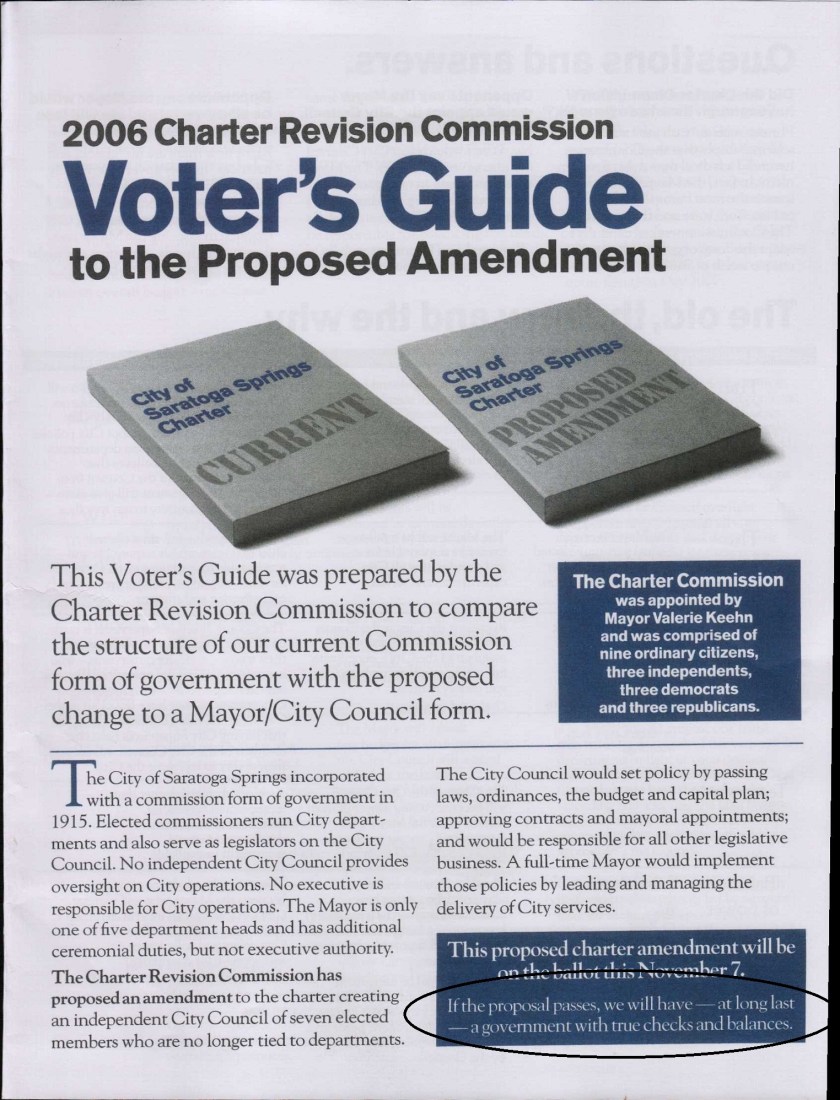
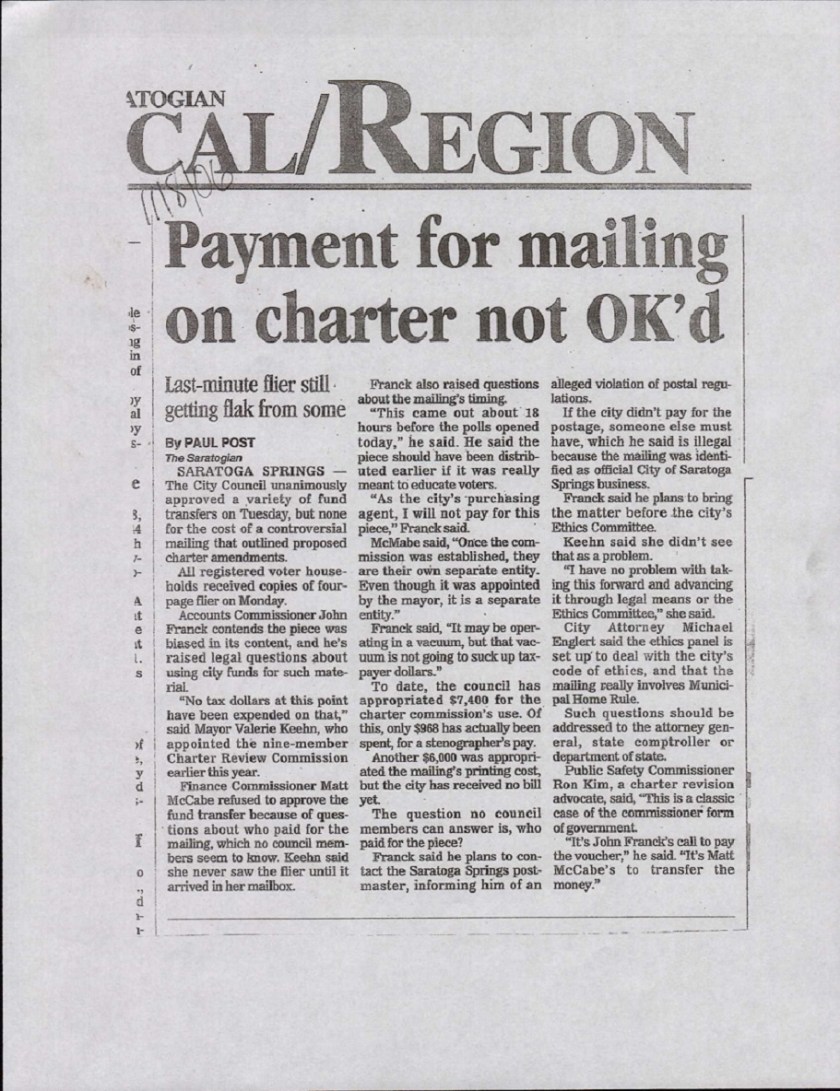
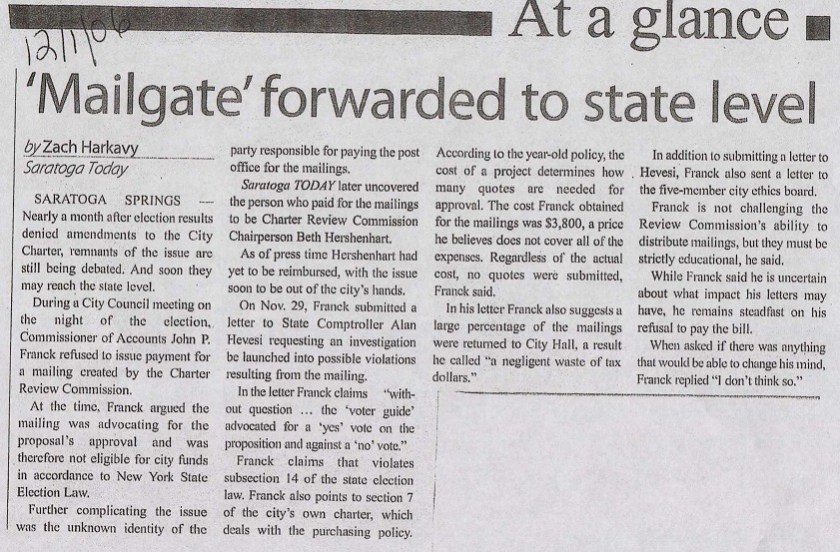
Bob Turner, chair of the Charter Review Commission, has forwarded to me his group’s assessment of what is proper in terms of “educating” the public as compared to “advocating” on behalf of the charter. He also included a number of legal cases meant to further clarify the issue.
I am encouraged that it now appears there is little daylight between Assistant Attorney Tony Izzo’s opinion and Bob’s thoughtful analysis.
From Bob Turner
New York State Laws and Guidelines on Public Outreach Activities for the Saratoga Springs Charter Review Commission
New York Municipal Home Rule Law § 36, Provisions for adoption of new or revised city charter proposed by a charter commission, establishes the state guidelines for how charter commissions operate. The state law is designed to make Charter Review Commission as independent as possible from the incumbent Mayor or City Council. The law states: “the charter commission shall provide for such publication or other publicity in respect to the provisions of the proposed charter or amendments as it may deem proper.”
The NY Division of Local Government Services report, Revising City Charters In New York State, spells out what they consider an effective public outreach strategy. Below are verbatim excerpts from the report:
Opponents might adopt a critical stance with respect to a commission’s efforts to educate the public about the revised charter, and particularly, with any effort it might make to advocate passage of the proposal.
Regardless of how it conceives its role, it is essential that the charter commission conduct a public education program. The earlier it is started, the greater the chances for generating and sustaining widespread interest in the community.
Designated members, or in some cases, all members, can make themselves available for interviews and public appearances to explain the functions of the charter commission and create a positive image from the outset.
The traditional public information techniques such as brochures with brief questions and answers, open letters with endorsements published in newspapers, interviews on news programs, and public service announcements on the media are equally applicable to charter revision efforts. One approach thought to be particularly beneficial is for charter commission members to explain the new charter in speaking engagements throughout the community.
Yet another option to be considered in implementing the public education program is publishing in a pamphlet either the draft proposed charter or a narrative final report of findings, or both. Many charter commissions have found that the narrative is most effective. It is a statement to the voters in language understandable by lay citizens. It can spell out the main features and merits of the new charter and explain why each provision was proposed. It can help to ensure that the impressions and interpretations made, especially by the press, are correct and as favorable as possible.
What I take away from this is it is expected that members of the Charter Review Commission conduct a public education program that is informative and favorable to the proposed charter. The public education program should include writing editorials and letters, social media outreach, as well as conducting public events and meeting with citizen groups. There are no legal limits on what members of the Commission may say. Members of the Saratoga Springs Charter Review retain their first amendment rights as private citizens to advocate for or against the proposed charter.
However, when it comes to using public funding for a mailing to inform the Saratoga Springs public, there are pretty clear guidelines based on NY case law about what constitutes information and advocacy (see attached cases). Those cases define advocacy by the use of the certain specific phrases: “vote for,” “support”, or “cast your ballot for”. Clearly, there is a very fine line between inform/educate and advocate that we are going to be very mindful of when using public funding for material.
When it comes to creating a publication to inform the Saratoga Springs public, we are leaning toward writing a narrative report that illustrates the differences between the old and new charter. I believe it would be more informative than mailing a copy of the new 21 page charter and the old 52 page charter.
Follow-up Email From Bob
Hi John,
Here are the legal cases that Wade Beltramo shared with us on the definition of advocacy versus inform. None were cited in Tony’s memo to the City Council.
Bob
Stern v. Kramarsky, 84 Misc.2d 447, 375 N.Y.S.2d 235 N.Y.Sup. 1975.84 Misc.2d 447375 N.Y.S.2d 235, 10 Empl. Prac. Dec. P 10,538
Annette Stern, as a Taxpayer of Harrison and as President of Operation Wake Up, et al., Plaintiffs,
v.
Werner Kramarsky, as Commissioner of the Division of Human Rights of the State of New York, et al., Defendants
Supreme Court, Special Term, New York County
October 22, 1975
CITE TITLE AS: Stern v Kramarsky
HEADNOTES
Injunctions–injunction against State agency’s campaigning for proposed constitutional amendment–defendants, State Division of Human Rights and its commissioner, are preliminarily enjoined from engaging in any activities to achieve approval of proposed Equal Rights Amendment to State Constitution; State agencies, supported by public funds, cannot advocate their favored position on issues, but must maintain position of neutrality and impartiality– while *448 Executive Law gives broad authority to protect human rights, neither it nor statutory scheme of our jurisprudence contemplates administrative agencies engaging in promotional activities in order to secure passage of proposed constitutional amendment–individual plaintiff, taxpayer and president of organization campaigning against Equal Rights Amendment, has standing.
(1) Plaintiff, as a taxpayer and as president of Operation Wake Up, an organization of women’s groups united to defeat what was known as the Equal Rights Amendment, and other plaintiffs, sought a preliminary injunction restraining defendants from engaging in any activities to achieve approval of the proposed Equal Rights Amendment to the State Constitution. Defendant Division of Human Rights was allegedly part of a coalition of organizations united to achieve approval of the amendment, made available at its offices pamphlets urging passage of the law, and promoted it through a series of radio and television broadcasts. The preliminary injunction is granted. Plaintiffs are not attempting to improperly abridge defendants’ rights of freedom of speech and association, since they do not suggest that either the commissioner or personnel of the division may be precluded personally from supporting the amendment, but contend that defendants have no authority to lend support in their official capacity. State agencies, supported by public funds, cannot advocate their favored position on the issue, but must maintain a position of neutrality and impartiality. Accordingly, defendant division may induce the public to vote, and educate them on facts and issues, but may not advocate either a positive or negative vote. Further, neither the commissioner nor the personnel of the division are prohibited from supporting or opposing the amendment in their capacities as private citizens.
(2) While sections 290, 294, 295 and 300 of the Executive Law vest the Division of Human Rights with broad authority to protect human rights, that authority must be construed in the context of the State and Federal Constitutions. Neither the language of the statutory authorities nor the statutory scheme of our jurisprudence contemplates administrative agencies engaging in promotional activities in order to secure the passage of proposed constitutional amendments.
(3) As a taxpayer and as president of an organization campaigning against the Equal Rights Amendment, the individual plaintiff has the requisite standing to maintain this action.
APPEARANCES OF COUNSEL
Louis J. Lefkowitz, Attorney-General, for defendants. Dorothy Frooks and Everett Frooks for plaintiffs.
OPINION OF THE COURT
Samuel A. Spiegel, J.
Plaintiffs, Annette Stern, as a taxpayer of Harrison, Westchester County, New York, and as president of Operation Wake Up — an organization of women’s groups united to defeat what is commonly referred to as the Equal Rights Amendment — and others, seek a preliminary injunction restraining the defendants, Werner Kramarsky, as Commissioner of the Division of Human Rights of the State of New York, and the Division of Human Rights itself from engaging in any activities to achieve approval of the proposed Equal Rights Amendment to the Constitution of the State of New York. The proposed amendment to the State Constitution, which is to be submitted to the voters of the State of New York on November 4, 1975, would add a “Section 13” to *449 article I of the State Constitution, stating: “Equality of rights under the law shall not be denied or abridged by the State of New York or any subdivision thereof on account of sex”.
Plaintiffs contend that the defendants are engaging in a campaign in support of the specified amendment, and as evidence of that campaign submit a copy of an August 25, 1975 inter-office memorandum of the Division of Human Rights addressed to certain of its staff members, which states, inter alia: “The Division of Human Rights is a member of the New York coalition for Equal Rights, a coalition of more than 70 organizations united in a statewide effort to achieve approval of the Equal Rights Amendment by the voters in November. The Division is asking you, our Advisory Council members, to help us educate the public about the Equal Rights Amendment.”
Plaintiffs have also submitted copies of various flyers and pamphlets prepared by supporters of the Equal Rights Amendment, such as the New York Coalition for Equal Rights and the League of Women Voters, which are made available to the public at the defendants’offices. Such a flyer prepared by the New York Coalition for Equal Rights in support of the Equal Rights Amendment states in part: “Its really quite simple. Either you believe that all people are created equal or you don’t. If you do … Vote Yes on Nov. 4th”. [Emphasis in the original.] It is further alleged by the plaintiff that the defendants are promoting the Equal Rights Amendment through a series of radio and televised broadcasts.
Defendants cross-move to dismiss the complaint upon the grounds that: (1) the plaintiffs’ application seeks to abridge their rights of freedom of speech and association; (2) the defendants, pursuant to article 15 of the Executive Law, have the requisite statutory authority to engage in activities in support of the Equal Rights Amendment; and (3) the plaintiffs’ lack of standing to maintain this action.
Regarding defendants’ initial argument, it does not appear that the plaintiffs are attempting to improperly abridge defendants’ rights of freedom of speech and association. Plaintiffs essentially argue that the defendants have no authority to support the Equal Rights Amendment in their official capacity. They do not suggest that either the commissioner or the personnel of the Division of Human Rights may be precluded from personally supporting the Equal Rights Amendment. Thus the issue raised by the instant application is not *450 one concerning freedom of speech or association, but whether it is a proper function of a State agency to actively support a proposed amendment to the State Constitution which is about to be presented to the electorate in a State-wide referendum. It should be noted that by lending their support to the campaign underway for the passage of the Equal Rights Amendment, defendants not only provide certain promotional and advertising assistance, but they endow that campaign with all of the prestige and influence naturally arising from any endorsement of a governmental authority.
The defendants argue that they “have the statutory authority to engage in activities in support of the Equal Rights Amendment”, specifically sections 290, 294, 295 and 300 of the Executive Law. These sections admittedly vest the Division of Human Rights with broad authority to promote and protect human rights; however, that authority must be construed in the context of the State and Federal Constitutions. Neither the language of the statutory authority relied on by the defendants nor the statutory scheme of our jurisprudence contemplates administrative agencies engaging in promotional activities in order to secure the passage of proposed constitutional amendments.
The court has found no reported cases directly in point, and notwithstanding the comprehensive and considered briefs submitted by the plaintiff and the Attorney-General, they have apparently been similarly unsuccessful in finding reported authority directly in point. The defendants cite, inter alia, Abrams v Rockefeller (NY County Clerk’s Index No. 18881), in support of their cross motion to dismiss the plaintiffs’ action. In Abrams v Rockefeller (supra), plaintiffs sought to enjoin certain public officials from spending public funds in connection with the promotion of Proposition No. 1 (The 1973 Transportation Bond Issue) on the November 6, 1973 ballot. The court granted defendants’ cross motion to dismiss the complaint upon the grounds, inter alia, that the application was untimely, and that the plaintiffs lacked standing to maintain the action. Since Abrams v Rockefeller (supra) was dismissed on essentially procedural grounds, inapplicable to the action presently before the court, it does not constitute authority warranting dismissal of the plaintiffs’ action.
In Matter of Olivieri (Ronan) (NY County Clerk’s Index No. 23334), petitioner — relying on section 8 of article VII and section 1 of article VIII of the New York State Constitution — *451 sought a preliminary injunction restraining the respondents William J. Ronan, Metropolitan Transportation Authority and New York Transit Authority from promoting “Proposition #1” (The 1971 Transportation Bond Issue) on the November 2, 1971 ballot. Specifically the petitioner sought to restrain the Metropolitan Transportation Authority and the New York Transit Authority from permitting their employees to put up placards and posters for the private organization known as “Yes For Transportation In N. Y. State, Inc.” during the hours when these employees are employed in their regular duties, and permitting the use of the public transit conveyances and facilities space for the display of the placards and posters of “Yes For Transportation In N. Y. State, Inc.” promoting an affirmative vote on Proposition No. 1. Respondents Ronan et al. cross-moved to dismiss the petition upon the grounds the petitioner lacked standing and the respondents had acted lawfully in authorizing the use of space on transit facilities under their jurisdiction, for the placement of posters and signs informing the public of the importance of a favorable vote on Proposition No. 1. By order dated November 1, 1971 the court granted petitioner Olivieri’s application for a preliminary injunction and denied respondents’ cross motion to dismiss the petition.
The court is aware that the State Charter Revision Commission for New York City has recently solicited the opinion of the New York State Comptroller regarding the proper scope of publicity for the proposed charter revision which is to appear on the ballot in New York City on November 4, 1975. By correspondence dated June 24, 1975 (a copy of which the court sua sponte makes part of the file herein, together with copies of revised guidelines establish for publicizing the proposed charter revision for New York City) the State Comptroller wrote to the State Charter Revision Commission:
“This is in reply to your letter of June 2, 1975, requesting the opinions of the Comptroller and the Attorney General as to whether funds of the Commission may be expended for publicity relative to the proposed charter and the extent to which and manner in which such funds may be used. Proposals include such expenditures as media advertising, direct mailing to voters, speakers, bureaus telephoning of voters, and a field organization to educate voters as to charter revision. …
“As a general rule, state funds have not been used for the *452 public promotion of propositions or proposed constitutional amendments. I have, on many occasions, advised State and Local government officials that public moneys may be used for the purpose of adequately informing the Public concerning a proposed State bond issue; but not to urge a ‘yes’ or ‘no’ vote.”
The logic of the court’s determination in Matter of Olivieri (Ronan) (supra), and the opinion of the State Comptroller quoted above is inescapable. The spectacle of State agencies campaigning for or against propositions or proposed constitutional amendments to be voted on by the public, albeit perhaps well-motivated, can only demean the democratic process. As a State agency supported by public funds they cannot advocate their favored position on any issue or for any candidates, as such. So long as they are an arm of the State Government they must maintain a position of neutrality and impartiality.
It would be establishing a dangerous and untenable precedent to permit the government or any agency thereof, to use public funds to disseminate propaganda in favor of or against any issue or candidate. This may be done by totalitarian, dictatorial or autocratic governments but cannot be tolerated, directly or indirectly, in these democratic United States of America. This is true even if the position advocated is believed to be in the best interests of our country.
To educate, to inform, to advocate or to promote voting on any issue may be undertaken, provided it is not to persuade nor to convey favoritism, partisanship, partiality, approval or disapproval by a State agency of any issue, worthy as it may be.
Public funds are trust funds and as such are sacred and are to be used only for the operation of government. For government agencies to attempt to influence public opinion on such matters inhibits the democratic process through the misuse of government funds and prestige. Improper expenditure of funds, whether directly through promotional and advertising activities or indirectly through the use of government employees or facilities cannot be countenanced. (NY Const, art VII, §8; art VIII, § 1.) People of all shades of opinion and belief contribute these funds from one source or another. No agency may misuse any such funds for promoting its own opinions, whims or beliefs, irrespective of the high ideals or worthy cause it espouses, promotes or promulgates. The merits of the Equal Rights Amendment are not involved herein *453 and the court is not asked to pass upon it, but rather the right of a State agency to advocate its passage.
Moreover, as a taxpayer and as president of an organization campaigning against the Human Rights Amendment the plaintiff Annette Stern has requisite standing to maintain this action (Boryszenwski v Byrdges, 37 NY2d 361;State Finance Law, art 7-A).
Accordingly, the plaintiffs’ application for a preliminary injunction is granted to the extent of restraining the defendants from supporting, promoting, campaigning or otherwise acting to achieve passage of the proposed Equal Rights Amendment to the New York State Constitution at the election on November 4, 1975.
Nothing in this decision however shall be construed as prohibiting the Division of Human Rights from engaging in activities to induce the public to vote on the proposed Equal Rights Amendment, or to inform the public of the facts contained in the proposed amendment, and to otherwise educate the public concerning the proposed amendment, without advocating either a positive or negative vote upon the amendment. Further, nothing herein shall be construed as prohibiting the Commissioner of Human Rights or the personnel of that agency from supporting or opposing the Equal Rights Amendment in their individual capacities as private citizens.
Copr. (c) 2010, Secretary of State, State of New York
N.Y.Sup. 1975.
STERN v KRAMARSKY
84 Misc.2d 447
END OF DOCUMENT
Opns St Comp, 1980 No. 80-762, 1980 WL 8118 (N.Y.St.Cptr.)
New York State Comptroller
NYCPTR Opn No. 80-762
December 11, 1980
TO: MISS GLORIA M. ROSENBLUM
TOWN OF ISLIP
State Constitution, Article VIII, § 1
Town Law, § 116(13)
$hVillage Law, §§ 2-206, 2-20
- TOWNS—POWERS AND DUTIES—CHALLENGING PROPOSED INCORPORATIONS OF VILLAGE
A town may not use town funds or town employees to prepare a proposed budget or other document for the purpose of showing residents of a proposed village the cost of incorporating or operating a village since a town has no legal standing to oppose the creation of a village and its intrusion into the incorporation process would be a partisan political act rather than an exercise of its proper governmental powers.
This is in reply to your letter concerning the proposed Village of Islandia. You stated in your letter that the town officials of the Town of Islip, in which Islandia would be located, are opposed to the incorporation and have directed Town employees to prepare a proposed budget and other documents to show the residents of the proposed village the cost of incorporating and operating a village. You ask the following questions with regard to this situation:
(1) May the Town incur any expenses in preparing a proposed budget and/or any other documents which would bear on the question of the wisdom of voting for the proposed village?
(2) May the Town pay for mail and/or otherwise distribute literature or information to the residents within the proposed village on the issue of incorporation of the village?
(3) If the answer to question 2 is yes, is the town restricted in the type and contents of information it may disseminate to the public and can it express any viewpoint, directly or indirectly, concerning the proposed village?
Municipal corporations are creatures of the State and have only such powers and authority as is conferred upon them by the Legislature and powers reasonably incident thereto (Whittaker v Village of Franklinville, 256 NY 11, 191 NE 716 [1934]; Hansell v City of Long Beach, 61 AD2d 84, 401 NYS2d 271 [2nd Dept, 1978]; Torsoe Bros. v Bd of Trustees, 49 AD2d 461, 375 NYS2d 612 [2nd Dept, 1975]). We can find no statutory authority for the expenditure of town funds for the purpose of advising residents on the incorporation of a village. It is true that section 116(13) of the Town Law allows a town to incur expenses for the publication and distribution of reports relative to its fiscal affairs, but this would not include financial reports of a proposed village since the finances of a village are not directly related to the fiscal affairs of a town.
Under the Village Law, the supervisor of the town encompassing the proposed village is required to hold a public hearing on the petition for incorporation to determine its legal sufficiency (Village Law, §§ 2-202, 2-208). Aside from this hearing and determination, there is no other role which the town or its officers may play in the incorporation of a village. There is no authority for them to hold hearings on the advisability of incorporation or to take any action which would otherwise affect such incorporation.
*2 Because the town has no legal standing to oppose the incorporation of a village, the activities being carried on by the town are political in nature rather than governmental. The courts have recognized that public funds should not be used for political activity. In Stern v Kramarsky, 84 Misc2d 447, 375 NYS2d 235 [1975], where a State agency was using public funds to encourage voters to approve a proposed constitutional amendment, the court said:
“The spectacle of State agencies campaigning for or against propositions or proposed constitutional amendments to be voted on by the public, albeit perhaps well-motivated, can only demean the democratic process. As a State agency supported by public funds they cannot advocate their favored position on any issue or for any candidates, as such. So long as they are an arm of the State Government they must maintain a position of neutrality and impartiality.
It would be establishing a dangerous and untenable precedent to permit the government or any agency thereof, to use public funds to disseminate propaganda in favor of or against any issue or candidate. This may be done by totalitarian, dictatorial, or autocratic governments but cannot be tolerated, directly or indirectly, in these democratic United States of America. This is true even if the position advocated is believed to be in the best interest of our country. To educate, to inform, to advocate or to promote voting on any issue may be undertaken, provided it is not to persuade nor to convey favoritism, partisanship, partiality, approval or disapproval by a State agency of any issue, worthy as it may be.
Public funds are trust funds and as such are sacred and are to be used only for the operation of government. For government agencies to attempt to influence public opinion on such matters inhibits the democratic process through the misuse of government funds and prestige. Improper expenditure of funds, whether directly through promotional and advertising activities or indirectly through the use of government employees or facilities cannot be countenanced (NY Const, art VII, § 8, art VIII, § 1). People of all shades of opinion and belief contribute these funds from one source or another. No agency may misuse any such funds for promoting its own opinions, whims or beliefs, irrespective of the high ideals or worthy causes it espouses, promotes or promulgates.”
Although the Stern case dealth with a State agency and a proposed constitutional amendment, the principles stated therein are equally applicable to any level of government which engages in political activity.
Opns St Comp, 1980 No. 80-762, 1980 WL 8118 (N.Y.St.Cptr.)
END OF DOCUMENT
Opns St Comp, 1980 No. 80-411, 1980 WL 8061 (N.Y.St.Cptr.)
New York State Comptroller
NYCPTR Opn No. 80-411
November 13, 1980
TO: CORNELIUS F. HEALY
DEPUTY STATE COMPTROLLER
State Constitution, Article Viii, § 1
Education Law, §§ 1709, 1815
- SCHOOL DISTRICTS—BUDGETS—EXPENDITURES OF MONEYS TO PROMOTE PASSAGE OF
Although a school district may use district money to educate and inform the public on a proposed school budget, it may not use district money to convey favoritism, partisanship, partiality, approval or disapproval of such budget.
This is in reply to an inquiry as to whether a school district may use public funds to urge district residents to vote “yes” on a proposed school budget.
This Department has consistently held that a school district may not expend school district money to urge residents in the district to vote for or against particular propositions that will appear on the ballot (24 Opns St Comp, 1968, p 30; 11 Opns St Comp, 1955, p 357; 5 Opns St Comp, 1948, p 478). The rationale for that position was that sections 1709 and 1805 of the Education Law contain no authority for such expenditures.
A more compelling argument may be found in the case of Stern v. Kramarsky, 84 Misc 2d 447, 375 NYS2d 235 (1975) where the court held that a State agency could not use public funds to encourage voters to approve a proposed constitutional amendment. The court said:
“The spectacle of State agencies campaigning for or against propositions or proposed constitutional amendments to be voted on by the public, albeit perhaps well-motivated, can only demean the democratic process. As a State agency supported by public funds they cannot advocate their favored position on any issue or for any candidates, as such. So long as they are an arm of the State Government they must maintain a position of neutrality and impartiality.
It would be establishing a dangerous and untenable precedent to permit the government or any agency thereof, to use public funds to disseminate propaganda in favor of or against any issue or candidate. This may be done by totalitarian, dictatorial or autocratic governments but cannot be tolerated, directly or indirectly, in these democratic United States of America. This is true even if the position advocated is believed to be in the best interests of our country.
To educate, to inform, to advocate or to promote voting on any issue may be undertaken, provided it is not to persuade nor to convey favoritism, partisanship, partiality, approval or disapproval by a State agency of any issue, worthy as it may be.
Public funds are trust funds and as such are sacred and are to be used only for the operation of government. For government agencies to attempt to influence public opinion on such matters inhibits the democratic process through the misuse of government funds and prestige. Improper expenditure of funds, whether directly through promotional and advertising activities or indirectly through the use of government employees or facilities cannot be countenanced (NY Const, art VII, § 8; art VIII, § 1). People of all shades of opinion and belief contribute these funds from one source or another. No agency may misuse any such funds for promoting its own opinions, whims or beliefs, irrespective of the high ideals or worthy causes it espouses, promotes or promulgates.”
*2 Although the Stern case dealt with a State agency and a proposed constitutional amendment the principles stated therein are equally applicable to all levels of government.
Therefore, it is the opinion of this Department that although a school district may use district funds to educate and inform the public on a proposed school budget, it may not use such funds to convey favoritism, partisanship, partiality, approval, or disapproval of such a budget.
Opns St Comp, 1980 No. 80-411, 1980 WL 8061 (N.Y.St.Cptr.)
END OF DOCUMENT
Opns St Comp, 1981 No. 81-26, 1981 WL 16599 (N.Y.St.Cptr.)
New York State Comptroller
NYCPTR Opn No. 81-26
February 9, 1981
TO: WILLIAM R. BENNETT, ESQ.,
TOWN
ATTORNEY,
TOWN
OF ISLIP
State Constitution, Art VIII, § 1
Town Law, § 116(3)
Village Law, § 2-206, 2-208
- TOWNS—POWERS AND DUTIES—CHALLENGING PROPOSED INCORPORATION OF VILLAGE
We reaffirm the views expressed in Opinion No. 80-762 and it remains our position that a town may not use town funds or town employees to prepare a proposed budget or other documents for the purpose of showing residents of a proposed village the cost of incorporating and operating a village.
This is in reply to your letter in which you ask us to reconsider the views expressed in Opinion No. 80-762. In that opinion, we concluded that a town could not use town funds or town employees to prepare a proposed budget or other documents for the purpose of showing residents of a proposed village the cost of incorporating or operating a village since a town has no legal standing to oppose the creation of a village and its intrusion into the incorporation process would be a partisan political act rather than an exercise of its proper governmental powers.
In your letter, you took issue with our position that a town does not have legal standing to oppose the creation of a village and with our interpretation of the Stern v Kramarsky (84 Misc2d 447, 375 NYS2d 235 [1975]) case.
With respect to legal standing, you cited the case of Levitt v Rockefeller, 69 Misc2d 337, 329 NYS2d 976 [1972], to support your contention that a town does have standing to challenge the creation of a village. The Levitt case dealt with a court challenge by the State Comptroller to an appropriations bill submitted to the Legislature by the Governor. On an objection to the legal standing of the Comptroller, the court held that the Comptroller’s constitutional and statutory duties were sufficient to confer upon him the right to maintain the suit. We fail to see how this reasoning could be applicable to your situation. The powers and duties of the Comptroller, upon which his legal standing was based, are not the same as the powers vested in a town board and the issue in that case, the validity of an appropriations bill, is not even remotely similar to the incorporation of a village.
We agree with the opinion of the court in Marcus v Baron, (10)-Misc2d% Y(10)-, 431 NYS2d 627 [1980] which stated that, under Article 2 of the Village Law, the supervisor of a town, within which it is proposed to incorporate a village, merely performs the ministerial function of determining whether the petition for incorporation complies with the statute and is legally sufficient, and is confined in the performance of that function to a consideration of the objections directed thereto. Furthermore, under the statute, the supervisor’s decision may not take into account the overall public interest of the residents of the proposed village or of the other residents of the town or towns. In fact, a bill was introduced in the 1977-1978 Regular Session of the Legislature (S-3944-A; A-5225-A) wherein it was proposed to amend the Village Law to allow the supervisor to consider the public interest of the residents of the proposed village and of the other residents of the town. This bill failed to pass and its rejection must be considered as an expression of the intention of the Legislature that the overall public interest of the town was not to be taken into account when a village was being incorporated (Marcus v Baron, supra).
*2 While you state that your town is currently challenging the constitutionality of Article 2 of the Village Law, the right to challenge the constitutionality of this statute does not necessarily imply a right to challenge the actual incorporation of a village. If in fact the law is constitutional, as it is presumed to be, there is nothing in the statute itself, aside from the petition for incorporation, which gives the town or any town officer a basis for challenging incorporation. Based on this fact and on the ground stated above, that the public interest of the town is not to be considered, we are lead to the conclusion that the town does not have standing to challenge incorporation or to otherwise use its powers or offices to take part in the incorporation process after the supervisor rules on the legal sufficiency of the petition to incorporate.
In regard to the Stern case, supra, we believe that the views expressed in Opinion No. 80-762 are correct. The court in that case stated that an agency may educate, inform, advocate or promote voting on any issue “PROVIDED IT IS NOT TO PERSUADE NOR TO CONVEY FAVORITISM, PARTISANSHIP, PARTIALITY, APPROVAL OR DISAPPROVAL . . . OF ANY ISSUE WORTHY AS IT MAY BE” [emphasis added]. The court also stated that the public may be informed of the facts of a proposition or may otherwise be educated as long as a positive or negative vote is not advocated. It is our opinion that the preparation of a model budget does more than merely inform the public as to the facts of incorporation, since a model budget does not contain facts. The actual cost of running a particular village can not be ascertained until the village is actually formed and operating and the statements and budget items contained in any model budget are only predictions of what the actual costs will be and these predictions can be shaded to reflect the views of the drafters and to influence the vote on any proposition to incorporate. We think that the Stern case clearly prohibits not only those kinds of actions which are obviously meant to influence the public but also those which would affect the public in a subtle way and thereby influence their vote on a particular issue.
Therefore, this Department reaffirms the views expressed in Opinion No. 80-762 and it remains our position that a town may not use town funds or town employees to prepare a proposed budget or other documents for the purpose of showing the residents of a proposed village the cost of incorporating or operating a village.
Opns St Comp, 1981 No. 81-26, 1981 WL 16599 (N.Y.St.Cptr.)
END OF DOCUMENT