Silly and Dubious Games From The Leadership of the Group Proposing Changing The City Charter

Those who followed this blog back during the 2017 campaign to change the city’s charter to a city manager form will remember the many dubious actions its advocates employed. The most egregious was a fake survey engineered by the Skidmore Political Science Department which I chronicled in:

I Should Never Have Recommended The Skidmore Survey

The Skidmore Survey Is Gone

A Skidmore College Professor Defends The Survey That Wasn’t A Survey

During that same campaign they created a fake Facebook page. The group opposing the proposed charter called itself Saratoga Springs Success. So the pro charter leadership put up one called Success Saratoga Springs.

Fake Facebook Page From 2017 campaign

This year the opponents to charter change set up a group called Saratoga Works.

So the leadership of the pro charter group decided to go all in and set up multiple sites to divert people looking for information from Saratoga Works.

Here are the ones I have found so far.

This one uses the name Saratoga Works 2020

This one uses Saratogaworks (by using the lower case for the “w”in works they were able to use the same name as the real Facebook page)

This one uses Saratogaworks

Here is a third one that combines the lower case “w” in works and the year 2020. It is apparently still under construction.

Third fake page which is under construction.

Two of the sites were created by Dillon Moran. Mr. Moran ran unsuccessfully against Skip Scirocco for Commissioner of Public Works and is a member of the Saratoga Springs Democratic Committee.


This stuff is really not very serious. Most people seeking information for the real site will find it. This is a link to the real website for Saratoga Works

This is a link to the Facebook page for Saratoga Works.

Whatever minor mischief they may successfully create will be offset by the further erosion of their credibility.

Saratoga County Losing AirBnB Tax Income. Why?

According to the Times Union, Washington County has reached an agreement with AirBnB on taxing their rentals.

According to the TU, AirBnB has agreements with thirty counties in New York State to provide them with taxes for rentals.

“The company also collects room taxes on behalf of Fulton, Rensselaer and Schenectady counties, locally, but not Saratoga and Albany counties.”

This is just another example of the on-going ineptitude of Saratoga County government.

Petition To Remove Saratoga County Administrator Spencer Hellwig and Others

The libertarian Party sent out the press release below:

                                                            For Immediate Release

Libertarians Launch Petition Calling for County Supervisors to Terminate County Administrator Spencer Hellwig and Co Conspirators.

Libertarian Party of Saratoga County seeks to deliver 1000 signatures by Oct 1st.

Ballston Spa— For Immediate Release Today, the Libertarian Party of Saratoga County announced that is has launched a petition calling on the Saratoga County Board of Supervisors to terminate County Administrator Spencer Hellwig, Director of Human Resources Marcy McNamara and County Attorney Stephen Dorsey.  The political party hopes to deliver 1000 signatures from county residents to the board by October 1st.

“Residents around the county are outraged by the blatant corruption and coverup stemming from the pay raise scandal by Saratoga County Leaders;” said Rob Arrigo Chairman of the Saratoga County Libertarian Party.  “A mess this big cannot be swept under the rug.  The Board of Supervisors must act to restore faith in our county government,” said Arrigo.

An external investigation into the County’s decision to hand out 50% pay raises to essential employees, management staff and elected officials, revealed that County Administrator Hellwig, HR Director McNamara and County Attorney Dorsey lied to the Board of Supervisors, unlawfully raised pay, potentially opened the county up for legal liability and worked to cover up their misdeeds.

The petition, titled “Hold Them Accountable,” can be found on their website: http://www.lpnysaratoga.org/petition-detail?petitionId=1003

Revisiting The Darryl Mount Story [Link Fixed]

In 2018, prompted by an article written by Barbara Lombardo for the Times Union about the Darryl Mount incident, I reviewed the discovery documents amassed by the attorneys for the Mount family. They revealed a breakdown of oversight by the city’s Department of Public Safety in general, and the city’s Chief of Police, Greg Veitch in particular.

Chief Veitch’s unfortunate email of September 2, 2013, compromised the integrity of the investigation and contributed to the calls for a proper investigation.

Chris Mathiesen was the Commissioner of Public Safety at the time. I consider Chris Mathiesen to be a friend and a person of great integrity. Nevertheless, he and I profoundly disagree about the handling of the “investigation.” The link to my story includes an email exchange between the two of us which I think reveals just how problematic the investigation was.

It may never be known how Darryl Mount was fatally injured. The tragedy is that the opportunity to properly investigate his death was squandered leaving a festering wound in our city.

A Little Known Shocking Killing In Kenosha, Wisconsin Exposes The Deep Rooted Excesses Of Too Many Police Departments

I put up this post because many of my conservative friends cannot believe that abuse by the police in our country is a systemic problem. It is important to note that because the excessive use of violence is systemic nationally does not mean that every local police force is guilty of this. I believe that we are very fortunate here in Saratoga Springs to have leadership in our own Police Department that is committed to opposing racism and to a program that champions restraint. We also have a City Council that supports this.

In 2004 the Kenosha, Wisconsin police shot Michael Bell, a twenty-one year old white youth, point blank in the head in front of his mother and sister.

After a two day review, the Kenosha Police Department and the District Attorney exonerated the police officer who shot Michael Bell.

Michael Bell’s father, Michael Bell Sr. had been a career fighter pilot who saw combat in two wars. Mr. Bell Sr. tells the interviewer, “It was really hard for me to believe that a uniformed person would do that.”

After funding an independent investigation, Mr. Bell Sr. sued the city of Kenosha over the death of his son and won a $1.75 million dollar settlement. He used that money to mount a statewide campaign to reform how police abuse is investigated. In 2014, some ten years later, Governor Scott Walker (a conservative Republican) signed the legislation.

People who have followed my blog will know that I was harshly critical of the handling of the investigation of Darryl Mount’s death under Police Chief Greg Veitch. It is regrettable that the mishandling of the investigation cast a pall over our local department. I believe that the current leadership would have followed proper procedure.

This interview with Mr. Bell Sr. is deeply moving. I hope people will listen to the interview and come away, as I did, both appalled by the actions of the Kenosha Police and grateful that our community has radically different leadership at both the Police Department level and the Council level.

There are many dedicated police officers who share my outrage over the too common failure of police departments to prosecute those who abuse their authority. It is essential that this country face some hard truths if we are ever going to bring about real reform.

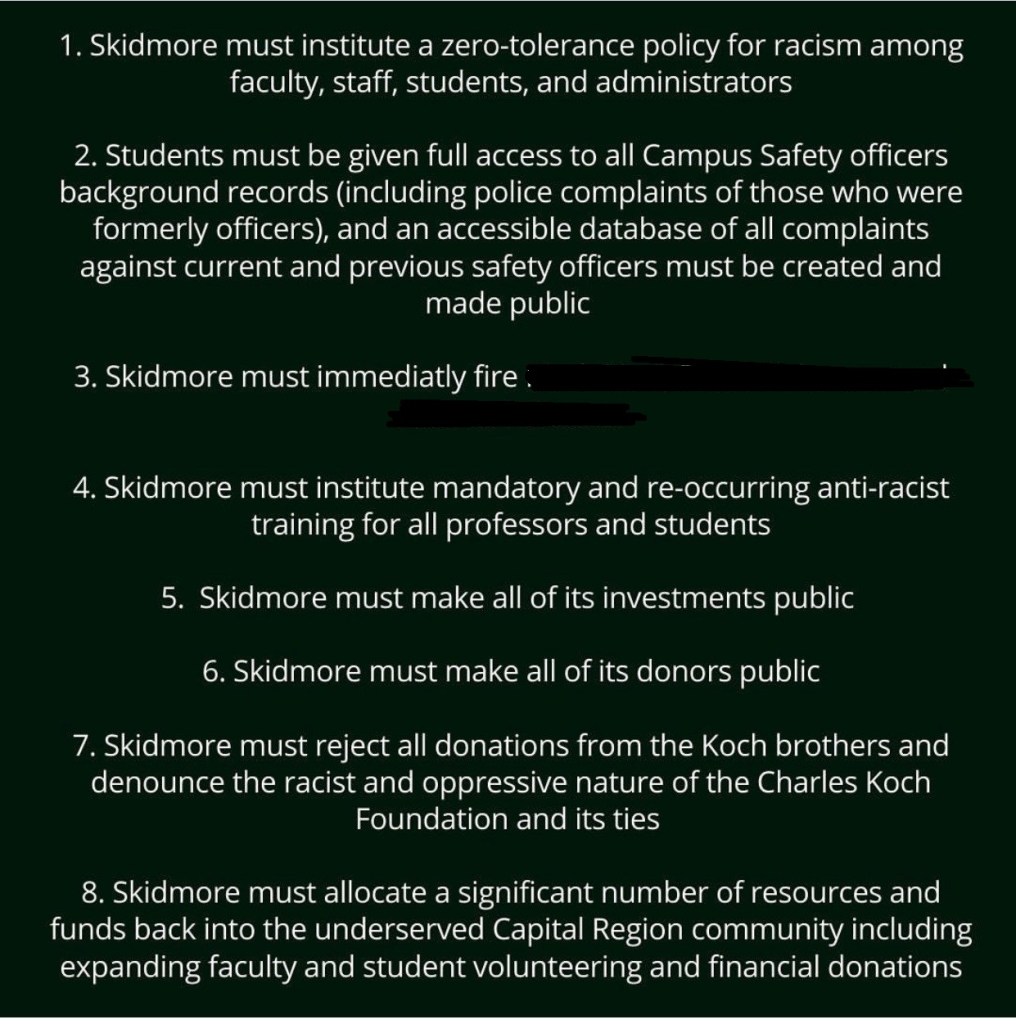
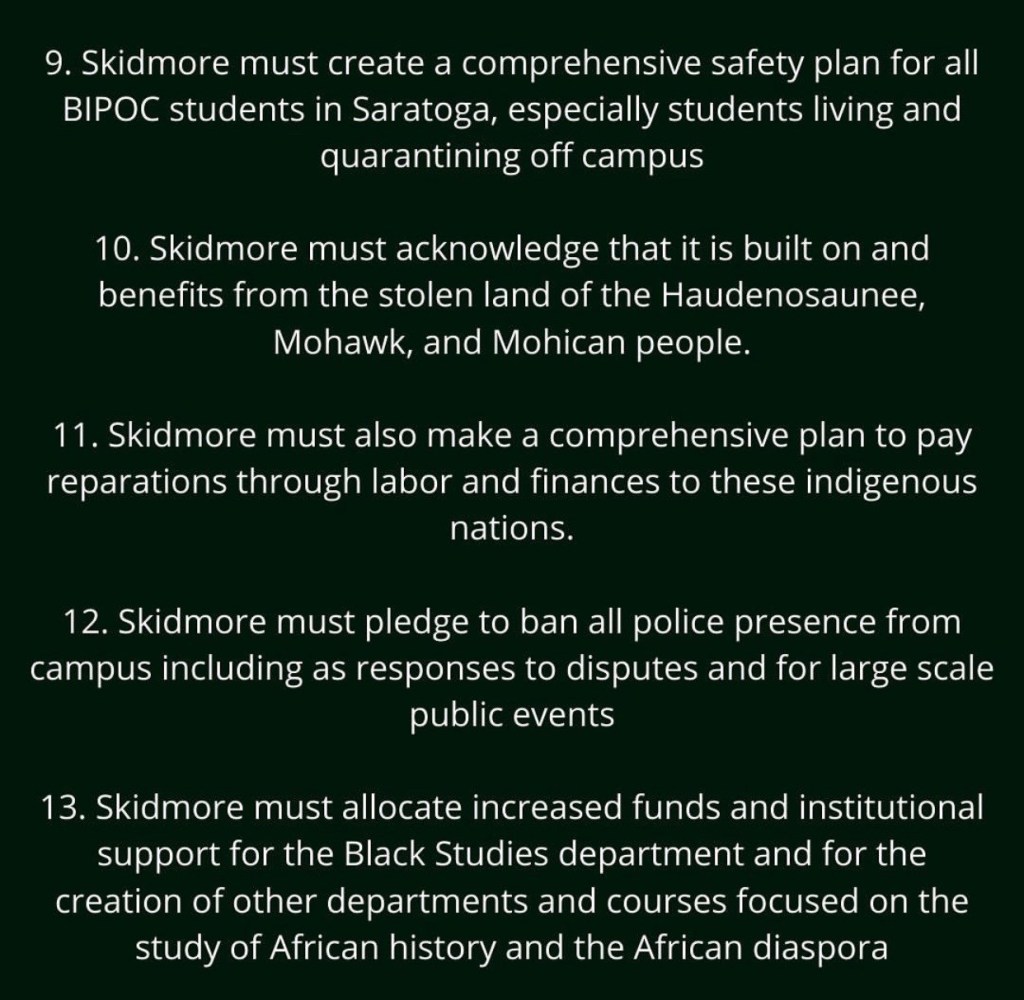
Skidmore Students Issue Demands

Monday there was an impressive turnout of students who marched through the Skidmore Campus terminating at the home of the new president of Skidmore, Marc Connor.

I found the demands below on Instagram. They have been issued by a group called Pass The Mic.

Their website describes them as follows:

We are a student-run platform for people of color, people with disabilities, international, immigrant, refugee, LGBTQ+ & economically disadvantaged communities on Skidmore campus to share their unfiltered experiences

I applaud the motivation behind these demands which is basically for Skidmore to be part of a more humane and just society. Unfortunately, the crudeness of the demands makes them sound like they came out of a brain storming session rather than a carefully crafted program. Change is not easy and it begins with carefully considered goals that can be defined and achieved.

Take for example the call for a zero-tolerance policy for racism.

The first problem here is defining what a racist act is. Apparently for some people, attending a demonstration that supports the local police (Back the Blue) is a racist act. As documented by videos on the web, there was at least one person of color who attended the Back the Blue rally. Would that person be considered a racist?

The second problem is how would Skidmore carry out this policy. What kind of structure would be required to administer such a program? What kind of standards would be used to determine guilt? Would there be just one possible form of disciplinary action i.e. firing?

I raise these questions not to undermine the effort of these students but to encourage them to be more rigorous that they might succeed.

The Shoe Falls: Sheriffs Sue County Over Covid Pay Fiasco

In the August 24, 2020, edition of the Times Union, Wendy Liberatore reports that the union representing the Saratoga County Sheriff Deputies have filed a suit against Saratoga County. Their suit is to recover lost wages taken from their paychecks without notice.

The union alleges that because the county ended the time-and-a-half policy in a meeting that violated the Open Meetings Law, they continue to be eligible for the additional pay.

Dan Sisto is a labor consultant who works on behalf of the union. Sisto cites Sheriff Michael Zurlo’s inability to remember pretty much anything that occurred during the pay fiasco.

Sisto told the Times Union:

“We have a lack of confidence right now in the leadership,” Sisto said. “It’s not that they are necessarily bad people, but the difficulty we have working through issues — in addition to the glaring inability to recall factual information at appropriate times as demonstrated in the report — is disheartening at best. … The sheriff, he didn’t really do anything to facilitate anything good or bad. He just sat there like a potted plant.”

Referencing Human Resources Director Margaret McNamara who alleged that she had told the unions about ending the bonus on March 19, Sisto said, “that they weren’t going to lie to cover up for their mistakes.”

They tried to place the bullet back in the gun. Basically, they said, ‘We forgot to say it on the 19th, so let’s just say we did.’ The facts don’t  match up to the story.

Sisto

Sisto alleges that the failure of the county to adhere to required procedures regarding their pay make them vulnerable to the union’ s litigation.

Raymond Watkin Who Served As Mayor From 1974 to 1980 Has Died

[JK: Below is an obituary for Ray Watkin who was a friend of Jane and mine. There will be a service at the Beth Israel Cemetery in Rotterdam tomorrow (August 26, 2020) at 11:00]

Raymond Watkin

Mayor of Saratoga Springs, 1974 to 1980

Raymond Watkin, 91, three-term Mayor of Saratoga Springs in the trans formative years of the 1970s, died Sunday August 23 at his home in the city.  

Under Raymond Watkin’s leadership as Mayor (1974 to 1980), Saratoga Springs began its transformation from a seasonal tourist destination to a thriving year-round “city in the country.”

Mr. Watkin was the first of the city’s mayors to champion historic preservation, establishing the city’s first programs and regulations concerning historic properties and neighborhoods.  His administration transformed Urban Renewal into Community Development, thereby emphasizing needed infrastructure over demolition projects.  Mr. Watkin promoted the city through the arts, especially New York City Ballet’s residency, He was an outspoken opponent of racism and anti-Semitism, advanced youth recreation and housing for seniors, and used his political stature to secure the exclusive thoroughbred racing meet, thereby setting a modern standard of Mayoral leadership.

Born in Schenectady, N.Y. June 9, 1929, Mr. Watkin worked as a teenager in a local meatpacking plant, then in various jobs at General Electric Co.  He was an active participant in the labor movement at the time, a turbulent and formative period marked by strikes and conflicts between GE and its workforce.   

Mr. Watkin visited Saratoga Springs as a child, arriving on the trolley from Schenectady to visit his sister, who worked then at the Weinstein Hotel. 

Laid off from American Locomotive Co. after his Army service, Mr. Watkin entered the shoe business and eventually owned the shoe department of an Albany store, M. Solomon, owned by the family of his co-worker at the time, later to become the area’s Congressman, Gerald Solomon, who was then a Democratic committeeman in Albany.

In 1963, Mr. Watkin married Joan Tubell, of Manhattan, after a three-year courtship that began during a summer visit with friends to a camp near Warrensburg. 

Through his pursuit of opportunities in the shoe business, Mr. Watkin established Raymond’s Bootery, a specialty shop for ladies’ shoes, on Broadway near the corner of Lake Avenue, a location where he had previously sold shoes for Cohen Brothers.  Raymond’s Bootery became a popular destination for women throughout upstate New York.

Mr. Watkin’s candidacy for Mayor began on Primary Day 1973, in the era of non-partisan elections, with a 350-vote write-in backed by then-Public Works Commissioner Thomas McTygue.  The subsequent campaign swept incumbents from office and brought a progressive, independent-minded Council into power, made up of two Democrats (Mr. Watkin and McTygue), two Republicans (Joseph Corsale and Donald Connelly) and one member not enrolled in a party (Remegia Foy).

Saratoga Springs in the early 1970s began to assertively embrace its own ambience, using the town’s history and style to advance tourism and commerce.  Mayor Watkin and the Council translated that grass-roots vision into city policy and ordinances.  

Before Mr. Watkin’s election, it was the official policy of the city to demolish “substandard” housing and commercial buildings, without regard to historic values, then re-develop the properties through the Urban Renewal program.  In 1971, the building inspector had threatened to demolish the Batchellor Mansion, at Circular Street and Whitney Place, vacant and in disrepair at the time, before it was rescued by a private buyer. 

In early 1974, just after Mr. Watkin’s election, the U.S. Postal Service announced plans to install a drop ceiling to obscure the leaded glass skylight in the Broadway post office, and also cover over the priceless WPA-era murals in the lobby.  Mayor Watkin took immediate action to stop the project, taking the Post Office personally to Federal Court in Utica after the City Council would not allow the city itself to be part of the suit..  The Court saw the issue Mr. Watkin’s way and issued an injunction against the Post Office.  Soon the Post Office backed down, and the historic interior of one of the city’s most significant public places was saved. 

Early in his tenure, Mr. Watkin ended plans for an arterial highway that would have divided the city, and laid the building blocks of planning and historic preservation that led to the city’s present renowned downtown. 

These enactments included the Historic Preservation Ordinance, establishment of the Board of Architectural Review, enactment of the Façade Easement Program and downtown Special Assessment District, all in 1977.  These initiatives provided for the first coordination of property facades on Broadway, and of public resources for historic improvements to the downtown business district.  Mr. Watkin soon initiated the establishment of the neighborhood historic districts within the zoning code, gaining approval from the council in 1979.    

Mr. Watkin reformed the Urban Renewal Agency from a demolition program into one whose mission was Community Development.  Mayor Watkin and his allies reassigned Federal funds from demolition toward the more important Village Brook drainage project, thus saving from decay and collapse the Canfield Casino and the entire neighborhood between Henry and Putnam Streets.  This reform made possible the development of the current Public Library and many commercial properties in “the gut.”  Renovation of the Drink Hall, development of the West Side Fire Station and other improvements stemmed from the Community Development plan developed by Mr. Watkin,  He recruited accomplished and qualified individuals to serve the city, including Dr. Bernard E. Donovan, former superintendent of New York City School System, who served the Watkin administration as head of both Community Development and the City Planning Board after relocating to Saratoga Springs.  

Mr. Watkin also saw that emphasizing the arts would both enrich the city’s civic life and broaden its economic base.  His mayoralty was marked by annual enthusiastic promotion (and city funding) of the New York City Ballet and SPAC.  His personal friendship with George Balanchine, highlighted by a parade in Mr. B’s honor, helped build audience and community support for the ballet. 

During the gasoline crisis of 1974, Mr. Watkin gained national prominence for negotiating with gasoline stations to implement an “odd-even” program to cut waiting lines at filling stations.  The approach, started here, relieved gas lines, congestion and drivers’ anxiety, and soon spread across the country. 

Mr. Watkin leveraged his prominent political standing in 1974 and support for racing’s role in the community to secure Hugh Carey’s support for city’s exclusive August thoroughbred meet.  Carey faced a Democratic Primary, and his opponent, Howard Samuels, favored Off-Track Betting and was indifferent to Saratoga’s exclusive program, the cornerstone of the city’s summer season. 

Mr. Watkin’s lifelong commitment to meeting the needs of ordinary people led to the establishment of the Senior Citizens Center on Williams Street, initiation of the federal Section 8 rental subsidy program, and, in 1979, the construction of the Raymond Watkin Apartments, among many other initiatives.  He also mobilized official city and community opposition against an area demonstration by the Ku Klux Klan, and introduced and saw passed unanimously a resolution in May 1978 against the anti-Semitic pamphleteer Richard Cotton, who had planned to campaign in the city. 

Fred Dicker, long time columnist for the New York Post, who covered Mr.Watkin for The Saratogian and Albany Times-Union from 1971 to 1975, and who became a close friend of Mr. Watkin, said, “Ray Watkin was clearly a transformative figure for the City of Saratoga Springs, which he loved, and was an inspiration for many Saratogians who came to love him because of his dedication to the city, his hard work, his courage, his incorruptibility, and his idealism, which was very real. He championed historic preservation, economic development, and high ethical standards, values that weren’t always identified with City Hall. Many times he said to me that he was determined to do what was right, not necessarily what was most popular. He acted on that principle and I can say as a longtime journalist who covered many many politicians over decades, he was one of the few who actually did.” 

After his Mayoral tenure ended, he narrowly lost a race for City Supervisor.  He then served on the staff of State Senator Howard Nolan, D-Albany, from 1980 to 1989 as a special advisor on thoroughbred racing.  In later years, he remained active in local politics, in 2006 leading the successful campaign against a proposed change in the City Charter.  Mr. Watkin remained attentive to and active in local politics and civic affairs, strongly supporting the renewed and revived cause of Charter Reform in the 2017 referendum.

Historic preservation, community development, support for the arts, and affordable housing.  The pioneering initiatives of Mayor Raymond Watkin, leading the City Council of the mid-1970s, though taken sometimes against concerted opposition, set a new tone and direction for Saratoga Springs.  The years since have seen these priorities take root, and the city flourish.

Mr. Watkin was predeceased in 2013 by his wife, Joan, daughter of Nathan and Bertha Tubell.  The Watkins celebrated their 50th wedding anniversary in June 2012.  Other survivors include cousins Randall Terk of El Dorado, California, Linda Lander of Norwalk, Connecticut, and Steven Terk of Estero, Florida.

Services will be at 11 a.m. Wednesday August 26 at Beth Israel Cemetery Abbottsford Road in  Rotterd

Financial Reports From Charter Campaigns

First reports in for finances in charter change campaigns.

It’s Time Saratoga = For Charter Change

Saratoga Works = Against Charter Change

Contributions To It’s Time Saratoga

ALTIMARI, JEFFREY AND JANET3,000.00
BOYD, GORDON M10,000.00
BULLOCK, ANN C500
PINGEL, MARK500
VAN METER, MARGIE H300
Total Contributions:14,300.00

Expenses It’s Time Saratoga

PROGRESSIVE ELECTIONS LLC3,000.00CONSL
(Libby Post’s Political Consulting Firm. A Panel regular on WAMC Round Table)
RICHARD FENTON278.57REIMB
UNITED STATES POSTAL SERVICE59OFFCE
Total Expenses3,337.57 

Saratoga Works

CAIN, GEORGE150
PARTRIDGE, JANICE E59
SELLERS, BONITA400
SELLERS, RICHARD450
WOYTOWICH, MICHAEL500
Total Contributions:1,559.00

My friend Gordon Boyd never does anything by half. A rather hefty donation to charter change organization, It’s Time, at $10,000.00

This is a picture from Jane and my wedding in 1978.

From left to right: Sharon Boyd, myself, Jane, Jane’s niece, Gordon.

Board of Supervisors’ Attorney, Stephen Dorsey, Buries Reputation In County Graveyard

In its report to Saratoga County, Stewart Hacker Murphy LLC found that the Covid Committee created by the county via resolution No. 84 had violated the New York State Open Meetings Law.

The five-member Covid-19 oversight group created by Board of Supervisors Resolution 84 of 2020 was a public body…

Accordingly, its meetings should have been open to the public and the group was required to keep contemporaneous minutes of its meetings. In fact, the meetings were held in private, and there are no minutes, or any other record, of business conducted during the meetings.

Investigative Report

On April 1, 2020, I emailed all the members of the Board of Supervisors advising them that I believed the Covid-19 group was in violation of state law. The only response I received (see below), was from John Lawler, the Supervisor from Waterford. He wrote back that he had requested the County Administrator (Spencer Hellwig) and the County Attorney (Stephen Dorsey) respond to my inquiry. In his email he asked that the response be circulated to all the members of the Board of Supervisors. I never heard anything further.

At its July meeting, prior to the issuance of the findings of the independent investigation, Supervisor Todd Kusnierz directly asked County Attorney Stephen Dorsey whether the Covid-19 committee was subject to the Open Meetings Law.

First Mr. Dorsey responded as though surprised:

“The Covid Committee?”

Supervisor Kusnierz patiently offers:

“The Compensation Committee. Three supervisors. Two county staff.”

Now, dear readers, try to wrap your mind around Attorney Dorsey’s response:

“I’ve been asked this before and my response was that the County has had several committees; change order committees, vacancy review committee; that deal with compensation issues, staffing issues that their meetings aren’t publically (SIC) noticed, not subject to the open meetings law. There was no real reference to these five individuals as being a committee. They aren’t referred to as a necessary. It certainly could have been done. It was not necessary.”

I am not sure what he meant when he asserted, “They aren’t referred to as a necessary.” Most stunning is his surprise that someone would suggest that the people who comprised the Covid-19 group constituted a “committee.”

Supervisor Kusnierz presses further:

“If I am understanding you correctly the committee that was created by this legislative body is not subject to open meetings law. Is that what you are saying?”

Mr. Kusnierz confusion is understandable. Attorney Dorsey attempts to clarify for him:

“It’s not a committee. It’s not referred to as a committee.”

Mr. Kusnierz continues confused:

“It’s not a committee? The compensation committee is not a
committee?”

Attorney Dorsey attempts to help Supervisor Kusnierz:

“it’s not a committee. It’s not referred to as a committee. The word committee does not appear in the resolution.” [JK: At the end of this post is the relevant text from the resolution]

Supervisor Kuznierz attempts a modest challenge:

“But they provided representation on behalf of this entire board.”

Unfazed, Attorney Dorsey attempts to close the discussion:

“They were given a duty. As I said the resolution alone, the Chairman alone had the authority under his executive authority as supplemented by the resolution itself to make those determinations. And he does that in consultation with four individuals named. And he did that.”

Mr. Dorsey Seems To Have Forgotten What He And Human Resources Director Margaret McNamara told the investigating law firm.

This from the investigative report:

On the morning of Tuesday, March 17, Stephen Dorsey (County Attorney) was in the process of revising proposed Board of Supervisor Resolution No. 84 of 2020… As of that morning, the draft resolution contained no content about time-and-a-half, or the formation of what would eventually be the Covid-19 oversight group.

Dorsey tells us that a little while later, McNamara came to see him and asked Dorsey to add language to the resolution for time-and-a-half pay to physically-present workers. Dorsey says that he discouraged the idea, and instead proposed the formation of a committee, whom the Supervisors could authorize to make compensation adjustments more flexible as the need arose. [JK: My emphasis]

Dorsey revised the Resolution to incorporate language that would create the Covid group, which would include Board of Supervisors Chair Preston Allen, Law and Finance Chair Dan Pemrick, Human Resources and Insurance Chair Tom Wood, Spencer Hellwig, and Margaret McNamara.

Investigative Report

So let’s parse this out.

First, in his discussions with the investigator, Dorsey himself apparently referred to the structure being created by the resolution as a “committee.”

Second, he described it as “authorize[d] to make compensation adjustments.” He did not describe it’s role as an advisory one to the Chairman of the Board of Supervisors.

Third, he makes Preston Allen, the chair of the Board of Supervisors, simply a member of the committee. This conflicts with his narrative that the other four members were simply acting as advisers/consultants.

Four, I FOILed the Board of Supervisors for all of the “declarations of emergency” issued by Preston Allen. There were four and none of them authorized the change in pay schedules for the county employees.

Finally, here is the relevant text from the resolution as adopted by the Board of Supervisors:

RESOLVED, that the Chair of the Board, the Chair of the Law and Finance Committee, the Chair of the Human Resources and Insurance Committee, the County Administrator and the Director of Human Resources shall have the authority to jointly determine appropriate County employee staffing levels and rates of compensation [JK: My emphasis] that are consistent and in compliance with the current directives of any Executive Order issued by the Governor of the State of New York relative to local government staffing levels; and be it further ….

Resolution 84

I am not a lawyer but it appears to me to be fairly clear. It does not say that Preston Allen shall decide pay rates drawing on the advice of the other named four. It uses the word “jointly” to describe how decisions will be made by the five named positions.

I wish I was in a position to ask Attorney Dorsey how he reconciles the obvious conflict between what he told Kusnierz and what he told the investigator as well as what is in the actual resolution.

The only thing I can do is offer to publish unedited his explanation on this blog.

All of this is just further proof of the breakdown in the management of Saratoga County’s government.


[JK: Lawler Email]

Mr. Kaufman,

Thank you for your email.

I have requested that the County Administrator consult with the County Attorney and to then respond to your concerns. I have also asked that the response be provided to all members of the Saratoga County Board of Supervisors.

Jack Lawler

Waterford Town Supervisor

From: john.kaufmann21@gmail.com [mailto:john.kaufmann21@gmail.com]
Sent: Wednesday, April 1, 2020 11:49 AM
To: daysupervisor@townofday.compbarrett@cliftonpark.orgeconnolly@townofballstonny.orgtngaston@saratogacountyny.govsupervisor@townofcharlton.orgekinowski@stillwaterny.orgtkusnierz@saratogacountyny.govjlant@townofwilton.comlawlerj@town.waterford.ny.usrlucia@townofcorinthny.comdoconnor@malta-town.orgbillpeckwelcomestockfarm@outlook.comdpemrick@greenfieldny.orgedinburg@roadrunner.comjschopf@saratogacountyny.govmsmith@townofgalwayny.orgktollisen@townofhalfmoon.orgmveitch@saratogacountyny.govprovidencesupervisor@nycap.rr.comtwood@saratogacountyny.govsupervisorwright@townofhadley.orgbzlotnick@saratogacountyny.gov
Cc: swilliams@dailygazette.net; ‘Liberatore, Wendy’ <wliberatore@timesunion.com>; mmulholand@wnyt.com
Subject: Violation of Open Meetings Law

New York State’s Open Meeting Law requires that public bodies as defined by law must, at a minimum, meet the following requirements:

  1. They must provide proper notice to the public of the date, time, and location of their meetings.
  2. They must allow public access to their meetings.
  3. They must provide the public with the minutes of their meetings.

Due to the COVID-19 emergency Governor Cuomo has issued an executive order waiving the requirement of public access.  The order does, however, require that such meetings must be streamed live and that a transcript of the meeting be provided to the public.

On March 17, the Board of Supervisors transferred the authority to establish staff positions and to set salaries to a special committee.  This committee subsequently implemented salary increases to selected employees.

I contacted the New York State Office of Open Meetings to seek advice as to whether this committee was required to adhere to the Open Meetings Law.  I spoke to Kristin O’Neil, its deputy director.  I reviewed the clause that established the special committee with her.  Ms. O’Neil advised me that had the committee been advisory it would not have been covered by the law but that since it was empowered to determine salaries it would indeed be covered by the law.

Putting aside the importance in our democracy of providing a transparent government, it is my understanding that decisions by a committee that occur in violation of the Open Meetings Law are legally invalid and subject to challenge.

I sent this information to Stephen Dorsey, county attorney.  To date he has not responded.

I am seeking your assistance in rectifying this apparent breach in the law.  I would appreciate if you would respond as to whether you plan to address this issue when the Saratoga County Board of Supervisors next meets.

John Kaufmann

Cell 518-281-2173

Saratoga Springs