I am writing this without my editor who is cruising the Seine at the moment. This is like walking a grammar/spelling tight rope without a net. I will write something longer on these events that will benefit from her tact and knowledge of the spelling arts.
The Zoning Board of Appeals reached its decision on Downton Walk this evening. It split the way it usually does. James Helicke and Susan Steer spoke in opposition to the project. Both of them deserve a great deal of credit for the clarity and substance of their comments. In contrast, Adam McNeil was Downton Walk’s champion and received the support of the other four ZBA members.
If my editor were here she would probably stop me from noting the following: While Mayor Yepsen appointed both Helicke and Steer she also reappointed William Moore for seven more years to head this powerful board. Why she would reappoint Moore as chair is hard to understand but it leaves unclear what the future of this board will be under her administration.
I recently learned that the Ethics Board would be issuing an opinion on the complaint made by Commissioners Madigan, Mathiesen, and Scirocco that Mayor Yepsen violated the city’s ethics code by entering into negotiations with Saratoga Hospital while the hospital had business before the Council. I would note that this “inquiry” was made on February 1, over five months ago. This is a link to the complaint: ComplaintRegardingMayor
This prompted me to go to the city’s website to check on the Ethics Board’s recorded activities. What I found was that the last item posted on the site related to the Ethics Board was a meeting on May 2, 2016.
After further investigation I was told by a source that the Ethics Board had met on June 20th, 2016. I emailed its chair, Justin Hogan, asking if he could confirm this. He emailed back that his committee had met on that date. I then emailed noting that there was no notice of this meeting on the city website. He responded that it was “posted” on June 14th. He did not share with me how or where or by whom this posting occurred (The emails are below).
I then contacted the New York State Committee on Open Government asking what the regulations were on notices for meetings under the Open Meetings Law. They referred me to Public Officers Law 7 (104) [I have highlighted the pertinent section]. I provide below the section in full with my emphasis:
§104. Public notice. 1. Public notice of the time and place of a meeting scheduled at least one week prior thereto shall be given to the news media and shall be conspicuously posted in one or more designated public locations at least seventy-two hours before such meeting.
2. Public notice of the time and place of every other meeting shall be given, to the extent practicable, to the news media and shall be conspicuously posted in one or more designated public locations at a reasonable time prior thereto.
3. The public notice provided for by this section shall not be construed to require publication as a legal notice.
4. If video conferencing is used to conduct a meeting, the public notice for the meeting shall inform the public that video conferencing will be used, identify the locations for the meeting, and state that the public has the right to attend the meeting at any of the locations. 5. When a public body has the ability to do so, notice of the time and place of a meeting given in accordance with subdivision one or two of this section, shall also be conspicuously posted on the public body’s internet website.
A Tour Of The City Bulletin Boards
Bulletin Board In Planning Office
Mayor’s Bulletin Board
Glassed In Bulletin Board Near Front Door
Community Bulletin Board Near Front Door
So, however the posting might have been done, the fact that it was not done on the city’s website violates the Open Meetings Law.
Being the obsessive person I am, I still went down to city hall seeking to find out where such notices are physically posted and whether a copy of the Ethics Board notice was still up.
The city has numerous bulletin boards on the first floor of city hall. I have been told that the board near the front doors of the building entitled “Community Bulletin Board” is where notices go but I found no notices there pertaining to formal city boards. The glassed in bulletin board seemed to deal with OSHA safety issues. The one by the Mayor’s office promoted a variety of programs and included press releases. The bulletin board in the Planning Office was entitled “Agendas” and while there were agendas for a number of boards, there was none from the Ethics Board. Given the fact that the meeting took place some weeks ago this is not surprising. Still, the question remains as to what record might exist that such an item was ever posted.
Of course, even if it was posted on a bulletin board that does not meet the requirements of the open meetings statute.
Without proper notice, any action taken at a meeting would be subject to challenge under the open meetings law. In light of the fact that it is possible that the inquiry regarding the Mayor may have been decided at the June meeting, it makes the issue all the more serious. With this in mind I emailed the Mayor asking whether, as it appears, the proper notice was not given for the June 20th meeting and if so whether any action at the June 20 meeting would now be invalidated.
From: John Kaufmann [john.kaufmann21@gmail.com]
Sent: Sunday, July 10, 2016 12:55 PM
To: ‘Joanne Yepsen’
Cc: ‘Christian Mathiesen’; ‘Michele Madigan’; ‘Skip Sciroco’; ‘John Franck’;’Tony Izzo’; ‘Vincent DeLeonardis’; ‘Justin Hogan’
Subject: Potential Violation Of Open Meetings Law
I am writing you regarding an apparent violation of the Open Meetings Law by
the Ethics Board.
As confirmed by Justin Hogan, its chair, his Board met on June 20, 2016. Even as of today, July 9th, there is no record of this meeting on the City web site, let alone a record of notice to the public that such a meeting would be convened.
I contacted Mr. Hogan regarding this apparent failure and he responded by stating that the notice was allegedly “posted” on June 14. In part because he did not share with me where or how this posting took place, I did visit City Hall today. There are a number of bulletin boards on the first floor of the building, and I did find a bulletin board in the City Planning Office with the title “Meeting Agendas” affixed to it.
While it is possible that timely notice of the meeting was posted on that space, now, some weeks following the Board’s meeting, there is no such notice on the bulletin board regarding the June 20 meeting. As far as I can tell, there is no record that the June 20 meeting was ever properly posted so as to give meaningful notice to the public of that event. Accordingly, would you please inform me by email as to by whom the notice was posted, and its location(s)?
The following are the requirements for notices to the public of meetings under Article 7, section 104 of the Public Officers Law. (I have underscored the most pertinent section):
§104. Public notice.
1. Public notice of the time and place of a meeting scheduled at least one week prior thereto shall be given to the news media and shall be conspicuously posted in one or more designated public locations at least seventy-two hours before such meeting.
2. Public notice of the time and place of every other meeting shall be
given, to the extent practicable, to the news media and shall be conspicuously posted in one or more designated public locations at a
reasonable time prior thereto.
3. The public notice provided for by this section shall not be construed to require publication as a legal notice.
4. If video conferencing is used to conduct a meeting, the public notice for the meeting shall inform the public that video conferencing will be used, identify the locations for the meeting, and state that the public has the right to attend the meeting at any of the locations.5. When a public body has the ability to do so, notice of the time and place of a meeting given in accordance with subdivision one or two of this section, shall also be conspicuously posted on the public body’s internet website.
Drawing from the above, even if there was documentation to show that a notice was posted on a bulletin board in City Hall, the statutory requirement for notices of meetings would not have been met. Based on my correspondence with Mr. Hogan, it would appear that the Ethics Board has been violating this provision for some time. While not venturing a legal opinion here, it is my understanding that any business transacted at a meeting that lacks proper notice is not valid.
Timing appears rather important here because the Ethics Board is currently dealing with a controversial inquiry. It would be unfortunate were the Board to publish an opinion whose authority is undermined by something as elemental as lack of required public notice, before this matter is resolved.
Thank you.
I am now waiting for her response. When she responds I will post her answer promptly on this site.
The following is my email exchange with Mr. Hogan:
From: John Kaufmann []
Sent: Friday, July 08, 2016 4:17 PM
To: ‘Justin Hogan’
Cc: ‘Brendan Chudy’; ‘Courtney DeLeonardis’; ‘Marilyn Rivers’; ‘John Ellis’;
‘Tony Izzo’; ‘Vincent DeLeonardis’
Subject: RE: May Meeting
I would have assumed that someone in your profession would be both more familiar with the open meetings law and more interested in following the spirit of the law as well as its letter.
The following is taken from the New York State Open Meetings Law:
§104. Public notice.
1. Public notice of the time and place of a meeting scheduled at least one week prior thereto shall be given to the news media and shall be conspicuously posted in one or more designated public locations at least seventy-two hours before such meeting.
2. Public notice of the time and place of every other meeting shall be given, to the extent practicable, to the news media and shall be conspicuously posted in one or more designated public locations at a reasonable time prior thereto.
3. The public notice provided for by this section shall not be construed to require publication as a legal notice.
4. If videoconferencing is used to conduct a meeting, the public notice for the meeting shall inform the public that videoconferencing will be used, identify the locations for the meeting, and state that the public has the right to attend the meeting at any of the locations.
5. When a public body has the ability to do so, notice of the time and place of a meeting given in accordance with subdivision one or two of this section, shall also be conspicuously posted on the public body’s internet website.
As you are the chair of this committee, the responsibility of insuring that the notice is properly executed rests with you. If I am correct and proper notice was not given, this raises questions about the validity of any discussions or actions the Ethics Board may have taken at the June meeting. [my emphasis]
From: Justin Hogan [mailto:justahogan@yahoo.com]
Sent: Friday, July 08, 2016 2:47 PM
To: John Kaufmann
Cc: Brendan Chudy; Courtney DeLeonardis; Marilyn Rivers; John Ellis; Tony Izzo
Subject: Re: May Meeting
Mr. Kaufmann,
The Board of Ethics did meet on June 20. The agenda/notice was posted on June 14.
The minutes are not on the web site because the Board has not yet reviewed and approved them.
Thanks,
Justin Hogan
From: John Kaufmann <john.kaufmann21@gmail.com>
To: ‘Justin Hogan’ <justahogan@yahoo.com>
Sent: Friday, July 8, 2016 2:17 PM
Subject: RE: May Meeting
Did you hold a meeting on June 20th? If so can you explain why there was no notice, no agenda, and no minutes posted on the city web site?
My decision to start blogging on public policy issues did not come out of a void. Increasingly the public has become frustrated by the disconnect between their concerns and the decision making bodies that affect their lives. Rather than react passively, people are turning out to meetings, contacting their legislators, and finding vehicles to educate those around them.
Not surprisingly, those same institutions are under strain. For many of the individuals who serve on these bodies and who devote countless hours attending meetings, this is a difficult period. Regrettably, it is not unusual for the public to be the recipient of anger and resentment from board members who had grown used to a passive public.
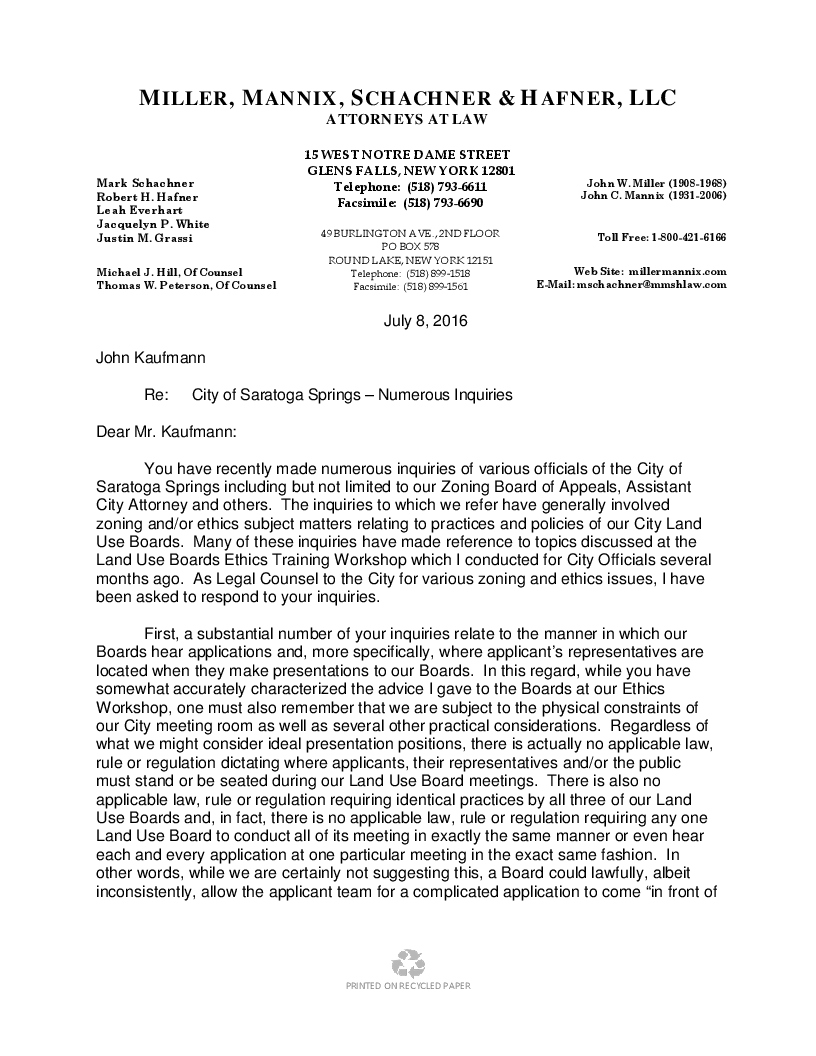
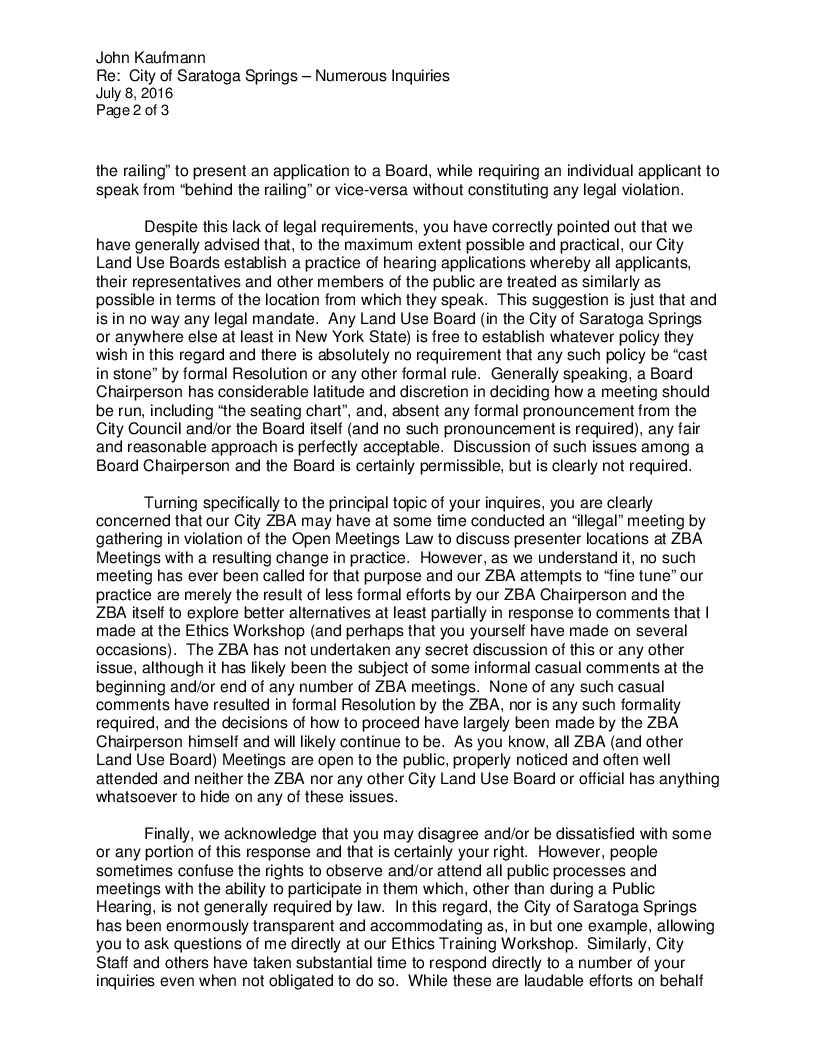
Below is an exchange between attorney Mark Schachner who specializes in land use issues for the city and myself. He is responding on behalf of William Moore, the chairman of the Zoning Board of Appeals, who I had emailed asking questions about recent events involving his board.
The central issues are as follows. Does the ZBA’s meeting structure favor the applicants for zoning variances over the people whose neighborhoods are being impacted? Did the decision on how to address this problem occur outside of the formal meetings of the ZBA? If so, did this constitute a violation of the Open Meetings Law? Finally, if it did not violate the law, did the public still deserve to observe the discussion at which this decision was reached?
As further background, Mr. Moore did not reply to my original email and I followed up with two more courteous requests.
On July 8th, I received Attorney Schachner’s letter.
I am fortunate to have readers who are interested in going beyond sound bites. I expect they will find these documents of considerable interest.
At the beginning of the May 9th meeting of the Zoning Board of Appeals, you announced that hence forth there would be a new policy on seating. You indicated that in the future applicants to the ZBA would be asked to leave the table at which members of the ZBA were seated and sit in the gallery during the public comment period.
While this is an improvement over the previous policy it fails to live up to the standard of impartiality advised by attorney Mark Schachner at the ethics training attended by yourself and the members of the board. To wit, that the boards should seek the highest standards as regards impartiality and openness and that having the applicant sit at the table with the board was not a good policy.
As you may be aware, the Planning Board requires applicants as well as the public to advocate from behind the railing from the gallery. In fact, historically this was the policy of the ZBA as well.
According to Commissioner Chris Mathiesen, both the public and the applicant were allowed to come up to the table when materials were presented that could not be seen from the gallery. This made it possible for the public to observe any hard copy documents presented by the applicant. Other than under those circumstances, as the Planning Board currently requires, both the applicant and the public were relegated to the gallery. This represented the highest standards consistent with the advice offered by Mr. Schachner.
I believe that it was Mr. Schacher’s point that seating applicants with you at the table sends an implicit, if unintentional, message about the status of applicants as compared to the public. I am respectfully requesting that you respond by explaining why you chose not to return to this policy but to continue to have applicants sit with you at the table during their presentation while relegating the public to the gallery.
I have reviewed the videos of the ZBA and I cannot find any meeting at which you discussed this change of policy. Having observed your interactions with your board, I know how inclusive you are with them. I find it very difficult to believe that you would have made this policy change without both consulting them and having a thoughtful conversation on this sensitive issue. It is possible that I missed this event. I respectfully ask that you respond by indicating at which meeting this decision was reached.
At your June 6 meeting Adam McNeil gave an impassioned statement over his frustration at what he characterized as the public’s unfair criticism of the members of the ethics board. Ms. Steer seconded his comments. I have a certain sympathy for their frustration. There is no question that the members of this board give extraordinarily of their time as members of this board. I would respectfully point out, however, that the board’s deliberations have a profound impact on the lives of the people of this city. It is also fully understandable that the people who live in the neighborhoods affected by the decisions of this board often find the decisions of this board both threatening and painful. The members of the public who have addressed this board have shown considerable restraint and respect. The fact that Mr. McNeil and Ms. Steer cannot understand why, for example, the public would be disturbed that a member of the board would go out for drinks with an applicant and his lawyer after a meeting unfortunately reflects a certain lack of empathy and deference to the public .
I would be appreciate if you could respond to my following two questions at your earliest convenience.
*Why did you choose to continue to have applicants sit at the table with the board during their presentations rather than in the gallery as was past practice with the ZBA and current practice with the Planning Board?
*At which ZBA meeting was this change discussed?
Thank you
Attorney Mark Schachner’s Reply [I am including a link to a PDF for those who have trouble reading this image:Letter from Schachner ]
I think if you review my email you will see that I never asserted
that there was any legal issue that would compel the Zoning
Board of Appeals to follow the example of the Planning Board in
the manner with which it receives input from the public.
While I am not surprised that you chose not to venture into a
substantive discussion of the merits of the Planning Board’s
approach I thought you articulated my basic concern quite well
at the original training you did. I only wish the members of the
Zoning Board of Appeals had taken your advice more to heart.
I am however disappointed at your defense/characterization of
the manner by which the change to the seating policy was
determined. Based on your own comments at the training, the
issue of impartiality is not a frivolous one and as such deserves
serious consideration. Not being a lawyer, I will accept the fact
that a discussion over an issue like this can be carried out
informally outside of public view without violating the open
meetings law.
Having said that, I think Mr. Moore and his board would have
been better served had you counseled them that encouraging
trust by discussing sensitive issues like this in full public view
would avoid unnecessary conflict and help to encourage a sense
of trust in the community. Explaining a policy change like this
seems like a modest endeavor and being obdurate about
offering an explanation does not become the chairman of an
important board.
I want to thank you and the mayor, who I assume asked you to
address this, for your letter.
Posted: 07/06/16, 3:28 PM EDT | Updated: 2 days ago
SARATOGA SPRINGS >> The Saratoga Springs City Council on Tuesday approved a motion to seek input on a State Environmental Quality Review Act (SEQRA) scoping process on a proposed Pilgrim Pipeline project.
According to Bill Boehmke, chair of the climate and energy committee for Sustainable Saratoga, Pilgrim Pipeline has applied to construct along the thruway from Albany an oil pipeline that would carry oil to New jersey refineries. Boehmke requested on Tuesday during the bi-weekly City Council meeting that the Council send in a scoping request to learn more about the potential impacts of this project on Saratoga Springs.
Boehmke said that to supply the capacity of 200,000 barrels per day, much more oil would be brought to Albany by rail which would bring an increased amount of oil trains through Saratoga Springs. Various schools, Skidmore College, Saratoga Hospital and businesses are within one mile of the emergency evacuation zone of this oil route.
SEQRA allows interested parties to identify concerns about potential impacts of an environmental act and Sustainable Saratoga suggested that safety concerns are not being addressed in Pilgrim Pipeline’s assessment and application of this project. They will be identifying concerns to state agencies.
Legally, there is little the Council can do to prevent the oil trains from passing through Saratoga Springs but the decision Tuesday would allow them to be an interested party in the SEQRA review. This means that the Council would receive more information on the project and would eventually be able to give their input. Their letter will go to lead agencies, the Department of Environmental Conservation and the New York State Thruway Authority.
Public Safety Commissioner Chris Mathiesen called the pipeline a bad idea and an insult to the Northeast. However, according to him, ways to minimize risks are being evaluated by Senator Charles Schumer, including speed limits for the oil trains.
“I still think that, overall, there are better ways of dealing with our energy problems,” he said.
A reliable source informed me that Mayor Yepsen has been postponing meeting with the Ethics Board for months.
As I have noted in previous emails, the Ethics Board operates with an impenetrability that would make the CIA blush. I went back through the available public records of this board and there was literally no record in any of the minutes or the agendas of the Ethics Board that referenced Mayor Yepsen’s name let alone that there was an inquiry pending regarding her dealings with Saratoga Hospital. I know that an inquiry regarding this matter was lodged by Michele Madigan and Skip Scirocco because Ms. Madigan confirmed it.
With no other choice, I emailed the mayor on June 30th asking if she could confirm that she had postponed meeting with the Ethics Board and why it was necessary to make these postponements. When I did not get a response, I followed up a week later with similar results.
[This is a post written by Sandra Cohen on behalf of Saratoga Neighbors For Zoning Enforcement. It is a report on what happened at the last meeting of the ZBA regarding “Downton Walk.” It is important for background to note that in order for the ZBA to reverse their original approval for this project, it must be shown that the project or its environment has changed. The members of the group did an excellent job systematically documenting the changes and Ms. Cohen has done an excellent job reporting on this. The project comes up for what is expected to be a final decision on Monday night]
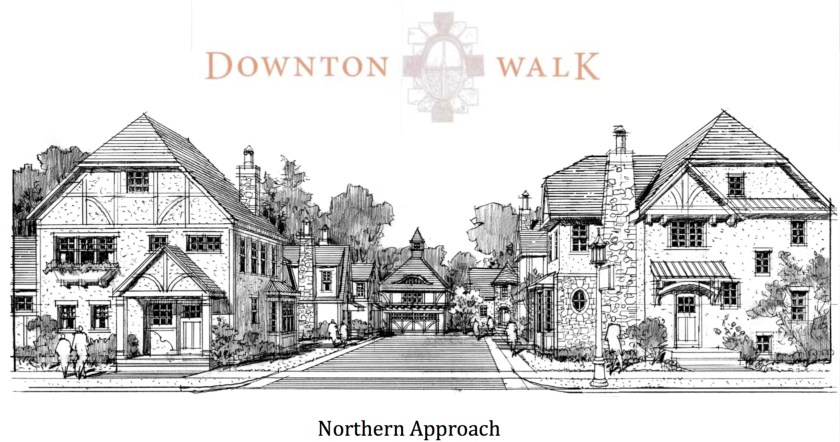
This is the drawing of the project from 2013.
This is the current graphic of the project
Just as the May 23rd session was, the June 20 meeting of the Zoning Board of Appeals became a marathon. With ten items on the agenda, several of which included their own hiccups, the agenda item saved for last was the one I’ve been following: Builder John Witt’s Downton Walk Proposal for 27 Jumel Place.
With Vice Chairman Keith Kaplan, sitting in for Chairman Bill Moore, the Board worked on comparing this year’s Application with the previous version(s) that had been approved in 2013/14. It was stressed in the last meeting that Significant Changes from the previous application are the only things that could allow the Board not to approve this project, so this was the focus of questioning throughout the evening.
It is important that it be clear that there aresignificantdifferences between the two applications submitted.
The ensuing financial discussion brought strong objections from Witt’s attorney Elizabeth Coreno, insisting the approval did not hinge on financials in 2013. But Board Member Susan Steer countered that the first point on the earlier decision — whether or not the benefits can be achieved by any other means feasible – wasfinancially-based, to which Coreno acquiesced. Steer concluded that the difference between the financial information in 2013 and 2016, in and of itself, represented a significant change between the two applications.
In 2013, the applicant reported that his 7 homes would sell at an average price of $640,000, bringing the total of all of them to $4,480,000. After land acquisition and development costs of $905,640, $3,574,360 remained.
In 2016, the applicant states the average price of the 7 units will be $930,000. Building and selling only 5 units at that average price, after subtracting the $1,303,380 land acquisition and development costs, the remaining $3,346,620 is feasible, because it is nearly the same amount as in 2013 with 7 units.
Additionally, selling the 7 units using today’s average price of $930,000, in essence will reward the applicant with $1.6 million more than in 2013 – to make up for the difference of only $397,740 in land and development costs.
Furthermore, the prices now being used by Mr. Witt and his attorney do not take into consideration the even higher prices that he supplied to the Board in February 2016 – prices between $700,000 to $1,500,000, instead of the $587,000 to $1,255,000 being used now. The prices Mr. Witt provided to the Board in February 2016 were reduced by 16% after Mr. Witt acquired an attorney in May 2016, even though Mr. Witt continues to allow the higher numbers of $700,000 to $1,500,000 to be used in newspaper articles promoting his Downton Walk development. There has been a constant calibration in price ranges, which represents an additional significant change.
Feasibility has significantly changed and must be considered now in evaluating “Whether the benefit sought by the applicant can be achieved by some method feasible for the applicant to pursue other than an [these] area variance[s].”
Yes, the numbers supplied by Mr. Witt prove he can feasibly build five homes now, not seven, which would thereby significantly reduce the substantial nature of the variances that he is requesting.
When discussion turned to drawings, which have been part of the Applications, Board Member Cherie Grey questioned the size and proportions of the structures – saying she felt that the 2016 Downton Walk homes look muchlarger than those drawn for Magnolia Lane in 2013. Although Witt protested that the size hasn’t changed, Grey persisted, citing that original application drawings show fewer second stories on garages and were not as tall as those in 2016, which present as three stories with their 30’+ heights.
Coreno continued to insist their square footage has remained static, which was met with dubious responses from more than one Board member, relative to footprints versus number of stories, which absolutely affects overall size and how much more crowded it makes the lot appear. Only thefootprint (first floor) measurement is “set in stone,” because that is what is used to calculate lot coverage and permeability. Hence, those are the only numbers the Board and public see prior to approval. So, in essence, both parties are correct: the footprint sizes have not changed; but the overall massing (interior square footage), more stories, and higher rooflines clearly indicate a significant change — when one compares the drawings from 2016 with those from 2013/14.
The Board’s final area of concern was an intensive discussion of the swimming pools, which illustrate another difference between the applications of 2013/14 and 2016. Board Secretary Adam McNeill supported 2016 as, in his words, a mirror image of 2013/14, saying, “I’ve never seen or heard of before a more precedential picture,” alluding to the Doctrine of Precedence (the legal ruling which requires a Board to approve an unchanged re-application of one that had previously been approved and then allowed by its applicant to expire.)
However, Board Member James Helicke pointed out that the drawings in the 2014 Variance Application indicated only three pools, versus four in the 2016 drawings – thus spoiling its status as a mirror image and representing another significant change in the application. There was a retort from Coreno that the drawings had not changed. But, Witt clarified for her that he did remove one pool for the 2014 submission.
Coreno also contended that the lot coverage measurement had not changed – although no pool measurements were included in those figures in any of the applications. In our view, this means that all the applications – 2013, 2014, and 2015 – were incomplete and misstated as far as lot coverage is concerned. We also do not know if the optionalporches shown in the presentation were included in the original footprint measurements in any of the applications, which would add to the pools as two more significant changes.
And one must note that, since the pool measurements clearly were not included in lot coverage, and possibly the optional porches were not included either, these things also will mark a change in thepermeability of the land that is part of the approval process is another significant change.
We realize the Board is anxious to close this matter, but ignoring such issues and significant changes will not be doing the City any favors. So, although they plan to present a resolution at the next meeting, on July 11, it is clear that they will be voting on something about which they do not even have all the facts.
During the Public Hearing, Kira Cohen reiterated the City Attorney’s explanation about significant changes in circumstances, which needed to be presented for a basis to deny the application. She directed the Board’s attention to ANW’s response to the May 23rd question of why they had not subdivided the land to which Coreno replied that one of the two purposes of building seven condos had been because of the desire for shared maintenance, which would not be available with a subdivided parcel. Cohen countered that State Law not only allows shared maintenance in subdivisions, but also the Attorney General’s office had simplified the procedure for applying for it in January 2014, another significant change in the application.
Sam Brewton presented the changes in the neighborhood the project would cause on the small, settled, more than 100-year-old community, many of the inhabitants of which have lived there for a very long time. His comments centered on things that neighbors wrote when signing the neighborhood petition – at least 14 of them reversing their original signatures from the developer’s petition they signed in the early days of the process. These individuals voluntarily added their names to what is a list of 47 neighbors, and some signed the change.org petition of more than 500, mostly Saratogians or individuals who have lived here – some who have grown up here and moved on but return to visit family and lifelong friends.
Although Kaplan stopped this presentation saying it was irrelevant, the Board’s 2013 resolution cited “The Applicant has demonstrated, and several neighbors have testified in support, that this development will have a very beneficial impact on the neighborhood,” which refutes Kaplan’s determination that it is irrelevant to the 2016 Application. So our showing the validdiminishment of that support does represent a significant change.
Question number 1 in the evaluation criteria that the ZBA must consider is, “Whether an undesirable change will be produced in the character of the neighborhood or a detriment to nearby properties will be created by the granting of the area variance.”
Members of neighborhood do increasingly feel that this development, as currently designed, will be overwhelming in both size and price. The structure sizes will dwarf the homes surrounding it, and it will bring a superfluity of populace, traffic, and noise to this single lot.
Gerald Mattison addressed the financials — how much they have changed since 2013/14, reiterating such things as how home prices have risen and the lower cost of constructing fewer homes would provide the builder the ability to make the project feasible with only five homes on a subdivided lot, at today’s selling prices.
Jane Valetta persisted that the neighborhood has changed since the ballet and karate schools have gone. Now it’s quiet with little traffic. She also noted that none of the homes currently there rise to the $500,000 range, so even the ones at the lowest end of Witt’s spectrum will change the nature of neighborhood. She cited that the drawings have changed. The 2013 drawings made the homes look smaller and cottage-like – which is how the developer described them when he came to get signatures on his petition. But the new drawings depict three-story homes much larger in volume. That is another significant change.
Debra Mattison spoke of the dangers presented by thedead-end lane into the community and the issue of not having accounted for the swimming pools in the original measurements. She pointed out that pools also need their own separate fences, which must follow code. She explained that the pools willcause increase in land coverage, and would lower permeability, none of which had been taken into consideration in the original numbers. And the absence of pool fences in the drawings is another significant change.
At the finish of comments, the Board approved a motion to hold open the public comment period until the next meeting when they would vote.
These NINE changes — financial information and feasibility, overallhome sizes, differences in number of pools and complete lack of pool fencing, price fluctuations, possible lot coverageincrease, possible permeability decrease as a result of these other issues, new knowledge of HOA law and its more recent changes, and the increased undesirable change in the character of the neighborhood — are eachsignificant and substantial changes that could and should allow that vote to change without violating the Doctrine of Precedence.
At the ZBA’s meeting on July 11, 7 p.m. at City Hall, private citizens will have their last chance to speak to the Board before they vote on this project. Currently, Downton Walk is first on the agenda. We hope many of you will take advantage of this opportunity.
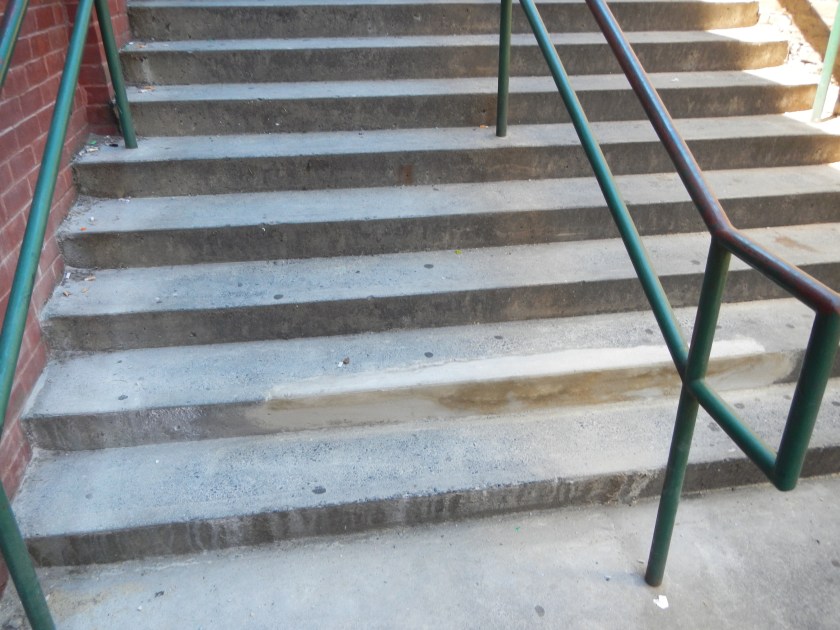
I visited the walkway today (July 6). I was pleased to see that the broken step had been repaired and the barrier removed. I have no idea what precipitated this repair but am glad to see it done. There continues to be litter along the walkway. I do not know how frequently the area is swept but the debris from my last visit was gone and new detritus has taken its place. Still, this represents some progress.
Norreida Reyes has done a terrific job in taking some very modest resources and putting out a very interesting newspaper, Saratoga Today. She recently did an interview with Angelo Calbone who is the CEO of Saratoga Hospital. The interview was quite revealing but not in ways that Mr. Calbone may have hoped for.
From Wikipedia
Doublespeak is language that deliberately obscures, disguises, distorts, or reverses the meaning of words. Doublespeak may take the form of euphemisms (e.g., “downsizing” for layoffs, “servicing the target” for bombing[1]), in which case it is primarily meant to make the truth sound more palatable. It may also refer to intentional ambiguity in language or to actual inversions of meaning (for example, naming a state of war “peace”). In such cases, doublespeak disguises the nature of the truth. Doublespeak is most closely associated with political language.[2][3]
From the Times Union:
The proposal would give Albany Med authority over Saratoga Hospital’s budgets and strategic plans, the hiring and firing of Saratoga Hospital’s chief executive, incurrence of debt, and hospital policies and procedures. Each health system would have representation on the other’s board.
From The Albany Business Review:
Under the agreement, Albany Med would have approval of Saratoga’s budgets and operating plans, hospital policies and procedures and contracts for clinical and management services. Albany Med would also have authority to appoint or remove the CEO, according to information submitted to the health department.
The following is from an interview the CEO, Angelo Calbone gave to Saratoga Today Newspaper in their July 1 edition:
Regarding the AMC affiliation, Calbone explained that it was a multi-year process that involved many thorough discussions with the board. “The board has a responsibility to know and understand how this will work,” said Calbone. “We spent upwards of two years in negotiating the specific terms of the relationship, making sure a very high degree of local autonomy and control stays intact.”
Calbone explained that creating a meaningful affiliation is done through a parent model in New York State, and it is how the State Department of Health regulates them. Although the model does list Albany Medical Center as the parent, the terms in detail are unique to this particular affiliation of the two institutions, and not readily apparent in the public eye [my emphasis added].
“So, internally we knew that is how this structure would work, but ‘parent’ is just a term that is used to describe how relationships are built, and doesn’t reflect the years of negotiations on specific terms. What I believe has happened is that individuals have probably looked at the regs as they are stated in somewhat generic form as to how parent relationships in hospitals work in the State of New York, and took it literally,” [My emphasis: I mean why would we take the regulations’ language literally?] Calbone added. “But unless they were in the room with the board, they won’t know the details. This meets the spirit of those regulations, but leaves a high level of local control and autonomy in place.”
The reason they had to use the parent model goes back to anti-trust laws and other legalities that protect the American public. “We are a business,” said Calbone, “and we cannot work closely as two institutions on regional planning, working to create programs, sharing of information and movement of potential medical education back and forth; you just can’t do some of those things without a relationship because it would break the law. You must connect yourself sufficiently to do it in New York State, and that’s called a parent model.”
Calbone said unequivocally that Saratoga Hospital remains a licensed hospital, which by its nature requires a number of responsibilities to be maintained by the local board. He confirmed that the parent, AMC, would have to approve the local board members.
Although it is a confidential agreement, Calbone could say, however, that the board members put before AMC would first be recruited, interviewed, and vetted by the local board before they are put forward for action by the parent. “Also, they can’t be denied and replaced by other candidates,” said Calbone. “They can only come through the local process of the local board. You wouldn’t know that unless you were part of the negotiations.”
For Calbone’s role, the local board can unilaterally dismiss any CEO they don’t find acceptable, but in choosing a new one, it will be done collaboratively. He said the “parent model” term has been over-interpreted as too dominant, but emphasized that the standard written into regulations [JK: Oh those pesky regulations again] don’t reflect the very unique relationship established between the institutions that is very respectful of the history of the hospital and the value the local board brings to oversee the operations.
“We weren’t forced to do this,” said Calbone. “The local board felt this was the best time to move ahead and it would be helpful to us and our patients. There is grave risk to institutions over the next five years and we choose to take this time to do this while we are successful.”
I have been copying the city council on my emails to Mayor Yepsen regarding the walkway beside Putnam Market. As of this date after two emails I have not heard from Mayor Yepsen. I did, however, receive an email from Commissioner Mathiesen. He indicated that the walkway will not be fixed until the fall. I followed up with a telephone conversation. He explained that because the walkway is heated, the fix will involve blocking off the entire walkway. In light of its role as an easy pedestrian access to parking from Broadway, it makes sense to do it after the racing season.
I raised with him the issue of what can be done to compel the owner to keep the area clean. Commissioner Mathiesen assumed that this would have been stipulated in the site plan agreed to when the easement was granted. He is going to have his code enforcement officer look into the matter. I will keep the readers of this blog informed.
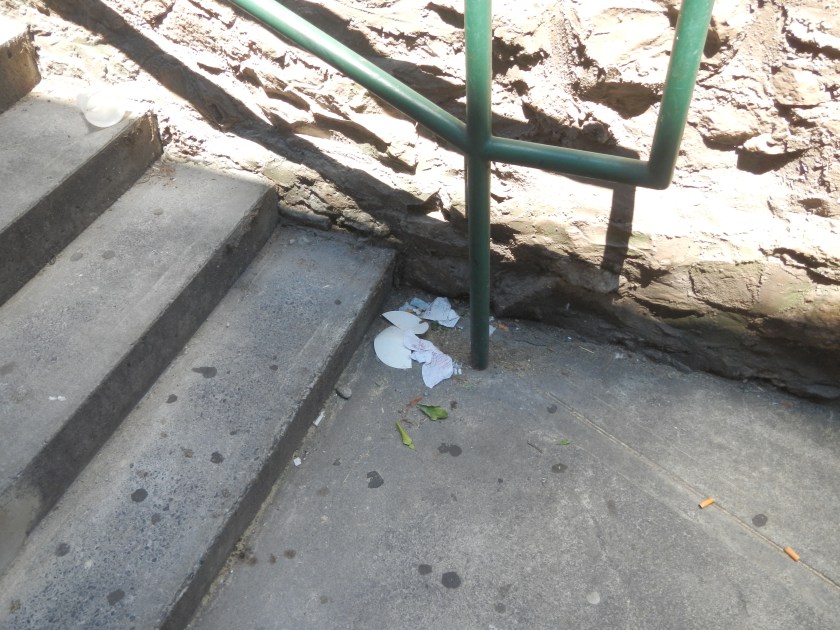
It has been a week since I emailed the Mayor asking that she take action about the dreadful condition of the walkway beside Putnam Market. I visited the walkway today and found that there is still trash there and of course, the sawhorse blocking one set of stairs remains. Regrettably I had no response from last Thursday’s email to the Mayor so I have written her again.Hopefully she will assign someone to find out who the owners of the walkway are so we can all find out when they are going to fix the broken stairs and when they are going to start to police the walk of trash.
Here is my latest email to the Mayor.
From: John Kaufmann []
Sent: Friday, July 01, 2016 7:46 PM
To: ‘Joanne Yepsen’
Cc: ‘Christian Mathiesen’; ‘Michele Madigan’; ‘Skip Sciroco’; ‘John Franck’;
‘Vincent DeLeonardis’; ‘Tony Izzo’
Subject: Walkway
Last Thursday I emailed you (see below) about the deplorable condition of the walkway next to Putnam Market. Having not had response, I visited the walkway again and I attach pictures of the newest trash there.
As noted in my email, I recognize how important our city is to you so I expected to hear from you on this matter. Do you plan to take any action?
Thank you
Sent June 23:
I have been contacted by people disturbed by the walkway that abuts Putnam Market. For at least a month there have been sawhorses blocking part of the path there (see picture). In addition, there does not appear to be any maintenance of the area. The walkway is strategically located at one of the center points of the city but it has been allowed to become an unsightly embarrassment. Trash has been allowed to accumulate there (see pictures).
I have been in touch with the Public Works Department and have learned that this area is privately owned and is not under the jurisdiction of Public Works. I understand that the heating system that is supposed to keep the walkway free of snow needs to be repaired. I expect that this might be a major engineering project and can understand that this cannot
be fixed overnight. I have learned that the owner does not expect to begin work on this until after the cing season is over. Whether this is a reasonable time frame, I do not know. What I do know is that the walkway is dirty and unbecoming of our city.
Has the city taken any action on this matter? If not, can the city take action to require the owner to keep the area clean and to expeditiously do whatever repairs are necessary to remove the sawhorses?
I know you take as much pride in our city as any citizen of this community and expect that you share people’s concerns that this problem be addressed. Could you please keep me advised on this and I will share the progress with the people who read my blog.






 Saratoga Springs Politics