Todd Shimkus Piece On Cuomo and the Threat to Saratoga’s Thoroughbred Race Track


[JK – Full Disclosure: I have not been to a race at the thoroughbred track in over a decade.  One does not have to be a fan of horse racing, however, to acknowledge the enormous importance our track has to the economic health of our city.  Todd Shimkus’ piece in the Sunday Saratogian lays out the very real threat posed by Governor Cuomo’s handling of the New York Racing Association and the race tracks it has managed both upstate and downstate.]

todd-shimkus

Todd Shimkus Reader’s View: Concerned citizens lay out #Whoa Cuomo Fact Sheet


Posted: 10/02/16, 1:00 AM EDT |

0 Comments

What The Concerned Citizens for Saratoga Racing supports:

1. It’s long overdue for New York horse racing to be run again by a not-for-profit entity made up of people who are committed to the long-term success of horse racing in New York – individuals predominantly from the private sector who know racing and have devoted their lives to it.

2. The revenues legally owed to horse racing must go to horse racing. New York state must honor the existing court-approved Franchise Agreement.

3. Relying on a “temporary” Board of Directors and one-year extensions of state government control over NYRA creates uncertainty and has already done harm to investor confidence in the future of our state’s thoroughbred horse racing industry.

In 2008, the state of New York negotiated in good faith and approved a contract with NYRA that is like a mortgage on your home. The state of New York was given ownership over the land on which NYRA’s three tracks operate estimated to be worth $1 billion at that time and likely more today. In return, the state of New York agreed to share a fixed percentage of revenues from a new VLT at Aqueduct for 25 years to support our state’s thoroughbred horse racing industry.

The goal of this agreement was to use VLT revenues to preserve and enhance New York’s position as the premier racing circuit in the U.S. These VLT revenues were to be used explicitly for increasing purses, funding our state’s breeding programs as well as capital improvements and operations at all three of NYRA’s tracks. This franchise agreement was further approved by the federal courts allowing NYRA to exit from bankruptcy protection.

The revenue sharing resulting from this agreement is what has really improved our state’s thoroughbred horse racing industry. These revenues have allowed NYRA to increase purses to attract the best owners, horses, trainers and jockeys to race in New York. VLT revenues have made our state’s breeding program the envy of the U.S. This revenue sharing is what is enabling NYRA to be more successful and profitable. These monies have also made it possible for NYRA to make improvements to the housing for backstretch workers and to consider additional capital improvements at all three tracks.

Gov. Cuomo did not rescue NYRA from bankruptcy. NYRA was sent into bankruptcy by the state when the state refused to honor a contract with MGM to build a casino at Aqueduct Racetrack. NYRA exited bankruptcy in 2008, years before Andrew Cuomo became governor, when NYRA sold its land to the state in exchange for this 25-year franchise extension.

More recently, Gov. Cuomo again used a questionable tactic to force the NYRA board to accept a state takeover. The governor withheld VLT payments until NYRA was faced with bankruptcy – again caused by the state of New York. NYRA only acquiesced in this case because the Saratoga season was put in jeopardy.

The governor’s latest proposal will reduce future VLT payments to NYRA. His proposal will cap revenues from the VLTs, redirecting those funds to non-racing activities and altering the franchise agreement. This action will reduce monies available now and in the future for capital improvements and operations at all three tracks. Each and every effort to divert or cap or reduce funds legally owed to support horse racing represents a threat to the future of the Saratoga Race Course and our state’s thoroughbred horse racing industry.

Thanks, but no thanks

This governor needs to honor the existing franchise agreement. His office has asserted in media reports that their proposal “guarantees the Saratoga Race Course $16 million annually for capital improvements.” But what happens to the guarantees now included in the franchise agreement if the governor has his way and is allowed to alter the existing agreement? To make this latest guarantee, the governor must break another one. If we let them alter the franchise agreement today, what will stop this governor or the next one from further altering this new deal? The current agreement provides New York’s thoroughbred racing industry and all three tracks with funds sufficient to be successful in the short and long term.

How these funds should be spent and at which of the three tracks is also important. We are convinced that it is the responsibility of the NYRA Board of Directors to make these decisions. The NYRA board has a fiduciary duty to the racing industry to decide where and when capital funds should best be spent. Perhaps Saratoga needs $20 million one year or just $5 million another. Whatever the proper amount is, it should be decided on in the budgeting process of the NYRA Board of Directors and nowhere else.

No-show in Saratoga

Gov. Cuomo has been a no-show at the Saratoga Race Course since his election in 2011. We’ve now completed five 40-day race meets in Saratoga and the governor has still never toured the backstretch, visited a local breeding farm, met with local leaders nor watched a race at the oldest sport venue in the U.S. He turned down numerous invitations when our community celebrated the Saratoga 150, in 2013, and again this year.

You’d think that the governor would benefit from visiting Saratoga and talking with local stakeholders who have worked for decades to ensure Saratoga’s race meet is the best in the U.S. We’re sure that a dialogue with local leaders will help him to understand what really makes the Saratoga meet successful.

Unfortunately, the governor has not responded to any of these invites. At the same time, he has ignored the advice of his former special adviser, John Hendrickson, and even the counsel of close friends that he appointed to the NYRA board. It’s frankly difficult to imagine that he has or knows what is in Saratoga’s best interest since he’s never taken the time to visit or to chat with us to find out.

No transparency

The 2016 State Budget included a provision – for which there was never a public hearing nor formal review by the Legislature – allowing Nassau County OTB to secure revenues from 1,000 new VLTs at the Aqueduct Casino. This action could result in a reduction of $25 million in revenues for New York’s thoroughbred horse racing industry. This action will damage our state’s thoroughbred horse racing industry, particularly by redirecting revenues away from horse racing and breeding to this financially troubled OTB.

This summer, we’re told the governor met with a select group of his appointees on the NYRA board. These discussions excluded NYRA’s CEO and our local legislators. The one NYRA board member from Saratoga Springs was not invited and no local stakeholders were asked to participate. There is no record of what was discussed nor is anyone who attended providing specifics about the deal. It’s a big secret. The only thing we know is that NYRA’s Chairman of the Board, Michael DelGuidice, said at NYRA’s most recent board meeting that he expects a deal to be in place by January.

We agree with the governor’s office that NYRA needs to be transparent and accountable. We think that should start today while the board is controlled by the governor. Private meetings between the governor and the men he has appointed to the current government-controlled board is neither transparent nor accountable. So if the performance standard by which we will judge NYRA should include transparency and accountability if it is private, we’d suggest it be so today when it is publicly controlled too.

Todd L. Shimkus, CCE, is president of the Saratoga County Chamber of Commerce

Saratogian On Commissioner Scirocco’s Decision Not To Meet With Charter Commission

Commissioner says he skipped charter review to avoid political games

mctyguetestifies

Former Commissioner of Public Works Tom McTygue testifies before the charter review commission on Tuesday. Travis Clark – tclark@digitalfirstmedia.com

By Travis Clark, tclark@digitalfirstmedia.com,, @TravClark2 on Twitter

Posted: 09/28/16, 5:22 PM EDT | Updated: 2 days ago

SARATOGA SPRINGS >> The charter review commission has been conducting their review of the city charter for the past month, interviewing past and current elected officials. However, on Tuesday night the commission interviewed only a former Commissioner of Public Works, Tom McTygue, as the current commissioner Anthony “Skip” Scirocco did not show.

Scirocco skipped testifying in front of the charter review commission because of what he perceived as a political play. Scirocco was under the assumption that commission chairperson Bob Turner had invited former Director of Public Works, and a former political opponent to Scirocco, Bill McTygue to testify at the meeting along with his brother Tom and Scirocco.

Scirocco, feeling uncomfortable at the prospect of being caught between the McTygues, as they “regularly make baseless claims against” his department, sent Turner numerous emails from September 23 to Tuesday looking for clarification on whether McTygue would be testifying at the table. Turner did not reply until a half hour before the meeting was to begin.

“I gave him every opportunity to respond back to me and he was clearly negligent,” Scirocco said. “I clearly objected to it and I think I had every right to object to it, because no other commissioner or mayor has sat there with [an unelected] political opponent.”

The initial email that Turner sent Scirocco indicated that Tom McTygue had asked if Bill could be at the meeting because “his memory is better.” Turner offered that Scirocco could bring his deputy and that he would “not allow it to become a political free for all of them criticizing you [Scirocco].” It was never clearly indicated whether McTygue would be sitting in the audience or if he would actually be testifying to the commission. To Scirocco, however, it was loud and clear.

As the only Republican on City Council, Scirocco felt that the commission was being bias for Democrats by inviting Bill McTygue to testify when he had never been an elected official. In a final email Scirocco sent to Turner on Tuesday, Scirocco said “no Democrat has been made to participate with former non-elected political opponents, and as the sole Republican I strongly object to this mistreatment. You are clearly treating me differently than everyone else.”

Turner said that this was miscommunication and that McTygue was never invited to testify.

“Our plan is to speak to every elected official in Saratoga Springs history,” he said, indicating that there was no political bias.

“We’ve had a number of political opponents in the past and what we’ve tried to do is not make it about the politics,” he continued. “It’s about the structure of government and how we can make that better. That’s far more important than the politics or the personalities.”

At Tuesday’s meeting, Bill McTygue did not testify, but was present at the meeting in the audience. Turner said that this had nothing to do with Scirocco’s email and Bill was never going to testify at the meeting.

Scirocco will be invited to testify before the charter review commission at a later date, possibly October 25, when officials who have not been interviewed will have their say.

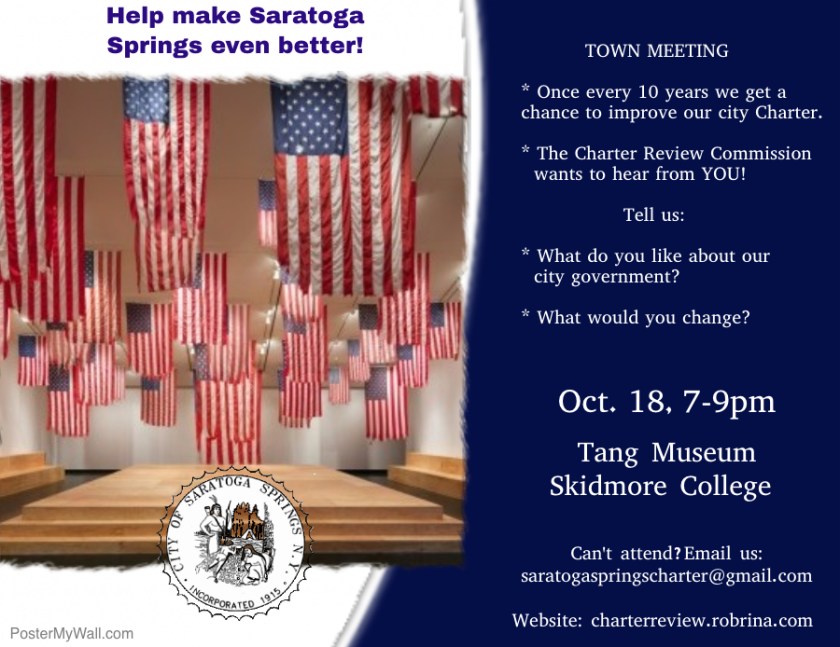
The next meeting will be a public hearing on October 11 at the Tang Teaching Museum at Skidmore College, where the public will be able to voice their questions or comments regarding the city charter.

Comptroller Issues Report That Places Our City As One of the Financially Soundest Governments In The State

I was fortunate to have received this (see below) from someone who follows this blog.  The New York State Comptroller, Tom DiNapoli, has issued a report that attempts to analyze the ability of local, public institutions to withstand potential financial problems.  As the writer points out, the report places the city of Saratoga Springs as one of only three local governments out of its cohort of sixty-one with a perfect score (Zero).

Here is what the writer posted to me:

The Fiscal Stress Monitoring System provides:

An early warning of fiscal stress to local governments and school districts by examining their financial information and aspects of their external environment;

The System has two main components:

Financial indicators evaluate budgetary solvency, the ability of a locality to generate enough revenue to meet expenses, by measuring:

• Year-end fund balances
• Operating deficits/surpluses
• Cashposition
• Use of short-term debt for cash flow

Environmental indicators capture trends that influence revenue-raising capability and demands for service:

Local Governments

  • • Population
  • • Age
  • • Poverty
  • • Property values •Employment
  • Dependence on revenue
  • from other government units (which can be highly variable)
  • Constitutional tax limits
  • Sales tax revenue
  • • Fixed costs (evaluated for local governments only)

Although environmental factors are largely outside a locality’s control, they provide insight about additional challenges confronting a community

.
___________________________________
Preceding is a cut and paste from their fact sheet:

http://www.osc.state.ny.us/localgov/fiscalmonitoring/pdf/factsheet.pdf

_________________________________

My language [The writer’s, not mine]:

Environment score rates the overall health of the city (not the finances) with an attempt to forecast pending problems.

We scored “0” which means we’re one of the healthiest cities with no indication of pending problems.
Stress score rates the financial health of the city with an attempt to forecast financial risk.
Here are the numbers. Be sure to click through the right hand column for Saratoga Springs.

Snowdon: A Gripping Film

It should come as no surprise to the readers of this blog that I greatly admire Edward Snowdon.  He is the ultimate whistle blower.

Oliver Stone has directed a very powerful film that is both chilling in its presentation of the power of the new technology to invade people’s lives and of the transformation of Mr. Snowdon from a volunteer in the Special Forces to his eventual decision to expose the NSA.

This is a link to the trailer of the film: Link

Volunteers Needed to Plant Trees On Saturday, October 1

Sustainable Saratoga will be doing its fall planting and is seeking volunteers.  It is both a fun event and something that makes a tangible difference.  Here is a link to the information Link To Flyer


Times Union Protects Public from Letter from Blogger’s Wife

Bloggers Wife: Threat To Public (And Times Union)

img_1080
Jane Weihe

Recently, my wife, Jane Weihe, wrote a letter to the editor of the Times Union newspaper in which she criticized their coverage of the proposed renovations for the city’s Finance Office.  The newspaper responded that in order to publish her letter she would be required to make substantive changes.

The correspondence really speaks for itself but I would like to make several introductory observations regarding this controversy.

Jane’s letter criticized the Times Union Newspaper and the reporter, Wendy Liberatore by name.  The newspaper responded  that Ms. Liberatore’s name could not be used since, they asserted, all the stories are a collaborative effort.  You will see in Jane’s letter that she addresses the significance of a byline.  I would add to this (a bit snarkily) that using this logic, were a TU reporter  awarded a Pulitizer Prize they would have to decline it since all published work in the paper  is,  according to them, a collaborative effort and cannot be attributed to any one person.  For that matter, any letters congratulating the proposed awardee would have to be rejected.

As the readers will note, Rex Smith, editor of the TU, was copied on all correspondence.  I would assume anyway that as editor this policy reflects his standards for journalism.  As many will know, Mr. Smith opines on a radio program on WAMC called the Media Project.  This program is supposed to analyze media coverage.   I think the comedic character of the following letters raises some concern about Mr. Smith’s expertise on what constitutes good journalism.

Original Letter

From: Jane Weihe [mailto:jane.weihe@gmail.com]
Sent: Monday, September 19, 2016 3:22 PM
To: TU Letters <TUletters@TimesUnion.com>
Subject: Saratoga Springs Finance Department renovations–letter to the editor

Shame on Wendy Liberatore and the TU editors for their front page treatment of proposed renovations to the Finance Office in Saratoga Springs.  I’m not sure what source Ms. Liberatore used to conclude that the renovations to the office which include a bathroom and kitchenette were for Commissioner Madigan’s private use but I would suggest she use caution before trusting this source in the future. These and other proposed renovations are not for the Commissioner’s private use. Instead the plans call for a much needed upgrade to the rather dilapidated Finance office including public spaces, and improved facilities are for the use of the entire Finance Department staff. I would urge the folks at the TU and their readers to take advantage of Commissioner Madigan’s invitation to tour the space and see the renovation plans first hand for a more accurate view of what has been proposed. Tours will be given every Tuesday at 2PM from October 4 to November 1.

Jane Weihe

44 White Street

Saratoga Springs, NY 12866

518 573-1732

First Response From Times Union

From: Tyler, Tena On Behalf Of TU Letters
Sent: Tuesday, September 20, 2016 12:25 PM
To: ‘Jane Weihe’ < >
Subject: RE: Saratoga Springs Finance Department renovations–letter to the editor

Thank you for writing. I’m interested in the letter; however, a couple of issues would have to be addressed.

It’s fine to criticize the Times Union, but we don’t publish ad hominem statements against individuals including reporters. Stories that are published are the result of a collaborative process. So, if you want to say “Shame on the Times Union…,” I would consider that for publication.

Also, the article doesn’t say that the renovations are for the commissioner’s private use, and letters are used for commentary on print-published content. There is a link to the story and a copy of it below. It says the renovations are for the private use of that department, which includes the commissioner. And, unless these facilities are going to be open to the public, then it would be for the private use of that department. However, if you would like to say “…early online versions of this story made it unclear who would benefit from the restrooms and kitchenette…” then I would consider that phrasing.

If you’d like to edit the letter and resubmit, I’ll consider it.

Tena Tyler

Senior Editor, Engagement

Reader Representative

Editorial Board

News and Information Services Department

(518) 454-5324

twitter.com/tenatyler

facebook.com/tenatyler

Box 15000

Albany, NY 12212

Fax: (518) 454-5628


Jane Weihe’s Response

From: Jane Weihe []
Sent: Wednesday, September 21, 2016 8:04 PM
To: Tyler, Tena <ttyler@timesunion.com>
Cc: Smith, Rex <RSmith@TimesUnion.com>; Jay Jochnowitz <jjochnowitz@tu.com>
Subject: my letter to editor


Dear Ms. Tyler:

I found your response to my letter to the editor rather troubling.  While I appreciate your generous effort to assist me in writing a letter that would be acceptable to your newspaper, you have raised a number of issues that I think are at odds with the tradition of American journalism.

The first, and in many ways most problematic issue, is your requirement that my letter not refer to the reporter by name.  I understand that a reporter does not operate independently, and that their work is subject to the review by and consultation with at least their editor.  The basic nature of a byline, though, is that it establishes who is accountable for the work.   By placing their name as the author (byline) they are informing the public that they have researched the story and that they take responsibility for its accuracy and professional standards.  One would assume that were an editor to insist on changes that the reporter believed undermined the honesty of a piece, the reporter would decline to have their name associated with the story.  The “byline” in journalism is fundamental to the integrity of journalism.  Knowing Ms. Liberatore, I would assume that she would share this sentiment and that she would be the first to take responsibility for a story to which her name was attached.   If you are asserting that all the stories in the TU are ”the result of a collaborative process” and thus no one person is responsible for a story then perhaps the paper should do away with bylines and replace them with “written by staff” or better yet list the names of all those who were involved.

As to your characterization that my letter was an ad hominem attack on Ms. Liberatore this seems to me to be an abuse of the phrase.  “Ad hominem” is defined  as “an argument directed against a person rather than the position they are maintaining.” My comments certainly did not attack Ms. Liberatore’s character.  I did not accuse her of being immoral, incompetent, or a bad person.  In fact I believe Ms Liberatore was a very good dance critic for many years at the Gazette and is a person of integrity who takes her work seriously. Instead I took her to task for her position in an article that bore her name, that is, “a position that she was maintaining”.  Ms. Liberatore’s original piece characterized a number of renovations as for the private use of the Commissioner.  I pointed out that in fact the renovations were designed to serve the entire staff of the Finance Department.   A front page story that would lead the public to believe that an elected official intended to spend many thousands of dollars of public money to frivolously indulge themselves is extremely damaging.  The failure to accurately reflect the true nature of the project was to any reasonable person, reckless to say the least.    I can fully understand that your paper might respond defensively to the word “shame”, but in this particular case it seems entirely appropriate.

There is also your direction that I should rewrite my letter to state that “…early online versions of this story made it unclear who would benefit from the restrooms and kitchenette…”  “Unclear” is a rather Orwellian euphemism here for what is straightforward inaccuracy.  The original version of the piece was quite clear and quite wrong in asserting that the restroom and kitchenette were for the Commissioner’s private use.

I must say that as problematic as Ms. Liberatore’s article was, the sensational and even more reckless headlines and captions were even worse.   In many ways, Ms. Liberatore’s errors were radically exaggerated by the New York Post-like headlines.   “Finance Chief Michele Madigan’s budget includes a private bathroom, a new ceiling and a kitchenette for her use” was the headline that went out on Twitter and Facebook. “Taxpayers on Hook for $750K” was the headline in the email sent out to the electronic subscribers (which we are). The photo caption in that version states “Work on City Hall office of Saratoga Springs Commissioner of Finance Michele Madigan will include a private bathroom, kitchenette, and storage area as well as a private conference room” again suggesting this was for the Commissioner’s private use in “her “office not in the Finance Department’s office.

Your paper does deserve some credit for rewriting the story even though the headlines were not much of an improvement and continued to suggest the perspective of the earlier version. It would have been more honest, however, and more in keeping with journalistic standards had the paper indicated that this new story was not merely an “update” but in fact a correction.

Finally, I am struck by how threatened the Times Union appears to be by my letter.   When I sent the letter I fully expected that you would probably simply publish it as a token gesture of your tolerance to criticism and acknowledgement of the problems with the article to which you had given such prominence.  Of course I thought also that you might not publish it, but I never expected you to suggest I rewrite it to include a statement that “earlier on line versions  of  this story made it unclear who would benefit from the restroom and kitchenette” when it was unfortunately certainly not  unclear.  I do not intend to put my name on such a statement to help sanitize what the paper did.  I am, though, rather amused that you should go to such lengths to have me craft it to your approval.

My short letter was never going to begin to mend the damage of the story your paper published.  I consider the letter I wrote originally to be sharp in its criticism but fair and well within the bounds of good taste.  If you feel that it threatens Ms. Liberatore and your newspaper, I expect you will exercise your power to simply not publish it.  The world will go on.

Sincerely,

Jane Weihe

44 White Street, Saratoga Springs, NY 12866

518 573-1732 (cell)

Last Response From Times Union 

From: Tyler, Tena On Behalf Of TU Letters
Sent: Tuesday, September 23, 2016 12:25 PM
To: ‘Jane Weihe’ < >
Subject: RE: Saratoga Springs Finance Department renovations–letter to the editor

Thank you for your note. As it happens, it is our standard guideline for letters criticizing articles that it is the Times Union that is identified, rather than individual writers, for the reasons I explained in my original response. I’ve re-included that email; the issues described in it remain unchanged. If you’d like to re-submit the letter tweaking in the ways described below, I will consider it. Otherwise, I understand that you don’t want the letter published.


Architects Who Did Study On Finance Office:Extraordinary Credentials

In a casual conversation with a friend who is an architect I mentioned the controversy over the Finance Office restoration.  He asked who the firm was that had done the study and after a little looking I found them and told him Mesick, Cohen, Wilson, Baker Architects, LLP.  He told me that they were considered the premier architects nationally on projects that involved preservation.

This is a link to their web site: link

I have selected from their website some of their projects that the readers of this blog might recognize.

Civic

  1. The Maryland State House
  2. The Tennessee State House
  3. Vermont State House
  4. New York state Capitol
  5. S. Federal Court (Washington D.C.)
  6. Rochester City Hall

Cultural

  1. Monticello (Jefferson’s Home)
  2. Chesterwood Studio (Stockbridge)
  3. The Hyde Collection (Glens Falls)
  4. Saratoga Automobile Museum
  5. Canfield Casino
  6. Arrowhead (Pittsfield – Herman Melville’s Home)

Educational

  1. Williams College
  2. RPI
  3. Skidmore
  4. College of William and Mary
  5. Union College
  6. University Of Virginia

Commercial

  1. Fort Orange Club
  2. Daughters of Sarah
  3. Proctors Theater
  4. Stuyvesant Plaza

The following is a list of  their awards:

2011

New York State Preservation League Award for Excellence in Preservation

Interior Renovation and Restoration project.  Cathedral of the Immaculate Conception, Albany, NY.

2010

The Thomas Jefferson Chapter of Preservation Virginia/APVA 2010 Preservation Project of the Year Award

This award was presented to the University of Virginia Office of the Architect and Facilities Management for the restoration of Pavilion X, one of Thomas Jefferson’s pavilions in the Academical Village. The Awards Committee was particularly impressed with the depth of research, the rigor of analysis and the strength of commitment to thinking in fresh ways about historic preservation in the Academical Village. Charlottesville, VA.


2008

The Florida Trust for Historic Preservation’s Outstanding Achievement in the Field of Restoration.

This award was given to Florida Southern College for the complete restoration of Frank Lloyd Wright’s Waterdome.


The New York State Historic Preservation Award

This Not-for-Profit Achievement Award was presented to the Hudson Mohawk Industrial Gateway for the restoration of the Burden Iron Works building in Troy, NY.


2007

New York State Preservation League Award for Excellence in Preservation and the Historic Albany Foundation Preservation Initiative Certificate.

These awards were given for the Improvements to the Great Western Staircase project at the New York State Capitol. The project involved cleaning over one hundred years worth of dirt, grime, and soot from the massive sandstone staircase. The project also involved the cleaning and restoration of all the historic light fixtures within the stair.


2004

The New York State Historic Preservation Award.

This Not-for-Profit Achievement Award was presented to the Cathedral of the Immaculate Conception, Albany, NY for an outstanding restoration of one of Albany’s most prominent landmarks.


2001

The Maryland Historical Trust Preservation Project Award for Hancock’s Resolution.

This award was given for the complete restoration of Hancock’s Resolution, 2001. The project required dedication and skilled craftsmanship to stabilize the deteriorated structural systems and other components and restore the original detailing of the landmark’s masonry construction.


1999

The New York State Historic Preservation Award for Chatham Union Station, 1999.

This award was given for the rehabilitation of Chatham Union Station, Chatham NY. This project restored the 1887 station to its original appearance while adapting it to its modern purpose, that of a bank.


1996

Build New York Award

The Pohndorff room, an addition to the Lucy Scribner Library at Skidmore College, was the recipient of this award for excellence in construction and teamwork.


Historic Albany Foundation Preservation Merit Award Recipients


Fort Orange Club- Award for restoration of the West Lounge


Albany Medical School- Medical Building Annex- Award for sensitive addition to existing historic building


Albany Law School- Moot Court Facility- Award for adaptive use


Rockefeller Institute of History and Government- Award for adaptive use/restoration of a Washington Park townhouse


1992

Massachusetts Historical Commission Project Award

The Eagle Office and Technology Park received this award for its adaptive use of a 19th century industrial space into a modern office and production space for the Berkshire Eagle newspaper.


TU Reporter Liberatore Responds To Blogger On Renovation Issue

On Friday I received a response from Wendy Liberatore  to my email to her which I posted in a recent blog and which I reproduce below.  I think Ms. Liberatore deserves a great deal of credit for engaging in a discussion on the coverage of the Finance Department’s renovations issue here.

I continue to disagree with Ms. Liberatore on the coverage of the issue but I think the matter has been pretty thoroughly discussed, so I am simply posting her response without further comment.


My Original Email To Ms. Liberatore

From: John Kaufmann <>
Date: Thursday, September 22, 2016 at 8:57 PM
To: Wendy Liberatore <wliberatore@timesunion.com>
Subject: Study By Architects

Per your recent blog, I have reviewed the study done by the architects for the proposed renovations to the Finance Office in Saratoga Springs.   They seem to me to be extremely thoughtful in their attempt to improve the offices of the Finance Department to make them both more efficient and to better serve the staff in doing their work.  Your original article and headlines like ““Taxpayers On Hook For $750K” strongly communicate that there was something improper in these plans that was newsworthy.  Could you take the time to email me what it is in the study by the architects that you found problematic?  The Facebook headline for your article stated “Finance chief Michele Madigan’s budget request includes a private bathroom, a new ceiling, and a kitchenette for her use”.  Could you please cite the section of this document that would support this statement.  Let me note that it would seem highly disingenuous to argue that these headlines would not lead the public to believe that these amenities were for the Commissioner’s personal use rather than for everyone in the department.

I look forward to your response.


Ms. Liberatore’s Response

From: “Liberatore, Wendy D” <wliberatore@timesunion.com>
Date: 09/23/2016 9:37 AM (GMT-05:00)
To: John Kaufmann <j>
Subject: Re: Study By Architects

Dear John,

The details you described were amended in the article to state the bathroom was for her and her staff. The original post mentioned the ceiling would be restored and that there was a kitchenette. It did not mention “for her use” in connection with the kitchenette, only the bathroom.

This is what has been printed and has been online.

http://www.timesunion.com/local/article/Saratoga-Springs-finance-chief-wants-750-000-9227194.php

We even printed one article on her defense of the project:

http://www.timesunion.com/local/article/Commissioner-defends-750K-in-renovations-for-9236043.php

Here are the blog posts, which allowed the public to weigh in:

http://blog.timesunion.com/saratogaseen/finance-office-renovations-will-cost-taxpayers-750000/27933/

http://blog.timesunion.com/saratogaseen/read-the-specs-for-finance-commissioners-750k-renovations-project/27956/

In every instance, Madigan’s point-of-view was clearly stated. We feel that she has been treated fairly in this matter.

As for the headline, that was the editor’s choice.

We did the story because we all felt that the price tag was high and that taxpayers would be interested in how their money was being spent.

I don’t believe there is anything in these articles that is factually erroneous.

Thanks for reading and taking the time to write to me.

— Wendy Liberatore
Times Union

518-454-5445

518-491-0454

Liberatore Responds To Criticism (Sort of)

As the readers of this blog will recall Wendy Liberatore of the Times Union wrote a story which this blog challenged for accuracy.  In apparent response she posted the following blog on the Times Union website.


THE SARATOGA BLOG

Read the specs for finance commissioner’s 750k renovations project

By Wendy Liberatore on September 21, 2016 at 9:26 AM

There has been a lot of back and forth on the merits of the Saratoga Springs’ Department of Finance Commissioner’s office renovations.

To read the specs and decide for yourself, click here.

You can also see for yourselves by taking one of Commissioner Michele Madigan’s office tours. They are planned for 2 p.m. Tuesdays from Oct. 4 to Nov. 1 in City Hall, Broadway.


I went to the link and what I found was the study done by the architects who were hired by the city to look at what renovations were needed for the Finance Office.

I encourage the readers of this blog to take the time to read the study which is actually relatively brief.  [financedept-revonvations] I am sorry to be so harsh but I find it difficult to believe that Ms. Liberatore could have read this study and written the story that she did.

The architects interviewed all of the employees of the Finance Department to learn what their work involved in order to better understand how best to design the offices.  What then follows is a very thoughtful explanation as to the design changes recommended by the architects to improve the work flow and environment for the employees.  They also make special note regarding the damage that previous restorations have done to many important architectural elements of the building and what they recommend be done to save what is left.

Of particular note was the fact that they recommended that the Commissioner and her deputy give up their existing space for smaller space in order to provide the IT staff with an area large enough for their needs.  There is no reference anywhere in this document to a toilet or a kitchenette being constructed for the private use of the Commissioner.  In fact, the floor plan of the option that has been selected  has neither the toilet nor the kitchenette adjacent to the Commissioner’s office.

How Ms. Liberatore can construe this document as anything but a thoughtful effort to address the Finance Department is really difficult to understand.

I have sent her the following email soliciting a response:

Per your recent blog, I have reviewed the study done by the architects for the proposed renovations to the Finance Office in Saratoga Springs.   They seem to me to be extremely thoughtful in their attempt to improve the offices of the Finance Department to make them both more efficient and to better serve the staff in doing their work.  Your original article and headlines like ““Taxpayers On Hook For $750K” strongly communicate that there was something improper in these plans that was newsworthy.  Could you take the time to email me what it is in the study by the architects that you found problematic?  The Facebook headline for your article stated “Finance chief Michele Madigan’s budget request includes a private bathroom, a new ceiling, and a kitchenette for her use”.  Could you please cite the section of this document that would support this statement.  Let me note that it would seem highly disingenuous to argue that these headlines would not lead the public to believe that these amenities were for the Commissioner’s personal use rather than for everyone in the department.

I look forward to your response.