Blogger Comes Out In Opposition To Proposed Charter

After months of listening, reading and writing about the proposed Saratoga Springs charter I have moved from being open to the change to being skeptical of the change to being opposed to the change. Here are my thoughts about why I will be voting No on November 7.

Saratoga Springs is successful and well managed.

The city has won repeated awards for the quality of life here.  We are among the lowest taxed cities in New York State.  We have one of the highest bond ratings that Standard and Poors awards.  How can we achieve all of this and be mismanaged?  Consider that when Standard and Poors gave us an AA+ they were telling potential investors that the city’s financial condition and its management are sufficiently strong as to be a reliable organization to lend money to.  Bear in mind that bonds must be paid back over time so they are expressing confidence  that the city can be expected to be well managed into the future. 

Can the city be managed better?  Of course it can but let’s be honest, to listen to the Charter Review Commission you would think the city is awash in waste, ugly turf battles, and incompetence.  If the city were run that poorly we would be unable to keep taxes low and we would never receive a bond rating that high.  In a later piece I will argue why the commission form is far more efficient than most people give it credit for.  It is stunning to me how brazen the advocates for charter change are in dismissing any suggestion that the city may be doing something right.

My sense is that the success  by the Charter Commission in portraying the city as mismanaged has a number of roots.  Most prominent is probably the conflicts that often erupt at the City Council meetings.  It is easy for people to assume that the animosity that occurs at the Council table spills over into the administrative level.  But literally none of the conflicts that occur at Council meetings have anything to do with conflicts over departmental issues

The city’s capital budget projects funding for projects six years out. This is potentially  a major source of all kinds of conflict over which department’s needs should be prioritized. Instead this has produced relatively little heat over the years.  The only capital budget conflict I remember was over funding for the bike path and not only was that subsequently resolved, it had nothing to do with the internal needs of any particular department.  In fact, the budget has been easily approved year after year (granted there have been a few exceptions, especially during the 2008 crash).

When one honestly thinks about it, the conflicts really have to do with major citywide policies.  The recent ones that come to mind are casino gambling, Saratoga Golf Course’s desire to become a resort, the city center/parking facility, the hospital expansion, the ethics board decision, and, most recently, whether to fund the charter mailing.  These community issues are what generate conflict and they do so because they reflect the conflict within the broader community.

My point here is that if there were serious problems between departments one would reasonably expect to hear about them at the Council table, especially given the personalities involved.

The Charter Commission’s evidence is flawed and their financial projections are not credible

Over the last four months this blog has documented repeated misrepresentations by the Charter Review Commission and by documented, I mean produced records and data.

The Charter Commission rests much of its case for change on alleged widespread employee dissatisfaction based on a survey that I have documented cannot honestly be considered to be a valid survey.  It is possible that a majority of the employees may opposes the current commission form but the charter commission cynically promoted something that they knew was invalid as though it were proof.  In the Goebbels tradition if you say something enough people will believe it.  Not a day goes by that someone does not tell me with authority that the employees of our city want a new charter.

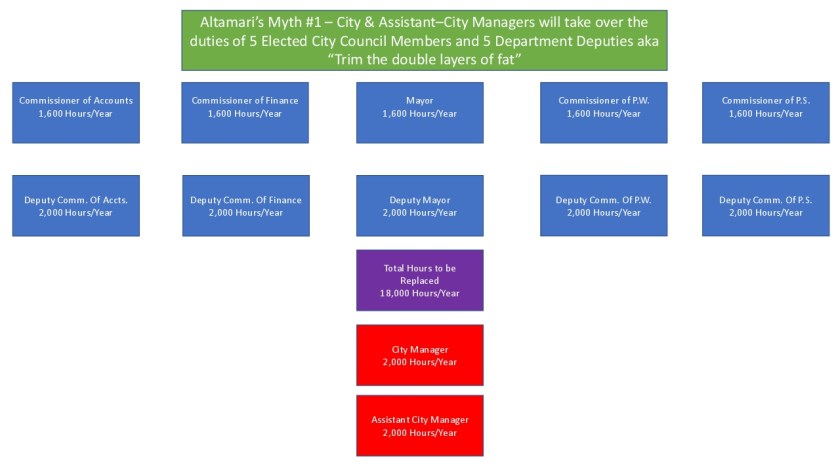
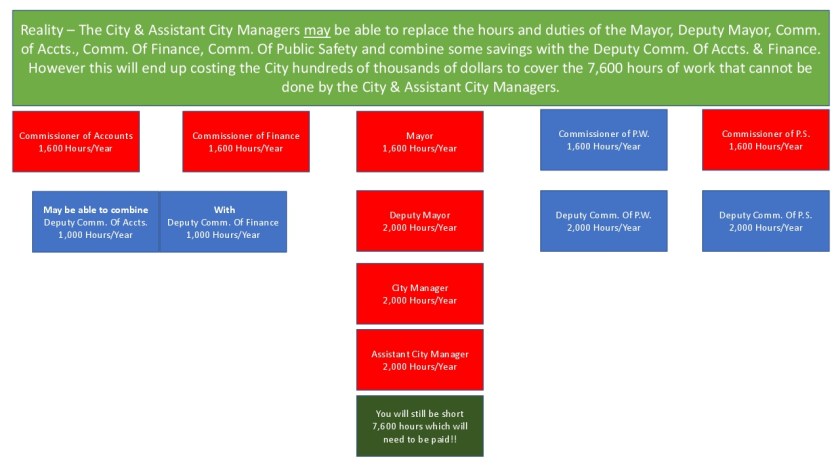
The projection of financial savings that will result from the change to a city manager is based primarily on the assumption that the work of all  five fulltime deputies and four part time commissioners can be replaced by the city manager and possibly an assistant city manager.   This assertion is undermined by their refusal to actually interview the deputies and commissioners to find out what they do in order to determine what staff will be required to replace them.  They have based this decision on the untested assumption that deputies are political operatives benefitting from patronage who perform little relevant work.  They also claim that they have successfully analyzed cities in multiple states that somehow make actually asking our own people irrelevant.  Similar to the “survey” it turns out, though,  that the Charter Review Commission has no materials of any kind to show that an in depth study of cities was ever done

The financial plan put forward by the Charter Review Commission fails to provide any money for the operations of the new city council or the mayor.  Given their expectations for the new mayor, it seems obvious that there will be a need for some kind of administrative support that they have failed to budget for.

Again, they rely on simply stating over and over again that the city will save some $4000,000.00 without providing any documentation to support their claim that one city manager can perform the duties of four part time commissioners and five deputies.

I would refer the readers to a previous post in which I document the lack of clarity in the role of the proposed new mayor and the potential institutional conflict this could entail.

The promise of no politics is unrealistic

Charter Commission members claim that the proposed city manager will be completely apolitical.  This person will not be a member of any political party.   This person will not contribute to any political campaign or provide any support for any candidate.  This assertion is based on the assumption that the person would be a member of the International Association of City Managers which requires its members to follow these guidelines.  There is nothing in the charter that would require a city manager to be a member of this association and therefore bound by this ethos.  Nor does the charter have any such requirements. I also have not been able to find out what penalties there are should a member of the IACM violate any of these standards. When I have attempted to point this out to several of the leaders of the Charter Commission they simply talk over me.

There are  problems with the provisions for the City Manager

The qualifications for the city manager are in the charter.  These include an advanced degree in the field.  My friend, Lew Benton, wryly observed that some of the worst bosses he worked for in government had impeccable academic credentials. 

The Commission’s Financial Disclosure Summary  projects a salary for the city manager of $125,000 plus benefits. They used a survey of the state to come up with the figure.  They are completely confident that there will be a raft of great candidates to chose from in spite of the fact that there are city employees who make more than this and that there will be no job security as the city manager can be fired at any time by the city council.  The Commission does not entertain even the possibility that there could be a problem. 

In addition the Commission has put off the selection of a city manager until after the new charter has gone into operation with a new city council and mayor in 2020.  That means it is impossible to have the new city manager on the job on day one.  In fact it means there is no way of knowing when a new city manager will be in place.  Anyone who has observed the pitfalls of hiring executives knows how unpredictable this process can be.  Candidates back out at the last minute or have current jobs that prohibit them from leaving with little notice.  Who will run the city prior to the arrival of the new city manager?  Not clear.

The Charter Commission simply refuses to acknowledge and plan for problems.  Anything that takes them off message is simply dismissed.

Four year, not two year terms for the mayor and council are too long

I am also adamantly opposed to changing the term of office for the council members and mayor from the current two years to four years. 

The Charter Review Commission sees four year terms as an advantage because officeholders will not have to go through the burden of running every two years and they will also be more insulated from what they see as the “whims” of public pressure. I don’t see protecting politicians from the public as an advantage.

There are lots of ways to do checks and balances

One of the criticisms charter supporters often make of our current commission form of government is that it does not separate legislative and executive functions as is done on the state and national level.  The council members we elect to make policy also oversee departments that carry out these policies.

I reject the idea that separating the executive duties from the legislative duties in a city manager form will be an enormous benefit.  In fact it can  be argued that politicians make better policies when they know they are also responsible for carrying them out.

School boards, town boards, and many county governments in New York State do not separate legislative and executive functions nor do most of the governments of the world which have parliamentary systems.   England, Denmark, and Finland are just a few examples.

One Caveat

Having said all of this, I do think charter supporters have a legitimate concern that the requirements of being a commissioner discourage some people from running for office.  I think this is a very important issue and in fact, this reform could potentially produce more candidates.  For me, though, the problems I have identified are sufficiently problematic that they trump this goal of increasing the candidate pool.

The Charter Commission’s campaign tactics have been disappointing

As should be clear, I have been more than disappointed by the way the Charter Commission has conducted their campaign.  I think they have overstated or misrepresented many, many issues in their zeal to convince the public to adopt this charter.  They have played badly on people’s discomfort with the conflict that constitutes so much of today’s politics.   If the new charter is adopted, I feel more than confident that the conflicts and egos will still be with us.

In the end we have a great and vibrant city and while I think their charter will create major problems if adopted, the city has survived gangsters and depressions so I guess it will survive this as well.
 

A Conversation With Chris Mathiesen Over Charter Change

Commissioner Chris Mathiesen and I had a long conversation regarding the charter and the campaign to pass it.

1,   I asked Chris about the difficulties of coordination that might exist between departments.  He told me that he felt it was a problem.  The question was, how serious a problem.  We agreed that in any large institution, the problem of coordination between elements of an organization are going to exist.  Each department has its own sense of priorities and friction between departments over priorities is endemic to bureaucracies.  Having a central manager as advocated by the charter commission is not going to end such issues.  He did, however, believe that the commission form of government exacerbated this problem.  He told me that he believed that having a city manager would significantly affect better coordination.

2. I asked him how much time he and his deputy spend on administrative duties in the running of the Public Safety Department.  He estimated that he spends well in excess of twenty hours a week.  While he is in his office frequently, most of his work is done away from the office responding to emails and reading documents.  He told me that his deputy spends over thirty-five hours a week on administration. I then asked him to consider how much of their time is spent simply reviewing decisions and policies recommended by the regular staff.

3. I asked this because I wanted to explore to what extent the Commissioner and the deputy simply represented another layer of bureaucracy as charter supporters claim.  He told me that in fact, most of his time was spent doing just that.  There is a very capable civil service administrator in his office who prepares much of these materials.  He basically told me that he thought that in spite of the many hours of work he and his deputy devoted to the job, that eliminating them and having the administrator in their office report to a city manager would not require a great deal more additional staff time to replace them.  He was careful to point out to me that the nature of what goes on in other departments is very different from his and that he was unwilling to draw any conclusions about the other departments based on what goes on in his.

4. He supports the general direction of the charter in terms of the proposed mayor.  While he acknowledged the potential for conflict between the mayor under this new structure and the city manager, he was less concerned about it than I am.  He thought the $40,000.00 salary for the mayor was fair because the mayor would have more duties than the council members.  These involved not just the ceremonial duties.  The mayor will nominate individuals to city boards which will require city council approval.  He saw the mayor as a liaison between the city manager and the council.  He thought that dealing with the many contracts that would need review and signing would require significant time.

5. I know from a previous discussion that he does not share my concerns over changing the length of the term of office from two to four years.  He thinks it will have little impact on the council members sense of vulnerability regarding the public’s ability to remove them.

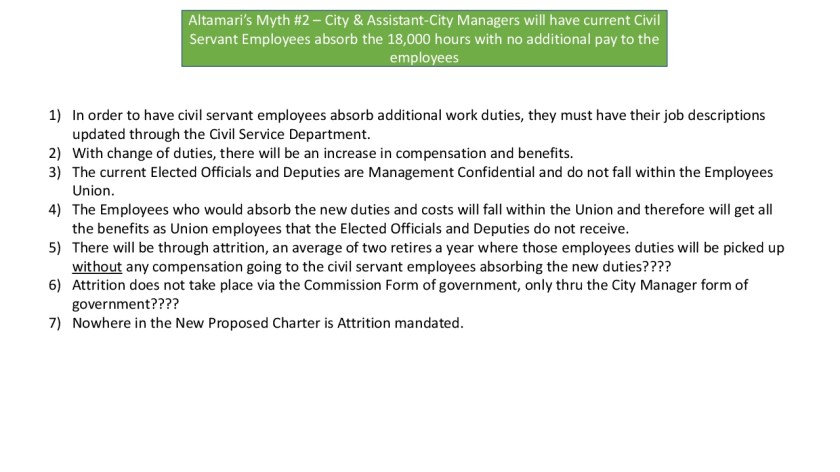
6. He thought that many of the promises being promulgated by the proponents of charter change were excessive.  He did not think the new charter would result in savings of $400,000.00.  He agreed that they had not budgeted for the support costs for the new council and the mayor.  He felt very strongly that the city staffing is “bare bones.”  If we are to continue to provide the current level of services we would need to be prepared to hire more people.  He thought the idea of not filling positions by attrition as advocated by the charter commission was unrealistic.

6, For all his concerns about the current form of government he rejected any suggestion that the city administration was “broken.”  It functions reasonably well but he believes it would function better under a new charter.  He expressed grave concern over the intemperate and exaggerated arguments put forward over the charter and lamented with me the absence of civil and open discourse.

In a follow up conversation I asked Commissioner Mathiesen to respond to the door hanger “Its Time” (the advocates for charter change) is circulating. Here are some of the claims made and Chris’ response:

    1. “Save money, lower taxes: Immediately: Half a million $$ per year.”  Chris responded this is not true
    2. “Hold city hall accountable: No more $750,000.00 office renovations while essential services don’t get done.”  Chris told me that city hall is in great need of repair.  He told me he would prefer a more comprehensive plan for the renovation but he rejected the idea of equating addressing badly needed renovations with cuts in service.
    3. “End Delays: Geyser Road path: 13 Years”  Chris rejected the idea that the long gestation of this project was due to the commission form of government
    4. “End Delays: New Police station: 20 years and counting”  Chris rejected the idea that the long gestation of this project was due to the commission form of government
    5. “End Delays: East Side fire station: 20 years and counting” Chris rejected the idea that the long gestation of this project was due to the commission form of government


An Unrepentant Pat Kane And A Cynical Bob Turner

On their web page this evening the Saratogian has a story about the Kane telephone message.  I assume it will appear in tomorrow’s paper.  Here is a link to the story.

There are two things that I find revealing in this story.

The first is that Mr. Kane is completely unapologetic.  He believes that he has every right to behave as he did in that message.

The second is the response by Bob Turner, Charter Commission chair.  He ignored the question about Mr. Kane’s behavior and stayed on message simply repeating one more time the commission’s talking points on the charter.

Eugene Ionesco, the playwright of the absurd, wrote a famous play called “Rhinoceros.”  It involves a hapless fellow who finds the people around him, his relatives, his co-workers, the politicians, turning into rhinoceroses.  Of course on the stage they do not literally turn into rhinoceroses but they increasingly make snorting noises, stomp their feet at odd times, and their postures become increasingly distorted.  Our hero finds this behavior baffling but when seeking confirmation of what he is seeing, people treat him patronizingly.  They assure him that he is confused and not to worry.

When I read both Mr. Kane and Mr. Turner’s remarks in the Saratogian,  I identified with the hero of the Ionesco play.  For me, I find Kane’s behavior and Turner’s reaction  reprehensible. For many around me, among them most of the members of the Charter Commission, Kane’s and Turner’s behavior is seen as normal.  Mr. Kane and Mr. Turner seem sincerely oblivious of what I perceive to be odious behavior.  The standards for civility and courtesy appear to be increasingly a quaint relic from a bygone era.


Disturbing Telephone Message From Pat Kane Poses Questions About Charter Review Commission

In the middle of last night’s City Council meeting Pat Kane, Vice Chair of the Charter review Commission, called Commissioner Skip Scirocco’s official city cell phone and left the following message.

I tried to reach Mr. Kane and left him a message but he did not return my call.  I understand that he is at the Charter Commission ‘s program at the library tonight (Wednesday) so I am confident he received my telephone call but apparently decided not to reply.  I had hoped to speak to him before posting this recording.

There are some very nice people who serve on the Charter Review Commission and I have been troubled by their passivity regarding a number of unpleasant things done in their name.   It will be interesting to see their reaction, if any, to this phone call made by their Vice Chairman to a Council member.

My question to the readers of this blog:  If you were a member of the Charter Review Commission and heard this tape, would you take some sort of action and if so what action would that be?


Bob Turner And Charter Commission Offer Watertown As Model For Staffing If The Proposed Charter Is Adopted. A Jaw Dropper

I was surprised to learn that the Charter Review Commission was having a public event that will be live streamed on Facebook showcasing the city manager of Watertown.

Full disclosure: My dog, Kate, and I hunt up there.

In the Saratogian article Bob Turner offers the following, “Watertown and Saratoga Springs are similar size cities and comparable budgets.  Voters can ask her for themselves how she is able to run their city with one city manager instead of five deputies.”

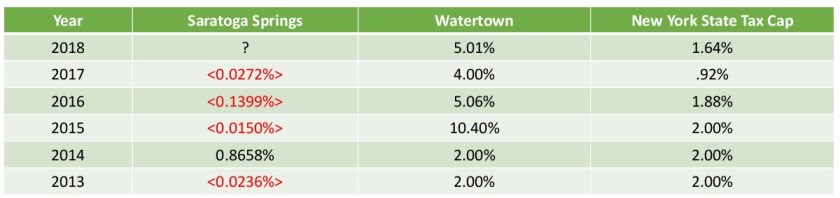
 Mr. Turner fails to mention that Watertown has been beset by major tax increases.  In fact, we have no idea what the condition of their services are but it is reasonable to assume that they did not resort to such high tax increases without draconian cuts to services first.

Consider the graph below comparing Saratoga Spring’s tax increases and Watertown’s.  In 2015 Watertown raised their taxes 10.4% tax.

TaxesWatertown 

A simple Google search of Watertown government produces a variety of stories about conflicts among its elected officials and the fact that there is a candidate running on a platform to end the city manager form of government.

Now I am not saying that Ms. Addison is not doing a good job under some very trying circumstances.   I expect she is.  I am in no position to really judge her city and judging by his remarks, Mr. Turner appears to share my ignorance. 

If Ms. Addison is as good a manager as Mr. Turner asserts, she will tell her audience and Mr. Turner that it would be an error to use Watertown’s experience to decide on the merits of continuing the employment of our city’s deputy commissioners.

The Poorly Defined Mayor In The Charter Invites Future Conflict

During the gestation of the charter, the Commission wrestled with what the role of the mayor should be.  Given that they had eliminated all the administrative duties that the mayor under the current charter has, they still wanted the new mayor to play some sort of leadership role beyond running the council meetings and appearing at public events representing the city.

If you were obsessive like me and listened to the charter meetings you would have heard members of the charter commission articulate a vision of the mayor as kind of a community organizer.  This mayor would work in the community to mobilize resources for unspecified projects.  The problem was that they could not find language to put in the charter that articulated this concept.  Instead they incorporated the following items under the mayor’s list of duties (section 2.04):

“Represent the City in Intergovernmental relationships”

“Perform other duties as may be specified by the City Council.”

Consistent with the lack of clarity surrounding this new type mayor, the Commission never specified whether this person would be part time or full time.  They raised the salary to $40,000.00 but the rationale for choosing this number, which has been discussed at length in other posts, had no discernible logic.

Some members of the charter commission saw the position as part time, others offered that some mayors will spend more time on the job than others.  It seemed particularly odd that the position includes health benefits.  The commission was quite proud that they had eliminated health benefits for the other members of the council.  They never explained why a position that appeared to be part time would receive these benefits.  Health benefits can cost the city upwards of $25,000.00.  The position seems to suffer from the neither fish nor fowl syndrome.  The position still seems to pay too little to get someone full time with the skill set that they envision.  On the other hand, given that the job includes no administrative duties and the fact that the median salary for mayors statewide in municipalities that have city mangers is $12,000.00 the pay seems too generous.

An Indifference To the Potential Dangers When Clarity Is Lacking

The central management problem with this design of the mayor’s position is that it is simply impossible to draw a clear line between the internal administrative operations of the city and organizing community resources for projects.

As just a practical example, let’s say that this new mayor decides that the city needs another recreation field.  He/she starts meeting with community groups to get input on where this new field should be placed.  In order to pursue this project the mayor will need support from various city departments.  He/she will probably need help from the planning department, from the city engineer, from the administrator for parks and recreation, from the department of public works, and from the city attorney.  In fact, assistance may be necessary even to arrange for meeting rooms and for some kind of administrative assistance to contact people for meetings.  Now according to  section 2.08 of the charter the mayor may only deal with city employees through the city manager. So what this mayor will need most of all is the active support and assistance of the city manager. But what if the city manager has set other priorities for the city and  finds that he/she simply cannot provide the resources the mayor requires for his/her project in a timely manner or at all.  Any sober person with management experience can see the potential for conflict here. If this seems abstract or unnecessarily pessimistic, one has only to do a Google search to learn otherwise.  Here is a link to what happened in Portland, Maine.

Link to Portland Story

My friend, Lew Benton, observed recently that the problem with the proposed charter is that no one is really in charge.  I know this is the criticism often put forward by the Charter Commission regarding our current commission form but Lew appropriately saw a similar problem with the city manager/mayor design proposed by the Charter Review Commission.

This is perhaps why the strong mayor/council form of government is so much more popular in New York than the city manager form.  Only sixteen municipalities in New York State have city managers and a number of cities that tried city managers switched to strong mayors.  With a strong mayor you have greater clarity regarding who is responsible for the management of the city. There is the added advantage that his person is elected and therefore directly responsible to the voters.

The fact is that there is no perfect design.  The strong mayor form has its own problems.  The frustration for me is that the Charter Commission refuses to acknowledge and try to address problems with the government they have designed in their charter.  They simply dismiss any concerns that are raised assuring us that everything will be perfect under their new system.  Problems like those in Portland Maine are ignored.  The need for clarity about distinguishing the roles of the city manager and the proposed mayor in writing their charter are simply not discussed.

Will It Actually Work?  Why Worry?

The last duty of the mayor listed in the proposed charter reads: the mayor shall “perform other duties as may be specified by the City Council” (section )2.04 The inclusion of this provision makes one wonder if any charter members have been observing the city council for the last five decades.  It’s not a stretch at all  to imagine a council asking a mayor to do something and the mayor telling the council, “I don’t have time to do that” or “that would be wrong and I will not do it”?  With respect to the members of the charter review commission, this  represents a serious lack of understanding about government in general and our government in particular.  How do the members of the charter commission expect this to be enforced?  If  readers of this blog think this provision should have been included in the charter, I invite them to explain how they think it will be enforced.


Flash: Utopia Comes To Our City

According to the door hanger being distributed by “Its Time”, the public relations arm of the Charter Commission, if the city adopts the proposed charter there will be “No more backroom deals.”  I like this, all our problems will be solved.

Who would not vote for this?


Mr. Altamari, You Are Better Than This

Charter Commission member Jeff Altamari bitterly attacked John Franck in an October 13 Reader’s View  in the Saratogian regarding criticism of the Charter Commission’s analysis of what the proposed change in government will cost.  He wrote:

“Then the shouting started.  At its September 18 City Council meeting (he has the date wrong, it was on the 19th) …Frank using profanity in the public forum, ridiculed the Commission’s work, accompanied by Madigan and Scirocco.”  Mr. Altamari goes on to urge people to view the video of the meeting.  He further states that “It’s disgraceful Franck angrily claimed the Commission’s findings ‘misrepresented the facts.’” 

I can understand why Mr. Altamari is stung by this criticism but rather than simply state that Franck’s allegations are false, it would have been more convincing and meaningful if he had addressed Franck’s points and  refuted them.

Given the regrettable record of inaccuracies and over statements regularly made by the Charter group, I decided to check out Mr. Altamari’s description of this meeting and watch the video.  Now I can understand and have sympathy for Mr. Altamari reacting viscerally to some very sharp and pointed criticism of his financial analysis of the charter proposal, but I have reviewed the video and to begin with there is no shouting.  I myself did not hear any profanity but I spoke with John Franck and he admits to using the word “bullshit” at one point. While Commissioner Franck is clearly disturbed by what he characterizes as numbers that simply lack logical credibility, neither he nor any of the other Council members, in my opinion, lose their composure.

I am terribly disappointed in Mr. Altamari. Although I have often disagreed with him, I had heretofore seen him as prudent and responsible.  This attack on Commissioner Franck seems  recklessly exaggerated on Mr. Altamri’s part and  out of character.  It cheaply plays to the prejudices of many regarding politicians.  I, like Mr. Altamari urge the readers of this blog to take the time to watch the video and decide for themselves.  

Video of September 19

In his letter Mr.Altamari also makes the kind of absolute statements that have been unfortunately  too commonly used by Charter supporters.   “There is no accountability”  he writes referring to the current city government. This is the kind of sound bite that so troubles me.  City council members are acutely aware that they must run for office every two years.   Would he not  consider that  accountability?  I would urge the readers to review his letter.  He goes on to claim that “Timely, long-term planning is nearly impossible.”  This shrill overstatement ignores  the city’s capital budget which does exactly that and has produced the bike trail, addressed the swamp that used to plague Congress Park, replaces aging fire trucks, etc.  Mr. Altamari does not do nuance.

In his explanation of how he arrived at some of the numbers in his financial impact statement Mr. Altamari writes that “over 20 cities with city managers were examined.” (He later refers to 31) He notes that “thirteen of these were studied in-depth [emphasis added]: five in New York, three in New Jersey, two in Massachusetts, and one in Vermont.” 

So I went to the Charter Commission’s website and under the tab titled “research” I could not find his study.  As this is one of the bases for their financial plan, it is more than odd that it has so far not been available to the public.  I have written to Robert Turner, the chairperson of the Charter Review Commission asking for a copy  of the study.  When I receive it I will share it with the readers of this blog. 

I would note that while looking at how city manager governments are structured in other communities  can be useful, the applicability of these examples is clearly limited.  This is particularly  true in the case of municipalities in other states  where differing mandates and responsibilities for services can have a significant impact on cities’ staffing and budgeting.

The bulk  of the savings Mr. Altamari is claiming in his financial analysis comes from the elimination of four part time commissioners and five full time deputies. It simply begs credibility that a man of Mr. Altamari’s experience would recommend the elimination of all of these employees based on looking at other cities rather than carefully analyzing what essential functions these people may perform in Saratoga Springs and how many hours these activities entail before assuming that a proposed city manager and maybe an assistant could absorb these duties.  There is also the suggestion that existing staff such as the city’s director of finance or the fire chief or the chief of police would take on some of the duties.  Unfortunately, neither Mr. Altamari nor the Commission saw the need to actually ask any of these people if they had the time to absorb these extra responsibilities.

The Commission also assumes there will be savings from two positions a year eliminated through attrition.  Even Commissioner Mathiesen who is a strong advocate for charter change characterized that as unrealistic.

It is quite frustrating to me that Mr. Altamari is fully aware of these criticisms but has chosen not to address them.  Whatever one thinks of Mr. Franck’s comportment it does  not  absolve Mr. Altamari from answering the very legitimate concerns expressed at the Council meeting on the 19th

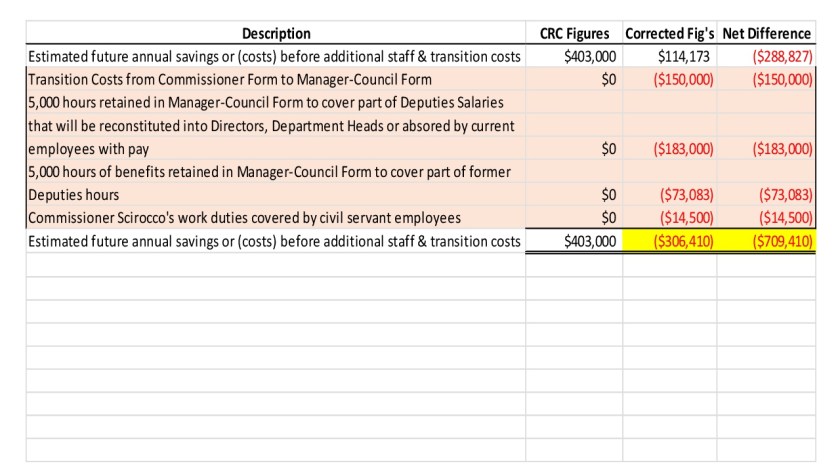
At the next City Council meeting on October 3rd  John Franck did a power point presentation on why he contends that the Charter Commission’s financial analysis badly misrepresent the true costs of implementing the proposed charter.   It is no rant.  He meticulously and methodically lays out the errors in the document.  His presentation goes well beyond the issue of the eliminated positions. 

Persons truly interested in assessing whether the financial document is accurate and valid would do well to take the time to watch the video.  I  have included the power point visuals here.   

Power Point Presentation: Corrective Analysis of Charter Review Commissions Financial Disclosure Summary 10032017-1Corrective Analysis of Charter Review Commissions Financial Disclosure Summary 10032017-2Corrective Analysis of Charter Review Commissions Financial Disclosure Summary 10032017-3Corrective Analysis of Charter Review Commissions Financial Disclosure Summary 10032017-4Corrective Analysis of Charter Review Commissions Financial Disclosure Summary 10032017-5Corrective Analysis of Charter Review Commissions Financial Disclosure Summary 10032017-6Corrective Analysis of Charter Review Commissions Financial Disclosure Summary 10032017-7Corrective Analysis of Charter Review Commissions Financial Disclosure Summary 10032017-8Corrective Analysis of Charter Review Commissions Financial Disclosure Summary 10032017-9Corrective Analysis of Charter Review Commissions Financial Disclosure Summary 10032017-10Corrective Analysis of Charter Review Commissions Financial Disclosure Summary 10032017-11Corrective Analysis of Charter Review Commissions Financial Disclosure Summary 10032017-12Corrective Analysis of Charter Review Commissions Financial Disclosure Summary 10032017-13Corrective Analysis of Charter Review Commissions Financial Disclosure Summary 10032017-14


And the video of the presentation:

I also urge Mr. Altamari to thoughtfully respond to Commissioner Franck’s critique in the manner it deserves.  I would be happy to post unedited his point by point answers or post a video of his response if he would prefer that medium.  Since this is such an important issue in deciding whether or not to support the charter, I can think of no reason why a person like Mr. Altamari who is committed to educating the public would not take the time to address the issues. 

Finally, SUCCESS has approached both John Franck and Jeff Altamari about participating in a debate which seems to me the best way to serve the public and address the issues.  Commissioner Franck has accepted and SUCCESS is awaiting Mr. Altamari’s response.  Hopefully he will be willing to attend.


The Commission also assumes that they will save money by not filling two positions a year related to attrition.  Even Commissioner Mathiesen who is a strong advocate for charter change characterized that as unrealistic.

Remigia Foy Speaks Out On Charter Change

Remigia Foy is an old friend with a legacy of service for this city.  She has asked me to post on my site a letter she has written .

A brief bio:

Ms. Foy served three terms as Commissioner of Finance.  She was a Fulbright Scholar twice .  She was the assistant vice principal of Mechanicville High School.

During her tenure as Commissioner of Finance she was a full-time Social Studies teacher. She also taught a course at St. Rose.


10/12/17

For some months your readership has been treated to a series of news articles and letters to the editor advocating for a new system of Government in Saratoga Springs known as City Manager/Mayor by the Charter Review Commission. This new system is predicated on the following notions;

1 The Commission System does not work because it is old and outdated having been instituted in 1915,

2 Council members act as both the legislative and administrative heads of Departments. This is also called the five-headed monster, The five silos or the five fiefdoms and doesn’t work.

3 The professional Manager will eliminate dysfunction of Elected Officials managing Administrative Departments in conflict with one another.

4 The proposed Charter will bring competition to local elections.

Let’s remember that 11 of the 15 members of this Committee were appointed by Mayor Yepsen who is in favor of Charter change.

They didn’t analyze the present Charter and make some changes. They already had the idea for a new Charter based on  Pat Kane’s 2012 Charter proposal which was soundly defeated by1750 votes

They claim that this bogus system, under the aegis of “Professional Leader”, will eliminate political bickering, the dysfunction of administrative/ legislative heads of departments, reduce the cost of Government and bring competition to local  elections.

Nothing could be further from the truth. Commissioners are in a better position to prepare budgets for the departments they head. They are both responsible and accountable and answer to the taxpayers every two years.

Furthermore, the elimination of the independently elected assessor will mean that the person who decides the value of a property will not be elected by the people.

Under our present system, we enjoy the second lowest property tax rate in the State. There has been plenty of competition for elected offices in our city. When there is no competition could it be that the people are satisfied?

Our system has succeeded through two World Wars, two recessions 1929 and 2008 and the times in between. No one knows what a faceless unelected bureaucrat will cost and how he will run all the departments that’s why I am voting NO and urge Saratogians to do the same.

Remigia Foy.95 oak st saratoga springs NY 518 584 2528…Former Commissioner of Finance 3 terms and chair of Success.

Charter Commission: That Employee Survey They Did – It Wasn’t A Survey

One of the key arguments put forward by the Charter Commission for changing the form of government is a “survey” that purports to show an overwhelming desire by city employees to change the form of government.   Given my past experience with the declarations of the Commission I secured a copy of the raw data of the survey to take a look at it for myself.  What I found was yet again, the extraordinary misuse of data by the Commission in their literature and presentations.

Surveying is a serious business.  To the lay person it’s about just asking people some questions.  A century of academic study has shown that to produce valid data, the authors must be disinterested and objective.  The crafting of questions, the method by which people are selected, and the vehicle by which the targets of the survey are contacted require a vigorous and time consuming process.  The reality is that a poorly designed survey provides unreliable results.  A survey to be a source of real decision making must address things like how representative are the respondents of the population under consideration?   In the case of this “survey”, the respondents were self selected  meaning the respondents had to take the initiative to respond, they were not randomly selected. There is no way of knowing therefore to what extent those who chose to respond might be representative of city employees as a  whole. Might those who responded, for instance, be those who are particularly unhappy with their jobs or have something else in common. The chair of the charter commission, Bob Turner, admitted that he had no idea who actually got the surveys.  In fact, he admitted at a meeting I attended that he did not know how many people were actually surveyed.

We do know that of 398 city employees 75 responded to the survey according to the Commission’s website.

Of the 75 employees, 70 responded to the following statement (#15): I believe city hall would operate better with a full time professional city manager.

The 70 respondents produced the following results:

Strongly Agree                                  17

Agree                                                  13

Somewhat Agree                              18

Neither Agree Nor Disagree            12

Somewhat Disagree                         10


Interestingly, unlike the other questions in the survey, for this question they changed the possible responses.  In the other survey questions they had:

Strongly agree

Somewhat agree

Neither agree or disagree

Strongly disagree

Why they chose to change the responses to this question is a mystery to me.  It may have just been sloppiness.  By the way, the label at the bottom of the chart for those opposed was mislabeled (see chart)


So if you total the first three responses which indicate some kind of support for a city manager you come up with 48.  In order to create the greatest contrast, they factored out the people who had no position.  This left the 10 who did not think city hall would operate better with a city manager.


Now since these raw numbers were still embarrassingly small, they chose to use percentages Instead.  This very much ginned up the impression for the public of their significance.  Remember that these are only the percentages of the 70 who responded to this particular question in the survey and not of city employees.

The result is a chart that shows 65.3% pro city manager and 15.3% negative.

So from a small, unscientific sampling—kaboom: the Commission declares the employees of Saratoga Springs overwhelmingly support charter change.

City-Hall-Employees-survey-results-23

Now I don’t know what the numbers are in city hall regarding feelings toward the two forms of government but neither do the members of the Charter Commission based on this kind of “research.”  What I do know is that  this should be considered a “questionnaire” rather than a survey.  It violates pretty much all the standards of what any serious social scientist would characterize as a survey and it’s results are anecdotal at best and cannot be legitimately used to draw any larger conclusions about what city employees think.

Robert Turner, who chairs the Charter Review Commission is a professor of political science.  He was instrumental in creating this “questionnaire” and in reporting its results.  For a person who is a social scientist he has both the knowledge and the responsibility to accurately portray what the data produced by this questionnaire represented.  If he were not going to characterize it as what it was, a questionnaire, he had the responsibility to include some disclaimer explaining to the public the limited character of the data.    Instead, he and the Charter Commission have recklessly presented these results as evidence of widespread discontent in city hall and support for a change of government on the part of city employees.  I finish with a quote from a letter to the editor Mr. Turner published in the Saratogian on September 10th.

“These results explain why 63.3 percent of City Hall employees said they believed city hall would operate better with a city manager.”  No, Mr. Turner, they indicate that 48 out of 398 city employees ,roughly 12%, have indicated some level of support for a city manager form.