Earlier this month I distributed a questionnaire to the candidates competing for three seats on the Saratoga Springs School Board. Five of the seven submitted answers. First I would like to apologize about the formatting of the answers to the candidates who responded. I use a software package called WordPress and it can be uncooperative sometimes. It has its own ideas about indenting and spacing and sometimes it doesn’t play well with documents that have been formatting using some other software.
The Candidates Who Did Not Submit Answers
I originally sent out the questionnaire early this month asking that the candidates submit their responses by April 15. I followed up with a second email asking that if a candidate did not intend to submit answers that they have the courtesy to let me know that.
John Brueggemann did not respond to either email.
Heather Reynolds responded to the second email writing that she was away and that she did not have time to answer the questionnaire. I wrote back to her expressing my strong desire for her participation. I indicated that I would extend the deadline and asked how much time she would need. She never replied. (I plan to discuss Dr. Reynolds’ candidacy in a later post).
The Replies of 5 Candidates

Connie Woytowich
- What is your educational background?
I hold a Bachelor of Science in Biology with a minor in Chemistry; a Master of Science in Curriculum Development and Instructional Technology; a Certificate of Advanced Study in Educational Administration and Policy Studies; and a Certificate of Advanced Study in Curriculum and Instruction. I was working on my proposal towards my PhD (also known as ABD “All But Dissertation”) for the latter degree when I discovered I was pregnant with my third child, and ultimately made the choice to expand my family to four children.
- What is your relevant professional background?
I am a NYS Master Teacher, a selective designation made by the State University of New York for teachers of STEM (Science, Technology, Engineering and Mathematics). I teach biology, chemistry, and a college level course called Personal Genetics at my alma mater, Colonie Central High School. I started my teaching career at Albany High School in the year 2000 after my student teaching experience in both Corinth (middle school) and Colonie (high school), giving me urban, rural and suburban teaching experience. My entire teaching career has been in the K-12 public education realm, which gives me a unique perspective on the needs of our school district and sets me apart from the other candidates.
In addition to my full-time teaching career, I own a small business called Training FUNdamentals, LLC, that specializes in helping businesses with their curriculum procurement and employee training needs.
I am also Co-Director of Camp Invention in Saratoga, which is a nationally acclaimed one-week summer program led by local teachers where children become innovators through teamwork and immersive, hands-on creative problem-solving.
- What volunteer activities have you been involved in in schools?
I am the immediate PTA President of the Division Street School, which is now a National PTA School of Excellence. Organizing, coordinating and collaborating with the PTA Board, school, and district to achieve this honor was an enormously valuable experience.
Other school-related volunteer activities that I have been involved in and/or led over the past decade include but are not limited to:
STEM Expo – I have chaired this event for the past 8 years for the Division Street School PTA. I organize and coordinate exhibitors from the community and student projects, and work with the school to communicate outreach to our families for hands-on STEM experiences.
Earth Balloon Initiative – As a part of the STEM Lab Committee, a needs assessment was done to identify how we could enhance our STEM instruction at Division Street. The Earth Balloon was put on our list as a “reach”, so I took it on. Six months later….I chaired the initiative and organized a gala as the PTA President to raise $25,000 to obtain the Earth Balloon. Our PTA was able to purchase it and we make it available for other schools to reserve for a small fee. We used to have to front over $7,000 to rent it for one week – this was a win-win for everyone!
Superintendent’s Forum – I was a member of the Superintendent’s Forum for its last two years, where parents were presented with ideas from the district and participated in open discussions with the Superintendent.
Gifted and Talented Committee – I worked on this committee for the needs of Gifted and Talented students and options about programming and opportunities for learning. I also created a presentation that was utilized throughout the district for outreach.
Foreign Language Committee – This was a short-lived committee for me, but very fruitful. Out of my work on this committee, the Each One Teach One program was implemented based on the program in my home district. Each One Teach One is where high school students visit the elementary schools to teach foreign language to young students while gaining experience in the classroom for potential futures in education!
Legacy Planning Committee – I participated in the initial visioning session, where group of parents, teachers, board members, students, administrators and other community members worked collaboratively to identify characteristics of an ideal school of the future.
- What other community activities have you volunteered in?
Through my faith community, I have volunteered in food pantry efforts and am a catechist for youth faith formation. In addition to this, I have volunteered for my daughters’ swim teams (Go Sharks! Go Blue Streaks!) and track team.
- What prompted you to run for the school board?
I have been interested in running for the school board for the past few years as I have a vested interest in the success of our district as a parent and educator. My volunteer work for the better part of the last decade is evidence that our school district has always been an active priority of my life. My background in K-12 public education would be an asset to the board due to the multitude of issues facing our district, and my unique perspective as a public school teacher and parent in the district is invaluable.
One issue in particular, that of school safety, has prompted several people to run for the school board and/or make certain decisions about our safety plan. Let me be clear that I was going to run anyway. I am concerned with our local community and how our school district makes decisions. While I support rearming the monitors, it is not why I ran, and the rearming issue is not a political, gun control issue for me. I ran because I care about our school district and understand the magnitude of work that goes into its operation. Our school district deserves to have people on the board that encourage a healthy working environment, are there to work collaboratively, and understand that the leadership is shared.
My platform is:
- PROFESSIONAL DEVELOPMENT – Teachers and staff deserve professional development that is not only engaging and relevant, but culturally proficient and educationally sound. Student achievement is directly impacted by the energy that is put into professional development efforts, and instructional excellence is reinforced by innovative teaching strategies and the iterative cycle of evaluating instructional practice and programming. The how, when and why of professional development should be considered in its planning, implementation and evaluation.
- EDUCATION PROGRAM – Our instructional program should be varied in order to provide every student with an educational experience that is personally relevant and ensures that they are ready for their choice of a career or higher education studies, and their individual life. Our world changes with new innovations and inventions, and our program should change with the times. Completing a needs assessment of all stakeholders will enable our district to move forward and enhance our program.
- HEALTH AND SAFETY – I support proactive measures for safety and health in our schools and understand the complexity that these challenges bring. I support the continued work of the Mental Health Task Force and increasing armed security that are qualified, trained and evaluated, as two for a district our size is not adequate.
- COMMUNITY – I value the spirit of a strong community with diverse perspectives that can respectfully agree to disagree. Professionalism, decorum, civility and trust are fundamental in community relationships, and I work hard to uphold these standards with every decision I make. I have worked on several committees and successful initiatives through my volunteer work in our district over the past decade, and look forward to continuing to collaborate with others who share my passion for education.
- Do you support the currently assigned armed School Resource Officers at the School?
Yes. Due to the decision to disarm the monitors, there was a need to hire a second SRO. The SRO at the high school has jurisdiction within city limits, and the SRO at Maple Avenue has jurisdiction county-wide. This allows for a relationship to be built with both agencies and enhanced communication on safety issues.
- Do you support finding a way to rearm the monitors at the schools?
Yes. Two armed security personnel to cover the unique size and scope of our district is inadequate. I support rearming the active and retired law enforcement officers (aka monitors), not arming teachers or administrators.
- What plan do you see that would be most helpful in improving safety in the district? (Please distinguish between existing programs and additions).
I would work collaboratively to ensure that our armed monitors would be qualified, trained and evaluated per a newly adopted BOE policy after legal counsel and insurance review and approval. Training programs that already exist through NYSDCJS, local law enforcement agencies, and neighboring school districts should be utilized as guiding documents and then specifically documented in BOE policy (see: https://www.criminaljustice.ny.gov/ops/sgtraining/). Data from other programs (see: https://www.nj.com/news/2018/03/armed_guards_or_retired_cops_in_nj_schools_whats_t.html and https://poststar.com/news/local/resource-officers-half-a-year-in-adjustment-has-been-smooth/article_30e44807-5068-5c13-8813-b209f10b6d4b.html) including pending NYS legislation that supports having a school resource officer, law enforcement officer, or security guard have written authorization to carry a firearm on school grounds (see: https://www.criminaljustice.ny.gov/ops/sgtraining/) should also be utilized for proper planning, implementation, and evaluation of the safety program and its employees.
I do not support adding more SROs than we currently have or arming teachers or administrators. I support rearming qualified, trained, and evaluated active/retired law enforcement school district personnel.
- How would you pay for any enhanced safety program (#6)
Hiring additional SROs is an expense that would not only cripple the school budget at $75K a position, but it will negatively impact instructional quality and force decisions about class sizes, hiring teachers, and expanding our program choices for our children. Hiring additional SROs is unnecessary in light of existing programs and legitimate pathways for rearming our monitors/law enforcement/retired officers. I obtained the training costs for active and retired police officers with DCJS from Janine Kava, Director of Public Information for DCJS via email: “An estimated average cost per course follows this note, however, each individual school sets its own fee schedule. In addition, security guards are licensed by the New York State Department of State”:
- 8-Hour Pre-Assignment Training Course for Security Guards: $50
- 16-Hour On the Job Training Course for Security Guards: $100
- 8-Hour Annuals In-Service Training Course for Security Guards: $50
- 47-Hour Firearms Training Course for Armed Security Guards: $750 (note: this is the same training SROs experience)
- 8-Hour Annual Firearms Training Course for Armed Security Guards: $150
These fees are minimal and do not have a large impact on the budget. For ten employees – a rough maximum cost would be $10,000, which is a fraction of what an SRO costs. There are licensing costs, but these are also minimal and may be incurred by the individual employee.
- What are your thoughts regarding the “tax cap” as it affects public education?
I support tax cap reform that allows for safety and security initiatives. School safety and security measures should be exempted from the state’s tax cap, so each community can make a local decision on safety spending. I also support implementing some tax cap corrections which the legislature and governor have already approved, such as including Payments in Lieu of Taxes in growth factor determinations.
- What other thoughts do you have that you would like to share with the readers of this blog?
I am the only candidate that has a solid background in public education, combined with a vested interest of being a parent and taxpayer in our district. My background in STEM education, parent leadership, and desire to do good work make me the ideal board of education member. I also own a trademark that reflects my philosophy on education and life in general. Please read about it on my website!
I highly value any opportunity to interact, and invite you to reach out to me directly via email or perhaps we can meet up for coffee if our schedules allow. Please visit and read my website and Facebook campaign page, if you are on social media. It contains a wealth of information and video snapshots of me explaining elements of my platform that I am releasing throughout my campaign.
- If you have a website and/or Facebook page, what is the URL?
Website: www.woytowichforboe.org
Facebook: https://www.facebook.com/Connie-Woytowich-for-Saratoga-Springs-School-Board-785866701794736/

Dean Kolligian
- What is your educational background?
- MBA / MHA, Towson University, Baltimore, MD 2002
- BS Kinesiology, Sports Medicine, The Pennsylvania State University, University Park, PA 2000
2. What is your relevant professional background
- Vice President, Security Officer & Facilities Manager of Adirondack Trust Company, 2014 – Present
- President / Partner, McGregor Village Development Corporation / Mountain Ledge Limited Partnership, 2012 – Present
- What volunteer activities have you been involved in in schools?
Youth Sports Coach (baseball, basketball, flag football), 2012 – Present
- What other community activities have you volunteered in?
- Wellspring 01/2019 – Present
- New York State Troopers Signal 30 Fund BOT 09/2018 – Present
- Chair, Saratoga Hospital Golf Invitational 06/2017 – Present
- Wilton Youth Baseball BOD & Coach 08/2012 – Present
- Town of Wilton Zoning Board of Appeals Member 06/2011 – Present
- Saratoga Hospital Foundation BOT 04/2008 – 12/2017
- Leadership Saratoga Advisory Board 06/2013 – 07/2018
- Leadership Saratoga Alumni Assoc BOD, President 05/2008 – 07/2018
- Alzheimer’s Association – Committee Member 06/2004 – 01/2013
- Alumni, Leadership Class of 2008
- What prompted you to run for the school board?
- I am seeking a position on the Saratoga Springs City School District Board of Education in hopes of being able to make a difference. I am the father of 4 amazing children, at three different schools, within the district. My wife, Erinn, has been a Coach for nearly 12 years and is currently the Assistant Coach for the Girls Varsity lacrosse team. She is also a third-generation alum. Our family has a lot invested in the education system and I would be proud to be a small part of the group that is tasked with overseeing that process.
- Do you support the currently assigned armed School Resource Officers at the school?
- Yes, I absolutely support the assigned armed Resource Officers at our schools. Officer Davis and Deputy Mahan are tasked with maintaining the safety and security of thousands of students, faculty, staff and visitors that walk through our buildings each day. Quite frankly they need additional support as well. Whereas additional SRO’s may seem like a good option, we would need to fully understand the cost associated with this additional expense. The active and retired law enforcement that were already employed by the district provide a most cost-effective measure for this support.
- Do you support finding a way to rearm the monitors at the schools?
- Yes, absolutely. For over 30 years these men and women were tasked with providing additional support for the safety and security of our school district.
These retired law enforcement individuals are highly trained professionals that spent many years protecting and serving their respective communities. Although they are retired from their law enforcement jobs, they are still some of the most qualified individuals to be placed into these positions. I do support maintaining their high levels or education and training so that they are always up-to-speed with the ever-changing environments in our schools.
- What plan do you see that would be most helpful in improving safety in the district? (Please distinguish between existing programs and additions.)
- I believe the program that existed before the current BOE vote to disarm the active and retired law enforcement personnel was the most helpful, and most cost effective, plan that was in place. Allowing active and retired law enforcement individuals to protect our schools promoted both fiscal and professional stewardship. Additionally, I would promote on-going education and training of these law enforcement individuals. There are also opportunities to collaborate with the Saratoga County Sheriff’s Department to provide similar services at a much less expensive option than the current SRO programs that are in place.
- How would you pay for any enhanced safety program (#6)?
- It must be noted that the program that was in place prior to the BOE vote to disarm the active and retired law enforcement staff was already included in the annual budget. These law enforcement officers had been district employees for many years, therefore no additional cost to the tax payers would be incurred. I would promote research for grant opportunities to pay for their additional training and education.
It is a proven fact that retired law enforcement individuals come with far less annual cost than those that are current, active-duty. It can cost the district upwards of $75,000 per year to employ an active-duty police officer as an SRO. However, a retired law enforcement officer collecting his / her pension is restricted in their annual earnings. In the state of NY this is approximately $30,000 per year. If we can provide them with annual education and training, the same as current law enforcement officers would receive, then the numbers don’t lie on what provides the best of both worlds. A school protected with highly trained active and retired law enforcement personnel, promotes fiscal conservatism to our community.
- What are your thoughts regarding the “tax cap” as it affects public education?
- The current 2% tax cap is a necessary evil. Wouldn’t it be nice to not have to worry about going over budget for the public education of our future leaders? However, this just isn’t possible. The tax cap keeps our BOE and the Administration in check when it comes to preparing the budget for the following school year. It must be noted though that when the need arises, the District Administration and the BOE must work together to ensure that the community understands the need for additional revenues. This must be done through education and transparency. There may be times when going “over budget” is necessary, but as long as the Administration and the BOE have worked diligently to make sure that there are no more cuts that can be made, the education of the community will be paramount in this process.
- What other thoughts do you have that you would like to share with readers of this blog?
- I believe that I bring a great deal of Board experience to the BOE. Although I do not have BOE experience, I have plenty of other Board Governance experience. Over the past 16 years of living in this community I have been involved with more than 8 different Boards including; Wellspring, Downtown Special Assessment District, Town of Wilton Zoning Board of Appeals, Saratoga Hospital and the New York State Troopers Signal 30 Fund, all of which I currently serve. In many of these I have also served in a leadership role such as; Chair, President, Vice President and Treasurer.
I believe that our School District is great and I completely value and support the public-school education system. Saratoga Springs City School District Is one of the best in the Capital District, supports student’s academic and athletic aspirations and has strong graduation rates. We could certainly work to improve; classroom sizes, challenging educational opportunities (STEM and Honors programs) and our athletic and extra-curricular opportunities.
- If you have a website and / or Facebook page, what is the URL?
- I do not have a website or social media page dedicated to running for the BOE.

Ed Cubanski
- What is your educational background?
-
- 1984 – Norwich Regional Technical High School, CT – Electrical Trade/Secondary Education Diploma (won Electrical Skills USA CT competition in 1983 and 1984. Placed 3rd nationally in 1983 and second in 1984).
-
- 1988 – United States Coast Guard Academy – Bachelor Science – Electrical Engineering [One of the four Military Services Academies with Air Force Academy, US Military Academy (West Point), and US Naval Academy (Annapolis)]
-
- 1992 – Naval Flight School Graduate (Wings of Gold)
-
- 2004 – Embry-Riddle University – Masters in Business Administration in Aviation
- What is your relevant professional background?Chief Operating Officer, American Red Cross – Eastern NY Region (2018-Present)
-
- Retired US Coast Guard Captain (O-6) in 2016 after 28 years of service (1988-2016)
-
- FEMA Type 2 Incident Commander (Qualification)
-
- FedEx Ground Operations Manager (2016-2018)
-
- Boy Scout Eagle Scout with six palms
-
- Rotary Paul Harris Fellow Recipient (2018)
-
- 51 st Recipient of Norwich Native Son/Daughter Award (2018)
https://www.norwichrotary.org/SitePage/native-son-daughter-award
- 51 st Recipient of Norwich Native Son/Daughter Award (2018)
-
- Regional Response Team – 6, 7, and 8 Co-Chair at USCG Captain with EPA Representative (showcases collaborative ability to solve issues between diverse stakeholders – government, private industry, and non-profit entities).
-
-
- As part of RRT-6 – revised 25-year Response Plan following the lessons learned of Deepwater Horizon
-
-
- What volunteer activities have you been involved in in schools?
-
-
- 2008-2013 – Belle Chasse Primary (Elementary School) – Belle Chasse, LA (just outside of New Orleans). Treasurer managing $100,000 annual fundraising account and playground renovation lead.
-
-
-
- 2013-2016 – Active leadership in Lordship, CT (Stratford) Elementary Schools to resolve issues brought up to PTA. Met as part of leadership team with Principal and Superintendent of Schools.
-
-
-
- 2016-Present – Attend school events.
-
-
-
- 2018 -Present – active attendance at BOE meetings starting in Nov 2018. Unable to participate early due to FedEx work shifts.
-
- What other community activities have you volunteered in?Coach U8 soccer 1991-1992 – Pensacola, FL
-
- President, Belleau Woods HOA (60 homes), Alexandria, VA – 2001-2003
-
-
- Established capital improvement fund
-
-
- President, Ortega Bluffs HOA (500 homes), Jacksonville, FL – 2004—2006
-
-
- Established capital improvement fund
-
-
-
- Championed update of HOA by-laws
-
-
- Coach U8 and U10 soccer – Belle Chasse, LA – 2008-2013
-
- Executive Vice President, Lordship Father’s Club – Stratford (Lordship), CT – 2013-2016
http://www.lordshipfathersclub.com
- Executive Vice President, Lordship Father’s Club – Stratford (Lordship), CT – 2013-2016
-
- President, New London Maritime Society/Museum – New London, CT – 2016-Present
-
-
- Non-profit museum that owns 3 lighthouses for public tours
-
-
- General Volunteer and Handyman – Saratoga Wilton Soccer Club – 2016-Present
- What prompted you to run for the school board?I ’ll address this is two sections, 1) my Platform and, 2) my Persona and Demonstrated Actions.
-
- My Platform encompasses Safety, Education, and Advocacy based on my observations and action of the Saratoga School District. Don’t get me wrong, I believe our school district is very good, but is it the best that it could be?
-
-
- First, Safety. Safety is an all-comprehensive program from physical security, identifying students and school adults that may be having issues that may negatively impact the school and those around them, counseling, and having the resources to resolve an active shooter in a timely manner.
-
However, the school district lacks in a “risk identification plan” from my research of open source material found on the school district website as well as having armed personnel to deal with an active shooter in less time than it takes the police to arrive 7.7 minutes after the call is made to them.
- Second, Education. We need to have programs to address each level of student from those struggling to pass a class, those that do very well in school, to those that do not feel challenged in our school district. We must provide resources to meet the needs of every student.There is some thought that kids that don’t feel challenged will leave the school and will go to a Charter School or private school. Does that benefit every student? Isn’t it better to have students that may be near the top of their school serve as role models for those ranked lower? What about the benefit of a diverse education skill level work together on a class project? Would such grouping benefit the student that learns a new study habit or how to gather information as part of a team project? I firmly believe the answer is yes.Would smaller class size K-3, less than 20:1 improve the core math and ELA skills to have students flourish in grades 4-12? The common-sense answer would state the answer is yes to reducing class sizes K-3 to less than 20:1. The Center for Public Education studied 19 different class size programs throughout the country over the last 20-years and came up with the same verdict.
- Smaller classes in the early grades (K-3) can boost student academic achievement;
- A class size of no more than 18 students per teacher is required to produce the greatest benefits;
- A program spanning grades K-3 will produce more benefits than a program that reaches students in only one or two of the primary grades;
- Minority and low-income students show even greater gains when placed in small classes in the primary grades;
- The experience and preparation of teachers is a critical factor in the success or failure of class size reduction programs;
- Reducing class size will have little effect without enough classrooms and well-qualified teachers; and
- Supports, such as professional development for teachers and a rigorous curriculum, enhance the effect of reduced class size on academic achievement.http://www.centerforpubliceducation.org/research/class-size-and-student-achievementThird – Advocacy. I have heard directly from teachers that many new programs that come out were not at the request of the teachers. Additionally, many of that same group told me that it was rare for school administrators take action on resource requests and are provided the answers, “we cannot do that due to budgetary reasons.” Additionally, the teachers also reported that most of the programs rolled out by Administrators relied mostly on the teachers training the teacher on the new program versus having a structured professional development program to teach the teachers as a group.I want to be part of a school board that listens to the teachers. I would survey the teachers to solicit anonymous responses (if they so desire) to a list of 1) fill in the bubble questions, but also 2) provide space for them to write down their issues. This written feedback is essential to gain the trust of the teachers that the school board is listening to them and can address their concerns, and maybe implement their solutions to a variety of school issues.I also want to be an advocate for the students. I would query the parents to find out how many are receiving tutoring outside of school and why. Having this data will truly measure the success of our schools because it will identify an uncaptured set of data that may show why so many kids are failing or not performing as well as they could because they don’t have the financial resources to pay for outside tutors.
- Persona and Demonstrated Actions.
-
- My career accomplishments show that I lead people and identify issues that need resolution that either just occurred or have been languishing for a solution for years. (I can provide an extensive list that collaborated with various groups to achieve common good).
-
- I’ve volunteered in nearly every community I’ve lived. I’ve settled into my post-military career cadence now in Saratoga Springs and know what time I now have available to give back to the community. I will have two daughters in high school next year and I want to help our eight community schools versus just the high school.I first started volunteering with my parents in a church group in Norwichtown, CT in the 1970s. My volunteerism grew as I moved through Boy Scouts and my career with the Coast Guard. Furthermore, once our children started attending school, I attended PTO meetings and heard of the issues that needed to be resolved. My first such undertaking was helping renovate the Belle Chasse Primary School playground that was destroyed following Hurricane Katrina in 2006. The playground sat idle for 2 years and in the end, we spent over $150,000 renovating the 4,000 sq ft playground with 30 cubic yards of rubber mulch, 200 ft of chain/rubber climbing devices, and replacing 5,000 board feet of lumber fastened with 10,000 screws. Concurrently, I became treasurer and worked as part of the proactive PTO with the Principal to identify programs needed for the school. Two such programs were an after school tutoring program and state test tutoring program. Both were funded by the PTO. Additionally, our PTO expanded Teacher Professional Development by bringing the instructors to the school to train 70+ teachers versus only sending 5 teachers per year to training.
- Do you support the currently assigned armed School Resource Officers at the School?
-
- Yes, I support SROs at our schools. Five of the 27 Active Shooter events in 2018 recently reported in the 2018 FBI report occurred at schools.
https://www.fbi.gov/file-repository/active-shooter-incidents-in-the-us-2018-041019.pdf/view
- Yes, I support SROs at our schools. Five of the 27 Active Shooter events in 2018 recently reported in the 2018 FBI report occurred at schools.
- Do you support finding a way to rearm the monitors at the schools?The monitors at the schools are retired police and law enforcement officers with extensive experience that can benefit the safety and security of our schools. There are several models available to mimic or create a hybrid model for Saratoga Springs School District.
- What plan do you see that would be most helpful in improving safety in the district? (Please distinguish between existing programs and additions).I would first form a TOGA School District Safety Committee meeting. The committee would be comprised of School Administrators, Teachers, other School positions (i.e. custodian as recommended in the Sandy Hook After Action Report, etc), a Social Worker and/or Mental Health professional, and one or two BOE members. I would require that data be captured and discussed at the meeting (i.e. reported school bullying, kids requesting mental health or social worker appointments, kids failing classes, any other safety related incidents, reports of vaping, and many other pertinent data, any disgruntled parent issues, etc). This data would be discussed and what concerns or additional resources are needed.
-
- This safety information is needed for budgetary reasons. There were several discussions during the recent 2019-2020 budget cycle stating that we need more social workers or mental health professionals. There were statements each of those positions are overworked, which I do not debate. However, there was no definition or context of the amount of overwork. I would want a report with numbers of appointments, incidents, incidents resolved, incidents need further resolution, etc. This will be real data to better inform the BOE in their duties to develop a budget with the Administration.
-
- The safety information is also needed for better risk assessment. When the safety data is broken down by school, grades, etc – it can better identify where the resources are needed to aid students, additional positions, etc.
-
- The data would also be made available in a less detailed manner at least annually so the parents can see the documented area of safety and risk concerns.
- How would you pay for any enhanced safety program (#6)The Safety Committee should not require any additional funding. More analysis is needed to determine the cost for rearming the retired police officers as monitors to include shooting proficiency range costs, judgmental range costs, and other human resource training that is required of any employee of Saratoga School District.
- What are your thoughts regarding the “tax cap” as it affects public education?There is not a limitless amount of money to fix every education issue. However, communities need to decide where it is best to spend tax money for the optimum return on investment. I believe the return on investment (ROI) is better on education than post high school and adult programs. There are many overtures for free college, but are kids getting the most out of their K-12 education? Why is the graduation rate only 94% in Saratoga Springs School District? What happened to that 6% that did not graduate? Were any of those kids ever discussed in the School Safety Committee? Would a Vocational School in Saratoga County provide an avenue for a high school degree for any of those 6% that did not graduate?
- What other thoughts do you have that you would like to share with the readers of this blog?My mantra is to “challenge the status quo.” I’ve read many after action or post event reports in government, various volunteer organizations, FedEx, and the Red Cross that list lessons learned from a tragedy or incident. The common failure is NOT turning those “lessons learned” into “lessons applied.”
-
- I want to leverage my personal drive, data analysis skill, and 42 years of leadership experience leading groups ranging from 3 to 2,600 people to resolve or mitigate issues that exist in the Saratoga Springs School District. My life and career resume have demonstrated my ability to resolve issues, many concurrently, in a timely manner.
- If you have a website and/or Facebook page, what is the URL?Facebook:https://www.facebook.com/CubanskiforTOGABOE/?view_public_for=479917885875798

Natalya Lakhtakia
- What is your educational background?
I earned my bachelor’s degree in Psychology from The Pennsylvania State University in 2007. I also minored in Spanish there. I earned my master’s degree from The University of Utah in Speech-Language Pathology in 2010.
- What is your relevant professional background?
I work for the public schools. I am a speech-language pathologist and have spent my career working with kids/students of all ages – I have worked in Early Intervention, at the preschool level, with elementary, middle, and high school students, and with adult transition programs. I am proud to work in special education and find great joy in helping young people communicate.
- What volunteer activities have you been involved in in schools?
While working in the schools, I have mentored grad students, worked on a state-level assistive technology committee, and done volunteer work for fundraisers for the schools I have worked at. My son is a toddler, and I am a volunteer reader at his daycare, where I am also a substitute.
- What other community activities have you volunteered in?
I have volunteered at fundraisers for the non-profit I worked for, but have generally confined my volunteerism to the schools. I know the school system well and have always felt best equipped to work on issues that I have a deep understanding of. For example, I have organized and run special field trips for my students and I piloted a therapy animal program for my students.
- What prompted you to run for the school board?
I have always known that at some point, I would run for the Board of Education. I started attending Saratoga Schools Board meetings in the fall, and was compelled to run after witnessing the open hostility that our administration and board received after the October 9th meeting. I teach my son and my students to always be kind and treat others with respect. As I expect that from them, I embody those principles myself. I make and share my decisions respectfully, but I am not easily intimidated. I will always stick up for kids and what is best for them.
I am running for school board because I want our wonderful school district to get even better through:
EVIDENCE-BASED DECISIONS: Following research-backed practices that will most benefit our students, educators, and support staff.
COMMUNICATION: Increasing and improving the quality of communication with parents, students, and the community.
FULL SPECTRUM SAFETY: Ensuring our schools are a safe place for every single student to grow into well-rounded adults by addressing a range of issues including mental health, bus driver shortages, and bullying.
- Do you support the currently assigned armed School Resource Officers at the School?
Yes. I understand why NYSIR recommended adding a second SRO from the Sheriff’s department to cover the three schools outside of the city’s jurisdiction and I support both SROs and the work they do.
- Do you support finding a way to rearm the monitors at the schools?
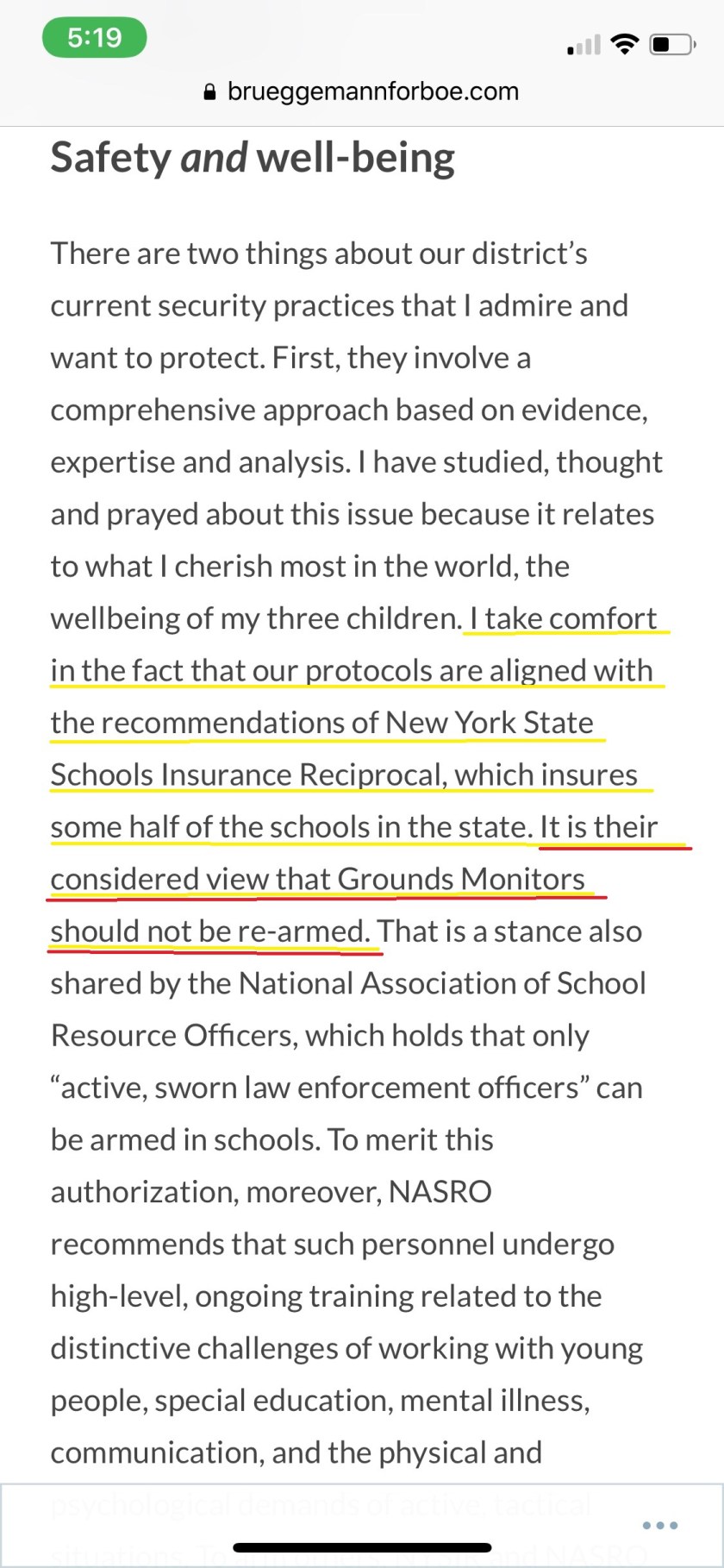
As the grounds monitors play a role in school discipline, I do not support them being armed. I do not believe that lethal weapons should be a part of school discipline.
I also think that anyone who does carry weapons on the grounds of our schools needs to be an active duty law enforcement officer who receives ongoing training and certification. This insures we keep our schools safe in all the ways that matter. Part of protecting our schools is doing things properly, following procedure, and filing the right certifications and paperwork. Having active-duty police also reduces liability to the district because oversight and training are done by the police or sheriff.
- What plan do you see that would be most helpful in improving safety in the district?
We had a risk assessment in the fall and were told by the expert at the school safety forum that our schools are very safe. I think we now need to focus strongly on prevention at many levels – whether we are talking about vaping, sexual misconduct, or students hurting themselves or one-another. There is a marked increase in teenage anxiety, depression, and suicide across the nation – this absolutely breaks my heart. We know that creating and maintaining a positive school climate helps every student feel that they are a part of something bigger than themselves – that they are not alone. I want the schools and community to come together to help every student feel connected and cared about.
- How would you pay for any enhanced safety program (#6)
I have attended every budget meeting open to the public, but our budget is extremely complex. I do not have all the answers. I do know that if we identify concrete needs for more counselors, social workers, or security infrastructure, it is within this community’s power to vote for appropriate funding.
- What are your thoughts regarding the “tax cap” as it affects public education?
It limits the ability of communities to decide for themselves how much they will spend on their schools and the new federal changes to state and local income tax have made it harder to evaluate. For example, the tax cap formula doesn’t account for the sort of growth we have in Saratoga County, where we grow by 4-5% each year. Each year we are essentially getting less money because the formula does not account for our level of growth. It would make more sense to have the property tax cap on the rate, not the levy.
- What other thoughts do you have that you would like to share with the readers of this blog?
As a related services provider, I have a special view of the school system. I am an educator, but not a teacher. I manage cases, but I am not a case manager. I learn everyday, but I am not a student.
For almost a decade I have worked in special education with students at all levels with speech or language disorders (or both!). Working in special education means that I have a deeper understanding of what many of our students are experiencing. I perform evaluations, write IEPs, and understand the laws and policies that govern these documents. It’s my job to help students with special needs access the general curriculum. I work hard to help parents understand the services the schools provide. I think the board will benefit from my expertise in this area.
I have a modern view of technology and how we can use it to maximize the efficiency of our communication. I have never been an adult in a world without social media, which lets me relate to kids in a way that adults even a few years older than me cannot. Students trust me and want to talk to me. I am very capable with 21st century communications tools. This expertise will directly address concerns I have heard about the quality and consistency of communications from the board to its various stakeholders. I pledge to be an ally to teachers on this issue.
And last but not least, for everything I do now and everything I will do in the future, I will place children at the center of my decision making.
- If you have a website and/or Facebook page, what is the URL?
My Facebook page is https://www.facebook.com/NatalyaForSchoolBoard/
My website is https://natalyaforschoolboard.com

Shaun Wiggins
- What is your educational background?
I have a Bachelor of Science in Electrical Engineering from Southern University. I am currently working on my Masters in Sustainability
2. What is your relevant professional background?
I have worked in senior management positions across public, nonprofit, and private entities. In my various roles I have led cross-functional teams, managed multibillion-dollar budgets, helped broker consensus from individuals with diverse opinions and backgrounds, and operated as a communications expert.
3. What volunteer activities you been involved in in schools?
My primary volunteer activities have been in secondary education. I serve on the Board of Directors for the Martin Tuchman School of Management at the New Jersey Institute of Technology – in this capacity, I maintain the responsibility of developing and implementing the mission and vision of the school; I work with the National Urban League in developing technology programming for underrepresented students; and I provide internship opportunities for college students on a yearly basis.
4. What other community activities have you volunteered in?
I have worked with a community church in supporting a gun buy-back program across Saratoga county; I support fundraising activities for Caroline Elementary.
5. What prompted you to run for the school board?
I witnessed a series of issues in our school system that I found to be personally problematic. The first being the disarming of personnel whose primary focus was to protect students from armed threats. The second being the increase of student-to-teacher ratios at Caroline Elementary. The third issue being the School Board’s less than satisfactory approach to communicating with parents. Finally, the lack of transparency in the School Board’s budgeting process.
6. Do you support the currently assigned armed School Resource Officers at the School?
I absolutely support armed School Resource Officers across out school district.
7. Do you support finding a way to rearm the monitors at the schools?
If elected, I would support armed School Resource Officers first. If that is not achievable because of budgetary constraints, I do support rearming the school monitors, but they must report to the Saratoga Springs Police Department and/or the Saratoga County Sheriff’s Department to ensure they are receiving the most up-to-date training. Certification in weapons is not sufficient.
8. What plan do you see that would be most helpful in improving safety in the district? (Please distinguish between existing programs and additions).
If elected, I would advocate to ensure that the Saratoga Springs School District develops and implement a comprehensive approach to school safety. My focus is not solely on having armed personnel. While that is critical, we do need to have “system” in place. The National School Boards Association lays out an excellent framework…we do not need to recreate the wheel:
ESSENTIAL TRAINING
This observation leads to the next burning issue in school safety: training. How your staff is prepared to respond to a threat or incident in school is not just a perennial issue; it remains the premiere issue for district leaders wanting to keep schools safe.
Yet evidence suggests many schools still fall short in providing this essential training. Patrick Fiel, founder of PVF Security Consulting and former chief of security for the Washington, D.C., school system, has observed this problem firsthand.
For example, school personnel have been told repeatedly of the importance of limiting outsider access to schools, he says. Yet, in conducting security audits at schools, “we find that we can still walk through side doors, back doors, cafeteria doors, gym doors”—school entrances that are unlocked, not closed properly, or propped open.
To avoid such security lapses, it’s essential that district leaders insist upon a well-conceived schedule of professional development on school safety practices, with that training reinforced by regular drills and brief refresher courses. These courses can be as simple as a five-minute “what if” role-playing exercise during staff meetings.
District leaders also need to recognize why schools shortchange training: School administrators are overworked, funding and time are in short supply, and there’s a lack of urgency in schools that have had the good fortune to avoid a serious incident. School boards need to make sure these obstacles are overcome.
“School people make up excuses,” Fiel says. “They say their budgets have been cut—or their schools are in good neighborhoods. But one of the things I say when I’m in front of a school board is that they’ve got to make security training a top priority—period.”
SMART TECHNOLOGY CHOICES
Technology plays a pivotal role in school safety. Metal detectors may serve as a deterrent to students bringing a gun to schools, and surveillance cameras can help identify those involved in vandalism, fights, or other incidents.
If school officials are looking for technology to keep schools safe, Fiel suggests they start with one piece of technology that’s decidedly old-school: a good classroom door lock.
The Sandy Hook Advisory Commission, which looked for lessons in the 2012 school shooting that left 26 dead, noted that, in its research, “there has never been an event in which an active shooter breached a locked classroom door.”
But the right lock is needed—one that is easily locked from inside the classroom without a key or, even better, locks automatically when closed. Campus Safety magazine has reported that, after asking teachers to react to a scenario where they hear gunfire, “we often see that it takes the employee between 30 and 40 seconds to find their key and lock the door.”
EAR TO THE GROUND
Security personnel have long understood the value of building relationships with students to monitor gossip about threatened suicides, bullying, or a student threat to bring a gun or bomb to school.
The latest twist on this practice, however, is found in Florida’s Orange County Public Schools, which is using software to monitor student posts on social media.
The district pays $18,000 annually for software that allows officers to scan for social media keywords associated with cyberbullying, suicidal thinking, or criminal activity. The software flags worrisome student posts for officers to examine for a real threat.
Such monitoring is potentially controversial, so school officials took time before the program began to explain their intentions and the scope of monitoring to the community, says Michael Eugene, chief operations officer for the district.
Only a handful of officers are authorized to monitor social media, and only public postings are examined, Eugene says. Private communications are not accessed.
“Not everyone is in favor of school districts monitoring social media,” he says. “So this is an important conversation to have clearly with parents so they understand why it’s important to utilize a tool like this.”
The district’s protocol is to respond immediately to troubling posts, Eugene says. So, it’s not uncommon for school police to visit a student’s home at night to investigate a suspected problem.
“It changes how you think about the day,” he says. “You don’t wait until the next morning to deal with an issue. You hit it first thing, as we don’t want the issue to come back to school.”
UNDERSTANDING THE ROLE OF SROS
You’ve seen newscasts of school-based police throwing students to the floor or handcuffing students so young that the restraints slip off their tiny wrists.
Such incidents have fueled one of the most significant recent trends in school safety: a rethinking of the role of school-based police.
According to the National Association of School Resource Officers (NASRO), the goal of school-based police or school resource officers (SROs) is to ensure school safety—not school discipline.
“Being a SRO is about community-based policing, not about how many kids you can arrest or how many crimes you can solve,” says NASRO Executive Director Mo Canady.
In addition to looking out for potential safety issues, SROs should be getting to know the students they seek to protect, he adds.
“By building relationships, you begin to collect information. It’s not about kids becoming a snitch, but it’s about good relationships where young people get concerned about some issue or something they saw on social media and they come talk to the SRO.”
For district leaders, one of the most important steps they can take is to ensure that SROs are properly trained, understand their role, and have the skills and temperament to interact with young people and de-escalate conflict, Canady says.
While SROs will respond to criminal activity, if asked to intercede in a disciplinary issue, they should know to refuse—and to point out correctly that student misbehavior is not a law enforcement issue, he adds.
“SROs are not there to mete out school discipline. If SROs are writing tickets to students for being late to class, that’s insane.”
WATCH THE FRONT DOOR
When a gunman was unable to open the locked front doors at Sandy Hook Elementary School, he shot his way through a glass panel at the entrance to gain entry.
The incident highlights an issue much on the minds of school safety experts: How do you screen—and contain—arriving visitors before they gain access to school hallways?
We’ve already talked about keeping school doors locked. So, let’s focus on where you want visitors to enter: the main entrance.
The thinking today is that, if possible, this entrance should have a vestibule with two door entrances: one to the school, the other to the front office. Both should be locked. (Some schools are going the extra mile and installing ballistic plastic over glass panels to make them more difficult for a gunman to shoot his way through.)
The entrance also should be equipped with an intercom and camera so school staff can visually verify a visitor’s identity before granting entrance to the school. Some schools opt for a visitor management system to check identification to determine if a visitor is a registered sex offender, has a criminal record, or is otherwise barred from the campus.
Nobody should be permitted inside until screened.
No one wants to turn a school into a fortress, but it’s important that staff and students understand the importance of access control, Trump says. He’s seen instances where visitors hit the intercom at an entrance and are granted entry without being asked to identify themselves—or a student is buzzed in and holds the door for a nearby adult.
Even the most rigorous of security precautions won’t guarantee that a threat can be kept out of a school, but there is evidence that a properly designed front entrance—responsibly monitored by staff—can slow down a gunman and possibly save lives
“We’re not likely to stop a determined individual,” Fiel says. The goal is to buy time for staff to be notified of the threat, the school to go into lockdown, and police to arrive. “We want to delay the individual.”
EVALUATE LIKELY RISKS
Nearly two-thirds of U.S. schools regularly conduct some form of “active shooter” drill to teach students and teachers how to react to an armed intruder.
Unfortunately, far fewer schools prepare for the more common scenario: the appearance of a parent, intoxicated or without custodial rights, who wants to pick up his child and becomes agitated and disruptive when the request is refused.
“The key thing is to understand what your security needs are,” Fiel says. “You must do a risk assessment. That’s the key to starting everything.”
Statistics put the risks in some perspective. For every school-related shooting, there are nearly 10,000 violent assaults, including rape, assault with a knife, sexual assault and violent harassment, beatings, fights, and robberies.
This doesn’t include the millions of students who are bullied each year.
“There’s been a tunnel vision focused on active shooters,” Trump notes. “That’s taken the eye off the ball for more common, day-to-day school security issues. Not enough conversations on school safety are talking about the rape that could happen under the stairwell or the importance of supervision during class changes to prevent violence.”
A risk assessment, conducted in consultation with security professionals, is designed to identify the potential safety risks of a campus, analyze the campus’ vulnerabilities, and point to strategies to improve safety, Fiel says.
What may result are decisions as obvious as expanding the presence of teachers and other adults to monitor hallways, restrooms, and stairwells during class changes, a simple step that can have a greater day-to-day impact on safety than anything else school leaders do.
“Sometimes it’s the simple tools, a focus on the basic safety risks, that work,” Fiel says.
In the end, the lesson for district leaders to learn is that—if school safety is a true priority, not just a nicely worded goal—they can make their schools safer.
“We reduced [school-based] crime while I was in Washington, D.C., and we had something like 200 gangs we dealt with every day,” Fiel says. “If you pay attention to the basics, the fundamentals, and you carry through with them, you’ll have safer schools.”
9. How would you pay for any enhanced safety program (#6)
I have reviewed the current school budget. At this time, I am not knowledgeable enough to intelligently and accurately state how an enhanced safety program will be paid. With that, if elected, I would take a “back to basics” approach, meaning that the entire school budget must have a teacher-student focus. Once the School Board has ensured that proper student-teacher ratios are established and sufficient school security measures are in place and properly budgeted, then the remaining budget can be allocated for all “supporting” efforts. This will require a change in how the budget is allocated. This will require a hard look at the current budget with an eye to cost-cutting. My position is that everything would be on the table for cost cutting consideration.
10. What are your thoughts regarding the “tax cap” as it affects public education?
I oppose a tax cap. Costs continually rise and we as citizens must step up to defray those costs through additional taxes.
11. What other thoughts do you have that you would like to share with the readers of this blog?
The Saratoga Springs School District provides a quality education for our students. Part of the attraction for businesses and talent to live in this district is the fact that we have among the best schools in the state of New York. It is critical that we ensure our school district changes with the times by ensuring that we have enough funds to keep our schools highly ranked and that we are properly allocating the funds to the core of our education system — the students and teachers. This means ensuring that we have well paid and well compensated teachers. This also means that we have well-funded security measures that foster a safe and secure environment.
12. If you have a website and/or Facebook page, what is the URL?
https://www.facebook.com/ShaunWigginsForSaratogaSchoolBoard/


 Saratoga Springs Politics