Vice Chair Of Charter Commission Pat Kane’s Disgraceful Behavior

Below is a screen shot of a post by Pat Kane, Charter Commission Vice Chair, that he has put up on multiple websites.

Over the time I have been writing this blog there have been many times when I have been tempted to write something unflattering about the motivation of a number of public figures.  I felt extremely confident in those cases about the unseemly motivation but I have never indulged myself by actually posting it.  I do this for two reasons.  First, without clear and supporting documentation I think such conjecturing does not rise to the level of accurate reporting.  Most centrally, writing something like that would poison the environment on my blog.

Pat Kane, the vice chair of the Charter Review Commission, has posted the following comments to multiple websites.

One of the places he posted this was on the site of the Greenbelt Trail Committee.  To their credit, that site removed his post and put up a message saying that they would no longer allow comments to be posted on their site,  <Place link>

This is not the first time Mr. Kane has flirted with what  I consider ethical norms but in this cases he has gone way over the line.

In accepting the vice chairmanship of the Charter Review Commission he took on the burden of being seen as a leader of this group and with that position came the responsibility of behaving in a way that would not compromise the credibility of that body.

The Charter Commission meets this evening.  Mr. Kane should take the opportunity of this meeting to apologize to Commissioner Madigan, the members of the Commission, and the public.  Barring this happening, the Commission needs to pass a resolution in the clearest terms disassociating itself from Mr. Kane’s posting.  If they do not, they are complicit in this disgraceful behavior.

kaneattack

Charter Commission To Scrap adopted Financial Impact Analysis And Consider New One

For those of you who watched the video from my last blog, you may remember that Mr. Turner commented that this (the September 18 meeting) was the last meeting of the Commission.  At this final meeting the Commission voted to adopt Jeff Altamari’s financial analysis of the impact of the proposed charter.  It projected a savings to the city of $381,000.00.

Well, it was not the last meeting as it turns out.  WAMC reports that Mr. Altamari is coming out with a new financial analysis and the committee is meeting on Thursday, September 28, to consider replacing the “old” one with this “new” version.  Apparently following John Franck’s withering critique of the adopted impact analysis,  Mr. Altamari has come out with a new, revised version that the Charter Commission will now consider.  According to a report by Lucas Willard of WAMC, the new analysis now includes projected costs for the transition.  Interestingly, Willard reports that in spite of the newly acknowledged costs for the transition, the new report shows an even greater savings for the city.  Mr. Altamari now projects a savings of $403,000.00.

I guess we will find out more on Thursday.


Charter Review Commission: A Disturbing Discussion With Some Down Right Unpleasant Behavior

I am including in this blog segments of the  video of the September 18 Charter Review Commission meeting.    

I find the tone of the interchanges here reminiscent of the very kind of belligerence and self righteousness that this group characterizes as “politics” under the current commission form of government.  I grant that my observations are subjective and I invite the readers of this blog to take the time to view these relatively brief videos and make their own determinations.

Some background is in order to understand what is going on in the video: 

-First of all  the New York State law that establishes Charter Review Commissions makes them independent bodies and requires that municipalities fund them so they can carry out their duties.  The local government, in our case our city council, has no authority over what they do.  There is, however, a caveat.  Any literature that is produced by a Charter Commission with public funds must be educational and not advocacy. 

-The 2006 Charter Commission sent out a mailing that they expected the City Council to pay for. The then Commissioners of Finance (Matt McCabe)and Accounts (John Franck)deemed the mailer advocacy and refused to pay. 

-The current Charter Commission has two attorneys who are paid to provide services to it.  One of the attorneys is the city’s Assistant Attorney, Tony Izzo, who attends all the meetings.  The other attorney, Robert Batson, is an Albany Law School professor specializing in government law who has acted as a resource for the Commission 

-The meeting that is the subject of this video occurred the day before the City Council meeting at which Commissioner Franck took strong exception to the financial analysis that was adopted by the Commission that was supposed to explain the economic impact of the proposed charter.  Early in the meeting that is the subject of the video, Tony Izzo advised the Charter Commission that at the City Council agenda meeting that morning at least one member of the Council had expressed interest in having the Council review the Charter Review Commission’s materials before they are mailed.  At the subsequent council meeting which occurred after the meeting in the video, the council voted unanimously to request that the Charter Commission send them the materials to be mailed to the voters prior to the mailing.  The Council resolution also called for the two bodies to work together on the issue.

The video segment picks up with the Commission discussion of how they will respond to this Council’s impending request.

 I am disturbed by the tone and manner of the discussion as regards their attitudes towards Tony Izzo and the City Council.  This is not the first time a Commission member has accused Mr. Izzo of being an agent of a hostile city council. In this instance this leads them to decide not to hear Mr. Izzo’s opinion on the appropriateness of the materials they want to send out. Whether you agree with Mr. Izzo’s opinions or not, he has extensive experience in city hall and with charter commissions and it is always worthwhile hearing what he has to say.   Similarly, the other members of the Charter Commission dismiss Matt Jones’ suggestion that they have their attorney in Albany review what they plan to mail out to the public.  For me their hostile attitude towards the City Council and their disinterest in Tony’s legal considerations of what they are mailing are regrettably mirrored by the ugly nature of the interactions between the members of the commission.

 I find it particularly telling that the request to have the materials reviewed by the attorney in Albany came from Matt Jones and that it was so resoundingly dismissed.  Mr. Jones is himself an attorney with considerable experience in government.  He has both the humility and the experience to know that these kind of things benefit from the assessment of an attorney who specializes in a particular area of law.  I have experienced decades of listening to people who are not attorneys make confident legal assessments and then be shocked when judges find otherwise.  I offer the recent overturning of the convictions of Assembly Speaker Sheldon Silver and Senate Majority Leader Dean Skelos as examples of how skilled attorneys can find strategies for overturning decisions that to most of us seem cut and dry.  With respect to the people who have worked so hard on drafting their charter, it is easy for group think to develop in a project like this and for people to become insular in their thinking.

 Bear in mind that the entire City Council voted to work with the Charter Commission to review the Commission’s materials that are to be taxpayer funded before they are mailed out.  Remember that both Mayor Yepsen and Commissioner Mathiesen support charter change but voted for this.   It would be prudent to consider any issues of concern offered by the Council on the mailing whether or not the commission accepted any of these concerns. 

 Finally, I find it more than strange, and I think anyone who views this video will find it strange, that Mr. Turner is now quoted in the papers on his confidence that he can work with the Council on the mailing.  I did not include in the video the conclusion of the meeting.  In the end they passed a watered down resolution saying they will send a communication to the City Council advising them to go to the city website if they want to view the documents for the proposed mailing.  To me,  the hostility to interacting with the Council on the mailing is palpable and makes Mr. Turner’s comments appear more as political spin for the public than a serious offer to work with the Council.


Commissioner Franck Warns Charter Commission The City Will Not Pay For Their Mailing

According to the Times Union Commissioner of Accounts John Franck has stated he will refuse to have the city pay for a mailing the Charter Commission wants to send to Saratoga voters because it contains inaccurate fiscal projections.

State law says cities cannot interfere with the work of a charter commission and must supply the commission with public funds to complete their work and educate the public about their proposal.  Public money cannot be spent on efforts to advocate for the passage of the charter, however.

Franck stated that the financial claims made by the commission are not credible. The Commission claims the major savings of changing to a city manager will come from eliminating four part time  commissioners and five fulltime deputies and replacing them with one city manager.

“I’m a CPA by trade,” Franck said. “They want us to believe they will replace 18,000 working hours with one manager who will work 2,000 hours a year. It’s statistically impossible. If they come back with projections that are factual and truthful, I’ll sign off in five seconds.”

Some Charter Commission members have suggested department directors can pick up the work of the commissioners and the deputies but Franck disagreed pointing out that reassigning work will involve working with civil service and the unions.

“Other employees cannot absorb the work, and if they do, you’ll have to pay them,” Franck said. “It’s going to cost more. I’m telling you, I’m not paying for something that misrepresents the facts.”

Other criticisms of the Charter Commission’s financial analysis include the lack of any estimate of what the transition to the new government will cost and the omission of funding for such things included in the charter as an internal audit.

If the city refuses to pay for the mailing the Charter Commission wants to do, the mailing can be done anyway by using the private funds that they have raised and the Commission can try to sue the city after the fact to recover the funds.

The full article is behind a pay wall but some of you may be able to access it at http://www.timesunion.com/news/article/City-council-blocks-charter-review-commission-12225110.php?cmpid=twitter-desktop


Bob Turner, Charter Review Commission Chair Withdraws From Participation In This Blog

The members of the charter commission have continually defended the mayoral salary of $40,000.00 that is included in the proposed charter by citing  data from the  New York Conference of Mayors showing the average salary for mayors in NY Sate is $50,000.00.  This figure is glaringly misleading.

The proposed charter calls for a city manager to take over the running of all city departments so the mayor under this form of government will have significantly fewer responsibilities than is currently the case under the commission form. It is not surprising then that  the NYCM data shows that mayors in municipalities that have city managers are paid an average of only $22,000.00.  In fact the median salary, the more relevant measure, is only $12,000.00.

This problem of the misrepresentation of the NYCM data has been repeatedly brought to the attention of Bob Turner, the chair of the charter commission.  In spite of this, last week, he again used the $50,000.00 figure in interviews with the Saratogian and Gazette Newspapers.

This prompted me to email Mr. Turner asking why he persisted in using a number that appeared to me to be so clearly inappropriate for a comparison.

When I did not hear from him, I wrote him a note asking if he planned to respond.  I have always greatly appreciated Mr. Turner’s availability to me and his willingness to engage publically.  He responded that he would write me a reply.

Over the following week I wrote him several times indicating that I wanted to incorporate his answer in a post I was working on.  I know that Mr. Turner, in addition to the many hours he devotes to the charter has a demanding job and a family with two daughters so I always feel guilty pressing him.

Today I received the following reply:


From: Robert Turner (Government) [bturner@skidmore.edu]
Sent: Thursday, September 21, 2017 12:09 PM
To: John Kaufmann
Subject: RE: Requests

John,

I have been very open and transparent to and only said nice things publicly and privately about Jane.  However, given your wife sees fit to keep slandering me in the Saratogian, “How many times do you think Saratoga Springs Charter Review Commission Chair Bob Turner or a commission member or one of their supporters has used faulty or secret information or cherry picked data to support the need for charter change? I’ve lost count.” I am going to pass on answering your emails.

Bob

Bob Turner
Associate Professor of Political Science and Environmental Studies and Sciences
Director, Environmental Studies and Sciences Program
Director, Faculty Student Summer Research Program
Skidmore College
Saratoga Springs, NY 12866


I regret his decision as I think his participation in this blog has been very helpful in educating the community on the charter.


Commissioner Franck Shreds Charter Commissions Financial Analysis (Version 2)

[JK:Due to an error with the video of Matt Jones, I am reposting the corrected version]

The Charter Commission is required by law to craft an analysis of the financial impact the adoption of their proposed charter will have.

This document was finally released Monday night and I published it in a previous post.  The brevity of the document was best described by Commissioner Madigan when she noted that the disclaimers were longer than the analysis.  I reproduce the document again below for the skeptical.

Commissioner Franck, in addition to being the Commissioner of Accounts, is a CPA and runs his own firm.  The following is a video of his searing critique of the document.  I might have been a little gentler in my style than Commissioner Franck but the substance of his remarks are clearer than anything I have been able to craft on this question.

The projected savings in the Charter Commission’s financial document are based on the elimination of the part time commissioners and their full time deputies.  Commissioner Franck delivers a devastating analysis that exposes the fact that the numbers bear little relationship to reality.

As important background, the Charter Commission interviewed literally hundreds of people in their deliberations but as a commission chose not to interview any of the deputies.  Their defense was that it would have been unfair to question the deputies about the viability of the commission form of government since they serve at the pleasure of their respective commissioners.

This argument ignores that the Charter Commission could have limited their questions to simply asking about what it is that deputies actually do.  For this blogger, and I have stated it in the past, it seems hard to fathom a decision to eliminate the deputies without first determining what functions the deputies carry out that might be required under the new charter and whether the scale of these responsibilities (along with the jobs of the  commissioners) could be absorbed by the single, proposed city manager.

Below are two videos.  The first is Commissioner Francks’ criticisms from the council meeting.  The second is an excerpt from the last charter meeting in which attorney Matt Jones takes exception to Chairman Turner for the unflattering way he has referred to the deputies.  I must say that I greatly admire the respectful and gracious way that Mr. Jones expressed himself.  I think it is an interesting contrast to Commissioner Francks’ style.  I think attorney Jones’ concerns will give  the reader some insight into why the Commission failed to interview the deputies.

Financial AnalysisFinancial Analysis

John Franck Video


Matt Jones Video

It is a little confusing but when Mr. Jones goes on about describing the deputies in very unflattering terms, he is quoting Mr. Turner.


Robert Turner Responds

Saratoga’s Racino Down 25%

Jesse McKinley reports in the September 20 edition of the Gazette that “…the Saratoga Casino Hotel has seen a precipitous drop in its net winnings since the opening of the Rivers Casino, some 30 miles south”.

The Gazette reported the racino brought in $16,000,000.00 last August, typically their best month.  This August their earnings were down by nearly 25%. 

The story reports that James D. Featherstonehaugh, part owner of the Saratoga racino, expected “even more declines.”  Featherstonehaugh said,   “It’s clear we’ve reached the stress point, especially in upstate New York.  The number of good quality jobs and first-rate facilities, we’re at the end of that”.

The Gazette has a pay wall but for those with access, here is a link.  https://dailygazette.com/article/2017/09/19/new-york-s-bet-on-new-casinos-has-yet-to-hit-jackpot


Charter Commission Releases Analysis of What Their New Government will Cost: They Don’t Have Any Idea

If you thought you were going to find out how much a new government under the proposed charter will cost you, you are going to be sorely disappointed.

Monday night the Charter Review Commission finally adopted their “Financial Disclosure Summary.”  This was supposed to disclose what the financial impact of adopting the new charter might be.

The poverty of this document is stunning but not surprising.  In effect, the Commission declined to risk any kind of projection as to what the cost of the transition to the new government might be or what the cost of this new government might be over the first year or for any time frame for that matter.

Commission member Jeff Altamari, its author, defended the document by saying that there were so many unknowns that he only felt comfortable using the most minimal known figures from the charter.  I have both respect and sympathy for Mr. Altamari.  He had neither the resources nor the time to figure out what he and the commission envisioned this new government to actually consist of and therefore had to base his analysis on a minimal series of assumptions. 

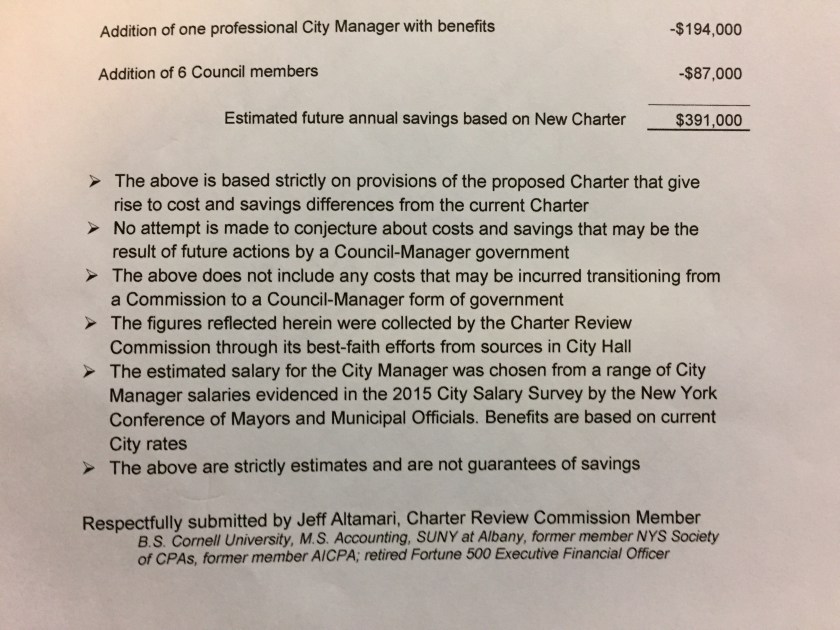
His document simply states that the cost savings of eliminating the salaries and benefits of the commissioners and their deputies along with the costs incurred for a city manager, six council members and the increase in salary for the new mayor will add up to a savings of $391,000.00.  He then covers himself by admitting that these numbers do not represent the actual costs of the new government.

One of the big problems with this financial  analysis is that the major savings are based on the assumption that the deputies will disappear along with the Commissioners. The proposed charter, however,  states that the deputies will continue after January 1st at the discretion of the city manager.  Nevertheless the financial analysis assumes the savings of the eliminated deputies as though their last day of work were the day before the charter takes effect. 

The document’s financial calculations, as written here, would also rest on the huge assumption that the new city manager alone will be able to absorb the work done by five full time deputies and four part time commissioners. Previous discussions by the commission during the year had assumed there would probably be a need for at least a deputy city manager. Budgeting for an external auditor was also dismissed in the drafting of this document.

In their defense, no attempt was made to hide the poverty of this financial analysis.  The document states:

“No attempt is made to conjecture about costs and savings that may be the result of future actions by a Council Manager government.”

And

“The above [the table of numbers] does not include any costs that may be incurred transitioning from a Commission to a Council-Manager form of government.”

In something of an understatement they write: “The above are strictly estimates and are not guarantees of savings.”

The Charter Commission is simply stating as an act of faith that the city will save money.


Financial Analysis

Financial Analysis


Saratoga County League of Women Voters Sacrifices Years Of Trust In Their Haste To Endorse Proposed Charter

Dear reader:

This is a rather long piece.  The length is necessitated by the gravity of my accusation against an institution which I believe to have played, up to now,  a vital role in our democracy. I deplore cheap attacks and to understand what the League has done, it requires understanding the history of the League and the specifics of what has occurred.  I have included at the bottom a copy of the League’s explanation as to what they have done.


The National League’s Standards For Fairness

[This excerpt is from the National’s narrative on how to arrive at an organizational position.  Note that the process is not exclusive to the members of the board but is supposed to involve the membership]

“The first step is vital: STUDY. League members across the country must look at all sides of an issue, study the facts, the ramifications of all approaches to that issue, alternative solutions, the impacts on people, places and things, the costs and benefits. Only after studying the issue do League members come together in their own local Leagues to discuss that issue at a meeting to arrive at the “consensus” of their League on the issue.

The results of all local Leagues discussing the issue are compiled to determine the consensus of the League as a whole. CONSENSUS is not a vote – rather, consensus is a mutual agreement of League members arrived at through civil discourse, the hallmark of the League of Women Voters.

In the process of discussing the issue, League members must turn the issue upside down, sideways, backwards and forwards. Because of our nature, training, upbringing,  experience and hearing others’ ideas, League members will see an issue differently. In fact we cherish the fact that we bring different perspectives on issues. Because the process of coming to consensus is an amalgam of members’ thoughts, ideas and ways of looking at the facts, members attending the consensus meeting must dig deeply into the issue. That is why we cannot typically pose a consensus question in the frame of “Do you support the NPV compact approach to electing the President?” Consensus questions are designed to spark a discourse about the issue akin to the discussion we would expect policymakers to have when they deliberate the issue. Consensus questions are not black and white, yes or no questions. There is no right or wrong answer to a consensus.”

How The Local League Studied The Forms Of Local Government And What They Decided

Concerned about the organizational effectiveness of the Saratoga County Board of Supervisors and other municipalities the local League initiated a “study” in May of 2015.  Consistent with the standards of its national organization it labored over this work for two years and issued its position in April of 2017.  Note how modest their finding is.  A mere two paragraphs, it reflected the caution that is consistent with both its history and the nature of the process.  Here is the text:

“The League of Women Voters of Saratoga County believes that it is important to have a clear separation of powers, and checks and balances in County Government and therefore we support having an elected County Executive. Additional reasons for supporting a County Executive are that because the County Executive would be elected county-wide the Executive would be focused on the needs of the County as a whole; and because the term of office would be longer than the current one-year term of the Chair of the Board of Supervisors continuity and long range planning would be enhanced.

The League of Women Voters of Saratoga County believes that Cities in this County should separate their administrative functions from their legislative functions by having a City Council that makes policy and laws and either an elected executive or an appointed administrator to carry out administrative functions. The League supports this separation of functions in order to have a strong centralized administration, to have clear lines of responsibility and to eliminate waste.”

The Local League Pushes Through Endorsement At Board Meeting

As noted in the excerpt from the National League, decisions are supposed to be the result of consensus which is supposed to involve the membership.  No notice was sent out to the membership of the local League advising them that the board planned to take action on endorsing the proposed city charter.

In a release to the media, the board of the local League defended their action by asserting that they had studied the charter to determine that it was consistent with their previously adopted position, to wit, that it would separate the legislative duties from the administrative duties.

This piece of legal sophistry is painfully thin.  The proposed charter involves far more than the separation of powers.  I will be going through the issues of the charter in a series of related posts but here are just a few.  The proposed charter changes the terms of city council members from two to four years and staggers the terms.  It creates a mayor who no longer has any administrative duties but whose salary is roughly triple the current mayor’s salary.  As of the date at which the League made its decision there had been no financial analysis of the cost of the new form of government although members of the charter commission have made claims that it will save many hundreds of thousands of dollars.  There are more but these are just some of the substantial issues involved.

Most conspicuous was the League board’s failure to invite representatives who opposed the proposed charter to their endorsement meeting.  The only person with an in depth knowledge of the document was Barbara Thomas who is one of the rotating League presidents, who is on the board, and who is also on the Charter Review Commission. This seems rather out of keeping with the National’s admonish, “members… must look at all sides of an issue.”

So using the terms from the national, would anyone argue that at this single meeting of the board our League “…study[ied] the facts, the ramifications of all approaches to that issue, alternative solutions, the impacts on people, places and things, the costs and benefits…”  Or that the “League members [had turned] the issue upside down, sideways, backwards and forwards.”

It is also worth noting that as a member of the charter review commission, Ms. Thomas’ decision not to recuse herself from the vote is quite troubling.  When asked by the Saratogian about this, Ms. Thomas responded that she “did not see it as a conflict.”  It seems to me that people of good faith could argue over this issue.  The thing that I used to admire about the League was that it would go the extra mile on issues like this to avoid even the appearance of a problem.  Their main concern was insuring their credibility in the eyes of a public grown cynical about manipulation.

I will be following up this post by going through the charter identifying what I believe to be the critical policy issues outside of whether a reader prefers the commission form or prefers the council/city manager form.  When you vote in November, notwithstanding the League’s myopic approach, you will decide on some very important changes to our government beyond these two models.

One can only hope that the board of the League will see the folly of what they have done and take action to acknowledge the error and to assure the public that they will again adhere to the policies that have made them such an important resource for the community.

Finally, I would take exception with the League’s original position that the legislative players in government should be structurally separated from the executive players.  Most democracies in the world have parliamentary systems.  These include Great Britain and the Scandinavian countries.  When a political party wins a majority of seats, the prime minister selects individual members of parliament to serve as the heads of the country’s key institutions.  There are positions like minister of health, minister of transportation, minister of housing, etc.  Many, myself among them, think that this is a more democratic model and less prone to the kind of executive excess and gridlock that our own country seems to suffer from.


[The League’s statement to its members]


Email not displaying correctly? View it in your browser.
LeageLogoLeague of Women Voters of Saratoga County Making Democracy Work ~  Not For Women Only! www.lwvsaratoga.org             


CharterLogoLWVSC Supports the Proposed new Charter

To the members of the LWVSC: LWVSC supports the new Charter proposed for SS At its meeting on September 6, 2017 the board of the League of Women Voters of Saratoga County decided to support the new Charter being proposed for the City of Saratoga Springs. The board decided that the proposed Charter (which will appear on the SS ballot on November 7th) meets the requirements in our position on the Governance of Local Governments, and that the current Charter does not.    The relevant part of our position is: The League of Women Voters of Saratoga County believes that Cities in this County should separate their administrative functions from their legislative functions by having a City Council that makes policy and laws and either an elected executive or an appointed administrator to carry out administrative functions. The League supports this separation of functions in order to have a strong centralized administration, to have clear lines of responsibility and to eliminate waste. Before announcing our decision to the public we want our members to have an understanding of the process we used to reach this decision.  How LWVSC came to support the new Charter being proposed for Saratoga Springs: [As you review the following chronology note that the League study of local governments was initiated a full year before the first meeting of the Saratoga Springs Charter Review Commission (6-28-16) and that the LWVSC board reviewed the proposed new Charter at its first regularly scheduled meeting (9-6-17) following the completion of the proposed new Charter, which was formally adopted by the Charter Review Commission on 6-26-17.]   May 30, 2015 – LWVSC adopted a proposed 2 year local study: “Study whether local governments in Saratoga County (villages, towns, cities and county government) should separate executive or administrative functions from legislative (policy making) functions. Year one of the study will look at current structures, practices and definitions. Year two of the study will reach a consensus position.”   October 2, 2016 – the local government study committee, chaired by Francine Rodger, presented its findings from the first year of the study at a membership meeting.   April 1, 2017– Consensus was reached. April 5, 2017 – The board received the report from the consensus meeting and formally adopted the Position on the Governance of Local Governments. http://www.lwvsaratoga.org/pdfs/LocalGovernance.pdf   September 6, 2017 – the LWVSC board reviewed the proposed new Charter for Saratoga Springs and determined by a vote of 11-0 that it meets the requirements of our position. Four board members who don’t live in the city abstained. (Once a position is adopted by membership consensus, the League board at the appropriate level, evaluates proposed laws and actions for their compliance with our positions).   You are encouraged to find out more about the proposed new charter for Saratoga Springs. LWVSC has scheduled a public information meeting Thursday, September 21st at the Saratoga Springs Library, 49 Henry Street, Saratoga Springs, beginning at 7 pm. Three members of the Charter Review Commission will describe the main provisions of the proposed charter, the process the commission used to study forms of government for cities, and share how they decided to recommend a new charter of the city of Saratoga Springs. Panelists will be Gordon Boyd, founder of EnergyNext, Minita Sanghvi, assistant professor, Management and Business, Skidmore College, and Barbara Thomas, community activist and will be moderated by Pattie Garrett, LWV Saratoga. Read the entire proposed charter :   https://saratogacharter.com/category/documents/ Questions?  Contact any steering committee member.

You are receiving this information because you requested to be on our mailing list. Board Meetings are open to all MEMBERS: Held 1st Wednesday of the month at 7:00-9:00 pm (except July and August); United Methodist Church, Henning Road,Saratoga Springs, NY

MEMBERS can receive our quarterly Bulletin electronically (it arrives in your inbox as a link in one of the Mail Chimp messages). Be sure to let us know if you change email addresses. You will also receive our Newsletter via US Mail unless you opt out by sending an email request to  Barbara Thomas .

League of Women Voters of Saratoga County   518-728-5201   lwvsaratoga@gmail.com

Unsubscribe mweihe1@nycap.rr.com from this list | Forward to a friend | Update your profile Our mailing address is:

League of Women Voters of Saratoga County

P.O. Box 1029

Saratoga Springs, New York 12866

Add us to your address book

Copyright (C) 2017 League of Women Voters of Saratoga County All rights reserved.

More Hotels! It’s Going To Be Big!

23 Washington
23 Washington Street
Adelphi Hotel
Adelphi Hotel

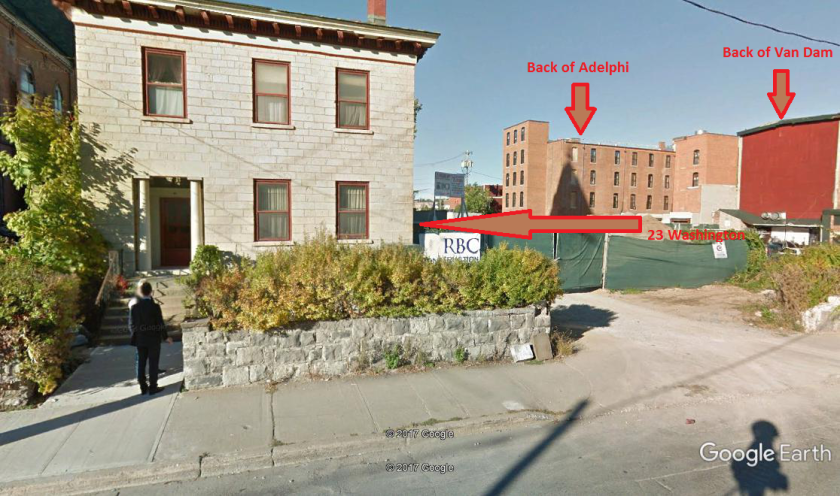
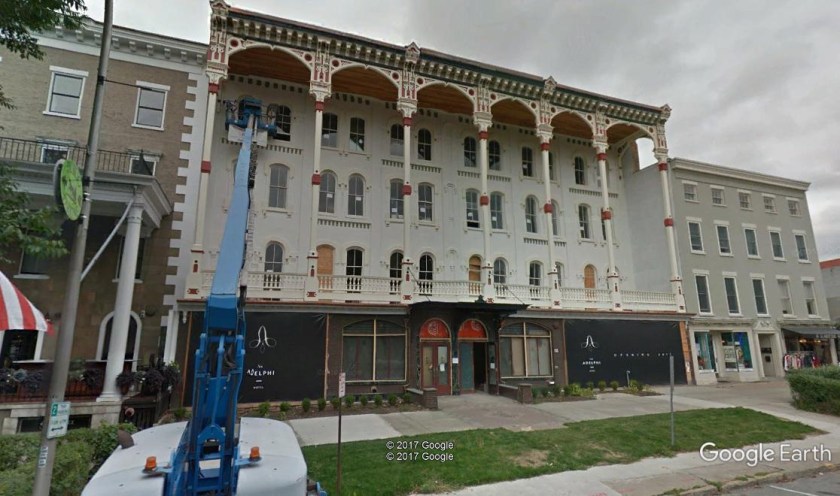
According to the Albany Business Review the owners of the Adelphi Hotel who are close to completing what must be the most expensive restoration in the history of the city ($28,000,000.00) have even bigger plans.  They are seeking to build what the ABR describes as “a second hotel with a spa and ‘resort-style pool’ on the land along Washington Avenue which includes the old parsonage at 23 Washington along with what appears to be the parking lot (19 Washington?).


The developers, Toby Milde and Adelphi Hotel Partners LLC say they are going to invest $14 million dollars to build a six story,  50 room hotel there.

The parsonage would be converted into what they describe as a “three-room presidential or bridal suite with an entertainment parlor on the first floor.”  This would be connected to the new hotel and through that into the Adelphi.

In the meantime, the Van Dam which abuts the Adelphi is going to be transformed into a 152 room hotel.  Earlier stories indicated it would be a Hotel Indigo property.

Just up the street on Washington is the Universal Preservation Hall being developed by Philip Morris, CEO of Proctors (Schenectady) for a measly $7,000,000.00 as an expanded entertainment venue.

This is going to be quite the intersection.