Video and Low Drama From the Debate Over the Censuring of Mayor Yepsen


[JK: This is my first attempt at incorporating video in the blog and unfortunately, it is all too obvious.  The complete video of the council meeting is accessible on the city’s website.

I am republishing the Saratogian article on the meeting for context.  There are three videos.  Two are relatively brief and are the highpoints for drama at the meeting.  The other was edited with more care and represents I think the key exchanges during the evening.]


Tensions rise within City Council following ethics violation

By Travis Clark, tclark@digitalfirstmedia.com, @TravClark2 on Twitter

Posted: 07/20/16, 1:15 PM EDT | Updated: 14 hrs ago

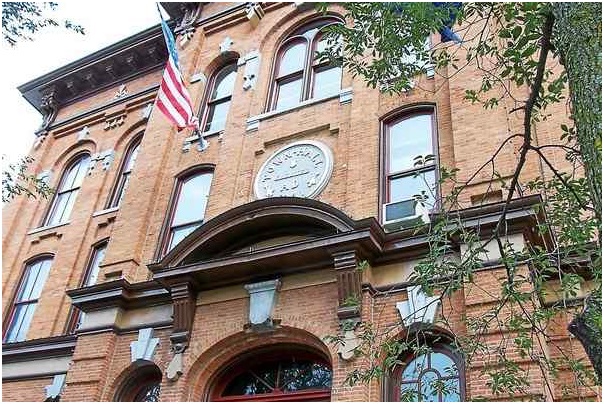
CityHall

SARATOGA SPRINGS >> Tensions were high at the Saratoga Springs City Council regular bi-weekly meeting on Tuesday night. Following the Ethics Board’s findings that Mayor Joanne Yepsen violated the city Ethics Code, Finance Commissioner Michelle Madigan motioned for the council to accept the board’s findings, while Public Works Commissioner Anthony “Skip” Scirocco proposed a resolution to censure the mayor in response to those findings.

The Council voted unanimously, minus Mayor Yepsen who abstained, to accept the Ethics Board’s findings. They also voted to pass the resolution, which both censures the mayor and calls for an investigation into the findings from the state Attorney General’s Public Integrity Bureau. Prior to the vote on the resolution, Madigan motioned for an amendment of the resolution to forward the findings to another entity to address them if the Atorney General’s office is not the right one.

“They needed more facts and I was not ready to share more facts with them at this time,” Madigan said. “So if they are not the right entity to address this issue, we may want to amend to find out who is.”

The Ethics Board’s findings follow accusations that Mayor Yepsen was seeking employment for grant writing services with the Saratoga Hospital Foundation while the City Council was actively participating in business with the hospital. The hospital was seeking approval from the Council for an expansion. After Mayor Yepsen recused herself from voting on the matter for the fourth time, according to Council members, concern was raised.

(function() { var secondaryMedia = $(“#secondary-media”).css(‘height’); var factbox = $(“#factbox”).css(‘height’); var internalContent = parseInt(secondaryMedia + factbox); if((internalContent<400) || (!internalContent)) { console.log(“Article within AD”) googletag.cmd.push(function() { googletag.display(“div_Cube_Article”); googletag.pubads().refresh(); }); }else { console.log(“No AD in article”); $(“#div_Cube_Article”).css(‘display’, ‘none’); } })(jQuery); $( document ).ready(function() { var ADbox = parseInt($(“#div_Cube_Article”).css(‘height’)); if((ADbox<200)){ $(“#div_Cube_Article”).css(‘display’, ‘none’); } })(jQuery); Advertisement

In a letter to the Ethics Board from one of Mayor Yepsen’s attorneys, Robert Ryan, Mayor Yepsen contacted the Ethics Board in January 2016 requesting an advisory opinion as to whether she would have to recuse herself from voting. The expansion had been actively discussed since August 2015. In March 2016, the Ethics Board responded to a letter of inquiry submitted by Madigan as to whether the mayor had violated the Ethics Code. Madigan stated that this letter was discussed and approved by not only her, but Scirocco and Public Safety Commissioner Christian Mathiesen.

Ryan’s letter states that the Ethics Board’s interpretation of the Ethics Code is misplaced.

“Without the ability to cure an actual or perceived conflict of interest through disclosure, recusal and abstention, it would effectively make all but a handful of citizens ineligible to sit on boards of the city,” the letter reads.

It also defends Mayor Yepsen by asserting that the Hospital Foundation was not the applicant for the expansion, and even if this were so, the board’s determination that the Foundation submitting a zoning application is “doing business” is misplaced. Madigan disagrees with this statement and believes the council was in fact doing business with the Hospital Foundation.

During the public comment period of the Council meeting, several community members accused the council of trying to run a smear campaign against the mayor for political gain. These individuals accused members of the Council of being under investigation themselves, which, during the response period, prompted Madigan to defend herself.

Public commenter Phil Diamond accused Madigan and Scirocco of being under investigation by the New York state comptroller in regard to water connection. According to Madigan, there was a 4-1 vote to waive water connection fees, and this was not just a Department of Finance or Department of Public Works vote. Madigan said that her department has been working very closely with the comptroller throughout these investigations and they are not directly focused on Scirocco, but look at water fees over the past 40 years.

Madigan had criticized the mayor for her handling of this investigation, saying she went to the press before bringing it to the Council’s attention. Mayor Yepsen defended herself by stating that the comptroller had reached out to her first.

Madigan then turned her comments toward public commenter Mark Lawton, denying that there is any smear campaign being conducted.

“Things happen, we need to take a look at them and we need to take them seriously,” Madigan stated.

Lawton was offended that Madigan used his name directly. An argument unfolded in which Madigan had Lawton escorted out by a police officer. Lawton left the room stating “so much for freedom of speech.”

Madigan said the reason she asked for Lawton’s removal is because he was shouting at her after public comment period had ended. She said it was time for the council to respond and public comment was closed. According to her, this is not the first time that Lawton has done something like this.

“The Mayor is the presiding officer. She is in charge of running the meeting and keeping order. We have had many meetings where there is no order,” said Madigan. “That’s upsetting to us. We want to feel safe and secure.”

After the exchange, a verbal back-and-forth occurred between Mayor Yepsen and Madigan. Madigan accused one of the public commenters to be the mayor’s “boyfriend” and Mayor Yepsen gaveled Madigan to end the discussion.

Mayor Yepsen said that the Ethics Board needs to stop being used as a political tool and that the Code of Ethics needs to be revisited to improve its language.


Clip Of Scrum During Public Comment Period

Clip Of Exchange Between Mayor Yepsen and Commissioner Scirocco


Edited Fuller Video Of Variety Of Exchanges Over Censure


Mayor Yepsen’s Statement On Ethics Board’s Report


[JK:I received this document from Mayor Yepsen. This was the statement she made at the beginning of her agenda on the Ethics Report at the Tuesday, July 19 meeting]


Comments by Mayor Joanne D. Yepsen

July 19, 2016


We received an advisory opinion from the Ethics Board last Friday. It was in response to a full review requested by me to the Ethics Board, which I made as soon as a potential conflict of interest was identified by me and the Hospital Foundation simultaneously. This advisory opinion recommends no disciplinary action.


I sincerely thank the Ethics Board for their efforts.


However, my attorneys and I respectfully disagree with this advisory opinion regarding section 13.3 of the Ethics Code. But I do accept it. We have many lessons learned and can benefit from their work.


Certainly I will guide my future actions accordingly, as I’m sure will my colleagues on this city council.


The mayor’s position is a part-time position paying $14,500 per year. It is, therefore, not unexpected that a person in this position will seek other outside employment.


I had a few brief and preliminary communications with the Saratoga Hospital Foundation It was at this very preliminary stage, with no specific work, no agreements or contract — verbal or in writing, and with no funds even close to changing hands, we both realized the potential for a conflict of interest.


I, therefore, went to the ethics board to ask for their opinion. Nearly simultaneously, there was a parallel and completely unrelated zoning application from the hospital in front of the city.


The Ethics Board suggested I recuse myself from an upcoming vote on the hospital’s proposal. I asked for their opinion and respected it. I recused myself from the related vote. (At the time, there was no definition for what constituted “doing business with the city” and no general assumption that this term included having a zoning application before the city. This came out of their advisory opinion, which I asked them to provide.)


It was never my intention to connect in any way any potential work with the Hospital Foundation and any proposals in front of the city.


The buck stops with me. However, I was going by the legal advice from the city attorney until such time I needed outside counsel.


As set forth in the June 10, 2016 submission by my attorneys – which I have copies of here this evening for council members and the public – we disagree with the Board’s interpretation of §13-3(I) of the Code as it relates to whether my discussions with the Hospital Foundation while Saratoga Hospital had a zoning amendment pending resulted in Code violation.  The Board’s interpretation of §13-3 (I) is misplaced under the circumstances and is not aligned with the general ethical standards established under the General Municipal Law.  In particular, the Board’s determination that submitting a zoning application is “doing business” with the City is misplaced.  A reasonable interpretation of §13-3(I) clearly establishes you did not violate the City’s Code of Ethics solely by engaging in a dialogue with the Foundation over potential work unrelated to the Hospital’s application for zoning, especially given the fact you recused yourself from taking any action on the Hospital’s application to avoid even the appearance of a conflict.  Also, it appears to us from the Board’s July 14, 2016 opinion that it did not even consider the arguments and analysis in our  submission.  The Board’s recent opinion does not refer to the submission or cite to the body of authoritative guidance cited. 


Also, This advisory opinion by the Ethics Board is not just going to affect me. Their interpretation of “doing business with the city” will unfortunately make it difficult or nearly impossible for part-time employees and volunteers to serve the city, as it applied to them as well as full-time employees. Prior to this review and opinion issued no definition of doing business with the city existed.


Let’s focus on our lessons learned and the steps we need to take moving forward.


First: There have been more inquiries to the ethics board this year than ever before. That’s because our Ethics Board has been used as a political tool. This has to stop! They are a volunteer board which has put countless hours into reviewing multiple inquiries. They continue to do the best they can with a Code of Ethics that has much room for improvement, as we’ve come to learn.


Second: We need to make improvements to the city’s ethics code language, to clarify it, so there is little room for interpretation.


Three:

I will call for an independent exploration into what standard practice is on the state level. Modeling it, or improving it, makes sense to me. The policies we will then all need to respect and adhere to, will make it clear exactly what is acceptable. There are other members of this city council, and their spouses, who have been or potentially will be in similar situations regarding conflicts and potential conflicts of interest. Every part-time and full-time employee and city volunteer will clearly understand what is expected of them.

There will be No Room for political positioning!


I have appropriately not interacted with the Ethics Board during this important practice out of respect for their role.


Now, we must all move forward and be productive with the business of the City of Saratoga and our constituents.


And I will guide my future actions accordingly, as I’m sure will my colleagues on this city council.


Mayor Appoints New Deputy

Lost in all the other events at last night’s City Council meeting was the Mayor’s announcement of the hiring of a new deputy to replace former deputy Joe Ogden who left to take a job as budget director at SUNY. His replacement will be Megan Kelly (or maybe Kelley?) No, not that Megan Kelly, but no further information is available at this time. I’ve asked the Mayor to email me a profile of her new assistant and will publish this information when I receive it.

Mayor to Media: “I’ve Done Nothing Wrong!”

The Mayor has appeared on local TV Channels 6 and 10 vigorously challenging the decision reached by the Ethics Board that she  violated the city’s ethics code.

She argues that the standard used by the Ethics Board that it was improper to enter into talks with the hospital while the hospital was seeking the Council’s approval for a zoning change was so restrictive that it will make it problematic for people to serve on our city’s boards.  I would note that last year she commended this same board, whose members she appointed, for the revised ethics codes they had submitted to the city.

She also asserts that the fact that she later recused herself from considering the hospital’s application made her earlier meetings with the hospital over contracting for work moot.

Here is the link to channel 6: http://cbs6albany.com/news/local/saratoga-springs-mayor-censured

Here is the link to channel 10: http://news10.com/2016/07/20/saratoga-mayor-fires-back-after-board-determines-she-violated-citys-code-of-ethics/


Harris Beach Law Firm Defense of Mayor Yepsen to Ethics Board

Mayor Yepsen has forwarded to me a copy of the letter her attorneys from the Harris Beach Law Firm submitted to the Ethics Board in her defense.  Apparently she chose to have her attorneys submit this document rather than meet with the Ethics Board.  Harris Beach Law Firm has represented the city in the past.


At Tuesday night’s council meeting, Mayor Yepsen told the Council that she planned to submit the invoice from Harris  Beach for the city to pay.   Commissioner Madigan responded by asserting that bills of this nature must be approved prior to the provision of service.


The Ethics Board members are appointed by the Mayor.  In their opinion they noted that prior to  making their decision they had reviewed this document.


June 10, 2016

HAND DELIVERY


Board of Ethics

City of Saratoga Springs

Board of Ethics

474 Broadway – Room 9

Saratoga Springs, NY 12866-2296

Attention: Chairman Justin Hogan


Re:         Joanne Yepsen – Reconsideration of Board’s March 24, 2016 Findings Contained in Inquiry Opinion #6-2016


PERSONAL AND CONFIDENTIAL


Dear Chairman Hogan:


Thank you for your correspondence dated May 26, 2016 allowing us the opportunity to provide a written submission in-lieu of a hearing by the close of business on June 10, 2016.


BACKGROUND


As the Board of Ethics (“Board”) is aware, Ms. Yepsen contacted the Board on January 14, 2016 requesting an advisory opinion as to whether she, as part-time Mayor of the City of Saratoga Springs (“City”), would have to recuse herself from voting on an application for a zoning change submitted to the City Council by Saratoga Hospital (“Hospital”) dated August 20, 2015.  Ms. Yepsen sought the advisory opinion due to the fact that she had been communicating with an entity related to the Hospital regarding a potential engagement for grant writing services with her consulting firm, Critical Needs Now.  Specifically, on October 14, 2015 Ms. Yepsen had a conversation over lunch with Amy Raimo, the Executive Director of the Saratoga Hospital Foundation (“Foundation”), followed by email correspondence with Ms. Raimo through January 16, 2016.


On January 19, 2016 the Board issued Ms. Yepsen Advisory Opinion 2-2016 determining that (i) the Foundation was an inseparable part of the Hospital, (ii) the Hospital was “doing business with the City” by submitting a zoning amendment to various boards and officials of the City, including the City Council and (iii) voting on the zoning amendment at a City Council meeting would be contrary to Section 13-3 (I) of the City’s Code of Ethics (“Code”).


At the January 19, 2016 City Council meeting, Ms. Yepsen, following the advice of the Board, announced she was recusing herself from the items on the agenda relating to the Hospital’s zoning amendment and stated her reasons for doing so.


On March 24, 2016 the Board issued Inquiry Opinion #6-2016 to Ms. Yepsen responding to a letter of inquiry dated February 1, 2016 submitted by Michele Madigan, Commissioner of Finance.  Commissioner Madigan’s inquiry requested an opinion as to whether Ms. Yepsen’s discussions with the Foundation, in and of themselves, constituted a violation of the City’s Code of Ethics. The Board determined that any efforts to solicit or negotiate for outside employment with one who does business with the City (within the meaning of §13-3 (I) of the Code of Ethics) constitutes a violation of such section, including Ms. Yepsen’s discussions with the Foundation.  The Board reasoned that §13-3 (I) of the Code does not allow either for the consideration of intent or for any quantitative analysis, that there is neither a threshold for the amount of the contract or the extent to which the negotiations have progressed. The Board further stated that this section becomes relevant even upon minimal efforts to solicit or negotiate for work under the stated circumstances. Lastly, the Board reiterated its determinations from Advisory Opinion 2-2016 that (i) a zoning amendment application to various boards and officials, including the City Council was “doing business with the City” and (ii) that the Foundation would be considered the Saratoga Hospital because the Foundation was an inseparable part of the Hospital.


CODE §13-3(I)      


Section 13-3(I) provides that:


No officer or employee shall:


  • engage in work for an outside employer or business who does business with the City;
  • solicit work for an outside employer or business who does business with the City;
  • negotiate for work for an outside employer or business who does business with the City;
  • promise to accept work for an outside employer or business who does business with the City.

which,


  • creates an implied conflict; or
  • impairs the proper discharge of his official duties; or
  • results in personal gain.


ADVISORY OPINION #2-2016


With respect to the Board’s determination in Advisory Opinion 2-2016, we agree that  voting on the Hospital’s August 20, 2015 application for a zoning amendment could reasonably give rise to the perception that Ms. Yepsen confronted some form of divided loyalty given (i) the close relationship between the Hospital and the Foundation and (ii) her discussions with the Foundation regarding the possible engagement of Critical Needs Now.  We also agree that it is the intent of §13-3(I) of the Code to prevent conflicts of interest whether actual or perceived.  Therefore, we recognize that an official act by Ms. Yepsen on the amendment would be contrary to §13-3(I) of the Code in that it would create an appearance of a conflict. Thus, we do not disagree with the Board’s determination that Ms. Yepsen should recuse herself, which she did, from voting on the Hospital’s zoning amendment.  It is a well settled ethical principal that disclosure, recusal and abstention is the appropriate course of action to cure any actual or perceived conflicts of interest because it removes the governmental employee from the official action, which may have been influenced by personal interests[1].


INQUIRY OPINION #6-2016


  • The Board’s Interpretation of Code §13-3(I) is Misplaced as a Matter of Law and Equity


With respect to Inquiry Opinion #6-2016, we disagree with the Board’s interpretation of §13-3(I) of the Code as it relates to whether Ms. Yepsen’s discussions with the Foundation while the Hospital had a zoning amendment pending resulted in a per se Code violation.  We believe the Board’s interpretation of §13-3 (I) is misplaced under these circumstances and is not aligned with the general ethical standards established under Article 18 of the General Municipal Law (“GML”).


As set forth in its Inquiry Opinion #6-2016, in contrast to the treatment afforded under the GML as well as the Public Officers Law (“POL”), the Board took a very literal reading of this section thereby establishing a strict liability standard with no minimum thresholds.  Such an interpretation creates an absolute prohibition that results in a per se violation of the Code as opposed to creation of an ethical standard that would trigger disclosure, recusal and abstention.  Given the Code’s definition of “officers and employee”[2] and the provision of §13-3 (I) as interpreted by the Board, any part-time employee or volunteer board member would either have to resign or incur a Code violation if their outside employer or client sought a permit, variance, zoning amendment or other item from the board or body on which such officer or employee serves.  For example, a volunteer planning board member that is engaged in work for XYZ Corporation as either an employee of XYZ Corporation or has XYZ Corporation as a client would automatically be in violation of the Code upon XYZ Corporation’s submission for a subdivision, special use permit, or other action by the planning board.  In order for such planning board member not to incur a Code violation, the member would be forced to resign prior to XYZ Corporation’s submission of its application or XYZ Corporation would have to forego seeking a subdivision, special use permit or other action by the planning board. This result is unreasonable and certainly cannot be the intent of §13-3 (I) given the City’s need for civic minded individuals to volunteer or work part-time on numerous boards and commissions of the City.  Without the ability to cure an actual or perceived conflict of interest through disclosure, recusal and abstention, it would effectively make all but a handful of citizens ineligible to sit on boards of the City.


Applying the Board’s same standard of interpretation to Section 13-3(P)(1) of the Code would make the City’s Code more stringent than Article 18 of the GML by prohibiting “any financial interest in a business relationship, financial instrument, contract with the City, or an interest in a bank or trust company, that is prohibited by §801 of the General Municipal Law of the State of New York,” without providing for the exceptions allowed in GML §802.  Regarding this prohibited interest, the Code does not state that the City officers and employees must adhere to the provisions of Article 18 of the GML, rather a literal reading of paragraph (P)(1) creates an absolute prohibition to any financial interest in a business relationship prohibited by §801 as opposed to a disclosable interest defined in (P)(2).  This creates a very strict standard without any exceptions.  Again, this result is unreasonable and cannot be the intent of the City.  Such an interpretation by the Board of these paragraphs (I) and (P)(1) would lead to many unintended violations of the Code that could not be cured, which would make any action in which there was a violation null and void, and subject the City officer or employee to penalties pursuant to (P)(3) that incorporates by reference §805 of the GML.


The New York State Legislature recognized that conflicts of interest of municipal officers and employees are not uncommon due to the multitude of interactions between governmental entities and the private sector.  A goal of the enactment of Article 18 of the GML was to establish “a formula of conduct which is not only clear but reasonable, one which will permit governmental employees to share the normal benefits of the democratic society and economy they serve.  If government is to attract and hold competent administrators, public service must not require a complete divesting of all proprietary interest.  Real conflict must be rooted out, without condemning the inconsequential.”[3]  Article 18 prohibits a municipal officer or employee from having a direct or indirect financial interest in a contract with a municipality where such municipal officer or employee has the power to negotiate, prepare, authorize or approve such contract.[4]  A “Contract” is defined as any claim, account or demand against or agreement with a municipality, express or implied.[5]  Thus, almost any business relationship with a municipality will result in a contract.[6]  However, by recognizing that conflicts of interest of municipal officers and employees are not uncommon due to the multitude of interactions between governmental entities and the private sector, the Legislature provided exceptions to the prohibition.[7] Conflicts that fall within an exception are still conflicts of interest, but they are not prohibited conflicts and they can be cured by disclosure[8].  Therefore, just because you have an interest in a municipal contract does not necessarily mean that your interest is prohibited.


In the instant case, applications for and the granting of building permits, licenses, zoning changes, variances or site plan approvals have consistently been determined to not constitute a “contract” with the municipality[9].  Therefore, it is clear that Ms. Yepsen does not have a conflict of interest under Article 18 since the Hospital’s zoning application is not even considered a contract (i.e., business relationship with the City).  Secondly, even if such zoning application were to be considered a contract with the City, Ms. Yepsen would still not have the required direct or indirect financial interest in the amendment.  Additionally, even assuming for argument sake that Ms. Yepsen had a financial interest in the zoning amendment before the City due to being a direct employee of the Hospital, provided (i) Ms. Yepsen’s remuneration for such employment with the Hospital was not directly affected as a result of the zoning amendment and (ii) her duties at the Hospital did not directly involve the preparation or performance of the zoning amendment, Ms. Yepsen would still not have a conflict of interest that is prohibited under Article 18.   Under those circumstances, Ms. Yepsen would have a conflict of interest that could be cured by disclosure pursuant to GML §803. Common law requires recusal in addition to the statutorily mandated disclosure under §803 of the GML.[10]


A similar statutory provision involving the POL is interpreted and treated in a similar fashion as the provisions under Article 18 of the GML.  Section 74 of the POL establishes a rule with respect to conflicts in subdivision (2) and then sets forth eight standards of conduct in subdivision (3).  The rule in subdivision (2) states “[N]o officer or employee should have any interest, financial or otherwise, direct or indirect, or engage in any business or transaction or professional activity or incur any obligation of any nature, which is in substantial conflict with the proper discharge of his duties in the public interest”  Paragraph (f) of subdivision (3) established a standard of conduct that states “[n]o officer or employee of a state agency….should not by his conduct give reasonable basis for the impression that any person can improperly influence him or unduly enjoy his favor in the performance of his official duties, or that he is affected by kinship, rank, position or influence of any party or person.”  State personnel who had been faced with substantial conflicts between their personal interests and their public duties were not deemed to be in violation of §74 of the POL where disclosure, recusal and abstentions were made. Similarly, in instances where State personnel were involved in personal matters that could reasonably be perceived as creating an undue influence on their official duties contrary to the standard of conduct contained in POL §74(3)(f), disclosure, recusal and abstention was the cure.  The occurrence of the circumstances that gave rise to the perception of an undue influence on the individual’s official duties did not, in of itself, result in a violation of the State’s Code of Ethics.[11]


Applying the Board’s literal interpretation to §13-3(I) as well as §13-3(P)(1) creates unreasonably strict prohibitions that fail to recognize the goal and intent of Article 18 of the GML; the enabling legislation by which the City’s Code was enacted, which requires such Code be consistent with its provisions[12].  The Board, when revising the Code, recognized that its provisions must be implemented in accordance with the “NYS General Municipal Law”[13] and within the context of the “NYS Public Officers Law and the NYS Ethics legislation”[14]. The Code explicitly provides in §13-1 that the Code was enacted pursuant to §806 of the GML and that the “rules shall serve as a guide for official conduct of officers and employees of the City of Saratoga Springs”. Moreover, the Code explicitly states that it “…shall not conflict with [ ] any prohibition of Article 18 of the General Municipal Law.”[15] The Board’s strict interpretation of §13-3(I) as an absolute prohibition opposed to a standard of conduct conflicts with the standard ethical principles established under Article 18 of the GML as well as §74 of the POL. Conflicts under analogous provisions of the POL have not been interpreted by the courts or the New York State Joint Commission on Public Ethics (“JCOPE”) as per se violations of the State’s Code of Ethics where the individuals disclosed, recused and abstained.[16]  Lastly, the wording of the Code, taken in its entirety, establishes that §13-3(I) is a standard of conduct that can be cured rather than a strict prohibition.  To illustrate, §13-3 is entitled Standards of Conduct, which contains sixteen standards of conduct enumerated in paragraphs (A) through (P) of which paragraph (P)(1) explicitly addresses prohibited interests.  Under the same §13-3 entitled Standards of Conduct, paragraph Q explicitly provides for recusal.  Therefore, it is reasonable to conclude the Code requires recusal whenever a City officer or employee runs afoul to the Standards of Conduct, which is consistent with the GML, POL and common law.


Based upon the foregoing, we are seeking the Board’s reconsideration of its interpretation of §13-3(I) of the Code in light of the provisions of Article 18 of the GML and the interpretations of such as provided by the courts, Attorney General and the Comptroller, as well as the interpretations of §74 of the POL by the courts and JCOPE.  An interpretation of §13-3(I) by the Board consistent with the interpretations given under Article 18 of the GML and §74 of the POL will help eliminate unintended consequences and protect innocent public officers from unwarranted assaults on their integrity, while still protecting the public from municipal contracts influenced by avaricious officers.[17]


  • No Violation of §13-3(I) By Ms. Yepsen as a Matter of Law  


In the event the Board maintains its current interpretation of §13-3(I) of the Code as a strict liability provision, Ms. Yepsen did not violate such section by engaging in discussions with the Foundation.  In order for such discussions to result in a violation of §13-3(I), the Foundation would have to be “doing business” with the City.  Although we do not disagree with the Board’s determination that the Foundation was doing business with the City for purposes of its opinion with respect to the need to recuse, we do, however, disagree with the Board’s determination when it comes to determining a violation under a strict liability provision such as the way the Board interprets §13-3(I).  First, the Foundation, as a separate legal entity, was not the applicant for the zoning amendment.  Secondly, even if the Foundation was the applicant, the Board’s determination that submitting a zoning application is “doing business” with the City is misplaced given common law, which provides that approvals of zoning, licenses, permits etc. are not contracts (i.e. business relationships) as opposed to the purchase and sales of goods, services and real estate, leases, construction contracts, vouchers as well as designations of bank accounts and official newspapers for publication[18].  Lastly, in order for there to be a violation of §13-3(I), assuming the Foundation was determined to be “doing business” with the City, such discussions would have to either (i) create an implied conflict, (ii) impair the proper discharge of Ms. Yepsen’s duties as Mayor, or (iii) result in personal gain.  First, since the engagement between the Foundation and Critical Needs Now was never consummated, there was never any personal gain realized by Ms. Yepsen.  Secondly, as addressed above, common law clearly regards disclosure and recusal as a cure to any appearance of or actual conflict of interest[19], which Ms. Yepsen did do in this case.  Any potential for a conflict was eliminated when Ms. Yepsen recused herself from taking official action on the zoning application.  Third, Ms. Yepsen’s official duties as Mayor of the City were not impaired solely by recusing herself from taking action on the Hospital’s zoning application.[20]  It would be unreasonable to interpret this clause as applying to a single duty on a single matter given that recusal is the appropriate course of action for all public officials when faced with a potential for conflicting interest.  The Mayor has numerous public duties and matters she is charged with undertaking as a public official, all of which have not been impaired by recusing herself in this instance.  Furthermore, it was not Ms. Yepsen’s recusal from voting on the Saratoga Hospital expansion that caused the inability of the City Council to vote.  The City Council could not vote to approve the necessary zoning amendment because neighbors near Morgan Street sent a petition asking the Hospital not to build on the parcel at issue.  This petition resulted in the Council needing a supermajority to vote, which it lacked due to the recusals of Ms. Yepsen and John Franck, Commissioner of Accounts.


Lastly, the Board’s interpretation of §13-3(I) assumes Ms. Yepsen “solicited work” or “negotiated for” work from the Foundation.  The terms “solicit” and “negotiate” are not defined in the Code, the City Code, GML §800 or the General Construction Law.  Based upon a reasonable interpretation of these terms, however, Ms. Yepsen’s single lunch meeting with Ms. Raimo and her few, sporadic, subsequent e-mail correspondence do not amount to “soliciting for” or “negotiating for” work from the Foundation[21], especially when interpreting such terms within the context of a strict liability provision as created by the Board in its interpretation of Section 13-3(I).  Although the email correspondence indicates an exploration of the services provided by Critical Needs Now and the potential needs of the Foundation, such correspondence clearly demonstrates that there was never a negotiation over any terms or conditions for employment nor did Ms. Yepsen ask the Foundation for work.


CONCLUSION


Based upon the foregoing, we are hereby requesting that the Board reconsider its interpretation of §13-3 (I) of the Code to be consistent with the GML, POL and common law in that such section does not create a strict liability prohibition without exceptions. In the alternative, if the Board determines that the correct and appropriate interpretation of §13-3(I) is a strict prohibition without any exceptions as a matter of law, then the Board’s  determinations thereunder should be applied in the same strict technical fashion.  For example, as a matter of law, the Foundation was not technically the applicant of the zoning amendment.  Therefore, the Foundation cannot be determined as doing business with the City with respect to such zoning amendment by the Hospital.  Secondly, as a matter of law the zoning application by the Hospital is not considered a contract with the City.  Therefore, since the application is not a contract as defined by GML §800, the Hospital cannot have a business relationship with the City as a result of such application. Without a business relationship, it is unreasonable for the Board to determine that the application for zoning is “doing business” with the City, especially since the Code does not define “doing business”.


A reasonable interpretation of §13-3(I) in light of the body of authoritative guidance cited herein, clearly establishes Ms. Yepsen did not violate the City’s Code of Ethics solely by engaging in a dialogue with the Foundation over potential work unrelated to the Hospital’s application for zoning, especially given the fact she recused herself from taking any action on the Hospital’s application to avoid even the appearance of a conflict.


I also respectfully request the opportunity to meet with the Board’s counsel to discuss this submission prior to the next scheduled Board meeting.  Thank you for your time and attention to this matter.  If you have any questions or would like to discuss further, please contact me.


Sincerely,


Robert J. Ryan


RJR:hr

cc:        Ms. Joanne Yepsen (via E-mail)

Tony Izzo, Assistant City Attorney (via hand delivery)


[1] Lexjac, LLC v. Beckerman (2d Dept. 2010) 72 AD3d 748.

[2] Section 13-2 of the City’s Code of Ethics defines “Officer” or “Employee” of the City as “[A]n officer or employee…..whether paid or unpaid, including without limitation,…..volunteers, interns and members of any advisory and/or decision-making board, body, council, commission, agency, departments, districts, administration, bureau or committee of the City of Saratoga Springs.”


[3]  L.1964, C.946 §1.

[4] GML §800 and 801

[5] GML §800

[6] 1996 Ops St Comp No. 96-14; 1984 Ops St Comp No. 84-12: 1989 Ops St. Comp No. 89-32; 1988 Ops St. Comp No. 88-23; 1988 Ops St. Comp No. 88-44; 1998 Ops St. Comp No. 98-5

[7] GML §802

[8] GML§§801, 802 and 803.

[9] Friedhaber v Town Bd. Of Town of Sheldon, 851 NYS 2d 58 (citing NY Op. Attorney General No. 74-106, NYS Comptroller Opinion No. 83-114); NYS Comptroller Opinion Nos. 91-48, 97-12, 88-68, 85-60 and 01-14.

[10] Zagoreos v. Conklin, 109 AD2d 281. Tuxedo V. Town Bd. Of Town of Tuxedo, 69 AD2d 320. NYS Comptroller Opinion Nos. 97-9; 82-200 and 92-31.

[11] NYS Ethics Commission Op. 95-29 (1995).

[12] GML §806. NYS Comptroller Opinion Nos. 82-189 and 80-234.

[13] Board of Ethics Minutes May 5, 2014

[14] Board of Ethics Minutes July 10, 2014

[15] City of Saratoga Springs Code § 13-1 [setting forth the purpose of the Code of Ethics]

[16] NYS Ethics Commission Op. 95-29 (1995).

[17] L.1964 C.946 – the trinity of purposes.

[18] 1996 Ops St Comp No. 96-14; 1984 Ops St Comp No. 84-12: 1989 Ops St. Comp No. 89-32; 1988 Ops St. Comp No. 88-23; 1988 Ops St. Comp No. 88-44; 1998 Ops St. Comp No. 98-5. Friedhaber v Town Bd. Of Town of Sheldon, 851 NYS 2d 58 (citing NY Op. Attorney General No. 74-106, NYS Comptroller Opinion No. 83-114); NYS Comptroller Opinion Nos. 91-48, 97-12, 88-68, 85-60 and 01-14.

[19] Stettine v Suffolk County, 105 AD2d 109 [2nd Dep’t 1984]

[20] NYS Ethics Commission Op. 95-29 (1995).

[21] Black’s Law Dictionary (10th ed. 2014) [Solicitation is defined as the “act or an instance of requesting or seeking to obtain something”.  The term “negotiate” is described as “to bring about by discussion or bargaining.”]
Council Votes to Censure Mayor

At tonight’s City Council meeting four City Council members, with the Mayor abstaining, voted to accept the city’s Ethics Board findings that Mayor Yepsen had violated the city’s ethics code when she solicited business from Saratoga Hospital while they had business pending before the Council. In a second 3-2 vote Commissioners Madigan, Mathiesen, and Scirocco voted to approve a resolution brought forward by Commissioner Scirocco to censure the Mayor and ask the New York State Attorney General and the Joint Commission on Public Ethics to review the actions of the Mayor.

I will be posting more details tomorrow.

Correction On Council Resolution Re Ethics Board

Michelle Madigan is offering a resolution to accept the Ethics Board’s Advisory Opinion.

The resolution to censure is being offered by Skip Scirocco.


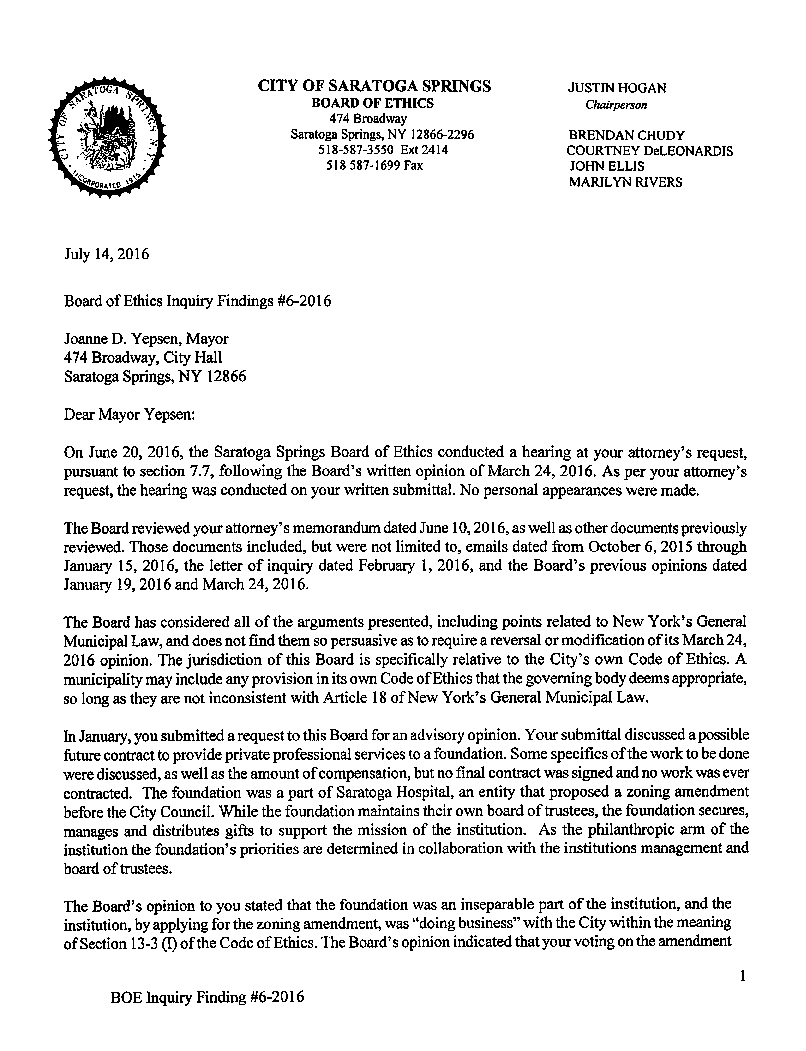
Ethics Board Finds Mayor Violated Code Of Ethics In Soliciting Business From Hospital; Scirocco Offers Censure Resolution

Ethics Board Finding

This is a link to the PDF: Board_of_Ethics_Inquiry_Finding__6-2016 Yepsen

Board_of_Ethics_Inquiry_Finding__6-2016 Yepsen-1

Board_of_Ethics_Inquiry_Finding__6-2016 Yepsen-2

The Ethics Board has released a letter to Mayor Joanne Yepsen formally notifying her of their advisory opinion regarding her dealings with Saratoga Hospital while they had business pending before the Council.  Apparently the Board drafted their original opinion on March 24th.  According to the document posted on the city’s website, Yepsen declined to meet with the Ethics Board but instead had her attorney send a response to the board. Her attorney’s memorandum was dated June 10th.   On June 20th the Ethics Board held a “hearing” (their term/euphemism since this session occurred in executive session and there is no public record of their deliberations).  Why the delay?  What was the Mayor’s defense?  None of this was made available as part of the decision/letter.

The decision cited section 13-3(I) of the city’s ethics code:

“Outside Employer of Business.  Officers shall not engage in, solicit, negotiate for or promise to accept work for an outside employer or business who does business with the city which creates an implied conflict with or impairs the proper discharge of his official duties or results in personal gain.”

The decision asserts that the statute does not allow for mitigating circumstances.

It then states that “as a matter of law”, Mayor Yepsen violated the city’s ethics code.

Resolution to Censure

Link To PDF of Resolution: Resolution_re_Ethics_Board_Findings_D3_071916

Resolution_re_Ethics_Board_Findings_D3_071916-1Resolution_re_Ethics_Board_Findings_D3_071916-2

Commissioner Scirocco has placed on his agenda for tomorrow night a resolution to censure Mayor Yepsen and to refer the matter to the New York State Attorney General’s Public Integrity Bureau and the New York State Joint Commission on Public Ethics.


New Stop Work Order Issued For Murphy Lane Barn: A Further Source of Embarrassment For ZBA

Zoning Board of Appeals In Action

Suicide


Some six months after the original stop work order for 39 Murphy Lane, the building inspector has issued a revised version.  This was prompted when the attorney for the building owner, Jean D’Agostino,  challenged the original order and asked that Steven Shaw, the building inspector explain it at a ZBA meeting.  Chairman Moore cut off the attorney and rather than make Mr. Shaw explain the order, directed that a revised order be crafted.  That after six months the ZBA finally crafted a stop work order of substance that they hope will stand up under court scrutiny graphically shows how ineptly this entire process has been handled.

There are a number of things that are interesting and instructive about the “new” revised version.

The most interesting one involves the building inspector’s role in approving the basement for this building.  In the original application approved by the ZBA, the barn was supposed to sit on a slab.  Subsequent to the approval of the original application, according to Mr. Shaw’s new stop work order, the applicant submitted a revised plan that was for a crawl space.  Mr. Shaw states that the change was “deemed minor.”  In spite of the fact that the slab was in the application approved by the ZBA, Mr. Shaw had the latitude to ok the change.  The logic was that  the new crawl space was presumed to have no effect regarding the variances granted.  Subsequently, the applicant decided to scrap the idea of a crawl space.  Instead the applicant jacked up the barn and poured a full basement.   Mr. Shaw then characterized the pouring of this full basement when they only had approval for a slab as “minor” because it “was not anticipated to affect the variances as approved.”  Mr. Shaw goes on to state, “As is our typical protocol [JK:My emphasis], you were allowed to proceed with the foundation pour on 12/22/15 under the condition that revised plans be submitted to show that the change was acceptable to your engineer.”  The letter from the engineer was not sent until three and a half months later.

The telling sentence was:

“The change was minor in nature as it was not anticipated to affect the variances as approved”

In fact, the approval of the full, raised basement would make compromising the variances inevitable.

As Shaw’s  new order documents, there were a cascade of changes that this “typical protocol” precipitated. 

Because the raised foundation was well above the original level of the building and therefore of the  ground, in order to meet New York State code, fill had to be brought in to adjust the landscape of the property:

“Fill had been brought in and a once level site is now much higher than the alley and adjoining properties “[my emphasis added].  This fill was the result of the foundation change and a requirement of the NYS Residential Code 401.3 to have adequate drainage away from the foundation walls.” 

Because the floor would be placed on top of the foundation, it significantly raised the height of the first floor from the height in the original plan approved by the ZBA.

Because the first floor was much higher now than the ground, the building now needed steps to be built in order to get into the building and thus caused “ further principle building coverage than the existing variance allows.”

So this “minor” change “as is our typical protocol” led inexorably to more zoning violations that would require more variances. 

It is not clear precisely when Mr. Shaw approved the full basement.  What the public should understand is that the barn, that was supposed to be rehabbed and not demolished, still existed after the basement was poured.  It had been jacked up and stood suspended over that basement.

Had Mr. Shaw insisted that the applicant seek approval from the ZBA to amend the plan there might still have been time to save the barn.

It should also be noted that the stop work order was not issued until after the applicant had demolished the barn and begun constructing a totally new house.  It was only after the neighbors descended on city hall to protest the demolition that a stop work order was issued.  It remains a matter of conjecture as to whether this project would have been fully constructed had the neighbors not acted.

It is easy to point all this out in hindsight.  The planning department is woefully understaffed.  This city has a major problem with code enforcement.  The root of the problem is that while the demands of the planning department have grown exponentially, the resources to run this critically important department have not.

There is also the human side of enforcement.  People like Mr. Shaw want to see our codes followed but they are also sensitive to the financial burden that excessively rigid applications of rules can have.

Under normal circumstances on a property appropriately zoned for a house, changing from a slab to a raised basement would have no adverse impact on the neighborhood in which the structure was located. 

Mr. Shaw and the members of his staff are under great pressure.  Many frustrated families and builders want their plans approved as soon as possible.  Delays cost money. 

The first moral of this story is not that Mr. Shaw made a mistake in allowing for changes that were at odds with the plans approved by the ZBA.  The moral is that Mr. Shaw is not given the time and resources to make it easier to more thoroughly consider the many, many changes thrown in front of him.

The second moral is the indifference of the ZBA to the repeated violations of zoning that they countenance.  Given that “do it and ask for forgiveness later” is routinely sustained without penalty, it is little wonder that situations like Murphy Lane occur.   The torturous history of 39 Murphy Lane is as much the ZBA’s fault as it is the applicant’s. 

To begin with, this project, which only passed by a four to three majority should never have been approved.  Attempting to convert a very small barn (more like a large shed) into a three bedroom home on a piece of property that was approximately one third the required minimum lot size was wrong.  The fact that it was being built on a narrow alley only reinforced how inappropriate the project was.

In its application to the ZBA the applicant not only described the project as a rehab of a barn, she explicitly stated that were they to tear down the barn it would have an adverse effect on the neighborhood.  Readers, this is what the owner asserted in her application that was approved by the ZBA.  The applicant is a realtor and not some naïve homeowner.  For the owner to then demolish the building without going back to the ZBA and then attempt to build a new home there is simply stunning.

In spite of all of this, given the extreme bias of the ZBA to developers, they then spent months trying to help this applicant complete this project. 

Readers, this meant that the neighbors ended up having to spend those same months researching and going to meetings.  Why should this have been necessary?  The ZBA should have told the applicant, you have grossly misrepresented this project (as the neighbors asserted to the ZBA many times during the public input period of the meetings) .  Instead of spending hours and hours at meetings exploring how the applicant might save this project, the ZBA  should have told her (as the ZBA attorney, Tony Izzo recommended) come back with your best plan that comes closest to the application we approved.  At that point, if the applicant’s best plan was inadequate, they should have told her that no additional variances will be granted effectively killing her project.

Here are links to the original stop work order and the new, revised order. 

Original Stop Work Order: StopWorkOrder1a

New Stop Work Order: StopOrder2

Below is a detailed review of the new stop order.

Per the instructions of the Zoning Board at their May meeting, Steven Shaw, the city building inspector  issued a revised stop work order. 

It is important to note that the original stop work order was dated January 21st, 2016.  This document simply states:

“The scope of work you are performing at 39 Murphy Lane is outside the scope of your permit.”

It advises Ms Jean D’Agostino, the owner, that she is to submit a revised set of plans to the engineer’s office and get approval from the Zoning Board of Appeals for them.

Ms. D’Agostino then emails back asking why the stop order and, in an email dated January 22, Shaw informs her that the changes have increased the height of the building and “increased the non-conformance.”  He also notes that the” additional steps in the setback will need to be addressed by the ZBA…”

A number of things are interesting about these documents.  First of all there is no reference in the first stop order to the application submitted by Ms D’Agostino that this was supposed to be a rehab and that the application explicitly ruled out removing the original building.  This is rather surprising because the building had indeed been removed from the site which contributed to the opposition by the neighbors.

It is also worth noting that the first stop work order makes no reference that the approved plan was for the barn to be on a slab and that the applicant had dug a full basement.

The new stop work order is dated July 8th.  This is almost six months after the original stop work order.

This one is far more comprehensive.  It now includes the fact that the construction had not conformed with the plans as pictured and as described in the application.

The new stop work order notes that the plans submitted in August which included a crawl space rather than the slab as stated in the original application presented to the ZBA was “deemed minor.”   It goes on to note that the applicant putting in a full basement without seeking approval for the revision was also considered minor as it “was not anticipated to affect the variances as approved.” [JK: Note the artful wording here in light of later events].  Mr. Shaw goes on to state, “As is our typical protocol, you were allowed to proceed with the foundation pour on 12/22/15 under the conditions that revised plans be submitted to show that the change was acceptable to your engineer.”  Shaw then observes that he did not get these plans until three and a half months after they had been requested and approximately four and a half months after the stop work order.

Shaw then states that between the time of the foundation pour inspection by Shaw and the issuance of the stop work order, “… the project had become significantly different from the approvals…”  “Fill had been brought in and a once level site is now much higher than the alley and adjoining properties.  This fill was the result of the foundation change and a requirement of the NYS Residential Code 401.3 to have adequate drainage away from the foundation walls.  An assessment should be done to ensure that this requirement is not being exceeded and thus creating a runoff problem in the alley and adjoining properties.  You may even qualify for that section’s exeption.”

Shaw states that the first floor is much higher than it was originally [when it was still a barn on a slab} and much higher than depicted in the applicants plans.  It requires the addition of a set of steps to be built which expand the footprint.  The new construction requires more coverage in the setback not considered by the ZBA requiring additional variances.

He finishes by stating that the ZBA’s decision on March 23,rd 2015 “clearly does not authorize either ‘tearing down the barn and starting new’ or a ‘removal of the existing barn’ [JK: as stated in their application] and then emphasizes the scope of the changes.


A New Look For The Blog

As you all can see, this blog has a new look. I was helped by Kate Austin-Avon of Advokate, LLC

She was great to work with and we have some plans to further strengthen the site.

I welcome any suggestions and feedback the readers of this blog might have.