The Saratoga Springs Charter Review Commission is expected to vote Tuesday on whether to draft a new charter with an alternative form of government for the city. If the Commission decides to propose a complete change in the city’s form of government it will be the third time such a proposal has been made in the past ten years. All recommendations made by the Commission including a proposal for a new form of government for Saratoga Springs would have to be approved by voters. The last two proposals to change to a strong mayor form and then a city manager form were voted down. The meeting begins at 7PM in City Hall. It will be webcast live at www.saratoga-springs.org/AgendaCenter
To Posterity By Bertolt Brecht
1.
Indeed I live in the dark ages!
A guileless word is an absurdity. A smooth forehead betokens
A hard heart. He who laughs
Has not yet heard
The terrible tidings.
Ah, what an age it is
When to speak of trees is almost a crime
For it is a kind of silence about injustice!
And he who walks calmly across the street,
Is he not out of reach of his friends
In trouble?
It is true: I earn my living
But, believe me, it is only an accident.
Nothing that I do entitles me to eat my fill.
By chance I was spared. (If my luck leaves me
I am lost.)
They tell me: eat and drink. Be glad you have it!
But how can I eat and drink
When my food is snatched from the hungry
And my glass of water belongs to the thirsty?
And yet I eat and drink.
I would gladly be wise.
The old books tell us what wisdom is:
Avoid the strife of the world
Live out your little time
Fearing no one
Using no violence
Returning good for evil —
Not fulfillment of desire but forgetfulness
Passes for wisdom.
I can do none of this:
Indeed I live in the dark ages!
2.
I came to the cities in a time of disorder
When hunger ruled.
I came among men in a time of uprising
And I revolted with them.
So the time passed away
Which on earth was given me.
I ate my food between massacres.
The shadow of murder lay upon my sleep.
And when I loved, I loved with indifference.
I looked upon nature with impatience.
So the time passed away
Which on earth was given me.
In my time streets led to the quicksand.
Speech betrayed me to the slaughterer.
There was little I could do. But without me
The rulers would have been more secure. This was my hope.
So the time passed away
Which on earth was given me.
3.
You, who shall emerge from the flood
In which we are sinking,
Think —
When you speak of our weaknesses,
Also of the dark time
That brought them forth.
For we went,changing our country more often than our shoes.
In the class war, despairing
When there was only injustice and no resistance.
For we knew only too well:
Even the hatred of squalor
Makes the brow grow stern.
Even anger against injustice
Makes the voice grow harsh. Alas, we
Who wished to lay the foundations of kindness
Could not ourselves be kind.
But you, when at last it comes to pass
That man can help his fellow man,
Do not judge us
Too harshly.
translated by H. R. Hays
Preservation Foundation Expresses Disappointment Over City’s Demolition Of 26 Caroline Street

Unfortunate Loss of 26 Caroline Street
The Saratoga Springs Preservation Foundation is disappointed that the City of Saratoga Springs did not disclose at the City Council meeting that the front façade of 26 Caroline Street could be preserved. Yesterday the Foundation received a copy of the City’s final structural engineer report from Ryan Biggs |Clark Davis Engineering & Surveying. The report noted the following:
Observations: “The front masonry façade does not appear to have been damaged or displaced by the fire; however, there are some pre-existing conditions of minor displacements and bulges in the masonry. However, further collapse of the building framing could compromise this wall.” Please note that the pre-existing conditions appear in a 1982 photograph.
Conclusions: “The front masonry façade appears to be stable with no signs of major structural distress; however, with potential additional collapse of the floor and roof framing, this could cause damage and/or movements of the façade with possible collapse of the wall. With regard to saving the front façade, in my opinion this is structurally feasible (emphasis added). However, design of a shoring and lateral stabilization system would need to be completed and implemented immediately.”
“The concern with attempting to retain the front façade is time the building would be left in an unstable condition during the design and construction of the stabilization, and the potential high cost to implement the stabilization. In addition, access to the building for demolition or major construction activities can only be made from the front (north side) and the safe demolition of the remaining portions for the building would be more difficult and costly if the façade is to remain.”
“Therefore, costs of the stabilization and shoring of the façade along with increased demolition costs appear to be disproportionally high to the benefit to save the front wall that has current problems.”
“It appears the complete demolition of the building may need to occur to form a safe condition if a stabilization system cannot be installed immediately.” Note: no cost for preserving the façade was provided by Ryan-Biggs.
“If the City decides to proceed with demolition of the building, it is recommended that each adjacent property owner have their buildings reviewed by their own engineer in advance of demolition to determine if there are any other concerns with the structural stability of their buildings if 26 Caroline Street is demolished.”
“Demolition will most likely need to proceed slowly to access the existing conditions where 26 Caroline Street abuts the adjacent properties to make sure no unstable conditions are formed in the adjacent properties.” In the interest of full-disclosure, please click here to view the final report provided by Ryan Biggs | Clark Davis Engineering & Surveying and click here to view the letter from the owner’s structural engineer addressing the preservation of the façade. The observations and conclusions made by Mike Miller of Ryan Biggs | Clark Davis Engineering & Surveying regarding the preservation of the façade and potential damage to the adjacent structures echo the structural engineer report that the Foundation hired Don Friedman of Old Structures Engineering to prepare. Click here to view the Old Structures Engineering report.
The Foundation is further disappointed that the City of Saratoga Springs chose not to seek a cost benefit analysis regarding the potential to preserve the façade prior to moving forward with approving full demolition and that the Design Review Commission was not given any opportunity to provide an advisory opinion or that several of its members were not informed of its imminent demolition. The Foundation did its best to fulfill our mission and advocate for the preservation of this structure or, at least, its façade with available resources. We are saddened by the loss of 26 Caroline Street and will be actively involved in the review of the redevelopment of the site. Again, thank you to our members for their continued support of our mission and to those who have expressed support and gratitude for our efforts!
For Those Wondering If Justin Hogan Corrected The Information On The City Web Site For Tonight’s Ethics Board Meeting…
No
City To Demolish Historic Building; Preservation Foundation Expresses Concern
From The Saratogian Newspaper:
Saratoga Springs plans to demolish Caroline Street building
By Joseph Phelan, jphelan@digitalfirstmedia.com,, @jphelan13 on Twitter
Posted: 12/07/16, 6:48 PM EST | Updated: 18 hrs ago
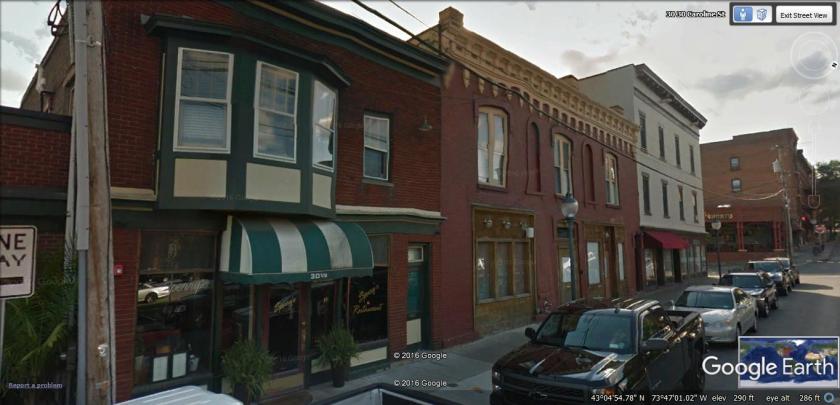
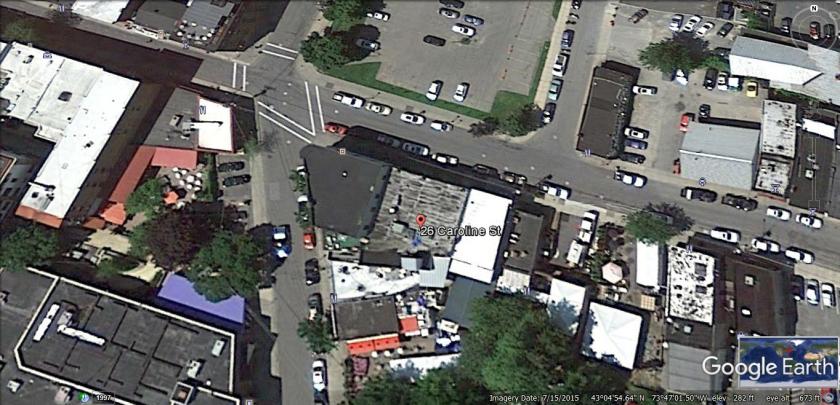
SARATOGA SPRINGS >> Despite efforts to preserve 26 Caroline St., the city, based on recommendations from two structural engineers, plans to demolish it Thursday morning.
At the City Council’s pre-agenda meeting Monday, two differing reports were presented, prompting the city to seek a third opinion.
Mike Miller, of Ryan Biggs, inspected the building — which was damaged in a Thanksgiving Day fire — Tuesday morning.
In an e-mail read aloud by city attorney Vincent DeLeonardis at Tuesday’s council meeting, Miller wrote: “The extent of damage has compromised the structural integrity of the building at 26 Caroline Street and forms an unsafe condition. This forms a risk to the public in front of the building, as well as to the adjacent properties. Further collapsing of the building could occur at any time with added loads from snow on the roof that can occur at this time of year. Based on the extent of damage that has occurred, in my opinion, the building should be demolished to reduce the chance of further collapse and a risk to the public.”
DeLeonardis joined Miller at the inspection and he described his experience.
“I walked through the building myself and it’s a devastating site,” DeLeonardis said. “From my own perspective, in a non-engineering way, the building was destroyed.”
City engineer Tim Wales described the possibility of the building collapsing before demolition.
“[Miller] felt it is possible for the roof to collapse [because of] those two big air conditioners sitting there on top, and he felt if we get wind load, snow load or get 6 inches of heavy snow that entire roof could come down … if that would occur, it could destabilize the structure enough to knock that front facade right down, out into the street as early as possible,” Wales said.
Mayor Joanne Yepsen described the situation as one where time is of the essence, which explains the urgency of demolishing the building Thursday.
Wales, however, detailed the construction of the four buildings impacted by last month’s fire and how 26 Caroline St. could cause obstacles for the adjacent buildings.
“These row type structures may not necessarily be keyed into each other, but they all function as one group and if you take out this middle piece it weakens both the sides,” said Wales. “… [Miller] recommended the engineer from [Sperry’s, and Hamlet and Ghost] also pay attention and evaluate the structure for whatever happens to protect their own individual structures. It all kind of ties together, you can’t just come in and rip things down, especially the wall bordering Sperry’s is something that can be very precarious.”
Both establishments complied with Miller’s recommendation.
Trinity, the project’s contractor, as of early Wednesday afternoon was waiting for final approval from the Department of Labor.
From The Saratoga Preservation Foundations Web Site
26 Caroline Street Demolition
By saratogapreservation | Published: December 7, 2016
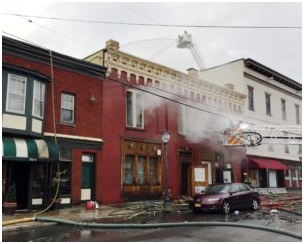
26 Caroline Street
The Foundation is pleased that the City of Saratoga Springs took action to declare 26 Caroline Street an emergency to hire an independent structural engineer to evaluate the building to assess its future, especially in light of the differences in the previous structural assessments. Like the City, the Foundation does not want to jeopardize the public’s safety. The decision to demolish any historic building in our city that is listed on the National Register of Historic Places should be given full consideration since the preservation of our architectural and cultural heritage contributes to the overall success of our community. That is why the Foundation hired Don Friedman of Old Structures Engineering to provide an assessment last week despite being denied access by the owner and why the Foundation is willing to contribute up to $2,000 towards the City hiring an independent assessment.
The Foundation was not only concerned with the future of 26 Caroline Street, but also concerned with the immediately adjacent historic structures should partial or complete demolition of 26 Caroline Street be necessary. We do not want to see any additional damage to those buildings as a result of the removal.
The Foundation is very disappointed to share that at last night’s City Council meeting it was announced that the preliminary report by Mike Miller of Ryan-Biggs indicates that the building posed a public safety risk and needs to be demolished immediately. The City also said that they plan to move forward with demolition under section 118 (9) (7) of the code.
The Foundation does not know why steps cannot be taken to preserve the façade since we have yet to receive a copy of the owner’s structural report dated November 30 that specifically addresses that topic or a copy of the Ryan-Biggs preliminary report.
Marilyn Rivers, City of Saratoga Springs Director of Risk and Safety, stated at the meeting that as a result of the City’s independent inspection all of the building owners were now in communication and that they each had been encouraged to hire their own structural engineers to protect their buildings as demolition takes place. While 26 Caroline Street will not be preserved, the inspection did result in increased communication among the owners and increased awareness about the potential impacts demolition may have on the historic adjacent structures.
We believe that the Foundation fulfilled our mission and did all we could to stay involved and advocate for the preservation of this structure or, at least, its façade. Our Executive Committee met almost daily to develop strategy and make decisions as to our course of action and was kept abreast of developments by the Executive Director. The full board was kept informed by regular communications from the Executive Director.
The Foundation looks to the future of this site and working with the property owner and the Design Review Commission to ensure that replacement infill is appropriate in scale and design. The Foundation thanks all those who expressed support of our efforts and to our membership. Without your continued interest and support we would not have been able to accomplish as much as we did, even if the result is not what we hoped.
Ethics Board Fails to Properly Post Meeting…You Can’t Make This Stuff Up
I received an email from Justin Hogan today. As you will see, in his email he advises me that the time of the meeting, as stated in the agenda for his board posted on the city’s web site, is wrong. He notes that the correct time is a half hour earlier and that it is posted on the city website’s calendar. The problem is that if one click’s on the calendar option on the website, all the other meetings of city board’s are listed but not the Ethics Board.
I think the documents below pretty much speak for themselves. I would make just one additional observation. Mr. Hogan refers to the proposed amendments to the city’s code of ethics as my (as in John Kaufmann’s) document. In fact the amendments were drafted by myself, Jerry Luhn, and Geoff Bornemann in consultation with Commissioner Mathiesen and they were submitted to the Ethics Board for comment by Commissioner Mathiesen. <Link To The Proposed Amendments>
From: Justin Hogan [justahogan@yahoo.com]
Sent: Wednesday, December 07, 2016 1:34 PM
To: John Kaufmann
Cc: jerry luhn; jerry luhn; Geoff Bornemann; John Ellis; Marilyn Rivers; Brendan
Chudy; Tony Izzo
Subject: Re: Ethics Code
Mr. Kaufmann,
Yes, the board will be reviewing and discussing your submission. General discussion regarding your submission will be open and like any other submission or inquiry if the board seeks legal guidance from counsel those discussions will be closed.
Also, as a point of clarification, tomorrow’s meeting is at 5pm in City Council Chambers (5pm is the stated time on the city web site). Typically our meetings begin at 5:30 and tomorrows agenda states 5:30. However, I was made aware today there is a scheduling conflict and will need to begin at 5pm.
Thanks,
Justin Hogan
[My original email] On Dec 4, 2016, at 9:01 AM, John Kaufmann <john.kaufmann21@gmail.com> wrote:
I see that you have posted an agenda for a meeting of the Ethics Committee for December 8. The agenda is rather vague. Do you plan to take up the proposed changes in the city’s ethics code as sent by Commissioner Mathiesen to Tony Izzo? If so, will the discussion of the proposed changes be held in executive session or open to the public?
My response to Mr. Hogan
From: John Kaufmann [john.kaufmann21@gmail.com]
Sent: Wednesday, December 07, 2016 9:03 PM
To: ‘Justin Hogan’
Cc: ‘jerry luhn’; ‘jerry luhn’; ‘Geoff Bornemann’; ‘John Ellis’; ‘Marilyn Rivers’;
‘Brendan Chudy’; ‘Tony Izzo’; ‘Joanne Yepsen’; ‘Michele Madigan’; Christian
Mathiesen; John Franck (johnfranck@your-cpas.com); ‘Skip Sciroco’; ‘Joseph
Levy’
Subject: RE: Ethics Code
Thank you for advising me of the correct time. Many people rely as I did though on the agenda posted by the boards to check on the time, date, and place as well as what issues the boards will address. I just went up on the city website and found that the incorrect time is still on your agenda.
Worse, if you go to the calendar page of the city website, you will see that while all the other boards show their date and time, there is no listing for your board at all. The only way to find the correct time would require that a person clicked on each date in the calendar to see what meetings are occurring. Since your board does not meet regularly there would be no reason for someone to assume that there was a meeting this month and go through the laborious process of clicking on each day to try to find it.
It’s a little late now but you need to contact whomever is responsible for the city’s calendar to fix this along with the agenda.
Given the history of the Ethics Board’s problems with open meeting compliance the failure to properly post the time of this meeting in an accessible way is quite problematic.
Image of city’s calendar page for December

City Ethics Board’s Unethical Record Continues Unblemished
Some time ago, Commissioner Mathiesen sent a proposal for comprehensive reform of the city’s ethics code to the Saratoga Springs Board of Ethics for their review and input. Several days ago I visited the city’s website and found that after a three month hiatus (they last met in September), the Ethics Board had posted the agenda for a meeting to take place on Thursday, December 8th. To their credit, after routinely violating the Open Meetings Law for months (possibly years) by failing to post notices of their meetings on the city’s website in a timely basis, they were finally in compliance. On the other hand, their agenda was as uninformative as ever. Here is the agenda:

So I sent the following email to Justin Hogan, the chair of the Board:
From: John Kaufmann []
Sent: Sunday, December 04, 2016 9:01 AM
To: ‘Justin Hogan’
Cc:
Subject: Ethics Code
I see that you have posted an agenda for a meeting of the Ethics Committee for December 8. The agenda is rather vague. Do you plan to take up the proposed changes in the city’s ethics code as sent by Commissioner Mathiesen to Tony Izzo? If so, will the discussion of the proposed changes be held in executive session or open to the public?
Consistent with the history of this Board I heard nothing.
I contacted Commissioner Mathiesen who told me that Tony Izzo had advised him that the proposed changes to the ethics code will be discussed at the Board’s meeting on December 8. Whether they will discuss these changes in public remains to be seen.
For those interested in who Justin Hogan is they can use the search function on my blog.
Interesting Concerts And Talks On Black Composer Linked To Saratoga Springs
The Bethesda Episcopal Church and Skidmore College are hosting a series of events celebrating the 150th anniversary of the birth of Harry T. Burleigh, one of America’s most important composers, mentor to and friend of Marian Anderson and Paul Robeson, and a specialist in African-American spirituals.
Mr. Burleigh worked for a period in Saratoga Springs where he got his musical start.
Stephen Salters, a leading interpreter of Burleigh’s music, will be performing both at Skidmore and Bethesda.
Here is a link to an excellent interview with Gordon Boyd about the celebration. Mr. Boyd, himself an accomplished singer and a member of the Episcopal Church, gives a fascinating history of Mr. Burleigh.
http://www.looktvonline.com/harry-burleigh-anniversary-interview/
The Burleigh observance schedule is as follows:
• Friday Dec. 2, 12:15 p.m. A talk by Myra Young Armstead (Bard College), “Blacks in Saratoga Springs: Then and Now.”
• Friday Dec. 2, 7:00 p.m. Pre-concert talk by historian Jean Snyder, author of “Harry T. Burleigh: from the Spiritual to the Harlem Renaissance” (2015), Ladd Concert Hall, Zankel Music Center.
• Friday Dec. 2, 8:00 p.m. Concert by Salters, Ladd Concert Hall.
• Saturday Dec. 3, 3 p.m., Service of Advent Lessons and Carols. Bethesda Church, 26 Washington Street, featuring Salters, the Bethesda choir and several works by Burleigh.
Interview With Robert Freeman Who Is the Executive Director of the NYS Committee on Open Government (and my hero)
A friend sent me a link to an interview that David Lombardo did with Robert Freeman, executive director of the New York State Committee on Open Government.
David Lombardo is the son of Barbara Lombardo who recently retired as editor of the Saratogian. Mr. Lombardo worked for the Daily Gazette newspaper some years ago and part of his beat was Saratoga Springs. He was an excellent reporter.
Robert “Bob” Feeman is my hero. He has worked in his current job for over forty years. I believe he retired briefly but returned to the job. Consistent with the mission of his office he is extraordinarily accessible. On a number of occasions he answered the phone himself when I called his agency. He was like having your own lawyer. On occasion, when I asked about the accessibility of a document under the Freedom Of Information Law he would offer advice as to how to make the request so that it fit within the law. In an age in which government institutions have become increasingly hostile to requests for information, it is quite amazing that Mr. Freeman has survived. I expect it is because, aside from being a person committed to the mission of his organization, he is a very good lawyer.
Miscellaneous: Gaffney’s Is Sold; Renderings of Moore Hall Condos
John Baker purchased Gaffney’s Restaurant on Caroline Street back in 1982. It was reported in the Albany Business Review that he has sold the restaurant to Ryan Venezia and his partner Gary Elfont for $3.4 million. Venezia is a real estate investor from Westchester. He already owns Mrs. London’s Bakery, Max London’s, and the Stadium Café.
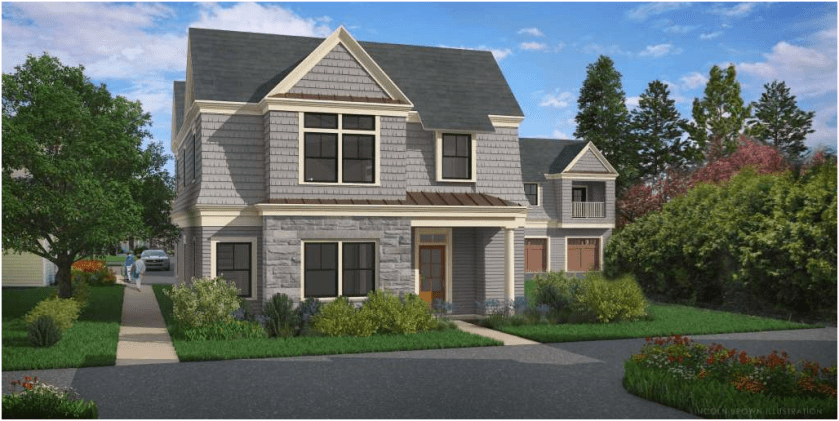
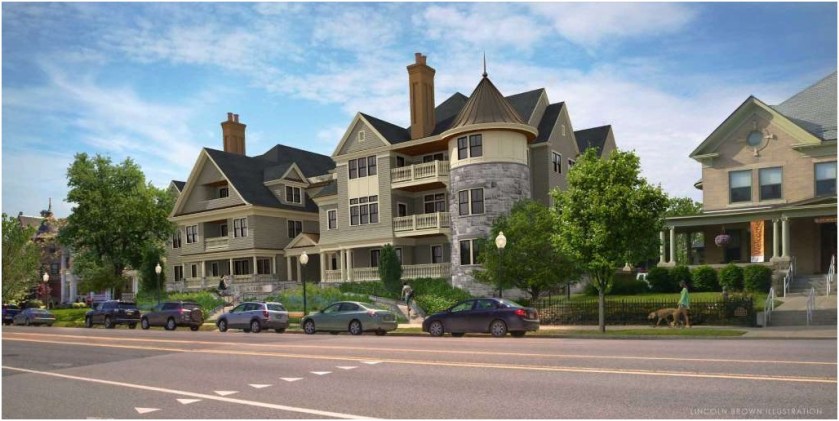
I received these renderings from Sonny Bonacio of the proposed condominiums for the Moore Hall site.