 Should NY have a Constitutional Convention? Should NY have a Constitutional Convention?
Monday, Jan. 23, 2017 6:15 pm. New York’s current constitution requires that the question “Shall there be a convention to revise the constitution and amend the same?” be put to the voters of this state every 20 years. 2017 is the year that that question will appear on the general election ballot. Should LWVNY take a position for or against? Why? On January 23 our League will meet to hear the pros and cons of a “Con Con.” Laura Ladd Bierman, Executive Director of LWVNYS and Jennifer Wilson, Program and Policy Director of LWVNYS, will be our speakers. Light refreshments will be served. MEETING PLACE: Community Room of the Adirondack Trust Office Building. 35 Church Street, Saratoga Springs. BUT you have to enter from the top floor of the City parking garage that is located on the corner of Woodlawn and Walton. (The entry to the upper deck is from Walton). In other words: Enter the building from the top level of the parking garage across from the Criterion Bowtie Movie Theater on Church Street. Map |
| Board Meetings are open to all MEMBERS: Held 1st Wednesday of the month at 7:00-9:00 pm; United Methodist Church, Henning Road,Saratoga Springs, NY
MEMBERS can receive our quarterly Bulletin electronically (it arrives in your inbox as a link in one of the Mail Chimp messages). Be sure to let us know if you change email addresses. You will also receive our Newsletter via US Mail unless you opt |
More From MM From The March
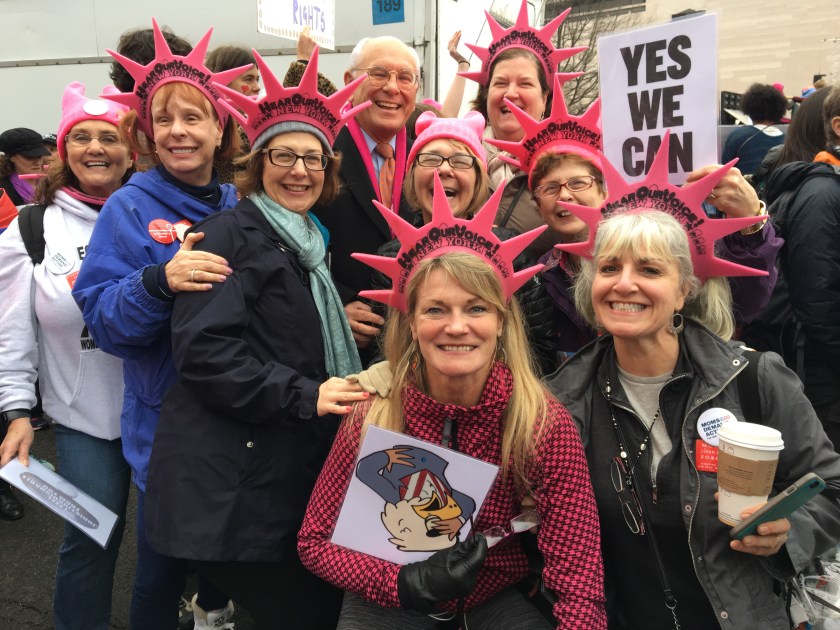
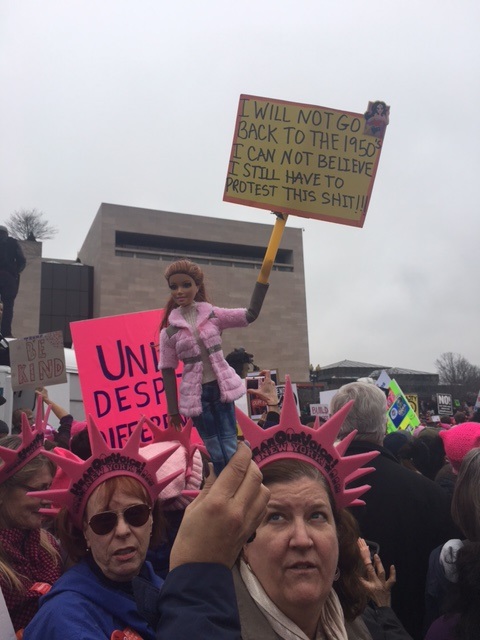


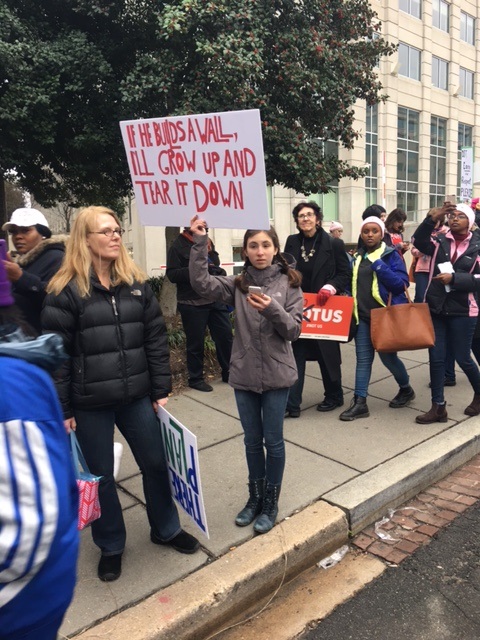



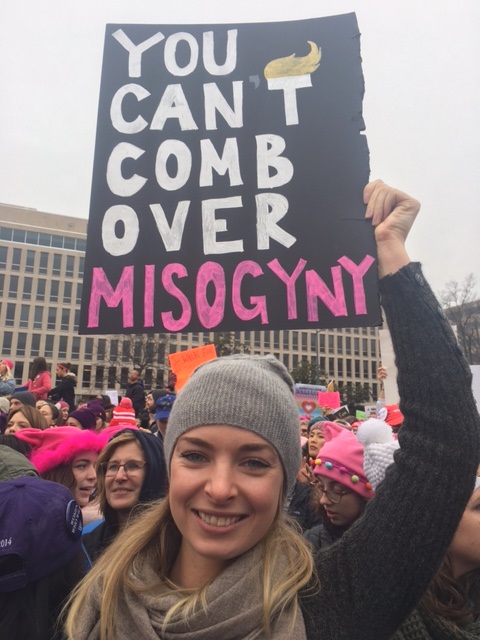
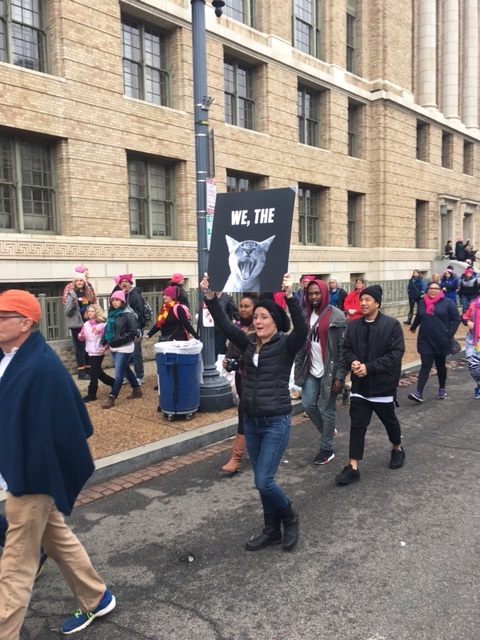
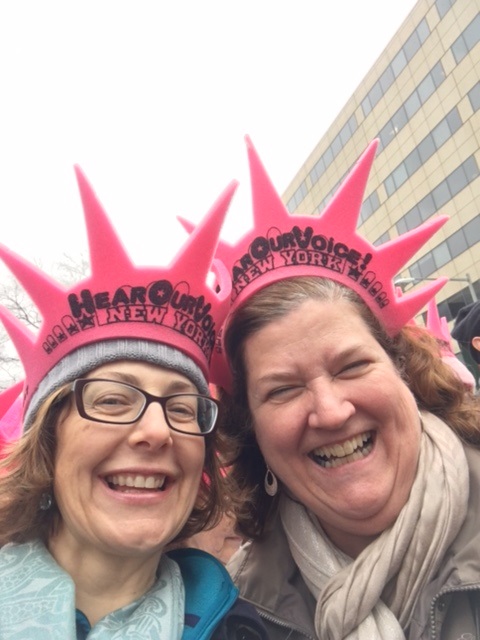

MM: Listening To Ashley Judd and Michael Moore


MM and Comrades At Washington Monument

MM Adventure Continues







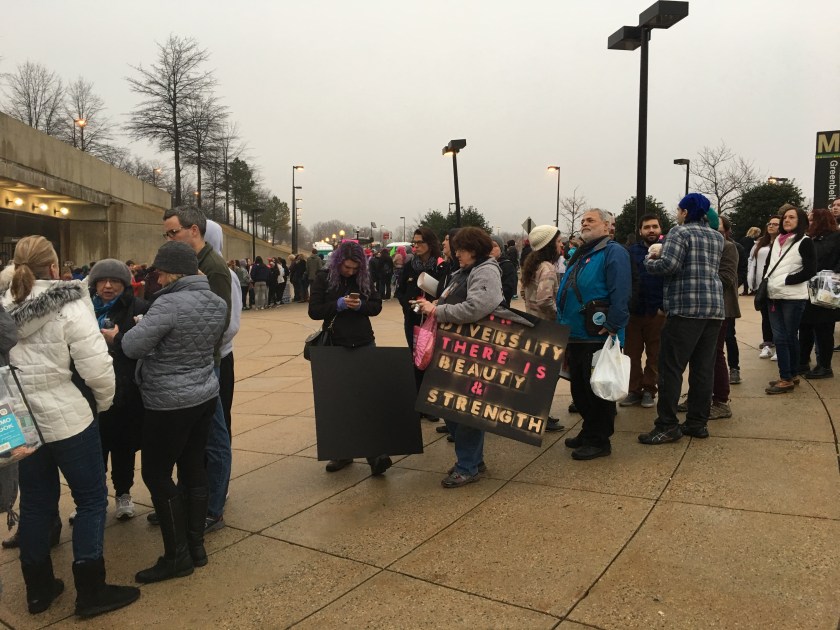

Michele Madigan’s Great Adventure: Women’s March


[JK: I asked Michele Madigan to post me pictures and stories regarding the Women’s March in D.C.]
They left at 11:45 this evening on a bus to D.C. She is traveling with her mother.
Crown Grill?
The Crown Grill owned by Christel and Colin MacLean on Broadway is under contract for sale. The perspective buyer has not been named. It was originally listed for $595,000.00.
The MacLean’s say they want to focus on their growing juice business.
Charter Commission Opts For Council Manager To Replace Commission Form
[JK: This is a release from the Charter Commission]
Spa City Charter Commission Unanimous 14-0 for
Council Manager Form of Government
After eight months of research and deliberations, the Saratoga Springs Charter Review Commission voted 14-0 in favor of the council manager form of government. The decision is a non-binding recommendation as the commission continues to develop a new charter that will go before voters in a May 30 referendum. If approved, a new charter would take effect in 2019.
The Charter Commission members discussed the importance of representing the wishes of the citizens, providing city services efficiently, and keeping taxes low.
One of the major themes was the increasing competition to attract and retain businesses and workers in the 21st century economy.
“I was on the City Center Parking Garage Task Force in 2001 and saw the plan fall apart due to jurisdictional and political turf conflicts between commissioners,” said Gordon Boyd. “It is 16 years later and we still have no garage. Now, we are competing with at least 30 other cities nationwide to retain Ayco. I am worried that the five silos of the commission form of government inhibit the ability to act quickly.”
Jeff Altamari, a former VP of Finance at a Fortune 500 company, emphasized that Saratoga faces increasing competition to attract and retain businesses and workers. “A new charter needs to be focused on the demands of future growth. While the existing commission form of government may have been adequate for the last 100 years, it cannot accommodate these demands given its parochial structure and short terms of service.”
Several commission members emphasized that interviews and research had highlighted how a city manager could improve city services.
“When we interviewed city managers from Corning and Batavia, I was impressed with their long-term vision for infrastructure improvements, technology and economic growth,” said Beth Wurtmann. “A strategic ten-year plan under a skilled city manager is what Saratoga Springs needs to stay abreast with 21st century demands.”
Mike Los, who has served in senior management for several major medical device companies, said, “In interviews with city managers from around the state, I was impressed by how they use their professional organization, the International City/Council Manager Association, to identity best practices to save taxpayers money. The city manager of Geneva saved millions on city employee health care costs by creating a regional health care consortium.”
Several commission members also felt that a council manager form of government could minimize partisan bickering and infighting.
“I think the council manager structure offers the dual benefits of professional management, which our dynamic City demands for its future growth, guided by the personal involvement, experience and commitment of citizens on the Council, the bedrock of our City’s historical strength,” said Ann Bullock.
“A council manager structure would reduce political pressures and in-fighting by having the City Council represent the will of the people and the city manager administer the daily operations of the city,” said BK Keramati.
Several members highlighted how they felt the council manager structure would reduce taxes for city residents.
“I think the city would save money by hiring one professional city manager instead of five deputy commissioners,” said Rob Kuczynski.
“In Canandaigua, the city council and mayor told the city manager to keep costs down,” said Bob Turner, Commission chair. “The city manager is forced to squeeze out the waste and inefficiency or lose his job.”
What is the Council Manager Form of Government?
Under the council manager form of government, the city council approves the budget, determines the tax rate and focuses on the community’s goals, major projects, and such long-term considerations as community growth, land use development, capital improvement plans, capital financing, and strategic planning. The council hires a highly trained non-partisan, professional city manager to carry out these policies with an emphasis on effective, efficient, and equitable service delivery. Managers serve at the pleasure of the governing body and can be fired by a majority of the council.
The council manager form is the most popular structure of local government in the United States. Among cities with 25,000-49,999 population, 63% of cities have a council manager structure, 31% have mayor council, and 1% has the commission form of government. Currently, Saratoga Springs and Mechanicville are the only cities in New York that have the commission form of government.
Next steps
The Charter Review Commission will continue developing an alternative charter at its next meeting on Tuesday, January 24, 7pm, City Hall, with a public comment period at the beginning of the meeting. Members will discuss the role of the mayor under the council manager form of government, as well as finance provisions, the city attorney role and the recreation commission.
Ethics Board: Not Tone Deaf; Just Plain Deaf
[JK:Both courtesy and protocol required that that those of us working to improve the city’s ethics code ask for input from the city’s Ethics Board before seeking action by the City Council.
Cynical as I can be about our public institutions, even I was not prepared for the unabashed indifference the Ethics Board showed the public who had come out on a cold night to hear their deliberations on the proposed changes. Emblematic of this was the Ethics Board’s decision to dispense with microphones and audio equipment which would have allowed them to be heard by the citizens in the audience. (The acoustics in the council chambers are notoriously poor). There were no name plaques to identify the members of the board nor any introductions. For all intents and purposes the chair never really acknowledged the presence of the public.
There was no public comment period. Most strikingly the committee never engaged the authors who were present about the proposed amendments.
Still, it was necessary to have gone through this step before approaching the City Council which has the actual authority to act on the proposed changes.]
Below is Joseph Levy’s wonderfully acerbic report on the meeting.
Meeting of the Bored [JK: Didn’t want anyone to miss this]
By Joseph Levy
I took John’s advice and skipped a rerun of “The Simpsons” to attend the January meeting of the city’s Ethics Board, which convened at 5:30PM, January 12th, in the City Council chambers. The major topic was a continuation of its discussion of the proposed reforms drafted by Your Faithful Blogger, John Kaufmann, attorney Jerry Luhn who is retired from New York State service, former City Planner Geoff Bornemann, and its sponsor, Public Safety Commissioner Chris Mathiesen. In a way, it felt as if the December meeting had briefly adjourned and was just reconvening following a break for beer and sandwiches. This was underscored by Board members arriving seemingly aware of the agenda and, with a few exceptions, unarmed with fresh insights.
Members in attendance were:
Justin Hogan, Chairman – Mr. Hogan is in charge of “Government Relations” with the law firm and lobbying organization Featherstonehaugh, Wiley, and Clyne. Mr. Featherstonehaugh is one of the principals of Saratoga Casino Hotel, formerly the Racino and before that, Saratoga Harness.
Brendan Chudy – Director of the Legal Department at Global Foundries in Malta.
Marilyn Rivers – Director of Risk and Safety in the Saratoga Springs Accounts Department.
John Ellis – who currently works for the Civil Service Employees Association (CSEA), has served on the Saratoga Springs Board of Education and previously worked for the Ballston Spa School System for 21 years.
Also present was Tony Izzo, the Assistant City Attorney.
As before, there were no identifying plaques, no microphones, and no opportunity for audience members to participate in this public meeting. In fact the only acknowledgment of the eight people in the gallery was a comment by one of the members that, apparently, for the first time in its history the board was outnumbered by the public.
While Mr. Hogan opened by saying that the principal business was to discuss the draft reform proposal, he never mentioned the authors or sponsor by name.
Mr. Izzo reported conducting a random online search and looking at codes from across the country, mentioning San Antonio and Miami by name. Those cities, among others, all had ethics codes that applied to every board and department and not restricted to a particular municipal group, such as the land use boards, the specific area of interest here. When queried, he said that he could find no separate ethics code from any comparable city in New York State, but would continue to research this point. In the end, he said that the concept of a code which was limited in its application to certain named boards (land use, in this case), but not as a blanket code for all municipal entities, appeared to be without precedent.
Mr. Izzo also mentioned that while the draft proposal was principally written to cover the city’s three major land boards – the Zoning Board of Appeals, the Planning Board, and the Design Review Board — other panels, such as the Special Assessment Board, occasionally took on issues that also dealt with that general area.
Mr. Hogan asked somewhat rhetorically, “Is there an issue to be fixed?” and wondered aloud what exactly prompted the need for such a proposal in the first place. Though several audience members were likely prepared to answer, without a format that invited their participation, the question was left hanging awkwardly in midair. It bears noting that the same question was raised in a similar manner at the Board’s first meeting on this subject, so for all appearances, it looked like little headway was made in answering the Chair’s own question.
The heart of the discussion which followed involved revisiting the four main concepts within the proposal, as Mr. Izzo saw them, modified by recent revisions submitted by the original authors. He then produced copies of the existing code and, at Mr. Chudy’s request, a line-by-line search ensued to seek out elements of the proposal which were already incorporated into the existing municipal code. To some extent, it was an exercise in “compare and contrast.” A few examples:
- Ms. Rivers pointed out that the existing clause regarding gifts between parties to an application and members of the board reviewing same, was actually stricter in its current wording and expressed support for retaining it in its current form. It seemed like there was at least some interest in maintaining a strong code.
- Mr. Izzo introduced a refined definition of the phrase ex parte, which in this context references inappropriate communication between an applicant and a board member outside of the formal meeting setting. He suggested that for a communication to cross the line, it must “substantively relate to the merits of an application” before a board and that currently there is no provision to address this issue. There was also some discussion about how one might prove that such communication actually took place. Parroting Mr. Hogan’s earlier question, Mr. Chudy wondered aloud what issue was out there that needed fixing and said, in effect, that just because there have been a few complaints, it didn’t mean there was a real problem. However, Mr. Hogan responded by saying that there may be some basis for certain allegations along these lines.
Mr. Izzo then asked what, in parliamentary terms, does the relevant board do with a public disclosure that is followed by the recusal of a member, saying that the present code has sparse language or guidance on this point.
- The concept of defining how far from a proposed project a board member had to have a property interest before a conflict arose (for example, 100 feet), was analogized in the proposal to that of defining the speed limit on a road — it could be 30 mph or 31 mph, but at some point the line had to be drawn. Mr. Hogan said that he was mystified by the analogy and seemed to mock the entire concept of defining a specific distance before recusal on the part of a board member was necessary.
- Returning to the current ethics code, Mr. Chudy felt that the existing “private interest” clause regarding ethical conflicts already covered much of the ground which the draft tried to define in greater detail, such as the last point, above.
As the meeting continued, diving deeper and deeper into the minutiae of the draft, I couldn’t help but feel that the members, especially Mr. Hogan and Mr. Chudy, regarded the reform proposal as if it were a party crasher, albeit one whom everyone knew and who nobody really had the nerve to escort to the door.
The discussion continued along these lines until about 6:45, at which point people started arriving for the Planning Board’s meeting, which was scheduled to begin at 7PM in the same chambers. With a few apparently unrelated items yet to be covered, the Ethics Board retired to Mr. Izzo’s office at 6:55 to convene in executive session without indicating how they might proceed with the draft and we called it a night, looking forward to some comic relief on “the tele.”
Charter Commission Dips Its Toes Into The Specifics Of Their New Form Of Government
[JK: I received this press release from the Charter Commission. Unfortunately, the video of the meeting had not been posted as of this morning (Monday, January 16). Your loyal blogger usually endures viewing these meetings. Often it is worth while because, as is understandably the case, other matters often come up that provide more insight to the process. I would observe that there were apparently no actual votes on these things. I will be posting some comments on this shortly]
Charter Review Commission Proposes New Direction for Saratoga City Council
Seven members, four-year staggered terms, term limits, neighborhood districts and at-large districts Saratoga Springs:
After seven months of interviews, hearings, interviews, and fact-finding, the Charter Review Commission got down to the business of drafting a new city charter, at its meeting on January 12.
Last month, the Commission voted 12-3 to draft a new charter that separates the legislative responsibilities from the administrative ones.
“In drafting a new charter, we wanted to start with the City Council, because a strong Council is at the heart of a responsive and efficient government.” said Bob Turner, Commission chair. The Commission discussed the number of members, the length of terms, term limits, and the merits of neighborhood districts versus at- large districts.
The first issue discussed was whether to keep the current number of city council members at five. Turner, who teaches political science at Skidmore, pointed out that James Madison, in Federalist #10, said that there is no magic number, however, it must be large enough “in order to guard against the cabals of a few; (but) must be limited to a certain number, in order to guard against the confusion of a multitude.”
The Commission reviewed national and New York data on the tremendous variation in the size of city councils. The consensus of the Commission was that seven members seemed appropriate for the size of this city.
The second issue discussed was whether to keep the current term length at two years. Former city council members and City Hall employees, in interviews, have stated that campaign politics in the second year of a term detracts from a focus on governance.
Council members felt that having a four year term would reduce the frequency of fundraising and campaigning. Approximately 70% of city governments in America have four year terms. The Charter Review Commission supported staggered elections for the city council.
The most lengthy discussion concerned the merits of neighborhood districts versus at-large elections. Under the current system, Commissioners are elected in city-wide elections. Under a neighborhood district system, council members are elected from a neighborhood or smaller geographic area. Candidates would have to live in the district they represent.
Neighborhood districts would make a positive contribution to the electoral and governance process of the City. Neighborhood districts make it easier for new candidates to run for office since they would only have to reach out to approximately 4,500 voters instead of 18,000. The smaller size would keep campaign costs down and enable an enterprising candidate to potentially knock on every door in their district.
The Commission’s studies have revealed that the vast majority of City Council candidates from the past 15 years have come from a small cluster on the central east side of the city. Neighborhood districts would ensure more geographic representation in City Council affairs. Commission members Gordon Boyd and Matt Jones thought the mix of at-large and district representation would reduce NIMBYism in city politics.
The tentative consensus of the Commission was that the Council members should be a combination of four neighborhood district representatives and three at-large district representatives.
The Commission also supported giving the City Council confirmation power over all Mayoral appointments to city boards and judicial appointments pending state law. The Commission felt that this was an important step in restoring checks and balances to a new system.
The Charter Review Commission’s next meeting is Thursday. January 19th when they will discuss the merits of city manager versus a strong mayor. The current commission form of government was adopted by Saratoga Springs in 1915. There are only two other cities in New York with the Commission form of government, Mechanicville and Sherrill.
The Charter Review Commission is a 15-member citizen board appointed by the Mayor and City Council. A new charter would be placed before the voters in a special election on May 30th.
 Saratoga Springs Politics