Correction On Song Post!

Yup, your well meaning blogger managed multiple mistakes in one post.  I think this is a new record.

Rockabilly Song was by Tom Denny and Russ Pittinger.  The other song was written and performed by Tom Denny.  My deepest apologies to Mr. Denny who is also the manager of the tree program.  Go Tom Denny!

Also, Rick Fenton was a forester and not an arborist.

From the website “Under the Oak Tree”

Forester vs Arborist – What’s the Difference?

 Simply put, a Forester will care for the forest as a whole while an Arborist will care for an individual tree.

Foresters will receive their formal education and training in college. The education and training of an Arborist is less formal than a college degree. The International Society of Arboriculture  offers different certification opportunities that are recognized as the gold standard of arborist education and training.

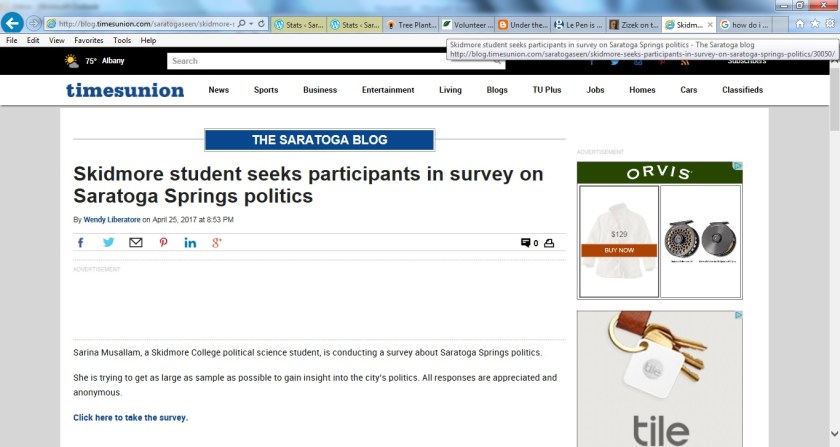
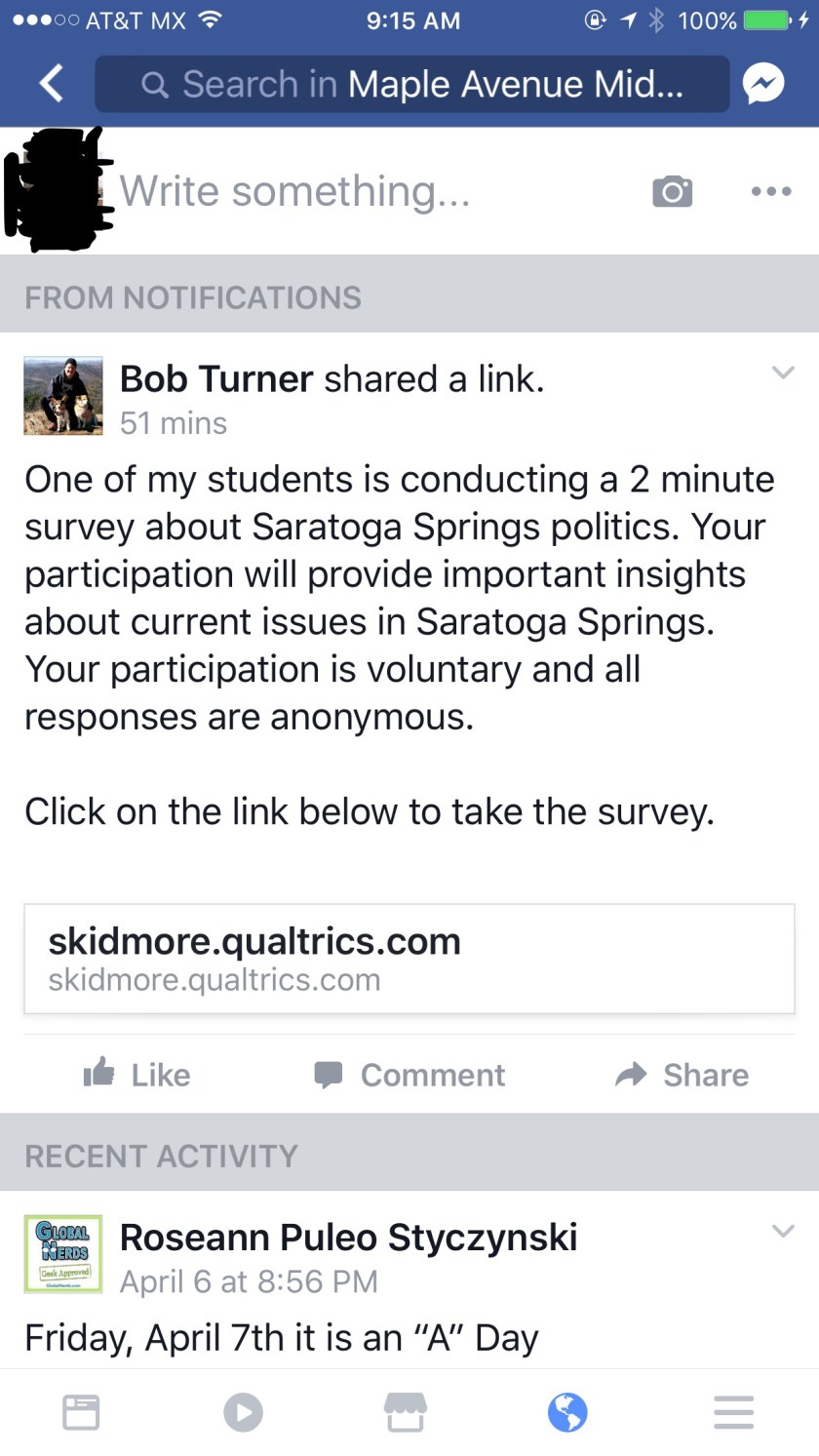
Help Out With Skidmore Survey On Local Politics

[JK:I received the following email from Bob Turner]

Hi, 

One of our Political Science students is doing a short survey about Saratoga Springs politics.  I am trying to help her get as large and representative sample as possible.  It is for a statistics class assignment.  Would you be willing to post this message and link on your blog?   Happy to have her share the results.

 Thanks

Bob

 Survey on Saratoga Springs Political Issues

 Please take just a few minutes to complete a short survey about Saratoga Springs politics. Your participation will provide important insights about current issues in Saratoga Springs. Your participation is voluntary and all responses are anonymous. Click on the link below to take the survey. Thank you in advance for your time.

 Sarina Musallam

 lick on the link below to take the survey.

https://skidmore.qualtrics.com/jfe/form/SV_0HsJAwOzEgxbArP


Bob Turner

Associate Professor of Political Science and Environmental Studies and Sciences

Director, Environmental Studies and Sciences Program

Director, Faculty Student Summer Research Program

Skidmore College

Saratoga Springs, NY 12866


How To Plant An Urban Tree Video With Music From Sustainable Saratoga

This is a fun video on how to plant an urban tree.  Words by Rick Fenton and music and performance by Russ Pittinger.  Mr. Fenton was an arborist in a previous life.

Time To Help Sustainable Saratoga Plant Trees: Great Interview With Tom Denny On History Of Their Program

April 29th, 9:30-noon

Sign up now to help with this event. We will need:

  • Tree Hosts (get a free tree)
  • Tree Planters (April 29)
  • Tree Waterers & Whisperers (Summer 2017)
  • Day of Event Team (April 29)
  • UFP Tree Team (ongoing, year-round)

Sign up below!

NOTE: If you are on a mobile device, you must rotate your screen to landscape in order to fill out the sign-up form. If unable to use the form, please email us


This is an excellent interview with Tom Denny that I highly recommend that gives a great background on the history and strategy of the tree planting program:

http://wamc.org/post/tree-planting-day-planned-saratoga-springs


A March For Science: I thought the need for this ended with the Inquisition

The Skidmore Student Environmental Action Committee organized a march from Congress Park to the City Center in defense of science as part of Earth Day on Saturday April 22.  What a bizarre sign of our times.

It was quite a turnout of a diverse crowd that I estimated at three to four hundred.

20170422_115953
Group begins to assemble in park
20170422_115806
March begins
20170422_110619
One of these is Dennis the Menace and the other is Ed Lindner

20170422_113040

20170422_110956
On the move

20170422_11000020170422_105904Signone20170422_115646

20170422_112813
Group Gathers At City Center For Speakers

wheelchair2


On New Code Blue Housing and an Aberration at the ZBA

In a remarkable act of generosity a number of major players in the development business here in our city have come together to help provide emergency shelter for the homeless.

Ed and Lisa Mitzen who are the owners of Fingerpaint Marketing (http://fingerpaintmarketing.com/) have committed to the financing of a building for Shelters of Saratoga.   The shelter facility will provide emergency housing for Code Blue Alerts. 

Sonny Bonacio has agreed to build the facility at cost.

The LA Group is handling the application process as the project will require very significant variances in light of its size and purpose given the zoning for the area.  They are pretty much donating their services for the project.  In an email I received from Mike Ingersoll who appeared at the ZBA meeting on Shelters behalf, he wrote, “Happy to assist for what we feel is a much needed and worthy cause.”

The project is anticipated to be a two story building of approximately 6,400 square feet to provide temporary shelter for 61 persons.

The Code Blue facility is to be constructed on land owned by Shelters of Saratoga and will be an approximately  6,400 square foot structure created to allow up to 61 individuals to have a place to sleep with associated uses for bathroom, shower facilities, dining facilities, laundry facilities, offices for volunteers and staff working solely on the Code Blue Program and interactive space for the volunteers, staff, and participants in the Code Blue Program to be utilized during the Code Blue operational periods.

Locating a project to serve the homeless in a city like Saratoga Springs has the potential for considerable conflict.  In this case the Masie Center working with the principals of the project were able to come to an agreement prior to the application for variances to the ZBA.  The gist of it is that the facility will only be used for cold weather emergencies known as Code Blue Alerts.

A Code Blue alert is triggered when the wind chill temperature drops below 32 degrees.  In order to address logistical issues the alert can be started twenty-four hours prior to the anticipated threshold and end twenty-four hours afterward.

There are a variety of items they agreed upon to minimize the impact of the facility on the neighborhood which I list below.  The most significant factor is that it will only be operational during brief periods during the winter.

Zoning Board Member Finally Finds A Variance He Can Oppose

Gary Hasbrouck who is a member of the ZBA is a realtor and operates a trailer park in Wilton.  Mr. Hasbrouck may have opposed a variance in the past but not at any of the meetings that I have ever attended.  He is a man who has shown a remarkable indifference to the value of zoning restrictions.  If a property owner wants something, even if the neighborhood is united in its opposition, Mr. Hasbrouck has never shown any fear in overriding the zoning.  One thing I feel reasonably sure of, up until this vote to grant variances for this homeless project, he has never been the sole dissenter on granting a variance.  There is no doubt that the project involved some very substantial relief.  Its scale and its placement on the lots are major.  Still, even William Moore and Adam McNeill, who have pretty much voted with him as a block supported the project. 

I find it particularly interesting that he was unmoved by the fact that Sonny Bonacio will be the builder. 

One of the factors in deciding on variances is the value to the community of a project.  In this case, he told his fellow board members that he could not live with lowering the standard for even something as well meaning as this shelter. 

Some Particulars On The Restrictions Agreed To For The Project

Code Blue staff are required to monitor and be responsible for an area within a perimeter within 250 feet of the Code Blue Center.

A six foot “solid” fence shall be erected along the eastern and northern perimeters of the property with a gate that will be remain closed “other than (1) as required by state and local fire and safety codes, or (2) to allow the access to the parking areas on Shelters’ land; or (3) to allow access to trash receptacles outside of the herein described fence.  It is understood that the vehicle gate through the fence on the east side of Tax Parcel … may be opened for maintenance, emergency services/or mobile outreach vehicles but shall remain securely closed when not in immediate use.  It is the Parties’ intention that the primary public access for vehicles onto the drive way/parking lot area of the real property of Shelters shall be from Walworth Street.”

Shelters will see that a light pole is added to Marvin Alley and that another two headed light is erected on the Southeast corner of the project.


Charter Commission: A Full Time Mayor? A Tangled Web

The issue of whether or not there should be a full time mayor in the new government proposed by the Charter Review Commission has become more complicated. 

 At the March public forum held by the Charter Review Commission the presentation by Bob Turner indicated that the commission envisioned a full time mayor.  When a member of the audience asked him about the salary for this position, Mr. Turner offered that he thought it should be in the $60,000.00 to $70,000.00 range. While Mr. Turner went on to describe activities they envisioned a mayor would engage in such as “consensus building” and “going out into the community and listening” none of this is referenced in the charter draft and indeed it is difficult to imagine how these ideas could be translated into language for the charter. The actual duties they have come up with are  listed in section 2.04 of their draft . They basically include presiding over meetings of the city council, appointing boards and committees, giving an annual state of the city address, and representing the city.

 The new thinking as reflected by the April 6 Charter Revision Commission meeting minutes is that the charter will not address the issue of whether the mayor should be full or part time.  In an email to me, Mr. Turner pointed out that the charter for any of the elected position does not address how many hours the positions require. 

In his note to me he offered:

 “The amount of time a mayor will spend on the job is a function of who the individual is.  It was pointed out to us that there has been a significant difference in the time the last 5 mayors have spent on their duties.  There is no language in any local, state or national charter or constitution about the amount of time a legislator or executive can or should spend doing their duties…”

So the city council we will elect this November would set the salaries and benefits for the future elected officials including how much a future mayor should be paid including if he/she  should have a staff should the charter pass.  There is no requirement in the charter that the mayor ‘s salary match council salaries so in effect, they would decide if there should be a salary for the mayor that is consistent with a full time position.  Nothing would require a mayor under this system, though, to actually work full time.  It is true that in the past most (not all) mayors have in fact put in what most people would consider to be a full week on the job.  It is important to remember, however, that with a city manager, many of the duties that these past mayors have had to handle would now be done by a city manager.

So a hot issue in the next election would be how much the candidates would be willing to pay the future mayor in the event they win and the charter passes. Of course nothing would hold them to this.

 There was quite a bit of push back at the public forum on having a full time mayor.  This new approach may reflect this.  At the risk of appearing snarky, I have a feeling that a majority of the charter commission would like to see a full time mayor but were afraid that if it was incorporated in the language of the charter, it might result in the referendum failing.

Salaries And Staggered Terms

I cannot remember the last time the mayor and city council’s salaries were raised.  Given the current atmosphere, I would doubt an action on this is in our immediate future under the current charter.

The staggered terms for council members the charter commission  is proposing could complicate the process in the future, though,  should their charter proposal pass.  State law requires that a seated council cannot raise their own salaries. They can only  raise the salaries for the next elected council.  So it’s hard to figure out how this would work with staggered terms since at any given time only a portion of the council would be eligible to vote for a raise.  There may be a simpler answer for all of this but it would appear on its face that a council would have to propose raising the salaries not following the next election but following the election after that so that none of the seated council members voted for their own salaries, a delay of perhaps four years. Or would this happen in a year when four were up for election and the other three abstained? Or would some get the raise and others have to wait for the next election cycle?


How You Can Help The Pitney Farm Proposed Project

[JK:I received this release from the Pitney Meadows Community Farm]

PLEASE VOTE TO HELP A COMMUNITY FARM IN SARATOGA!

Pitney Meadows Community Farm, a 166-acre historic farm, is being brought alive again and turned into a community farm for the whole community to enjoy, learn about agriculture, and be a part of. They would appreciate your support and votes, and ask for 30 seconds per day for a short time.

The Pitney team recently applied for the Seeds of Change Grantentering the Children’s Greenhouse & Gardens Project for PMCF into the community division in hopes to win $25,000.

To move onto the next round, they have to be voted as one of the TOP 50 farms in the community division in the country. Voting has just opened and remains opened until Wednesday, April 19th, 2017. Each individual is allowed one vote per day, and family can use different devices to vote on the same day.

 The direct link is:   https://www.seedsofchangegrant.com/GalleryDetail.aspx?id=3966


If you want more information on Seeds of Change and the program you can use this link (as well as vote):

https://www.seedsofchangegrant.com/TheGallery.aspx  (search “Pitney” to find us.) Please forward this note to all your friends and family to help us out, and like our Facebook Page and share it!  It only takes 30 seconds each day to vote for us… Thanks!   The rendering of this exciting project is below that we hope to build in May!

Sandy Arnold, President, PMCF


The Charter Draft: An Assessment

On March 29 the Charter Review Commission held a forum to present a draft of their proposed new charter and ask the public for comment. The document is still a work in progress although we are now two months beyond their original target date of February 15. I have a number of concerns about both what is in and what is not in the document.

Let me start with 2 particular problems I have with what they are proposing in the document they presented.

Extending the Length of Office for City Council members.

Their proposal calls for a seven member council which would include a full-time mayor. All seven plus our two county supervisors would serve for four years rather than the current two year terms.

Charter commission representatives have made a couple of arguments in support of this change.

First they feel four year terms would provide greater stability and continuity by avoiding the possibility of a turnover in government every two years. This would also allow officeholders a longer time to complete projects they may have started.

This seems to me a solution in search of a problem. I have lived in Saratoga Springs since the 1970’s and in my experience  and from what I understand of the history of the city before my arrival the situation we have now with the current council where all members have served multiple terms is the norm. My friend Tom McTygue served for decades as Public Works Commissioner.  Our previous mayor, Scott Johnson served for 3 consecutive terms before deciding not to run again, and so on.

In addition major projects would be the responsibility of the city manager, not the council so I don’t understand this argument of the need for more time.

I would also note that the entire NY State Legislature and the US House of Representatives all serve two year terms. At the risk of snarkiness I do not hold these institutions up as models of good government but I have not heard any cogent argument that their problems are caused by two year terms.

The charter committee’s second argument for longer terms has to do with what Chairman Bob Turner calls the “silly season”. He was referring to that annual fall event commonly known as elections. As near as I can tell, the charter committee wants to protect elected officials from enduring going before the voters every two years. I believe that implicit in the concept of referring to elections as the “silly season” is the belief that policy decisions are simply a question of good management and that by insulating elected officials from the “mob” they will be better able to exercise their “good judgment.”

The committee seems excessively fixated on seeing good government as merely a management issue. While proper management is of course an important feature of government, seeing this as the only or at least the overriding goal ignores the fact that factions exist in every community and in a democracy government plays an essential role in how these factions resolve their conflicts.

We saw this play out in our community quite clearly in the last local election cycle. Those who wanted to see increased development in the greenbelt put together a PAC to back candidates who they felt would change zoning restrictions in the outer district to accommodate such projects as the resort planned by Saratoga National Golf Course. Other candidates such as Chris Mathiesen ran on a clear platform opposing such development. There was nothing “silly” about this election. Two very different visions of how the city should grow were offered, debated, and left up to the voters to decide.

This is not to dismiss the reality that campaigns can involve pettiness and ego. It is, however, a reminder that in Saratoga Springs as in other communities there are substantive issues that citizens must decide, and they make these decisions by voting for the person who best reflects their views. The public should not be burdened by waiting four years before they can remove someone who they believe is acting against their interests.

I don’t usually agree with Democratic Chair Charlie Brown but I shared the concerns he voiced at the meeting. He spoke about his concerns that since it would be easier to run for just a council position, less qualified candidates who ran good campaigns but may not turn out to be capable council members could be elected and he was not happy about the prospect of being stuck with them for four years. Chairman Turner reassured him that there will be a “robust pool of candidates” so presumably having inept office holders will not be a problem in his opinion.

For me the ability of voters to choose their council representatives every two years is so important that if four year terms  are included in the proposed charter I will be a “no” vote.

A Full Time Mayor

The Charter Committee is proposing that the mayor’s position be made full time. The salary for this position will not be included in the charter which makes sense, but estimates made by Bob Turner and Pat Kane at the meeting were for something between $40,000 to $70,000 not including benefits. No mention was made of whether this full time mayor would require a staff as well. Would he/she need a secretary, a deputy, an administrative assistant?

The committee made two arguments for making the mayor’s position full time.

The first is that all the past city mayors they interviewed felt the demands of the job made it full time. I would agree that this is an accurate description of what the current job involves. The new charter, however, assigns many of the duties that are currently the responsibility of the mayor to the proposed city manager so with all due respect I don’t find this argument credible.

At the public meeting a gentleman from Alexandria, Virginia, told the audience his city is many times larger than Saratoga and they had functioned quite well with a city manager and only a part time mayor.

The Committee’s second argument is that they envision the future mayor as being kind of a community organizer who would work to mobilize community resources. They don’t want him/her to be just a figurehead.

I see a real potential for conflict between the city manager and a full time mayor. In his presentation Chairman Turner stated that he expected a new city manager to meet with the businesses in town to better coordinate city government efforts with the needs of the private sector. I would expect the city manager to find him/herself having many of the same kind of meetings the current mayor has. This seems like fertile ground for turf conflicts. Given the possibility that strong competitive egos could be involved there seems a real possibility of conflicting visions  leading to conflicting agreements being made as the two network through the city. The possibility that the manager will be from outside the city while the mayor will be a local could add to the intrigue.

A part time mayor who chairs council meetings, nominates board members, and represents the city at public events, while more modest ,is less fraught with problems and would save a considerable amount of money.

Dialing Back Expectations

It may amuse the readers of this blog to learn that I am a bit of a conservative when it comes to management issues. Having run a modestly large organization for a decade I learned many lessons, some the hard way. The old clichés about “if something can go wrong…”, “everything takes longer…”etc. are all true as far as I am concerned.

As a review of past blogs will confirm when the charter committee announced they expected to have a completed charter ready for a vote on May 30, I expressed great skepticism. My cautionary warnings were dismissed by my friends on the committee. It is now mid April, two months after their original target date to have a document ready for a May 30 vote and in my opinion they still have much to do before they have a competed document ready for a public vote.

So now for what’s not discussed in this proposed charter.

The proposed charter does not describe any departments or duties aside from the city attorney, the city clerk, and the city assessor. This makes sense if you are going to empower a new city manager to create a new integrated management structure for the city which will require the elimination of some positions and the creation of others.

It does, however, highlight the enormous challenge facing a new city manager who will be expected to restructure the entire city government. The degree to which this restructuring not only improves on the current government but makes the transition as seamlessly as possible depends of course on the knowledge and skills of who is hired as city manager.  I find the hyper optimism of the charter committee regarding the ease with which the transition will occur as troublesome as I found their confidence that the document would be ready by the middle of February.

This brings us to the issue of the challenge of finding the right person for the city manager job. The committee is insisting that the city manager be an “at will employee”. Section 3.01 reads that “The City Manager shall serve an indefinite term at the pleasure of the City Council.”  The proposed charter stipulates that this person shall have a master’s degree and five years experience. This person will also have to be proficient in budgeting and fiscal policy, have strong management skills, not to mention strong social skills to work with a seven member council that will no doubt have its own set of internal conflicts in spite of the committee’s constant reassurances that their charter will “take the politics out of government.”  I think finding such a person who will probably need to relocate their family here without some kind of job security will be much more challenging than the committee is anticipating.

Since the council will set the city manager’s salary and benefits, which I presume will include a severance package, this is not addressed in the proposed charter. The committee offers only average ranges of what this position may cost. We also have no firm numbers for salaries and benefits for the council and mayor. While it makes sense not to include these numbers in the charter it makes it challenging to get a handle on what this change in government will cost.

State municipal law requires that charter proposals be accompanied by a financial analysis. I wrote to Bob Turner to inquire about the proposed charter’s financials.

He responded that “Once Jeff [Altamari] come[s] back he is going to be doing a full financial analysis and presentation. However trading 5 deputies and benefits for 1 city manager will be a significant savings.”

I found this response troubling. As in the past with charter review committees, I think this committee too may not appreciate the amount of work done not only by the deputies but by the commissioners themselves. How this work will be reassigned and to whom will be an enormous challenge to an incoming city manager.  I find the hyper optimism of the charter committee regarding the ease with which this transition will occur worrisome . It also adds to my belief that any financial analysis will necessarily be speculative.

The proposed charter also references a transition team (8.07) but leaves many questions unanswered. What would be their responsibilities? How would it be formed? Who would make the appointments? When would they begin work? Would they need a budget and staffing? None of this has been dealt with.

While the committee has worked hard I have felt from the beginning that the members of the charter committee were both underestimating the scale of the task they were taking on and overestimating the impact of what a city manger would achieve. This charter proposal is still a work in progress. I would feel better if in doing their work the committee were more realistic in their consideration of how truly difficult a transition will be and if they recognized that they can give no assurances about the cost of this change.


An Inspiring Victory In Clifton Park

In a stunning victory for a community group trying to protect public land, the citizens of Clifton Park defeated a proposed land sale 5,542 to 2,323 in a turn out characterized by the Times Union as “heavy”.  The group calling itself Friends of Clifton Park Open Space defeated BBL Construction Services which the Albany Business Journal described as “one of the largest construction/development firms in the region.”

BBL had offered to buy 34 undeveloped acres owned by the Shenendehowa Central School District for $2.05 million.  They planned to build a Shoprite and had included the promise that they would set aside some land for a public park.

The controversy was quite spirited.  A paid advertisement appeared in the Gazette newspaper from a group identified as “Vote Yes For A Park LLC.”  The add supported the sale to BBL.

In a terrific story in the Gazette reporter Kassie Parisi raised serious doubts regarding a number of statements made in the ad  such as the claim about the taxes the project would generate.  In fact she characterized as a falsehood the claim by this group about the park the community would get.

She also reported on robocalls that voters in Clifton Park were subject to that were really “push polls.”  According to Parisi, “An internet search suggests the call came from a landline operated by Global Crossing, a telecommunications company headquartered in Bermuda, and that it originated in Jonesville. It was unclear who commissioned the calls.”

I think there is a cautionary tale here for the next election in Saratoga Springs.  People in this area put a high value on quality of life issues like parks and open space and will mobilize around these issues.