Saratoga’s Racino Down 25%

Jesse McKinley reports in the September 20 edition of the Gazette that “…the Saratoga Casino Hotel has seen a precipitous drop in its net winnings since the opening of the Rivers Casino, some 30 miles south”.

The Gazette reported the racino brought in $16,000,000.00 last August, typically their best month.  This August their earnings were down by nearly 25%. 

The story reports that James D. Featherstonehaugh, part owner of the Saratoga racino, expected “even more declines.”  Featherstonehaugh said,   “It’s clear we’ve reached the stress point, especially in upstate New York.  The number of good quality jobs and first-rate facilities, we’re at the end of that”.

The Gazette has a pay wall but for those with access, here is a link.  https://dailygazette.com/article/2017/09/19/new-york-s-bet-on-new-casinos-has-yet-to-hit-jackpot


Charter Commission Releases Analysis of What Their New Government will Cost: They Don’t Have Any Idea

If you thought you were going to find out how much a new government under the proposed charter will cost you, you are going to be sorely disappointed.

Monday night the Charter Review Commission finally adopted their “Financial Disclosure Summary.”  This was supposed to disclose what the financial impact of adopting the new charter might be.

The poverty of this document is stunning but not surprising.  In effect, the Commission declined to risk any kind of projection as to what the cost of the transition to the new government might be or what the cost of this new government might be over the first year or for any time frame for that matter.

Commission member Jeff Altamari, its author, defended the document by saying that there were so many unknowns that he only felt comfortable using the most minimal known figures from the charter.  I have both respect and sympathy for Mr. Altamari.  He had neither the resources nor the time to figure out what he and the commission envisioned this new government to actually consist of and therefore had to base his analysis on a minimal series of assumptions. 

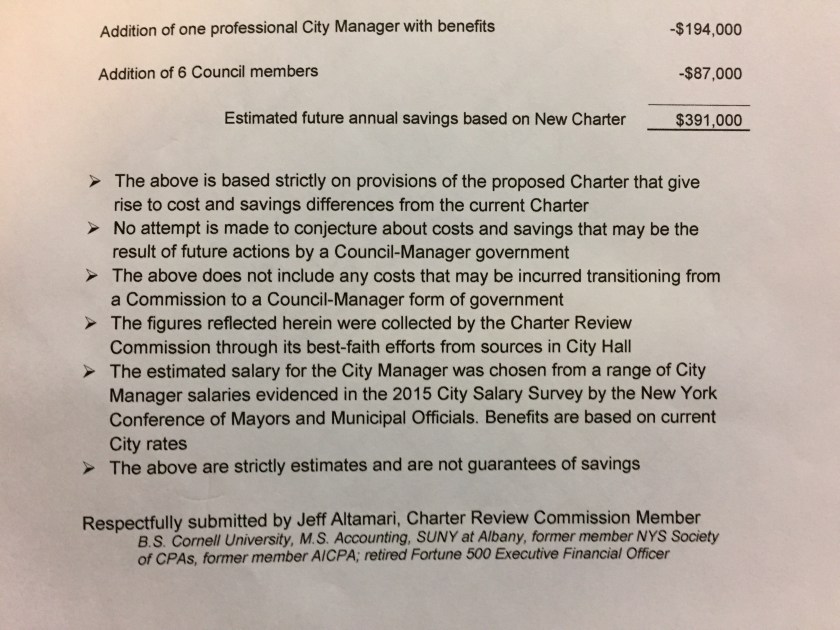
His document simply states that the cost savings of eliminating the salaries and benefits of the commissioners and their deputies along with the costs incurred for a city manager, six council members and the increase in salary for the new mayor will add up to a savings of $391,000.00.  He then covers himself by admitting that these numbers do not represent the actual costs of the new government.

One of the big problems with this financial  analysis is that the major savings are based on the assumption that the deputies will disappear along with the Commissioners. The proposed charter, however,  states that the deputies will continue after January 1st at the discretion of the city manager.  Nevertheless the financial analysis assumes the savings of the eliminated deputies as though their last day of work were the day before the charter takes effect. 

The document’s financial calculations, as written here, would also rest on the huge assumption that the new city manager alone will be able to absorb the work done by five full time deputies and four part time commissioners. Previous discussions by the commission during the year had assumed there would probably be a need for at least a deputy city manager. Budgeting for an external auditor was also dismissed in the drafting of this document.

In their defense, no attempt was made to hide the poverty of this financial analysis.  The document states:

“No attempt is made to conjecture about costs and savings that may be the result of future actions by a Council Manager government.”

And

“The above [the table of numbers] does not include any costs that may be incurred transitioning from a Commission to a Council-Manager form of government.”

In something of an understatement they write: “The above are strictly estimates and are not guarantees of savings.”

The Charter Commission is simply stating as an act of faith that the city will save money.


Financial Analysis

Financial Analysis


Saratoga County League of Women Voters Sacrifices Years Of Trust In Their Haste To Endorse Proposed Charter

Dear reader:

This is a rather long piece.  The length is necessitated by the gravity of my accusation against an institution which I believe to have played, up to now,  a vital role in our democracy. I deplore cheap attacks and to understand what the League has done, it requires understanding the history of the League and the specifics of what has occurred.  I have included at the bottom a copy of the League’s explanation as to what they have done.


The National League’s Standards For Fairness

[This excerpt is from the National’s narrative on how to arrive at an organizational position.  Note that the process is not exclusive to the members of the board but is supposed to involve the membership]

“The first step is vital: STUDY. League members across the country must look at all sides of an issue, study the facts, the ramifications of all approaches to that issue, alternative solutions, the impacts on people, places and things, the costs and benefits. Only after studying the issue do League members come together in their own local Leagues to discuss that issue at a meeting to arrive at the “consensus” of their League on the issue.

The results of all local Leagues discussing the issue are compiled to determine the consensus of the League as a whole. CONSENSUS is not a vote – rather, consensus is a mutual agreement of League members arrived at through civil discourse, the hallmark of the League of Women Voters.

In the process of discussing the issue, League members must turn the issue upside down, sideways, backwards and forwards. Because of our nature, training, upbringing,  experience and hearing others’ ideas, League members will see an issue differently. In fact we cherish the fact that we bring different perspectives on issues. Because the process of coming to consensus is an amalgam of members’ thoughts, ideas and ways of looking at the facts, members attending the consensus meeting must dig deeply into the issue. That is why we cannot typically pose a consensus question in the frame of “Do you support the NPV compact approach to electing the President?” Consensus questions are designed to spark a discourse about the issue akin to the discussion we would expect policymakers to have when they deliberate the issue. Consensus questions are not black and white, yes or no questions. There is no right or wrong answer to a consensus.”

How The Local League Studied The Forms Of Local Government And What They Decided

Concerned about the organizational effectiveness of the Saratoga County Board of Supervisors and other municipalities the local League initiated a “study” in May of 2015.  Consistent with the standards of its national organization it labored over this work for two years and issued its position in April of 2017.  Note how modest their finding is.  A mere two paragraphs, it reflected the caution that is consistent with both its history and the nature of the process.  Here is the text:

“The League of Women Voters of Saratoga County believes that it is important to have a clear separation of powers, and checks and balances in County Government and therefore we support having an elected County Executive. Additional reasons for supporting a County Executive are that because the County Executive would be elected county-wide the Executive would be focused on the needs of the County as a whole; and because the term of office would be longer than the current one-year term of the Chair of the Board of Supervisors continuity and long range planning would be enhanced.

The League of Women Voters of Saratoga County believes that Cities in this County should separate their administrative functions from their legislative functions by having a City Council that makes policy and laws and either an elected executive or an appointed administrator to carry out administrative functions. The League supports this separation of functions in order to have a strong centralized administration, to have clear lines of responsibility and to eliminate waste.”

The Local League Pushes Through Endorsement At Board Meeting

As noted in the excerpt from the National League, decisions are supposed to be the result of consensus which is supposed to involve the membership.  No notice was sent out to the membership of the local League advising them that the board planned to take action on endorsing the proposed city charter.

In a release to the media, the board of the local League defended their action by asserting that they had studied the charter to determine that it was consistent with their previously adopted position, to wit, that it would separate the legislative duties from the administrative duties.

This piece of legal sophistry is painfully thin.  The proposed charter involves far more than the separation of powers.  I will be going through the issues of the charter in a series of related posts but here are just a few.  The proposed charter changes the terms of city council members from two to four years and staggers the terms.  It creates a mayor who no longer has any administrative duties but whose salary is roughly triple the current mayor’s salary.  As of the date at which the League made its decision there had been no financial analysis of the cost of the new form of government although members of the charter commission have made claims that it will save many hundreds of thousands of dollars.  There are more but these are just some of the substantial issues involved.

Most conspicuous was the League board’s failure to invite representatives who opposed the proposed charter to their endorsement meeting.  The only person with an in depth knowledge of the document was Barbara Thomas who is one of the rotating League presidents, who is on the board, and who is also on the Charter Review Commission. This seems rather out of keeping with the National’s admonish, “members… must look at all sides of an issue.”

So using the terms from the national, would anyone argue that at this single meeting of the board our League “…study[ied] the facts, the ramifications of all approaches to that issue, alternative solutions, the impacts on people, places and things, the costs and benefits…”  Or that the “League members [had turned] the issue upside down, sideways, backwards and forwards.”

It is also worth noting that as a member of the charter review commission, Ms. Thomas’ decision not to recuse herself from the vote is quite troubling.  When asked by the Saratogian about this, Ms. Thomas responded that she “did not see it as a conflict.”  It seems to me that people of good faith could argue over this issue.  The thing that I used to admire about the League was that it would go the extra mile on issues like this to avoid even the appearance of a problem.  Their main concern was insuring their credibility in the eyes of a public grown cynical about manipulation.

I will be following up this post by going through the charter identifying what I believe to be the critical policy issues outside of whether a reader prefers the commission form or prefers the council/city manager form.  When you vote in November, notwithstanding the League’s myopic approach, you will decide on some very important changes to our government beyond these two models.

One can only hope that the board of the League will see the folly of what they have done and take action to acknowledge the error and to assure the public that they will again adhere to the policies that have made them such an important resource for the community.

Finally, I would take exception with the League’s original position that the legislative players in government should be structurally separated from the executive players.  Most democracies in the world have parliamentary systems.  These include Great Britain and the Scandinavian countries.  When a political party wins a majority of seats, the prime minister selects individual members of parliament to serve as the heads of the country’s key institutions.  There are positions like minister of health, minister of transportation, minister of housing, etc.  Many, myself among them, think that this is a more democratic model and less prone to the kind of executive excess and gridlock that our own country seems to suffer from.


[The League’s statement to its members]


Email not displaying correctly? View it in your browser.
LeageLogoLeague of Women Voters of Saratoga County Making Democracy Work ~  Not For Women Only! www.lwvsaratoga.org             


CharterLogoLWVSC Supports the Proposed new Charter

To the members of the LWVSC: LWVSC supports the new Charter proposed for SS At its meeting on September 6, 2017 the board of the League of Women Voters of Saratoga County decided to support the new Charter being proposed for the City of Saratoga Springs. The board decided that the proposed Charter (which will appear on the SS ballot on November 7th) meets the requirements in our position on the Governance of Local Governments, and that the current Charter does not.    The relevant part of our position is: The League of Women Voters of Saratoga County believes that Cities in this County should separate their administrative functions from their legislative functions by having a City Council that makes policy and laws and either an elected executive or an appointed administrator to carry out administrative functions. The League supports this separation of functions in order to have a strong centralized administration, to have clear lines of responsibility and to eliminate waste. Before announcing our decision to the public we want our members to have an understanding of the process we used to reach this decision.  How LWVSC came to support the new Charter being proposed for Saratoga Springs: [As you review the following chronology note that the League study of local governments was initiated a full year before the first meeting of the Saratoga Springs Charter Review Commission (6-28-16) and that the LWVSC board reviewed the proposed new Charter at its first regularly scheduled meeting (9-6-17) following the completion of the proposed new Charter, which was formally adopted by the Charter Review Commission on 6-26-17.]   May 30, 2015 – LWVSC adopted a proposed 2 year local study: “Study whether local governments in Saratoga County (villages, towns, cities and county government) should separate executive or administrative functions from legislative (policy making) functions. Year one of the study will look at current structures, practices and definitions. Year two of the study will reach a consensus position.”   October 2, 2016 – the local government study committee, chaired by Francine Rodger, presented its findings from the first year of the study at a membership meeting.   April 1, 2017– Consensus was reached. April 5, 2017 – The board received the report from the consensus meeting and formally adopted the Position on the Governance of Local Governments. http://www.lwvsaratoga.org/pdfs/LocalGovernance.pdf   September 6, 2017 – the LWVSC board reviewed the proposed new Charter for Saratoga Springs and determined by a vote of 11-0 that it meets the requirements of our position. Four board members who don’t live in the city abstained. (Once a position is adopted by membership consensus, the League board at the appropriate level, evaluates proposed laws and actions for their compliance with our positions).   You are encouraged to find out more about the proposed new charter for Saratoga Springs. LWVSC has scheduled a public information meeting Thursday, September 21st at the Saratoga Springs Library, 49 Henry Street, Saratoga Springs, beginning at 7 pm. Three members of the Charter Review Commission will describe the main provisions of the proposed charter, the process the commission used to study forms of government for cities, and share how they decided to recommend a new charter of the city of Saratoga Springs. Panelists will be Gordon Boyd, founder of EnergyNext, Minita Sanghvi, assistant professor, Management and Business, Skidmore College, and Barbara Thomas, community activist and will be moderated by Pattie Garrett, LWV Saratoga. Read the entire proposed charter :   https://saratogacharter.com/category/documents/ Questions?  Contact any steering committee member.

You are receiving this information because you requested to be on our mailing list. Board Meetings are open to all MEMBERS: Held 1st Wednesday of the month at 7:00-9:00 pm (except July and August); United Methodist Church, Henning Road,Saratoga Springs, NY

MEMBERS can receive our quarterly Bulletin electronically (it arrives in your inbox as a link in one of the Mail Chimp messages). Be sure to let us know if you change email addresses. You will also receive our Newsletter via US Mail unless you opt out by sending an email request to  Barbara Thomas .

League of Women Voters of Saratoga County   518-728-5201   lwvsaratoga@gmail.com

Unsubscribe mweihe1@nycap.rr.com from this list | Forward to a friend | Update your profile Our mailing address is:

League of Women Voters of Saratoga County

P.O. Box 1029

Saratoga Springs, New York 12866

Add us to your address book

Copyright (C) 2017 League of Women Voters of Saratoga County All rights reserved.

More Hotels! It’s Going To Be Big!

23 Washington
23 Washington Street
Adelphi Hotel
Adelphi Hotel

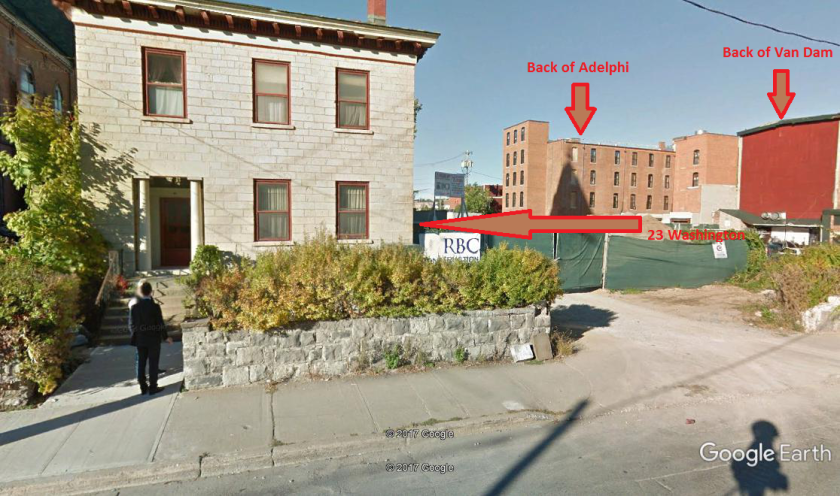
According to the Albany Business Review the owners of the Adelphi Hotel who are close to completing what must be the most expensive restoration in the history of the city ($28,000,000.00) have even bigger plans.  They are seeking to build what the ABR describes as “a second hotel with a spa and ‘resort-style pool’ on the land along Washington Avenue which includes the old parsonage at 23 Washington along with what appears to be the parking lot (19 Washington?).


The developers, Toby Milde and Adelphi Hotel Partners LLC say they are going to invest $14 million dollars to build a six story,  50 room hotel there.

The parsonage would be converted into what they describe as a “three-room presidential or bridal suite with an entertainment parlor on the first floor.”  This would be connected to the new hotel and through that into the Adelphi.

In the meantime, the Van Dam which abuts the Adelphi is going to be transformed into a 152 room hotel.  Earlier stories indicated it would be a Hotel Indigo property.

Just up the street on Washington is the Universal Preservation Hall being developed by Philip Morris, CEO of Proctors (Schenectady) for a measly $7,000,000.00 as an expanded entertainment venue.

This is going to be quite the intersection.

Saratoga County League of Women Voters Charter Panel Violates Their Standards of Fairness and Balance

The Saratoga County League of Women Voters has a long and extraordinary history of serving our county regarding public policy issues and elections.  They have earned a reputation for scrupulous impartiality.  They have been tested on many occasions as they have become the established body to host the “candidate nights.”

In addition, they have taken on a kind of consumer reports function by studying a variety of controversial public policy issues and providing educational materials and events to share their findings.  People rightly look at recommendations from the League as an important resource in assessing community controversies.

The League handbook states under Guidelines for Presenting Differing Views of an Issue at a League of Women Voters Information Meeting: “When the League of Women Voters Study Committee has studied an issue and arrived at consensus (my emphasis), it is legitimate that we inform the public of our position and why we support the stand.  In such cases, it is not necessary to present opposition views.”

In April the League issued a position paper entitled “LWV Saratoga Position on Governance of Local Governments”.  The position paper vigorously argued that Saratoga County government needed professional management and advocated establishing an executive who would professionally manage the county.  Currently the county is managed by its legislature through subcommittees.  It also included the following text regarding the cities in Saratoga County:

The League of Women Voters of Saratoga County believes that Cities in this County should separate their administrative functions from their legislative functions by having a City Council that makes policy and laws and either an elected executive or an appointed administrator to carry out administrative functions. The League supports this separation of functions in order to have a strong centralized administration, to have clear lines of responsibility and to eliminate waste.

Several weeks ago the League announced that it would hold a public forum on the proposed Saratoga Springs city charter.  Three representatives from the Saratoga Springs Charter Commission would be the presenters.  No one opposing the adoption of the charter was included. The League leadership cited the position taken in April on separation of powers and the section of their handbook cited above as the justification for presenting a panel on the charter that included only those in favor of the change.

Jane Weihe, my wife and one of the leaders of SUCCESS, a group opposing the adoption of the proposed charter, contacted the League.  She pointed out that the proposed charter involved far more than the establishment of a city manager.  For example, in addition to the replacement of the current commissioners with council members who only have a legislative function, it established a mayor’s position with an increased salary and decreased responsibilities.  It revised the city attorney from a part time position to a full time position.  It changed the terms of the members of the council from two years to four years and it staggered their terms.  It established term limits for members of the council.  It established a controversial plan for how the transition would take place.  Many questions about what the new government would actually look like and what it would cost have been the subject of heated debate.

Jane would have had no problem with a one sided forum on the virtues of separating administrative from legislative functions in local governments as that was the position adopted by the League.  What she took grave exception to was that the League has never studied the proposed charter (it still may not be complete) let alone endorsed it and it was specifically this document that was to be the topic of the forum

A common definition of  “consensus” is unanimity.  I know for a fact that there are members of the League who vigorously oppose the adoption of the charter.  Not only has the League not formally taken a position on the charter, in light of the divisive nature of the issues it is extremely unlikely that they could adopt it by consensus.  [JK: Betty Gallagher, who was one of the founders of the League has indicated that the League’s definition of “consensus” does not require unanimity.]

The League seems to not have considered that it is quite possible to support the idea of a city manager but to disagree with other facets of the proposed charter and thus oppose its adoption.

I would note that the League has a stellar history statewide of taking strong exception to maneuvers by politicians who stretch rules to serve their goals.  It is hard to reconcile this record with the failure by the Saratoga County League to study and unanimously endorse the Saratoga Springs charter while putting on a panel consisting only of supporters of that charter.

My friend Barbara Thomas is one of the three people who head the League as a member of the Presidential Steering Committee.

I cannot think of a person in our city who has worked harder on social justice issues than Ms. Thomas.  She was on my board when I was the executive director of the Saratoga County Economic Opportunity Council.  For decades she worked for Planned Parenthood championing women’s rights to healthcare and abortion.  She has served for decades in a leadership position in the League of Women Voters.  If there is an issue of injustice, I can fully expect that Ms. Thomas will be there to fight to right it.

Last year Mayor Joanne Yepsen appointed Ms. Thomas to the Charter Review Commission. I was concerned earlier this year when she defended the Commission’s plan to hold a special election the day after Memorial Day week end to vote on the charter by claiming the voter turnout on that day would be higher than the turnout at the regular November election.

She has now been selected by the League to be part of the three member Charter Panel.  So Barbara chairs the League, is a member of the Charter Review Commission, and will be a panelist presenting the virtues of a new charter.

Following complaints by members of SUCCESS about the lack of balance on the proposed panel, the League emailed Jane.  They proposed that in addition to the panel made up of 3 charter commission members, they wanted someone opposed to the charter and someone in favor of the charter to each speak for 10 minutes.

After consulting with other members of her group, Jane declined the offer.  Three charter commission members were to be allotted an undetermined amount of time to state their case and in addition a member of the pro charter advocacy group It’s Time would be given another 10 minutes to make arguments for the adoption of the charter.  That would leave 10 minutes for one member of SUCCESS to put forward arguments against adoption. 4 to 1 and an unbalanced time allotment did not meet the standards the League has always met for presenting balanced information on controversial topics.

I am simply stunned by all of this.  There has been plenty of zealotry accompanying the controversy over the charter.  As I have documented on this blog, some rather questionable tactics have been used by good people whose judgment has been compromised.

I would have expected my friend Barbara, in spite of her role in crafting the charter, to insist as the League always has, that both sides of the issue be scrupulously balanced so that all the facts would come out

 Wherever one stands on the future of the proposed charter, I hope that you would share my concern that the League is tarnishing its extraordinary record and its credibility by violating the rules that are the essence of the trust they have earned over the years.


__________ Information from ESET Smart Security, version of detection engine 16028 (20170904) __________

The message was checked by ESET Smart Security.

http://www.eset.com

Pat Kane, Vice Chair of Charter Commission: His Recollections Challenged

I received an email from Pat Kane [See full text at end of this post] in response to a comment that was posted on the blog as part of the discussion of the city’s payroll system. A commenter had challenged Mr. Kane’s description of the time and personnel involved in doing payroll and noted that Florence Wheeler, the fulltime person who does payroll, had not been interviewed by the Charter Commission.

In response Mr. Kane wrote:

“Yes Christine G-brown [JK:She is the city director of finance] was interviewed and stated that she dedicates 2 days a week to payroll. Mrs Brown is the Director of Finance and highest paid employee in the Finance Department. She also started (sic) in the same interview that conflicts amounts (sic) the 5 Commissioner (sic) impacts 50% of her work days.”

These are quite serious allegations so I emailed back to Pat that I would need to confirm the comments he attributed to Ms. Gillmette-Brown with her.

Gillmet-Brown, a registered Republican, was originally hired by Democrat  Ken Klotz when he was Commissioner of Finance to serve as his Deputy.  When the city created the position of Director of Finance as a civil service position she was hired to do that job.  Since then she has served under Finance Commissioners from both parties.  One of the reasons I felt the need to confirm the comments attributed to her is that they seemed entirely out of character.  Ms. Gillmet-Brown has always maintained a very low profile.  She has done a superb job and, in the spirit of a civil service, has eschewed anything not directly involved with her work.  Mr. Kane, by publically referencing her comments, was involving Ms. Gillmett-Brown in a highly heated controversy. I felt this required making sure that he was accurately reporting her position.

Here is my correspondence with Mr. Kane:

On Aug 31, 2017, at 9:11 AM, John Kaufmann <> wrote:

Pat:

I want to confirm with the Director of Finance the statements you attribute to her before posting your comment.  Ms. Gillmette-Brown is on holiday so it will have to wait until Tuesday.

JK


On Aug 31, 2017, at 12:19 PM, Patrick Kane < > wrote:

John

I am happy have you check with her.That would be the right thing to do everyday.  I wish you would have called any of us to fact check Michele’s statements.

Many of the claims she made about the CRC were bogus.

Waiting until Next Tuesday is more suppression than fact checking.

She testified in front of The Sub Committee chaired by Matt Jones.

In the Music Hall. CRC members in attendance were Matt, me, Ann Bullock, Jeff A [JK:Altamari], and I believe Beth Wurtmann was in attendance.

Additionally, testimony Christine provided to us.

Her answer to us was that she spends two days a week on payroll.

She also stated that has to deal with the political bickering amongst departments and commissioners

I asked how much of your time is spent dealing with the bickering?

10%. NO

20% No

Higher? Yes

50%?  “that is accurate.”

We were  shocked that she would speak out like this knowing that she works for Michele.

But actually do not bother going through with the effort. You are posting many people’s submissions with obvious falsehoods and if my word is not good enough then so be it.

I will continue to monitor your blog to help supply facts.

But once again you censor my comments and let everyone else just fly through.

Best wishes

Pat

On Aug 31, 2017, at 12:27 PM, John Kaufmann < > wrote:

This comment and you are by no means the first for holding up a comment to fact check. —————————————————————————————————————————————–

From: Patrick Kane <pkane1@nycap.rr.com>

Date: August 31, 2017 at 12:47:32 PM EDT

To: John Kaufmann <john.kaufmann> Cc: Jeff Altamari < >, Gordon Boyd < > Subject: Re: Finance Director- John Kaufman 2

Selective at best not the general rule.

——————————————————————————-

I was able to get comments from two other people who were at the meeting Mr. Kane described: Commission member Matt Jones who chaired the meeting and, although she was on vacation, Ms. Gillmett-Brown also responded.

Mr. Jones told me that it had been quite some time since the interview and his memory was a little sketchy.  He was, however, quite sure that Ms. Gillmett-Brown had offered no percentages regarding how much time she spent dealing with political conflicts between commissioners and departments.  He observed that it would have been no revelation that such conflicts occurred, but that he would have remembered if she had  said that half of her work time was spent dealing with such disputes.

Noting again how long it had been since the meeting, he could not recall  the specifics of a discussion involving how much time Ms. Gillmett-Brown devoted to payroll.  He regretted that there was no recording of the meeting to which he could turn.

Ms. Gillmett-Brown, however, was quite emphatic that Mr. Kane’s account of her statements to the committee were untrue.  She asserted that half her time is not devoted to addressing problems related to conflicts between Commissioners.  She was also very clear that she does not spend two days a week on payroll.  She said she spends about thirty minutes.

She also noted that she waited a long time to be interviewed by the committee but her actual conversation with them lasted only about 5 minutes. She offered to return to meet with them again but they never contacted her.  Ms Gillmett-Brown is the Director of Finance and as such oversees the payroll system. She would have been one of the best people to give Charter Commission members an in depth look at how payroll is handled in city hall.

I have noted before in this blog that I appreciate Pat Kane’s dedication to the city.  He believes passionately that adopting the proposed charter will significantly reduce the cost of city government and  improve services.  Memory is a funny thing. I find it possible that Mr. Kane believes his description of Ms. Gillmett-Brown’s testimony.

Readers will have to make up their own minds as to what occurred in the interview.


[Pat Kane’s original comment]

My data about the county information came from 2 high ranking elected officials.

Let start with my comment about staff using two days each week. Yes Christine G-brown was interviewed and stated that she dedicates 2 days a week to payroll. Mrs Brown is the Director of Finance and highest paid employee in the Finance Department. She also started in the same interview that conflicts amounts the 5 Commissioner impacts 50% of her work days. [My emphasis added]
We attempted to interview as many tenured employees as possible. Most declined for fear of retribution in the workplace.

Saratoga County has eliminated paper checks. The county employees without checking accounts are giving a card similar to debit card for their pay.

Saratoga County government is a much larger organization and the officials I spoke with are very proud of the progress the county staff and employees have made to modernize their processes.

I believe that modernization will solve many of these issues in all departments.
You are right, the form of governance does not solve all of the issues. The important question is

Should a 50 million dollar operation be as efficient and effective as possible?
The current form of governmence has been in place for 102 years and for many of those years doing a good job.

But we can do better given the right circumstances.

The light bulb was not invented because the candle broke.
This not experimental surgery. This a proven solution to outdated governmental operations. 65% of cities our size using Council manager and the rest use strong Mayor.
Have a nice day.

Joseph Levy: Geyser Road Bike Trail Story – Part 2

[JK: More great coverage by Joseph Levy on the proposed city bike path]

In an effort to clarify some of the details that were left dangling in Part 1, I visited City Hall and spoke with Bradley Birge, the city’s Administrator for Planning and Economic Development, who’s overseeing the project. He walked me through the trail map and provided information that essentially confirmed most of what was written in Part 1.

If the planned trail is to be completed, there are seven properties that will loose a strip of land fronting Geyser Road, plus two others that I speculated about, which will not loose any. Let’s take them in geographical order, from west to east:

1. The Village of Ballston Spa Water Reservation. There’s a large parcel behind the northeast corner of Rowland Street and Geyser Road that’s owned by the village and includes a reservoir, which is actually located in the Town of Milton. Mayor John Romano of Ballston Spa expressed reservations because he thought the trail would lead to people swimming in the reservoir, with the risk of drowning. What he failed to mention is that the reservoir is already very accessible via Baker Road, which comes off Geyser Road. The new trail wouldn’t bring anyone any closer or provide easier access, since there are already dense woods and numerous private properties on the Geyser Road side opposite the reservoir.


As I suggested earlier, the real issue with the village seems to be a stingy financial offer (as reported by the mayor), as well as insulting behavior towards the mayor and the village by the city’s representative.

Since money talks, one would expect to see a settlement based on a better offer and, hopefully, an apology.

2. 159 Geyser Road. Tim Harrington, who lives at that address, made an emotional statement before the City Council’s August 1st meeting to protest possible confiscation of this land. However, the city has no need to acquire property from this parcel because the existing right-of-way is already wide enough to accommodate the trail. While the trail will still run in front of his house, it will be on land already owned by the county.

At the August 15th City Council meeting, Dave Morris suggested that Mr. Harrington’s well-head and flagpole were in the way of the path, but lacking a survey of the property, there’s no immediate way to confirm this. Of course, if that is the case, then Mr. Harrington has been using public land as if it were his own and may have other problems to resolve. In fairness, this is not uncommon in areas where there are no sidewalks to begin with and the boundaries are not clearly marked.

3. 111 Geyser Road. This is Jack Pompay’s property, the one with the mature shrubs. It turns out that some of the shrubs are situated on public land, but moving all of them back at city expense is in the budget. Additional funds are also available to replace any shrubs that don’t survive. Mr. Pompay is party to a law suit, apparently instigated and funded by the Saratoga Spring Water Company, so the final resolution may end up with the courts.

4. 119 Geyser Road. As with the property at 159 Geyser, the right-of-way is already wide enough for the trail, which will go in front of the existing fence. The fence and other landscaping features will be unaffected, so no additional land or adjustments are required.

5. The Geyser Road Elementary School. The city school district has agreed to cede land required for the trail at no cost.

6. The same is true of Geyser Park and neighboring Veterans Memorial Park, which are already in the public domain.

7. Munter Land Holdings. The Munter family has made a generous donation of their frontage to the project.

8. Van Hall Holdings negotiated a sale of their frontage, so no further action is needed.

9. 11 Geyser Road. The is the property of the Saratoga Spring Water Company. In 2015, they came before the planning board to request permission to expand their facility and, as part of the variance granted, they tacitly agreed to allow the trail to run along the road in front of their plant. At my request, Mr. Birge kindly provided copies of both the variance maps submitted by the company and the minutes from the Planning Board meeting of April 22, 2015, both of which are no longer linked from the city website (they’ve been uploaded to one of my personal sites).

The map on page 2 of this excerpt from the variance application (page 6 in the original) shows the trail as currently proposed:

http://www.sludgehead.com/Saratoga_Spring_Water_variance_excerpt.pdf

Page 1 of the proposal says quite explicitly, “Property owner acknowledges Geyser Road path proposed to be constructed as 8 foot wide path on north side of Geyser Road. Specific location and details will be coordinated as the design progresses.”

As you can read in the minutes of the Planning Board, below, (page 3 of this except; page 4 in the original), a caveat mentioning the trail as a condition of the variance was adopted unanimously:

http://www.sludgehead.com/Saratoga_Planning_Board_excerpt_04-22-2015.pdf

The trail is on the owner’s variance map, as well as on the front of their variance proposal, so why have they suddenly decided to sue to stop the project or have the trail rerouted? While I still don’t have an answer, I speculated earlier that it’s politically motivated and so far haven’t heard a reason to think otherwise.

Any of the other properties on the road that were not specifically mentioned are in the same situation as ones detailed above — the public right-of-way is already wide enough for the trail or the land is already in the public domain.


One point that does not have an elegant resolution is what happens at the Milton Town Line, where the trail will officially end, as shown in the photo, looking west, below.
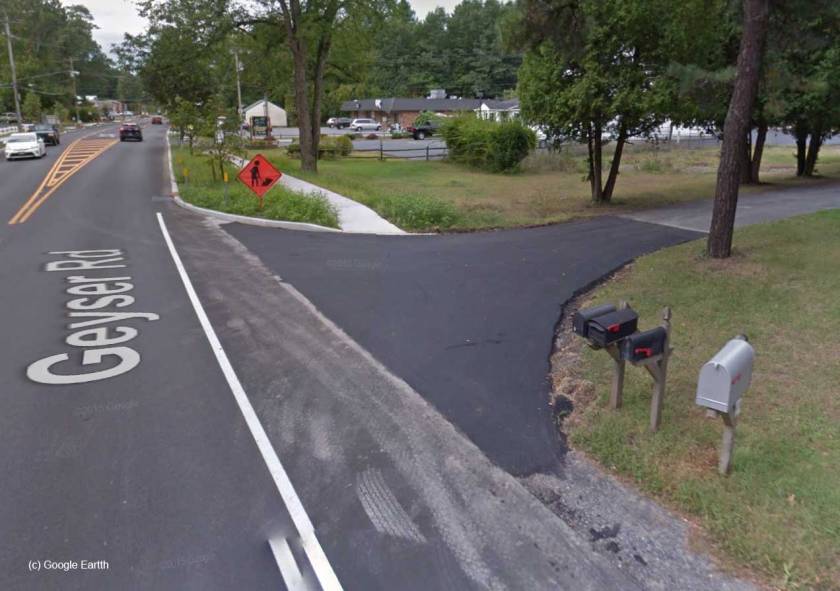
The trail would terminate in back of the mailboxes on the right leaving people to continue on their way via the sidewalk on the other side of the driveway. The town line is actually another 150 feet to the west, beyond the driveway, but that’s academic. While pedestrians would still have a sidewalk on both sides of the road, bike riders would be dumped onto Geyser Road, itself, along with all of its traffic. At that point, it would be up to the Town of Milton to continue the trail or create a bike lane. But let’s step back and consider the Big Picture. The trail is really a spur off the Saratoga Springs Greenbelt Plan. In other words, its initial intent is not to connect trail networks at each end, only at the Spa Park end. In the long run, the Town of Milton may build connections on the western end, but it’s immediate purpose is for easier access from the Geyser Road developments to downtown Saratoga Springs.

Wrapping up, at the August 15th City Council meeting, two residents of Geyser Crest spoke in favor of the proposed route and one against.

One of pro speakers, Lurana McCarron, opposed the alternate routes on the grounds that joggers and walkers have been known to be attacked on woodland trails, but that can happen on city streets, as well, and isn’t a very strong argument. That’s to say nothing of the many existing woodland trails in this area where I can’t recall any sort of dangerous activity being reported.

Opposing the proposal, again, Dave Morris emphasized the perceived danger of a distracted driver losing control of their vehicle and careening onto the trail, killing or maiming its users. In fact, this can happen on any road in the city or suburbs, including the Geyser Road developments which lack sidewalks and where everyone on foot or bicycle is forced into the pavement. It’s the risk you take every day when you step out of your house. While he’d like to see bollards or a fence between the path and the road, they’re not in the budget.

After the verbal comments, additional written and eMailed materials from the public were entered into the record for further consideration. Then the mayor declared that the final vote will take place at a future city council meeting, possibly as early as September 5th.

For those of you who want to wade through additional details, the Final Design Report of the trail is online via the city’s website, directly linked here:

http://www.saratoga-springs.org/documentcenter/view/5857

As for the court challenges, look for updates as they wend their way through the system. Whether walking, running, biking or driving, have a safe Labor Day weekend.



Madigan Calls Out Charter Review Commission on “Antiquated” Payroll System

I received the following description from Commissioner Michele Madigan regarding the city’s computerized accounting system with a focus on payroll. 

Members of the charter review commission have repeatedly asserted that the city’s payroll system is antiquated.  In fact, some members of the commission have even claimed that it is still done with pencils on paper.  Most recently, one of the commission’s members asserted in a post on this site  that “the city payroll system is antiquated… at least 500k can be saved by implementing a modern payroll process.” 

To an unsophisticated person like myself, their statements would make me believe that the city not only has no automated payroll functions but has no plans to address the lack of such accounting tools.

As someone who is a computer programmer and has worked on deployments involving payroll and time recording I can assure the readers of this blog that it is far, far more complex than one would assume. 

I would like to invite any members of the Charter Review Commission to submit a guest post to respond to Commissioner Madigan’s description of how payroll is done currently in the city.  It would be helpful if their response were as specific and detailed as possible explaining what is antiquated about the current system and what system they have in mind that would save the city at least $500,000.


According  to Section 4.3.1 of the current City Charter: “Accounting Systems: The Commissioner of Finance shall maintain and supervise the general accounting system for the City government and each of its offices, departments and entities in accordance with the uniform system of accounts prescribed by the State Comptroller…” As a result: The City of Saratoga Springs utilizes one of the most sophisticated financial management and accounting systems available on the market today – MUNIS – from Tyler Technologies has expertise in Financials, Revenue, Payroll &amp; HR, Citizen Services, and Human Capital Management. 

We are not antiquated, far from it; we have integrated MUNIS software modules into a structured departmental system that centralizes in the City Finance Office. We utilize state of the art technology to streamline all the various nuances of our 7 separate Union Contracts and our Non-Union Employee Contract – ensuring compliance within those individual contracts along with various Finance Policies and Procedures (as required under the current Charter and Commission Government Section 4.2.1 Finance Policy and Procedures Manual).  The City utilizes MUNIS Payroll functionality to manage Contract Improvements, Step and Longevity Increases, Accrual allotment and charges, and Employee Deductions (Health Insurance, Deferred Compensation, NYS Retirement Contributions, etc). At the same time we are interfacing Payroll Cost Accounting into our General Ledger every time we post a payroll. In addition the City uses MUNIS modules for Online Tax and Utility Billing, Tax Collections, Accounts Payable, Building Permits and Purchasing. It’s a sophisticated system.

 Additionally, the Finance Department is in the process of implementing a Time and Attendance system module.  Roll-out of the system has occurred in DPW and within our Police Department.   This project will take approximately 2 years from start to finish and included a detailed review by committee with representation from each department.

System implementations are expensive and take time.  We have invested years in our state-of-the-art MUNIS system. I’ve grown tired of the misinformation being peddled by members of the Charter Review Commission.  Vote yes or no to change the form of government, but please let’s have an honest assessment of this proposal and the costs associated with this new hybrid form of government (City Manager w/ a Strong Mayor).

Thank you,

Commissioner Michele Madigan


Commissioner Madigan: Proposed Charter Will Increase Costs to City and Its Taxpayers


Commissioner of Finance Michele Madigan has written the following analysis of costs associated with the proposed charter. The charter which would change the Saratoga Springs city government from the current commission form to a city manager form will be on the ballot on November 7.


Commissioner Madigan:

Saratoga Springs voters will decide if we should change our form of government via the adoption of a new Charter this November. Our current commission form of government works extremely well for small cities, is quite democratic, and is often compared to parliamentary systems. Some medium-sized cities, such as Portland, OR, find that it works well for them.

Over the years bi-partisan City Councils have, through open and transparent public debate (sometimes contentious, as democracy tends to be), improved and enhanced services while maintaining one of the lowest property tax-rates of any city in NYS.  We have one of the most stellar municipal bond ratings in the country.  We have achieved the highest score of any city in NYS in our recent review by the NYS Comptroller.

Adoption of the proposed Charter, changing to a council-manager form of government, would require significant change management and will increase the costs of city government. Those who think it will lead to new day, a new beginning for the city haven’t been paying attention.

Proponents of change claim it will lead to savings. I am skeptical – as Finance Commissioner I am very familiar with the costs of city government, and their numbers don’t add up. Savings will allegedly come from the elimination of Deputy Commissioners. Ignore for the moment if this is feasible, and note that, according to Paragraph 8.09.B, the proposed charter lets the City Manager decide whether or not to eliminate Deputies. Assuming such savings seems imprudent. The costs of the required new City Manager, Assistant City Manager and an Internal Auditor or additional audit firm (an unnecessary expense given our size) will cost the City roughly as much as the 5 Deputies currently do. Absent a Deputy Finance Commissioner we would need to create and fill a civil service, union Director of Budget Operations position, which will certainly cost us more than the current Deputy Finance Commissioner. The proposed charter almost triples the Mayor’s annual salary while reducing the work required of that position. It also adds 2 additional salaried Council members. So where are these savings? The Charter Commission have said health insurance is a material area of savings; their arguments misrepresent the actual costs involved by assuming all Council members elect the most expensive coverage possible, which is not the case now and has not been the case in recent history, but even so they could be addressed in far less draconian manner than changing our form of government.

Proponents of this proposed charter claim it will create efficiencies by assigning job duties across City departments. This betrays a complete lack of knowledge of civil service and collective bargaining, while ignoring the monumental tasks and legal expenses of making this fantasy a reality. It is also based on a faulty premise. Job duties are specifically outlined and approved by the Civil Service Commission and the Council with an eye towards being as efficient as possible. Despite what you may hear from the Charter Commission, there is no duplication of effort across Departments, and we do not have employees sitting around doing nothing – far from it. Our Departments are streamlined; this is why our property tax rates are so low and so stable. The Commission continually states that we have 5 payroll departments, we have 1 and it sits in the Finance Department.  They state that the Fire Department should not plow their own driveway, but of course they should as they need to be ready at any given moment to respond to an emergency call. These are just a few examples of the unrealistic cost-saving claims made by the Charter Commission.

Regardless of the desirability of the proposed form of government relative to the current one, I am here to tell you that making this change – with this proposed charter – is not going to save the city and its taxpayers any money. It will increase costs. The next time you hear a proponent of change claim otherwise, please demand real concrete evidence as you make your decision before heading to the polls in November.

Charlie Brown, Chairman of the Saratoga Springs Democratic Party Steps Down

Citing family demands the long time chair of the Saratoga Springs Democratic Party, Charlie Brown, has announced his decision to step down.  He will remain a member of the party’s Executive Committee.

In accordance with the committee’s by-laws Courtney DeLeonardis, who  currently serves as vice chair, will assume the position as Chair.

Ms. DeLeonardis is a teacher.  She served on the city’s Ethics Board and is the wife of Vince DeLeonardis, the City Attorney.