Today, Monday, November 20, was the deadline for receiving military ballots for the November 7 election at the Board of Elections. None were received leaving the election results where they were last week after the absentee ballots were counted. The charter change proposal remains defeated by ten votes. Some charter change supporters indicated last week that they may consider asking for a manual recount of all the ballots. I do not know if they are still considering this. I will post any new information as it becomes available.
Charter Commission “In Depth Study”? I Don’t Think So!
Weeks ago I FOILed the Charter Review Commission for materials related to the alleged “in depth” study that they supposedly did of municipalities with city manager governments. This study you may recall was repeatedly cited especially by Jeff Altamari as the evidence for the Charter Commission’s claim that no staff would be needed in the new government to do the work of the four commissioners and five deputies that were to be eliminated in the proposed charter. The elimination of these positions was the basis for the savings they promised would come with charter change.
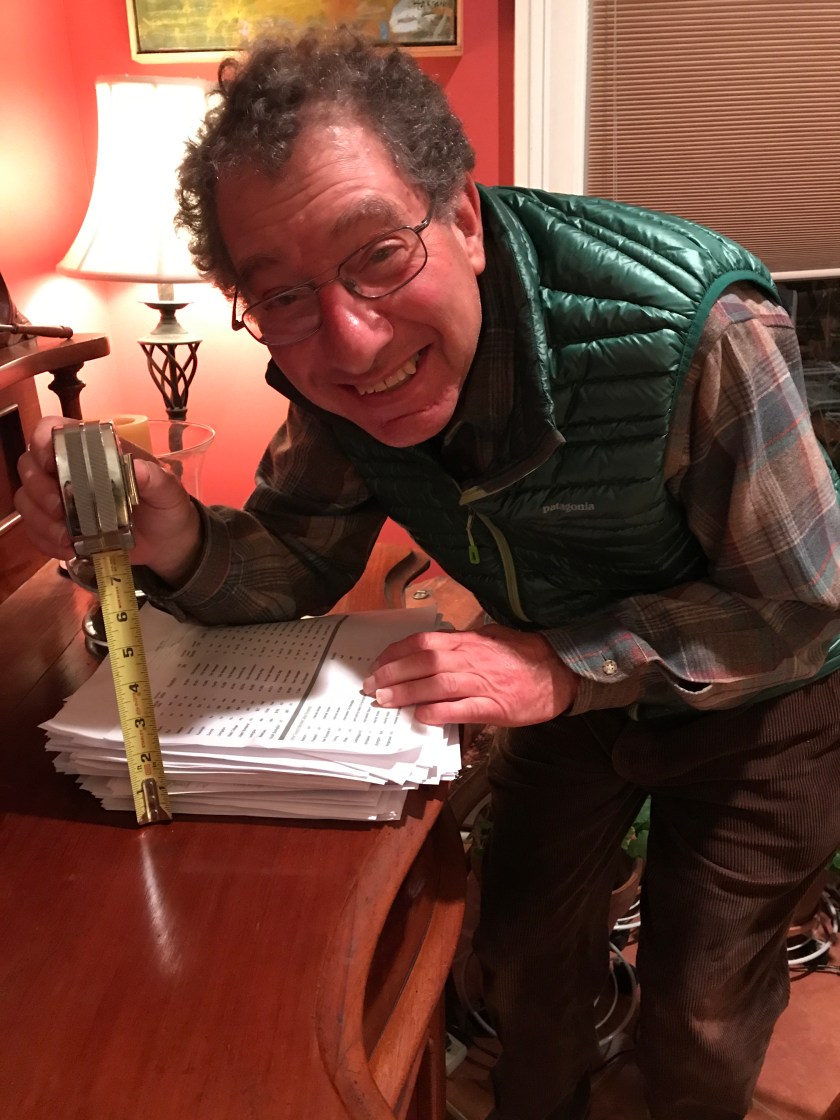
On Friday night, November 10th, three days after the election, I received the response to my FOIL. Three to four inches of documents were hand delivered to my door by Ann Bullock who was the secretary of the Charter Review Commission.
As a veteran of FOIL requests it has been my experience that there are two tactics employed by institutions that are hostile to such requests. The first is to simply deny that any relevant documents exist. The second is to overwhelm those requesting the documents with loads of items no matter how remotely relevant.
In the case of Ms. Bullock I am willing to believe that the volume of documents she delivered was probably a zealous approach to transparency.
To be fair, it is better to err on the side of transparency and I will accept that they have sent me everything remotely related to my request.


The documents can be roughly broken down as follows:
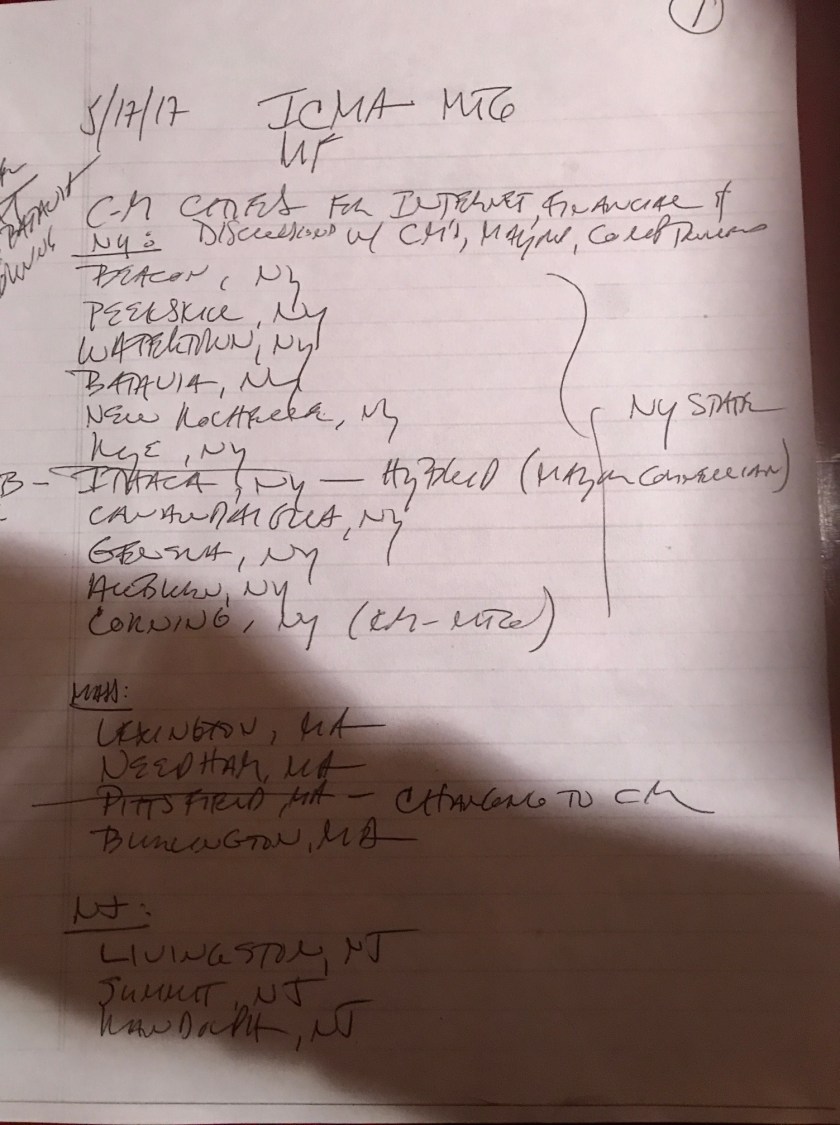
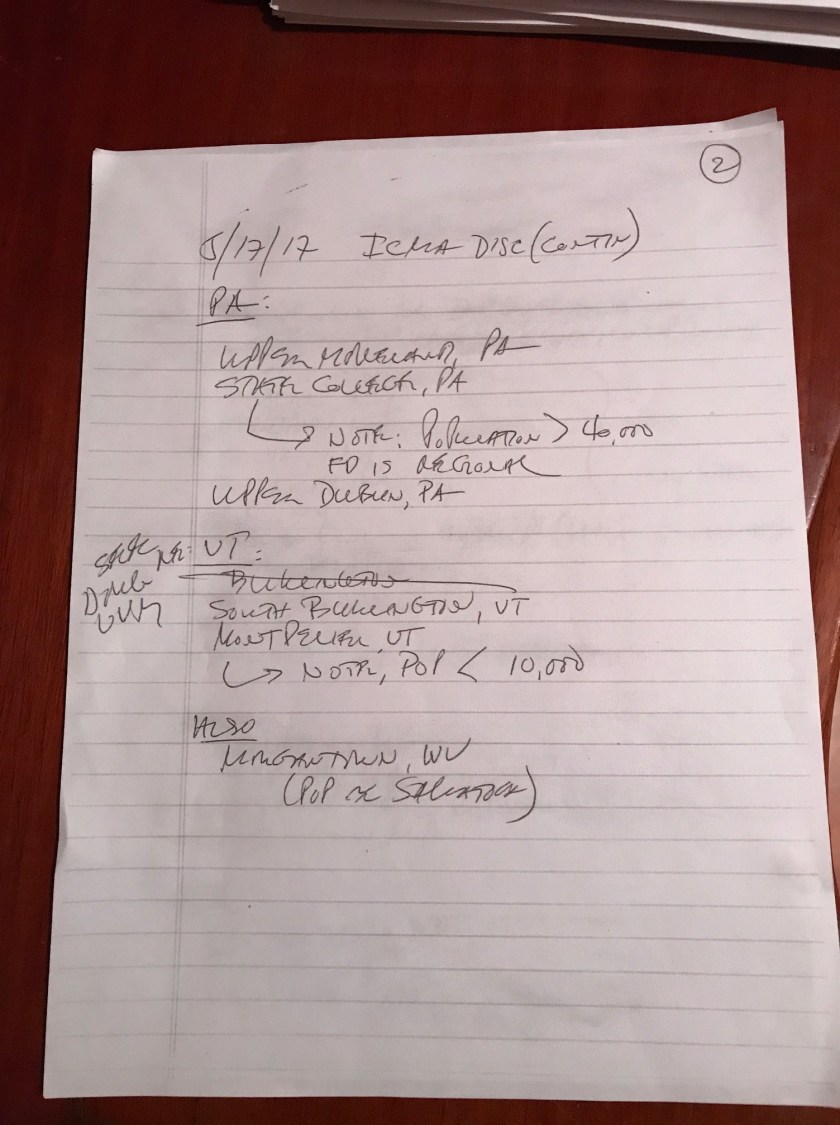
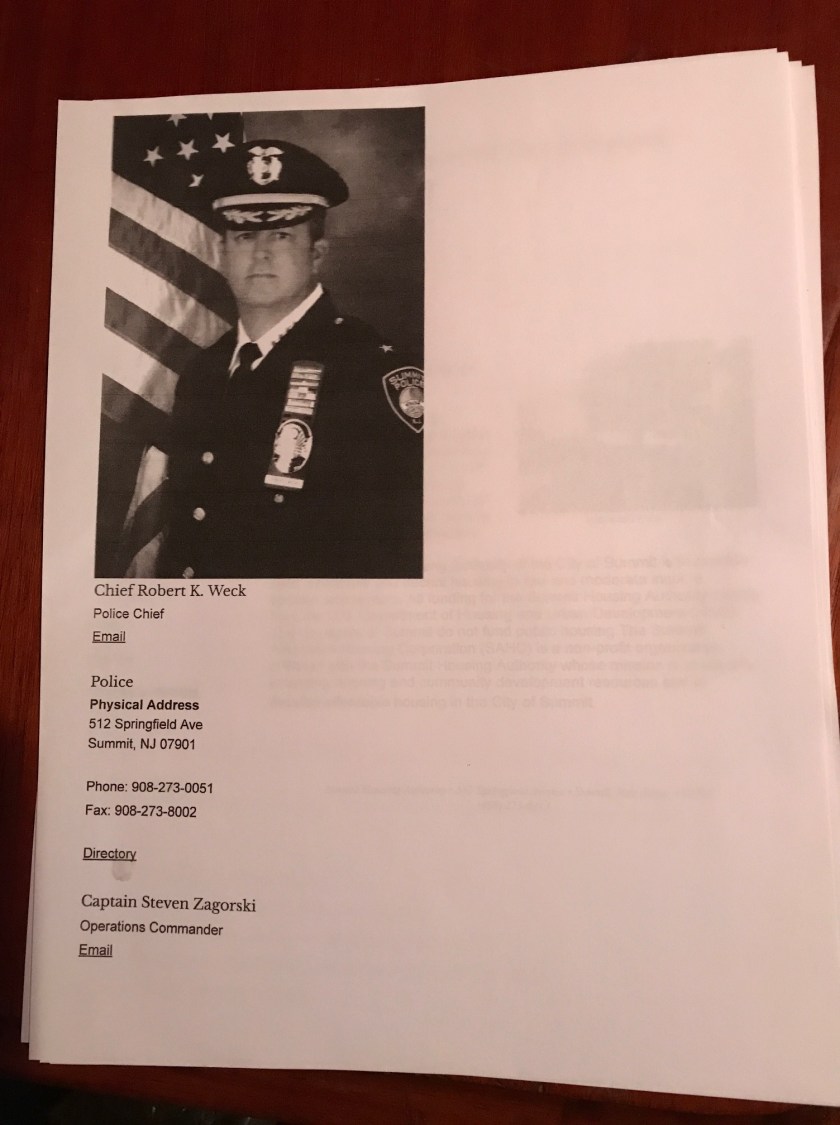
- Some notes of a meeting that apparently occurred on May 17th that involved the International City/County Management Association. This is the organization that donated $15,000.00 to “It’s Time Saratoga!”. There is nothing in the document to indicate where this meeting took place (perhaps it was a conference call?)or who participated. In fact, the notes consist simply of a list of cities/towns.
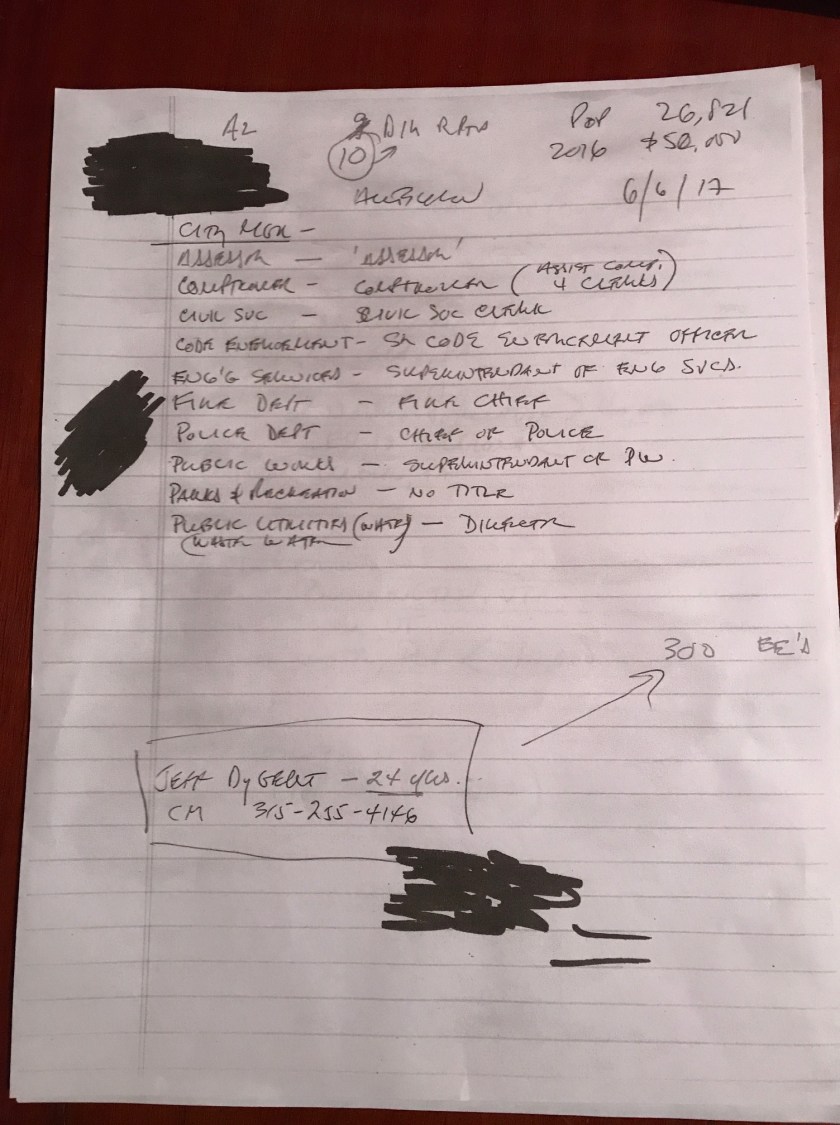
- A handwritten page with the date June 6, 2017, with the heading “Auburn” . Below the heading is a list of what appears to be departments. Much of the document is roughly written and difficult to read.
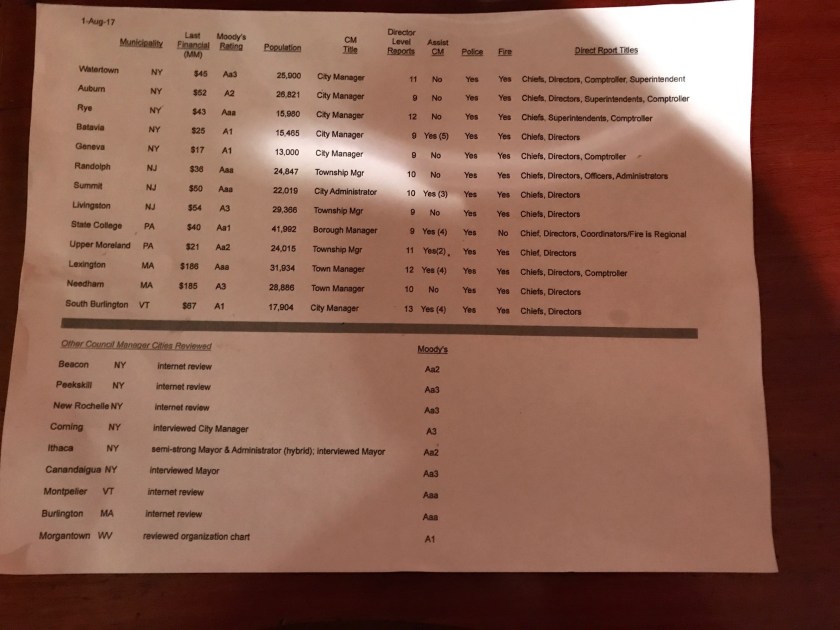
- A spreadsheet like columnar report listing cities and towns with some related attributes.
- A huge dump of web pages from fourteen cities/towns.
There were no pages of narrative, no analysis of the data, no discussion of conclusions, no explanation of methodology. These documents consisted of raw data, some of which might possibly be useful in a staffing study, but there was no study as such included in the many sheets of paper that were delivered .
As I understand it from viewing meetings of the CRC, the “study” was authored by Jeff Altamari. As noted in other posts, Mr. Altamari is a Certified Public Accountant whose most recent career before retiring was working as an executive for the oil and gas industry in Texas.
The CRC relied on his work, including this “study” in accepting the financial impact study of the proposed charter he authored. Interestingly, the CRC simply took his word for both the thoroughness of his study and its conclusions. The “study” itself was never presented to the CRC.
At the risk of appearing snarky, my idea of an “in-depth” study is very different from Mr. Altamari’s. I would think that providing the standards for the study would be paramount. Central to this would be a discussion of methodology used. How were the municipalities chosen? In what way were the municipalities comparable to Saratoga Springs? Given the unique attributes and success of our city this would be quite difficult. Just for instance Saratoga Springs has many more miles of roads to patrol and maintain than Watertown, New York, and of course more significantly we are a major resort destination. All of this and more put unique demands on the city and impacts our staffing needs. A study that would try to look at municipalities with city managers to determine what Saratoga Springs’ staffing needs would be under a different form of government would require some sort of detailed discussion about the deviations in character between municipalities and how these differences affected the conclusions.
In defense of the CRC, given their meager resources, doing a rigorous authentic study was simply not possible. One thing is certain, though, I would never have boasted, as Mr. Altamari did in a letter to the Saratogian and on Look TV, that what he produced was an “in-depth” study. This kind of hype has been the problem with the leadership of the CRC and with their advocacy group, “It’s Time Saratoga!” all along. They repeatedly grossly exaggerated both the data supporting their proposal and the problems with the commission form of government.
One thing is unequivocally clear. The enigmatic notes and the undisciplined nature of the web document dump make any serious assessment of the “study“ itself impossible.
The Selection Process
Comparing the handwritten notes from what I assume was a telephone conference call involving the International City/County Manager Association [see heading of doc] with the web dump and the tabular list it appears that the ICMA was the source of the municipality selection.


Clearly the word cryptic does not begin to describe the documents I received. In this case there is nothing to indicate what criteria were used to select the municipalities. Given that the ICMA provided the bulk of moneys to the local advocacy group, “It’s Time Saratoga!” for its campaign to pass the charter, one suspects that the selection was based on providing the most favorable picture of city manager run municipalities. Mr. Altamari might have included some discussion of this issue in his “study” in order to protect its credibility.
The Web Dump
As best as I can tell, Mr. Altamari was looking for documentation on the management staffing of the municipalities. Interestingly, in his letter to the editor on October 10 he said he focused on thirteen municipalities but there were fourteen municipalities included in the dump.
There were, to say the least, many pages with no apparent value as regards the staffing of the municipalities.
The following are a few examples:


Analysis?
This is the only document with any kind coherency. For whatever reason there are thirteen municipalities analyzed but the dump included a fourteenth, Montpelier, Vermont.

DOCUMENT
The only thing these thirteen municipalities all seem to share is that they have strong Moody’s bond ratings.
They also seem to have very lean management structures. Six have assistant city managers. I am not sure what the parenthesis number beside the assistant manager means. There was no annotation.
One of the problems with trying to do an analysis with this kind of limited data is that there is no information about the staffing below the manager level in these cities. The CRC chose not to interview Saratoga’s deputies so they had no information on what their duties currently are. In order to do a proper comparison, they would have needed to know what functions our deputies performed and then what staff handled these duties in these other municipalities.
For example, in our current commission form of government the deputy Commissioner of Finance plays a major role in crafting the city’s annual budget. This is a huge undertaking. The city’s Director of Finance has a full time position handling the day to day operation of maintaining the city’s financial records and would not be able to pick up this work. We do not know who in these other municipalities perform these duties. Similarly, the CRC did not know what the deputy for the Department of Public Works does. While a municipality may not have a deputy, the duties done by our deputy may be done by someone in another fulltime position in these municipalities. Again as stated above, none of this takes into account that the size and responsibilities of a public works department may vary significantly given a city’s other attributes making staffing comparisons challenging to say the least.
There are also the obvious differences between a number of these municipalities given the fact that some of these are in other states. For example, consider that in Massachusetts the state operates the department of social services whereas in New York these are operated by the counties. This means that the cost of county operations in Massachusetts would be significantly less than the costs for New York counties. This is an extreme example, but we simply do not know how to assess the costs of local municipalities because we do not know what services are handled or not handled by the state government. This greatly complicates any comparison with municipalities outside of New York. Yet nine of the thirteen municipalities compared here are from other states.
There are also the major differences in populations and budgets between our city and those in the list. Our city has an operational budget of approximately $45 million. Lexington, Massachusetts and Needham, Massachusetts have $186 million and $185 million dollar budgets respectively.
My Conclusion
While if it were properly documented and analyzed, this data might have offered some insight into the requirements of management staffing, to call this an “in-depth” study on which to make a decision on how to structure our own government seems manifestly inadequate. Given Mr. Altamari’s strong credentials, it is hard to imagine that he would ask the CEO of a company he might work for to make a major decision to completely restructure the organization based up this kind of research.
Blogger Apologizes To Readers For Tardiness

Why I am behind on my posting: I am the one in front of the two grinning guys. Don’t worry, I swam away after the picture.
The Depressing Condition Of The Press
Mark Mahoney, the editorial page editor for the Gazette, published an editorial today, Thursday 11/16, regarding the outcome of the recent Saratoga Springs charter vote. His editorial included harsh criticism of Commissioners Madigan, Scirocco, and Franck. Referring to the special City Council meeting where the three Commissioners voted to hire a lawyer to observe the counting of absentee ballots, he wrote:
“The three commissioners, knowing they had the votes to pass it, didn’t even invite the mayor and commissioner of public safety to the meeting. Didn’t even let them know it was happening. Didn’t show them the courtesy.”
Interestingly, after being contacted by Commissioner Franck, the on line version of the editorial was changed to the following:
“Mayor Joanne Yepsen said the three commissioners, knowing they had the votes to pass it, didn’t even invite the [sic] her and the commissioner of public safety to the meeting. The three commissioners dispute the mayor’s allegation and said she and the other commissioner were indeed aware of the meeting.”
“Regardless of who is telling the truth [JK: Emphasis added], this is the kind of political, self-serving garbage that 49.94 percent of the voters voted against. That’s why despite all the happy news coming out of the Spa City, they voted for change.”
I have thoroughly documented in a previous post [https://saratogaspringspolitics.com/2017/11/13/what-a-tangled-web-this-absentee-ballot-count-has-become/ ] the irrefutable fact that the Mayor was not only invited to the meeting but that in fact she was the one who sent out the notice to the Council. Her email is included in my blog post and Mr. Mahoney is in possession of a copy of that email.
Since when does a newspaper care so little about who is telling the truth when clear documentation exists in the form of an email issued over the Mayor’s name? Why would a newspaper print a serious accusation with so little concern about its accuracy? And who is guilty here of “political, self-serving, garbage”? Is it the Mayor or the three Commissioners?
Most centrally, how would changing the charter address the rampant disease of politicians who lie? This is in fact, though, the absurd promise repeated by the Charter Review Commission.
Having worked with Art Clayman, Mr. Mahoney’s predecessor who I admired greatly, this is just another example of the degradation of a critical institution, the newspaper.
Latest Absentee Numbers
Unofficial count has charter losing by nine votes. Still eighteen military ballots could come in. I am told the average return of military ballots is 25%.
What A Tangled Web This Absentee Ballot Count Has Become
I may very well have misunderstood John Franck regarding the role of a lawyer representing the city in the review of absentee ballots from the November 7th election. I had understood from him that the attorney the city was to hire was to defend against any absentee ballots being set aside. It is now my understanding that the city has no standing regarding the absentee ballots and that, according to Franck, the lawyer is simply going to be an observer.
For those of you following all the accusations flying around, it has been alleged by now former Charter Commission member Gordon Boyd (the Charter Commission officially ended at 9PM election night) that Franck somehow contributed to the fact that some voters did not turn the ballot over and vote on the charter. John Franck told me that in the event the charter fails he expects that there will be some kind of litigation regarding the charter vote. He told me that he believes that the city needs to be prepared to deal with such suits and having an attorney observe the process of counting the absentee ballots is part of this.
The decision to hire a lawyer was made at a special City Council meeting that was held at noon today, Monday. Mayor Yepsen issued a press release [see below] complaining about the calling of the special meeting to secure an attorney alleging that: “I only found out about the meeting by a member of the press. This is not how our city has done or should do business; this is not serving the whole constituency.”
This is utterly bizarre because the email announcing the meeting was sent out from her office on the previous Thursday over her name:
From: “Lisa Shields” <lisa.shields@saratoga-springs.org> To: “Tony Izzo” <tony.izzo@saratoga-springs.org>, “Lisa Shields” <lisa.shields@saratoga-springs.org>, “Christian Mathiesen” <christian.mathiesen@saratoga-springs.org>, “Christine Gillmett-Brown” <christine.brown@saratoga-springs.org>, “Donna Buckley” <donna.buckley@saratoga-springs.org>, “Eileen Finneran” <eileen.finneran@saratoga-springs.org>, “frank coppola” <frank.coppola@saratoga-springs.org>, “Joanne Yepsen” <joanne.yepsen@saratoga-springs.org>, “John Franck” <john.franck@saratoga-springs.org>, “John Hirliman” <john.hirliman@saratoga-springs.org>, “Kathy Lanfear” <kathy.lanfear@saratoga-springs.org>, “Lindsey Connors” <lindsey.connors@saratoga-springs.org>, “Lisa Ribis” <lisa.ribis@saratoga-springs.org>, “Lisa Watkins” <lisa.watkins@saratoga-springs.org>, “Maire Masterson” <maire.masterson@saratoga-springs.org>, “Marilyn Rivers” <marilyn.rivers@saratoga-springs.org>, “Meg Kelly” <meg.kelly@saratoga-springs.org>, “Michele Madigan” <michele.madigan@saratoga-springs.org>, “Mike Sharp” <mike.sharp@saratoga-springs.org>, “Miriam Dixon” <miriam.dixon@saratoga-springs.org>, “Skip Scirocco” <skip.scirocco@saratoga-springs.org>, “Stefanie Richards” <stefanie.richards@saratoga-springs.org>, “Trish Bush” <trish.bush@saratoga-springs.org>, “Vincent DeLeonardis” <vincent.deleonardis@saratoga-springs.org> Sent: Thursday, November 9, 2017 4:43:36 PM Subject: Special Council Meeting Monday November 13
On behalf of the Mayor: Commissioner Franck has called special city council meeting for Monday, November 13. So far, there has been a request for one agenda item. Please let me know if there other other items to add to your agendas before 5pm today.
Thank you,
Joanne Yepsen, Mayor
City Hall, Suite 9
474 Broadway Saratoga Springs, NY 12866
(518) 587-3550 x2520
I have to say I am skeptical of the value of having any attorney spend time watching the absentee ballots being opened.
It seems odd to me that Mayor Yepsen and the “It’s Time Saratoga!” folks carry on about paying for lawyers to be involved in this process. According to the Gazette, Mayor Yepsen went down to the Board of Elections the morning after the election with city Assistant Attorney Tony Izzo and former Charter Commission members Bob Turner and Gordon Boyd to explore the legal issues associated with the election and the subsequent processing of absentee ballots with the Democratic and Republican Commissioners of Election. As Mr. Izzo is on the clock, a city official (the Mayor) along with partisans who are for the charter seem to have already utilized an attorney at taxpayers’ expense. As we Jews say, Oy!
It is also ironic that Mayor Yepsen seems outraged about allegedly not being properly advised about the special Council meeting but sets up a conference call with a representative of the New York State Board of Elections with Commissioner Mathiesen and the city’s attorneys and does not invite the other members of the Council to attend and then reports on what happened not to them directly but only to the press.
On an entirely different track, Tara Gaston who was elected as a County Supervisor, has sent out a request for funds to pay for a lawyer to represent her at the absentee ballot count. I sent her an email asking if the attorney she was raising money for was to just represent her, the Democratic candidates, and/or the pro charter people. She wrote back saying it was only for her. It seems very odd given the margin of her win that she would spend money on a lawyer to participate in the opening of absentee ballots. No one is questioning her victory.
Gordon Boyd solicited moneys to hire a lawyer on the “It’s Time Saratoga!” website the day following the election.
It is my understanding that Gaston and Peter Martin will both be represented by attorney Jim Long.
Readers may pardon my suspicion that “It’s Time Saratoga!” may benefit from attorney Long’s role in reviewing the ballots.
I find all of this excessive and unpleasant. I leave it to the readers to decide for themselves who if any are the villains in this business.
The following are releases from Mayor Yepsen and from Commissioners Madigan and Franck
FOR IMMEDIATE RELEASE:
November 13, 2017
FROM THE OFFICE OF MAYOR JOANNE D. YEPSEN
SARATOGA SPRINGS, NY. – Since Commissioner Franck’s announcement of scheduling a special council meeting to hire an outside law firm for the purposes of observing an absentee ballot count for the charter, many citizens have raised questions about what happens next and have voiced their concerns to me about making sure all citizens are represented fairly during this process. Many of these concerns are born from the inappropriate way the meeting was scheduled.
Unfortunately, our current charter allows for three council members to call a meeting without any notification to the full council. In the rare case that a special meeting is called, the normal protocol has been to reach out to the full council to ensure availability. Commissioner Franck, Commissioner Madigan and Commissioner Scirocco, the three Commissioners who have been very vocal against the new Charter proposal, and in favor of the group SUCCESS, chose not to include the Mayor or the Public Safety Commissioner in the scheduling process, both of us who are in favor of charter change. I only found out about the meeting by a member of the press. This is not how our city has done or should do business; this is not serving the whole constituency.
In order to respond to citizen concerns, I held a meeting on Friday to review the law and get answers. I invited Vince Deleonardis and Tony Izzo, our two city attorneys, Meg Kelly, my Deputy and Mayor-Elect, and Chris Mathiesen, Commissioner of Public Safety. I then called Brian Quail, NYS Board of Elections, and asked him to participate via speaker phone.
The response from Mr. Quail was that in his 17 years of experience, no legislative body has ever hired an attorney for this purpose, and he expressed that it’s probably unlawful. He clarified that according to NYS election law, groups such as It’s Time Saratoga, Success or a City Council have no interest or standing in the opening of the ballots. Only a candidate or an individual may hire an attorney to participate in the process of opening absentee ballots. Furthermore, on Wednesday, 11/8/17, the morning after election day, as Mayor I met with both the Republican and and Democratic Commissioners of Elections at County headquarters, William Frucci and Roger Schiera. I brought our Assistant City Attorney, Tony Izzo, who also acted as the City Charter Committee’s legal advisor, to make sure the City was well informed of the next steps in this process. As Mayor, I am charged with setting up a transition team within 60 days of election day in order to properly move our city forward into full conversion by 2020.
Commissioner Franck has stated in the media that hiring an outside attorney is about protecting the city’s and the voter’s best interest. If the Commissioners’ real intent were to protect the city, they would have contacted me and the Commissioner of Public Safety for our availability. It has the optics of being biased and people don’t like that.
The board of elections is already contracted by the taxpayers to protect the voters of Saratoga Springs. If each individual commissioner feels strongly about this they should use their own campaign funds or private money to hire an attorney, not the people’s money. This is a misuse of public dollars and unfair to the taxpayers.
CONTACT: Mayor Joanne Yepsen, 518-526-5272
For Immediate Release: November 13, 2017
From the Offices of Commissioner of Finance, Michele Madigan and Commissioner of Accounts, John Franck
Response to Mayor Joanne Yepsen regarding Charter Absentee Ballot Meeting by Three (3) City Commissioners
While we would prefer to have discussions and debates amongst City Council members occur transparently during City Council meetings, given the timeliness of the matter we thought a public response to Mayor Yespen’s statement released earlier today was appropriate.
On Thursday November 9, 2017, an email was sent by Mayor Yepsen’s Executive Assistant with the subject line “Special Council Meeting Monday November 13.” This email was sent to all City Council members, each of their deputies, and the City Attorney’s office, along with other City Hall employees. In the email it is explicitly stated that Commissioner Franck is calling a special City Council meeting on Monday November 13, and asking if any other City Council members have agenda items to add. This meeting, and the related document, was also posted on the internal web portal used by City Council members to prepare for every City Council meeting. The notion that Mayor Yepsen and Commissioner Mathiesen, or their staff, weren’t adequately alerted to this meeting or that the process differs drastically from prior Special City Council Meetings is factually incorrect, and shows either the blatant misinterpretation of actual events, or a failure to appropriately track City Council-related communications. I realize each City Council member is busy, both personally and professionally, but I don’t believe an iteration of “I missed that email” is an adequate response, especially with such an obviously titled email as “Special Council Meeting Monday November 13.”
Had Mayor Yepsen attended she would have heard that the actions taken today by the City Council members in attendance have nothing to do with each members stance on the proposed Charter. Instead, the actions taken today were to ensure that each and every ballot cast by a City resident is accounted for properly, no matter what their position, and that the results can be properly communicated to all City Council members and the City Attorney. The firm we have hired is not there to advocate or influence, but instead to oversee, and to ensure that any representatives in attendance don’t attempt to alter the count. We have absolute faith in the County Board of Elections, who have done a fantastic job over the years, and we see our actions today as providing support to their cause of a fair and legally appropriate election. Seeing this occur, no matter the outcome, is to the benefit of all City residents.
We take issue with the hypocrisy of Mayor Yepsen’s misguided frustration regarding a City Council meeting occurring without her, but then noting that she had a meeting with the City Attorney and Commissioner Mathiesen, followed by a call with a representative of the NYS Board of Elections. The first we heard of this meeting was today via her press statement and we are hearing details about it through the Mayor’s press release. Given that the Mayor’s meeting happened on Friday 11/10, this would have been useful information for a broader discussion with City Council members. I would also note that from what I’ve been told, Mayor Yepsen also met with Bob Turner and Gordon Boyd, former members of the Charter Review Commission, to discuss legal ramifications. Neither Commissioner Scirocco, Commissioner Franck, nor Commissioner Madigan (myself) have had any meetings with representatives from SUCCESS to determine legal strategy involving the absentee ballots. Additionally, in an attempt to clear up any misconceptions, the entire City Council, not singularly or not even Mayor Yepsen, will be tasked with appointing members to the Charter Transition Task Force should the proposal pass. While the Mayor’s Office is allowed more representatives than other Council members, any potential transition will be an team effort. Whatever the outcome, our hope is that for the remainder of Mayor Yepsen’s term, and for City Council’s going forward, we can engage in transparent, fact-based discussions, even when we might disagree on a given topic.
Thank you.
Commissioner Michele Madigan
Commissioner John Franck
Michele Madigan
Commissioner of Finance
City of Saratoga Springs
474 Broadway
Saratoga Springs, NY 12866
518-587-3550 ext. 2557
A Thoughtful Piece By Barbara Lombardo
Barbara Lombardo published a Readers View piece in the Saratogian about a week ago in support of charter change. It was an excellent piece that laid out the arguments in a thoughtful manner that avoided the inflated rhetoric of many of the other advocates. It also was the only piece from a charter supporter that I know of that criticized some of the pro-charter leadership for some of their excesses.
Her blog is quite entertaining. This is a link to both her piece and her blog:
The Agony Of The Charter Campaign Continues
In the November 8 edition of the Times Union Wendy Liberatore wrote a follow-up story on the charter vote.
In the story Bob Turner voices alarm that of the 8,724 ballots cast, 368 did not vote one way or the other on the charter. Ms. Liberatore wrote, “He and Gordon Boyd, another member of the Charter Review Commission, were told by voters that not all of the poll workers told them to turn over the ballot, as the workers should have. “We are concerned by the under vote,” he said.
Liberatore goes on to point out that the “The city’s Commissioner of Accounts John Franck, for whom the city clerk works, said he does not know of any irregularities at the polls and that it is often the case that voters don’t turn over the ballot, even when they are told to. But Franck said he didn’t tour each polling site this year like he usually does.” In true Liberatore fashion she implies that somehow Franck was responsible for the problem.
In a considerably better article that appeared in the Gazette, Bill Fruci, Democratic Election Commissioner, explained that the training of the people from both political parties who staff the polling places is done by the county not the city. He further noted that it is not uncommon for voters to abstain from voting on items on the ballot. Also, to have only 4% of the ballots not completely marked is a very modest number.
Liberatore continues, “The charter review commission countered that Franck’s involvement in the fight was also a violation of state law because elected officials are to remain publicly neutral when city voters consider adopting a new charter.” Since the Charter Review Commission dissolved at 9:00 PM the night of the election, I will guess that this came from either Turner, Kane, or Boyd or all three. Why Ms. Liberatore did not properly attribute this complaint is unclear. Consistent with the past comments of the pro-charter spokespersons they (and Ms. Liberatore) ignored that Mayor Yepsen and Commissioner Mathiesen had not been publicly neutral. Both had written letters to the editor, made statements to the press, and appeared prominently in the pro-charter mailers.
Saratoga Today also has an article in this week’s edition on the on-going saga of the charter. In it Bob Turner in a demonstration of wretched excess compared the charter election to Florida in 2000. He warns us we are heading for brand new legal territory. In fact, reliable sources tell me that the “It’s Time Saratoga!” people have hired attorney Jim Long to represent them when the absentee ballots are opened and to potentially challenge them.
In response, there will be a special meeting of the City Council on Monday to consider hiring a lawyer to represent the city in this process. I spoke to John Franck who told me emphatically (John Franck knows how to tell you something emphatically!) that the purpose of the lawyer representing the city is not to challenge any ballots but to insure the proper process is followed and to advocate on behalf of the city that to the extent possible, all ballots be counted. This is to say that should the “It’s Time” people challenge a ballot the attorney representing the city will review and if appropriate defend such ballots.
So, dear reader, you might ask “what is the point of challenging a ballot when you do not know if it is for you or against you?” Well, the names of all the people casting absentee ballots are public. Excessively zealous individuals could contact these people trying to find out how they voted. They could then attempt to invalidate the ballots of those people on the other side of the issue. I know it sounds bizarre but it has been done in the past.
In contrast to all of this, Richard Sellers on behalf of SUCCESS told the paper, “We’re confident in the Saratoga County Board of Elections and we look forward to a clear outcome.”
I do not know the Republican Commissioner of Elections but I have known the Democratic Commissioner, Bill Fruci , for decades. Bill, aside from being an extremely nice person has demonstrated over the years extensive knowledge of election law and a high standard for fairness. Notwithstanding Bob Turner’s hyperbole, this is not the first election in which absentee ballots have been scrutinized and potentially challenged. In the end, if one or more ballots are challenged, a judge will determine their validity.
Ballots can be invalid for a number of reasons but the issues are not as obscure as hanging chads. If the voter checks off more than one choice for the same office or propositions, that particular selection is obviously invalid. The envelopes the absentee ballots are sealed in must be properly signed and dated. The post mark must be prior to the election. All of this is fairly straight forward. In general the courts have been reluctant in these cases to rule ballots invalid emphasizing the need to protect the right to vote.
“It’s Time Saratoga!” The Election Is Over But Their Dubious Campaigning Continues
The following was posted on November 8 on the “It’s Time Saratoga!” Face Book Page: “…we were outspent 2-1..”
“It’s Time” is the PAC that was established to promote charter change. In a pair of earlier blogs I posted the latest financial filings with the NY State Board of Elections by both “It’s Time” and SUCCESS, the group that opposed charter change. SUCCESS reported raising $22,799.00. It’s Time Saratoga reported raising $22,399.00.
So based on public records, where would “It’s Time Saratoga!” come up with this extraordinary claim. One would have hoped with the election being over we might be spared the continuation of these kinds of dubious claims.
I have emailed Rick Fenton, Bob Turner, and Gordon Boyd who have been prominent spokespeople on this site asking them for some sort of supporting documentation for their claim.
When Is A Survey Not A Survey: A Brief Tutorial Regarding Disinformation
There seems to still be confusion about the problems with the Charter Review Commission’s qua survey so in spite of my earlier post on the subject, I thought I would go into more detail here.
An entire industry has developed along with a huge academic discipline regarding how to accurately assess what a particular population believes about something by using surveys.
The classic debacle of the Truman vs Dewey election of 1948 is a sterling example of a survey gone wrong. In this case telephone interviews were done of a sample population to try to predict who the winner of the Presidential election would be that year. Newspapers printed headlines based on the results of that survey showing Dewey defeating Truman which obviously turned out to be wrong. The flaw was that, at the time, telephones were something of a luxury. By using that medium the sample was skewed to a group that was more affluent than the overall population and thus not representative of voters in general .
Wikipedia is usually a helpful resource for things like this and here is a link to their explanation about what the methodology for surveying is: https://en.wikipedia.org/wiki/Survey_methodology
When most people hear the word survey they naturally assume that it references the kind of survey explained in the above Wikipedia entry.
To begin with, there is the challenge of designing the questions. Critical to this is having disinterested professionals craft questions so that they are free of language that would tend to prejudice the respondents.
Next is the selection of the sample population. Usually the greater the sample, the more accurate the results. Costs are commonly a limiting factor. So a variety of strategies are developed to determine how to get a representative group. In the case of city hall there would be a variety of problems in developing that sample. For example, it would be reasonable to assume that certain positions would be more impacted by interactions with commissioners then others and therefore might have stronger opinions on the strengths or weaknesses of the current form of government. The work of a clerk for example might make them less affected by decisions made by a commissioner than a mid management position. There is also the factor of how well a particular employee might get along with a particular commissioner. If they got along particularly well with a commissioner it might prejudice them to support the current form whereas if they did not they might be prejudiced to oppose it. I am sure there are more issues but this is the kind of analysis that a rigorous professional in the field of survey methodology would be thinking about. They would be struggling with how can they develop a model for sampling that gives an accurate picture of the population.
Another key element in a professional survey is to insure that the respondents are not allowed to be prejudiced in their responses. There are a variety of tools and techniques applied to this process. One of the things to control is that the respondents are reached in a manner and time that keeps them from speaking to one another about the survey. The last thing a professional wants is for partisans with interests in the survey to affect the respondents. As I understand it, some surveys where the risk of such interactions cannot be avoided build in a variety of algorithms to adjust the results accordingly.
It is axiomatic that the last thing a proper survey wants is self selecting respondents. This is a reference to surveys where the participants are not selected according to the designed sample but where the sample is simply based on the people who want to fill out the form. No adjustments are considered to deal with why some people decided to participate while others declined so it is impossible to determine to what extent those taking the initiative to answer are representative of the larger group. They may in fact, like those with telephones in the Dewey example, share characteristics which set them aside from the population the survey is looking at. Thus their responses will not be useful in determining what the group in general thinks.
To be blunt and obvious, no one would pay for a survey in an electoral race if they just sent out questionnaires with a self addressed envelope to people in a particular district and asked them who they planned to vote for. Even if they limited the mailing to registered voters or voters who cast ballots in the last two elections, what intelligent person would tabulate the results to determine whether a particular candidate was going to win based on who took the time to send the survey back?
So what did the Charter Review Commission do?
Did they seek the professional assistance from an expert in surveying to help them craft the questions? No. They crafted the questions themselves.
Did they consider that the questions might have hidden biases? No. They assumed that it was just a matter of asking some straight forward questions. They were so sure of their good intentions they had no fear that there could be any problem with what they came up with.
So did they seek a professional to help them determine how many respondents they would need in order to draw conclusions about the target population (city employees)? No.
Did they ask a professional how to determine what a representative sample of employees would constitute? No.
Did they ask how they might solicit responses in such a way to insure that the survey would not be interfered with by partisans or that it could be done in a way in which respondents would not discuss the survey with others? No.
What they did was to send out a questionnaire through the city’s computer network. They didn’t even control that process. When I asked Bob Turner, chair of the commission, who got the survey, he admitted he did not know. Apparently there was some sort of internal city mailing list. Pressed he was unable to offer anything about the nature of that mailing list nor did he know how many surveys were sent out. According to the Commission literature, it was a mailing list that went to employees in city hall. Why did their survey not include all 398 employees who work for the city? In some cases it was apparently because some city employees do not have access to computers but this is not true of major departments that were overlooked. It does, though, expose one of the many limitations of using workplace computers to distribute the survey.
Still, the most damning thing about this survey was that its respondents were self selected. This means that only employees motivated to respond did so. According to the Charter Commission’s website seventy-five employees responded. It is unclear how many employees work at city hall. It is unclear what constituted working at city hall. Do the police work at city hall? Some do but others are out patrolling. How many? But this is the least of the problems with this survey. The most serious problem is that it was self selected.
No person in good conscience could claim with certainty that the respondents to this survey were representative of the employees of city hall let alone the city. The respondents of this survey were simply the seventy-five employees who chose for whatever reasons to answer the survey. No one has any idea how representative they may or may not be of city hall employees in general.
Sometimes the “Its Time Saratoga!” people flat out say that their survey found that 65.3% of the employees in city hall support having a city manager. Other times they are more nuanced and just say that the survey was of city hall employees then give the numbers omitting that the numbers are a percentage of the 75 respondents only. (Since no one knows how many surveys were sent out we don’t even know how significant getting 75 responses was.)As should be abundantly clear, there is no way based on what was really simply a questionnaire that any conclusions can legitimately be drawn.
As just one of many examples, Bob Turner who chairs the Charter Commission published a letter in the September 10th Saratogian in which he asserted: “These results explain why 63.3percent [JK: The actual percent was 65.3] of City Hall employees said they believed city hall would operate better with a city manager.” No caveats or qualifications here and patently untrue. 65.3% of city hall employees never told anyone anything. Turner can only assert truthfully that 65.3% of the respondents to that particular question answered it in that particular way. But 65.3% of 75 is only roughly 48 employees, not a number that the Charter supporters want to throw around. Saying 12% of city employees answered a question saying they preferred a city manager form does not fit the pro charter change narrative.
Other times they simply say that their survey of city hall employees shows that 65.3% support a city manager. I find this particularly cynical and disturbing. The innocent reader would take it that the number represented a percentage of all city hall employees. Instead, in a Clintonesque play of words, if challenged, they can claim they only meant the people who actually took the time to fill out their questionnaire and that they were using the word “survey” in the colloquial sense. They didn’t mean a real survey.
Having hammered on this abuse of public trust repeatedly, their last mailing, buried among the large graphics and headlines about support for the city charter is the following: “The Commission’s survey and interviews with more than 75 employees found:” Some might call that qualifying fragment progress.
Survey? What survey?