To Candidates For Public Safety: Will Yor Feed From Saratoga PAC’s Money Trough

I attempted to contact all three candidates for Public Safety regarding whether they would solicit or accept an endorsement from the Saratoga PAC. In an earlier post I have discussed this PAC in detail. Suffice it to say that their membership is mostly the traditional funders of the Republican Party business leadership. Among their board members are Gary Dake (Stewarts), Sonny Bonnacio (construction), and Bob Manz (Construction).

Rick Wirth responded to my first email to him but never answered the question. Instead he asked whether Commissioner Mathiesen had ever taken money from a PAC and whether, if he had, he would return it. I sent him two follow-up emails but never received a response

Rick Wirth Fitst Response

Email Exchange With Rick Wirth

Worse was Sarah Burger. I went to her Facebook page and asked the same questions. She never allowed my question to be posted on her page and she never responded to me. I did a follow-up attempt with the same outcome. To make sure that she received it, I waited to see if other posts would appear. There were two posts subsequent to my attempts so I feel confident she received them. I think her unwillingness to even address the issue does not speak well for her.

I owe Sarah Burger an apology.  I discovered tonight that my questions were posted on her Facebook page.  I try to be rigorous and careful in what I write and I guess I do not understand how layouts work on Facebook because I looked in the wrong place for the posting.  Having said that, she still has not answered the question about whether she will accept PAC support.

Chris Mathiesen responded. He was unequivocal. He will not solicit Saratoga PAC’s support nor accept their money if offered.

Chris Mathiesen On Saratoga PAC

——————————————————————————————————–

Subsequent to this post I received an email from Rick Wirth saying he has been very busy and will respond in several days.  When I get his email, I will post it.

RIck’s Email Saying He Will Respond

Thinking Outside The Mayor’s Box

Saratoga Springs city government has had a box at the flat track for as long as anyone can remember. It seems that it is called the “Mayor’s Box.”

At the last city council meeting, Commissioner Michelle Madigan raised concerns about Mayor Joanne Yepsen paying $4,000.00 out of her campaign funds (half the $8,000.00 cost) to secure the box for this racing season.

The full discussion can be viewed at Video Of Discussion Of Box

Move the timer to 34:52 for the discussion.

According to the discussion, a few years ago NYRA, which had traditionally provided the box for free to the city, changed its policy and required the city to pay for the box. Apparently both the governor and the senate gave up their respective boxes rather than pay the fee. At the time Scott Johnson indicated that he did not think the tax payers should foot the bill. He asked the other members of the council if they would contribute. During that first year, John Frank and Michelle Madigan contributed to the cost of the box as well as Johnson. Last year, Mayor Yepsen queried the council regarding the bill and only Michelle Madigan contributed in addition to the Mayor who paid the bulk of it.

This year, when Mayor Yepsen received the bill she put the initial payment down using her campaign moneys but did not advise the other members of the council. At the meeting Madigan strenuously complained about not being notified and, after conceding it was legal, argued it was inappropriate to use campaign funds.

The mayor then asserted that she acted to save the box. She noted that no one had contacted her and in turn, Madigan, Mathiesen, and Scirocco replied that she should have advised them.

In the most interesting part of the discussion, Tony Izzo, suggested that the council use public money for the box. He noted that there was already a precedent of non-profit agencies paying the $221.00 daily cost to use for fund raisers. He suggested that the city might recover much of the cost of the box in this way and save the use of it for special days like the Travers Race.

There was a consensus among the council members that it was important for the city not to lose the use of the box. There also seemed to be a consensus not to use public money. In the end, they agreed to try to come up with a plan outside of the council meeting.

Rethinking The Box From The Outside?

First I should note that while the flat track is great for the city, I personally have no interest in racing. Having said that, I believe that it is quite important for the city to keep its box.

Many years ago I ran a non-profit agency here in Saratoga Springs. Every August a variety of agencies that funded my organization would choose that month to visit my agency. Among my visitors was the head of Federal Region II. This gentleman never went North of New York City as far as I could tell so it was quite a coup to be able to spend a day with him. Ray Watkin, who was then mayor, helped me out by making his box available to my agency for the event.

The reality is that getting things you want is often a matter of getting quality time with the people who make the decisions that are important to you and to building relations with them. In that context, the box is an extremely valuable a fossetr our city.

Starting A Dialogue

I would like to start a dialogue with the people who follow this blog about ideas the city might use to handle managing the box.

I believe that the city should, as suggested by Tony Izzo, use public funds to pay NYRA for the box.

The city council could then establish a committee to manage the box made up of appointments by each commissioner and the mayor.

The committee would keep minutes of its meetings which would be posted on the city’s web site.

Records would be kept of who arranged with the committee for use of the box and they would also be expected to provide the committee with a list of who used the box.

In the case of non-profits or other outside organizations, they would be expected to pay the cost of the box for the day.

I think that the members of the city council should not have to pay to use the box. Whatever any of us may think of the individuals who serve on our council, these people put in long hours for a mere $14,000.00 (They do get health insurance which is a valuable benefit and they can receive benefits under the state retirement system). I do not think that it is unreasonable to allow them this perk. They used to get the perk anyway. Now it would cost the city some money to provide it.

I am not concerned about the “political” use of the box as long as it is not excessive. Let’s remember that for decades, the box was used as the mayor and the council saw fit. I am quite confident, seeing fit included inviting key members of their respective parties.

The tricky part of this is who gets the top days like the Travers. I hope that people reading this blog might have suggestions that the council would find helpful.
I think the committee which is expected to manage the box could submit their selection methodology to the council for formal approval.
Theresa Capozzola Letter Raises Key Questions On Planning Board and Saratoga National Golf Course

Theresa Capozzola is a heroine of mine.  No one has been more dedicated to protecting what is left of the green areas of this city than Ms. Capozzola.  She has sat through endless meetings.  She has provided the most thoughtful analysis for many of us about what is going on with development.

She has written an important letter to Mark Torpey that raises some key questions about the Saratoga National Golf Course’s campaign to build in the conservation district.

Capazzola Letter

The Planning Board Provides Saratoga National Golf Course With The City’s Lawyer

I attended the Planning Board Meeting on Wednesday night. On the agenda was the text amendment that was referred to the Planning Board by the City Council for an advisory opinion. The text amendment is being “promoted” by Saratoga National Golf Course in order to accommodate their very ambitious plans.

The discussion was extremely convoluted so some background on the process follows. Please try to bear with it.

Formally, the text amendment is about a change to the overall zoning definitions for the conservation (green) district. It is not suppose to be about any particular project. Of course, this is a kind of kabuki dance because there is only one golf course in the conservation district and the text amendment is related to definitions for permissible structures for golf courses in the district. The most obvious point of contention is defining a golf course club house as containing lodging involving one hundred guest rooms.   Most people would describe such a building as a hotel but hotels are not allowed in the conservation district. There are also some additional, smaller, residential units that are meant to be kind of mini houses to accommodate groups but specifically barring any cooking facilities.

In the meantime, things are even more convoluted due to confusion about what is actually under consideration. Is it the specific text amendment referred to the Planning Board by the City Council or is it one of several versions that have been subsequently amended by Saratoga National Golf Course? The members of the Planning Board were unclear about what they should be dealing with. Making it even more confusing is that the revision and the revision of the revision were not labeled in a clear way to know which the latest iteration is.

If this was not enough, Chairman Mark Torpey noted that the final version of the city’s comprehensive plan had not been posted on the web site. As he pointed out, one of the key elements in determining the appropriateness of the text change was whether it complied with the comp plan. He noted that without access to the final version of the comp plan, the ability for the pubic to evaluate the proposed change was problematic.

In the end, the Planning Board agreed to put off a public hearing and a full discussion of the text until the next meeting. They did, however, agree to allow Michael Toohey, the attorney for SNGC to address the board.

Toohey had nothing substantial to say but it took him at least twenty-five minutes to say it. The most memorable thing he said was that the SNGC was about to donate the most land in the history of the city with the exception of the State Park. This is a claim he has made before but what exactly constitutes this donation is yet to be clarified.

The most disturbing event was the decision to pay for the attorney the city uses on real estate matters to work with Toohey. This recommendation was made by Tom Lewis. Mr. Lewis, who was appointed by Scott Johnson was, for many years, the chairman of the City Rep  ublican Party. He was also employed as an executive at Stewarts for real estate acquisition. Given the economics and politics of this issue, Mr. Lewis is one of several seats at the table representing the interests of SNGC. Tom Lewis recommended that the city’s real estate lawyer (he is on retainer) work with Toohey to insure that the wording is legal. The idea that the city tax payers are footing the bill to assist the developer with the language for something that the city has yet to decide it wants is highly questionable.

In the meantime, for those of you as obsessive as me, here is the set of documents sent by the city to the planning board along with an amusing memo by Toohey as to what constitutes a club house

Text Amendment For Advisor Opinion

Definistion Of Club House.

A Troubling Leaflet Attacking The City Center

A group calling itself Citizens For High Rock distributed a leaflet at the Farmer’s Market on Saturday.  The Leaflet is titled “Saratoga Deserves Better!”  It is a full throated attack on the proposed City Center structure.  While I disagree with many of its arguments, I am always for stimulating community discussion about important issues.  What I find very troubling was the following statement on the pamphlet:

“Doesn’t generate property tax of (sic) sales tax revenue-leased to City Center For $1.

The current proposal from the City Center provides half the parking revenue to the city, the sales tax generated by the parking, and an annual lease payment of $70,000.00.  I find it very disturbing that this group would distribute something with such glaring inaccuracies.

The group has a web site and I have posted on it a request that they correct the leaflet before distributing any more.

RFP On Its Way

There was a discussion on the RFP as part of Commissioner Chris Mathiesen’s agenda at tonight’s meeting.  There were some minor tweaks but the council seemed united in its praise for the RFP.  There was an agreement on the need to move swiftly and it appears that the RFP will be issued tomorrow with bids due in ten weeks (the end of September).  There also appeared to be a consensus that the City Center should move forward through the required land use boards simultaneously.

Shakespeare In The Park Takes On Love’s Labor’s Lost

Our own local Shakespeare company performs Love’s Labor’s Lost in the City Park.  Lary (yup. One R) Opitz directs.  It opens tonight at 6:00.  The company is very good about editing the plays and crafting the performance to make the language accessible.  Many are put off by Shakespeare because of productions where the language is so dense and the delivery so fast that it is incomprehensible.  Not so with our own local production.

For more details regarding the production and its schedule along with other things the company is doing this summer go to their web site: Saratoga Shakespeare In The Park

The City Center’s Proposed Structure: Less Hysteria And More Thought

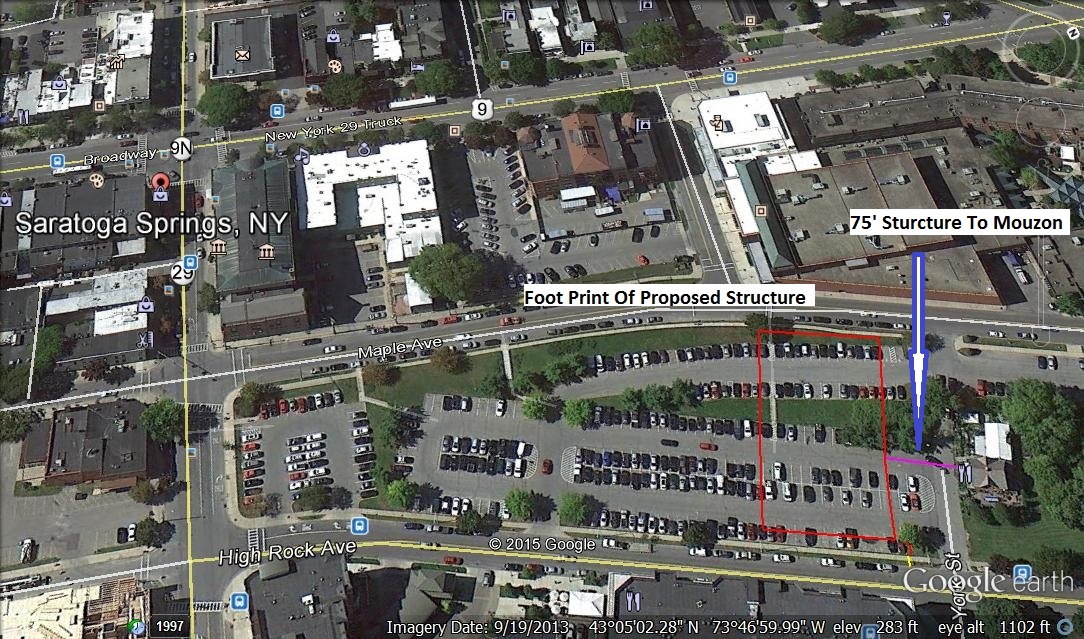
Large Overview

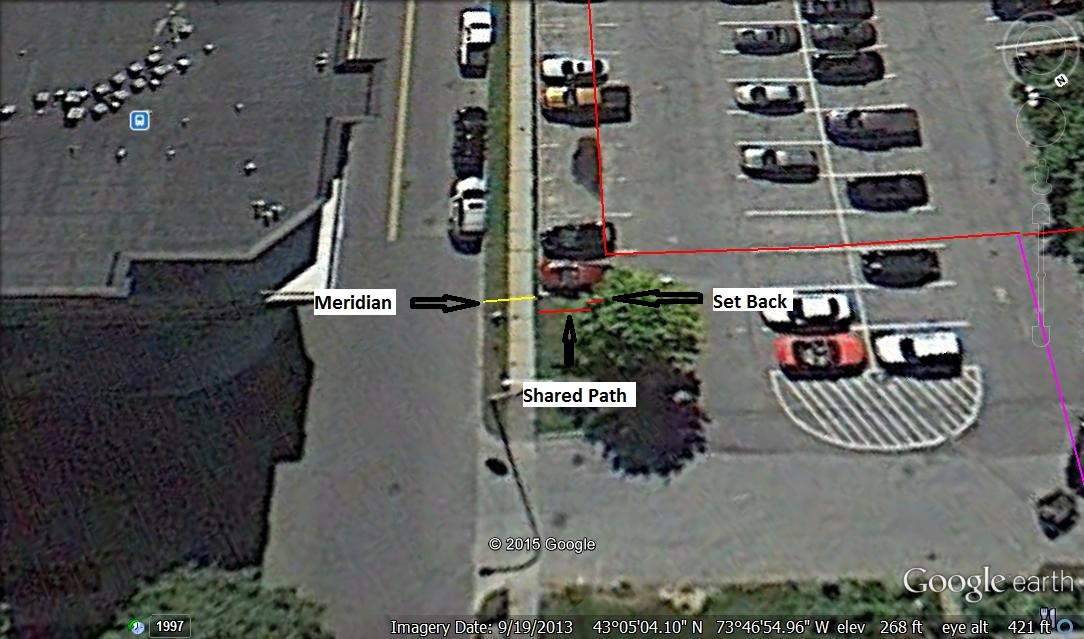
Median - Shared Path - Buffer

Structure And Mouzon House

To properly view these photos double click on them individually

I have great sympathy for the owners of the Mouzon House.  The restaurant business is extremely challenging.  They have worked very hard to build an excellent restaurant whose reputation for the quality of its food and the courtesy of its staff is well deserved.  I can speak from experience.

It is clear that they feel profoundly threatened by the structure being proposed by the City Center and they have campaigned hard to block its development.

In the course of doing so, they have played on many of the common prejudices.  To begin with, the image of a parking garage for many of us, conjures images of cracking walls, dark smelly stairways, ominous and huge towers blocking out the light and huge, threatening edifices.

There is also the image of a large, well funded, government agency ruthlessly crushing its critics and opponents.

None of this is true regarding the City Center and its proposed structure.

The first thing to understand is that because the City Center is a public entity they were not required to go through the normal zoning requirements.  In spite of this, the City Center is pursuing the required approvals by the city’s land use boards as though they were a private developer.

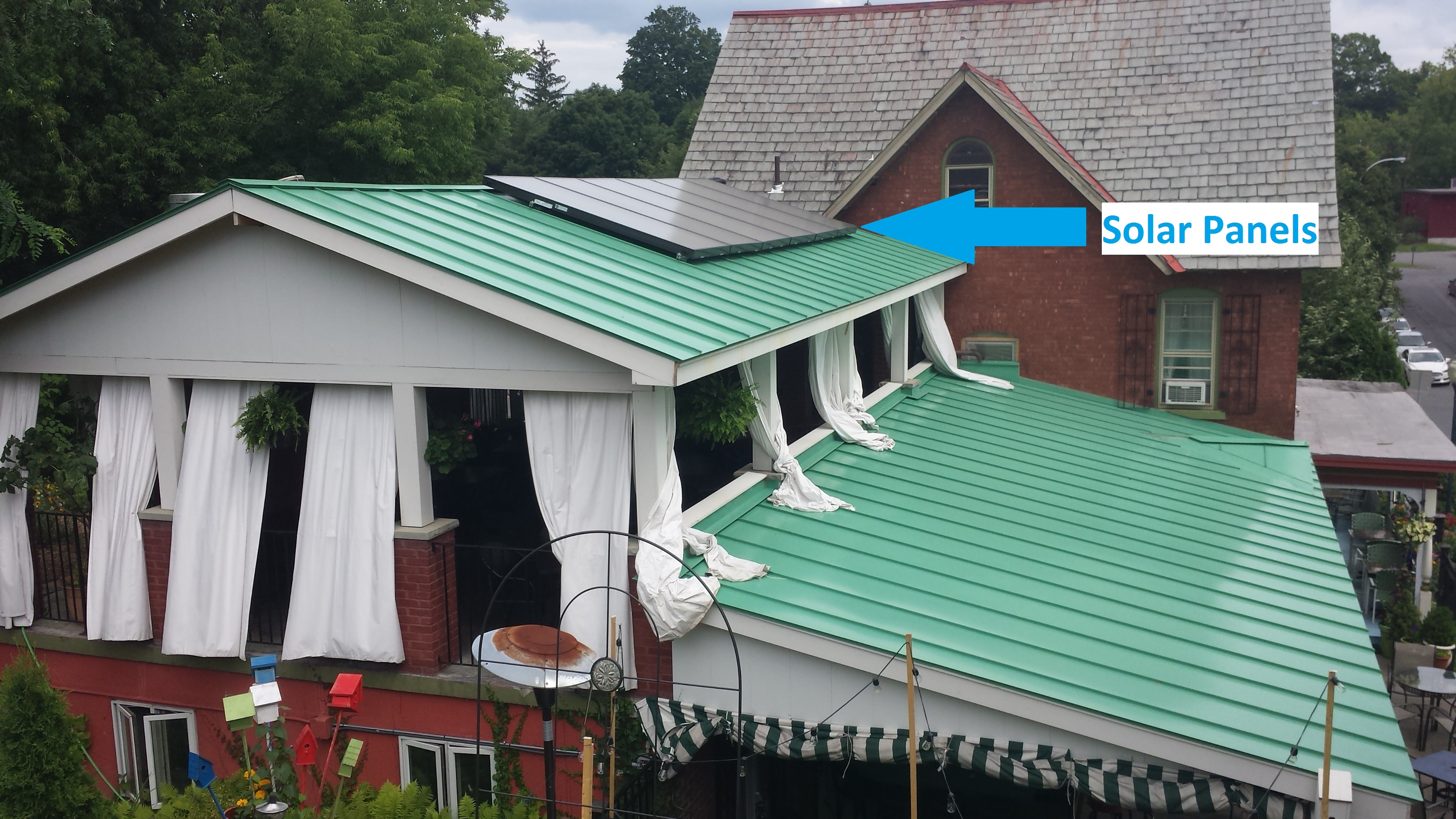
SolarPanels

Then there is the issue of the solar panels on the Mouzon House.  The panels are not photo voltaic.  They are passive thermal panels meant to heat hot water.  The Mouzon House installed these without the required building permits or the approval of Design Review.  A reasonable person in looking at the timing of their construction and their circumvention of the required steps could conclude that they may have been installed as a strategy to throw a legal impediment in the path of the City Center.

The fact that the ordinance regarding solar panels that the Mouzon House used has now been changed does not mean that the decision was retroactive as many of the City Center critics have maintained.  In fact the City Center is still required to go through the Land Use boards for approval.  This is not to say that the change did not greatly benefit the City Center and that their chances of success have not been improved.  I have argued in a separate blog that this change has an important and beneficial impact for all downtown development.  The fact is that the Mouzon House exposed the very serious problems with the existing ordinance.  It is instructive that no landowner in the city core that would be affected by the change spoke against it other than the owners of the Mouzon House.  If the change had been solely to benefit the City Center one would have expected that other landowners who felt they would be adversely affected by it would have come forward.

Some have suggested that the City Center should have offered to put the panels on the Center’s proposed structure but because the panels are thermal and are meant to heat water, this was simply not a feasible solution.  The City Center, in its negotiations with the Mouzon House, continues to discuss options that may help mitigate the impact of the structure to their business.

It is important to put the project in perspective of the needs of the city as a whole.  One of the principals of the Northshire Bookstore made an impassioned plea regarding the need for customer parking. This is the need most commonly expressed by downtown business owners. It is also critical to understand the importance of the City Center in sustaining the downtown.  Most of us do not appreciate how difficult it is for merchants to get through the winter months.  The conventions attracted to the City Center place thousands of people right in our city’s “center.”  The recent expansion of the City Center means more attendees which means more people in town to shop and eat downtown. The planned parking structure is important not only to accommodate the increased volume at the City Center but will relieve the parking crunch for other downtown venues (including the Farmer’s Market) as well.

A Serious Look At the Proposed Structure

So let’s look at what is really being proposed.  Below are a number of photos meant to give people a better sense of the project.  These are meant to expand on photos in an earlier blog that showed renderings of the actual buildings.

We all come at this kind of thing with our own eye, but the footprint of this building shows that while it is a large structure, it is not as large as many people think

The City Center has an excellent record of maintaining its facilities.  It would be a mistake to dismiss the possibility that the proposed building would be allowed to deteriorate but it seems unlikely.

As the photos show, the Mouzon House will not be cheek by jowl with the proposed structure.

The proposal includes a significant buffer to the street in order to plant trees as planned by the City Center.  There is a ten foot grass median from the curb.  There is another ten foot shared biking/walking path and then there is an additional three foot buffer between the path and the structure.  There will not be an imposing prison like wall running along High Rock Avenue.

It is important to remember that this parking structure will be built at no cost to the city with the City Center Authority paying for all operating and maintenance expenses as well. In addition the City Center will be paying an annual lease payment (currently proposed to be $70,000.00) to the city and the city will be receiving a share of the parking revenues (currently proposed to be half) as well as sales tax.

Multi Use Building

This is not to dismiss the current plan to issue an RFP for a multi-use structure.  If the structure can accommodate the parking in the current proposal along with whatever additional parking that the new uses will require, this would be outstanding.  I have expressed my skepticism about all of this coming together but time will tell.

A Civil And Thoughtful Assessment

It is wonderful that people care so much about our city that this project has generated such interest and at times passion.   I have been enormously impressed by the people I know from Sustainable Saratoga.  The city is extremely fortunate that we have a group of such quality working on behalf of our city.  I have also had many interactions with Mark Baker in the recent past.  I have found him to be not only accessible and open but extremely well informed.  I think that the city is fortunate to have him running our City Center.  The point of this post is simply to argue that the proposed project has significant merits that should be considered in our discussions.

ITS BIGGGGG! Draft of RFP for City Parking Lot

I have to give credit where credit is due.  I have gotten a draft copy of the RFP for the city parking lot.  Mayor Yepsen moved right along in drafting something to go out.   Proposals are due September 29th.

Here is the DRAFT 2015 RFP For High Rock Parking Lot Redevelopment

I am reminded of the classic: Be careful what you ask for.

The bid is to sell or lease the entire property between Maple Avenue (West), Lake Avenue (South), High Rock (East), and York Street (North).  That is pretty much the whole enchilada of our available downtown, public property.

This whole thing seems rushed.

I have a number of immediate concerns.

1. The number of parking spaces in the proposed city center structure is 404.  The structure will take up an area that now has 188 parking spaces leaving 263 parking spaces not affected.  So if the City Center were successful we would have a total of 619 spaces.  The proposal asks for a minimum of 600 spaces and clearly, there would be a need for additional spaces for the other mixed uses.   It is important to note that a successful bidder would probably use up all the land so there would not be an opportunity to expand parking there in the future.

2. The RFP would involve either selling or leasing the city property.  Do we want to sell this land so that it is permanently gone for other city uses?  I am not sure, but it would seem to  merit some thought before an RFP is issued.

4. Normally in doing RFP’s the developers are required to provide the earnest money which is meant to insure that they are serious and have some skin in the game to minimize later conflict.   No such money is required in this RFP.

4. Related to item #2 and #3, shouldn’t the city do a market value survey to determine how much the land is worth.  We have already gone through a painful battle over a previous land purchase and sale.  Relying on the proposals from an unknown number of developers who are not required to put up any money creates an opportunity for speculation.