Cutting Through The Public Relations Campaign Of Saratoga Hospital

Saratoga Hospital has done itself little service through a narrative that assumed a trusting, gullible and unsophisticated citizenry.  That revealed, it has only served to create suspicion, generally not a good thing.  The Hospital — which is to say, the community healthcare interests it necessarily represents — would have been better served by being more forthright with this community and adopting a more collaborative strategy for advancing its long-term aspirations.


I have spoken at length with a number of knowledgeable physicians with long histories in the profession.  Some are local doctors, while others have served as institutional medical practitioners and administrators in other municipalities.  The story they tell me is that the emerging trend in the industry, one which we are witnessing here in Saratoga’s environs, is for hospitals to buy the practices of doctors and for these doctors to in turn become employees of the hospitals.  This serves a number of functions designed to benefit both sides of such transactions.


For the doctors, it reduces the increasingly onerous burdens of the administration — the “paperwork” — that inheres in contemporary medical practices.  For example, the requirements of multiple insurance carriers that carry the costs of care in any given practice necessitate increasingly complex and increasingly expensive software to handle billing and record keeping.  Just as important is the need of each practice to effectively deal with the insurance companies that are, to say the least, aggressive in reducing or even denying the reimbursement for services.  Hospitals that employ an army of doctors are in a far better position to negotiate with the many funding sources that their patients necessarily introduce into modern medical practices.  As if participating in a compulsory Darwinian scheme, doctors are thus increasingly forced into working for hospitals.


There is also the increasing cost of the ever more sophisticated technology to actually provide care.  The greater efficiency of shared equipment (and its costs) reduces overhead through aggregated fiscal burdens.


For the hospitals, medical testing is a super powerful engine for generating income, and thus for operational carrying costs, making it essential to the survival of hospitals.  Having hundreds of doctors on their payrolls exposes an economic reality that both requires and incentivizes medical testing by a given hospital.  I am told by the medical professionals I’ve interviewed that medical tests supply the life blood (i.e., money) for today’s hospitals.  Consistent with this model, Saratoga Hospital has been engaged in an ambitious and successful campaign of buying practices in all areas of medicine, from orthopedics to cardiology.  The success of this campaign is reflected in the plainly amazing growth of our Hospital; be it a bricks-and-mortar project or acquisition of the aforementioned areas of specialization, the trend is as obvious and irresistible as gravitational pull.


This is meant as no criticism of the Hospital but it forces a reckoning: this strategy is driven by economics rather than care considerations per se.  Clearly, it seems, for it to provide care, our Hospital must have adequate financial resources and, given today’s “health care” system (I use the term health care with bitter irony), the Hospital is compelled to adopt an operational and strategic template which effectively (and perhaps necessarily) dictates both the climate and the menu we have before us.


Forwarding to the present debate, Saratoga Hospital representatives argue that building a new set of offices close to the main facility — the mother ship, if you will —  will likely save some information technology costs.   Whether in the long term it will do that, and how much it will save, is necessarily an open question given that every design may be influenced by competing ideas and consequent choices.  The sheer scale of operating costs suggests it is a fair question to ask for more information bearing on the proposition advanced: namely,  that the savings and community benefits will be sufficiently great to justify material alteration of old Saratoga neighborhoods.


The above notwithstanding,  I’m here to suggest this:  what it will not do is improve the coordination of care.  The patently absurd fantasy promoted by the Hospital — that these doctors will be meeting together to better coordinate the care of shared patients — is utterly transparent, and certainly not self-evident as a logical proposition.  Most of us have been touched by the problems of acute and complex illness whether in our own lives or in the lives of the members of our families and friends.  We have seen firsthand how little communication there is between doctors in different specialties.  Oncologists meeting with cardiac doctors over balancing the needs of a patient with cancer and heart disease?  There are a few places that provide this kind of tightly-coordinated medical care, in institutions like the Mayo Clinic, but they are in the experience of most people an exception rather than the norm.


There is a nascent specialty in medicine in which certain medical professionals are called “hospitalists.”  They practice medicine in a variety of specialties and they work entirely in the setting of the hospital.  They are the ones that you see most of the time when you are admitted to the hospital for care.  You may be operated on by a surgeon that you select who has privileges at the hospital but the general care you will receive will be done by these hospitalists.  Commonly, these people work three twelve hour shifts a week.  This creates problems with continuity of care because a patient will see whichever doctor is on call that day. The physician and support staff in turn would presumably not regularly meet with off-day staff, but more routinely read charts at their disposal to guide them.  For many years, predating computers and hospitalists, physicians have quipped, “one doesn’t go to a hospital to get well”.  Even if the verity of that irony is inescapable, the people in this community may demand a credible assurance that we are planning and designing something better than we had before, and not simply dressing up an old problem in new clothes.


So I recognize and accept an honest argument about why Saratoga Hospital needs to provide the best environment they can to attract individual doctors and practices.  I can also understand why they found the land owned by D.A. Collins near their facility so attractive.  What I do not accept is that their convenience (rather than the real care of patients) seemingly trumped the needs of their neighbors or the city.  There are other places they can find to address office space expansion.   Close proximity to the Hospital is not essential in this age of telecommunications and in a city where traffic, while irritating, is not an enormous obstacle.


The Hospital has confused the enormous power they have with the assumed righteousness of their cause.  If they had been up front to begin with — which is to say, had the Hospital engaged its own community — about their need to find a good place to put their offices in this area and to develop a plan, this conflict (or the intensity of it) might have been avoided altogether.  They have only themselves to blame for the enormous waste of resources they put into a plan that is dead, at least for the immediate future.


The failure of Saratoga Hospital to embrace Commissioner Mathiesen’s call for reassessing the Comprehensive Plan to come up with a sound strategy only serves to show how little they have learned behind closed doors.  Of course, it is possible the hospital will use its considerable economic and political muscle to force something on another group.  Admittedly, this is skepticism borne of experience in this matter, and thus I am not hopeful.
Mathiesen’s Attempt To Have The Council Reconsider The Comp Plan Regarding The Hospital Expansion Fails

The issue of the Saratoga Hospital expansion was discussed at Tuesday night’s City Council meeting on Commissioner Michele Madigan’s agenda and on Commissioner Chris Mathiesen’s agenda.

When Commissioner Madigan’s turn came to give an update on the hospital expansion, Joanne Yepsen immediately recused herself and left.

John Franck chose to make a statement. He gave a history of his relationship to the players who were in conflict with the hospital.  He has, for many years, provided accounting services to the Birch Run Homeowners Association and to the Special District set up for Birch Run.  Similarly he has represented the Morgan Street Home owners association and the special district there.  He estimated that over the years he has had income from the work for them of approximately $42,000.00.

He noted that he had recused himself 31 times over the course of his period in office.

He said that he began to think about the recusal issue months ago and that although he participated in the hearings, he did not take calls from the parties of the conflict.   He said that he contacted the Mayor shortly before the meeting where he recused himself to advise her at which time she told him that she was considering recusing herself as well.

I am still unclear about why he waited as long as he did to recuse himself but having said that, I think that his decision was entirely understandable and appropriate.  He then left the meeting.

Commissioner Madigan then expressed frustration that the Council was unable to consider the PUD.  She told the Council that she believed that if it had been allowed to go forward that the Council could have come up with a compromise that would have satisfied both the hospital and the neighbors.  She then asked that Vince DeLeonardis, the city’s attorney, to review with the Council the neighbors’ petition.

Mr. DeLeonardis described it as a “protest petition.”  Basically, if property owners, whose parcels abut 20% of a property that is being considered for rezoning, oppose the change then it requires a super majority of the City Council to enact it.  In this case he explained that five properties along Morgan Street and one property along Myrtle had filed the petition.  They constituted 100% of the abutters. He further noted that the petition had a technical problem which had to do with the way the signatures had been “witnessed,” but that in the end the neighbors would prevail with their petition.  He noted that a vote on the PUD would be pointless because a super majority would require four votes and that due to the recusals there were only three possible votes.

Commissioner Mathiesen expressed the hope that the hospital would withdraw its proposal.  He said that he had been in conversation with the hospital and that he understood they were already looking elsewhere.

There was no vote scheduled currently.

Commissioner Scirocco agreed with Commissioner Madigan that he believed it was unfortunate that the proposal was dead because he too believed that a compromise was possible.  He offered that it was a worthwhile project that enjoyed his support.

I would note here that the neighbors who were attending the meeting expressed extreme skepticism about the viability of a serious compromise given the scale of the project and the limited land.

Commissioner Mathiesen repeated his concerns.  He particularly noted that it would double the traffic in the neighborhood.  He noted that the Hospital could modify their PUD proposal and come back to the Council.

Commissioner Madigan then noted that PUDs are a powerful tool for development in that they give the Council wide discretion and authority over a project.  In a troubling aside she noted, “this is one of the reasons people pitched the idea of the PUD for the greenbelt.  The city would have all the control of what could be in a PUD in the greenbelt and what could not be.”  I found this both odd and troubling.  Commissioner Madigan had been part of a unanimous decision to preclude PUDs from the greenbelt.

The value of a PUD assumes that a more intensive use of a piece of property than is normally allowed by the existing zoning is appropriate.  There was a clear logic as to why the council disapproved PUDs for the greenbelt: they did not want any intensive development to occur in the greenbelt.  The key issue here is similar to that of the greenbelt debate.  The neighbors are arguing that the more intense development being proposed by the hospital would be detrimental to the adjoining neighborhoods.

Commissioners Madigan and Scirocco believe that it is possible to come up with a PUD for a large medical offices building and parking that would be acceptable to the neighbors.  Clearly, the neighbors do not, in light of where the land is, see any way to build such a large facility without undermining the quality of life in their area.

Later, as part of Commissioner Mathiesen’s agenda, he proposed that the Council revisit the designation in the Comprehensive Plan that had changed to allow for institutional construction for the hospital.

Again, as the discussion turned to the hospital expansion, Mayor Yepsen and Commissioner Franck who had returned to the meeting by this time, recused themselves and left the meeting room.

After they had left, Commissioner Madigan said that she understood why Commissioner Franck had left but was “not sure” why the Mayor had recused herself.  She did not elaborate.

Commissioner Mathiesen’s argument was fairly simple.  He said he did not find fault with anyone but that the process by which the land was changed to institutional for the hospital had missed him.  He said that it was unfortunate that a change whose impact was so significant to the neighbors had somehow been done without their opportunity for input.  His proposal was to have  a full airing of the issue and following that to consider whether to reverse the status of the controversial property in the Comprehensive Plan.  He expressed concern that the process had failed to insure that the affected neighborhoods had been appraised of the possible change and involved with the consideration of the change.

Commissioner Madigan took exception with this.  She noted that the Comprehensive Plan review had been an open process that went on for eighteen months.  She noted that when the Comprehensive Plan  Committee approved the change to the map there was no disagreement.  She said that she did not see how people missed this because she was aware of it through her reading of the documents.  She had Brad Birge confirm that it was in the body of the document and not one of the fifty-three suggested amendments.  She noted that the decision was made on November 17th.

Commissioner Mathiesen countered that given what we have learned from the community, it makes sense to reconsider the issue with the newly raised concerns of the neighbors as part of the process.  In Brad Birge’s remarks he noted that two of the three parcels that had been changed to allow institutional development were owned by D.A. Collins.  The hospital has an option on these properties contingent on approval for the project.  It is a very small world.  D.A. Collins was a key organizer in creating the Saratoga PAC and Robert Manz, CEO of D.A. Collins is the chair of the PAC.  The CEO of Saratoga Hospital, Angelo Calbone is also a member of the Super PAC.

It was also noted that the third parcel was a piece of land donated to the hospital.  According to Matt Jones, the hospital plans to sell this parcel.

Madigan argued against re-opening the issue.  She noted that if they did re-open this change in the Comprehensive Plan that it would open up other issues.  She particularly noted that she would expect the issue of PUDs in the Greenbelt would probably come back.   I was troubled by Commissioner Madigan’s reference to the PUD question in the Greenbelt.  Unlike the hospital expansion, that issue was thoroughly and very publically discussed.  It enjoyed a very high profile as compared to the hospital expansion and it was unanimously rejected by the Council.

Skip Scirocco also spoke against re-opening the issue.  He said it would be a Pandora’s box.

As there was no motion on the floor, the discussion simply ended and Mayor Yepsen and Commissioner Franck returned.


Blogger Meets With Saratoga Springs Ethics Board

I met this evening (Monday February 1) with the Ethics Board.  They allowed me to submit my statement prior to the executive session at which they would discuss my allegations.  The following was my statement.

==========================================================================

Statement To The Saratoga Springs Ethics Board

February 1, 2016

In my conversation with Justin Hogan, the chair of the Ethics Board, I was unable to clarify the issue of whether the appearance of a lack of impartiality could require a member of a land use board to recuse themselves.  It appeared that the only way to address the issue was to bring a concrete example to the Ethics Board for their consideration.

In the case of both Tom Lewis and William Moore, Bonacio Construction is building the former’s home and recently completed work building the latter’s home.

I believe that both these men should have and should in the future recuse themselves from matters involving Bonacio Construction because these transactions create the appearance that their respective impartiality could be compromised.

My review of the ethics code is that the only possible basis of such a recusal would be under section 13-3 B, item 1.d.

On Page 4

13-3

Section B

Item 1

“(d) The foregoing City officers and employees are listed due to the unique nature of their offices and positions which, in turn, raise ethical conflicts unique to those offices and positions. This list is not to be deemed all-inclusive. Every City officer and employee shall endeavor to pursue a course of conduct consistent with the spirit of this Chapter as well as the actual provisions and strive to act so as not to raise suspicion among the public that he or she is likely to be engaged in activities that are in violation of his or her trust.”

It would seem that the standard would require showing that the person is “likely to be engaged in activities that are in violation of his or her trust.”  This would be a very difficult standard to establish so I come here with very low expectations that the committee will pursue the inquiry I have submitted.

My greater purpose is to demonstrate that the current standards for impartiality are inadequate. 

This city should strive for the highest possible ethical standards. 

Bonacio Construction regularly comes before the two boards these men sit on.  The decisions these boards make can have enormous financial impacts on Bonacio Construction.

The issue as regards Mr. Moore and Mr. Lewis begins with the opaque nature of their business relationship with Bonacio Construction. 

The public is unable to ascertain whether the original price that was agreed upon to build these two men’s houses involved the true cost of the construction.  After all, houses are not simple commodities such as items at a hardware store where a comparison would be a simple matter.  This of course assumes that these gentlemen were to make public what they have paid for their respective homes which they are not required to do.

Even assuming that it did originally reflect the true cost, if you have ever had a house built you know that the original price is usual subject to change due to the unanticipated problems attendant in construction.  Some haggling over what should or should not be considered a change order and when additional fees are appropriate are common sources of conflict.

In the case of Bonacio Construction, these negotiations would take place with Bonacio Construction being acutely aware that they will be going before the boards these two men sit on.  Were there to arise a conflict over the cost of the work, Bonacio Construction would have to worry that the cost of a bitter dispute over what may be a modest amount of money would be unwise given the much greater sums are at stake when Bonacio Construction appears before the land use boards.

The relationship between the customer and the builder in these cases is inherently problematic.

I offer as proof just how serious an appearance of the risk of impropriety these two cases involve, that the Times Union, the largest newspaper in the region, ran a front page story on this.

If the existing ethics code does not cover these two cases, It is my hope that the board will share my concern that they serve to undermine the public trust in our land use boards and as such our city’s code of ethics needs to be strengthened.

============================================================================

The executive session proceedings are by definition held outside of the public purview.  While I cannot share the substance of the discussion, I can say that I felt that the board treated me with courtesy.  The nature of their comments was thoughtful and probing.  I felt that I was provided a serious hearing.

I have low expectations regarding any significant action regarding William Moore and Tom Lewis due to the weakness of the existing Saratoga Springs Code of Ethics.  I do think that the board appeared open to reviewing the code in light of our discussion.

They will be issuing an advisory opinion and I will share it to the readers when I receive it.


Excuse Me, Mr. Bonacio, I do not believe that belongs to you.

Sonny Bonacio seems to have become the celebrity developer.  Unfortunately, for Sonny, the coverage is not always favorable.

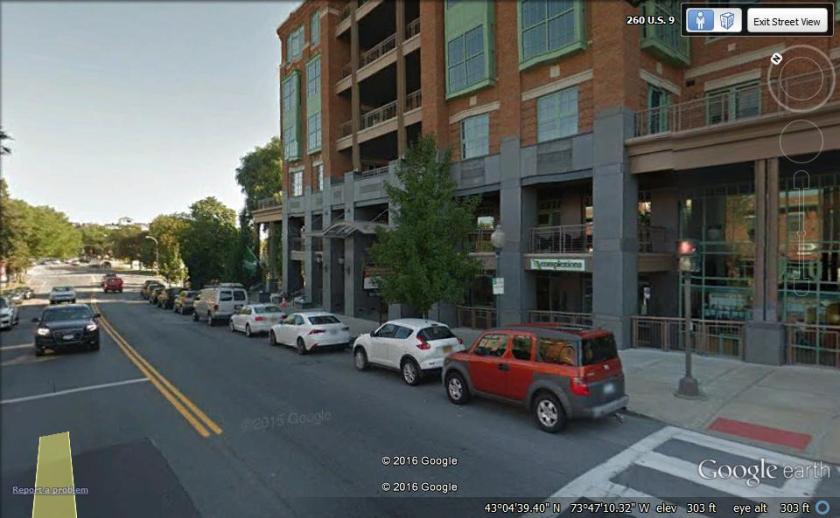
Mr. Bonacio, in a joint project with Roohan Realty, built a super expensive set of condos at 268 Broadway immediately adjacent to Congress Park.  Rumor has it that one of the tenants is a sheik from the Middle East.

268 Broadway street
268 Broadway

268 Broadway

Apparently, when the structure was built, it encroached on to city owned land including  Congress Park.  There apparently were two different encroachments that will now require post facto easements or changes in what occupies the land.

Dennis Yusko broke the two stories on this and I include them with this post.  I am just adding a few items to help fill in the stories further.

Transformer From Above
Transformer Location
Transformer
National Grid Transformer (Doesn’t look like it is underground)
Park From Transformer
View Of Park From Tranformer

One of the problems has to do with a large transformer that was required to provide electricity to the Bonacio structure.  At a City Council meeting some time in 2006, Commissioner Thomas McTygue asked for an easement for the transformer.  In the brief discussion it was presented as a request from National Grid to place it “underground.”  Mr. McTygue remembers it as a request by National Grid to replace a power pole.  It passed the Council unanimously.  As it happens, National Grid placed it on top of a slab on property that was part of our park which is under the New York State Parks and so required approval from the New York State Legislature.

Walkway and Patio
Walkway and Patio
ParioCanfield
View of Canfield Casino From Patio
Walway Toward Canfield
View Of Canfield Casino From Walkway


The other piece of land involves a patio and walkway adjacent to the Bonacio building that encroaches on city land.  There was no request by Bonacio and Roohan for an easement and none was issued.

It is important to note that in the Planning Board minutes back on September 13, 2006 they record that  “Sonny Bonacio said there would be no penetration to the park but there would be glass there.” 

At another point in the same meeting “Amy Durland asked where the park actually was on the site plan.  Sonny Bonacio showed the board the property line.  Amy Durland asked if the proposal currently went into the park.  Mike Ingersoll [Bonacio’s architect with the L.A. Group] clarified that the project is only on their property.”

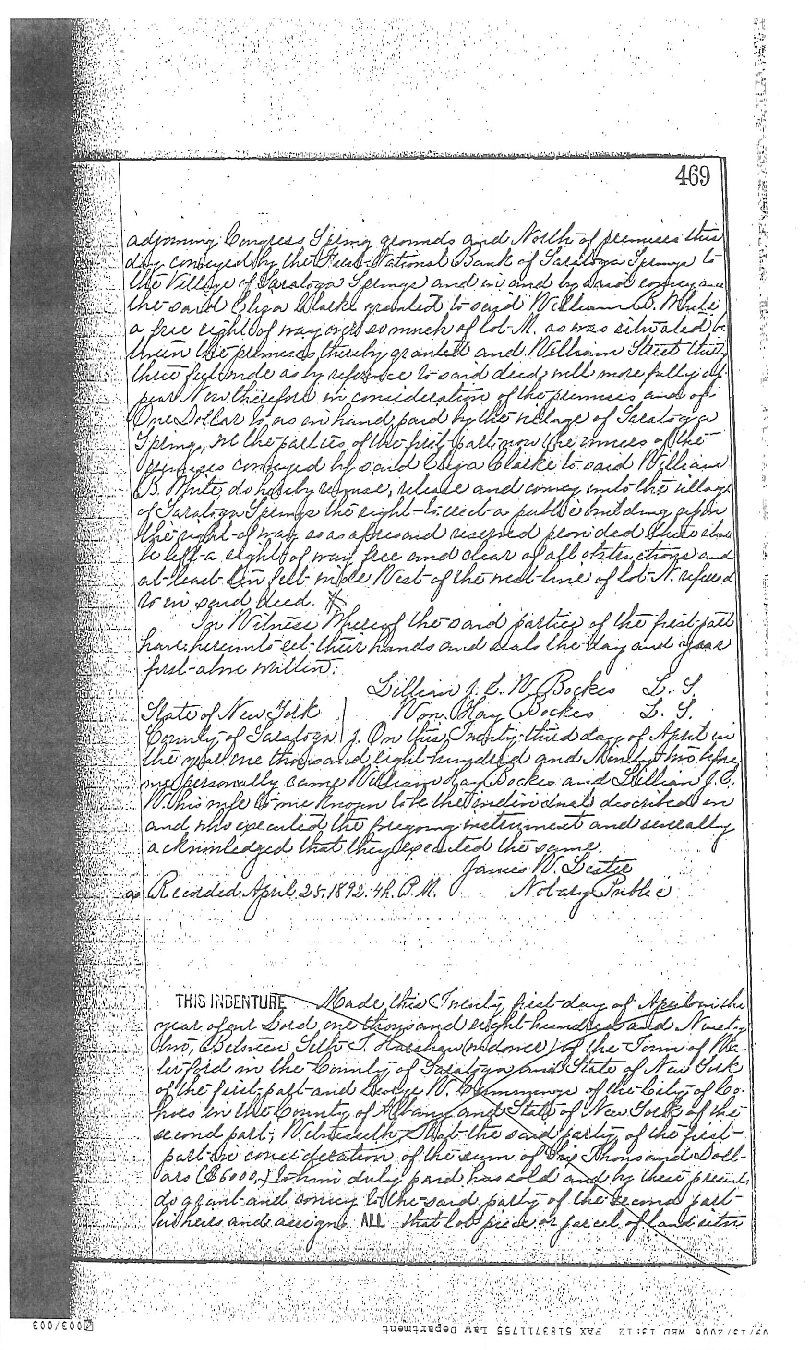
More recently, after the issue of the apparent infringement arose, Kieth Ferrar, Bonacio’s attorney claimed that a hand written deed they had was the basis of their claim to the land now in dispute.  It is noted in the minutes of the meeting that “Keith provided a deed from 1892 (which is very difficult to read)…”

I would say that hard to read is something of an understatement.

4 26 1892 Deed-2
Deed Page #1
4 26 1892 Deed-1
Deed Page #2


More recently in April of 2015, when the City’s Realty Board began to try to untangle this mess, in a rare moment of candor, Keith Ferarra, attorney for Bonacio  is quoted in the minutes as follows: “Keith Ferrara was asked how the easement came to be and he responded saying ‘Just did it, ask for forgiveness, Let’s see how it turns out.”  Later, Mr. Ferrara said he could not remember saying this.

Here are Dennis Yusko’s articles.


Exclusive: Bonacio seeks easement at Congress Park in Saratoga Springs

By Dennis Yusko on April 27, 2015 at 5:24 PM

Bonacio Construction has requested an easement from the city on a piece of Congress Park that the company may have encroached upon while building its Park Place condominium project, according to city records.

The company recently applied for access rights to an approximately 300-foot by 25-foot piece of city-owned parkland behind 268 Broadway, where it built a concrete patio and walkways, city officials said. The Saratoga Springs Real Estate Board is reviewing the easement request, which Bonacio Construction recently submitted after completing work on the six-story, 215,000-square-foot complex, according to Mayor Joanne Yepsen.

“They may need an easement to approve walkways and landscaping they did on park property,” Yepsen said when asked about it.

Congress Park is listed on the National Registry of Historic Places, and the City Council and state Legislature could make the final decisions on Bonacio’s land-use request, the mayor said. The Park Place building itself does not infringe on public land, according to city officials.

Bonacio Construction received city approvals to build the residential and commercial project along Congress Park and Broadway in 2006. Now, nine years later, questions about an easement — a legal right to use someone else’s land — have surfaced.

“After reviewing the plans, there is considerable property involved, and more investigation is needed to determine what the impact is,” Real Estate Board members said of the easement request, according to minutes from its March 5 meeting.

At the board’s next monthly meeting on April 2, Keith Ferrara, chief operations officer for Bonacio Construction, suggested that a 123-year-old property deed handed down from a previous landowner included an easement to build on the piece of Congress Park.

However, according to minutes of the meeting, when he was asked how the easement on Congress Park came to be, Ferrara had responded, “Just did it, ask forgiveness — let’s see how it turns out.”

Reached by phone last week, Ferrara said he didn’t remember saying it that way and said he thought the company’s work on a “unusable” portion of the park was permitted through the 1892 deed.

Bonacio Construction is not offering money or land in return for the easement, Ferrara said. “This is just taking a 100-something-year-old easement and cleaning it up,” he said.

The Real Estate Board, a little-known advisory committee, is chaired by City Attorney Vince DeLeonardis. Other voting members are Kameron Klippel, the city’s receiver of taxes, Brad Birge, administrator of planning and economic development, Tony Popolizio, the assistant assessor, and city police Officer Kevin Veitch.

DeLeonardis said the old property deed was handwritten and difficult to read, and the Real Estate Board must investigate if the document authorized the company to use parkland, or if additional approvals were necessary. The board is also looking into an anonymous claim that a city official or officials verbally approved an easement at the construction site years ago, DeLeonardis said.

“Right now we are in the preliminary stages of finding facts,” DeLeonardis said. “It’s important to note parkland is impressed with the public trust for the benefit of the people and state, and the use of land for anything other than park purposes requires approval of the state Legislature.”

Asked why the project never received state approvals, he said, “That’s a good question, and we’re looking into that now.”

The city approved Park Place in 2006. The Planning Board voted to allow the Design Review Commission to serve as lead agency in an environmental review process. The commission decided the project would not have a negative environmental impact on the surrounding area, but required the company to hire an archaeologist to monitor excavation of the site, according to city records. The project changed slightly as it evolved, DeLeonardis said. “Right now, we really have more questions than answers,” he said.

The Real Estate Board is expected to continue to discuss the easement application at its next meeting on May 7.

Bonacio’s project extended into Congress Park, Saratoga officials say

Areas of condo site violate boundaries of park, city land

By Dennis Yusko

Published 7:49 pm, Thursday, January 21, 2016

Saratoga Springs

Bonacio Construction encroached on state parkland and city property with a six-story condominium project it built along Broadway and Congress Park, and the city may need action from the state Legislature to correct part of the problem, city officials said.

A recently completed land survey determined the construction company built on taxpayer-owned land behind the 215,000-square-foot Park Place building, and a National Grid transformer that serves the building sits on a small section of bordering Congress Park, which is owned by the state, Public Works Commissioner Anthony Scirocco announced at Tuesday’s City Council meeting.

Further review of the project, which the city approved in 2006, revealed the City Council voted in 2007 to provide National Grid an easement to build the utility transformer behind the condominiums, City Attorney Vince DeLeonardis said. The city granted the easement for $1, according to a copy of the agreement, on land that it doesn’t own, according to Scirocco.

“There’s no way the City Council can grant an easement,” Scirocco said Tuesday. “The only way the easement can be granted is through the state Legislature because it’s state historic property.”

What land was used to complete Park Place became an issue last year, when the city engineer’s office noted potential land encroachments behind the building while reviewing final as-built drawings for the project. Bonacio Construction then requested an easement from the city on an approximately 300-by 25-foot piece of city-owned land behind 268 Broadway, where it built a patio and walkways as part of Park Place, according to city officials.

Scirocco had a land survey of the area completed to delineate exact boundaries. Performed by Environmental Design Partnership, the study found small segments of Park Place intruded on parts of city and state land, DeLeonardis said. He gave two examples: the National Grid transformer and a fenced-in picnic and barbecue area that was built on city property between the Palio and Holiday Inn buildings.

The Park Place building itself does not infringe on public land, DeLeonardis said. He said there had been some confusion over the park’s boundaries because the Broadway portion of a wrought-iron fence that surrounds the park and is thought to denote property lines was removed years ago, possibly during a major fire. City officials reviewed a number of old maps, documents and deeds to determine boundary lines with the help of Bonacio employees, DeLeonardis said.

The Saratoga Springs Real Estate Board was reviewing Bonacio requests for easements on city land that was used. But Congress Park is listed on the National Registry of Historic Places, and using it for anything other than park purposes requires approval of the state Legislature. The city is potentially looking at having to get authority from the state to allow the National Grid transformer to remain on Congress Park, or undertaking efforts to relocate the station, DeLeonardis said.

National Grid spokesman Patrick Stella said the company was open to moving the structure. A spokesperson for Bonacio Construction could not be reached.

dyusko@timesunion.com • 518-454-5353 • @DAYusko


Commissioner Madigan To Report On Status Of Hospital Expansion: Proposal Still Undergoing Changes

From: Michele Madigan []
Sent: Saturday, January 30, 2016 2:19 PM
To: John Kaufmann
Subject: Saratoga Hospital PUD Amendment

John,

Regarding the Hospital PUD Amendment:  I did indicate at the last Council Meeting that I was moving toward bringing the Hospital PUD Amendment forward to the three remaining Commissioners for a Discussion and Vote.  However, at this time, I find that we do not have accurate updated language for the PUD Amendment and until we receive accurate language from the City Attorney, City Planning Department, and the Applicant I cannot bring this forward to the Council for a Vote. My office has been working diligently to address this for the past two weeks, but there are still some inaccuracies in the legislation that require input form the City Planning Dept. so the legislation is not yet complete.

Additionally, it has come to my attention that a petition has been filed by residences in opposition of the Hospital PUD Amendment, but I have not officially received the formal petition and therefore have not had a chance to review the petition.

I plan to add a Discussion item to my agenda on Monday morning at the City Council Pre-Agenda Meeting and hope to gather more information so I may fully inform the public as to the status of the Saratoga Hospital PUD Amendment.

Thank you,

Michele Madigan
Commissioner of Finance

Hospital Expansion Dropped From City Council Agenda

The City Council process is to distribute a tentative agenda on Fridays.  On Mondays the Council meets to discuss this tentative agenda in order to finalize it for Tuesday’s meeting.

This is a link to that tentative agenda. Commissioner Madigan had originally said the hospital expansion would be discussed and voted on at this Tuesdays Council meeting.  That item does not appear on her agenda. http://www.saratoga-springs.org/AgendaCenter/ViewFile/Agenda/02012016-1243


Hospital Expansion Blocked: Another Neighborhood Demonstrates The Power Of Community

[I received this release this afternoon]

For Immediate Release

January 29, 2016

Re: The proposed rezoning for Saratoga Hospital Expansion

Contact:

Mr. Andy Brick 489-9423, Counsel representing the residents of neighborhood

Mr. Jack Despart 239-273-7931, Morgan St. Neighbor

On Friday afternoon, January 29, 2016, attorney Andy Brick, acting on behalf of the residents of Morgan St., Myrtle St., Seward St, Woodlawn Ct., and much of Birch Run filed a protest petition at Saratoga City Hall requiring the City Council to pass the Hospital-requested proposed rezoning legislation with a super majority, or 4 out of 5 votes. Normally legislation would be passed with a Council majority of 3 out of 5 votes.  Saratoga Hospital would like to expand it’s PUD into the residential area of the Northern part of Morgan St.  The neighborhood would like to keep this area zoned residential.

The Protest Petition City Ordinance Section (10.2.8.1) is a mechanism residents can use when they do not want to see rezoning happen in their neighborhood. If a petition is filed, 4 affirmative votes are needed to pass the rezone.

“The residents not only provided enough signatures, but they also provided signatures from just about the entire residential neighborhood,” stated Andy Brick, attorney representing the residents. He continued, “We have not only met the criteria in order to force a super majority vote by City Council, but we surpassed it.”

Because two members of the City Council have officially recused themselves, citing conflicts of interest, the City Council only has 3 possible votes and therefore is unable to obtain the 4 votes necessary to pass the rezoning legislation needed in order for the Hospital to expand into the residential neighborhood.

“This is a case of David beating Goliath,” said Jack Despart, Morgan St. resident. He continued, “When we first heard of this expansion, everyone told us we couldn’t win, the Hospital has too many resources and connections, and we didn’t have a chance.  But, we came together as a neighborhood and a community and it worked.  I’m so proud of our neighbors, each and every one of them.”

Despart further explained, “We all want the best for the Hospital and the community but we honestly feel the Hospital failed to recognize the rights of its neighbors and that makes many of us very disappointed. There are several other alternatives already situated within commercial zoning and within a close proximity to the Hospital, which were never properly explored.”


Blogger Files Complaint With City Ethics Board Re: Moore and Lewis

I decided to follow-up on the recent Times Union article that focused on Tom Lewis, member of the Saratoga Springs Planning Board, and William Moore, chair of the Saratoga Springs Zoning Board of Appeals regarding  issues of recusal.

I contacted the chair of the city’s Ethics Board to better understand what the standards for recusal are for Saratoga Springs land use board members.

Justin Hogan is the Ethics Board chair.  Here is a link to his biography from the website of J Strategies Link To Bio where he is employed.  J Strategies appears to be a hybrid public relations/lobbying/media consulting firm.  For a number of years Mr. Hogan worked for the New York Senate “members’ services” office.  Both the Democratic New York State Assembly and the Republican dominated Senate have these offices.  It is common knowledge that these two offices basically are political operations meant to help elect the members.  They sail very close to the wind so to speak.  Mr. Hogan was also the political director for Republican Jeanine Pirro’s 2006 failed campaign for Attorney General.  Back in 2004 he was field director for the Bush/Cheney campaign in West Virginia and the head of media operations for the Republican convention that year.  Most recently, and before taking his current job, he was Director of Development for the Rockefeller College of Public Affairs & Policy at the University at Albany.

Lest my Republican friends think I am going after them, J Strategies president, Jaime Venditti was an analyst for Democratic Speaker Sheldon Silver.  Following that she was “the Vice President of a Central New York government affairs firm where she oversaw the management of all clients. Jaime was responsible for all client media campaigns ranging from media tours, event planning, press conferences, editorial boards, and media placement. In addition, she managed the firm’s lobbying, legislative affairs and public relations efforts for many of the firm’s corporate and not-for-profit clients.”

There is nothing partisan about J Strategies…

Mr. Hogan was originally appointed as chair of the Ethics Board by Mayor Scott Johnson in 2009.  Most recently he was reappointed by Mayor Joanne Yepsen.

On Wednesday, January 27 I spoke with Mr. Hogan on the phone.  As you might expect he is quite affable but trying to clarify the city’s ethics codes was something of a challenge.  I was able to clarify a very few things.  First, the Ethics Board’s opinions are only advice.  The board has no enforcement authority.  Second, they have subpoena power but it has never been used.

When I tried to clarify if there were circumstances in which the appearance of a lack of impartiality would require recusal I found myself in a verbal maze with Mr. Hogan.  When I raised the question about whether a board member would have to recuse themselves if their best friend appeared before them, he responded about how it is a small town and everyone knows everyone, and in the famous words of Jerry Seinfeld: yada yada yada.  So I asked him what he would do if he were on a board and his best friend came before that board.  I never could get an answer.  As for the issue of Tom Lewis, his house that Sonny Bonacio is building, and Bonacio’s appearances before the board that Lewis is on, Mr. Hogan’s first response was that we lacked the facts.  I pointed out that it was unlikely that we would be able to determine whether Bonacio had done anything special for Mr. Lewis.  I also noted to him, as proof of the “appearance” of a potential lack of impartiality, the front page story in the Times Union.  He then indicated that the only way he would answer that question was if it was formally submitted to the Ethics Board.

So Wednesday, January 27th I formally submitted the appropriate inquiry form to his board regarding Tom Lewis and William Moore.  This will at least clarify for me and for the public whether these cases involving Lewis’ and Moore’s refusal to recuse themselves have violated the city’s ethic code.

Subsequent to our conversation I received the following email from Mr. Hogan:

From:      Justin Hogan [justahogan@yahoo.com]

Sent:       Wednesday, January 27, 2016 2:06 PM

To:          John Kaufmann

Subject:  Re: Board of Ethics

Mr. Kaufmann,

To follow up on your question regarding the code of ethics and the conduct of City employees and officers please see section 13-3 B. (d), http://www.saratoga-springs.org/DocumentCenter/Home/View/3948. I have also pasted the section below. Please let

me know if there is any further information I can provide or if you have any more general

questions about the ethics board and procedures.

Sincerely,

Justin

(d) The foregoing City officers and employees are listed due to the unique nature of their offices and positions which, in turn, raise ethical conflicts unique to those offices and positions. This list is not to be deemed all-inclusive. Every City officer and employee shall endeavor to pursue a course of conduct consistent with the spirit of this Chapter as well as the actual provisions and strive to act so as not to raise suspicion among the public that he or she is likely [my emphasis] to be engaged in activities that are in violation of his or her trust.

====================================================================

The standard seems to be that one must show that the person is “likely to be engaged in activities that are in violation of his or her trust.”  Proving “likely” would seem to be an unnecessarily high hurdle to get over.

I know that it is difficult to draw the line at what point one’s closeness to another person becomes a problem.  I am reminded of the problem the legal community had in dealing with the outlawing of pornography.  I know that one wag put it well when they said, “I do not know how to define pornography but I know it when I see it.”  I would say the same about the appearance of a lack of impartiality.

Reprint Of Jennie Grey Story On Moore’s Violation of Zoning Ordinance

[Some readers had problems navigating the Saratogian and asked that I post the story]

Zoning Board chair’s home project questioned

Neighbor: ‘violation is an abuse of power, disregard of the authority of the board’

Moores House

By Jennie Grey, The Saratogian

Wednesday, January 27, 2016

SARATOGA SPRINGS >> When the chair of a land-use board comes before that very board with an application of his own, the other members are left to sort out any issues and make a fair evaluation. Lately, that’s been challenging for the Saratoga Springs Zoning Board of Appeals (ZBA), since its chair, William Moore, has sought an area variance modification for the home office above his detached garage.

Some neighbors have approved, and some have objected, as seen at the board’s Jan. 25 meeting, when Moore’s application came before the members.

Moore’s house and garage are located at 75 South Franklin St. in the Urban Residential-3 District. He uses the finished space on the second floor of his garage for his business, The Appraisal Company, of which he is president. Having hired one employee, an assistant who works out of the space where Moore applied to modify his variance.

Vice Chair Keith Kaplan presided over this agenda item when Moore recused himself. Moore stepped out into the hall to let the other board members have discussions and make decisions without his presence.

ZBA member Susan Steer questioned whether having a home occupation, such as this business office, was permitted in an accessory structure like a garage. Kaplan read aloud the requirements a home business must fulfill when using space in an accessory building: only 15 percent of the structure can be used as business space; only the home’s occupants and one other person can work there; the sole employee working at that location may use the space; No more than 10 trips to the home office can be made daily by customers; onsite parking for the one employee must be provided; just one exterior wall sign is permitted; and no outdoor storage is allowed.

“So, habitable space would be permitted over the garage,” Kaplan said. “It would be a work space. Business or professional office facilities, workshops and studios are all allowed.”

The original 2013 variance’s language said no kitchen or bathroom facilities, and no overnight stays. Moore did install water and sewer lines, and build a half-bath, which drew the notice of a neighbor.

Anthony Dawson, chief executive officer of Moto Holdings, which owns property located at 77 South Franklin St., has objected to Moore’s building.

In an email to the Saratogian, Dawson wrote, “The ZBA granted conditional approval; conditions were crystal-clear in regards to the accessory building: no kitchen or bathroom — put another way, no water or sewer connection; and then no overnight stays.”

Dawson said that shortly after the final inspection was done and the certificate of occupancy was issued, Moore engaged contractors to install water lines, connect to sewer and finish the interior walls of the garage. Moore then relocated his business to that location.

“In the beginning of December 2015, I put city officials on notice,” Dawson wrote. “No action was taken; instead, I received a notice for the public meeting regarding Moore’s application.”

Moore wrote to the Saratogian also pointing out, “I got my original variance for the following: one foot on the side back requirements and a 3 percent increase in square footage in the accessory building (the garage). I also applied to have finished space over my garage, which would include a half bath, and no shower and no kitchen, and yes, no overnight stays.”

He said this language is typical in variances, as the ZBA has never wanted to give people the chance to make space in a garage or a carriage house be an additional living unit.

“There are two building permits on file: one for the house and another for the garage,” he continued. “I always had permission to finish the space above my garage as approved by the zoning board with a half bath. My certificate of occupancy for both house and garage were issued in March 2015. If the bath was not allowed, I would never have received a certificate of occupancy.”

As for putting in the lines, Moore said, “I did not have plumbing done after I moved in, as you need a street opening permit as well as a permit for the water. This would prove exceptionally difficult, considering the sewer connection is in the alley, and the water connection is on South Franklin. Sewer was connected in December 2014, and we had to open the street in February 2015 on South Franklin for water and natural gas. The city does inspections on all these items, as well as giving plumbing permits for water and sewer connections.”

After Dawson wrote to Senior Planner Susan Barden, she emailed him, “William Moore has submitted an area variance application to modify his previously approved variance that permitted finished/habitable space in the detached garage. The current application is to permit a home occupation in the approved space. The city’s zoning ordinance permits home occupations within the principal structure and not in an accessory structure. Please be aware that the condition of the prior approval states, ‘No kitchen or bath facilities, or any overnight stays will be permitted in the finished space in the accessory structure.’ The approved plan was to have a half bath with a toilet and sink.”

At the Jan. 25 meeting, Kaplan took up the issue of the bath. He said that having a half-bath was within the scope of the conversations the board had previously had about the project.

“Our mistake was in not saying ‘bathing facilities’ but just ‘bath,’” he said.

In other words, the variance did not permit a full bathroom containing a tub and shower, but a half-bath, with just toilet and sink, would be allowed for the workers in the home office. Kaplan said the application should be corrected to make this clear.

Assistant City Attorney Tony Izzo reminded the board that any application of Moore’s must be sent through the same procedure as for any other applicant.

Board member James Helicke asked planning staff if there were other instances in Saratoga Springs of such home offices in accessory buildings.

“We permitted a certified public accountant, I remember,” Barden said. “I’ll do some research to see if there are more cases.”

Dawson wrote, “Mr. Moore created this situation and grew out of space, and should go back to renting or leasing adequate, legal space offsite from which to operate his business, just as any other company would have to do. That is the remedy to this situation, not special treatment from the city officials to remedy a situation he created by disregarding conditions imposed by the board.”

During the public hearing for Moore’s application, attorney Andy Brick of Donald Zee spoke for Dawson. The lawyer said that Moore ought to be seeking a use variance for the property, not an area variance.

“Home occupation must take place in a dwelling,” Brick cited. “The board should reject this application, and Mr. Moore should resubmit it as a use variance, which would need a State Environmental Quality Review Act process.”

Other neighbors of Moore’s spoke during the hearing, mostly in favor of the home office usage.

Maureen Curtin of 224 Grand Ave. said she thought the use of the garage space was legitimate. She did object to Moore’s application, classifying the neighborhood as largely commercial.

“The neighborhood is 74 percent residential,” she said.

Frank Capone of 119 Grand Ave. said Moore had dramatically enhanced the home on Franklin Street. Jack McKeever of 120 Grand Ave. agreed.

The ZBA then discussed what would happen if Moore’s business expanded; while Steer persisted that a home occupation wasn’t allowed in an accessory structure.

Dawson wrote, “Clearly, this violation is an abuse of power and a disregard of the authority of the board that Mr. Moore chairs. If this were any other resident, the remedy would be fines from the date of violation until the disconnection; the same should hold true here. No accommodation should be made by the ZBA to remove conditions they required because the chairman disregarded them. Additionally, I feel he should be removed from the board.”

Izzo said he would review the applicable code and cases, and write a brief for the board.

The public hearing will remain open until the next ZBA meeting, Feb. 8 at 7 p.m.


William Moore Goes Before His Own Zoning Board Over His Violation Of City Zoning Ordinance

In another excellent article by Jenny Gray, she covers the Zoning Board of Appeals hearing over its chairman, William Moore’s violation in his construction of his garage/office.

Link To Saratogian Story