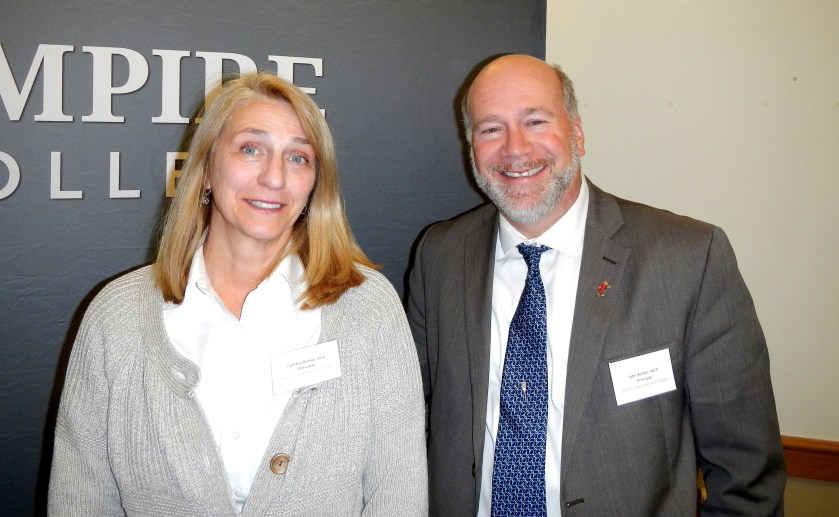
Geoff Bornemann (Retired City Planner) and Tony Izzo (City Attorney)
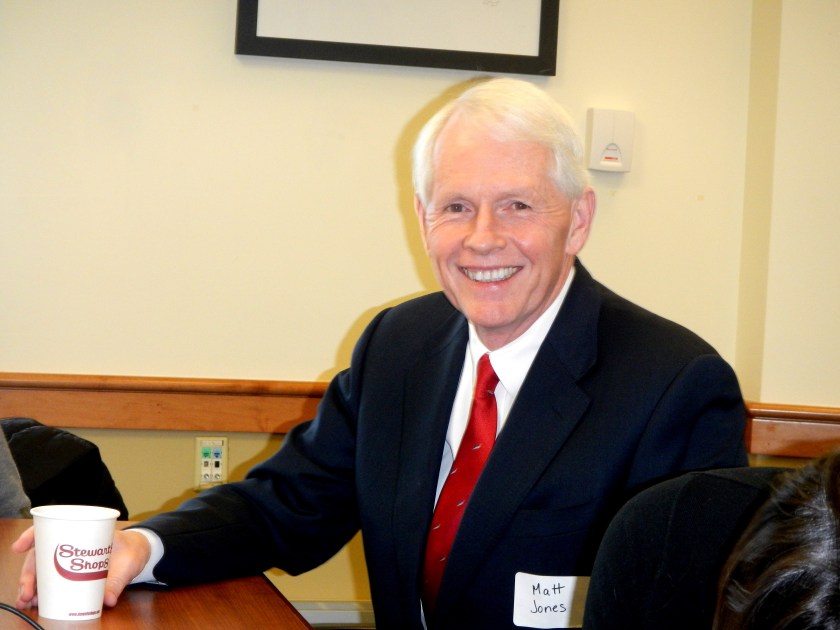
Matt Jones (What a smile!)David Carr (LA Group) across table and Michael Allen (Behan Planning and Design) on rightJohn Behan and Susan Barden (City Planner)
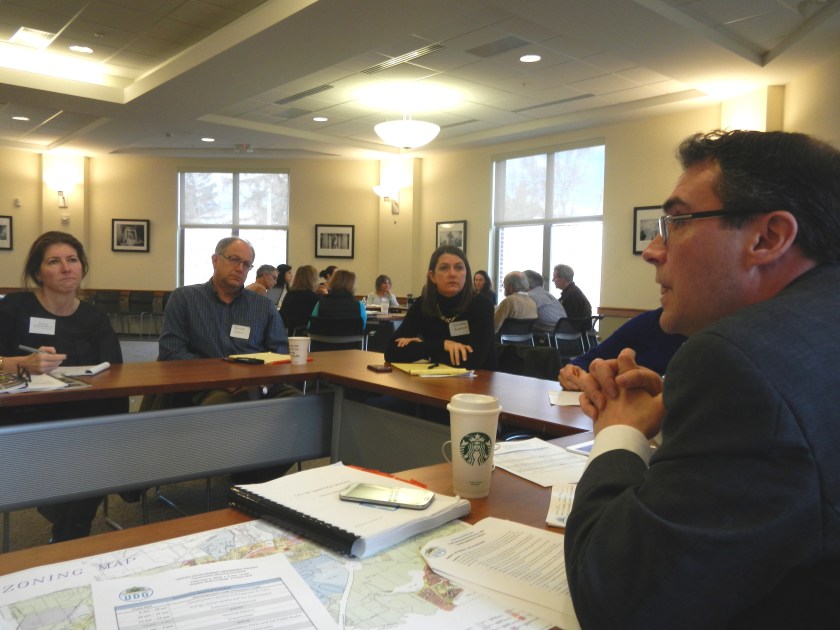
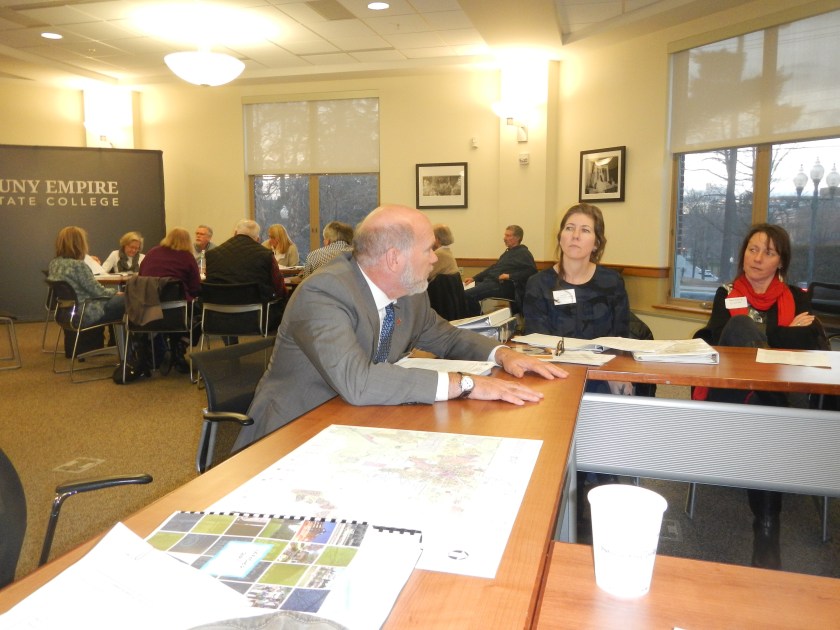
I spent the day at the Unified Development Ordinance workshops a few weeks ago. I have to say that it was quite fun. John Behan was the facilitator of most of the individual groups I sat in on and he kept the discussion lively and interesting.
I did not attend the evening general session but the most interesting things to me were who did not attend the day’s events and how little of the discussions focused on specific changes to the city ordinances. Todd Shimkus, the head of the Chamber of Commerce did not attend. David Carr and Mike Ingersoll of the LA Group attended. Samantha Bossart, the executive director of the Saratoga Springs Preservation Foundation was quite active. The city’s planning staff was heavily represented all day.
The initial session in the morning filled three large tables with about fifty people. The rest of the day, aside from staff there were about thirty participants. Again, I did not attend the evening general session.
Here are some brief observations:
Charlie Brown, chairperson of the Saratoga Springs Democratic Committee, shared his prepared statement which I posted several days ago. The statement questioned why the advisory committee called for in the contract with the city had not been established. John Behan did not respond directly but offered that the drafts, as they evolved, would be posted on the UDO website.
Matt Jones, noting with good humor how uncomfortable he was agreeing with me, noted the need for the land use boards to operate more efficiently. We both agreed that there was a critical need to expand the staff of the planning office including building inspection and code enforcement.
Bob McTague expressed a concern I heard a number of times, that the greenbelt needed to be rigorously protected.
Samantha Bossart noted it would be helpful if the materials for land use meetings included a check list of the documents and issues to be discussed. She argued that if all the required information is not submitted for a particular project/application, that the board should postpone consideration pending receiving all required documents. She also argued that preservation should be seen as a key element in sustainability.
There was a very interesting discussion that involved David Carr from the LA Group and an engineer from Glens Falls about the issue of public lighting. This involved not only the issue of light “pollution” but what could be done to conserve energy by rethinking what should be lit and how bright that lighting should be.
A couple who had recently moved here from Chicago talked about the program in Chicago that involved compost. Apparently Chicago has special receptacles that are provided to the community for composting as a way of minimizing what goes into the waste stream.
There were some interesting discussions about how the city should address the growing short term rental market given the growing popularity of Airbnb and VRBO. As it turns out and as was noted in a recent post, the city has launched an enforcement campaign while simultaneously rewriting the ordinances for this.
The issue of enforcement came up repeatedly but not about rental issues. People were quite upset at the apparent violations of city ordinances for things like setbacks, sidewalks, height, etc. that draw no penalty from the city. Tony Izzo, the city attorney, argued that proper enforcement would require additional staff for licensing, administration, and prosecution.
Given the generality of many of the suggestions, I asked John Behan how this would translate into ordinance language. He said it would be the responsibility of his firm to craft the language. His firm would be publishing an “ordinance diagnostic” report which I was a little unclear about but which I think will lay out the issues that need to be addressed in crafting the ordinances.
Mr. Behan said the site would post all the comments they receive and identify who submitted them. At some point a draft representing 50% of the final document would be posted on their site. He said they might have another workshop.
SARATOGA SPRINGS >>The city of Saratoga Springs has moved that a lawsuit filed by the owners of the Mouzon House Restaurant at 1 York St. against the city be dismissed, saying the suit lacks merit.
David and Dianne Pedinotti, the Mouzon House owners, filed this suit against the city Oct. 9, 2015 in the New York State Supreme Court in Ballston Spa, accusing the City Council of voting to change Saratoga Springs’ solar access law to benefit the City Center’s controversial parking structure proposal. The Pedinottis are represented by attorney Jonathan Tingley of Tuczinski, Cavalier and Gilchrist in Albany.
The Pedinottis’ suit specifically asked the city to repeal that law, which as written would permit the taller parking structure to cast a shadow on the solar panels the Mouzon House has installed on its roof. The suit also seeks to annul a subdivision of the parking garage site the Planning Board approved in September 2015.
Since the parking structure’s inception, the Mouzon House owners have battled the project, which is designed to go up right next door to their eatery on the edge of High Rock Park. The land there, currently a parking lot, is owned by the city.
Advertisement
Now City Attorney Vince DeLeonardis has filed a legal motion in the state Supreme Court, arguing that the Pedinottis were aware of plans to develop the High Rock parcel before they installed their solar panels in 2014. He also said that the 25-year-old solar law the city changed last year needed a review since it was inconsistent with the city’s Comprehensive Plan. That plan encourages the growth of high-density development in downtown Saratoga Springs, which could have been slowed by lack of an updated solar ordinance.
The Pedinottis have been claiming this type of growth would take away business from their restaurant, which would be hidden from view by the proposed five-story parking structure. In spring 2015, the Saratoga Zoning Board of Appeals denied the City Center a variance, saying the proposed building would block the sun to the Pedinottis’ solar panels, thus violating the solar ordinance.
The City Council voted to change that law in July 2015. The Pedinottis then accused the council of spot zoning — changing a law or granting a variance for the sake of one sole project and not for the greater good of the community. But the city attorney disputes that claim.
“The courts of this state have long since held that where, as here, zoning is found to be in compliance with the city’s Comprehensive Plan, which is calculated to serve the community’s general well-being and welfare, it is not, by definition, spot zoning,” DeLeonardis wrote.
According to him, city officials told the Pedinottis a decade ago that the High Rock parcel could be developed with a multi-story facility. The couple said then that it would not oppose the development of the 2.6-acre lot, recently assessed at $2.9 million.
The City Center is awaiting a response from the council on a lease for the land before returning to the planning board with its site plan. Concurrently, the city is reviewing two designs received for the High Rock parcel after sending out a request for proposals (RFPs) The proposed plans feature a mixed-use development, with housing, business and retail space as well as the parking.
“I encourage the planning board to take a long view of what the city will become,” said Dianne Pedinotti at the Aug. 12, 2015 planning board meeting. “Citizens have spent a lot of time, money and effort talking to the city council and supporting the RFPs … Have faith in the talent that’s out there, and in the people.”
Link To Story The Post Star Newspaper ran an incredible story about Siemens Building Technologies contracts with Warren County for their heating and cooling projects. Some industrious critic did some serious research and analysis documenting the fiasco. He shows that the county, over fifteen years, spent approximately $4,000,000.00 with Siemens which saved them $1,000,000.00 in energy bills. In other words, they lost $3,000,000.00
Through some tricky wording about the way the cost of energy would be determined, Siemens inflated the savings the county realized.
I wrote earlier on Saratoga County’s agreement with Siemens for similar energy devices that turned out to be wasteful. In the case of our county, the magnitude of the loss was never disclosed. The energy plant was part of the nursing home that was sold. The buyer of the nursing home, recognizing that the energy plant was a loser, required the county to separate the plant from the deal and to decommission it.
As documented in my posts, I contacted both the Saratoga Springs Supervisors, Matt Veitch and Peter Martin, regarding the fiasco. I urged them to initiate a full investigation of the history of the plant to determine who was culpable for the fiasco and to what extent Siemens could be liable for the losses. Veitch made clear that for him the case was closed and nothing further would be done about it. Martin responded by telling me that he was passing my charge on to the County Administer and county attorney. As far as the public record goes, nothing was done.
Both Peter Martin’s and Matt Veitch’s failure to pursue this is an indictment of both men. It appears that protecting the ineptitude of the Saratoga County supervisors is more important than investigating the waste of huge sums of public money. The story in the Post Star does a great job showing how Siemens operates and how, at least in Warren County, the issue is still very much alive.
There is an interesting story in this week’s Saratoga Today about code enforcement for illegal rentals in Saratoga Springs. Link To Article
In the age of Airbnb and VRBO.COM homeowners are increasingly renting out their houses. As someone who has used VRBO I can testify that many of us prefer the advantages of staying in a nice apartment or home where there is a kitchen when we travel. In effect you usually get a lot more for your money in terms of space and amenities.
Recently, as documented in the linked article, the city has sent out cease and desist notices to people illegally lodging guests in the city. I made some inquiries about what is going on.
Apparently, this was precipitated by complaints about full house rentals in residential districts. The complaints apparently have not been so much about someone who rents out individual rooms of their primary residence or their whole house when they are away. The complaints have more often been instead about non- owner occupied houses being illegally rented out in residential districts.
In response the city has set up a task force made up of city attorneys Vince DeLeonardis and Tony Izzo along with representatives from the city code enforcement to work on refining the existing ordinance. In the meantime the cease and desist orders have been sent out. Supposedly these notices were not targeting short term rentals of owner occupied dwellings. I know of at least one person, though, who rents out rooms through Airbnb on occasion who was the recipient of a cease and desist notice. So there appears to be some confusion here.
What follows is the statement released by Charley Brown, chairman of the Saratoga Springs Democratic Committee, at the Unified Development Ordinance meeting.
What is most interesting is the objection to the failure to establish an advisory committee to oversee the UDO process. This is a concern that I share as stated in earlier posts. What makes this particularly interesting is that it is the first time that the Committee has implicitly put pressure on a Democratic incumbent. The Behan contract with the city included the advisory committee. Mayor Yepsen, who is identified as the project manager for the city, has so far been unwilling to take any action to see that this part of the contract is carried out. Michele Madigan was the only vote against the contract with Behan Associates. She has expressed similar concerns about the need for an advisory committee.
I do not view this as an attack by the Democratic Committee on Mayor Yepsen. I do not see this as the Committee supporting Madigan against Yepsen. What I see, and I am encouraged by it, is the Committee taking an important policy stand in the interest of the city. I also see this as the Democratic Committee expressing a concern shared by many about the potential for mischief as the city’s ordinances are rewritten.
It should be possible for the Democratic Committee to advocate for a position on an important issue that may differ from a member of its party who holds an office.
Disagreement over a particular issue does not necessarily constitute a lack of overall support. I applaud the Committee for eschewing the idea that people of good will who share a common purpose cannot disagree with one another about an important issue.
The Statement
Statement re: Saratoga Springs UDO project
By: Charles Brown, Chair, Saratoga Springs Democratic Committee
To: Saratoga Springs UDO public meeting, Feb. 4, 2016
My name is Charles Brown and I am representing the Saratoga Springs Democratic Committee. We have been actively involved in the Comprehensive Plan discussions from the outset. Our main points are as follows:
Continue to protect the City’s Greenbelt.
Incorporate the terms of policies officially adopted by the City in areas such as Complete Streets, the Urban Forest and similar documents into your work product.
Translate the 2015 Comprehensive Plan’s principles regarding smart growth and sustainability; the City’s downtown character and its infrastructure into practical guidance within the UDO document.
Regarding the Unified Development Ordinance process, we are glad the community is being given this chance to participate. However, we remain concerned about the opportunities for continued involvement by the community and by our elected officials. The original UDO plan included the role of an advisory committee. We believe that it is not too late—indeed, this might be the optimum time—to form such a committee, to which our officials could appoint individuals to represent and advise them. The ideal make-up would be of people who are already familiar with City land-use code and the Comprehensive Plan discussion.
Your contract stipulates that an “advisory committee” made up of representatives of the City’s Departments along with representatives from City Boards was to be established. The contract further states that the consultants “will provide ‘check points,’ such as copies of any diagnostic reviews, recommended changes, draft outlines and copies of the draft code, over the course of the work to provide the city staff and public regular opportunities to review the progress and ensure a totally open and transparent project. These materials will be hosted online and made available to the public.”
The Saratoga Spring Democratic Committee believes that these provisions of your contract are essential in ensuring public trust, and an outcome that retains the integrity of the new Comprehensive Plan and the current Zoning Ordinances.
In particular we request that any, and all, proposed changes to the Zoning Ordinances be posted on your web page, and sent to the Stakeholders, before they are presented to the City Council for a vote. We also request that the public, and Stakeholders, have an opportunity to address the changes before they are presented to the City Council for a vote. We understand that this will entail a great deal of work and time. However, the decisions made from this process will have lasting effects on our City’s future.
It is evident that this final project is the point at which all the work of many, many people can lead to a valuable document that informs proposals and decisions about future development in our City. Given the tensions that exist between development and preservation, it also is the point at which we must remain vigilant about crucial choices of language for the UDO document and for amendments to City code. We encourage the UDO team to remain entirely transparent by exposing each draft to provide the maximum opportunity for ongoing pubic scrutiny and input.
For those of you following the Murphy Lane “barn conversion”, we left off on Friday with William Moore saying in an email that he would check into whether the public would be allowed to address the Zoning Board of Appeals at its workshop on this issue on Monday, February 8.
Having not heard from him, I arrived early for the workshop. As it happened I ran into him in the hall. He explained to me that because the agenda had gone out late, the board would not be hearing from Steve Shaw, the building inspector. Instead, Susan Barden, the city planner would be giving the board an update on the application.
I presume that Mr. Shaw would have been reporting on his stop work order for 39 Murphy Lane. Why he would not be reporting but Ms. Barden would be because the agenda was sent out late is a mystery I did not have time to explore.
I was too polite to ask Mr. Moore why he had not emailed me to advise me that the agenda had been changed and that the public would not be allowed to address the board.
As it was still ten minutes before the meeting was to begin when I entered the meeting room, I engaged the Board in a conversation about a number of issues that were of concern.
These concerns had to do with the lack of fairness and balance provided to the public by the land use boards in general and the ZBA in particular. I will be writing soon about my experience at last Thursday’s Unified Development Ordinance (UDO) workshop. One of the most interesting things about the workshop was the number of times that people expressed frustration and even anger over how the land use boards deal with the public. Even members of the planning staff expressed cautious sympathy over the issue.
So I expressed to the members of the ZBA the effect on the public of attending meetings and being relegated to sitting in the gallery while the applicant and his or her attorney and other staff sat at the table with the Board. Aside from the fact that the public sits behind a wooden rail, the participants at the table sit elevated above the gallery. I was not prepared for Board member Susan Steer’s response. Her explanation involved the convenience of having the applicant sitting with them. She noted that it was rare to have the public even at the meetings opposing applications for waivers. She also shared that this was the way the Board had always carried out business. What impressed me most though was her tone. There was not the slightest acknowledgement that this might be a valid issue nor any sign of empathy for what it might be like to sit out in the gallery when a project seems to threaten your home or neighborhood and you have come to oppose it.
I then brought up the rule that the public was only allowed two minutes each to address the ZBA while the applicant was afforded unlimited time for their presentation. I noted the incident at which Chairman William Moore had attempted to limit the attorney representing the neighbors of Moore Hall to two minutes during that controversy. Ms. Steer replied that in spite of Mr. Moore’s initial ruling the attorney was allowed to finish his remarks. Keith Kaplan went even further. He asserted that the public was always provided ample opportunity to address the Board. Unlike, Ms. Steer, he had no recollection of Mr. Moore attempting to limit the attorney. I attempted to direct the discussion to the need to find some way for a spokesperson for a group in opposition to select someone to do a full presentation to the Board. I noted the need for some sort of procedures. I was truly not prepared for Ms. Steer’s dismissal of this issue. The only person on the Board who appeared to acknowledge that there was a real issue that needed to be addressed was James Helicke. It was clear that trying to argue the issue further would be counterproductive.
Shorty after, it appears that the workshop began. I say “appears” as explained below. I waited until the meeting was available on line to complete this post. I wanted to be as accurate and fair as possible about what occurred. The difference between the experience of sitting in the gallery area and listening to the meeting on line is instructive. The volume of the speaker system was quite low so sitting in the meeting one could hear very little in contrast to the video.
The video begins with Susan Barden, the city planner in mid sentence saying, “so we’ll have that for you next time.” Video Of Meeting
For people sitting in the gallery, it was impossible to tell when the meeting actually began or even that it had begun. As noted the video begins with Ms. Barden in mid-sentence. It does not show what happened prior.
Mr. Moore never actually convened the session. Instead there is some low level chatter as the members take their seats. Ms. Barden approaches the table engaging in the general chatter as she hands out ipads. In hindsight, there was probably relevant information on the ipads about the meeting which was unavailable to the public who had come to observe. This went on for a few minutes and then Ms. Barden seated herself before them. The public could catch fragments of the discussion referencing some change in some plans. If the speaker system was working it was set extremely low. At one point you could hear Ms. Barden reference a set of plans in front of the Board members. There was never any effort to inform the public what the plans were about. 39 Murphy Lane was never referenced (even in the video it is never referenced). People sat patiently waiting for the meeting to begin.
Subsequently, Ms. Barden gets up and city attorney Tony Izzo then takes the chair and he could be heard fairly clearly as he projects quite well. He was advising the Board about a legal opinion that appeared to be relevant to the variance being sought by Chairman Moore. I then noticed that chairman Moore had removed himself from the room. This discussion was not listed as part of the “workshop” on the posted public agenda. No explanation was offered as to why it was added. The board probably knew why but felt no need to inform the public.
Mr. Moore then returned and called the meeting to order. A number of neighbors of the Murphy Lane project had come out in the snow to listen to the workshop. There was an exchange of looks between them. One of them offered that it appeared that the workshop was over. We all got up to leave.
As it turns out, Mr. Moore’s application for a variance was the first thing on the agenda and he went out into the hall while it was being discussed. Both the neighbors and Mr. Moore ended up in the hall together. I asked what happened with Ms. Barden’s report. I did not point out to him that he never bothered to share with the Board or the public that Mr. Shaw had originally been supposed to speak regarding the stop work order and that Ms. Barden would be speaking instead. He replied that she gave her report. One of the neighbors, in a courteous tone, told him that none of us heard her report. He did not bother to reply.
I find a number of things interesting about this.
Not only did Mr. Moore not tell the audience that the meeting had been changed and that Ms. Barden would be giving a report rather than Steven Shaw, as far as I can tell, he never said anything to the board. I would hazard a guess that he emailed them about the change prior to the meeting or it was communicated in some other way. The idea that the public should be advised of the change probably never crossed his mind. The idea that for clarity he might have formally recognized Ms. Barden and asked her to report probably never crossed his mind. The idea that the report should be done in a way that was accessible to the public probably never crossed his mind. In fact, the idea that the public might be interested and might deserve to be updated on the project probably never crossed the mind of anyone on the Board.
What is indisputable is that the neighbors who had come to this meeting had no idea what transpired up there nor was it possible for them to even ask what had happened.
What I learned that night was how much I had underestimated the marginal role the public plays in the eyes of the members of this Board (with the exception of Mr. Helicke). For these people the universe is made up of the sophisticated applicants who come before them often with attorneys and architects along with the Zoning Board members themselves. The public is a kind of noise that can occasionally become quite loud but that is ancillary to the process.
I will humbly admit to the readers of this blog that I truly underestimated just how pervasive and deep this problem is. Mr. Moore, who is not an evil man, is truly representative of this mentality. The fact that Mayor Yepsen appointed him for another seven years is just another indication of the problem.
Here are a number of interesting facts about the proposed hospital expansion and Bonacio Construction.
At the Comprehensive Plan meeting of November 17, 2104, the issue of approving the change of the city land use map to allow for the hospital expansion takes up only four minutes. Most of that time was taken up by Sonny Bonacio, who instructs the Committee about the area proposed for change and advises them as to who owns the land under consideration. Here is a link to the video of the meeting. The discussion of the change in the map begins at 106:00.
Julie Bonacio and the Director of Operations for Bonacio Construction, Pete D’Aloia, serve on the Saratoga Hospital Care Foundation. To their credit they have helped raise a considerable amount of money for the Hospital.
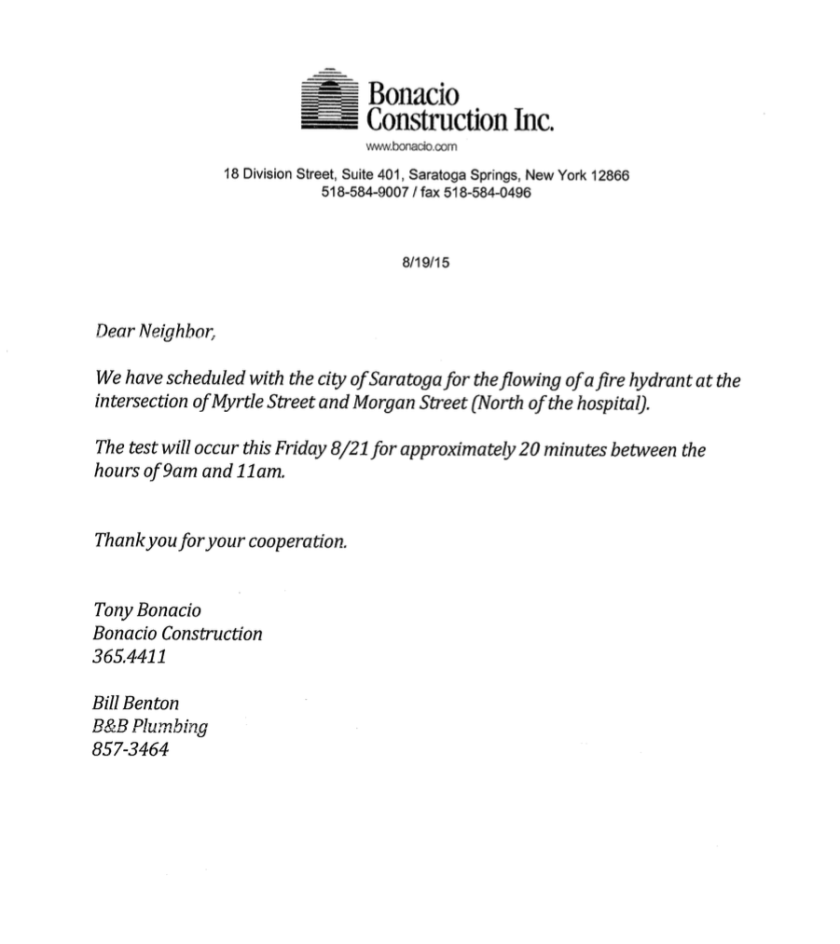
Bonacio Construction Letter
In a letter dated August 19, 2015, under Bonacio Construction letterhead and signed by Tony Bonacio (brother of Sonny), neighbors of the Hospital residing on Myrtle and Morgan Streets were advised that, in cooperation with the City of Saratoga Springs, a test involving a city water hydrant would be conducted. A neighbor inquired of Tony Bonacio about the nature of the test. Mr. Bonacio offered that as a result of the tests, he would not have any good news for the Hospital. The land basically sits on rock. The neighbor told me that he assumed that the tests revealed that it would be very difficult and expensive to run water and sewage in the area.
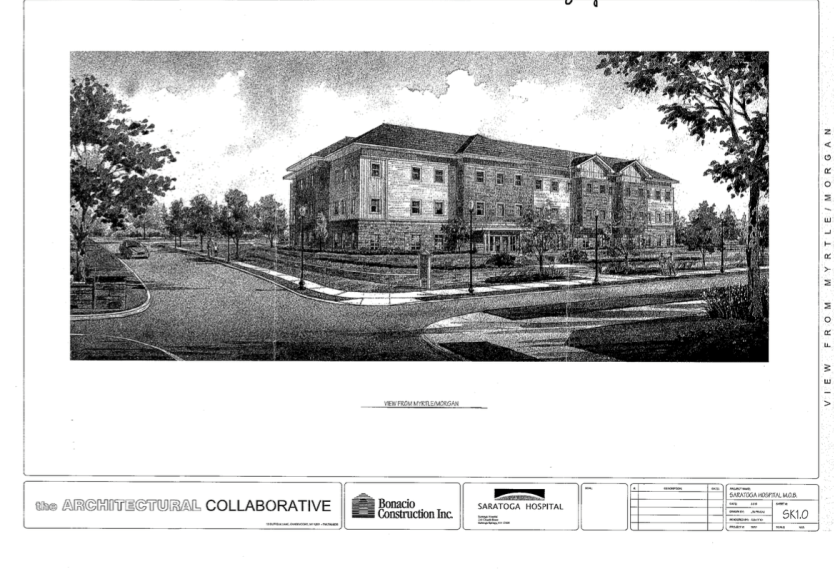
Rendering Linking Bonacio Construction and Hospital
This is a rendering of what was the proposed office building for the Hospital expansion. Note that at the bottom of the rendering are the logos for Bonacio Construction and Saratoga Hospital. It is my understanding that the L.A. Group created the rendering but I have been unable to confirm this. These facts lead to a core question regarding Sonny Bonacio’s role in promoting a material change in the city’s land use map at the Comp Plan meeting referenced at the outset. “What did he know and when did he know it?” is still a good, probing inquiry when clear answers to unknown questions are sought. Bear in mind that under our existing Ethics Code, he could have known that the Hospital had plans to build on the controversial site and that they were going to use his firm to build the proposed facility and, as far as I can tell, he would not have been in violation of the code.
Aerial ViewBuilding Permit For “Renovation of Barn To House”Original House
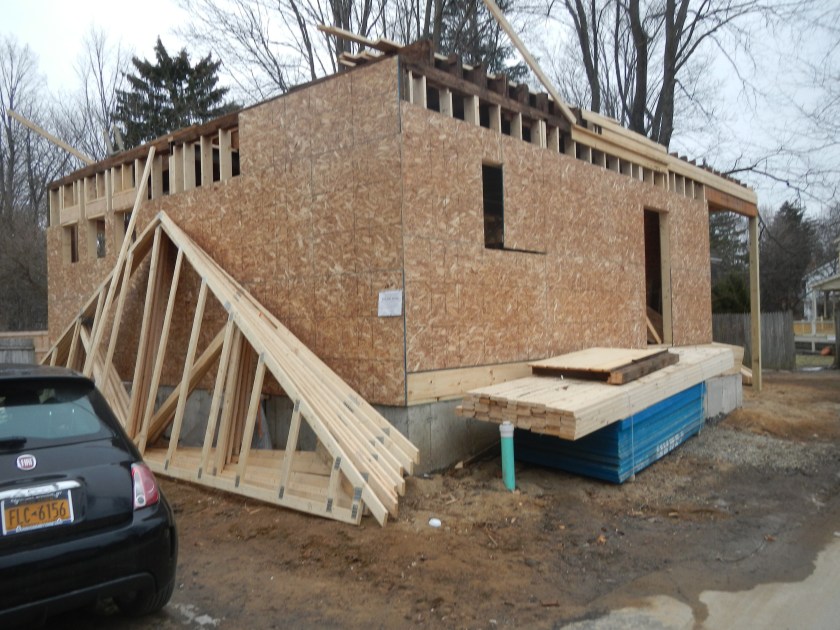
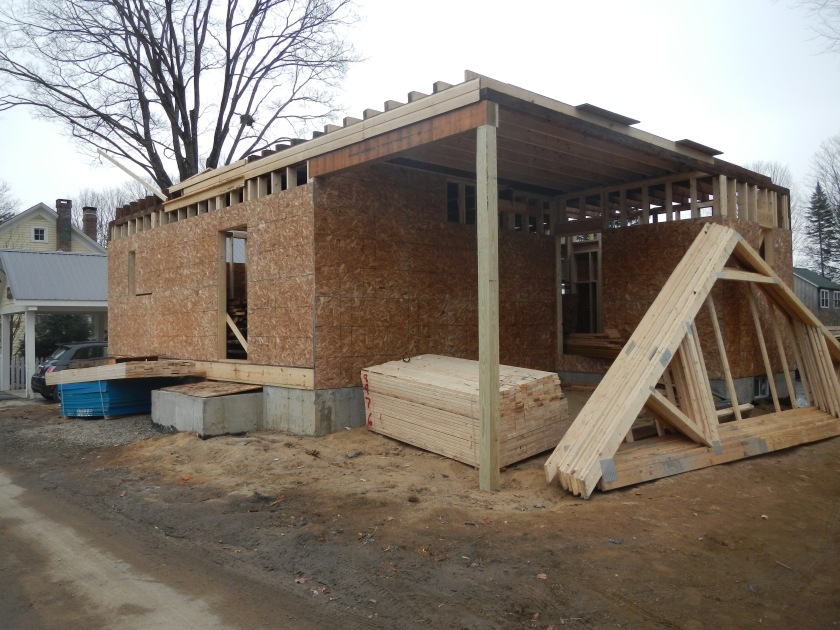
Does This Look Like A renovation To You?
New House View 1New House View 2
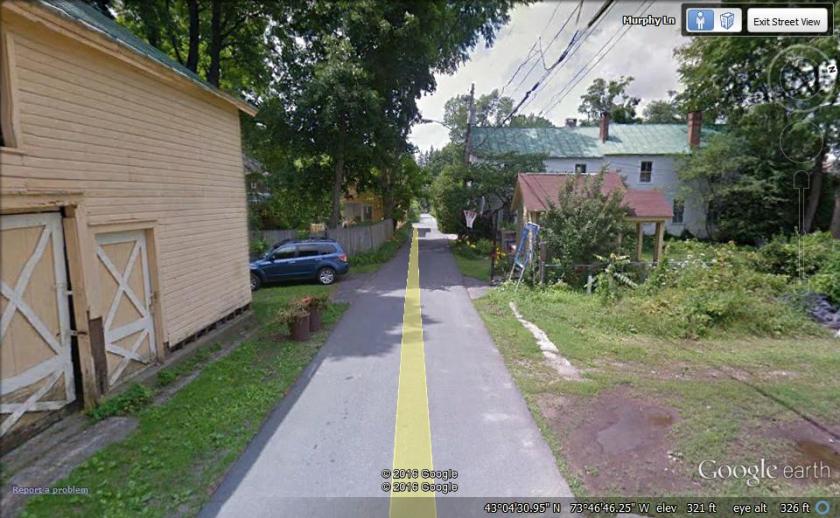
Jean D’Agostino who is a realtor with USA Realty purchased a barn at 39 Murphy Lane. This was originally part of a larger lot but sometime in the dark past the very small plot on which the barn stood was subdivided from a larger lot that included the associated house. The lot sits on a very narrow alley. There is a term referring to the purchase of something that by its very nature is in conflict with the zoning ordinances and it is called “self created.” This by itself does not disqualify the lot from development. It should, however, raise some serious red flags and is supposed to be used as a factor in allowing subsequent variances.
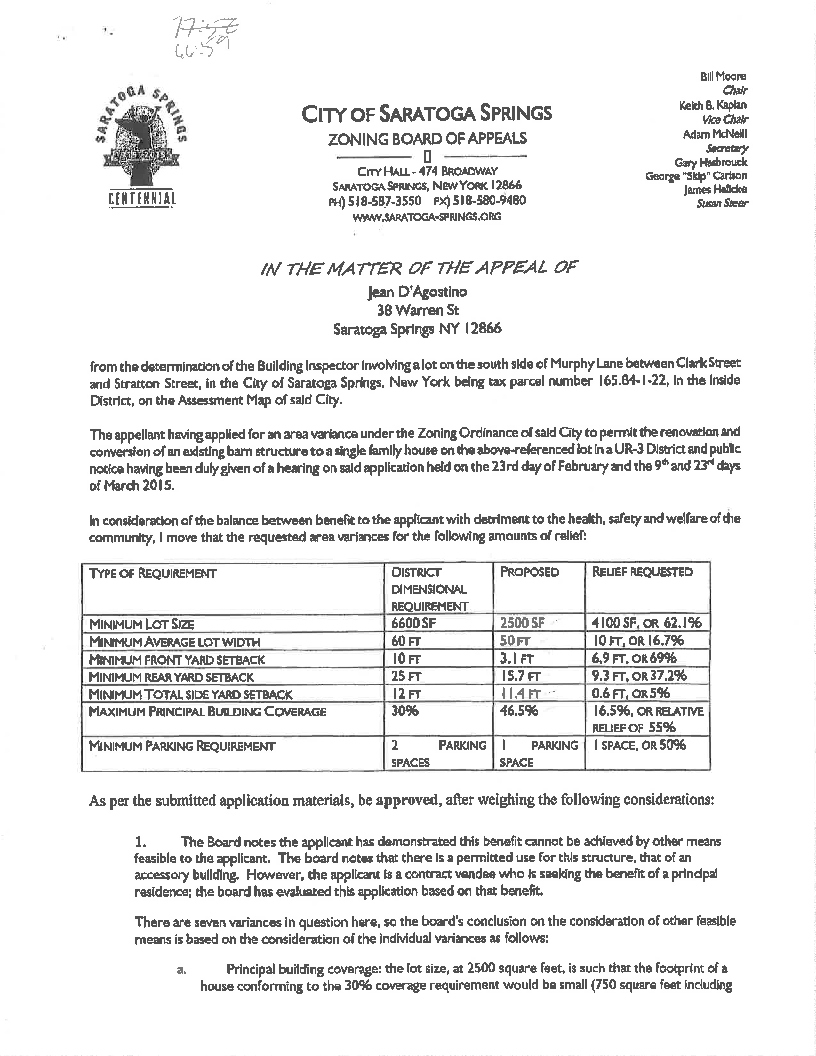
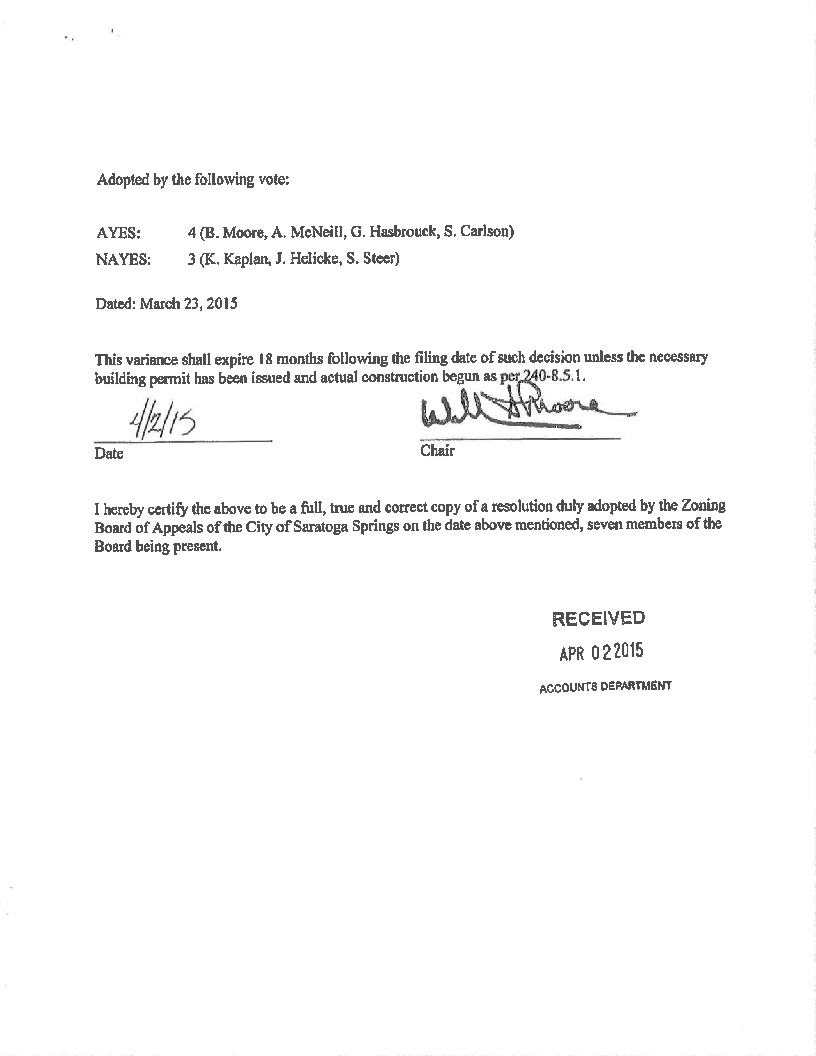
Last year, on March 23, 2015, the Zoning Board of Appeals approved this project by a four to three vote. I would urge the readers of this blog to watch the video. It is not very long (a problem in itself) and it is one of the clearest examples of the failure of our land use boards.
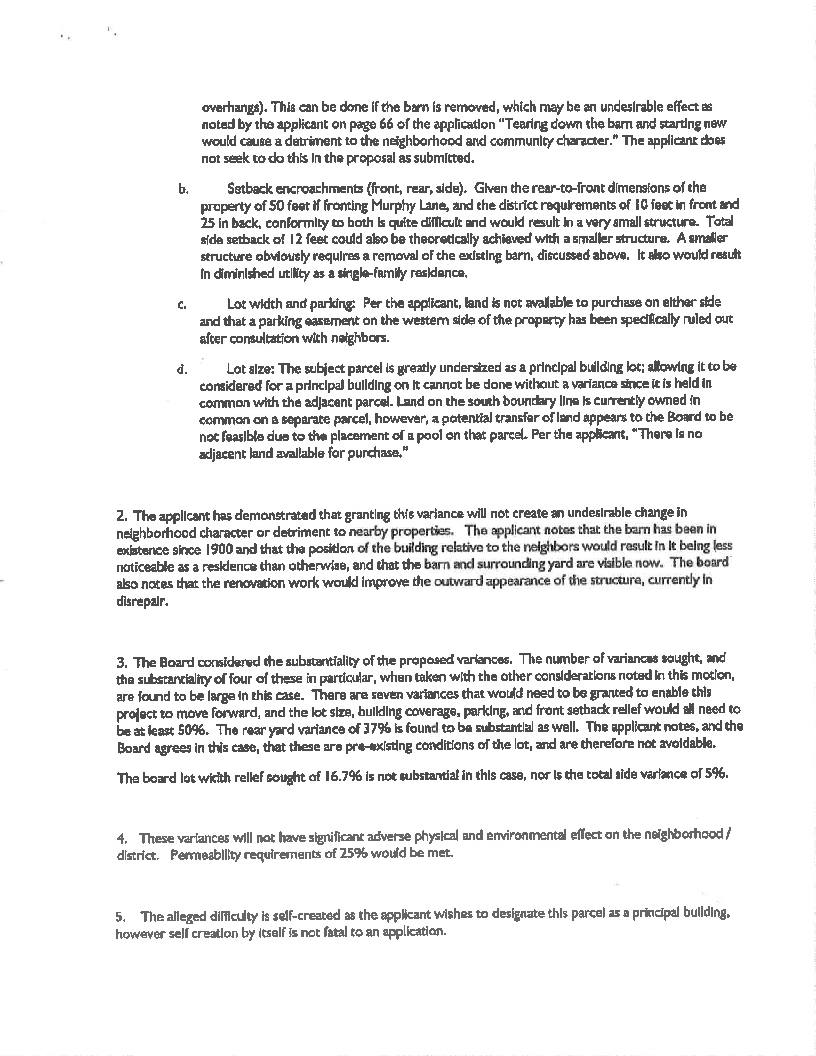
Resolution To Grant VarianceResolution ContinuedResolution Continued
The chair, William Moore, reads the resolution that would approve the variances sought by Ms. D’Agostino. He then polls the board for their comments. Skip Carlson, John Hasbrouk, and Susan Steer offer no comments on the matter. James Patterson briefly reviews the reasons he plans to vote against the variances. He notes the scale of the variances being sought and the negative impact putting a tiny house on the alley would have on the neighborhood.
Following Mr. Paterson, Adam McNiell offers his reasons for supporting the application. To view his remarks move the time bar to 70:30. I found Mr. McNeill’s brief remarks difficult to follow. He argues that it is a legally buildable lot (I assume this is based on it being grandfathered as a pre-existing, non-conforming structure). That is a very low bar. Theoretically, using his standard, you could build some kind of house on petty much any historically non-conforming parcel no matter how small as long as a cooperative ZBA granted the necessary variances. He asserts that Ms. D’Agostino has demonstrated the ability to minimize the number of variances they are seeking. Given that they are seeking seven variances and that four of them are at least 50% below the minimum requirements, one would not expect Mr. McNiell to point this out as some sort of achievement. Getting their variance request down to seven seems to a lay person like me, an indication of a serious problem and not something to be praised.
Keith Kaplan is then recognized by the chair. I really urge the readers of this blog to take the three or four minutes required to view his remarks. He gives a cogent and succinct (persuasive) critique about why the variances should be opposed. He notes the troubling history that would have produced this tiny lot. His point is that this lot and its problems were created from a larger parcel. He accurately characterized the variances being sought as “massive.”
Mr. Kaplan did not go into all the details of why he considered the variances as massive, but here are some of the items that he was referring to. For example, the city code for minimum lot size requires 6600 square feet and the lot on which this barn sat was 2500 square feet. In other words the lot was 4100 feet smaller or 62.1% too small. The minimum front yard setback (the front yard being the alley) is a mere 3.1 feet as compared to the required 10 feet or 69% too small. The rear set back was 15.7 feet rather than 25 feet or 37% too small. The code requires two parking spaces (the proposed rehab was to create three bedrooms) but they were seeking to reduce this to one. One would think that the board might have wondered over where any additional car might park on this alley.
He then went on about the negative impact on the neighborhood of this project. He particularly pointed to the narrowness of the alley calling it “ridiculously” narrow. He reminded the board that they had been to this alley for another project when there was snow which further narrowed it.
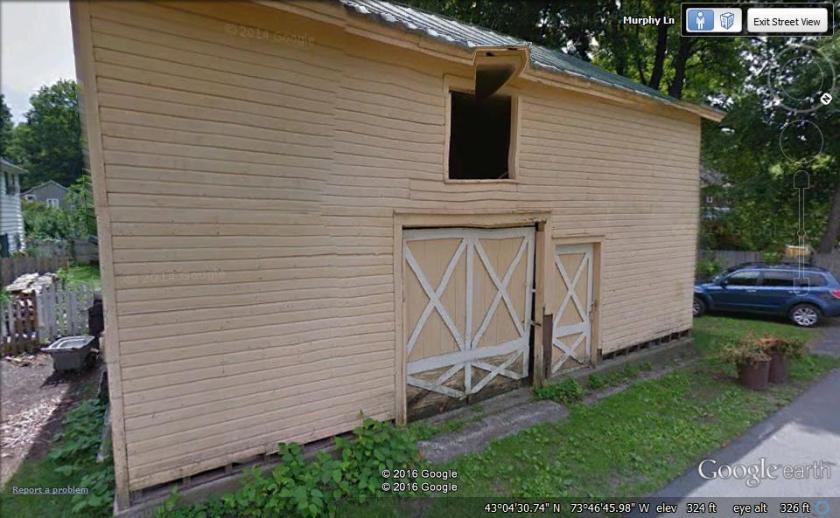
View Of Murphy Lane (Without snow)
Following his statement one might have expected Misters Hasbrouck or Skip Carlson to offer some sort of counter argument to explain what would be their subsequent vote to approve the variances. One might expect this only if one had not attended other meetings of the ZBA. They said nothing.
Chairman William Moore then simply said he would not have created the lot but that “this is the infill to expect as the city grows.” In light of the discussion and the later events, this is rather a chilling statement. It affirms that this is one of many such projects he plans to approve.
The Rehab That Wasn’t
Some context is needed at this point. The application by Ms. D’Agostino was to “rehab” a barn into a three bedroom single family house. Under item 1.a the variance resolution states “…This can be done if the barn is removed which may be an undesirable effect as noted by the applicant on page 66 of the application ‘Tearing down the barn and starting new would cause a detriment to the neighborhood and community.’”(this statement came from Ms. D’Agostino) To the more simple minded, this is why Ms. D’Agostino was applying to “rehab” the barn.
I regularly walk my dogs by Ms. D’Agostino’s property. Sometime during the fall, the entire barn was raised and placed on supports while a foundation and basement (not included in the originally submitted building plan) were poured under it. Most of us assumed that the barn would then be lowered back onto the foundation. Then, just a few weeks ago the barn disappeared and construction on a new house began.
Barn Hoisted Up On Supports. View From Across Ally. Note excavation mound in neighbors yard.
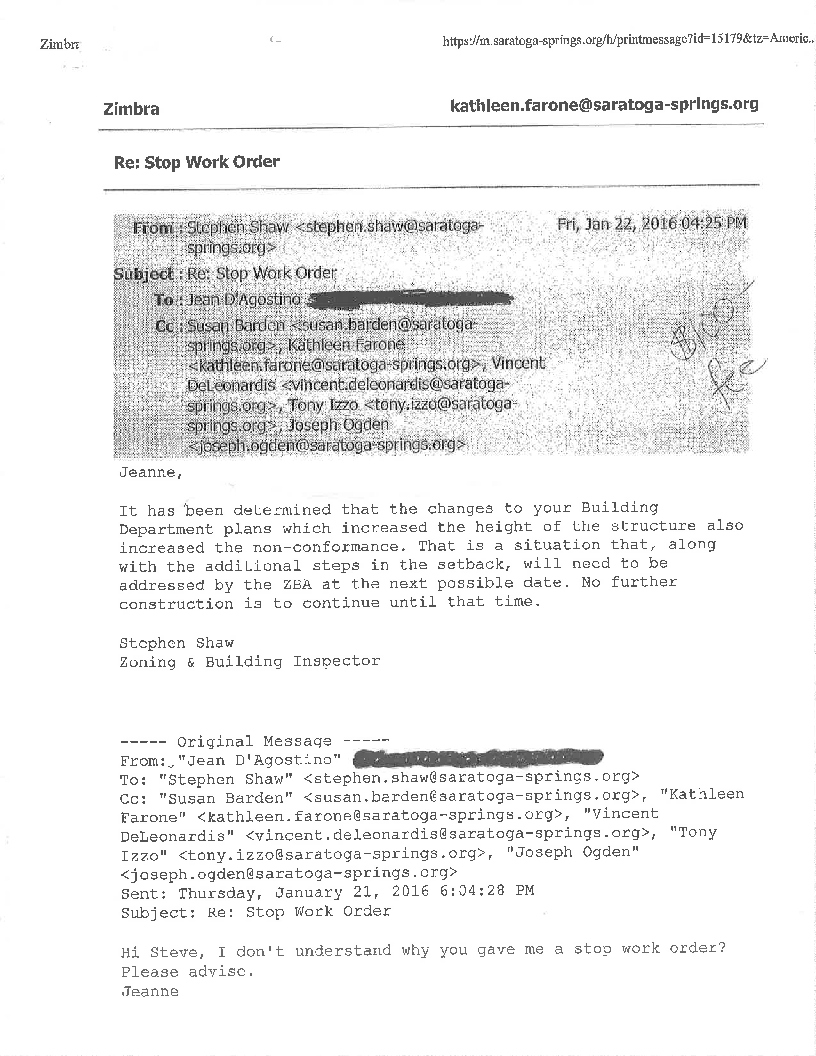
On January 21, 2015, building inspector Steve Shaw having received a complaint about apparent violations at 39 Murphy Lane, inspected the site and issued a stop work order. It is to Mr. Shaw’s credit that he acted so swiftly sending an email to Ms. D’Agostino with letter to follow.
Stop Work Order From CityStop Work Continued
Notwithstanding Chairman Moore’s praise regarding Ms. D’Agostino’s success in minimizing the need for variances and aside from the fact that the entire barn had been removed counter to her original application, the height of the new building under construction was in violation resulting in the need for at least two more variances. So much for her success in minimizing the needed variances. As they say, “you can’t make this stuff up.”
I think it is worth emphasizing here that Ms. D’Agostino is a veteran real estate broker with USA Realty. Just the idea that it was possible to rehab the original, very small barn into a three bedroom house on a narrow alley begs credibility.
Ms. D’Agostino is on the agenda for Monday night’s ZBA meeting. It will be interesting to see just how far this project can go and whether there will be any significant penalty for what she has done.
An Interesting Sidebar
I spoke to the property owner across from the site. He told me that during the excavation they used part of his backyard as a temporary dump for the soil. My brief review of the application required that all soil be removed from the site and not be stored there. When the gentleman called Ms. D’Agostino she told him to call the contractor. He expressed understandable frustration about the damage to his lawn and the failure of the Ms. D’Agostino to address this.
The contractor also failed to place a porto-potty on site. The workmen were forced to use the street until the neighbor complained to the police and they required that the porto-pottie be placed there.
An uncorroborated source told me that Ms. D’Agostino paid $115,000.00 for the plot. I also was told by an uncorroborated source that she spent approximately $30,000.00 on plumbing. I expect it was quite expensive to jack up the building and put a new foundation in. Just the cost of removing the detritus of the old structure would have been expensive. There would have been the required architectural and legal fees. There is also the cost of the construction that was going on before the stop order. Ms. D’Agostino has a lot invested in this project so things are probably going to get very unpleasant.
More Developments
The agenda for the Zoning Board of Appeals has been posted on the city website. A special workshop prior to the regular ZBA meeting has been set for 6:30. It is my understanding that while the meeting is open to the public to view, that such workshops do not allow the public to address the board. Since it is not a regular meeting, it is not clear whether it will even be videoed and put up on the city’s website.
I have written to William Moore, chair of the ZBA, asking whether at the discretion of the board, the public may be allowed to address the board and if so, whether this privilege will be afforded at Monday night’s meeting.
I have also asked whether the workshop will be video taped and posted on the city’s website.
It is unclear to me why this would not be a valid item for the regular agenda of the ZBA.
Below the workshop meeting notice on the website there is a link to two documents from Engineering America, Co. It appears that they are requesting additional variances for stairs to allow access to the property in two locations which will require more variances. Under a category called “Modifications During Construction” they advise the ZBA (after the fact) about the construction of a foundation and basement. They advise that they have raised the base of the house. They also advise that during construction they discovered conditions that are required “due to deteriorating condition of studs and roof.” “During construction, it became apparent that there were more decaying studs & rafters to be repaired than (sic) existing framing members to be saved. The Owner decided to reframe the exterior walls and to install new trusses (not yet installed).”
If you take a look at the picture of the barn you can see that it was, as originally described, a true barn. As such there were no sheetrock walls, etc. It is difficult to believe that when this building was originally assessed that a person with a flashlight could not have walked around the inside of the barn and inspected the studs and other structural pieces. One would assume that such an inspection would have easily revealed the condition of the wood in the structure.
In the original plans, there was to be a slab and not a full basement. Wasn’t there some responsibility for Ms. D’Agostino to advise the building department of this change as well as the ZBA?
It is even harder to understand why with all the radical changes made to this building; it took a stop construction order to prompt the engineers to address the issues to the Zoning Board of Appeals.
Further Update
I received the following emails from William Moore, chair of ZBA.
From: William Moore [bill927@me.com]
Sent: Saturday, February 06, 2016 4:28 AM
To: John Kaufmann
Subject: Re: Workshop on 39 Murphy Lane
John,
It is my understanding, all of which should be verified with Susan Barden, that the mailings and notifications were not sent out in time. We were doing this in the workshop which are on video for the City so that we may get an update from Mr. Shaw on the reason for the stop work order, the matter will be back on for the next meeting as an agenda item. As far as the public speaking we have never had that come up before so I will check with the City as to procedure, this was initially put on in the workshop so Mr. Shaw could update the board while they reviewed the application for the next meeting. If I get an answer before Monday I will share that with you, I’m forwarding all this to Susan and the rest of the Board at your request under separate cover. Thanks John
Bill
Sent from my iPad
On Feb 5, 2016, at 6:18 PM, John Kaufmann <john.kaufmann21@gmail.com> wrote:
I see from the agenda of the ZBA for Monday night that you will be having a workshop on issues associated with 39 Murphy Lane.
It is my understanding that the public is not normally allowed to speak to the ZBA at a workshop. The people in the neighborhoods related to this property are deeply troubled about this project. They would very much like to address the ZBA with their concerns as part of the proposed workshop/meeting.
Can you advise as to whether their participation will be allowed? If it is at the discretion of the ZBA to allow the public to participate could you please share why this privilege will not be allowed?
Might I ask that you share this email with the other members of your board as well as with the staff from the planning office?
How The Hospital Expansion Was Incorporated into the Comp Plan
At the City Council meeting on Tuesday, Brad Birge asserted that Matt Jones appeared before the Comprehensive Plan Committee regarding the proposed change of the area that the hospital was potentially interested in building on from residential to institutional. Here is a link to the video Move the timer to 13:15 to hear it. Birge asserted that this was done some time between June and November of 2014.
I have spoken to several people who were on the Comprehensive Plan Committee and none of them have any recollection of Attorney Jones doing a presentation prior to November 17. Even at the November 17 meeting his only role was to briefly answer a question. I understand that the neighbors of the hospital plan to FOIL the city on this matter. They tell me that they have spent many hours trying to find when, prior to November 17, the hospital requested this controversial change. It seems now incumbent on Mr. Birge to provide documentation.
Adding to skepticism regarding this is the presentation made by Kevin Ronayne, Hospital Vice President for Operations/Facilities at that November 17 meeting. The public was allowed to make comments during the beginning of each Comp Plan meeting. Mr. Romayne spoke to the Comp Plan Committee during the public comment segment. Here is a link to the video. Move the timer to 6:00.
Mr. Ronayne began his statement to the committee by asking “for your indulgence” and by offering that this request was “a little late in the game.” Now that sounds to me as though this was the first effort by the hospital to amend the Comp Plan to allow for their expansion. He then went on to explain that “last summer” the land (which we now know was owned by D.A. Collins) came to the hospital’s attention as being available. He then went on to note the many advantages to the hospital of building offices on this land.
It seems very odd that given the length of time that they had regarding their planning, that the hospital would make their request at the next to the last meeting of the Comp Plan Committee. After all, the committee had been meeting for at least six months. My impression is that hospitals are very rigorous when it comes to planning so this seems very odd. At the risk of appearing cynical, one possible explanation was that the longer their plans to expand into this area were public, the greater the chance that opposition would arise. Better to wait until the last possible moment.
It was during that same meeting that the issue of allowing PUDs in the greenbelt came up. This was at least the third attempt to find a way to allow Saratoga National Golf Course to build their resort. In contrast to the previous attempts, this time, with the help of Jamin Totino who switched sides, the PUD option was adopted. Both the arguments over the change and the resulting vote were quite heated and exhausting. It was immediately following this that the hospital issue came up. The issue was somewhat obscured by the fact that there was no actual proposal for any kind of buildings. The vote was whether to designate a very large area by the hospital and the neighborhoods as “institutional.” No one was talking about a 750,000 square foot office with 250 parking spaces. Everything was very abstract. This was further complicated by the fact that the actual zoning for the area remained as residential in spite of the new designation as “Institutional” (I know this hardly makes sense but this is the world of planning). What this gambit meant was that the residential area was “vulnerable” to the hospital proposing a PUD to actually build offices there if the “institutional” designation was adopted in spite of the fact that the zoning for the area remained residential. If you review the video (link here) which runs from timer 106:00 to 110:30 (four and a half minutes) you will see that there was no discussion of the substance of what was being proposed. There is a paradox about the Comp Plan. It is to be a general document about directions for land use and it is not to be a blue print for particular projects. This was the perfect environment for slipping this land use change through. Bear in mind the entire discussion lasted only four and a half minutes. The sound quality is poor. The main protagonist in the discussion is Sonny Bonacio who basically presents where on the map this area should be located. There is a vote and no one votes to oppose the change.
Now my friend, Michele Madiga, believes all of this was clear and that she fully understood completely what was going on. She also notes that the change was adopted without opposition. As someone who knows Commissioner Madigan well, I can testify to her thoroughness and the fact that she grasps all of this.
Her remarks were in response to Commissioner Mathiesen who apologized to the public for missing this. Remember that the change in the actual document was a matter of a color change on a section of the city map. I would note that I have spoken to a number of people who were on the Comp Plan Committee and who, like Commissioner Mathiesen, admit their culpability in failing to recognize the significance of this change.
I am disappointed that Commissioner Madigan is unwilling to allow this specific change in the Comp Plan to be revisited. While many of us are culpable of missing what she clearly saw, I would have hoped that she would have been more sympathetic on this matter. I know the neighbors would have appreciated it.






 Saratoga Springs Politics