Indeed I live in the dark ages!
A guileless word is an absurdity. A smooth forehead betokens
A hard heart. He who laughs
Has not yet heard
The terrible tidings.
Ah, what an age it is
When to speak of trees is almost a crime
For it is a kind of silence about injustice!
And he who walks calmly across the street,
Is he not out of reach of his friends
In trouble?
It is true: I earn my living
But, believe me, it is only an accident.
Nothing that I do entitles me to eat my fill.
By chance I was spared. (If my luck leaves me
I am lost.)
They tell me: eat and drink. Be glad you have it!
But how can I eat and drink
When my food is snatched from the hungry
And my glass of water belongs to the thirsty?
And yet I eat and drink.
I would gladly be wise.
The old books tell us what wisdom is:
Avoid the strife of the world
Live out your little time
Fearing no one
Using no violence
Returning good for evil —
Not fulfillment of desire but forgetfulness
Passes for wisdom.
I can do none of this:
Indeed I live in the dark ages!
2.
I came to the cities in a time of disorder
When hunger ruled.
I came among men in a time of uprising
And I revolted with them.
So the time passed away
Which on earth was given me.
I ate my food between massacres.
The shadow of murder lay upon my sleep.
And when I loved, I loved with indifference.
I looked upon nature with impatience.
So the time passed away
Which on earth was given me.
In my time streets led to the quicksand.
Speech betrayed me to the slaughterer.
There was little I could do. But without me
The rulers would have been more secure. This was my hope.
So the time passed away
Which on earth was given me.
3.
You, who shall emerge from the flood
In which we are sinking,
Think —
When you speak of our weaknesses,
Also of the dark time
That brought them forth.
For we went,changing our country more often than our shoes.
In the class war, despairing
When there was only injustice and no resistance.
For we knew only too well:
Even the hatred of squalor
Makes the brow grow stern.
Even anger against injustice
Makes the voice grow harsh. Alas, we
Who wished to lay the foundations of kindness
Could not ourselves be kind.
But you, when at last it comes to pass
That man can help his fellow man,
Do not judge us
Too harshly.
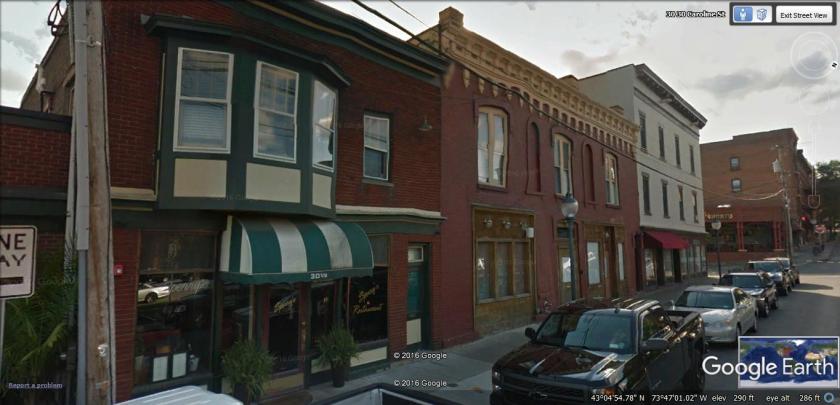
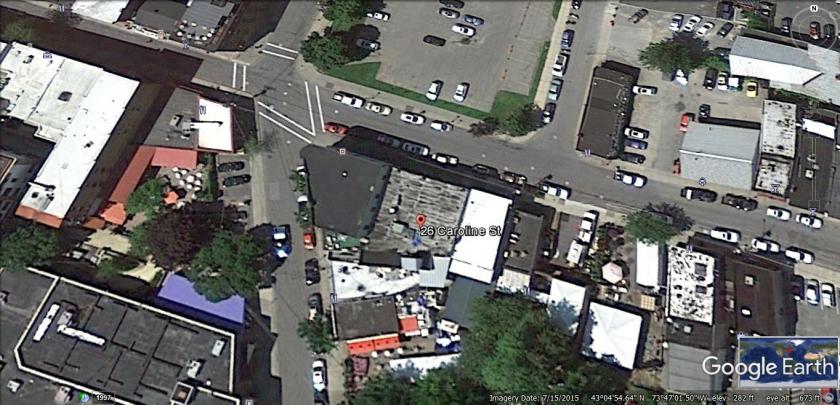
The Saratoga Springs Preservation Foundation is disappointed that the City of Saratoga Springs did not disclose at the City Council meeting that the front façade of 26 Caroline Street could be preserved. Yesterday the Foundation received a copy of the City’s final structural engineer report from Ryan Biggs |Clark Davis Engineering & Surveying. The report noted the following:
Observations: “The front masonry façade does not appear to have been damaged or displaced by the fire; however, there are some pre-existing conditions of minor displacements and bulges in the masonry. However, further collapse of the building framing could compromise this wall.” Please note that the pre-existing conditions appear in a 1982 photograph.
Conclusions: “The front masonry façade appears to be stable with no signs of major structural distress; however, with potential additional collapse of the floor and roof framing, this could cause damage and/or movements of the façade with possible collapse of the wall. With regard to saving the front façade, in my opinion this is structurally feasible (emphasis added). However, design of a shoring and lateral stabilization system would need to be completed and implemented immediately.”
“The concern with attempting to retain the front façade is time the building would be left in an unstable condition during the design and construction of the stabilization, and the potential high cost to implement the stabilization. In addition, access to the building for demolition or major construction activities can only be made from the front (north side) and the safe demolition of the remaining portions for the building would be more difficult and costly if the façade is to remain.”
“Therefore, costs of the stabilization and shoring of the façade along with increased demolition costs appear to be disproportionally high to the benefit to save the front wall that has current problems.”
“It appears the complete demolition of the building may need to occur to form a safe condition if a stabilization system cannot be installed immediately.” Note: no cost for preserving the façade was provided by Ryan-Biggs.
“If the City decides to proceed with demolition of the building, it is recommended that each adjacent property owner have their buildings reviewed by their own engineer in advance of demolition to determine if there are any other concerns with the structural stability of their buildings if 26 Caroline Street is demolished.”
“Demolition will most likely need to proceed slowly to access the existing conditions where 26 Caroline Street abuts the adjacent properties to make sure no unstable conditions are formed in the adjacent properties.” In the interest of full-disclosure, please click here to view the final report provided by Ryan Biggs | Clark Davis Engineering & Surveying and click here to view the letter from the owner’s structural engineer addressing the preservation of the façade. The observations and conclusions made by Mike Miller of Ryan Biggs | Clark Davis Engineering & Surveying regarding the preservation of the façade and potential damage to the adjacent structures echo the structural engineer report that the Foundation hired Don Friedman of Old Structures Engineering to prepare. Click here to view the Old Structures Engineering report.
The Foundation is further disappointed that the City of Saratoga Springs chose not to seek a cost benefit analysis regarding the potential to preserve the façade prior to moving forward with approving full demolition and that the Design Review Commission was not given any opportunity to provide an advisory opinion or that several of its members were not informed of its imminent demolition. The Foundation did its best to fulfill our mission and advocate for the preservation of this structure or, at least, its façade with available resources. We are saddened by the loss of 26 Caroline Street and will be actively involved in the review of the redevelopment of the site. Again, thank you to our members for their continued support of our mission and to those who have expressed support and gratitude for our efforts!
Posted: 12/07/16, 6:48 PM EST | Updated: 18 hrs ago
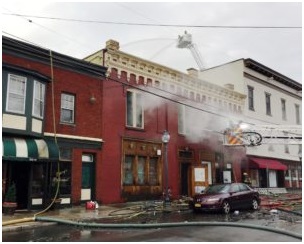
SARATOGA SPRINGS >> Despite efforts to preserve 26 Caroline St., the city, based on recommendations from two structural engineers, plans to demolish it Thursday morning.
At the City Council’s pre-agenda meeting Monday, two differing reports were presented, prompting the city to seek a third opinion.
Mike Miller, of Ryan Biggs, inspected the building — which was damaged in a Thanksgiving Day fire — Tuesday morning.
In an e-mail read aloud by city attorney Vincent DeLeonardis at Tuesday’s council meeting, Miller wrote: “The extent of damage has compromised the structural integrity of the building at 26 Caroline Street and forms an unsafe condition. This forms a risk to the public in front of the building, as well as to the adjacent properties. Further collapsing of the building could occur at any time with added loads from snow on the roof that can occur at this time of year. Based on the extent of damage that has occurred, in my opinion, the building should be demolished to reduce the chance of further collapse and a risk to the public.”
DeLeonardis joined Miller at the inspection and he described his experience.
“I walked through the building myself and it’s a devastating site,” DeLeonardis said. “From my own perspective, in a non-engineering way, the building was destroyed.”
City engineer Tim Wales described the possibility of the building collapsing before demolition.
“[Miller] felt it is possible for the roof to collapse [because of] those two big air conditioners sitting there on top, and he felt if we get wind load, snow load or get 6 inches of heavy snow that entire roof could come down … if that would occur, it could destabilize the structure enough to knock that front facade right down, out into the street as early as possible,” Wales said.
Mayor Joanne Yepsen described the situation as one where time is of the essence, which explains the urgency of demolishing the building Thursday.
Wales, however, detailed the construction of the four buildings impacted by last month’s fire and how 26 Caroline St. could cause obstacles for the adjacent buildings.
“These row type structures may not necessarily be keyed into each other, but they all function as one group and if you take out this middle piece it weakens both the sides,” said Wales. “… [Miller] recommended the engineer from [Sperry’s, and Hamlet and Ghost] also pay attention and evaluate the structure for whatever happens to protect their own individual structures. It all kind of ties together, you can’t just come in and rip things down, especially the wall bordering Sperry’s is something that can be very precarious.”
Both establishments complied with Miller’s recommendation.
Trinity, the project’s contractor, as of early Wednesday afternoon was waiting for final approval from the Department of Labor.
From The Saratoga Preservation Foundations Web Site
The Foundation is pleased that the City of Saratoga Springs took action to declare 26 Caroline Street an emergency to hire an independent structural engineer to evaluate the building to assess its future, especially in light of the differences in the previous structural assessments. Like the City, the Foundation does not want to jeopardize the public’s safety. The decision to demolish any historic building in our city that is listed on the National Register of Historic Places should be given full consideration since the preservation of our architectural and cultural heritage contributes to the overall success of our community. That is why the Foundation hired Don Friedman of Old Structures Engineering to provide an assessment last week despite being denied access by the owner and why the Foundation is willing to contribute up to $2,000 towards the City hiring an independent assessment.
The Foundation was not only concerned with the future of 26 Caroline Street, but also concerned with the immediately adjacent historic structures should partial or complete demolition of 26 Caroline Street be necessary. We do not want to see any additional damage to those buildings as a result of the removal.
The Foundation is very disappointed to share that at last night’s City Council meeting it was announced that the preliminary report by Mike Miller of Ryan-Biggs indicates that the building posed a public safety risk and needs to be demolished immediately. The City also said that they plan to move forward with demolition under section 118 (9) (7) of the code.
The Foundation does not know why steps cannot be taken to preserve the façade since we have yet to receive a copy of the owner’s structural report dated November 30 that specifically addresses that topic or a copy of the Ryan-Biggs preliminary report.
Marilyn Rivers, City of Saratoga Springs Director of Risk and Safety, stated at the meeting that as a result of the City’s independent inspection all of the building owners were now in communication and that they each had been encouraged to hire their own structural engineers to protect their buildings as demolition takes place. While 26 Caroline Street will not be preserved, the inspection did result in increased communication among the owners and increased awareness about the potential impacts demolition may have on the historic adjacent structures.
We believe that the Foundation fulfilled our mission and did all we could to stay involved and advocate for the preservation of this structure or, at least, its façade. Our Executive Committee met almost daily to develop strategy and make decisions as to our course of action and was kept abreast of developments by the Executive Director. The full board was kept informed by regular communications from the Executive Director.
The Foundation looks to the future of this site and working with the property owner and the Design Review Commission to ensure that replacement infill is appropriate in scale and design. The Foundation thanks all those who expressed support of our efforts and to our membership. Without your continued interest and support we would not have been able to accomplish as much as we did, even if the result is not what we hoped.
The Bethesda Episcopal Church and Skidmore College are hosting a series of events celebrating the 150th anniversary of the birth of Harry T. Burleigh, one of America’s most important composers, mentor to and friend of Marian Anderson and Paul Robeson, and a specialist in African-American spirituals.
Mr. Burleigh worked for a period in Saratoga Springs where he got his musical start.
Stephen Salters, a leading interpreter of Burleigh’s music, will be performing both at Skidmore and Bethesda.
Here is a link to an excellent interview with Gordon Boyd about the celebration. Mr. Boyd, himself an accomplished singer and a member of the Episcopal Church, gives a fascinating history of Mr. Burleigh.
• Friday Dec. 2, 12:15 p.m. A talk by Myra Young Armstead (Bard College), “Blacks in Saratoga Springs: Then and Now.”
• Friday Dec. 2, 7:00 p.m. Pre-concert talk by historian Jean Snyder, author of “Harry T. Burleigh: from the Spiritual to the Harlem Renaissance” (2015), Ladd Concert Hall, Zankel Music Center.
• Saturday Dec. 3, 3 p.m., Service of Advent Lessons and Carols. Bethesda Church, 26 Washington Street, featuring Salters, the Bethesda choir and several works by Burleigh.
A friend sent me a link to an interview that David Lombardo did with Robert Freeman, executive director of the New York State Committee on Open Government.
David Lombardo is the son of Barbara Lombardo who recently retired as editor of the Saratogian. Mr. Lombardo worked for the Daily Gazette newspaper some years ago and part of his beat was Saratoga Springs. He was an excellent reporter.
Robert “Bob” Feeman is my hero. He has worked in his current job for over forty years. I believe he retired briefly but returned to the job. Consistent with the mission of his office he is extraordinarily accessible. On a number of occasions he answered the phone himself when I called his agency. He was like having your own lawyer. On occasion, when I asked about the accessibility of a document under the Freedom Of Information Law he would offer advice as to how to make the request so that it fit within the law. In an age in which government institutions have become increasingly hostile to requests for information, it is quite amazing that Mr. Freeman has survived. I expect it is because, aside from being a person committed to the mission of his organization, he is a very good lawyer.
John Baker purchased Gaffney’s Restaurant on Caroline Street back in 1982. It was reported in the Albany Business Review that he has sold the restaurant to Ryan Venezia and his partner Gary Elfont for $3.4 million. Venezia is a real estate investor from Westchester. He already owns Mrs. London’s Bakery, Max London’s, and the Stadium Café.
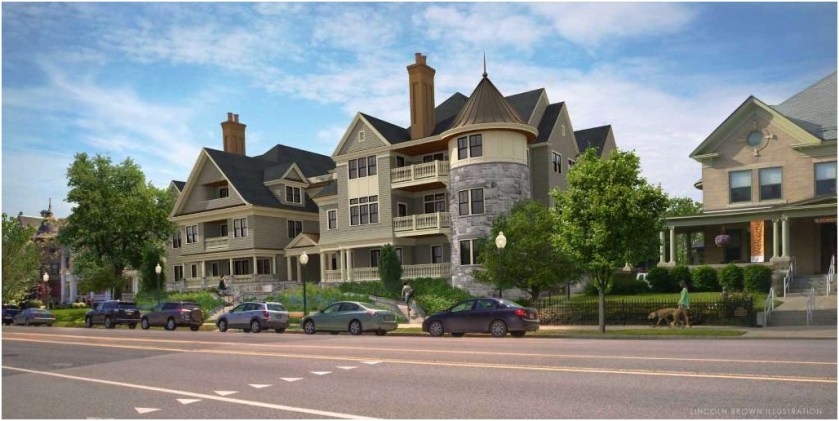
I received these renderings from Sonny Bonacio of the proposed condominiums for the Moore Hall site.
The study, which examined cities with populations between 25,000 to 100,000, ranked Saratoga No. 11 out of 1,268 cities nationally. The ranking was calculated by looking at the affordability, economic health, education and health, safety and quality of life in each city.
Since its inception, Mark Baker has been the President and CEO of the Saratoga Springs City Center. After thirty-three years he has announced that he will be retiring at the end of December. He will be staying on in his current position until the Center hires his replacement. He will also continue in some capacity to assist in the building of the proposed parking facility.
This city has been tremendously fortunate to have had Mark’s services. It has been my pleasure to know Mark. He is a quiet spoken and thoughtful man. During the recent controversy over the parking project I have spoken and corresponded with him on many occasions. His grasp of the smallest detail of the project is consistent with the excellent management of the Center. My interactions with the staff simply reaffirm the positive atmosphere that his leadership has brought.
I know I speak for many when I wish Mark the best for his retirement.
The popular analysis by the usual suspects is to blame the triumph of Donald Trump on anti-immigrant feelings, racism, authoritarianism, provincialism, misogyny, et al. There is also the more strategic approach which involves blaming wikileaks and/or FBI Director Comey for the eleventh hour reintroduction of Hillary Clinton’s email server.
I studied to be an historian and these kinds of critiques ignore the underlying issues. It is the usual ahistorical moralism that provides easy answers. While the above may have been contributing factors to Clinton’s defeat they do not fully explain how this country that elected Barack Obama twice now has Donald Trump as its President-elect albeit it seems by way of the electoral college. Indeed it does not provide any insight into why, for instance two counties in Ohio that Obama had carried twice went for Trump on Tuesday.
I would argue that the anger, maybe rage would be a better term, has been building for the last decade. We, in Saratoga Springs, are fortunate to live in something of a bubble. One does not have to drive far, though, to pass through the small towns that are decaying shells. The inflation adjusted wages of most Americans have been declining for decades. The once thriving industries that provided people willing to work hard with good wages have been vanishing. The epidemic of opiod addiction and rural meth labs are an expression of the despair that is eroding this country. Good, well paying jobs that provide futures for those currently employed and their children are vanishing at an alarming rate.
In the meantime, people have not only had to endure the 2008 crash in terms of their loss of jobs and homes, they have had to suffer through the knowledge that the bankers who brought this all on and were bailed out by these same struggling people’s tax dollars are enjoying huge bonuses and golden parachutes.
They also must suffer through a culture that touts “smart” people who are making out handsomely as deserving of their great success while ordinary people working two and three jobs worry about their own future and that of their families. The “smart people” are the winners in the globalization game. You see them on TV in shows about lawyers and doctors, and young professionals.
In spite of all the retraining programs, without good paying jobs for modestly skilled and educated people, the vast majority of people must suffer the sense of being losers and the even deeper indignity that no one really cares.
The reality is that in Washington, with a few exceptions, no one really does care. The Republicans promise that with tax cuts for corporations and the shredding of regulations (the basic agenda of all the lobbyists who shower money on them) the jobs will flourish. The Democrats claim that with education and retraining programs along with more tax incentives for the same corporations, the jobs will come. Well, for the people living in Gloversvile, Malone, and Amsterdam, nothing has changed. There is, in fact, no significant sign of even a government presence doing anything in places like these across the country.
It does not take a degree in political science for many of the trapped Americans to see that the road they have been traveling is one that involves diminishing resources and hopelessness.
I do not share the same demonization of Hillary Clinton that many of my conservative friends do. I do see her as someone who had and probably still has, no real sense of just how bad things are in America. Donald Trump’s zinger asking her what she has been doing for the last thirty years has been dismissed by my friends who strongly supported her candidacy from the beginning. The fact is that the needs of all of these Americans have been very low on the priority list. Every four years the “promise machine” goes into high gear and some vapid slogan with the word “change” in it is trotted out for the campaigns.
Hillary Clinton would have lost even if there had never been an issue with her server. It was seized on as a symbol to be exploited. The real issue was that she was the poster child for “more of the same.”
I kind of enjoy using this metaphor. In 1968 people marveled that black Americans, burned down their own neighborhoods when Martin Luther King was assassinated. People wondered as to how they could do something that was so self destructive. On Tuesday, angry Americans burned down their country when they elected a narcissistic conman because in their rage they wanted to send a message to Washington.
This brings me finally to a local issue which is what my blog is really about. The Democratic Party in this city is cut from the same cloth as the leadership of the National Democratic Party. They see their responsibility as electing Democrats period, rather than as speaking as a party to some of the major issues facing this city. The threat to the greenbelt posed by Saratoga National Golf Course’s plan to build a huge resort? The Democratic Party has no position. The threat to the neighborhoods posed by our hospital’s expansion? The Democratic Party has no position. The threat to neighborhoods from the Witt Project “Downton Walk?” The Democratic Committee has no position. The pathetic ethics code of this city and the Ethics Board’s violation of open meetings law? The Democratic Party has no position. The attempt by Sonny Bonacio to convert Moore Hall into micro apartments with all the issues of parking and the exorbitant rents he wanted? The Democratic Committee had no position. The on going abuse of the Zoning Board of Appeals decisions to grant variances? The Democratic Committee has no postion.
Is it any wonder how angry people are at the traditional political parties? Is it any wonder that this country could elect Donald Trump? The answer is no and no.
After writing this I came on Glenn Greenwald’s piece on the Intercept web site. Readers will note many of the same points but I am no Glenn Greenwald. I highly recommend his piece.
Commissioner Chris Mathiesen has sent a draft of proposed changes to the city’s ethics code to the Ethics Board seeking their comments. Much of our current code is more an honor system than a serious standard that properly protects our city. Here are two simple examples. As a member of the Zoning Board of Appeals, if your immediate boss were to come before you there is nothing in the code that would require you to recues yourself. Similarly, if your next door neighbor came before you seeking a variance to build a garage on your property line, you would not be required to recues yourself.
Geoff Bornemann, Jerry Luhn, and I worked with the Commissioner on the document.
Below is the text of the document.
PROPOSED ETHICAL STANDARDS FOR LAND USE BOARD MEMBERS
with foreword
The standards proposed in this draft are somewhat more exacting than the present guidelines and rules applicable to Ethics Board functions. Notably, they would prompt more recusals by sitting members than current practices anticipate. One of the realities animating this change is the fact that the City has grown, and continues to do so: we are not the insular, small town of just twenty years ago. Growth and prosperity bring with them a number of challenges to governing, even while foundational concerns, such as integrity and accountability, remain constant.
In this vein, recusals as appropriate — an admittedly indefinite concept influenced by individual judgments — are a valuable tool, a complement if you will, to governing the City in ways that inspire confidence and trust. That said, it is necessary to plan for recusals to avert undue burdens and delays in the functions of land use boards so as not to jeopardize their critical and timely functions, such as having quorums allowing them to proceed with their mandated tasks.
_____________
The current standards set out in the City Code (Chapter 13, Code of Ethics) do not assure the strong and consistent ethical expectations that govern the conduct of various City land use board members. In particular, for example, standards which guide the Ethics Board’s actions should be grounded in common experience, explicit and easily understood by its members as well as by the public. They should, at a minimum, aim to reduce ambiguities and thus the opportunities for inconsistency in the Board’s issuance of opinions intended for guidance of public officials in matters affecting land use in the City of Saratoga Springs.
Upon the assumption that the Ethics Board has inherent authority to recommend standards stronger than those presented in the existing City Code, it is proposed that the Board adopt and propose to the City Council standards that reflect the following principles.
REQUIRED RECUSAL
The board member of a City land use agency or board must publicly disclose and recuse him/herself from acting in a particular matter if:
During any time (a) in the twenty-four (24) months preceding the filing of an application before that member’s board, the member has been employed by the applicant or property owner having an application before the relevant board, or (b) In the preceding six (6) months has supplied goods or services to the member including, but not limited to, professional services having an aggregate value greater than one thousand ($1,000) dollars.
(a) At any time in the twelve (12) months preceding the filing of an application before that member’s board, the board member has received a personal gift, consisting of goods, services or favors having an aggregate monetary value of seventy-five ($75) dollars from the applicant or property owner; or (b) at any time following submission of an application by the applicant or the property owner to the member’s board, the member has accepted a gift of any kind from that applicant or property owner.
NOTE: Personal gifts of any kind are likely to raise questions and suspicions among the public, other officials, competing applicants, etc. Worst of all, gift-giving risks establishing a de facto pay-to-play threshold, however unintended. By way of comparison, the NYS JCOPE rules allow for some token gifts in limited circumstances, but the City’s Ethics Board may advance stronger expectations, by enactment of codes of conduct. If we know that arsenic is not good for our health, why allow even a drop to be added to the pitcher we intend to drink from?
During anytime in the past twenty-four (24) months preceding the filing of an application before that member’s board, the board member has been employed directly or indirectly (as by subcontract, for example) by any firm, architect, engineer, surveyor, landscape architect or attorney who represents the applicantor property owner with business before the member’s board.
During any time in the twenty-four (24) months preceding the filing of an application before that member’s board, the board member has employed or paid, in cash or in kind, a sum or thing of value greater than one thousand ($1,000) dollars for the services of the applicant or the property owner.
During any time in the twenty-four (24) months preceding the filing of an application before that member’s board, the board member has made a financial investment of any kind having, in the aggregate, a value greater than one thousand ($1,000) dollars with the applicant or the property owner.
The board member has any financial investment of any kind in the project pending before the relevant board.
The board member has any ownership of property that lies within one hundred (100) feet of the property that is subject of the application.
Any member of the board member’s family (e.g., spouse, domestic partner, sibling, parent, children, including children of spouse or domestic partner, grandchildren and the spouses of any of them, and any member of the individual’s household) is currently employed by the applicant with pending business before the member’s board, or any of the professionals representing the said applicant.
NOTE: This proposal is admittedly challenging. The courts in New York have wrestled with small-town/small community relationships and interpersonal familiarities where, in a manner of speaking, or literally in some cases, everybody knows everybody and one can’t hope to categorically avoid some intersections between civic business and broader social exchanges. The focus of this standard may have to be inherently flexible, erring on the side of no-reasonable-suspicions or the like. The courts tend to support each other up on the “know it when I see it” judgment calls but they too err on the side of standards that pass the straight-face test where latent conflict issues present themselves.
The board member is an officer or member of a financial institution that is, or is actively considering financing a project that is the subject of the application before the member’s board.
REQUIRED DISCLOSURES
The board member must publicly disclose, for the public record, at the most proximate board meeting:
Any ex parte communication or conversation with anyone about a pending application and reveal the date, name and substance of the information received or given.
Whether the board member has any ownership of property that lies within five hundred (500) feet of the property that is subject of the application pending before the member’s board.
The board member is an officer or a board member of a non-profit organization that intends to or has submitted comment on an application before the member’s board.
The board member is a personal friend of the applicant or any of the professionals representing the applicant having business before the board.
RECOMMENDED BEHAVIOR STANDARDS
The board member should scrupulously avoid the following kinds of actions:
Outside of a board meeting, land use board members should have no discussion about an application pending before their relevant board with the applicant, a person standing as his or her agent, or any of the professionals representing the applicant.
Outside of a land use board meeting, the board members should have no discussion among themselves or with any individual that could lead a person of ordinary sensibilities to suspect undue influence, subterfuge, or doubt the integrity of the board members concerned about an application that is pending before that Board.
Individual board members should refrain from making any public statement or publicly talk about an application that is pending before their land use board.
A former land use board member may not be employed by any applicant, or by a professional representing an applicant whose application for action appears before the board, within twelve (12) months of the member’s departure from board service.
NOTE: Even while enforcement of this is likely to pose challenges in select instances, it may serve as a vehicle for communicating the City’s expectation of openness and integrity in all realms of board functions. Waivers may be sought through an established procedure that preseves the integrity of exceptions drawn in compelling cases.
Any action that would risk creating the public appearance of a lack of fairness or impartiality regarding an application before the relevant land use board.