This blog reported that Saratoga Springs Mayor Ron Kim had been referred to the police desk sergeant to make his complaint against someone who allegedly emailed threats to him and someone in his family. I wrote in the blog that the desk sergeant reviewed the emails and that none of them rose to the level of threat requiring police action, and this was what provoked Kim’s angry outburst in City Hall.
In fact, the video released by the police tells a slightly different story. Apparently, Kim first called Deputy Public Safety Commissioner Jason Tetu with his complaint, and Tetu told him to go to the desk sergeant. It was this response by Tetu that set the Mayor off. In the video, Kim shouts at Tetu “Is that all I get?” before going into his office and slamming the door.
Kim Doesn’t Understand
In our form of government, the Public Safety Commissioner is charged with overseeing the police and fire departments, but there is a distinct limit to that authority that Mayor Kim doesn’t seem to understand.
The Commissioner’s power does not extend to directing the police to make specific arrests. That responsibility remains with the “sworn officers.”
This makes sense. Consider the danger of a politician with no background in criminal law ordering the arrest of people?
Note that when Public Safety Commissioner Montagnino took action in the case of Chandler Hickenbottom for allegedly disrupting a Council meeting, he made a complaint to the Police Department. He did not order her arrest.
It is also troubling that Kim’s remark (“Is that all I get?”) implies that he believed Tetu should provide him some sort of special treatment from the Police Department.
Saratoga Springs Police have released a video of Mayor Ron Kim in an epithet-laced rant at Public Safety Deputy Commissioner Jason Tetu and Public Safety Commissioner James Montagnino that took place in City Hall.
Apparently, Kim had received some emails that he considered threatening. He also claimed that the same person who sent these emails to him sent threatening emails to someone in his family.
Kim was referred to the police sergeant who handles complaints. Apparently, the sergeant, after reviewing the emails, said that they did not rise to the level of serious threat and declined to pursue the matter.
This prompted Kim to take his anger out by going to the Commissioner of Public Safety’s office where he confronted Public Safety Deputy Commissioner Jason Tetu with sufficiently abusive language that Tetu threatened to have Kim arrested.
Montagnino came out of his office and received additional abuse from Kim.
Another Aborted City Council Meeting. Everyone knew that the BLM group planned to disrupt the meeting. It was openly discussed at a meeting held on the Skidmore campus on April 26.
The May 2,2023, Saratoga Springs City Council meeting was once again so disruptive that it had to be adjourned. Mayor Kim, yet again, relinquished control of the meeting to Black Lives Matter. The members of the Council sat mostly passively, with the exception of unhelpful remarks by Accounts Commissioner Dillon Moran toward Public Safety Commissioner James Montagnino and Montagnino taunting Mayor Ron Kim about his failure to take any action to bring order.
Interestingly, Mayor Kim began the meeting by moving the consent agenda from its normal position to have it voted on before the public comment period began. The consent agenda includes authorization to pay the city payroll. If this authorization is not taken care of, city employees cannot be paid. Mayor Kim also warned the BLM people present in the audience that he expected there would be “repercussions” (arrests) if the meeting were to be interrupted.
These actions suggest that Kim anticipated allowing the meeting to be shut down by a BLM demonstration.
The vote on the consent agenda was followed by two hours of public comment dominated almost exclusively by BLM activists and some Skidmore student allies repeating the usual litany of vituperative attacks directed primarily towards the Saratoga Springs Police Department, Commissioner Montagnino, and Saratoga Springs in general. When the meeting finally began the only item discussed and voted on was a Resolution on Restorative Justice that was on the Mayor’s agenda. This passed 4-1, with Montagnino voting no. After that, chaos broke out, with the BLM group chanting and shouting till Kim gave up and adjourned the meeting without any further city business being addressed.
It was an open secret that the BLM people planned to disrupt the Council meeting once again. Skidmore students were enlisted for the event at a meeting on the college campus on April 26.
Some media coverage, however, reported that the demonstration that precipitated the Mayor’s adjournment was prompted by remarks made by Commissioner Montagnino. The Commissioner knew that the BLM had planned to disrupt the meeting, and Montagnino was smart enough to know he was being inflammatory when he accused the BLM people of being complicit in the vandalism of the Union soldier statue in Congress Park. It was a reckless and irresponsible remark. Still, the media coverage failed their readers by supporting the narrative espoused by Lexis Figuereo that they were just responding to Montagnino when BLM had in fact planned ahead of time to disrupt the meeting.
The Council meeting has been scheduled to reconvene on May 4 at 2:30.
A Sober And Critical Look At Kim’s Restorative Justice Resolution
Kim’s resolution on restorative justice grew out of the recommendations of the Saratoga Springs Police Reform Task Force appointed in 2020. It is useful to review this proposal in light of how others have addressed this issue.
[JK: I wanted to put a link to the resolution for this story, but as documented below, the link to the resolution is now unavailable. I will be discussing the breakdown of effective management of IT by Finance Commissioner Sanghvi in a later post, but here is a screenshot of this latest failure.]
The most famous campaign to address past injustice is the South African “Truth and Reconciliation” Commission, set up in 1995 in the aftermath of apartheid. Nelson Mandela, the leader of the African National Congress (ANC), was key in creating this body.
The “Truth” part involved investigating and exposing and acknowledging the cruelty of a system where the opponents of apartheid were routinely tortured and murdered. The “Reconciliation” part was to find a path forward to unite a nation where the victims of this cruelty could live with both their pain and with the white South Africans who supported these past policies. In some cases, this involved the prosecution of those who committed serious crimes.
Nelson Mandela, the leader of the ANC, set an example of reconciliation. Brutalized by the police, he spent twenty-seven years in prison. Yet upon his release, he showed no rancor. His focus was on how to bring his nation back together and move forward. His most important quality was his ability to inspire the people of South Africa to understand each other and to set a path to justice and compassion.
For Mandela, this process was not about apologizing. It was instead about acknowledging the harm done and then finding ways to address those wounds. Addressing those wounds was not about worthless apologies but about identifying concretely the policies and institutions that needed change and identifying the people in authority who needed to acknowledge the problems and address them.
For sixteen years, I was the executive director of the Saratoga County Economic Opportunity Council (now called LifeWorks). The last thing I wanted to hear from an employee who had screwed up was an apology. What I wanted instead was an acknowledgment of the error and a plan to make sure it didn’t happen again.
Shame Is Not A Strategy. Guilt Is Not A Strategy
Conspicuously absent from Mayor Kim’s “restorative justice” resolution is any effort to take the first necessary step of doing the work to actually identify specific actions and policies that need to be acknowledged and addressed.
Saratoga Springs exists within the United States. The fact that black people (and Jews, and Irish, and Italians, and women and others) were discriminated against throughout this country is axiomatic. A general apology for this history, however, takes us nowhere.
As with the South African example, identifying and acknowledging specific examples of racism, either individual cases or institutional cases, and providing proposals for addressing how these can be reformed is where the hope lies. Blanket condemnations and vague apologies, as contained in Kim’s resolution, may bring enjoyment to some but do little to produce real change.
Our Local BLM
The reality is that Lex Figuereo and his allies are the polar opposite of Mandela. Any reasonable observer of their tactics at City Council meetings can see that their goal is to humiliate and indulge in unrestrained rage. Insulting elected officials is self-indulgent nonsense. This picture of BLM people in front of Montagnino’s office is a testament to the infantile nature of so much of what they do.
BLM events are not really about politics; they are about psychodrama. Michele Madigan, who served in the previous administration, put aside money for a mediator and offered to meet with Figuereo. In the standard operating procedure for Figuereo, he strung her along only to refuse to participate. Figuereo is not really interested in sitting down, identifying specific problems (truth), and seeking solutions. Figuereo’s identity is invested in drama and media.
The narrative that if elected officials will just sit down with Figuereo and his allies that an accommodation can be achieved is a myth.
The Missing Factor: Truth
BLM makes wild accusations about the city’s police. If you listen to them, you would think that we were living in Alabama in the 1950s, that Bull Connor is the chief of police, and that any moment a phalanx of police armed with guns and dogs and tear gas are about to brutalize them.
Missing from their rants is substance-truth. If the police need further reform, it begins with BLM doing the hard work of actually documenting incidents of real abuse. Without identifying examples of failure in police procedures with details of who, what, and where, there can be no corrective action.
Restorative Justice
Mayor Kim’s resolution calls for restorative justice. Let’s get beyond the culture wars and consider what restorative justice is.
“Restorative justice seeks to examine the harmful impact of a crime and then determines what can be done to repair that harm while holding the person who caused it accountable for his or her actions. Accountability for the offender means accepting responsibility and acting to repair the harm done.”
University of Wisconsin, Madison, Law School
In this definition, the process begins with identifying real events that are documented for the purpose of change.
Kim’s poorly crafted resolution misses the point about what restorative justice is. Instead, his nebulous resolution fits right into Figuereo et. al.’s playbook. It calls for “…a community-wide dialogue with residents and institutions on defining what restorative justice means to Saratoga Springs in the 21st century.” This amorphous charge can only lead to more confusion and conflict.
The vague language in Mayor Kim’s restorative justice committee resolution is an exercise in noise and will result in little or no constructive findings.
An Odd Date For His Final Report
I find it particularly suspect, that Kim’s resolution would have his committee report its findings on December 19, 2023. That date is conveniently after the city’s next election.
Kim, the other Council members and Figuereo are, as they say in popular culture, co-dependent. With the exception of Public Works Commissioner Jason Golub, they all crave media coverage without substance. They feed off each other.
Kim got his story into the Times Union about his plan to establish a “restorative justice committee” (no great feat), but that is all he has achieved. This new committee (one of too many) will produce nothing.
With BLM planning to disrupt yet another Saratoga Springs City Council meeting, and Mayor Ron Kim abrogating his responsibility to ensure speakers have equal access to the microphone at the public comment period (see previous post—)this coming Tuesday night’s (5/2/2023)City Council meeting sadly promises to be yet another exercise in how not to govern.
A look at the agenda for the upcoming May 2 City Council meeting seems to indicate that current Council members are more interested in appearing in newspaper stories and on television than directing their time and energy to the job of actually governing our city.
Commissioner Sanghvi’s Fake Resolution
Case in point:
Finance Commissioner Minita Sanghvi will be offering a resolution that seems at first glance to promise to direct assets seized by police in controlled substances arrests to “City-based programming for the treatment of addiction, homelessness, and other restorative justice initiatives within the city of Saratoga Springs.”
According to Commissioner Sanghvi, the resolution is “in response to the Saratoga Springs Police Task Force 50-point initiative” that included this item. The city’s task force, readers will recall, was set up in 2020 in response to an Executive Order by then Governor Andrew Cuomo.
But Sanghvi’s resolution includes the following qualifying language:
“To the extent allowed by existing New York Statutory requirements for the dispersal of property seized in controlled substance arrests and criminal activity…”
The clue that something is wrong is her use of the phrase “to the extent allowed.” So what is the “extent allowed?”
Bizarrely, her resolution has a whereas clause that cites “New York State Civil Practice Laws and Rules (CPLR) Section 1349 – Disposal of Property” regarding the meaning of “extent allowed.”
I say bizarrely because the statute she cites specifically limits the use of these funds to only “law enforcement purposes.” In other words, it precludes using the money for the very purposes Commissioner Sanghvi cites in her resolution.
That this dispersal of funds is not allowed should come as no surprise to those of us who followed the Police Reform Task Force’s recommendations that included this promised dispersal of money as number 41 of the 50 proposals of their “Reinvention Plan” . At the time, Police Chief Shane Crooks told the Task Force that this proposal for the use of seized assets violated state law. He was seen by Task Force members as an obstructionist rather than a truth-teller.
At a minimum, Commissioner Sanghvi’s resolution is misleading. A less generous assessment would be that she is trying to fool the public in general and the Black Lives Activists in particular, into thinking that she is fulfilling the Police Task Force’s proposal when she is clearly not because the truth is that this proposal cannot legally be fulfilled.
Commissioner Moran: An Incoherent Resolution
Case #2
Accounts Commissioner Dillon Moran has placed this item on the consent agenda for the May 2, 2023, Council meeting.
The heading of the item provides some clue as to its purpose: “Temporary Outdoor Dining Committee-Approved Applications” So this is probably about approving the restaurants/bars listed at the end of the document.
The consent agenda is normally reserved for items that require approval but are noncontroversial, like the authorization to fund the city’s payroll or payment authorized by a contract that had been approved by the Council.
As readers will observe, this item, though, begins with a statement that allegedly the applications for outdoor dining have been reviewed and approved by a variety of city departments. In previous posts, I documented that I had unsuccessfully asked Commissioner Moran for some kind of documentation regarding the signoff by the Fire Department on applications for outdoor dining permits. I also FOILed for such documents and was advised they do not exist. Moran may or may not have received informal approval of these applications, but consistent with his casual approach to governing, he failed to set up a procedure to document this process.
So we only have the Commissioner’s word for it that these reviews and approvals actually took place.
In addition there is no language stating what a vote on this item by the Council will accomplish. There is no wording for instance saying “Therefore, the Saratoga Springs City Council approves the applications of the following establishments.”
Then there is this statement:
“The Department of Accounts has noted any department conditions as part of the outdoor dining permit.”
Reader, I challenge you to explain the purpose of this sentence. There is no explanation as to what these conditions are nor which applications they are related to.
Finally, we get a list of five dining/drinking facilities with no explanation as to why they are listed. I guess they may be applications that Moran claims are in order and require Council approval, but there is no language that would indicate that in adopting this item, the Council is approving them.
Finally, demonstrating just how sloppily this was crafted, the title says that these applications were approved by the “Temporary Outdoor Dining Committee.” The problem is that the “committee” no longer exists. Moran previously pushed through an amendment to the code dissolving them.
I feel confident that this item was crafted by Moran himself and that he didn’t bother to consult with Tony Izzo, the City Attorney or the new Assistant City Attorney.
Montagnino’s Pointless Resolution
Case 3:
Public Safety Commissioner James Montagnino also has a peculiar agenda item. This one is calling for an amendment to the city code to make the carrying of a firearm while drunk a violation.
My contacts in law enforcement have characterized this proposal as “unenforceable”. The foot patrols that try to maintain order on Caroline Street do not carry breathalyzers. It is not illegal to be drunk and an officer would not have the right to frisk an individual to see if they were carrying a gun. Penalties already exist if a gun is in the possession of someone involved in another violation such as drunk driving so this proposal adds nothing to existing law.
This is all about Montagnino’s eternal quest for media and not about seriously dealing with guns.
Why Can’t They Just Do Their Jobs?
This Council suffers from excessive drama and a lack of sound management and judgement. I fear we will be paying the price for this for years to come.
While the April 18, 2023, Saratoga Springs City Council meeting was subdued in contrast to the previous April 4 meeting, it was notable for Mayor Ron Kim’s mismanagement.
Mayor Kim Abrogated His Responsibility Over The Public Comment Period
For starters Mayor Kim announced that while there would still be a four-minute limit on individual comments, he would no longer enforce it. When is a limit no longer a limit?
This means that any person can now filibuster for as long as they want. Potentially one person can use up all the time allocated for public comment.
I expect Kim watched the video of the last meeting, where he appeared feckless as he fruitlessly advised people, what seemed like hundreds of times, that their time was up.
At the April 18 meeting, Kim lectured the public that monopolizing the microphone was unfair to others who might wish to speak, but essentially left it up to members of the audience to sort it all out over who would get to use what amount of time.
This means that if someone takes it upon themselves to venture out at night to address the Council on a matter they find important, they may discover that the person ahead of them has exhausted the available time, and they are out of luck. It seems to me this could potentially add to the disorder at meetings and could lead to some disruptive conflict between those wanting to have their time at the microphone.
You Couldn’t Get Into The Meeting
The April 18, 2023, meeting was held in the old Council chambers, and many people could not get into the meeting. They were allowed to sit in the hall where a screen was set up that displayed the meeting.
Pretty much every speaker complained about Kim’s decision to hold the meeting in the old Council chambers rather than the Music Hall. It was especially embarrassing because the Council was to honor the late Clarence Dart of the Tuskegee Airmen. His descendants, who had been invited to the Council meeting, were unable to get into the room as no seats had been reserved for them. When people learned that the Dart family was in the hall, many gave up their seats for them.
Kim offered two excuses for the venue. He asserted that the video and audio quality was better in the chambers and that he had assessed the agenda items and believed that public attendance would be sufficiently modest so that the chambers would accommodate those who wanted to attend.
It was clear from the groans in the audience that his rationale did not go down well. For one thing, it should have been obvious that the no-knock warrant issue on the agenda would draw a crowd. A number of Facebook pages, including one sponsored by BLM, had posted calls to attend.
A Different Meeting Without Lex Figuereo
Lex Figuereo and Brigitte Barr were charged with two misdemeanors each for their disruption at the April 4 meeting.
Lex Figuereo was absent from the April 18 meeting, as were most of the other leaders of BLM. I expect that Figuereo’s attorney had advised him not to attend future Council meetings until his charges are resolved. In his absence, the group was relatively subdued. With the exception of Angela Kaufman (AKA Diogenes), the other speakers’ remarks were free of epithets. No one from the group attempted a filibuster.
All of them directed vituperative attacks towards Public Safety Commissioner James Montagnino. They also spoke in favor of eliminating “no knock” warrants.
If this is representative of the future, it appears that without Lex Figuereo’s fiery leadership, the city may be spared the kind of disruptions that has made transacting city business problematic.
When Saratoga Springs Public Safety Commissioner James Montagnino pursued charges against Black Lives Matter activists for disrupting City Council meetings, Mayor Ron Kim and the other City Council members accused him of racism and sexism. Now according to area media, Mayor Kim has instructed Assistant City Attorney Michael Phillips to seek an order from a judge banning one of those activists, Bridgette Barr (sometimes referred to as Bridgette Parisi), from City Council meetings. Curiously Kim has not been the subject of a similar attack from either his colleagues on the Council or BLM.
It is interesting that at the April 18 meeting of the Council, the BLM people attacked Commissioner Montagnino for charging Figuereo for disrupting the previous meeting but made no objection to the same charges brought against Barr, a white woman.
In a related development, Lex Figuereo told the media that Barr is not a member of Black Lives Matter, and the media reported this as though it were a fact.
So I texted Figuereo to try to determine why Ms. Barr was excluded from being a member of BLM. I asked him, “What are the requirements to be a Saratoga BLM member?”
Figuereo responded to my text by asking who I was. After I responded with my name, he at first didn’t answer and then texted me this:
Figuereo: Just be anti racist why you trying to join if u wanna be a man to man conversation that’s great.
Blogger: Texting works for me. How do people become members of Saratoga BLM?
Figuereo: Well, Texting doesn’t work for me. You also didn’t greet me when you sent me questions. Insulting, I would say. When you learn to speak with respect, maybe, just maybe, you can talk to me. If not, you can continue running with your false narrative when you don’t even know us. Good day sir.
Saratoga BLM has no formal membership. There are no BLM dues, membership cards, or lists. Apparently, Lex Figuereo is the czar of the local BLM activists, deciding on his own who gets to enjoy the status of membership.
At the April 4, 2023, City Council meeting, Barr actively participated with Figuereo and other BLM activists in disrupting the meeting. It was impossible to distinguish her role from Figuereo’s and the other BLM people.
In fact, Barr, along with Figuereo, both breached the cordon that separated the Council from the public. Both continually shouted at the Council. Barr grabbed the microphone used by Public Safety Commissioner Montagnino, and Figuereo grabbed the microphone from Mayoral candidate Chris Mathiesen. So why was Figuereo so insistent that Bridgette Barr was not a member of BLM?
Judge Skeptical In Response To City
Both City Court Judges Vero and Wait recused themselves in both the Figuereo case and the Barr case. Judge Constantine F. DeStefano was brought in to preside.
Mayor Kim sent the new Assistant City Attorney Michael Phillips to pursue an order of some kind to block Barr, but not Figuereo, from attending future Council meetings. It did not go well for Mr. Phillips.
Judge DeStefano first questioned why Phillips thought he had standing to bring this motion before the court. Phillips tried to ignore the judge’s question at first but finally acknowledged that it was indeed the prosecutor’s sole prerogative to ask for the court’s action not his.
Judge DeStefno next wondered why the city was only pursuing charges against Barr when Figuereo was alleged to have exhibited the same behavior.
Phillips responded that Barr represented a greater danger of violence and that the city was pursuing this case to try to help Barr.
The judge then expressed concern that Phillips had spoken to the press concerning Barr’s mental health history without having a HIPPA release (the federal requirement that protects the release of patient health information from being disclosed without the patient’s consent or knowledge) and that it looked like a violation. Judge DeStefano told Phillips he planned to consider the matter further.
Throwing Bridgette Barr Under The Bus
So how to explain Figuereo’s sudden interest in creating a BLM membership list that didn’t include Barr. As Figuereo’s narrative is that charges brought against BLM are racist and about suppressing their free speech, Kim, given his earlier attack on Montagnino’s actions, was in a bind when he wanted to pursue a similar court order against Barr. Figuereo seems to have conveniently given Kim a pass by simply pronouncing that Barr was not a member of BLM.
Apparently, for Mayor Kim, if you’re not a member of BLM, court orders against you don’t represent an infringement on your free speech. Consistency has never been a priority for either Kim or Figuereo.
[JK: A recent FOIL revealed more examples of inappropriate language used by Mayor Ron Kim in city hall communications. The following piece by Mike Brandi, the chair of the Saratoga Springs Republican Committee who submitted the FOIL, documents how toxic the environment in city hall has become and includes what appears to be a concerning example of foul language being used by Kim in reference to an employee under his supervision.]
John,
After several leaks of internal emails from the local Democratic party posted to your blog, it has become wildly apparent that Mayor Kim is prone to sending late-night, expletive-laden, abusive emails. Accordingly, under the Freedom of Information Law, I requested all emails sent by Kim which contained a certain expletive we all know as the “F-word.” In response, two heavily redacted emails were provided.
One of which piqued my interest because it happened to be in reference to a FOIL appeal that I had submitted in early 2022. Specifically, on February 4, 2022, Mayor Kim emailed the City FOIL officer asking to set up a meeting about my FOIL appeal. Subsequently, Kim forwarded that same email to Deputy Mayor Angela Rella and his executive assistant, Kerry Huyben. The forwarded email to Rella and Huyben added heavily redacted commentary from Kim. The City released only Kim’s writing that “I did some research on FOIL appeals” and “f***ing”. Keep in mind that at this time, there was no designated City Attorney (despite Kim’s attempts to appoint himself), and there was no designated FOIL Appeals Officer. So, it appears that Kim was seeking to inject himself into this process.
It was not unreasonable to assume that Mayor Kim’s bad language in that email may have been directed at me, a citizen exercising his FOIL rights. Accordingly, I appealed the City’s redactions, seeking to have the email released in full.
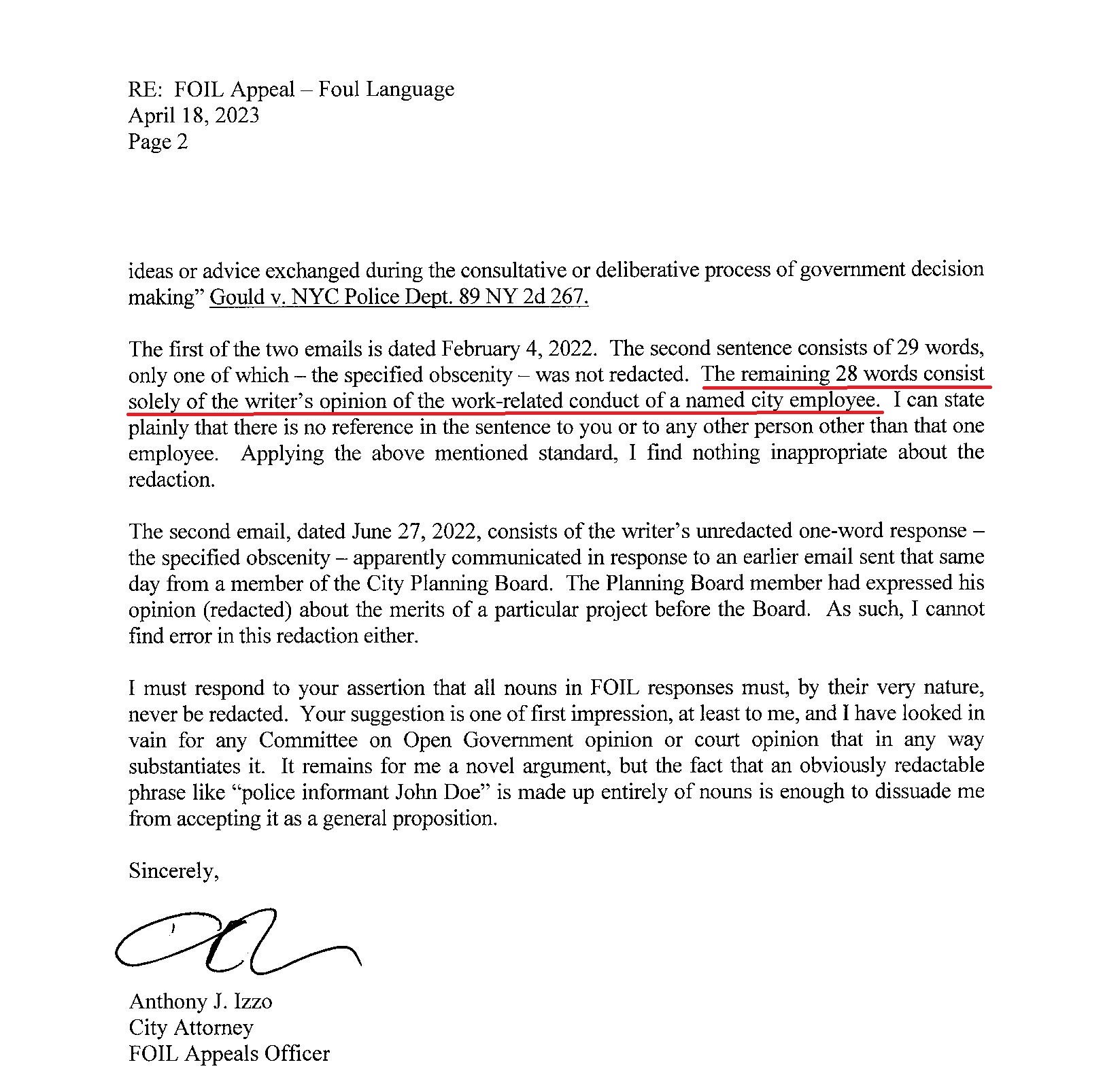
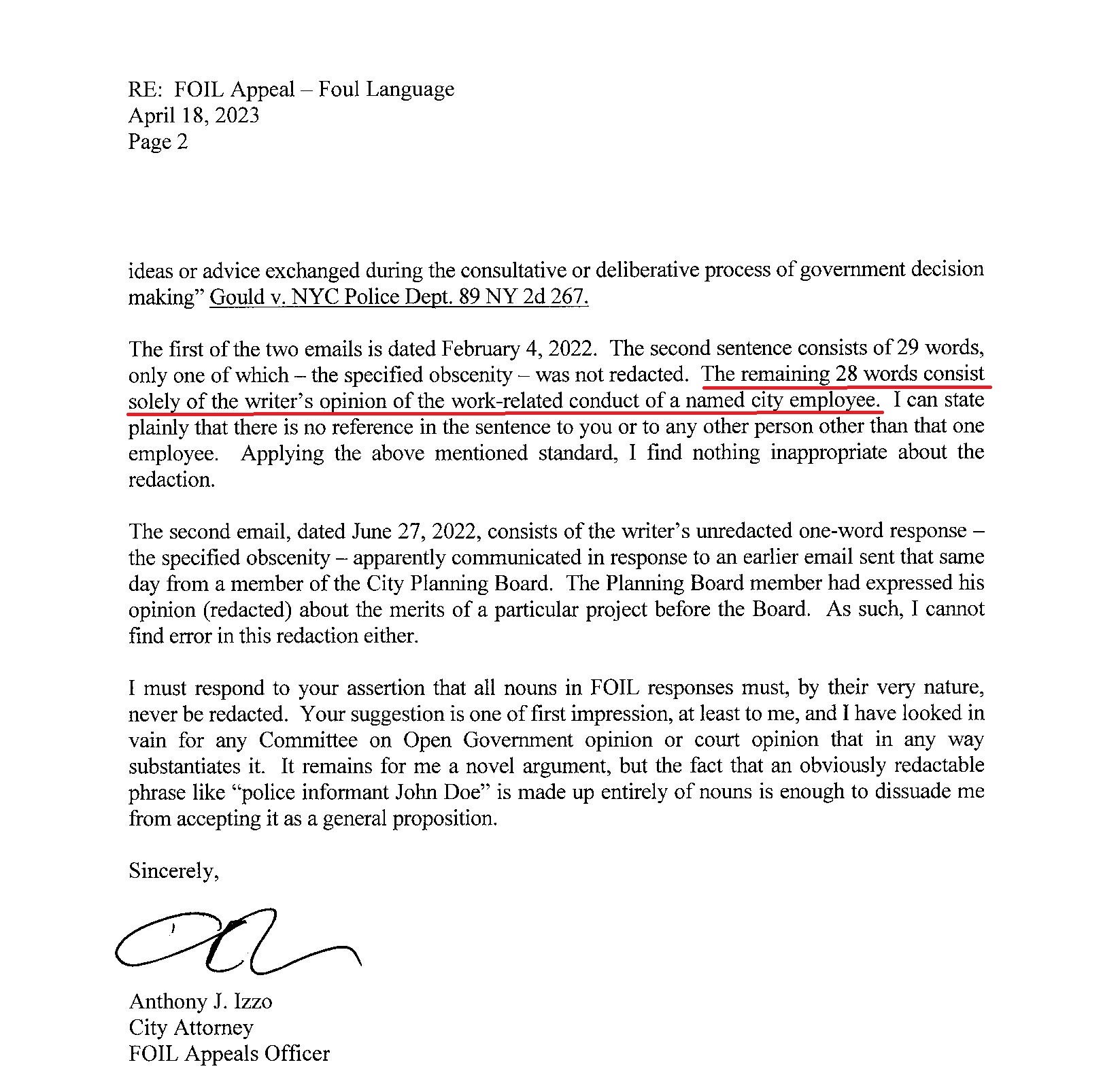
This is where things take a more sinister turn. City Attorney Tony Izzo upheld the City’s redactions but clarified the redacted portion of the February 4 email. Izzo writes that the expletive-containing sentence in question contained “[Kim’s] opinion of the work-related conduct of a named city employee.” Accordingly, Mayor Kim, at 10:56 PM on a Friday night, used offensive language in communicating about an unknown public employee’s work-related performance to two other city employees. This is wildly inappropriate.
With the City’s insistence that the redactions remain, we can only speculate as to which employee has drawn the mayor’s ire and what exactly he was saying about them. But one thing is clear, Mr. Kim is a bully who has no qualms about exposing the City to liability in creating an overtly hostile work environment. It is completely inappropriate in any circumstance, but especially for a mayor of one of the most respected cities in the country, to use this sort of language to refer to an employee or in a communication with employees under his supervision.
So what is the big deal? Considering the context, this is no minor incident. The United States Department of Labor classifies “verbal abuse including offensive, profane and vulgar language” as workplace violence and identifies this sort of intimidating, discourteous behavior as a “level 1” warning sign for workplace violence. Researchers at the Southhampton School of Business found that “Repeatedly swearing, making threats and engaging in verbal abuse can lead to depression, stress, reduced morale, absenteeism, retention problems, and reduced productivity [and can] damage the image of the organization.” Karen Hinds, Diversity and Inclusion expert and founder and CEO of the Workplace Success Group states, “Bosses who use profanity to express themselves are in fact, attacking morale and creating a hostile work environment. Their behavior is a poor reflection of their management skills, and in essence, this behavior is workplace bullying.”
Heck, even the Trump White House had standards when it came to profanity. Your readers may recall, Anthony Scaramucci was fired after merely 10 days working for the Trump White House for making “comments that were inappropriate for a person in that position” after a vulgar rant to a reporter.
In closing, Kim’s behavior here is simply reprehensible. Such language directed at an employee’s performance is nothing short of bullying. In choosing his words, Kim reveals much about his character.
In reference to government transparency, Supreme Court Justice Louis Brandeis once said, “sunlight is the best disinfectant.” There is no better cure for the rot of government mischief than the citizen exercising their right to throw back the curtain and examine the behavior of their elected officials. While these two emails were disclosed, one is left to wonder how many other instances of Kim’s inappropriate behavior remain out of the light of day and how many more we may see as Kim’s administration bumbles toward the expiration of its term.
Excerpt From Tony Izzo To Mike Brandi
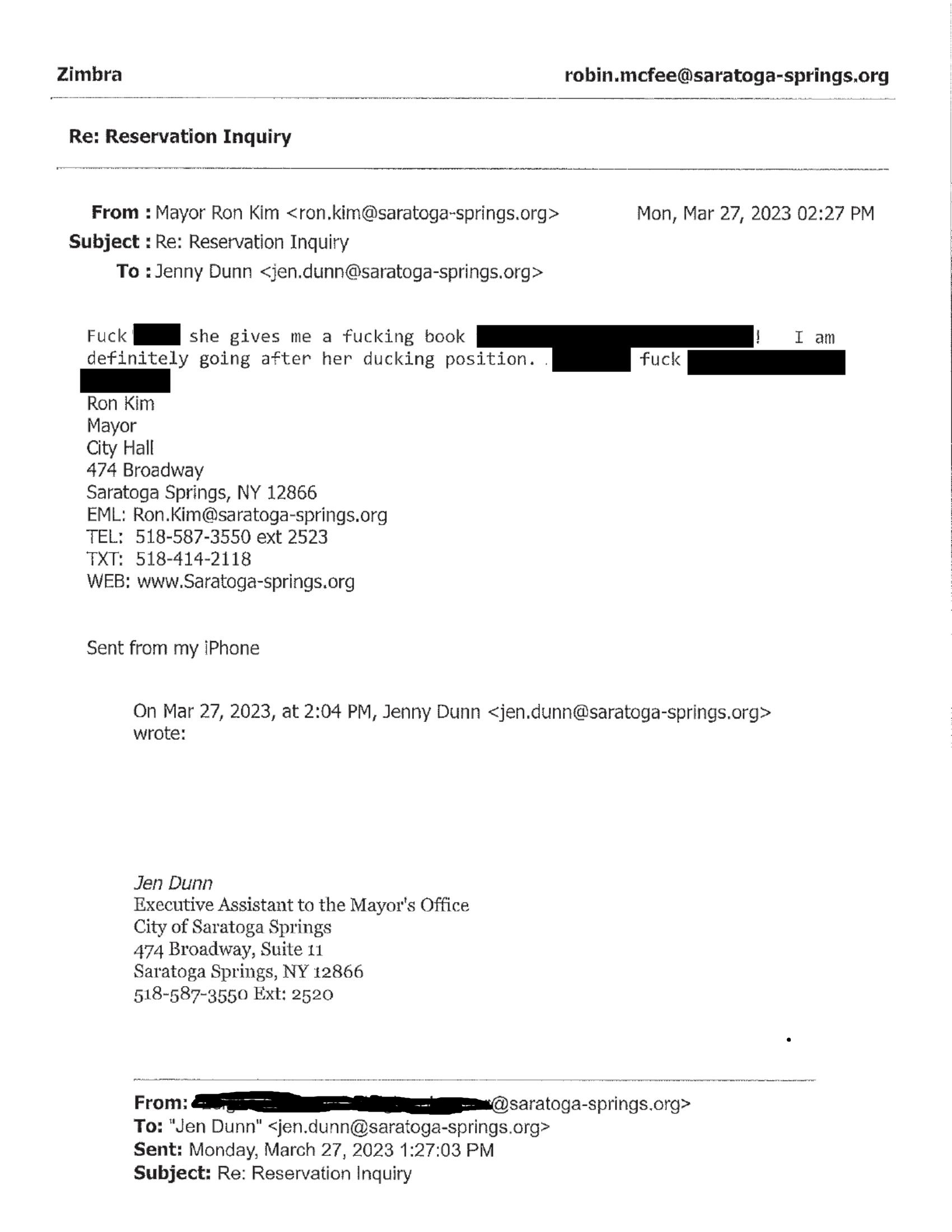
Emails
This email contains the F word regarding a city employee. Note that the email thread includes a response from Robin McFee, who is the executive assistant to the city attorney. She handles FOIL requests. This all occurred relatively early in the Kim administration when he was attempting to act as the city attorney. Vince DeLeonardis, the previous city attorney, acted as the appeal officer for FOIL denials. At this stage, McFee does not know who is acting as the appeal officer with DeLeonardis gone and no city attorney.
Mayor Kim Responds To Email From Bill McTygue
Here Kim emails to his deputy, Angela Rella, in response to an email from Bill McTygue. McTygue’s original email is pretty much all redacted, so we do not know what McTygue said to prompt Kim’s email.
[JK: Jim Martinez is a registered architect. A stalwart preservationist and founding member of the Saratoga Springs Preservation Foundation, he has authored many articles about our surviving resources and their stewardship.]
The COVID-19 emergency declarations will end on 11 May 2023. This follows Governor Hochul’s announcement on 15 June 2021, that social distancing requirements and seating distance in restaurants would no longer be needed. Yet today, just shy of 2 years of that proclamation, we are still accommodating extra seating for select businesses in the public rights-of-way (ROW) to lessees and property owners, reducing and in some cases ignoring sidewalk Fire Code and City Code requirements, eliminating valuable public parking and challenging the distinguished visual landscape of our heralded historic downtown district.
Pandemic emergency responses aside, should we question the legitimacy of the taking of public land for private use? The Design Review Board (DRB) was given design review and approval of the outdoor dining corrals, but the legitimacy of the construction barriers was off the table. At their March 3rd meeting, the DRB were issued prescriptive guidelines as they were presented with 12 applications and a new sidewalk removal request. Were these guidelines vetted by the community, the preservationists or by the Departments of Public Works and Public Safety that might impart code compliance standards? The DRB was informed that the approval and review of these barriers was not part of their charge, instead to simply comment on their compatibility with guidelines questionably unfit for our historic and sacred downtown. The DRB should find them unacceptable in our once great city center.
The issue overlooked by design was the legitimacy of the concrete barriers recently purchased by the city for the express use by select businesses to be maintained by the Public Works Department for the lessees and property owners to increase their commercial space in the public right of way two years after the pandemic emergency was lifted. Is this municipal option open to all residents on public throughfares?
Additionally, last year Short Alley, a posted ‘No Parking Fire Lane’ was closed to traffic to accommodate dining along Henry Street. Unsecured flammable propane tanks along with an assortment of miscellaneous detritus was permitted to be stored openly in the fire lane one block from our fire station. Post pandemic restrictions, some businesses on Phila Street have increased their seating by 50% at the expense of the public having to navigate between “The Pillars of Hercules” on one of our historic feeder streets and the loss of valued public parking. Recently a restaurant next to Congress Park has received tentative approval to use its public rights-of-way sidewalk for dining, resulting in forcing all pedestrians into the road. This property already received approval in the past for the construction of an entry portico, stairs and ramps on the public ROW sidewalk, conditioned on preserving the resulting path clear for the public. Is it legal to remove the sidewalk completely against state and local codes?
Was the tentative approval of this application based on consultation with our city departments, inspectors and planners? Sidewalks and cleared paths on unpaved level surfaces are specifically defined in our City Code as to be a minimum of 5 feet wide, so why is the city now allowing in some instances 4 feet to be the distance between table edges in our downtown core (Caroline Street) and in some others removing them completely? How will this reduced dimension accommodate wheelchairs and baby carriages, let alone the public at large? Have accessible sidewalks, adherence to traffic controls (fire lanes) and our city codes become selective and irrelevant?
In conducting a code review, the researcher understands that codes are complimentary. One code or one section of a code may be usurped by another more restrictive requirement in another section or another code. Our City Code establishes a five-foot minimum width for public passages on city streets. While another code may permit a four-foot width requirement for accessibility, the larger requirement is what determines the acceptable minimum dimension.
Per City Code § 203-23.A.(2)(a), “The minimum width [of sidewalks] shall be 5.0 feet.” However, Fire Code imposes greater space requirements at the public right-of-way.
Seems this UDO provision relating to signs (Article 12) should also apply to any usage of outdoor dining space:
“C. Encroachment into Right-of-Way
For a sign to permissibly extend into a public right-of-way, prior review and approval by the Commissioner of Public Works, after consultation with the Department of Public Safety, is required. Adherence to the design standards included in this Article does not imply approval of an encroachment.”
The City Code also defines the City’s“Fire Limits”, which used to have specific requirements as to construction types allowed therein. Typically, only non-combustible construction is allowed within fire limits.
One reason that Public Safety needs to review sign installation (and should also regulate sidewalk dining constructions in the public right-of-way) is that the Fire Code regulates egress from buildings.
Per 2020 Fire Code of NYS:
EXIT DISCHARGE. That portion of a means of egress system between the termination of an exit and a public way.
PUBLIC WAY. A street, alley or other parcel of land open to the outside air leading to a street, that has been deeded, dedicated or otherwise permanently appropriated to the public for public use and which has a clear width and height of not less than 10 feet (3048 mm).
1028.5 Access to a Public Way
The exit discharge shall provide a direct and unobstructed access to a public way.
Exception: Where access to a public way cannot be provided, a safe dispersal area shall be supplied where all of the following are met:
The area shall be of a size to accommodate not less than 5 square feet (0.46 m2) for each person.
The area shall be located on the same lot not less than 50 feet (15 240 mm) away from the building requiring egress.
The area shall be permanently maintained and identified as a safe dispersal area.
The area should be provided with a safe and unobstructed path of travel from the building.
Taking up the entire public right-of-way/sidewalk with dining adversely impacts the available public way for safe egress.
We should also understand that the taking of these taxpayer streets and sidewalks are being offered for a pittance to selective lessees who may or may not be city taxpayers. It should be noted that these gifted property extensions are set up by the longitudinal street facing dimensions which at best are discriminatory against businesses with limited frontage or against those restaurants on thoroughfares considered unacceptable. Are these giftings and fee structures transparent and fair let alone legal?
Codes and requirements are usually the hurdle for most city projects, whether on private parcels or municipal lands. I can remember when this city recognized the attractiveness of its downtown, passing legislation that respected its surviving resources and established guidelines for new contemporary additions to the cityscape. The creation of a review commission charged with embracing the guidelines protects our legacy.
Such traffic barriers are questionably legal, ugly and have no place in the public street outside of a short-term emergency.
Saratoga Springs Accounts Commissioner Dillon Moran has steamrolled through a personal takeover of temporary outdoor dining in the city. In fact, this has become his personal fiefdom. He is now the czar of outdoor dining and he rules with opacity.
As documented below, attempts to secure the most basic information on how he awards the city’s rights of way to local restaurants and bars and and how he arrives at the fees he charges have gone unanswered in spite of repeated emails promising to provide key information (see emails below).
A Little History
In the face of devastating threats to the hospitality industry caused by COVID restrictions on bars and restaurants, New York State allowed businesses to expand outdoor dining seating into public rights-of-way. The previous city administration set up a special committee to develop guidelines and implement a program to assist businesses in taking advantage of these new rules.
The committee was made up of Vince DeLeonardis (the City Attorney), Aaron Dryer (Assistant Fire Chief), Mike Veitch (Public Works Deputy Commissioner), and Marilyn Rivers (Director of Risk and Safety). This blue ribbon committee accepted applications from businesses and ensured that the applicants met all the requirements of the city regarding legal issues, public safety, street logistics, and adherence to insurance requirements before issuing permits. This process depersonalized the approval of applications and made sure that the key players with expertise eyeballed every application.
When Commissioner Moran took office, he quickly moved to take control of the city’s outdoor dining program and marginalize the other players. The Public Works Department’s role was reduced to “advice and consent.” All the others who had formerly been involved in the permitting process would now only be consulted at the discretion of Moran. This kind of management is an invitation to trouble.
What Are Some Key Questions About City-Supported Outdoor Dining?
So with Moran now in charge, I wrote to him on March 27, 2023, asking the following questions.
Do you have any documentation that supports the claim that the fire department has reviewed and approved all applications for outdoor dining since January 1, 2022 as regards adherence to the city’s fire safety requirements?
If you do, could you please provide them to me?
Do you have any documentation that demonstrates that all applications since January 1, 2022, adhere to access on the sidewalks to sufficiently meet the city’s right-of-way requirements and the ADA?
Do you have a spreadsheet or other document that reports for each year on the expenses the city has incurred implementing the outdoor dining program since January 1, 2022, including staff time required to review and process the applications, the cost of acquiring or leasing the barriers, and the cost for deploying barriers?
If you do, could you provide them to me?
Do you have a spreadsheet or other document that reports on the income the city has received from restaurants for outdoor dining since January 1, 2022.
Do you have any documents that explain how the fees for outdoor dining were arrived at. This would include the process that was used to arrive at these costs as well as the basis for them?
As the emails below document, first Commissioner Moran promised to answer my questions. What followed, however, were multiple emails meant to explain his delays in answering my questions, and then crickets.
A Failed Rush To Open
Moran announced that the season for temporary outdoor dining would begin on March 29 and that by that date the barriers used to protect diners eating in the parking spaces in front of the restaurants would be deployed.
Under New York State Labor Law, contractors and subcontractors must pay the prevailing rate of wage and supplements (fringe benefits) to all workers under a public work contract. Employers must pay the prevailing wage rate set for the locality where the work is performed. Prevailing wage is the pay rate set by law for work on public work projects. This applies to all laborers, workers or mechanics employed under a public work contract.
NYS Department of Labor
Moran apparently selected the Fort Miller Group as the vendor for the barriers. In order for them to deploy the barriers, they would have to meet the “prevailing wage” requirement, but they do not. There is some question as to whether the Public Works Department had the needed heavy equipment to carry this out.
This is emblematic of Moran’s routine failure to perform due diligence properly before rushing forward.
All of this is totally opaque. It remains unclear if the city has even approved this year’s applications for outdoor dining. In fact, as far as I can tell, Moran has yet to get approval for this year’s fees from the Council.
So How Did Moran Arrive At What To Charge For The Use Of Rights-Of-Way?
As the correspondence below documents, the public has no idea how Moran arrived at the fees the city charges businesses for outdoor dining permits (if he has arrived at a fee schedule for this year at all).
Judging by the previous year, the city is charging token fees for some very expensive real estate. Last year, it made no difference if a restaurant had only a small area in front of it using only one parking space or if they took up a street corner with multiple parking spaces. The fees were the same: $250.00 a year for just part of the sidewalk and $1,000.00 for parking spaces whether it was for one or many.
I believe this is a pittance of the value of these right-of-ways, but with no formal assessment of the worth of these properties, who knows?
Would You Like To Own The Parking Space In Front Of Where You Live Or Work?
For some reason, the privilege of using the space in the street in front of a business is limited to restaurants. Retail businesses would love similar privileges for their customers.
Putting aside the arbitrary nature of who benefits from the outdoor dining program and who doesn’t, a major question is what is the value of the sidewalk and street parking spaces? Under Commissioner Moran, this has been a fire sale endearing himself to the businesses who are the recipients of his largess.
An Unhealthy Situation
This is representative of how Commissioner Moran operates. He appears uninterested in rigorous planning and accountability. Such an approach would require an open process involving his colleagues and their staff in city hall.
Previous Councils would never allow this kind of wild west behavior. They would insist on the details. This would normally be especially true regarding the role of the Finance Commissioner. Commissioner Sanghvi’s failure to evaluate the financial considerations in Moran’s initiative is more than disturbing. She should be asking the same questions that I asked.
Watching this Council is a grim undertaking.
Emails
On March 23, 2023 I wrote to Dillon Moran:
This is a follow-up to your call today:
Do you have any documentation that supports the claim that the fire department has reviewed and approved all applications for outdoor dining since January 1, 2022 as regards adherence to the city’s fire safety requirements?
If you do, could you please provide them to me?
Do you have any documentation that demonstrates that all applications since January 1, 2022, adhere to access on the sidewalks to sufficiently meet the city’s right-of-way requirements and the ADA?
Do you have a spreadsheet or other document that reports for each year on the expenses the city has incurred implementing the outdoor dining program since January 1, 2022, including staff time required or review and process the applications, the cost of acquiring or leasing the barriers, and the cost for deploying barriers?
If you do, could you provide them to me?
Do you have a spreadsheet or other document that reports on the income the city has received from restaurants for outdoor dining since January 1, 2022.
Do you have any documents that explain how the fees for outdoor dining were arrived at. This would include the process that was used to arrive at these costs as well as the basis for them?
Please note that the adoption of a resolution by the council did not provide any of this information.
Thank you for your assistance.
JK
On March 23, 2023 Moran responded:
John
I’ve been in Boston the last couple of days and am booked full tomorrow.
I’ll get you something next week, and I will also share how it’s working this year
Kind Regards,
Dillon Moran
On March 28, not having heard from Moran I wrote:
You were going to get back to me with answers to my questions this week.
Still not hearing from Moran, on March 30 I wrote:
Dillon:
You said you would provide me with answers to my email this week. What is the status of my request?
On March 30, 2023 Moran responded:
Still working out some of the details.
The applications are easy to access, I’m working on the rates at present.
I have an assessors exam tomorrow so I’m not going to have everything done until next week.
Kind Regards,
Dillon Moran
On April 3, 2023 I again wrote to Moran:
What is the status of answering my questions re outdoor dining
On April 4, 2023 Moran wrote:
I will be doing an update at the Council meeting tonight. After that we can figure out what your concerns are and address them.
Kind Regards,
Dillon Moran
On April 4, 2023, I wrote:
What my concerns are spelled out in my email. To the extent that they will not be directly and clearly addressed in your presentation tonight you should answer them.
JK
On April 6, 2023 Moran wrote:
Barb is going to be sending you the applications from the last go round.
There’s a lot going on, I don’t have staff laying around like the others.
Your patience is appreciated
Kind Regards,
Dillon Moran
On April 8, 2023 I wrote Moran:
Thank you for sending the applications. Unfortunately for some reason you did not include the schematics documenting how the outside areas would be laid out that was part of the application. These drawings would have been the only thing of value to me.
More centrally, neither your presentation at the last council meeting nor your emails addressed any of my questions. I find this troubling as you had announced that the deployment of outside dining would begin on March 29. I don’t see how you can approve any applications until you have addressed the issues that my questions were based on.
Do you plan to answer my questions?
On April 10, 2023 I wrote:
I am still waiting for answers to my email re outdoor dining. Do you plan to answer my questions?
On April 10, 2023 Moran wrote:
I’ve tried to provide you what you asked for.
What are you trying to uncover or prove here? I simply don’t have time to play wack a mole about an approval process from 2022 that I’m not directly involved with.
[I got the following release from Courtney DeLeonardis, the chair of One Saratoga]
FOR IMMEDIATE RELEASE
One Saratoga: Seeks an independent line on the ballot and has endorsed a diverse slate of candidates.
Beginning on April 18, One Saratoga members and supporters will be going door to door asking for residents of Saratoga Springs to sign petitions to get their endorsed candidates an independent line on the November 7 ballot. Any person who is registered to vote, regardless of their party affiliation and including No Party, may sign.
One Saratoga has endorsed candidates from both the Democratic and Republican parties. It is a true fusion slate. One Saratoga has endorsed Chris Mathiesen for Mayor, Tim Coll for Public Safety, and Matthew Veitch and Michele Madigan for County Supervisors.
Courtney DeLeonardis, Chair of One Saratoga, said, “One Saratoga was created to promote City before Party and this year we hope to further that effort with a line on the ballot that we believe contains candidates who share our goal.”
One Saratoga is a non-partisan coalition of local residents that seeks to have the best-qualified people governing Saratoga Springs regardless of partisan affiliations. Their watchword is “City before party”.
For more information about One Saratoga, signing petitions, and to learn about their endorsed candidates go to their website at- https://realonesaratoga.org/