Sonny Bonacio’s Building Program For Tom Lewis and William Moore Makes The Front Page of the Times Union

Another great story by Dennis Yusko for the Times Union. This is on the problems of conflict of interest in government.  Link To TU article


Growth sparks concerns about conflicts of interest in Saratoga County

Robust development hikes risk of conflict of interest for those on land-use panels

By Dennis Yusko

Published 7:48 pm, Saturday, January 23, 2016

Tom Lewis wears many hats.

He was a Stewart’s Shops real estate agent for 22 years, getting approvals from planning and zoning boards for the convenience store chain to build new stores.

During that time, Lewis was appointed to the Saratoga County Planning Board in 2003 and the Saratoga Springs Planning Board in 2011, which put him at times on both sides of the approval process.

Lewis also served as county treasurer for 17 years.

Last summer Lewis disclosed that Dave Trojanski was constructing a new home for him in Saratoga Springs, but he did not abstain from voting on city applications submitted by Trojanski Builders, which has merged with Bonacio Construction.

Lewis, 69, says he neither issued nor received favors for the home project and recuses himself from matters in which he has a financial stake.

“I try to follow the rules because it’s foolish not to,” said Lewis, who in 2013 became deputy chief of staff for state Sen. Kathleen Marchione, R-Halfmoon, earning $74,630 a year.

 Critics say state laws are weak on the issue of public officials’ conflicts of interest. But as years of robust development reach the doors of residents in bustling Saratoga County, some want Lewis and other community planners to be held to higher standards when their personal or professional business intersects with their public duties.

In recent months, residents in the county’s largest towns have confronted planners over potential conflicts of interest and argued for stronger requirements that people abstain from votes.

“It’s come to a boiling point, a tipping point,” said Vince Aceto of Clifton Park, in describing battles over development in southern Saratoga County.

A former member of the Shenendehowa school board and Clifton Park-Halfmoon Library board, Aceto joined dozens of homeowners last fall in opposing a 4,800-square-foot child care center proposed near their homes off busy Route 146. He said conflicts arise because some members of the town’s volunteer land-use boards work in real estate and other commercial enterprises.

State law prohibits public officials from voting on issues in which they have a direct financial interest, though conflicts of interest also can be defined by local ethics boards and courts, said Mark Davies, a government ethics expert who co-chairs the Ethics and Professional Responsibility Committee of the New York State Bar Association‘s Municipal Law Section.

He said a recusal is effectively equivalent to a “no” vote if it makes it impossible for those voting to get a majority. “You really shouldn’t recuse unless there’s a good reason. On the other hand, you should definitely recuse if you, your family or business is benefiting financially,” he said.

Serving on multiple land-use boards can be incompatible because members should not review their own decisions, Davies said. Ethics boards decide gray areas, such as the political activities of board members, so those with a declared conflict of interest should refrain from sitting with other board members during deliberations in order to prevent accusations of improper influence, he said.

As county Planning Board chairman, Lewis recused himself from voting 11 times on 10 projects between June and November, mostly on city projects he already had voted on as a city Planning Board member. “I never voted on the Stewart’s projects, but I do now,” he said.

 Another member of the county Planning Board, Don McPherson, an associate principal and landscape architect for The LA Group, abstained 13 times on 11 referrals during six months. Edwin Vopelak, vice president of technical services and chief engineer at C.T. Male Associates, recused himself six times. Members who recuse themselves can remain at meetings and listen.

Lewis said requiring board members who’ve recused themselves to leave the room during deliberations goes too far. “I think it’s overkill,” he said. The county board does not have alternate members who can step in and replace members who withdraw from votes.

On Wednesday, more than 500 planners and elected officials from across the state are expected to attend the Saratoga County Planning and Zoning Conference 2016 in the Saratoga Springs City Center. The annual day of education sessions is one of the largest events of its kind in the state. Jason Kemper, the county planning director, said engineers, architects and builders provide valuable input into land-use decisions.

“When you have members on your board that work in full-time jobs that involve some part of the planning or zoning approval process, you are going to get recusals,” Kemper said. “It is up to municipalities to determine the frequency that the recusals happen and if those recusals are impacting the function of the board, especially if alternate members are not available.”

Lewis and his wife, Sandra, bought a 0.17-acre vacant parcel at 60 Franklin St. from Joseph Boff in September for $343,750. He hired SBDT Ventures (Sonny Bonacio and Dave Trojanski) to build the family’s home. Bonacio Construction hung a sign at the construction site, and in recent years, also built a home for Zoning Board of Appeals Chairman William Moore. Lewis said he didn’t need to recuse himself from reviewing applications submitted by Bonacio Construction and Trojanski Builders because he shared no financial interest with them from the home construction.

“I don’t believe I’ve done anything wrong,” Lewis said.

A real estate appraiser and ZBA chairman, Moore purchased a lot at 75 S. Franklin St., for $70,000 from Christopher Cuccio in June 2014 and three months later hired Bonacio Construction to build him a home. Moore did not publicly reveal his business relationship with Bonacio, one of the region’s prominent builders, at meetings nor abstain from voting on applications requested by Bonacio after Moore’s home was completed in February.

Moore said last week that he’s built four homes in the city, and hired Bonacio for the one on South Franklin Street because the builder came in with the lowest bid. “I probably should have disclosed Sonny built my house, I’m not saying that’s unreasonable,” Moore said. “But I have a clear conscience. Anyone who has ever done business with me wouldn’t even question that.”

 John Kaufmann of Saratoga Springs, a blogger who writes about politics, did question it. He argued that to avoid the appearance of impropriety, Lewis and Moore should have recused themselves from judging projects of builders they hired. He wrote that while the planners may not have broken laws or ethics rules, only they knew for certain if they were given special treatment from the builders. It was unfair of them, he said, to ask the public to simply trust them. “The city needs to establish a higher standard in its ethics requirements,” he said.

On Tuesday, Mayor Joanne Yepsen, who owns a private consulting business, reappointed Moore to a seven-year term. She also announced she would recuse herself from voting on an expansion proposal submitted by Saratoga Hospital because she was in discussions with the hospital foundation to provide it private services. Yepsen said she reported the possible conflict to the city Ethics Board, which told her to refrain from voting. Accounts Commissioner John Franck also said he would not weigh-in on the hospital’s proposed 75,000-square-foot medical office building in a residential area, saying his accounting firm had worked with area homeowner associations, which oppose the project.

During the review of the child care center last fall in Clifton Park, opponents of the project focused on the fact that the town Planning Board’s vice chairman, real estate broker Joel Koval, was working as listing agent for the property. While Koval abstained from voting, he remained seated with the board. Aceto accused him of making facial grimaces, flipping his tie and chatting with other board members during a review of the project, which was recently approved. A discussion over Koval’s mere presence grew so heated, town leaders eventually asked him to leave the Town Hall room, a recusal policy the town intends to continue following.

“He has an unfair advantage because of his position and that’s not the way government is supposed to operate,” Aceto said of Koval. “He can recuse himself from a meeting, but that doesn’t mean he doesn’t have influence in what happens.”

But Koval, 55, said he serves on the board to help his community and because it runs in his family — his father served on the same board. Koval said he had no problem removing himself from votes in which he stands to gain financially, and never received anything in return for a vote.

“It can be frustrating because you’re there as a volunteer trying to do your best, and people see nefarious things,” Koval said.

In October, Koval’s brother, Thomas, who is an electrical contractor, was appointed to the Planning Board in neighboring Halfmoon. His appointment, board alternate Margaret Sautter said at the time, raised concerns over possible conflicts of interest, as Thomas Koval, 50, owns Koval Contracting and has gone before the board for permits in the past.

Conflicting roles and development have been issues in Halfmoon for years. Robert Chauvin simultaneously worked as attorney for both the town and Belmonte Builders for years. In 2013, prosecutors asked the state attorney general to investigate Chauvin’s business dealings in Halfmoon. That was prompted by a Times Union story that revealed Chauvin, while working as a town attorney for 25 years, allegedly concealed from the public his financial interests in numerous large residential development projects, including some with builder Peter Belmonte Jr., who purchased lots and built homes in Chauvin’s subdivisions.

Chauvin said he recused himself from all Belmonte projects. He became a state Supreme Court justice in 2012.


I Will Take That As A No…?

As I understand the Mayor’s email (see below) neither she nor her office agreed to the language that Mr. Shimkus sought regarding weakening (making more flexible) the language in the Comprehensive Plan.

My Last Email To Mayor Yepsen

From:    John Kaufmann [john.kaufmann21@gmail.com]

Sent:     Friday, January 22, 2016 10:13 PM

To:          ‘Joanne Yepsen’

Subject:               Chamber and Comp Plan

In your last email you indicated you would review my question carefully and respond by the end of the week. It is now Friday night and I have not heard from you.

I mean no disrespect but this is my fifth email to you. if I do not receive an answer to my original question by Wednesday, January 27th, I will assume that you do not wish to answer and I will not correspond with you further on this matter.

Mayor Yepsen’s Response

From:    Joanne Yepsen [Hidden For Privacy]

Sent:     Saturday, January 23, 2016 1:35 PM

To:          john.kaufmann21@gmail.com

Cc:          joseph.ogden@saratoga-springs.org; joanne.yepsen@saratoga-springs.org

Subject:               Response

Mr. Kaufmann:

(The entire server is down for City Hall, so to get this response to you, I send through my personal email address.)

This is in response to your previous inquiries which I am happy to address at this time.

As you may recall, when I came into office, the Comprehensive Plan Committee had been appointed and meeting for seven months; I had no appointments to the committee. By the summer of 2014 the Comprehensive Plan Committee (CPC) had grown increasingly divisive and less productive.

Members of the committee were threatening to walk away entirely, thereby derailing months and months of time and effort by the committee, city staff and financial esources, the city’s consultant ($60,000 contract approved by previous Mayor and Council) and the general public.

In an effort to move the process to a better place so we could give our citizens a long over-due Comprehensive Plan update, members of my staff (the deputy mayor, the Office of Planning and Economic Development, our CPC consultant MJ Engineering, as well as myself on a couple of occasions) met with many members of the Comprehensive Plan committee to discuss their frustrations and concerns about the overall process, and on how best to move forward. Neither myself, nor my staff, ever met exclusively with the Saratoga County Chamber of Commerce with regards to the Comprehensive Plan.   City staff did meet with Mr. Shimkus, among many other committee members (many of whom requested a meeting) but only in his capacity as a member of the CPC. The CPC members we worked with identified areas that were significant sticking points and our goal was to identify those points for additional, productive conversation at the committee level.

The Mayor’s Office, myself included, never insisted that any particular word, phrase, or language be used in the plan. In addition, it should be noted that with the exception of the 53 items that were unable to be resolved at the committee level, every section and every word of the CPC’s final work product was brought before the City Council, publicly reviewed, discussed and voted on prior to its inclusion.

Currently, we are gearing up for our Unified Development Ordinance project (UDO), which is, for those who are not familiar with it, a review and analysis of our city’s zoning laws, policies, and regulations which must be done shortly after an updated Comprehensive Plan. Please keep in mind, the comp plan is a vision, something to aim for and work towards and zoning is the primary tool to implement this plan so the UDO process and product will be critical.

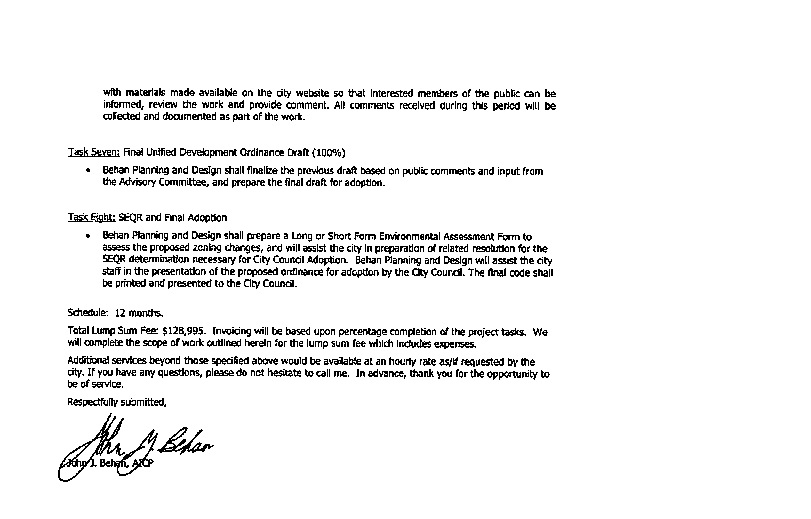
Please be advised that my office has not met with the Chamber, or any other outside organization regarding the UDO. Our consultant for the UDO, Behan Planning and Design, is in the process with meeting with various organizations in the city, including the Chamber. This weekend, we are issuing a press release announcing a large community workshop to be held all day and evening on February 4th, the point of which is for our consultant to be the beneficiary of additional public input prior to their drafting of the zoning diagnostic report.

It is my hope that you can share the information with others so we can set the record straight and so that we can conduct our UDO project with the utmost public faith, cooperation, and full participation, starting with the workshops on February 4.

Respectfully,

Mayor Yepsen


Original Email On Mayor Yepsen And The Chamber

On Dec 27, 2015, at 5:32 PM, “John Kaufmann” <john.kaufmann21@gmail.com> wrote:

Joanne, in reading the comments on the Unified Development Ordinance site I came across comments apparently submitted by the Chamber of Commerce. The text is below. They assert that they met with you and that you came to an agreement with the Chamber to weaken the language for many items replacing  words like implement, establish, or require with words like review, consider, evaluate, etc.

Is this an accurate description of what transpired?

From UDO Web Site Re Chamber’s Comments

Through the Mayor’s office, there was one effort made to find common ground that resulted in the use of some specific words in various recommended actions that we believe specifically indicates a clear preference to create flexibility including:

  1. “Update” the open space plan not implement.
  2. “Review and update” the City’s Historic Preservation plan not implement.
  3. Adopt “reasonable” guidelines that “encourage” restoration not require.
  4. “Review” guidelines for stream buffers not establish.
  5. “Encourage” the development of residential and commercial buildings that exceed minimum state level energy efficiency not require or establish or implement.
  6. Ensure an adequate size and width for public right of ways “wherever feasible.”
  7. “Consider” establishing a Generic Environmental Impact Statement to address citywide traffic impacts not establish or implement.
  8. “Evaluate” form-based zoning not establish or implement.
  9. “Consider” establishing dedicated funds for affordable housing not create.
  10. Thank you for your prompt response.

The Final Hearing On The Hospital Expansion: Whistling In The Dark

Tuesday night was the last evening for the on-going hearing on the proposed expansion of Saratoga Hospital.  The Council will vote on the issue at their next meeting, February 2nd.

As noted earlier, at Tuesday night’s City Council meeting the hearing on Saratoga Hospital’s expansion plans began with Mayor Yepsen and Commissioner Franck recusing themselves.  Mayor Yepsen cited potential work she was seeking with the Hospital Foundation.  Commissioner Franck explained that he served as accountant to both the Morgan Street Homeowners Association and to the Birch Run Homeowners Association.

This left three Council members: Commissioners Madigan, Mathiesen, and Scirocco.  The City Charter requires a minimum of three Council members to pass legislation so all three would have to vote in favor of the hospital’s proposal for it to pass.

The hearing then proceeded.  We heard much of what we heard at the two previous public hearings.  Staff from the hospital as well as representatives from the hospital board spoke of the need to be competitive in a challenging market.  A number of people argued that proximity to the hospital can mean the difference between life and death.  They also argued that by locating the offices together it would allow patients to more easily make visits to multiple doctors.

The neighbors countered with a number of arguments.  One particularly amusing counter argument had to do with the odds of successfully coordinating putting together appointments with more than one doctor on the same day even if they were in the same location.  Most of us know how challenging it is these days just to get an appointment with one specialist so his comments drew laughs.

Neighbors spoke of their concern that the hospital’s expansion would exacerbate the flooding they already experience.  They spoke of their concerns about traffic.  In fact, later in the meeting when City Planner Kate Maynard addressed the Council she noted that the traffic along the adjacent streets was expected to double.   People spoke of how much they have loved living in their respective neighborhoods and spoke of the impact that this imposing structure with its large parking lot might have.  They took strong objection to the hospital advocates’ repeated assertions that they had been in close contacts with the affected neighbors.

One of the most interesting presentations was done by Andrew Brick , an attorney hired by the neighbors. Unfortunately, I do not have a copy of the Comp Plan map but the site of the proposed doctors’ offices is in just a small part of a much larger area in that part of town that the Comp Plan has designated as “transitional.”   “Transitional  land”  is land that the hospital could potentially develop. Mr. Brick pointed out that the drawings presented by the hospital showed a road to nowhere and water and sewer lines that seemed to arbitrarily end, all located on an additional site in this “transitional” area.

It seems likely that the hospital’s current expansion plan represents just one step in what is a much larger plan to grow. The City Council needs to require the hospital  reveal what other long term plans they have to expand and how those plans will meet the needs of the city in order to properly evaluate this one step they are asking for now.

Another problem is the lack of objective information and independent analysis concerning the hospital’s proposal.  It is difficult to evaluate the hospital’s assertions about the importance of having doctors lodged within walking distance of the hospital based only on the evidence presented by local supporters of the hospital.  The City Council in one sense is being asked to determine if the benefit to the community of the hospital’s expansion outweighs the rights of the neighbors to maintain the quality of life of their neighborhood. Without some independent professional analysis of the effect that doctor proximity has on patient care it would seem difficult for the City Council as laypeople to make this determination.

The road to the hospital’s expansion began with the dubious process of inserting a change in the Comp Plan to allow change in a residential area without sufficient transparency and opportunity for public discussion. It is little wonder then that the hospital’s argument that their expansion plans are all about patient care lack credibility for many.

For the City Council to make an informed decision I feel, as I stated at the public hearing, that two steps need to be taken.

  1. The City Council needs to require that the hospital be fully transparent about all plans for the future growth of the hospital in Saratoga Springs
  2. The City Council should engage an independent consultant to advise them on evaluating the hospital’s arguments and help them determine if possible alternatives exist to meet the hospital’s needs.

Only then can the public be more confident that a fair and equitable decision is made that will be in the best interest of the community.


More Appointments By Mayor Yepsen

In addition to the regular appointments to the land use boards, Mayor Yepsen appointed three alternates.  They will fill in when regular board members are unable to attend or participate.

Amy Durland

Mayor Yepsen appointed Amy Durland for a two year term as an alternate for the Planning Board.  Ms. Durland has served in the past as a full member of the Planning Board and chaired the Board. There are two people whose dedication to the struggle on development issues has been just extraordinary.  Amy is one of them.  She is meticulously thorough and scrupulously honest and fair.  She has logged in more hours at these meetings than any human should bear.  Should any member of the Planning Board recuse themselves or be unable to attend meetings, the community will be the better for it.

Oksana Ludd

Ms. Ludd was appointed to serve either one or two years as an alternate on the Zoning Board of Appeals.  I am unclear which is her term.

There is an exception to every rule.  I have expressed dismay at the many members of our boards who are from the real estate industry who routinely rule in favor of said industry. 

Ms. Ludd is an attorney who specializes in real estate.  This is a link to her: Link

I have been assured by people I respect that as a member of the Comprehensive Plan Committee she was a major asset regarding protecting the city’s greenbelt.  Her background made her a very effective voice for thoughtful land use practices.

Cheryl J. Grey

I know relatively little about Ms. Grey.  She is married to Kenneth Grey who has been involved in the Smart Streets initiative and who is with the Marshal and Sterling Insurance Company.  Friends tell me that they have both been involved in preservation issues.  Ms. Grey coaches LaCross.

From what I gather if she has an opportunity to fill in on the ZBA she should be a fair and constructive force.


A Small Event With Large Consequences

Sometimes the most significant events are overlooked when they occur and their importance only becomes evident much later.  This post is about one such event. The topic of this posting probably will not appear in any of our newspapers or on television but its far reaching repercussions make this one of the most important blogs I have written.

This post is about Mayor Yepsen’s appointments to our land use boards at Tuesday night’s meeting.

Under the existing City Charter the Mayor of our city enjoys the unrestricted power to make appointments to our land use boards.  There are no requirements that the Mayor advise the public of the choices prior to their appointment.   No approval from the other members of the City Council is required

The enormous power of our land use boards only becomes apparent to many in the community when they find themselves affected by a major land use decision.  The neighbors of Moore Hall have had that  education.  The neighbors of Saratoga Hospital are starting down that road to enlightenment.  Those who have been involved in the conflict over the attempts to commercialize the city’s greenbelt have learned this lesson.

While the City Council  plays a major role in many aspects of land use issues, the boards are just as, if not more, powerful.  If the hospital gets its approval for their expansion from the City Council, the Planning Board will be affecting how traffic will flow.  They will decide whether to accept proposals for blasting in the area.  They will make similar decisions about what happens with Moore Hall and they will decide many, many issues if Saratoga National Golf Course gets approval to become a resort.

The terms for the members of both the Zoning Board of Appeals and the Planning Board are seven years.  Scott Johnson who served for multiple terms was able to fill both these boards with his appointments.  He chose people whose loyalty to the real estate industry was beyond reproach.

It was the hope of many of us that when Mayor Yepsen was elected  she would reconstitute the boards with people who were independent of the zealous development industry and whose decisions would show greater sensitivity to the citizenry at large.  It was understood that given the terms of these board members the changes in their composition would take many years.

Last night  Mayor Yepsen announced her latest appointments and any illusions that her reelection would result in a shift in the make-up of these boards were dashed.

Mayor Yepsen Reappoints William Moore to Continue as Chair of the Zoning Board of Appeals for Seven Years

Mr. Moore was originally appointed to the Zoning Board Of Appeals by Scott Johnson.  Moore is a real estate appraiser.  Like many of the real estate people who serve on the land use boards, the people who come before him are often potential clients.  As should be obvious, this places Mr. Moore in an interesting position.  Were he to routinely rule against the people in the real estate industry coming before him, it would do little good for his business.  On the other hand, being a good old boy who regularly assists them places him in a particularly good situation for later business.

I was able to observed Mr. Moore first hand as he chaired the meetings regarding the Bonacio application for variances for Moore Hall.  Mr. Moore’s bias towards well connected applicants was stunning.  Mr. Moore has the applicants for variances sit at the table with the ZBA members.  In contrast, any who oppose the variances are relegated to the seats beyond the railing.  If you sit in the “gallery” you immediately understand your status as compared with those who are privileged to sit up close and personal with the board.

Mr. Moore made no attempt to limit the time of the attorney representing Bonacio at the meetings in spite of the fact that the attorney’s remarks were often not germane to the specific standards of the variance under consideration or were wholly redundant.   In contrast, when it came time for the public to comment, Mr. Moore sternly advised them that they would be limited to two minutes each. He then attempted to cut off the attorney representing the neighbors when he had used up his two minutes.  Only an angry response from the many neighbors at the meeting along with some who offered to give up their time to the attorney allowed the neighbor’s representative to finish his remarks.

During each of the meetings Mr. Moore took the opportunity to praise Mr. Bonacio’s proposal.  In hindsight, this pandering was particularly disturbing because Mr. Bonacio had recently completed building Mr. Moore’s house.  Not only did Mr. Moore not recues himself from a decision affecting someone he had so recently had a business relationship with but he saw no need to advise the public of the potential conflict of interest.  Even later when this was brought to his attention he did not see any problem with his relationship with Mr. Bonacio and his review of Mr. Bonacio’s projects.

After it was disclosed that one of the members of the ZBA had joined Mr. Bonacio and his attorney for drinks following one of the meetings about the Moore hall project, Mr. Moore  showed a complete indifference to the concerns of the neighbors.   In fact, he publically shared a laugh with the lawyer for Mr. Bonacio over the incident.

Mayor Yepsen has decided that Mr. Moore is the best person in this city to lead the Zoning Board of Appeals for the next seven years.

Mayor Joanne Yepsen appoints Jamin Totino to a seven year term on the Planning Board

Mr. Totino is  Director of Student Academic Services at Skidmore College. Link to Skidmore Profile

Mr. Totino was originally appointed to the Planning Board by Democratic Mayor Valerie Keehn.  With Keehn’s defeat, Mayor Johnson began filling vacancies to the city’s land use boards with appointments who had ties to the real estate and development  industry.  Mr. Totino, an affable man, developed a cordial relationship with his new colleagues.  In fact, he cooperated with them so well on votes and  connected socially so well them that he became the development community’s favorite Democrat I am told.   He apparently was considered so reliable that Mayor Johnson chose to reappoint him when Totino first term was up.

Totino resigned before his second term ended.  Eventually the long and often dull meetings became too much for him.  He did not have the incentives of business opportunities that his other friends on the board enjoyed.

More recently, Commissioner Scirocco  appointed Totino to the Comprehensive Plan Committee.  As the readers of this blog may recall, the Committee had a series of votes meant to facilitate more intense development in the greenbelt by allowing Planned Unit Developments (PUDs).  This proposal was repeatedly defeated in seven to six votes.  This article by Tom Dimopoulos gives a good overview.  Link To Story

Then  Mr. Totino, Todd Shimkus, president of the Chamber of Commerce, and Jaclyn Hakes, the consultant working with the Comp Plan committee met together at the Mayor Yepsen’s invitation. At the next Comp Plan meeting, Mr. Totino, who had consistently voted against opening the greenbelt to more development suddenly and surprisingly changed his vote.

The public outcry at this Comp Plan Committee vote was so intense that it prompted Commissioner Mathiesen to introduce legislation banning PUDs in the greenbelt.  At a standing room only meeting the Council unanimously adopted Mathiesen’s resolution.

Shimkus was furious. He complained bitterly that the Mayor could not be trusted which simply reaffirmed the rumors about her involvement.  To say the least, it was an embarrassing moment for Totino.  Nevertheless, he sent out an email in which he defended his vote using the exact argument put forward by the Chamber that PUDs provided the tools needed for flexible development.

Mayor Yepsen believes that he is the best person that she can find in our city to serve on the Planning Board for the next seven years.


Code Blue Calls For Volunteers

I received this from the Code Blue folks:


Friends, In case you can either help or can forward on to others who may be able to help.  Thanks, mb Michele Brumsey The Salvation Army 518-463-6678 Ext. 17/518-463-0138 fax 518-229-2548 cell Michele.Brumsey@USE.salvationarmy.org Website TwitterFacebook

Dear Steering Committee, The Program Committee held an emergency meeting Sunday afternoon to address the issue of overnight volunteers. If you have looked at the schedules lately you would see that we are sorely lacking in overnight volunteers. The 1:30am-5am shift is especially hard to fill. We have the paid overnight staff person from 12midnight – 8:30am but we still need at least 2-3 volunteers to complete the staffing for the night shifts from 10pm-1:30am and 1:30am-5am.  The sign ups for these shifts is very minimal and so we are staffing with a few volunteers from the program committee and myself. This can’t continue for the rest of the season. We must have additional help. As members of the steering committee we need your help. Immediate needs require us to ask you to sign up for a shift or two. We need you to also promote Code Blue in your respective agencies and recruit volunteers for the overnight shifts. Code Blue Saratoga is growing and in order to continue to meet the needs of our community and guests we must have volunteers. As our steering committee we are relying on you to help solve the issues Code Blue is facing. Thank you, Cheryl Ann Cheryl Ann

Cheryl Ann Murphy-Parant

Code Blue Saratoga Director

Saratoga County Continuum of Care Coordinator

(518) 812-6886 – cell

www.codebluesaratoga.org

Office Address:

Nolan House

Presbyterian-New England Congregational Church

24 Circular Street, Saratoga Springs, NY 12866


A Stunning Development In The Saratoga Hospital Expansion Process

A real stunner of a City Council meeting tonight.  Much more will follow but it is late (are any City Council meetings not long and drawn out?)

To the surprise of the other Council members, Joanne Yepsen and John Franck recused themselves from any further involvement with the Saratoga Hospital expansion.  This seems particularly bizarre because they have participated in the two previous (and very long) public hearings on the expansion.  What suddenly prompted their action tonight is simply unknown.  I will review the video tomorrow but Joanne Yepsen said that she either has had or expects to have Saratoga Hospital as a client.  She is a consultant for fundraising.  John Franck, as best I understood him, has been the accountant for the housing complexes by the hospital.

The City Charter requires that in order to pass legislation a majority of the Council must vote affirmatively.  This means that any legislation must have at least three affirmative votes.  Commissioner Mathiesen asked City Attorney Tony Izzo what would happen were he to recuse himself on this issue.  Mathiesen noted that his father lives in Birch Run.  Tony admitted that he really did not know.  Nothing of this sort has ever come up.  Commissioner Mathiesen then indicated that he did not plan to recuse himself.

Basically, if any of the three were not to vote for the Hospital’s PUD application, it would fail.  My take on this is that Michele Madigan is very much in support of the hospital.  It is unclear how the other two Council members will vote.


Statement On Saratoga Hospital Expansion

Alice Smith has been active with the group opposing Saratoga Hospital’s proposed expansion.  She has asked me to post the following statement from her:

A Public Hearing will be held on Tuesday (Jan 19th) re: the hospital’s expansion plan.

The hospital advocates have told the public it is a necessary addition to provide better care to the the community and to save money.   The hospital currently provides excellent care to the community, and the emergency room is staffed with doctors trained to handle emergencies.

When doctors have an office full of patients with scheduled appointments, it is hard to believe they are constantly running out to take care of emergencies at the ER.  The hospital (through their representative law firm) has made various statements to the public which are very misleading.

They have minimized the adverse effects it will have on the surrounding area, such as damage to the environment, potential flooding, parking lot lighting, and traffic.  Additionally, they have lied about working with residents of the area.

As I have stated before, they have not been communicating with residents.  Most of the area residents have very limited knowledge of the proposed plan.

The Saratoga hospital has been trying to attract more business (evident by the constant adds on TV) and they would no doubt make more money with the proposed addition  -but this can be done by looking at other options, without violating the rights of residents who have worked very hard to own and maintain their homes and their neighborhood.

Jones Law Firm has also stated that they have not found any loss of value of the properties surrounding the area.  This is something that happens AFTER

The loss of property value happens after the area is rezoned and building is started. I do hope our Planning Board and City Council carefully evaluate the information provided by the hospital and realize that it  fails to guarantee the preservation of the surrounding area.

Thank you.


Saratoga County Government: Yet Another Scandal

Saratoga County government has developed a reputation for indifference to the quality of services it delivers . We have a Public Defender guilty of DWI and caught on camera trying to get Saratoga Springs police officers to do him a favor and not charge him.  We have the case of Michael Prezioso, director of the county Department of Mental Health. You will recall that Prezioso  was found guilty of sexual harassment at his previous place of employment by the NYS Department of Mental Hygiene. At his present county post he has been the subject of many complaints about his management of the county facility.  

Now we have a new scandal in Saratoga County covered in the article below in the Times Union.  I have emailed both Saratoga Springs Supervisors asking  what actions they plan to take in response to these revelations.

Link to TU story with pictures


$3 million Saratoga project big loser before closure

Saratoga County leaders, told of shortfalls, deflect blame

By Dartunorro Clark

Published 6:32 pm, Saturday, January 16, 2016

Ballston Spa

A $3 million co-generation plant built by Saratoga County and Siemens Building Technologies lost hundreds of thousands of dollars even though county leaders publicly touted the success of the project, which was designed to provide self-sustaining energy to a county-run nursing home.

A Times Union review of engineering studies and other records for the project — which were never made public — indicate county leaders were informed of the project’s failures even as they publicly blamed energy-market conditions for the losses.

The project began in 2002 when Saratoga County officials were eager to upgrade the utilities at Maplewood Manor, a 277-bed nursing home. The county struck a deal with Siemens Building Technologies to install a cogeneration plant for $3 million to produce heat and electricity, which at the time was touted as a way to save money by cutting the facility’s annual utility bill in half.

Nearly 15 years later, however, the plant has been decommissioned, the equipment sold and the nursing home privatized.

Documents obtained by the Times Union through a Freedom of Information Law request, and interviews with people familiar with the project, show the county’s estimated losses reached $180,000 a year by the time the facility was proposed for decommissioning.

The revelations come as other government projects involving Siemens have come under scrutiny. In October, the Warren County Sheriff’s Department released records from a multi-year criminal investigation that said there was probable cause to consider criminal charges against a Siemens engineer, and that a company representative may have falsified documents related to a cogeneration plant built for that county’s nursing home in 2004.

The sheriff’s report suggested Warren County Administrator Paul Dusek could have faced a misconduct charge for his role in advising, and allegedly misleading, county leaders about his understanding of the deal.

The sheriff’s investigation found Siemens officials may have inflated energy savings. Internal documents obtained by the investigators included a spreadsheet labeled “Contract $” with savings listed at $118,512. But another entry labeled “Actual $” calculated the savings at $68,262, according to the sheriff’s report. An investigator characterized the discrepancy as “intentional deception.” The sheriff’s investigators also found evidence a Siemens supervisor chided an engineer who complained about the alleged fraud and encouraged him to be a “team player.” The employee later quit.

In November, the Times Union reported that Rensselaer County officials took part in a “fact-finding” meeting with members of state Attorney General Eric Schneiderman‘s Taxpayer Protection Bureau on the county’s use of so-called “energy performance contracts,” including $56 million in energy performance projects with Siemens. The attorney general’s office declined to discuss the scope of the inquiry.

In Saratoga County, county officials commissioned a $37,000 study on the cogeneration plant as the end of a 10-year maintenance agreement with Siemens approached in 2012. An engineering firm, New York-based Guth DeConzo, and the New York State Energy Research and Development Authority, which paid half of the cost of the study, were hired to assess the performance of the facility. But, at the insistence of county officials, the scope of the study was limited to one year and did not examine prior years of performance.

Still, the study recommended county officials decommission the plant and re-connect the nursing home to National Grid because it was losing hundreds of thousands of dollars, at least at the time it was proposed for decommissioning, according to documents.

When it was announced, the project was expected to trim Maplewood’s $264,000 annual electricity and gas bill to $131,000 — the cost of the natural gas needed to fuel three natural-gas-fired generators — and the project was expected to pay for itself within 10 years of operation.

When questioned about the cogeneration plant two months ago, Spencer P. Hellwig, the Saratoga County administrator, said the cogeneration plant became “budget neutral” and the county saved hundreds of thousands of dollars over the years. Hellwig also said Medicaid rates and elderly cost-of-care concerns were the reasons to privatize the nursing home, which was sold to Zenith Health Care Group in January 2015 for $14.1 million. He also said the new owners had no use for the plant.

In the study commissioned by the county, the cogeneration project was characterized as economically unsuccessful.

“Cogeneration isn’t necessary to provide heating and cooling to your clients. Cogeneration is an economic proposition,” a Guth DeConzo presentation said. “If cogeneration isn’t (saving money), there (are) limited additional benefits. … It does not appear that continued operation of cogeneration plant is economically feasible, as compared to re-connection to National Grid.”

In an interview last week, Hellwig backpedaled when asked about the documents revealing the money lost by the cogeneration plant. Hellwig said the cogeneration plant became financially unsuccessful due to a number of factors, including market changes and energy costs. But his comments marked a shift from November, when he characterized the plant, overall, as successful but said decommissioning it had to be done prior to privatization. He said at the time of the original agreement in 2002, however, the county felt assured in the savings proposed.

“The expectations that were in place are why the decisions were made,” he said.

Still, county officials, including Hellwig, and the outside engineering company hired by the county to oversee the decommissioning, previously said falling electricity rates were reasons for decommissioning the cogeneration plant, which worked by converting natural gas to electricity and using the “waste heat” generated in the process.

But according to historical data from NYSERDA, natural gas and electricity rates showed annual decreases on average statewide for residential, industrial and commercial customers over the period in question.

For instance, according to NYSERDA, from 2011 to 2012 residential rates decreased from $13.64 to $12.87 per 1,000 cubic feet for natural gas, and 18.26 to 17.62 cents per kilowatt-hours for electricity, respectively.

Commercial rates fell from $9.28 to $7.79 for natural gas and 15.81 to 15.06 cents for electricity. Industrial rates decreased from $8.15 to $6.87 for natural gas and 7.83 to 6.69 cents for electricity.

Also, the county’s study noted the energy capacity that the cogeneration was built for was largely underutilized, which indicated it was inefficient for the nursing home at the onset. And when the 10-year maintenance deal expired in 2012, and the plant was proposed for decommissioning, Siemens was proposing a new $168,000 annual maintenance contract with an “escalation rate” of 4 percent, which the study concluded was “exceptionally high.”

Coupled with lack of savings, sources said, it became advantageous for the county to cut its losses.

“This is largely due to the reality that a large percentage of the equipment is idle for a good portion of the year, and has to still be maintained,” the study said.

Siemens stands by its project and its role in providing upgrades to the county and the cogeneration project.

“Siemens is proud of the work completed at Maplewood Manor, which added further protection from potential power failures at the facility,” said Amanda Naiman, a company spokeswoman.

There is no indication the Saratoga County project with Siemens is being reviewed any agency.

More Information

Timeline

  • 2000 Saratoga County sought proposals to upgrade equipment at the 277-bed Maplewood Manor Nursing Home and to improve energy efficiency. The Saratoga County Board of Supervisors recommended that a proposal submitted by Siemens for the construction of a cogeneration project be accepted, according to documents, with the intent to have the project paid for over a 10-year period with no cost to the county. The cost of the project was approximately $3 million.
  • 2002 The county home went off the grid and the cogeneration plant was installed.
  • 2012 The Saratoga County Board of Supervisors voted to commission a $37,000 study, produced by NYSERDA and outside engineering firm Guth DeConzo, to assess the performance of the cogeneration plant at the end of the 10-year agreement. The study revealed the cogeneration plant was underperforming and losing about $180,000 a year by not being connected to the grid. The committee voted unanimously to pay $20,000 to Guth DeConzo to decommission the cogeneration plant and reconnect the facility to National Grid to provide electric service. The committee also voted to resell the cogeneration equipment, which at the time had an estimated fair market value of $60,000 to $100,000, to recoup some of the investment.
  • 2015 The county’s Maplewood Manor Local Development Corp. voted to sell the nursing home to Zenith Health Care Group for $14.1 million. Zenith renamed the Ballston Avenue facility Saratoga Center for Rehabilitation and Skilled Nursing Care. The company’s newly formed entity, Saratoga Center for Care LLC, is licensed to operate 257 beds, down from the former 277.


dclark@timesunion.com • 518-454-5008 • @DartDClark