Jumel Place Neighbors Tell Their Story

One of the rewarding things about doing this blog is the ability to print long pieces that drill down into issues.  It is also the pleasure of exposing institutions that heretofore were able to act badly with impunity because the sunlight never shone on them.   Sandy Cohen has written a long piece detailing the July 11 meeting of the Zoning Board of Appeals that dealt with John Witt’s Downton Walk project.  I admire Ms. Cohen and her neighbors tremendously.  They knew that the chances of receiving justice from the ZBA were remote but their loyalty to their neighborhood and their friends was such that they truly fought the good fight.  Here is their story in their words:


A Letter to All Our Supporters

From the Neighbors of Downton Walk


With thanks to AQUA for the following song:


“It’s time to turn off the light.

This has been such a beautiful night.

We’ve served you a lot of delights

And some really wonderful sights.


My friend this is the end.

So long I’ll see you soon again.

Bye-bye, kissing you hi.

Someday we will be back together.


Chorus:

(Goodbye to the circus.

We hope you enjoyed the show.

Now it’s nearly at the end.

But we will be back you know . . .)


It will be back, you know

It will be back, you know.


You have given us all of the best.

You are beating inside our chest.

Staying with us as time has gone by.

Gave us hope when tide was high.


My friend, this is the end.

So long I’ll see you soon again.

Bye-bye, kissing you hi.

Someday we will be back together.


Chorus


The band played on

From dusk ‘til dawn.

And time is almost gone.

The beat goes on.

It’s almost done,

This music marathon.


It will be back, you know.

It will be back, you know.

Chorus (repeat)

We will be back, you know.

We will be back, you know.”

Step right up Ladies & Gentlemen . . . the circus has been in town . . .


And, for the past four months, that’s exactly what it has felt like! In as much as this was the first time for most of us participating in a run-in with the Zoning Board of Appeals, we have no idea if what we’ve all experienced is the norm; but if it hadn’t been so disturbing, it might have been entertaining.


All the elements were there: Ringmaster, troupe, clowns, dancing bears, and audience . . . Monday evening, July 11 was no exception – and possibly the most amazing performance thus far.


For possibly the first time ever, we were first on the agenda, so we missed out on the shenanigans of others. But they granted that position to Builder John Witt’s Downton Walk Proposal for 27 Jumel Place.


Ringmaster Bill Moore made sure to attend this one after his absence two weeks prior. No alternates this time around. This was going to be the end of public comment and the final vote – come hell or high water.


At this point, there were very few illusions that this resolution would be voted down.


Once public comment was open, our Attorney, Jonathan Tingley, took the mic to advise the Board that he received an email that morning advising him that Margaret Roohan and her husband had stepped up back in March, trying to purchase the Jumel lot that was still an active listing on the market. The Roohans were offering full price – well in excess of $100,000 more – for the land than John Witt had listed in his Land Development chart.


Sadly, however, the seller had to turn down the offer, as, reportedly, he no longer had access to a 48-hour contract addendum requiring Witt to either meet the offer or walk away. He also had received a threat from the Witt’s counsel that there would be extensive and costly litigation, should he decide to cancel the contract and accept the other offer. Both Tingley and our group knew there was no chance that this new builder nor we would get any sympathy from the Board, but the information was paving the way for proof of the contention that there was a much better and more feasible way available for using the land – one that hewed closely to the existing UR-3 zoning requirements and required fewer, if any, variances. Witt’s plans clearly are not the lowest variances, as required by law, as we understand the Roohans had planned to subdivide the lot to build four duplexes, a totally acceptable alternative under our ordinances.


Had our group known this earlier, we might have had time to do some sketches proving how it could be done. Witt had already rejected the possibility of subdivision of the land, which we still feel was the key mistake on his part. In essence, the Roohans were willing to pay 31% more and build 43% less on the same land. So, the feasibility argument should have been clear to the Board. The land could have been divided creatively and any variances would have affected only the new community internally and likely would have minimal effect on the surrounding homeowners.


Speaking in Witt’s favor were only individuals on his payroll: Tim Monahan, his Realtor, who claimed that Witt actually did pay a higher price for the land after the Roohan offer and he claimed the difference was not $114,000. Yet the price Witt has given on his land development cost was $370,000 – versus the $484,000 offer from Roohan, which, in our book, shows a difference of $114,000. He also advised the Board that the seller had been told that they would have to reimburse Witt for all costs to date, if his offer wasn’t accepted. Shortly thereafter, Libby Coreno, Witt’s Attorney, insisted that the land would revert to commercial and or other different uses that had been previously granted and not UR-3 if this application were not approved. This, however, is not the way our Zoning Ordinance reads. She also took her usual umbrage with one of Tingley’s statements: this time she insisted that she never used the term “Slam Dunk,” which he really never attributed to her, but, apparently, that is how she heard it. She heart-rendingly adjured the Board to recognize that only Witt has expended money on this property; and only Witt has spent his time dealing with this project for the last three years. (Cue the violins; and we really suppressed our desire to write: “Enter Dancing Bears” before this paragraph!)


Volunteer speaker after speaker, on our side of the eight-foot fence (no pun intended but entirely accurate) pleaded with the Board to listen and really hear what the neighbors were saying. Themes ranged from Kira Cohen offering 10 Significant Changes between this year’s application and those prior. (We noted an additional change to bolster our previous blog article, reworked, and added more information to what was previously printed, including that 10th point that the zoning actually had already reverted to UR-3.)


But the fact that it read differently didn’t faze Adam McNeill. He interrupted Cohen’s speech, as he did to Sam Brewton in the prior meeting, to question if this was the same letter (blog article) that they had received the during the last week. As she was speaking on her mother’s behalf and had not studied the previous letter, she couldn’t tell them exactly how they differed, but; thankfully, he allowed her to continue.


Cohen was followed by Maureen Curtin, who addressed the five criteria the Board had to consider before voting. As she elaborately deconstructed each point, Curtin spoke of the only neighbor who still came to speak for Witt in the last meeting – the next-door neighbor, on the lot’s west border, who said he did it only because he got Witt to agree to move the 8-foot stone wall/fence to 30”, rather than the 18” from the this man’s window, where it had originally been placed on the drawings. She also countered Coreno’s words, pointing out that, while Witt had been investing his money in that lot and this protracted review, the neighbors were trying to protect the money they have invested in their homes. For many of them, this is the largest investment they will ever make in their lives. Curtin reviewed previously offered information that five homes in today’s local market would bring in almost the same revenue as seven homes would have brought three years ago, when the project was first approved. This means that Witt could subdivide and build fewer homes, still making very close to the same money he would have made in 2013, which was his burden of proof. Curtin’s information proved that, if they were seriously considering these issues, the board’s vote on financial feasibility must be “no”. (They did stare well and looked like they might be listening.)


Anne Proulx, a lifelong Jumel Place neighbor, spoke next, recalling Witt’s visiting in her foyer several years ago — asking her to sign a petition in his favor – long before he had any drawings to show or was imparting any critical information about the size and breadth of the project. Happy at the prospect of demolishment of the unsightly building, she had signed for him but was now at the meeting to retract that endorsement, saying she was appalled at the magnitude of the planned development, something Witt had omitted mentioning during his visit. “It’s far too ambitious; bring it down,” she pled.


Blogger John Kaufmann was next in the center ring. He came to support the neighbors, speaking about why these people and much of the populace are upset with the lack of consideration they get in meetings such as these. He explained how zoning is supposed to be used to keep neighborhoods consistent by making only “reasonable and modest adjustments.” Kaufmann told them they had taken considerable license with this project in the past, and now it is just not consistent with the other homes in the neighborhood. He called out the Board for their “developer friendly” stance and admonished them to listen to the people they are supposed to represent.


Neighbor Gerald Mattison employed an interesting analogy, bringing a ream of paper to the microphone. Each of the 500 pieces of paper represented a signature on the change.org petition (which actually had reached 508 at last count) as well as close to 50 neighbors who had signed a paper petition in our favor, several of whom had originally been on Witt’s side but had subsequently withdrawn their support.


Since the dozens of neighbors opposing this project do not receive equal time and table position as the applicant does in presenting to the Board; nor do we receive answers to questions we ask about our legitimate concerns – the Board refuses “to “banter” with the public” – we question whether we, the neighbors, who will be most gravely and forever affected, were heard or treated fairly.


We presented on July 11, and previously at the June 20 meeting, legitimate and significant changes regarding this application, in comparison to that in 2013/14. But we question whether every Board member examined our presentations and gave them time and consideration equal to what they gave the applicant before making this important and lasting decision. We believe not.


Once the public comment session was closed, the Board debated the required State Environment Quality Review (SEQR). That’s when one could see where the divisions were. Those who were destined to vote in our favor were seeing the comparison to the actual modern zoning of the land vs those who could not let go of its last non-conforming use. They went so far as to ask the attorney which they should be considering. And, regardless of the attorney telling them that the lot is UR-3, they continued to assume that, if this application were rejected, it would revert to non-conforming use and not to true modern zoning (which is the actual requirement).


This writer, who served as an armchair quarterback – not in the room but watching, live in real time and listening closely – was hoarse by the end of the evening, from screaming out facts to them. It certainly would be nice if some members of the board would take at least some time to familiarize themselves with the finer points and implications of our city’s zoning ordinances.


Just before the vote however, Coreno interrupted to remind them, and have it written into the record, that the previous SEQR had been given a neg-dec (negative declaration, meaning there were no environmental issues) and the applicant expected the same this time around. This was after the public comment session was closed, but she was allowed to speak, because it was only procedural. After the requisite “neg-dec” was achieved on the SEQR (with a 5 yes, 1 no, and 1 abstention vote) the Board turned their attention to discussion and vote on the application itself. There was little pretense on where anyone stood. The votes were known before they were cast.


The only two who supported our side were Susan Steer and James Helicke, both of whom had been fair throughout the past several months. They fought hard in this meeting and really did try to make the others see their side. Helicke pointed out that the Board has lost sight of the substantiality of the variances being requested, ignoring the impact of the effect of those variances. He went so far to say that the whole purpose of this application was to circumvent the city’s subdivision regulations. He continued, saying that the Board had given very little consideration to the character of the neighborhood and the resultant detriment to the neighborhood this project would bring. He pointed out that the original approval spoke of providing housing for those who wished to downsize, which is certainly not what is going to be built there.


(Although Witt has stated in meetings that the largest units will be around 3,000 square feet, his drawings and charts show that the largest footprint – first-floor measurement only – is more than 2,700 square feet.  Once you add the roof overhangs, the first floor measures more than 2,900 square feet. The drawings indicate that these will be 2-1/2 to 3-story condos. It boggles the mind how much larger than 3,000 square feet that single structure will grow during construction. We would add that five of the seven homes start out with footprints larger than 2,000 square feet. And these measurements do not include the garages.)


Helicke was countered by McNeill, who actually admitted that much of the financial information they had been given had been — using his word — “obfuscated.” (Look it up; you’re gonna love it!) But he said he felt that only about 1/15 of their consideration had been financially based. He also reminded everyone that the Planning Board gave this project a unanimous approval. So, that’s another Board that might need an eye cast at it.


Steer concurred with what Helicke said and weighed in explaining that the condos proposed are not at all in character with the residential homes in the neighborhood. She also pointed out the change in pricing and the conflicting revenue information the Board had been given. She suggested that those who planned to vote in favor of the resolution think long and hard before doing so. Steer pointed out that the 2013 resolution mentioned how well the homes conformed to the neighborhood and explained that these new plans do not conform, being much larger than most of the homes already in the area. She was able to put herself in the shoes of the residents saying that she would be seriously upset if she lived in this neighborhood and would never impose on a neighborhood in this manner.


Members of the Board admitted that at the heart of the resolution was the “blight” of the building standing there now and dearth of applications that had come before. So Witt’s was the only proposal that had made it to the approval stage. Is that the measure by which we decide what is best for our neighborhoods? (If the building is such a blight – which we agree it is – why can’t the city condemn it and require the current owner to remove it? An empty lot would be much less of an eyesore.)


The end result was 5-2. Those favoring this overblown project were Bill Moore, Keith Kaplan, Adam McNeill, Skip Carlson, and Gary Hasbrouck. Those opposed were Susan Steer and James Helicke. Based on the previous discussion, the outcome was pretty much based on this being the better of the evils that had been proposed before, NOT the highest and best use of the land with minimum variances. (The two proposals they had seen were a Montessori school and a mixed-use development, both of which voluntarily pulled their own proposals from consideration.) So Witt’s is the only proposal that has made it to the approval stage. There had been no other housing applications to compare it to.


McNeill had already patted them all on the back for the “standard of care” they showed with their “two-page resolution” – as if space means quality. It’s important to note that part of their statement even gave approval to an extra swimming pool that was not included in the earlier 2014 application. We were left with insult added to injury, remembering that both Hasbrouck and McNeill had nerve enough to state that they would have expected, and the group against the application had “conveniently not submitted,” plans proving that subdivision would have worked financially with fewer and easier variances! They even implied that it might actually have made a difference to them.


ARE YOU KIDDING US? We’ve already spent upwards of $10,000 of our own money fighting this . . . Do you really think the citizens aren’t expending enough blood and treasure just to discern our rights and be listened to? Keep in mind that Keith Kaplan referred to the Board as “Finders of Facts”. Yet we “civilians” were the ones who had spent literally thousands of hours of our own time, away from our careers, reading, researching, writing, speaking, doing their math for them, and providing them with salient information. We went into this endeavor seeing the ZBA as an arm of the people of this City, put there to protect our zoning codes and to help developers find the best way to hew to and work within our ordinances. But, instead of realizing we were trying to help them see the reality of the situation and find a way to extract themselves from a mess the previous Board had gotten into by approving such an application, the majority of this Board decided to treat us as adversaries, squelching us at every turn. We had even gone to the expense of filing a legal appeal to give them something that would allow them to get out from under the Doctrine of Precedence to which they were otherwise bound, because it would bring into play the larger question of a Use Variance that would have trumped the entire application. Instead, they killed that. And then they expect us to hire architects and contractors to prove to an administrative board that four structures would take up less land than seven? That the sale of five homes at today’s selling prices could generate almost the same money as seven would have brought in 2013? And that eight homes (in four duplexes) would bring in more money than seven? “Elementary, my dear Watson.”


If this was something so important to them, why didn’t they take the time to ask the Planning Department to take a run at placing five homes on that lot and see how it would turn out, relative to lot lines and variances? That would certainly be considered due diligence – especially when we had already pointed out that the numbers Witt presented to them on the seven homes in 2016 required the total revenue to increase by more than $2 million dollars to make up for only $397,740 in extra land development costs in 2016. (Here’s the math we had already given them: their 2013 average minimum selling price of $640,000 increased to $930,000 in 2016 = an additional $290,000 x 7 homes = $2,030,000 added revenue.) We DID show them this math, and apparently they didn’t recognize the hint that the applicant’s “proof” pricing was somewhat overstated along with the obfuscation. The resolution, instead, said that the applicant’s financial presentation had “proportional consistency.” Makes one wonder what inconsistency looks like, doesn’t it?


And this is from a Board that was on the verge of approving a project of seven condos — a 600% area variance — about which they had zero accurate knowledge regarding lot coverage or permeability — on a single lot in a single-family/two-family neighborhood. These are the people who are vested with upholding and protection of our zoning ordinances. And they reward our trust by allowing a developer to circumvent and subvert our subdivision codes and set a precedent for every developer that follows to say, “But you allowed Witt to do it. I don’t want to apply for a subdivision. I just want to increase the number of structures on my lot.”


What our Zoning Board of Appeals did on July 11, whether they see it that way or not, could be considered Spot Zoning, and it is considered unequal treatment. It has been defined as “making unjustified exceptions for a parcel or parcels within a district.” Whether you want to see it as I still see it: allowing condominiums (which are defined in city and state ordinances as multifamily, regardless of the opinion of the ZBA) in a UR-3 single family/two-family district; or if you see it, as two ZBA members choose to see it: throwing away our subdivision codes and allowing a developer to increase by 600% the structures allowed on one lot, it is spot zoning, and it sets a dangerous precedent for every developer to come.


The ironic postscript is that our group and all of our supporters were actually working in Mr. Witt’s best interests whether or not he can see that. He has stated that he won’t start building until all the condos are sold. Sonny Bonacio, who has extreme experience in this area, has already advised the Board that condos selling for $600,000 or higher (which will be the price of the majority of Witt’s units) can take years to sell. What happens if Bonacio is right? If Witt goes ahead and builds the first units that sell in a timely manner, he has to pay the balance of the condo dues on those that remain unbuilt and unsold. If he waits until they are all sold, the worst-case scenario is he’ll lose the initial buyers who likely won’t want to wait for several years.


What we do know is that, prior to the June 20 meeting, Witt did sign a note for that one neighbor previously mentioned, promising to build the fence a bit farther inside the Downton Walk lot line, so that the gentleman would actually have enough space to maintain the exterior of his home, so he could actually see out of the window, and so he could open the door of his home wide enough to move furniture in and out. That was a lovely gesture . . . but it will likely be worthless after all the condos are sold. Witt will be gone. His signature will be worth nothing. Instead, the neighbor will have to deal with seven condo owners and, not inconceivably, litigation, if any issue comes up about moving that fence at a later date – unless, of course, Witt legally deeds an easement to the neighbor before he closes on any of his sales.


All that said, Downton Walk, with its 600% variance in number of buildings, 53++% more building coverage, 90% and 74% closer setbacks, and 33% higher fences likely will be built.


Although the music has stopped, and this tent has folded, the Saratoga Neighbors For Zoning Enforcement is not going away. Perhaps, eventually, if they see and hear from enough of us the ZBA will realize we are trying to help them, we mean business and we deserve some attention.


Now that the circus has pulled out, we are the people who live in this neighborhood, and we are the people who will suffer any negative effects because of the decision of five members of this Zoning Board of Appeals.


But, you were with us, show after show, and we want to say thank you for all your support during this most trying time. You cannot imagine how good it felt to watch the petition signature list grow, to read your comments – on the petition and in the Facebook groups. It was awesome to see so many of you at the meetings speaking on our behalf and on behalf of all the citizens of Saratoga who have been wronged by this decision and the orientation of the Board. The “Thank You” includes John Kauffman for giving us blog space and The Saratogian whose reporters did check in with us periodically and also gave us some space to vent. As difficult as it still was, it made our fight so much easier, and we can never thank you enough.


Let’s hope for better luck next time. Because the greater fight still goes on. We will be in touch.


“It will be back, you know . . .

We will be back, you know.”


P.S. We wanted to stop. We really did. But, then we listened again to the reading of the resolution and they got to those dreaded pools that we’ve been harping on for two weeks. This is what happened:


Even though there is a swimming pool that has been added since 2013, the Board found that, because no variance had been requested for the additional pool, it (I guess, magically) causes no significant change. Forget lot coverage. Forget permeability. Oh yeah, sorry, they already forgot about that . . . In the meeting on June 20, the developer noted that no measurements for any of the four pools have been included in those lot coverage and permeability figures anyway. At that meeting Keith Kaplan actually made an effort to put limits on allowances for pools, possibly eliminating this one, since the developer is already being granted 52% more coverage variance than allowed. But, for some reason, in the final cut of the resolution, no limits on pools were included. This means we don’t even know how much higher than the excessive 52% lot coverage will be. And remember, the Planning Board also gave these plans – with that missing information – a unanimous approval.


But, the resolution actually reads that, because the previous Board approved the original application (without footprint, lot coverage, or permeability information for any of the pools), five members of this Board saw no reason to ask for such information this time around. We’ll repeat their exact words, “Since no additional variances are being requested for pools, the Board concludes it [the extra pool] causes no significant change.” This means that when they saw a mistake, and they were given the opportunity to correct it, they simply ignored it – although they did make formal note of that in their resolution – and moved on. Please keep in mind that the neighbors saw these issues and pointed them out, time and time again, throughout the process – verbally and in writing. And, no, the Board is not expecting any future variances to be filed to fix this pool issue. The pools have all been approved.


Its pains us that, even when there was a dot of light in the darkness – that, perhaps we had been heard at least about the pools and the Board looked like it was about to set some limits – it came to naught. Once again, the developer was denied nothing.


Notice of Interesting Conference From Michele Madigan

City of Saratoga Springs, NYSTEC, IgniteU NY MEDIA ANNOUNCEMENT: July 12, 2016 Contact: Commissioner of Finance, Michele Madigan: michele.madigan@saratoga_springs.org : (518) 526-9377 NYSTEC, contact Jana Behe: behe@nystec.com

IgniteU NY, contact Evan DeGennaro:edegennaro@nystec.com

Announcing the Smart City Forum and Showcase at Saratoga Springs City Center IgniteU NY, established last year by technology consulting firm NYSTEC to help foster entrepreneurship and innovation in Upstate New York, will host the Smart City Forum and Showcase at the Saratoga City Center on Thursday, July 14, 2016, from 11:30 am to 7:00 pm. The event will bring together entrepreneurs and leaders in business, education, and government to discuss the changing landscape of information connectivity and data gathering, as well as highlight innovative approaches for cities to operate more efficiently, attract and support businesses, and improve overall quality of life.  Speakers will discuss how smart solutions can make cities more entrepreneurial, vibrant, and sustainable. Enterprise presenters include Cisco Systems, EMC, and Pitney Bowes. A scheduled broadband panel will include Calix, eX2, Hudson Valley Wireless, FirstLight Fiber, and PrimeLink. The evening startup showcase will feature presentations from ParqMi and Apcera. The Smart City Forum and Showcase is part of the Saratoga Smart City Project, spearheaded by City of Saratoga Springs Commissioner of Finance Michele Madigan. The goal of the project is to help leverage existing broadband infrastructure and funding streams to foster sustainable economic growth and enhance the quality of life for all Saratogians. Together with NYSTEC, the project is led by the Smart City Commission, made up of representatives from the Saratoga region. “This is important not only to our economic viability, but also to the health, safety, and welfare of our citizens and visitors,” Madigan said. The Smart City Forum and Showcase is free and open to the public. For registration information, including a luncheon and evening cocktail reception, visit www.igniteuny.com/smartcity/

About NYSTEC With offices in Rome, Albany, and New York City, NYSTEC is a not-for-profit company offering specialized information technology consulting services. Acting as a trusted and unbiased technology advisor to government agencies and other institutions, NYSTEC helps organizations with their IT strategies, solutions, acquisitions, and security across numerous industries, including government and public safety, healthcare and human services, and education.

For more information about NYSTEC, contact Jana Behe: behe@nystec.com For more information about IgniteU NY, contact Evan DeGennaro:edegennaro@nystec.com


Michele Madigan

Commissioner of Finance

City of Saratoga Springs

474 Broadway

Saratoga Springs, NY 12866

518-587-3550 ext. 2557

The ZBA: In Defense Of Empathy

Following the vote by the ZBA to approve Downton Walk on Monday , there was a troubling incident that speaks to the culture of the ZBA.   As people were filing out, a woman pointed at ZBA member Adam McNeil who led the support for Downton Walk, and said “shame on you.”  Her home abuts the proposed project.  The board had approved a variance that put an eight foot fence only one foot from the edge of her house.  As she explained to me later, aside from its intrusive proximity, this will block the sun from her home.

Mr. McNeil unleashed his unrestrained anger at this woman.  He berated her about her lack of respect for what he characterized as the professional standards of the ZBA.  Now on one level, his response was human.  None of us enjoy being criticized, especially in such a devastating way.  On the other hand, it demonstrated a profound lack of empathy and an utter lack of understanding of the effect the actions of this powerful body and his vote has on people’s lives.

I would also note that at an earlier meeting, Mr. McNeil used the privilege of being on this board to excoriate its Critics.  Among the targets of his anger were the neighbors of the Moore Hall project who had criticized board member Gary Hasbrouck for going out for drinks with Sonny Bonacio, the Moore Hall developer, and his attorney, Michael Toohey immediately following a ZBA session that dealt with this project. Mr. McNeil expressed outrage that the public should attack Mr. Hasbrouck who devotes many, many hours to public service on the ZBA.  I would ask Mr. McNeil to review the stories about ex-president Bill Clinton paying a social visit with Attorney General Loretta Lynch while the Justice Department was considering charges against Hillary Clinton for her use of a private server during her tenure as Secretary of State.  As with Gary Hasbrouk’s social visit, no one knows what Lynch and Clinton discussed. The public attacks on their meeting were nevertheless explosive.  Even Mrs. Clinton’s supporters considered the meeting of the two as ill advised. 

Bear in mind, that the way the ZBA meetings are run, while the ZBA routinely carries on discussions directly with applicants, there is no vehicle for the people attacked by board members like Mr. McNeil to defend themselves.  The “public comment” period involves the opportunity for people to address the ZBA but the board has the privilege of simply ignoring comments.  When the board members do comment, the public has no opportunity follow up.

All of this simply points to how insular and insensitive many (not all) of this hugely powerful board are.


Zoning Board of Appeals Approves Downton Walk

I am writing this without my editor who is cruising the Seine at the moment. This is like walking a grammar/spelling tight rope without a net.  I will write something longer on these events that will benefit from her tact and knowledge of the spelling arts.

The Zoning Board of Appeals reached its decision on Downton Walk this evening. It split the way it usually does.  James Helicke and Susan Steer spoke in opposition to the project.  Both of them deserve a great deal of credit for the clarity and substance of their comments.  In contrast, Adam McNeil was Downton Walk’s champion and received the support of the other four ZBA members.

If my editor were here she would probably stop me from noting the following: While Mayor Yepsen appointed both Helicke and Steer she also reappointed William Moore for seven more years to head this powerful board.   Why she would reappoint Moore as chair is hard to understand but it leaves unclear what the future of this board will be under her administration.

Apparent Violation Of Proper Notice By The Ethics Board Places Cloud Over Deliberations On The Inquiry Regarding The Mayor

I recently learned that the Ethics Board would be issuing an opinion on the complaint made by Commissioners Madigan, Mathiesen, and Scirocco that Mayor Yepsen violated the city’s ethics code by entering into negotiations with Saratoga Hospital while the hospital had business before the Council.  I would note that this “inquiry” was made on February 1, over five months ago.  This is a link to the complaint:  ComplaintRegardingMayor

This prompted me to go to the city’s website to check on the Ethics Board’s recorded activities.  What I found was that the last item posted on the site related to the Ethics Board was a meeting on May 2, 2016.

After further investigation I was told by a source that the Ethics Board had met on June 20th, 2016.  I emailed its chair, Justin Hogan, asking if he could confirm this.  He emailed back that his committee had met on that date.  I then emailed noting that there was no notice of this meeting on the city website. He responded that it was “posted” on June 14th.  He did not share with me how or where or by whom this posting occurred (The emails are below).

I then contacted the New York State Committee on Open Government asking what the regulations were on notices for meetings under the Open Meetings Law.  They referred me to Public Officers Law 7 (104) [I have highlighted the pertinent section].  I provide below the section in full with my emphasis:

§104. Public notice.
1. Public notice of the time and place of a meeting scheduled at least one week prior thereto shall be given to the news media and shall be conspicuously posted in one or more designated public locations at least seventy-two hours before such meeting.
2. Public notice of the time and place of every other meeting shall be given, to the extent practicable, to the news media and shall be conspicuously posted in one or more designated public locations at a reasonable time prior thereto.
3. The public notice provided for by this section shall not be construed to require publication as a legal notice.
4. If video conferencing is used to conduct a meeting, the public notice for the meeting shall inform the public that video conferencing will be used, identify the locations for the meeting, and state that the public has the right to attend the meeting at any of the locations.
5. When a public body has the ability to do so, notice of the time and place of a meeting given in accordance with subdivision one or two of this section, shall also be conspicuously posted on the public body’s internet website.


A Tour Of The City Bulletin Boards

Planning Bulletin Board
Bulletin Board In Planning Office


MayorsBulletinBoard
Mayor’s Bulletin Board


GlassBulletinBoard
Glassed In Bulletin Board Near Front Door


Community Bulletin Board
Community Bulletin Board Near Front Door

So, however the posting might have been done, the fact that it was not done on the city’s website violates the Open Meetings Law.

Being the obsessive person I am, I still went down to city hall seeking to find out where such notices are physically posted and whether a copy of the Ethics Board notice was still up.

The city has numerous bulletin boards on the first floor of city hall.  I have been told that the board near the front doors of the building entitled “Community Bulletin Board” is where notices go but I found no notices there pertaining to formal city boards.  The glassed in bulletin board seemed to deal with OSHA safety issues.  The one by the Mayor’s office promoted a variety of programs and included press releases.  The bulletin board in the Planning Office was entitled “Agendas” and while there were agendas for a number of boards, there was none from the Ethics Board.  Given the fact that the meeting took place some weeks ago this is not surprising.  Still, the question remains as to what record might exist that such an item was ever posted.

Of course, even if it was posted on a bulletin board that does not meet the requirements of the open meetings statute.

Without proper notice, any action taken at a meeting would be subject to challenge under the open meetings law.  In light of the fact that it is possible that the inquiry regarding the Mayor may have been decided at the June meeting, it makes the issue all the more serious.  With this in mind I emailed the Mayor asking whether, as it appears, the proper notice was not given for the June 20th meeting and if so whether any action at the June 20 meeting would now be invalidated.

From: John Kaufmann [john.kaufmann21@gmail.com]
Sent: Sunday, July 10, 2016 12:55 PM
To: ‘Joanne Yepsen’
Cc: ‘Christian Mathiesen’; ‘Michele Madigan’; ‘Skip Sciroco’; ‘John Franck’;’Tony Izzo’; ‘Vincent DeLeonardis’; ‘Justin Hogan’
Subject: Potential Violation Of Open Meetings Law


I am writing you regarding an apparent violation of the Open Meetings Law by
the Ethics Board. 

As confirmed by Justin Hogan, its chair, his Board met on June 20, 2016.  Even as of today, July 9th, there is no record of this meeting on the City web site, let alone a record of notice to the public that such a meeting would be convened.


I contacted Mr. Hogan regarding this apparent failure and he responded by  stating that the notice was allegedly “posted” on June 14.  In part because he  did not share with me where or how this posting took place, I did visit City  Hall today.  There are a number of bulletin boards on the first floor of the  building, and I did find a bulletin board in the City Planning Office with the  title “Meeting Agendas” affixed to it.

While it is possible that timely notice of the meeting was posted on that space, now, some weeks following the Board’s meeting, there is no such notice on the bulletin board regarding the June 20 meeting.  As far as I can tell, there is no record that the June 20 meeting was ever properly posted so as to give meaningful notice to the public of that event.  Accordingly, would you please inform me by email as to by whom the notice was posted, and its location(s)?

The following are the requirements for notices to the public of meetings under Article 7, section 104 of the Public Officers Law. (I have underscored the most pertinent section):
§104. Public notice.
1. Public notice of the time and place of a meeting scheduled at least one week prior thereto shall be given to the news media and shall be conspicuously posted in one or more designated public locations at least seventy-two hours before such meeting.
2. Public notice of the time and place of every other meeting shall be
given, to the extent practicable, to the news media and shall be conspicuously posted in one or more designated public locations at a
reasonable time prior thereto.
3. The public notice provided for by this section shall not be construed to require publication as a legal notice.
4. If video conferencing is used to conduct a meeting, the public notice for the meeting shall inform the public that video conferencing will be used, identify the locations for the meeting, and state that the public has the right to attend the meeting at any of the locations.5. When a public body has the ability to do so, notice of the time
and place of a meeting given in accordance with subdivision one
or two of this section, shall also be conspicuously posted on the
public body’s internet website.

Drawing from the above, even if there was documentation to show that a notice was posted on a bulletin board in City Hall, the statutory requirement for notices of meetings would not have been met.  Based on my correspondence with Mr. Hogan, it would appear that the Ethics Board has been violating this provision for some time.  While not venturing a legal opinion here, it is my understanding that any business transacted at a meeting that lacks proper notice is not valid.

Timing appears rather important here because the Ethics Board is currently dealing with a controversial inquiry.  It would be unfortunate were the Board to publish an opinion whose authority is undermined by something as elemental as lack of required public notice, before this matter is resolved.
Thank you.

I am now waiting for her response.  When she responds I will post her answer promptly on this site.


The following is my email exchange with Mr. Hogan:
From: John Kaufmann []
Sent: Friday, July 08, 2016 4:17 PM
To: ‘Justin Hogan’
Cc: ‘Brendan Chudy’; ‘Courtney DeLeonardis’; ‘Marilyn Rivers’; ‘John Ellis’;
‘Tony Izzo’; ‘Vincent DeLeonardis’
Subject: RE: May Meeting

I would have assumed that someone in your profession would be both more familiar with the open meetings law and more interested in following the spirit of the law as well as its letter.

The following is taken from the New York State Open Meetings Law:
§104. Public notice.
1. Public notice of the time and place of a meeting scheduled at least one week prior thereto shall be given to the news media and shall be conspicuously posted in one or more designated public locations at least seventy-two hours before such meeting.
2. Public notice of the time and place of every other meeting shall be given, to the extent practicable, to the news media and shall be conspicuously posted in one or more designated public locations at a reasonable time prior thereto.
3. The public notice provided for by this section shall not be construed to require publication as a legal notice.
4. If videoconferencing is used to conduct a meeting, the public notice for the meeting shall inform the public that videoconferencing will be used, identify the locations for the meeting, and state that the public has the right to attend the meeting at any of the locations.
5. When a public body has the ability to do so, notice of the time and place of a meeting given in accordance with subdivision one or two of this section, shall also be conspicuously posted on the public body’s internet website.

As you are the chair of this committee, the responsibility of insuring that the notice is properly executed rests with you. If I am correct and proper notice was not given, this raises questions about the validity of any discussions or actions the Ethics Board may have taken at the June meeting. [my emphasis]

From: Justin Hogan [mailto:justahogan@yahoo.com]
Sent: Friday, July 08, 2016 2:47 PM
To: John Kaufmann
Cc: Brendan Chudy; Courtney DeLeonardis; Marilyn Rivers; John Ellis; Tony Izzo
Subject: Re: May Meeting

Mr. Kaufmann,

The Board of Ethics did meet on June 20. The agenda/notice was posted on June 14.
The minutes are not on the web site because the Board has not yet reviewed and approved them.

Thanks,

Justin Hogan

From: John Kaufmann <john.kaufmann21@gmail.com>
To: ‘Justin Hogan’ <justahogan@yahoo.com>
Sent: Friday, July 8, 2016 2:17 PM
Subject: RE: May Meeting

Did you hold a meeting on June 20th? If so can you explain why there was no notice, no agenda, and no minutes posted on the city web site?

Impartiality, Open Government And The Sad State of the ZBA

My decision to start  blogging on public policy issues did not come out of a void.  Increasingly the public has become frustrated by the disconnect between their concerns and the decision making bodies that affect their lives.  Rather than react passively, people are turning out to meetings, contacting their legislators, and finding vehicles to educate those around them.

Not surprisingly, those same institutions are under strain.  For many of the individuals who serve on these bodies and who devote countless hours attending meetings, this is a difficult period.  Regrettably, it is not unusual for the public to be the recipient of anger and resentment from board members who had grown used to a passive public.

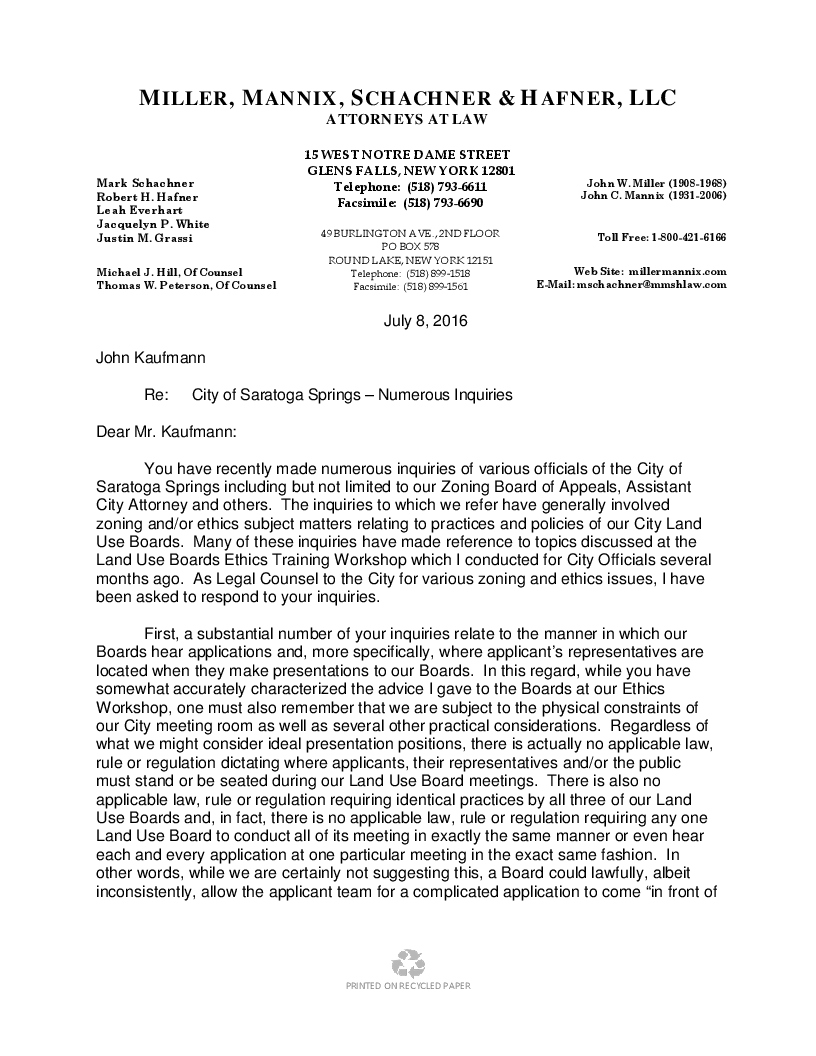
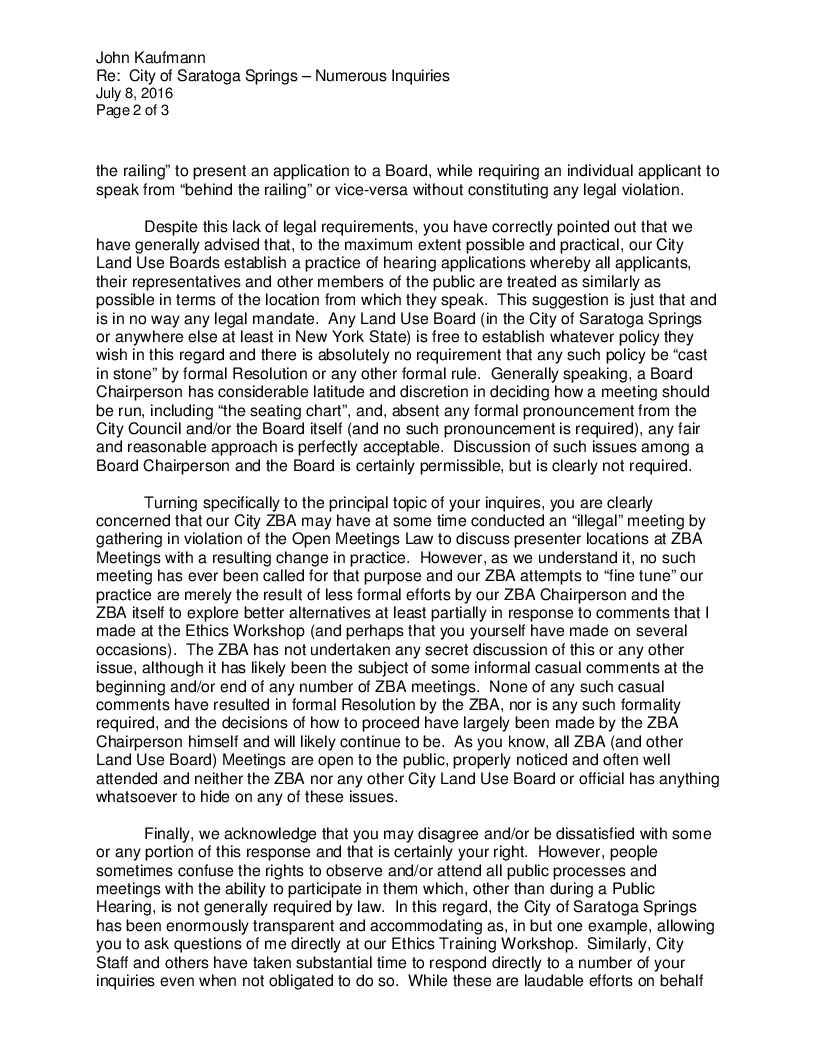
Below is an exchange between attorney Mark Schachner who specializes in land  use issues for the city and myself.  He is responding on behalf of William Moore, the chairman of the Zoning Board of Appeals, who I had emailed asking questions about recent events involving his board.

The central issues are as follows.  Does the ZBA’s meeting structure favor the applicants for zoning variances over the people whose neighborhoods are being impacted?  Did the decision on how to address this problem occur outside of the formal meetings of the ZBA? If so, did this constitute a violation of the Open Meetings Law?  Finally, if it did not violate the law, did the public still deserve to observe the discussion at which this decision was reached?

As further background, Mr. Moore did not reply to my original email and I followed up with two more courteous requests.

On July 8th, I received Attorney Schachner’s letter.

I am fortunate to have readers who are interested in going beyond sound bites.  I expect they will find these documents of considerable interest.


The Original Email (There were two follow ups)

From: John Kaufmann []

Sent: Thursday, June 23, 2016 4:25 PM

To: ‘William Moore’

Cc: ‘Joanne Yepsen’; ‘Michele Madigan’; ‘Christian Mathiesen’; ‘John Franck’; ‘Vincent DeLeonardis’

Subject: ZBA Compliance With Open Meetings Law

At the beginning of the May 9th meeting of the Zoning Board of Appeals, you announced that hence forth there would be a new policy on seating.  You indicated that in the future applicants to the ZBA would be asked to leave the table at which members of the ZBA were seated and sit in the gallery during the public comment period.

While this is an improvement over the previous policy it fails to live up to the standard of impartiality advised by attorney Mark Schachner at the ethics training attended by yourself and the members of the board.  To wit, that the boards should seek the highest standards as regards impartiality and openness and that having the applicant sit at the table with the board was not a good policy.

As you may be aware, the Planning Board requires applicants as well as the public to advocate from behind the railing from the gallery.  In fact, historically this was the policy of the ZBA as well.

According to Commissioner Chris Mathiesen, both the public and the applicant were allowed to come up to the table when materials were presented that could not be seen from the gallery.  This made it possible for the public to observe any hard copy documents presented by the applicant.  Other than under those circumstances, as the Planning Board currently requires, both the applicant and the public were relegated to the gallery.  This represented the highest standards consistent with the advice offered by Mr. Schachner.

I believe that it was Mr. Schacher’s point that seating applicants with you at the table sends an implicit, if unintentional, message about the status of applicants as compared to the public. I am respectfully requesting that you respond by explaining why you chose not to return to this policy but to continue to have applicants sit with you at the table during their presentation while relegating the public to the gallery.

I have reviewed the videos of the ZBA and I cannot find any meeting at which you discussed this change of policy.  Having observed your interactions with your board, I know how inclusive you are with them.  I find it very difficult to believe that you would have made this policy change without both consulting them and having a thoughtful conversation on this sensitive issue.  It is possible that I missed this event.  I respectfully ask that you respond by indicating at which meeting this decision was reached.

At your June 6 meeting Adam McNeil gave an impassioned statement over his frustration at what he characterized as the public’s unfair criticism of the members of the ethics board.  Ms. Steer seconded his comments.  I have a certain sympathy for their frustration.  There is no question that the members of this board give extraordinarily of their time as members of this board.  I would respectfully point out, however, that the board’s deliberations have a profound impact on the lives of the people of this city.  It is also fully understandable that the people who live in the neighborhoods affected by the decisions of this board often find the decisions of this board both threatening and painful.   The members of the public who have addressed this board have shown considerable restraint and respect.  The fact that Mr. McNeil and Ms. Steer cannot understand why, for example, the public would be disturbed that a member of the board would go out for drinks with an applicant and his lawyer after a meeting unfortunately reflects a certain lack of empathy and deference to the public .

I would be appreciate if you could respond to my following two questions at your earliest convenience.

*Why did you choose to continue to have applicants sit at the table with the board during their presentations rather than in the gallery as was past practice with the ZBA and current practice with the Planning Board?

*At which ZBA meeting was this change discussed?

Thank you


Attorney Mark Schachner’s Reply [I am including a link to a PDF for those who have trouble reading this image: Letter from Schachner ]

Letter from Schachner-1

Letter from Schachner-2

Letter From Schachner 3a


My Reply To Mr. Schachner

From: John Kaufmann []

Sent: Saturday, July 09, 2016 8:18 AM

To: Mark Schachner (mschachner@mmshlaw.com)

Cc: ‘Kerry Miller’; ‘Joanne Yepsen’; ‘Christian Mathiesen’; ‘John Franck’;
‘Michele Madigan’; ‘Tony Izzo’; ‘Vincent DeLeonardis’; ‘William
Moore’; ‘Bradley.Burge@saratoga-springs.org’; ‘Susan Barden’

Subject: RE: City of Saratoga Springs

Thank you for your long and thoughtful letter.

I think if you review my email you will see that I never asserted
that there was any legal issue that would compel the Zoning
Board of Appeals to follow the example of the Planning Board in
the manner with which it receives input from the public.

While I am not surprised that you chose not to venture into a
substantive discussion of the merits of the Planning Board’s
approach I thought you articulated my basic concern quite well
at the original training you did. I only wish the members of the
Zoning Board of Appeals had taken your advice more to heart.

I am however disappointed at your defense/characterization of
the manner by which the change to the seating policy was
determined. Based on your own comments at the training, the
issue of impartiality is not a frivolous one and as such deserves
serious consideration. Not being a lawyer, I will accept the fact
that a discussion over an issue like this can be carried out
informally outside of public view without violating the open
meetings law.

Having said that, I think Mr. Moore and his board would have
been better served had you counseled them that encouraging
trust by discussing sensitive issues like this in full public view
would avoid unnecessary conflict and help to encourage a sense
of trust in the community. Explaining a policy change like this
seems like a modest endeavor and being obdurate about
offering an explanation does not become the chairman of an
important board.

I want to thank you and the mayor, who I assume asked you to
address this, for your letter.

Potential Risks Of Oil Trains Traversing City Discussed By Council

From the front page of the July 7th Saratogian

Oil pipeline plan raises safety concerns for Saratoga Springs

By Travis Clark, tclark@digitalfirstmedia.com,, @Travclark2 on Twitter

Posted: 07/06/16, 3:28 PM EDT | Updated: 2 days ago

SARATOGA SPRINGS >> The Saratoga Springs City Council on Tuesday approved a motion to seek input on a State Environmental Quality Review Act (SEQRA) scoping process on a proposed Pilgrim Pipeline project.

According to Bill Boehmke, chair of the climate and energy committee for Sustainable Saratoga, Pilgrim Pipeline has applied to construct along the thruway from Albany an oil pipeline that would carry oil to New jersey refineries. Boehmke requested on Tuesday during the bi-weekly City Council meeting that the Council send in a scoping request to learn more about the potential impacts of this project on Saratoga Springs.

Boehmke said that to supply the capacity of 200,000 barrels per day, much more oil would be brought to Albany by rail which would bring an increased amount of oil trains through Saratoga Springs. Various schools, Skidmore College, Saratoga Hospital and businesses are within one mile of the emergency evacuation zone of this oil route.

SEQRA allows interested parties to identify concerns about potential impacts of an environmental act and Sustainable Saratoga suggested that safety concerns are not being addressed in Pilgrim Pipeline’s assessment and application of this project. They will be identifying concerns to state agencies.

Legally, there is little the Council can do to prevent the oil trains from passing through Saratoga Springs but the decision Tuesday would allow them to be an interested party in the SEQRA review. This means that the Council would receive more information on the project and would eventually be able to give their input. Their letter will go to lead agencies, the Department of Environmental Conservation and the New York State Thruway Authority.

Public Safety Commissioner Chris Mathiesen called the pipeline a bad idea and an insult to the Northeast. However, according to him, ways to minimize risks are being evaluated by Senator Charles Schumer, including speed limits for the oil trains.

“I still think that, overall, there are better ways of dealing with our energy problems,” he said.

Has Mayor Yepsen Been Delaying Inquiry With Help Of Ethics Board?

A reliable source informed me that Mayor Yepsen has been postponing meeting with the Ethics Board for months.

As I have noted in previous emails, the Ethics Board operates with an impenetrability that would make the CIA blush.  I went back through the available public records of this board and there was literally no record in any of the minutes or the agendas of the Ethics Board that referenced Mayor Yepsen’s name let alone that there was an inquiry pending regarding her dealings with Saratoga Hospital.  I know that an inquiry regarding this matter was lodged by Michele Madigan and Skip Scirocco because Ms. Madigan confirmed it.

With no other choice, I emailed the mayor on June 30th asking if she could confirm that she had postponed meeting with the Ethics Board and why it was necessary to make these postponements.  When I did not get a response, I followed up a week later with similar results.


From:    John Kaufmann []

Sent:     Tuesday, July 05, 2016 9:17 AM

To:          ‘Joanne Yepsen’

Cc:          ‘Christian Mathiesen’; ‘Michele Madigan’; ‘John Franck’; ‘Skip Sciroco’;

‘Vincent DeLeonardis’; ‘jerry luhn’; ‘jerry luhn’

Subject:               FW: Ethics Board


I thought I would follow up one more time, could you respond to my June 30 questions?


From: John Kaufmann [mailto:john.kaufmann21@gmail.com]

Sent: Thursday, June 30, 2016 10:09 PM

To: ‘Joanne Yepsen’

Cc: ‘Michele Madigan’; ‘Skip Sciroco’; ‘John Franck’; ‘Christian Mathiesen’; ‘Vincent DeLeonardis’; ‘Tony

Izzo’

Subject: Ethics Board


Joanne:

I understand that you have postponed meeting with the Ethics Board a number of times during the

last three months.  Can you confirm this and if so, can you indicate why you have postponed?

Thank you


Will Nine Downton Walk Changes Be Significant Enough to Sway ZBA?

[This is a post written by Sandra Cohen on behalf of Saratoga Neighbors For Zoning Enforcement.  It is a report on what happened at the last meeting of the ZBA regarding “Downton Walk.”  It is important for background to note that in order for the ZBA to reverse their original approval for this project, it must be shown that the project or its environment has changed.  The members of the group did an excellent job systematically documenting the changes and Ms. Cohen has done an excellent job reporting on this.  The project comes up for what is expected to be a final decision on Monday night]

2013 drawing
This is the drawing of the project from 2013.


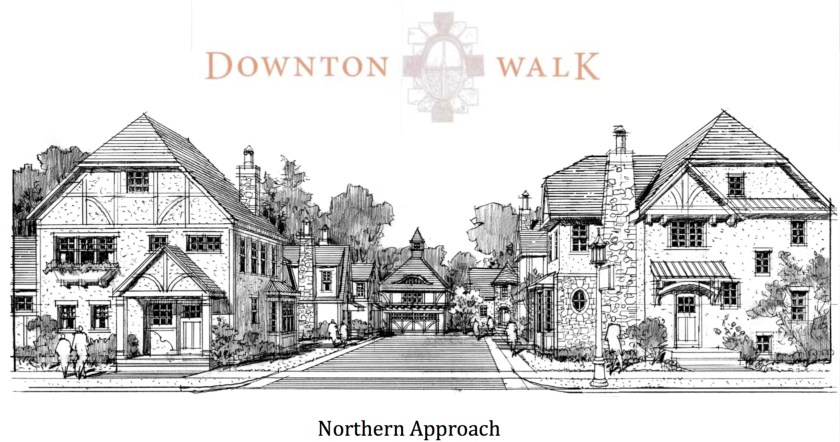
DW Drawing 2016
This is the current graphic of the project

Just as the May 23rd session was, the June 20 meeting of the Zoning Board of Appeals became a marathon. With ten items on the agenda, several of which included their own hiccups, the agenda item saved for last was the one I’ve been following: Builder John Witt’s Downton Walk Proposal for 27 Jumel Place.


With Vice Chairman Keith Kaplan, sitting in for Chairman Bill Moore, the Board worked on comparing this year’s Application with the previous version(s) that had been approved in 2013/14. It was stressed in the last meeting that Significant Changes from the previous application are the only things that could allow the Board not to approve this project, so this was the focus of questioning throughout the evening.


It is important that it be clear that there are significant differences between the two applications submitted.


The ensuing financial discussion brought strong objections from Witt’s attorney Elizabeth Coreno, insisting the approval did not hinge on financials in 2013. But Board Member Susan Steer countered that the first point on the earlier decision — whether or not the benefits can be achieved by any other means feasible – was financially-based, to which Coreno acquiesced. Steer concluded that the difference between the financial information in 2013 and 2016, in and of itself, represented a significant change between the two applications.


In 2013, the applicant reported that his 7 homes would sell at an average price of $640,000, bringing the total of all of them to $4,480,000. After land acquisition and development costs of $905,640, $3,574,360 remained.


In 2016, the applicant states the average price of the 7 units will be $930,000.  Building and selling only 5 units at that average price, after subtracting the $1,303,380 land acquisition and development costs, the remaining $3,346,620 is feasible, because it is nearly the same amount as in 2013 with 7 units.


Additionally, selling the 7 units using today’s average price of $930,000, in essence will reward the applicant with $1.6 million more than in 2013 – to make up for the difference of only $397,740 in land and development costs.


Furthermore, the prices now being used by Mr. Witt and his attorney do not take into consideration the even higher prices that he supplied to the Board in February 2016 – prices between $700,000 to $1,500,000, instead of the $587,000 to $1,255,000 being used now. The prices Mr. Witt provided to the Board in February 2016 were reduced by 16% after Mr. Witt acquired an attorney in May 2016, even though Mr. Witt continues to allow the higher numbers of $700,000 to $1,500,000 to be used in newspaper articles promoting his Downton Walk development. There has been a constant calibration in price ranges, which represents an additional significant change.


Feasibility has significantly changed and must be considered now in evaluating “Whether the benefit sought by the applicant can be achieved by some method feasible for the applicant to pursue other than an [these] area variance[s].”


Yes, the numbers supplied by Mr. Witt prove he can feasibly build five homes now, not seven, which would thereby significantly reduce the substantial nature of the variances that he is requesting.


When discussion turned to drawings, which have been part of the Applications, Board Member Cherie Grey questioned the size and proportions of the structures – saying she felt that the 2016 Downton Walk homes look much larger than those drawn for Magnolia Lane in 2013. Although Witt protested that the size hasn’t changed, Grey persisted, citing that original application drawings show fewer second stories on garages and were not as tall as those in 2016, which present as three stories with their 30’+ heights.


Coreno continued to insist their square footage has remained static, which was met with dubious responses from more than one Board member, relative to footprints versus number of stories, which absolutely affects overall size and how much more crowded it makes the lot appear. Only the footprint (first floor) measurement is “set in stone,” because that is what is used to calculate lot coverage and permeability. Hence, those are the only numbers the Board and public see prior to approval. So, in essence, both parties are correct: the footprint sizes have not changed; but the overall massing (interior square footage), more stories, and higher rooflines clearly indicate a significant change — when one compares the drawings from 2016 with those from 2013/14.


The Board’s final area of concern was an intensive discussion of the swimming pools, which illustrate another difference between the applications of 2013/14 and 2016. Board Secretary Adam McNeill supported 2016 as, in his words, a mirror image of 2013/14, saying, “I’ve never seen or heard of before a more precedential picture,” alluding to the Doctrine of Precedence (the legal ruling which requires a Board to approve an unchanged re-application of one that had previously been approved and then allowed by its applicant to expire.)


However, Board Member James Helicke pointed out that the drawings in the 2014 Variance Application indicated only three pools, versus four in the 2016 drawings – thus spoiling its status as a mirror image and representing another significant change in the application. There was a retort from Coreno that the drawings had not changed. But, Witt clarified for her that he did remove one pool for the 2014 submission.


Coreno also contended that the lot coverage measurement had not changed – although no pool measurements were included in those figures in any of the applications. In our view, this means that all the applications – 2013, 2014, and 2015 – were incomplete and misstated as far as lot coverage is concerned. We also do not know if the optional porches shown in the presentation were included in the original footprint measurements in any of the applications, which would add to the pools as two more significant changes.


And one must note that, since the pool measurements clearly were not included in lot coverage, and possibly the optional porches were not included either, these things also will mark a change in the permeability of the land that is part of the approval process is another significant change.


We realize the Board is anxious to close this matter, but ignoring such issues and significant changes will not be doing the City any favors. So, although they plan to present a resolution at the next meeting, on July 11, it is clear that they will be voting on something about which they do not even have all the facts.


During the Public Hearing, Kira Cohen reiterated the City Attorney’s explanation about significant changes in circumstances, which needed to be presented for a basis to deny the application. She directed the Board’s attention to ANW’s response to the May 23rd question of why they had not subdivided the land to which Coreno replied that one of the two purposes of building seven condos had been because of the desire for shared maintenance, which would not be available with a subdivided parcel. Cohen countered that State Law not only allows shared maintenance in subdivisions, but also the Attorney General’s office had simplified the procedure for applying for it in January 2014, another significant change in the application.


Sam Brewton presented the changes in the neighborhood the project would cause on the small, settled, more than 100-year-old community, many of the inhabitants of which have lived there for a very long time. His comments centered on things that neighbors wrote when signing the neighborhood petition – at least 14 of them reversing their original signatures from the developer’s petition they signed in the early days of the process. These individuals voluntarily added their names to what is a list of 47 neighbors, and some signed the change.org petition of more than 500, mostly Saratogians or individuals who have lived here – some who have grown up here and moved on but return to visit family and lifelong friends.


Although Kaplan stopped this presentation saying it was irrelevant, the Board’s 2013 resolution cited “The Applicant has demonstrated, and several neighbors have testified in support, that this development will have a very beneficial impact on the neighborhood,” which refutes Kaplan’s determination that it is irrelevant to the 2016 Application. So our showing the valid diminishment of that support does represent a significant change.


Question number 1 in the evaluation criteria that the ZBA must consider is, “Whether an undesirable change will be produced in the character of the neighborhood or a detriment to nearby properties will be created by the granting of the area variance.”


Members of neighborhood do increasingly feel that this development, as currently designed, will be overwhelming in both size and price. The structure sizes will dwarf the homes surrounding it, and it will bring a superfluity of populace, traffic, and noise to this single lot.


Gerald Mattison addressed the financials — how much they have changed since 2013/14, reiterating such things as how home prices have risen and the lower cost of constructing fewer homes would provide the builder the ability to make the project feasible with only five homes on a subdivided lot, at today’s selling prices.


Jane Valetta persisted that the neighborhood has changed since the ballet and karate schools have gone. Now it’s quiet with little traffic. She also noted that none of the homes currently there rise to the $500,000 range, so even the ones at the lowest end of Witt’s spectrum will change the nature of neighborhood. She cited that the drawings have changed. The 2013 drawings made the homes look smaller and cottage-like – which is how the developer described them when he came to get signatures on his petition. But the new drawings depict three-story homes much larger in volume. That is another significant change.


Debra Mattison spoke of the dangers presented by the dead-end lane into the community and the issue of not having accounted for the swimming pools in the original measurements. She pointed out that pools also need their own separate fences, which must follow code. She explained that the pools will cause increase in land coverage, and would lower permeability, none of which had been taken into consideration in the original numbers. And the absence of pool fences in the drawings is another significant change.


At the finish of comments, the Board approved a motion to hold open the public comment period until the next meeting when they would vote.


These NINE changes — financial information and feasibility, overall home sizes, differences in number of pools and complete lack of pool fencing, price fluctuations, possible lot coverage increase, possible permeability decrease as a result of these other issues, new knowledge of HOA law and its more recent changes, and the increased undesirable change in the character of the neighborhood — are each significant and substantial changes that could and should allow that vote to change without violating the Doctrine of Precedence.


At the ZBA’s meeting on July 11, 7 p.m. at City Hall, private citizens will have their last chance to speak to the Board before they vote on this project. Currently, Downton Walk is first on the agenda. We hope many of you will take advantage of this opportunity.


Walkway: Small Victory

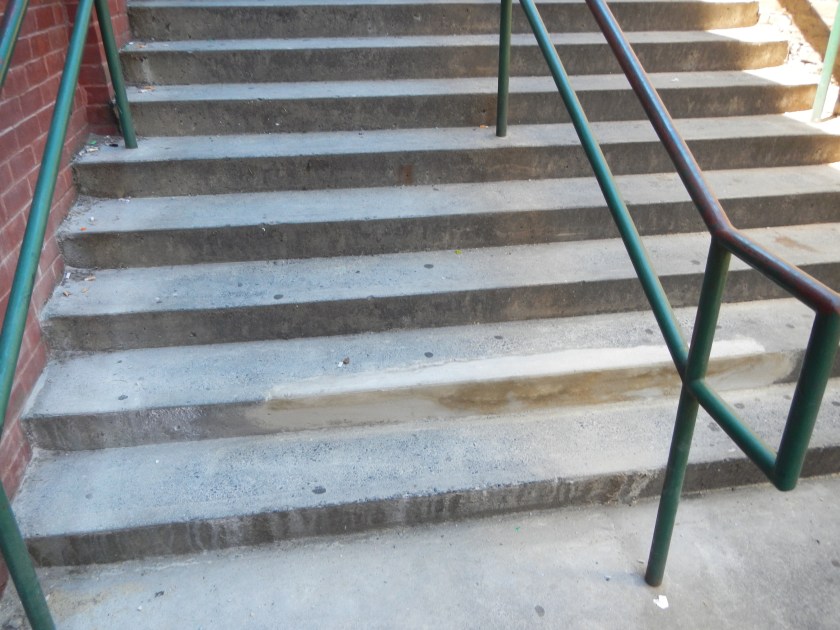
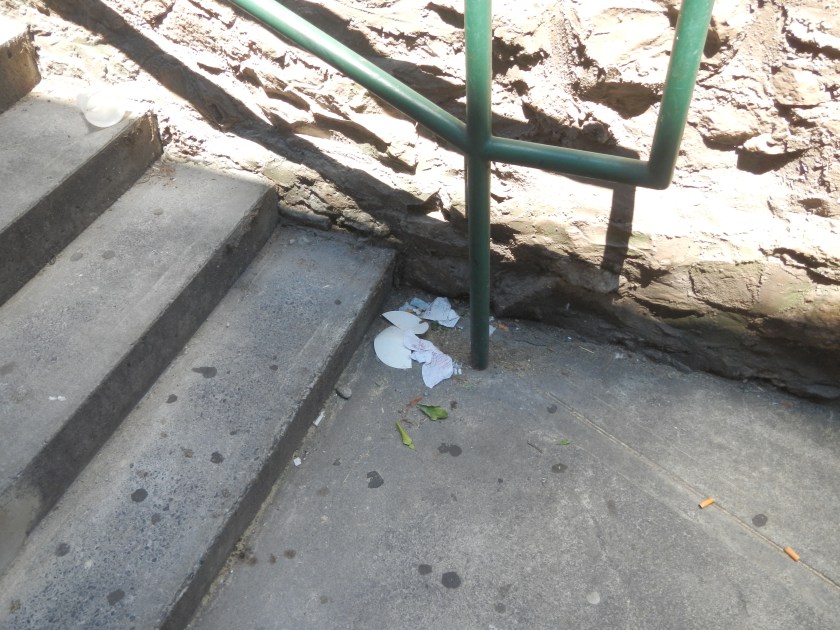
I visited the walkway today (July 6).  I was pleased to see that the broken step had been repaired and the barrier removed.  I have no idea what precipitated this repair but am glad to see it done.  There continues to be litter along the walkway.  I do not know how frequently the area is swept but the debris from my last visit was gone and new detritus has taken its place.  Still, this represents some progress.

DSCN4785
White area is where repair was made

DSCN4786

DSCN4784