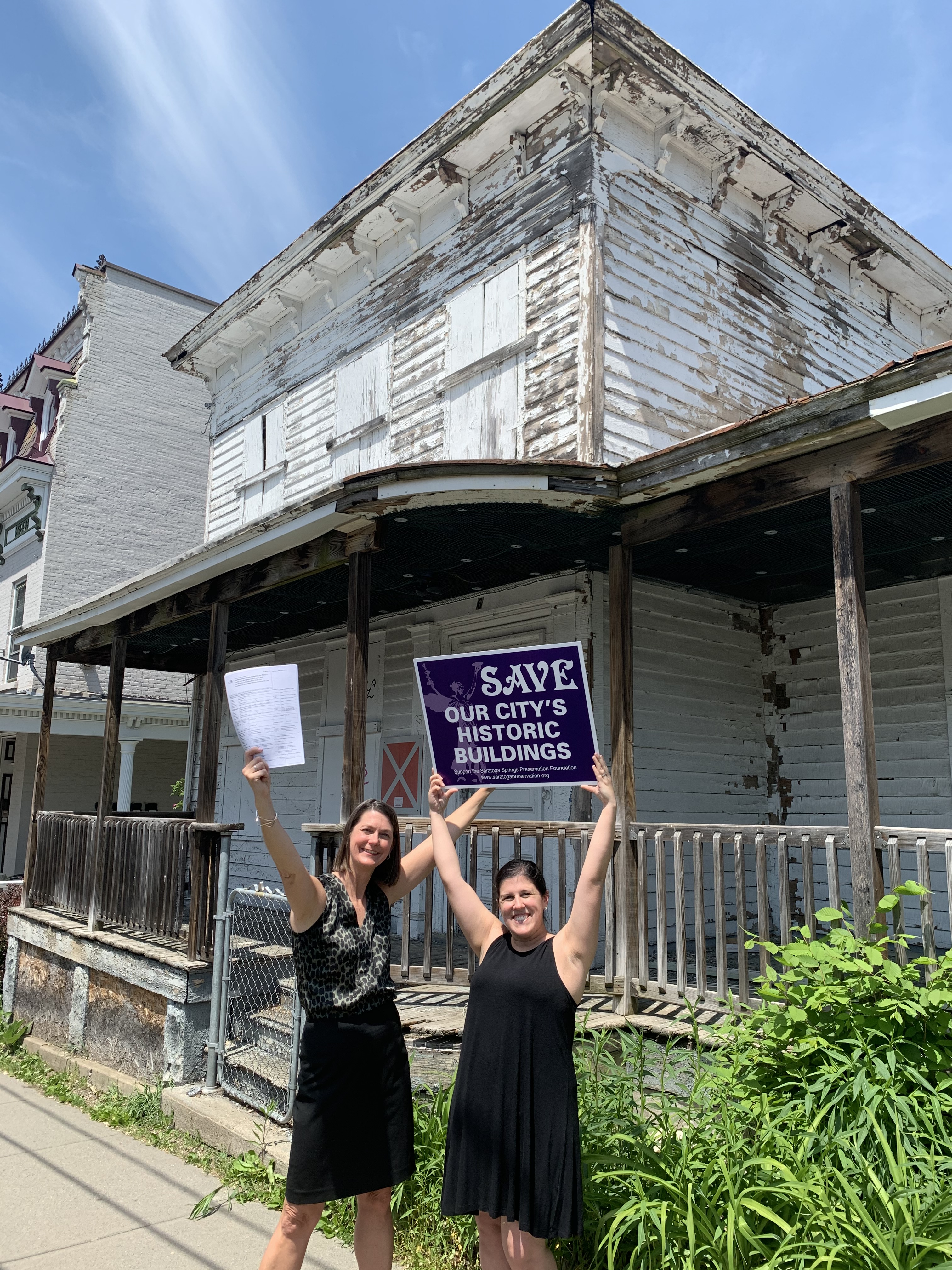
Samantha Bosshart and Nicole Babie Celebrate The Purchase of 65 Phila Street
[JK: Correction. Mark Haworth is a member of the Saratoga Springs Preservation and is not a member of it’s board]
Congratulations and kudos to Samantha Bosshart, her board, and her staff for their successful protection of the two derelict houses on Phila Street that the owners wanted to demolish.
In a press release, the Saratoga Springs Preservation Foundation (SSPF) announced that they have purchased the threatened building at 65 Phila Street. The other house had been purchased by a private buyer. SSPF assisted the private buyer in their purchase of the other house.
Thanks as well to Mark Haworth, a member of the SSPF Foundation, who provided the loan to SSPF for the purchase which made all of this possible.
The current plan is to raise the $250,000.00 it is estimated will be needed for rehabbing the structure.
“Our goal is to make it safe for future owners and the neighborhood, something that is long overdue,” continued Bosshart. The Foundation plans to start with environmental remediation, necessary structural repairs, and a new roof. Construction costs have risen significantly in the last 18 months so the Foundation will lean on the community for financial and in-kind support in addition to utilizing funds they have raised over the past few years to undertake a special project such as this. “Our friends and members rallied when the houses were proposed to be demolished. We hope that our community will rally to revive 65,” said Favro.
From the SSPF release
The existence of SSPF is a testament to the grassroots support this city enjoys for preserving Saratoga Springs’ special architectural heritage.
The Foothills Business Daily (FBD) published an excellent story on the May 16, 2021, Black Lives Matter demonstration. FBD is an excellent resource and very much worth supporting.
The article offers accounts of the event from the police and from Lexis Figuereo, one of the organizers of the event.
According to the article as Mr. Figuereo had told the police not to telephone him, Police Lieutenant Robert Jillson texted Mr. Figuereo prior to the event. In the text he observed that Figuereo had been on social media promoting an event. Lieutenant Jillson asked what the event would entail. The purpose of the text was to determine whether the event would require police support such as protecting participants if they decided to march on the city streets.
Mr. Figuereo declined to provide any information beyond the fact that his group was going to have a rally.
According to FBD:
“Where the police chief said he saw the texts that Jillson sent to Figuereo as a way to reach out and communicate, Figuereo saw them as an irritant from a police officer whom he particularly does not like.“
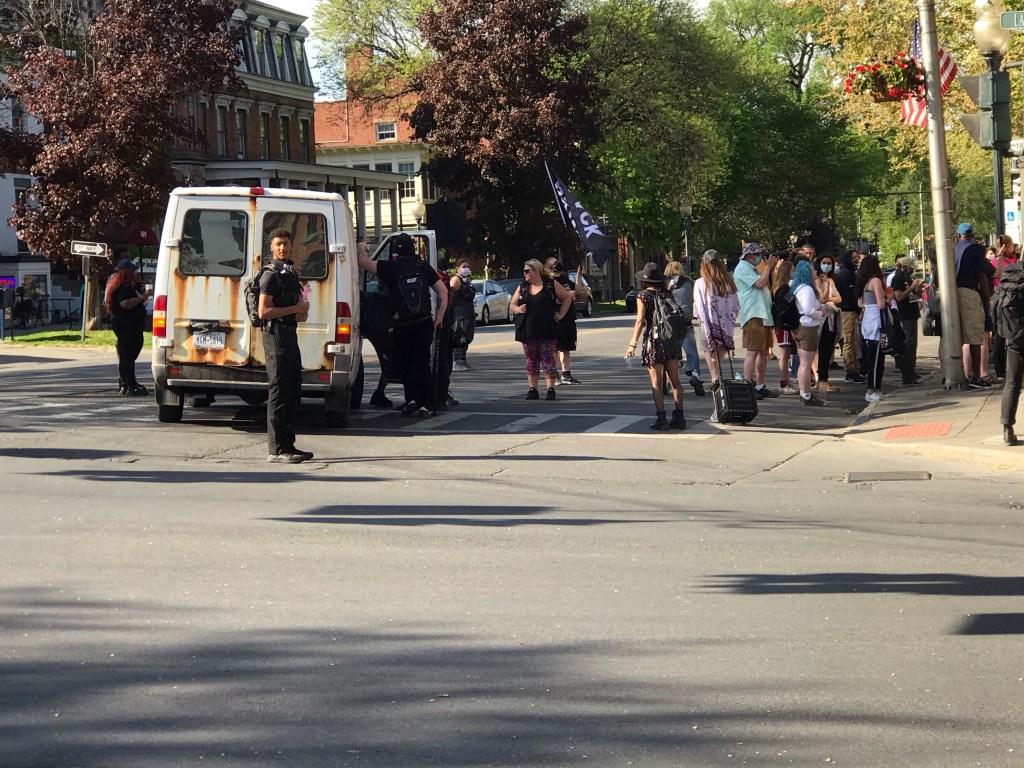
When the BLM group occupied Broadway in front of City Hall, SSPD Chief Crooks briefly rerouted traffic and had Lieutenant Jillson (one of only two uniformed police who approached the demonstration) direct the demonstrators to relinquish the street and return to the sidewalk.
According to FBD, Figuereo saw this “…as an intended distraction from the speech he was giving on the steps of city hall. Since traffic was shut down, the threat posed either by people in the street or by motorists was minimal so there was no need for the confrontation…”
Characterizing this as a confrontation at this point seems excessively dramatic. As there was plenty of room on the sidewalk, a request to relinquish the street so that traffic could flow seems reasonable.
In the meantime, the local police, along with elements of the New York State Police, and the Saratoga County Sheriff’s Department were marshalling in the Collamer Parking Lot. Chief Crooks was prepared to make arrests should the demonstrators insist on continuing to occupy the city’s main intersection.
According to the FBD, “Figuereo said dozens of police in riot gear and on horseback, with a van ready to make mass arrests was intimidating and a threat to free speech.”
In fact, the police had no problem with Mr. Figuereo addressing the participants but did want to keep participants on the sidewalk and traffic flowing in order to minimize disruption downtown.
Where Figuereo saw the marchers moving peacefully from the steps of City Hall back to Congress Park and dispersal at the end of the rally, Crooks said police did not know what the intention was, that the group could have changed direction at any point. The mounted police following the group stayed a reasonable distance back the chief said, but Figuereo said it felt as though the group was being ushered quickly out of town.
Foothills Business Daily
Significantly, Mr. Figuereo’s fortunate decision to lead the demonstrators back to Congress Park relieved Chief Crooks from initiating arrests.
I think an argument can be made that the inconvenience of people obstructing traffic is worthwhile and should be tolerated in the interest of alerting the public to the need for addressing racism. Similarly, there is a valid argument that obstructing the main thoroughfare of the city is illegal and that the police have an obligation to enforce the law.
The central problem in all of this is the gratuitously provocative nature of Mr. Figuereos’s leadership and methods.
If Mr. Figuereo had simply cooperated with the police and told them that his group was going to march to city hall along the east lane of Broadway, speak briefly, and return to Congress Park via Maple Avenue, there would have been no issue. There would have been no “distraction” from his speech.
Instead, Mr. Figuereo insisted on drama and provocation. His security people carry bats and wear bulletproof vests. They routinely taunt the police. With respect, this does not seem to me to be the most thoughtful or effective way to educate the community in the quest for social justice.
Following the death of George Floyd a huge crowd filled Congress Park to protest this horrific example of police violence. The group Mr. Figuereo led on Sunday’s march was down to about sixty people.
Some Thoughts About The Leadership Of Our Local Black Lives Matter Group
A person in need of supervision (PINS) is an individual under the age of 18 who:
Does not attend school
Behaves in a way that is incorrigible, ungovernable, or habitually disobedient
Is beyond the control of a parent, guardian or lawful authority
Is suspected of drug abuse
And requires supervision or treatment
New York State Courts
According to Mr. Figuereo he spent five years in juvenile detention. My experience working with the Neighborhood Youth Corps in Troy and the Saratoga County Economic Opportunity Council educated me regarding the New York State’s youth detention centers. The facilities did little to rehabilitate their residents. New York State basically warehoused problem youth relying on force rather than social programs to enforce control. Mr. Figuereo shares some of the unpleasantness he endured in these places (he was incarcerated in three different facilities) in the Gazette article.
With that in mind I have a real sympathy for Mr. Figuereo. His anger and hatred for the police is humanly understandable. It is regrettable that he seems unable to distinguish between police who conscientiously and fairly perform their duties and those who do not.
But understanding and sympathy does not mean being uncritical.
Mr. Figuereo appears to believe that all members of the police are dedicated to brutalizing people in general and people of color in particular. As a matter of principle he refuses to cooperate with our local police department in the planning of the street actions he leads. His actions are so provocative that it appears that he is seeking conflict, hoping the police will be drawn into a confrontation that he will use to argue how bad they are.
He came within a hare’s breath of a confrontation with the police at his last street action. Had he and his supporters not abandoned the intersection in front of city hall the police would have cleared the street and made arrests.
One can criticize him, as I regularly do, for his lack of judgement but one has to acknowledge that he has the courage of his convictions.
I feel badly for this troubled person. It is only a matter of time before an error in judgement results in another arrest. Worse, given his history of intemperate behavior I fear he may end up being hurt in an altercation. He is treading the razors edge.
Where I am sharply critical of Mr. Figuereo is in his decision to involve young people in these actions. I believe that many of the well meaning kids in these demonstrations are not aware of how badly things can go should the police take action. In the chaos of a confrontation in which immature kids may resist the police, people are very likely to be hurt.
MLK Saratoga Breaks Its Silence…Sort Of
As people who follow my blog know, I have been quite concerned about the apparent indifference of the group MLK Saratoga regarding the provocative and undisciplined demonstrations led by Mr. Figuereo. They seem oblivious to Mr. Figuereo’s excesses and to the potential danger this puts people who participate in his street actions in.
Weeks ago in an email to me they wrote that they intended to address my concerns, but to date I have not received any communication from them.
On the other hand, one of MLK Saratoga’s leaders, Hollyday Hammond, posted the following comment on Mr. Figuereo’s Facebook page just prior to the last May 16 street action. I will take this as their answer.
[JK: I am republishing a letter to the editor by Reverend Jay Ekman. The recent horrendous violence in Israel and Gaza is the terrible logic of the brutal, illegal occupation by Israel of Gaza and the “Occupied Territories. Gaza already was in crisis as regards safe drinking water and electricity. Israel has now bombed both facilities. How can anyone characterize these as military facility targets? As a Jew I feel shame.]
Reverend Jay Ekman
To the Editor
Schenectady Gazette
5/ 10 /21
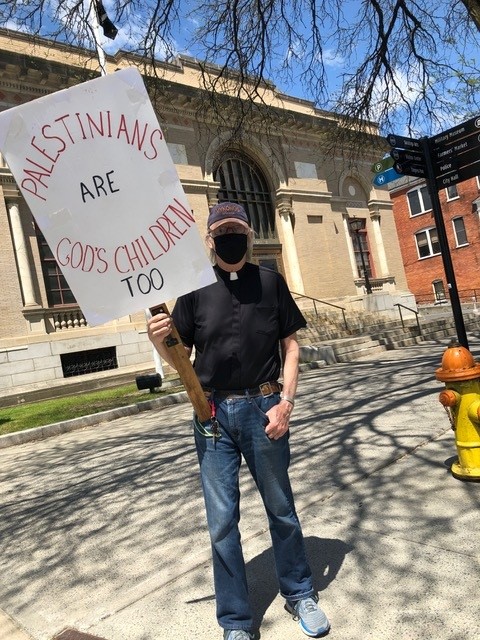
Throughout history Jews have been routinely singled out and scapegoated. In similar fashion Palestinians have been denied justice and common humane decency by both Israeli and Arab governments. Because of its economic and military might, modern Israel bears a heavy responsibility for the welfare of Palestinians. I have a hope that any people who have suffered massive injustices as Jews have, should be first in line to demand that “Never again…” shall this happen to any of God’s children.
You can prove most anything from scripture. That said, if you believe that God gave you the land of Israel as a homeland, then you must (also) accept the moral demands of this same God. In their most humane interpretations, the Hebrew prophets portray God as giving a constant justice message, “ …Do justly, love mercy and walk humbly with your God ( Micah 6:8) or “ Welcome the stranger for you were once strangers in Egypt….” (Exodus 22:21)
Evicting Palestinians from their homes in East Jerusalem or denying them farm land, safe water, adequate nutrition, medical care in Gaza is anything but …”justice and mercy….” When some in modern Israel trample on the values of their own Hebrew faith, should this not be labeled as another form of anti-Semitism?
On Sunday, May 16, 2021, the local Black Lives Matter group lead by Chandler Hickenbottem and Lexis Figuereo again took to the streets of Saratoga Springs and briefly blocked a Broadway intersection to demonstrate against, among other things, racism in schools. The Saratoga Police response was a model of best practices that will hopefully be emulated by other communities.
The BLM group has diminished in size from previous demonstrations. There were maybe sixty participants.
The group rallied in Congress Park. There was no uniformed police presence during the rally. After speakers exhorted the group to “take to the streets”, the demonstrators marched down Broadway to City Hall. A Saratoga County Sheriff’s patrol car followed them from the rear to protect them. Other patrol cars blocked traffic from entering Broadway at Division Street and then at Lake and Church .
After speeches on the steps of City Hall Figuereo called on the crowd to “take the streets”, and the demonstrators spilled out onto Broadway. Chandler Hickenbottem lead provocative chants about how there are no good police. Some in the crowd chanted “f..k the police.” Two police officers appeared and told the crowd that they must leave the intersection. A few minutes later the crowd set off down Lake Avenue with two mounted police officers urging stragglers on and one uniformed police officer on foot. The crowd turned right on Maple Avenue and returned to Congress Park.
Demonstrators occupy Broadway in front of city hall
It is my understanding that the police were prepared to make arrests in the event that the demonstrators had established a blockade on Broadway. Fortunately, in spite of their bravado, the leadership of BLM chose to follow the police directive and vacated the intersection.
Our Police Refused To Succumb To Provocation
Antifa Demonstrator Bullet Proof Vest And Club
As noted earlier, the leadership of the demonstration led chants directed at the police. Some demonstrators wore bullet proof vests and carried clubs.
Racism in our country is real and the excesses committed against black Americans is real. For all the advances made by Black Americans, systemic racism still exists, and there are still too many Americans who view people of color with suspicion and often hostility.
Supporting the need to address the history of racism and being empathetic to the frustration and anger of our fellow Black Americans is not the same as accepting reckless behavior, however.
Our local BLM leadership appears to have rejected the tactics of nonviolent civil disobedience. The taunting of the police and the carrying of weapons creates an atmosphere of hostility and aggression. Ironically it is not inconsistent with the degradation of civility in the greater society. The fact is that people of all colors, and I include in that group our previous President, feel entitled to insult and degrade others.
This is what de-escalation looks like
I know that many of my fellow Saratogians are outraged by the flagrant violation of our city’s laws by BLM. They cannot understand what they see as the police’s tolerance of the repeated protests that have shut down Broadway. Many of these people believe that the protesters are in control.
All of this is an illusion. Our police, supported by the Saratoga County Sheriff’s Department and the State Police, are in control. They have the resources to maintain order. The question of when and how to exercise that force, though, has been the subject of debate and controversy in communities locally and across the country. A brief march and the brief occupation of an intersection while vexing does not pose an immediate threat to the public requiring mass arrests.
The fact is that we have very strong professional leadership in our local police department. They will not be provoked to act foolishly to simply demonstrate power. There is no room for self indulgent machismo. If there is a real threat to public safety the streets will be cleared , but a small group of people marching briefly in our streets is simply not a serious threat that requires the massive use of force.
Managing the arrest of a group of people is no simple problem. A poorly executed action brings with it enormous risk. It is quite possible that not only might demonstrators be seriously injured but the police and bystanders are also at risk. New York City has had to settle millions of dollars worth of lawsuits due to the chaos and excess that the use of some of their ham fisted tactics have precipitated.
The people of Saratoga Springs are fortunate that we have leadership in our police department that eschews the lure of precipitous action. Our police force has protocols as to what kind of resources are required to successfully deal with crowd control, and no amount of taunting so far has undermined that professional commitment.
Courage and Service
When Chief Shane Crooks ordered that the intersection on Broadway be cleared Sunday he did not send a phalanx of armed shield carrying officers.
Instead he sent just two officers. While I think the risk to these officers was low, there is no denying that the risk was very real. The protesters had a white panel van in front of City Hall whose contents were hidden. Some protesters were clearly armed with clubs, and there was no way of knowing what else protesters might be carrying.
These two officers sought out the leadership of BLM and quietly told them that they must leave the intersection. Chandler Hickenbottem ranted at them at great length and with much profanity. Officers simply continued to gesture that people needed to move along. This is what the highest standards of law enforcement look like. This is what de-escalation is about. This is what the use of minimum force is about. This is what service to city is about.
Finding A Balance
Racism is real. The need for our country to address racism is critical to the health of our nation. People have a right to protest.
Trying to find a balance in the current environment of division and anger is not easy.
In April I wrote to MLK Saratoga regarding the March 27 rally and march organized by All of Us in support of the adoption of the Police Task Force recommendations. I observed that the apparent decision by the leadership of the march to eschew working with the Saratoga Springs Police Department in taking to the streets had put the participants at unnecessary risk to be hit by a motorist or assaulted by a counter protester. I also noted that some participants were apparently supposed to be “security” and were carrying baseball bats. Such provocative displays of weapons could only further risk violence and injury.
I pointed out that such tactics were fundamentally counter to the principles of nonviolence as advocated by Martin Luther King and Mahatma Gandhi. I expressed my deep concern that the young, untrained youth who were participating in these demonstrations were unnecessarily at risk.
While it took some time for MLK Saratoga to respond, they agreed to enter into a dialogue. Regrettably, since then, in spite of a follow up email (see below) MLK Saratoga has been silent.
An Alarming Video
Today I found a video posted by All of Us, the sponsors of our city’s demonstrations, purporting to show training for civil disobedience.
In this video, readers will view the training All of Us offered for what to do in the event someone is arrested. This poorly organized event offered two methods for addressing arrests. These techniques represent aggressive resistance rather than peaceful non-violence.
Swarming – In this scenario, a person playing a demonstrator has been wrestled to the ground by participants portraying the police. The other participants in the training were told to throw themselves onto the body of the person being arrested which was supposed to somehow free the arrestee.
This poorly crafted exercise bordered on the satirical and quickly devolved into chaos and confusion.
If anything, it demonstrated the folly of trying to interpose oneself between a person being arrested and the police who are subduing the individual. The people playing the “rescuers” ended up piled on top of the police and the poor individual being arrested.
Simple common sense should inform anyone watching this video that doing this with real police will not end well. The police will feel they are being attacked.
Snatching – In this scenario, a demonstrator who is standing up and being restrained by the police is somehow grabbed and “snatched” from the police.
This maneuver was attempted at the July 30, 2020 demonstration in Saratoga and it resulted in not only the arrest of the original person but the arrest of the two people attempting the “rescue”. It also ended up in a melee with the police “swarming” on top of the “rescuers.” Fortunately, no one was hurt.
These Tactics Can Only End In Disaster
All of Us’s tactics may be civil disobedience but they are not the non-violent civil disobedience advocated by Martin Luther King. Central to Dr. King’s tactic was passivity. The act of peaceful resistance was both a tactic and a statement. It was a statement against all violence. It championed the theme that violence begets violence and excess.
I urge the readers of this blog to watch the documentary series “Eyes On The Prize” which is available from the Public Broadcasting System through streaming. This is the story of how courageous people brought about change through struggle without resorting to violence. It documents how that movement used peaceful, noon-violent civil disobedience.
MLK Saratoga should be a voice for justice that places as a priority the safety of everyone from the demonstrator, to the bystander, to the police. Their silence in the face of the looming threat that the tactics of All of Us represents is profoundly disappointing.
Time is Running Out
Lex Figuereo and Chandler Hickenbottom, the leaders of All of Us locally, have put out a call for a protest on Sunday, May 16.
I urge MLK Saratoga to find its voice to help avert a potential disaster for the earnest but poorly led people who can be expected to participate in this event. The history of these marches involve an undisciplined seizing of the streets and a blockade of an intersection downtown. There is the real possibility that the police will not allow the blocking of downtown.
The potential for injury is great. MLK Saratoga, use your voices to help avert what may be a disaster.
The Correspondence
Hello Mr. Kaufmann
Our apologies for the delay in acknowledging your last post and email. Our emails typically include our organization signature. In completing the online email form, I forgot that would not be included.
The email post was submitted by me but was from the three chairs. We will send a fuller response when time permits.
We will be gathering tonight at 6 pm in Congress Park to come together as a CommUNITY in peace and solidarity.
Peace,
Hollyday Hammond
April 20, 2021 email from MLK Saratoga
To Hollyday Hammond
From John Kaufmann
I appreciated your email indicating that you were going to respond to my questions. Wondering when I can expect to hear from you?
As the Unified Development Ordinance (UDO) moves into its final stages of review, concerns remain about how this document could affect the city’s greenbelt.
The term “greenbelt” is frequently used but seems to mean different things to different people.
While the Comprehensive Plan and the UDO offer technical definitions for this area of the city, the idea that it was desirable for the city to have a more densely developed inner core surrounded by a less densely developed outer zone, namely a “greenbelt”, has over the years become a widely supported general vision for how the city should grow.
Development in the greenbelt first became a contentious focus of Saratoga politics in the 1980s when a number of proposals for large scale residential and commercial development on the city land east of the Northway (such as what is today known as Water’s Edge and a plan for an office park at Exit 14) came before Saratoga’s land use boards and the City Council. It’s hard for many to realize now, but at this point this area of the city was so sparsely populated that hunting was permitted.
While the term “greenbelt” refers to an area surrounding the city, most of the controversy about development tends to focus on this eastern part of it.
In 1987 then Skidmore professor Ron Edsforth coined the phrase “Small City in the Country” to describe the vision of local Democratic candidates running for city offices who opposed uncontrolled development in the city’s outer zone. Except for Tom McTygue, all those candidates lost that election, but the phrase eventually became a widely used and popular way to describe Saratoga Springs. Now, however, it has different specific meanings for different individuals and groups.
Few have ever argued that there should be a total halt to development east of the Northway, but there has been over the years considerable debate over what kind of development should be permitted. This debate continues with the proposals in the UDO.
To understand how all the current controversy has evolved, I offer a brief history of the UDO along with an analysis of the most recent iteration of the “greenbelt.”
Land Use, The UDO, And The Greenbelt: A History Of Conflict
Among the objectives of the UDO is to update the city’s zoning to comply with the 2015 Comprehensive Plan. Some readers may remember that the Comprehensive Plan was the subject of bitter conflict. The Committee that was to craft the plan was split between representatives of the development community and what I call the quality of life people. This latter group had minimizing development in the city’s greenbelt as a top priority.
The division over the plan was so intense that the Comprehensive Plan Committee was never able to complete its work. In the end it dropped the plan and all the unresolved issues into the lap of the then City Council. That Council adopted a plan that generally favored the quality of life people.
The UDO
The creation of a Unified Development Ordinance has been a torturous continuation of the conflict burdened by confusion and suspicion. As discussed in previous posts, the campaign to craft the UDO has gone on for years.
Most people do not appreciate the scale of the work that was required. In addition to updating the city’s zoning laws, the UDO had to incorporate practically every document the city has that is related to land use and construction. In addition to the Comprehensive Plan this includes for instance the Open Space Master Plan, the Complete Streets Plan, the Urban and Community Forest Master Plan, and the Saratoga Greenbelt Trail Plan. Language had to be included from major documents dealing with everything from zoning, to standards for management of the city’s trees, to required parking for commercial properties, to energy efficiency needs, to the required space between buildings, to design standards for signs, to…[you get the idea]
The project to craft a UDO was funded by a grant from the New York State Energy Development Agency. The project was underfunded to begin with. The first year of the grant was squandered by poor management by the city’s planning office. Mayor Kelly, when elected, dismissed the original consultants and reset the process. The city had to scramble to find money to supplement what funds were left to hire new consultants.
The result was that the project had to be done within an even more bare bones budget.
The process was further tainted by the new consultants, Camiros, a Chicago-based urban planning firm. In the first draft they designated a major area of the city for greater density. The neighborhoods in question were outraged, and it turned out that the change was in conflict with the Comprehensive Plan. The Mayor’s office quickly corrected the error, but the damage had been done. I still do not understand how Camiros could have made such an egregious error.
The consultants also attempted to weaken the setback requirements for the neighborhoods around the city core. They claimed that the change would have little effect on density, but it turned out that they had cherry picked the numbers. Again when residents of these neighborhoods raised this as an issue, the Mayor’s office deleted the change.
The UDO: An Overwhelming Document
By its ambitious nature it had to be expected that the UDO would be a tome that would overwhelm anyone who is not a professional planner. It is unquestionably intimidating.
Normally such a document would distinguish the proposed changes by indicating the language being removed with red lines through it, and language being added in blue. As the UDO incorporates so many different documents related to the city’s land use issues into one document, however, it did not allow for a simple comparison between the proposed changes and what currently exists.
What was needed was an additional document that would annotate what the current standards are and how the UDO would change them. Unfortunately, the city apparently did not have the money to pay the consultants to do this kind of additional work.
The result was that most of us simply could not tell everything that was being proposed. Lisa Shields, the Deputy Mayor, made an heroic attempt to identify many of the most consequential changes in a spreadsheet she drafted, but it was too much to expect that her work would comprehensively cover everything in such an extensive and technical document.
The lack of a comprehensive annotation of the changes has hung over the UDO.
The Mayor’s office did its best to address issues as they arose. The Mayor’s key staff spent many hours meeting with concerned citizens including Sustainable Saratoga to try to address concerns. The reality was that while the Mayor’s staff could respond to individual issues, the meetings could not address the vexing problem that there was no reliable resource for understanding all the changes the draft UDO included.
Readers may better understand the Mayor’s commitment to complete the UDO in spite of its problems if they consider that the Comprehensive Plan was adopted in 2015 so we are now in the sixth year of trying to implement it. Thousands of dollars in cash and major staffing resources have been invested in this effort.
Given the city’s Covid related fiscal challenges, it is unlikely that money will be found for consultants in the foreseeable future to annotate the proposed changes.
Who Do You Trust
So the issue really comes down to one of trust. Do problems exist in the UDO obscured by the document’s size and technical language? Some people may feel that without a document that annotates the UDO they simply cannot support its adoption. Given the choices, they would prefer to keep things as they are. This is an understandable position. What is unfair is to question the motivations of those who feel that it should still be adopted.
Suspicion and distrust run especially high in regard to proposed changes in permitted uses in the city’s greenbelt.
I know all the members of the Council, and I feel confident that they are committed to continuing to minimize development in the the city’s greenbelt.
Powerful Forces for Change in the Greenbelt
The readers of this blog may not be aware of the powerful forces who would very much like to rewrite the zoning regulations in the greenbelt.
The Anderson family owns a large swath of land that runs from Exit 14 north to Route 29. For decades they have been trying to build an ambitious project there including an office park and a large housing development. In fact they have sued the city to try to force it to allow them to proceed.
The principals who own Saratoga National want to build, among other things, a hotel and condos in the greenbelt.
The Chamber of Commerce has been outspoken in their criticism of the city for its resistance to development in the greenbelt.
I find it particularly troubling that there have been unpleasant attacks on Mayor Kelly that allege that she is trying to shred the protections for the greenbelt. The record of the Mayor’s resistance to large scale development in the greenbelt is clear. No proposal for greenbelt development has even been considered by the current Council . Nothing has changed at Saratoga National Golf Course and the extensive land owned by the Anderson family remains undeveloped.
If Mayor Kelly or anyone else on the Council didn’t care about the greenbelt, the city would be having hearings on rezoning the RR district to accommodate proposals from the three above and others.
There Are Still Issues
That is not to say that there are not still outstanding issues regarding the UDO in general and aspects of the UDO that deal with the greenbelt in particular.
Discussing the greenbelt can be confusing. In the comprehensive plan it is referred to as the Conservation District (CDD), and in the UDO it is referred to as the Rural Residential District (RR).
Here is the definition of the Rural Residential District from the UDO
A. RR Rural Residential District
The RR Rural Residential District is intended to accommodate low density residential development and agricultural uses in a manner that helps to preserve open space and Saratoga Springs’ rural character areas. Low densities within the RR District are also designed to accommodate specific features of the rural areas of the community, such as prime soils, limiting topography/steep slopes, and a lack of public infrastructure.
UDO Draft #3
It is important to understand what is meant by “low density residential development.” This specifically refers to how large the lot sizes must be for residential dwellings only. This does not address other types of structures that might be allowed in the RR district.
The following is the definition for the greenbelt, called the Conservation Development District (CDD), from the Comprehensive Plan.
Conservation Development District (CDD)
The Conservation Development District designation reflects the “Country” of the City in the Country. This designation allows for low density residential, outdoor recreation, agricultural, and other rural uses [JK: My emphasis] utilizing land conservation methods such as clustering. Areas typically include single-family lots and subdivisions, existing planned developments, farms, estates, and natural areas. Commercial activities should be limited to those that support rural and recreational uses [JK:My emphasis] and which protect valuable open space, protect natural resources and maintain natural systems. This designation reflects a rural or agrarian character that works to preserve contiguous open spaces, protect natural resources and restore and maintain natural systems, which will all become increasingly important and valuable community resources.
Development in this area shall require a “conservation analysis” and utilize land conservation methods to protect environmentally sensitive areas and features, minimize the development’s edge effects and conserve significant open space.
2015 Comprehensive Plan
So the question then is what uses should be allowed that conform to the Comprehensive Plan?
The following list of UDO proposed uses in the greenbelt have drawn the attention and concern of Sustainable Saratoga and were raised by Commissioner Dalton at a recent City Council meeting as subjects for consideration as to their appropriateness:
Camp Grounds
Community Center
Country Clubs
Schools
Marinas
Private/Social Clubs
Small Animal Care Facilities Without Outdoor Area
I know my friends at Sustainable Saratoga have also expressed concern over “domestic violence home” and “Children’s Home” as permitted uses.
These are considered residential, however, and as long as they are residential then they are subject to the limits established for homes in the district which is one per two acres. This does not appear to me to be an issue.
Technically speaking, I believe that the definitions in the Comprehensive Plan are so broad as to allow all the things proposed in the UDO. Still, I am not a lawyer.
For me, the argument that any of these proposed uses actually violate the Comprehensive Plan is weak.
The real question to me, and one that people of good will can disagree about, is whether the uses for the Greenbelt as proposed in the UDO would fit into whatever vision individuals may have about what activities are appropriate in the greenbelt.
My concern is that in and of themselves these uses might or might not undermine the rural character of the greenbelt. Their potential impact is really determined by the scale and the design of projects. Many proposed uses require that before particular projects are approved they are subject to a special use permit by the Planning Board. I believe that the appointments made by Mayor Kelly to the current Planning Board represent people who would be properly cautious about approving any proposals that would compromise the rural character of this area of the city .
I am, however, concerned that future mayors might make appointments to the Planning Board of people who would support projects that I would find excessive.
For me, Saratoga National Golf Course is an asset to the city. It is a premium venue and an important resource to draw people to our city as well as providing recreation for our own citizens (who can afford a round of golf there).
Unfortunately, the history of Saratoga National Golf Course is a cautionary tale of how attorneys and developers can exploit the city’s planning process. When they submitted their original plan they asked to include a structure to serve food. It was assumed that they were proposing a snack bar for their golfers. They also agreed to limit parking on the site to some modest parking lots.
What they built was the Prime Restaurant. By all accounts Prime is an excellent restaurant but the city’s comprehensive plan called for such operations to be placed in the city’s core and not in the greenbelt. The Planning Board stipulated that parking was supposed to be limited to the modest parking lots on the golf course. Unfortunately, the language in the approval for parking was poorly crafted, and today many more cars park on the grass adjacent to the lots.
Saratoga National also agreed to provide two nature trails and to maintain them. In a post some years ago, I documented that for all intents and purposes, one of these two does not exist.
This is why I, and many others, look with suspicion and concern at many of the new uses being proposed for the Greenbelt.
When I look at the list of approved uses proposed in the UDO I worry about how those might be abused in the future. For example, one proposed use is a “country club.” Here is the definition of a country club:
An establishment open to members, their families, and invited guests organized and operated for social and recreation purposes and which has indoor and/or outdoor recreation facilities, eating and drinking establishments, meeting rooms, maintenance facilities, and/or similar uses.
8.4 PRINCIPAL USE DEFINITIONS AND STANDARDS ITEM V
When I read this I am struck by the potential for abuse that this definition affords. I understand that a use like this would require site plan review and that the Planning Board would have some authority over its scale. I simply do not have confidence that future planning boards would sufficiently limit this “country club” so that it would not compromise the rural character of the greenbelt. “Drinking establishments”, “Meeting rooms”, “and/or similar uses” all seem to have the potential for excess.
There are other uses that also seem to me could become problematic.
It Is About Dialogue And Not War
I know the members of the City Council. These people have no interest in turning the greenbelt into a sprawling amusement park. They are actually open and courteous to people who approach them with thoughtful comments and are truly willing to listen, but listening does not mean agreeing.
This is a recent analysis done by Deputy Mayor Lisa Shields in which she lays out a comparison between the currently approved uses and the proposed uses. “P” represents a permitted use for the greenbelt (does not require planning board approval). “S” represents a special use requiring oversight by the planning board:
Let’s Get Involved
Here is a link to the UDO. On pages 49 to 61 is a list of the permissible uses allowed in the different zoning districts in the city. The first column in each chart is RR which is the greenbelt.
I would urge the readers to go through the list and if they have concerns to write Mayor Kelly and copy the other members of the Council. I can assure the readers of this blog that the Mayor will read what you send her. It is best to use thoughtful arguments rather than threats to convince the Mayor of your position. Being an elected official does not bring with it the license for people to abuse you.
The City Council voted four to one that the third draft of the UDO had sufficient merit to proceed with sending it on to the city and county planning boards for review.
While the planning boards have a limited amount of time to issue their opinions, John Franck pointed out that there is no time restraint on how long the Council can take before deciding on whether to adopt the plan once the boards have completed their reviews.
Commissioners Madigan, Franck, and Dalton have signaled that they will not support a vote on the draft until the COVID restrictions are eased and the public can directly participate in live meetings.
I have selected excerpts from the meeting to provide background on what was discussed.
Co-Chair of Sustainable Saratoga Addresses Council
City Attorney, Vince DeLeonardis Responds To Sustainable Saratoga Issues
Saratoga Hospital has been named one of “The World’s Best Hospitals 2021” by Newsweek. Saratoga Hospital is one of only six in New York State to earn this distinction and is the only community hospital in the state to make the list. Newsweek based its rankings on recommendations from medical experts, results from patient surveys, and medical key performance indicators for hospitals.
The Newsweek list named 2,000 hospitals from 25 countries including the US, United Kingdom, Germany, and Canada. Saratoga Hospital ranked 162 on the list.
According to Newsweek “The 2,000 hospitals named….stand out for their consistent excellence, including distinguished physicians, top-notch nursing care and state-of-the-art technology…”
On Tuesday night (May 4, 2021) the City Council will be asked to accept the third draft of the Unified Development Ordinance (UDO). The UDO will determine land-use issues for our city for the foreseeable future. The process at this point will be to refer the draft to the city and county planning boards for review. Following that review the city will hold at least one public hearing before voting on whether to adopt the document.
As they say, the rubber is about to hit the road. This particular road has been a very long one. It began during the tenure of Mayor Joanne Yepsen who contracted with the first consulting group.
The UDO has been controversial. The city is required to adopt new zoning laws consistent with the most recent Comprehensive Plan but the “Unified Development Ordinance” as its name implies incorporates far more than zoning. It determines standards for design and for energy efficiency, for instance.
The UDO’s impact is profound. The legal, aesthetic, and economic issues are extensive and complex. Its scope will impact all of us. It is little wonder then that it is controversial and explains why the crafting of this document has taken so long. The fire in City Hall and the COVID epidemic have also affected this process.
The Mayor and her staff have had an enormous job trying to bring this document to fruition.
The biggest problem in explaining this document to the public has been the challenge to compare the current zoning laws and standards with those being proposed. Usually a document like this would be “red-lined.” That is to say, the language from the existing laws and standards being removed would be identified with red lines through them while additions would be printed in blue.
In the case of the UDO , however, it was not possible to do this. The Mayor’s deputy, Lisa Shields, did a yeoman’s effort to create charts to try to explain some of the changes and make the information more accessible to the pubic.
Having said all this, the process has been burdened by both its scope, the available resources the city has, and the related opacity.
At least for me, these actions undermined their credibility and made the work for the Mayor’s staff that much more difficult.
The Need For Responding To Public Concerns
Sustainable Saratoga submitted extensive comments on the second and third drafts of the UDO along with others from the community. Most recently, they sent the Mayor and Council members a one page document identifying their most pressing concerns. Much of the document focused on the city’s greenbelt.
The Sustainable Saratoga people complained that in spite of meetings held with representatives of the city, the city failed to offer any feedback as to why it declined to incorporate most of Sustainable Saratoga’s recommendations for revisions.
In defense of the Mayor and her staff, this project taxed their meager resources. COVID and the retirement of the head of the planning department only exacerbated a difficult situation.
I do not know why the city has rejected the changes identified in the Sustainable Saratoga document. On their face, the items identified by Sustainable Saratoga seem quite compelling as there appears to be a real threat that the new UDO would allow uses in the greenbelt that would degrade its character. Still, land-use law can be quite arcane. There may very well be legitimate reasons behind the city’s decision.
Commissioner Dalton Seeks Answers
Commissioner Robin Dalton has written to City Attorney Vince DeLeonardis seeking answers to the issues raised by Sustainable Saratoga and suggesting they provide more time to answer the outstanding questions.
I spoke to the Mayor’s office. They are very much aware of the importance of protecting the greenbelt and expect to address the issues at the upcoming Tuesday, May 4, Council meeting.
If you or someone from building and planning could get back to me on the attached one sheet that articulates concerns, I would appreciate it.
In particular, my biggest worry is the seemingly expanded uses in the greenbelt >>
● Intensive uses: Campground, Community Center, Country Club, Schools,
Marina, Private/Social Clubs
● Uses that belong in the Urban Core, where they can be reached more easily by the public: Small Animal Care Facility without Outdoor Area, Children’s Home, Inn, Lodging House, Rooming Houses (all 4 types)
Just generally speaking, I realize this has been going on for five years & apparently we’ve run out of money, but I don’t find those arguments particularly compelling – especially regarding the worry over expanding uses in the Greenbelt. These concerns were raised in a timely manner & if you are going to allow for delays as requested by the planning board, I’m not sure why my request here is so problematic. I’d rather address something now than kick it down the road, that seems like the least responsible option, in terms of coming to a successful conclusion.
It does not appear to me that answering the questions here would require any additional expenditure with Camiros nor does it delay this from moving forward in any meaningful way.
I know how much time has gone into this in the Mayor’s department and how eager everyone is to see this come to a conclusion, I really appreciate your time and all the effort.




 Saratoga Springs Politics