With everything the state police have to do these days – especially now with violent crime and mass shootings on the rise – the last thing these highly trained investigators should be wasting their time on is whether election petition signatures are valid.
Election petitions are part of a political process, a tradition kept alive because they help keep incumbents in power. A growing number of states don’t even require them any longer for candidates to demonstrate their eligibility for the ballot.
Challenges to petitions are brought not because the candidate feels a strong moral and legal obligation, but to knock an opponent off the ballot.
That’s an issue for elections officials, not law enforcement. And nowhere is the need to change the challenge process more evident than with the recently closed case involving a complaint filed by Saratoga Springs Democratic Committee Chair Pat Tuz against Republican public safety commissioner candidate Tracey LaBelle.
Tuz alleged in her complaint that the petition signatures from the United Saratoga party line didn’t match voter registration signatures. Two state police investigators interviewed 19 people over several months, only to conclude that the forgery allegations brought against LaBelle were unfounded.
On top of that, the outcome of the election wasn’t in jeopardy. LaBelle lost last November.
Did Democrats really need to keep pushing this, and did state police really need to keep investigating a case that was moot?
The reason this investigation continued was because it included allegations of a crime. And police likely were obligated to carry their investigation to its conclusion.
They shouldn’t have been involved in the first place. The matter should stay within the state elections system, first going through some initial review by a committee, then through the county board of elections or an independent arbitrator. Then if it still wasn’t resolved, on to the state Board of Elections for final review.
Unless allegations of fraud went beyond signatures to a crime that involved bribery or coercion of petition signers, then police should not be brought into these matters.
By going to the police, the political parties are, as Saratoga Springs Republican Committee Chairman Michael Brandi said, setting a “dangerous precedent of criminalizing the petitioning process.”
It’s in the interests of the political parties and candidates from all along the political spectrum to keep these challenges procedural, rather than criminal.
If the parties insist on going the criminal route, then the Legislature needs to take that power away from them and put it into law.
A New Addition: This Is Not A Joke (But It Should Be)
In order to snuff a crime spree of people parking in elected city officials’ parking spaces, Saratoga Springs Public Safety Commissioner James Montagnino has taken decisive action…regarding his parking space. The picture above is not photo-shopped.
Also, apparently, the current City Council has added a new perk for their deputies. They too now have special reserved parking spaces.
This is progress✌️
An Understaffed Police Department Faces A Difficult Summer
The latest video from Talking Saratoga discusses the problems faced by the Saratoga Springs Police Department growing out of the problematic management of Commissioner Montagnino. The new patrolman promised by Commissioner Montagnino due to his elimination of one of the three police lieutenants has apparently not happened and the police force now has twenty vacancies as the department continues to lose sworn staff.
Yes, it was almost too good to be true. Elise Stefanik, that ‘great replacement’ theorist, was coming to town toting her carpetbag to save us from the immigrant hoard and Make America Great Again, again.
And it was all owed to the ‘special master’ Jonathan Cervas, the Carnegie Mellon political scientist appointed by Steuben County Supreme Court Judge Patrick McAllister to deliver us from all manner of leftist extremism.
Tears of joy flowed freely down Caroline Street and washed away stale beer from the gutter in front of Gaffney’s. The sounds of rejoicing echoed from every neighborhood, hill and vale.
Church bells were said to have sounded at the news of the coming of the congresswoman. One stout red-faced man was overcome with emotion and was rushed to the hospital by the fire service.
The irony was too delicious. A lowly Republic Steuben County judge and a Pennsylvania teacher had done what our illustrious State Legislature and governor could not. The good judge and the professor had teamed up to spare us the evils of gerrymandering.
And while I looked forward to the impartial and non-partisan representation Congresswoman Stefanic would bring to the 118th Congress, there were some naysayers among us.
There always are. The same ‘effete core of impudent snobs who characterize themselves as intellectuals’ that Sprio Agnew, another great American, warned of many years ago. Truly a man ahead of his time.
That same crowd that perpetuates the global warming hoax, claims that Joe Biden won in 2020, attempts to force our schools to actually teach history and harbors some insane notion that we should all have access to quality, affordable health care. These radicals even advocate for infrastructure improvements and free and fair elections.
Their time was nigh.
But then came Saturday and with it news that Elise would not be coming to rescue us after all.
The good judge had blinked, caved to pressure brought by a few reactionaries. Just as then-Vice President Pence wimped out to the Constitution on January 6, 2020, and denied us all another four years to Make America Great Again, again, the judge had fallen victim to common sense and rational thought.
It is a bitter disappointment to see Elise go even before she arrived. We are left with only the ‘what might have been.’
Yes, the world can be cruel and often conspires against us. But take heart, the next decennial census is but 8 years away and the next reapportionment only ten.
On Monday, May 23, 2022, Saratoga Springs Finance Commissioner Minita Sanghvi arrived at City Hall only to discover someone’s car in her parking space. Her reaction was to call 911. My understanding is that the dispatcher at the Sheriff’s Department who took the call referred her to the Saratoga Springs Police Department. As it turns out, the vehicle in question belongs to Mayor Ron Kim’s wife.
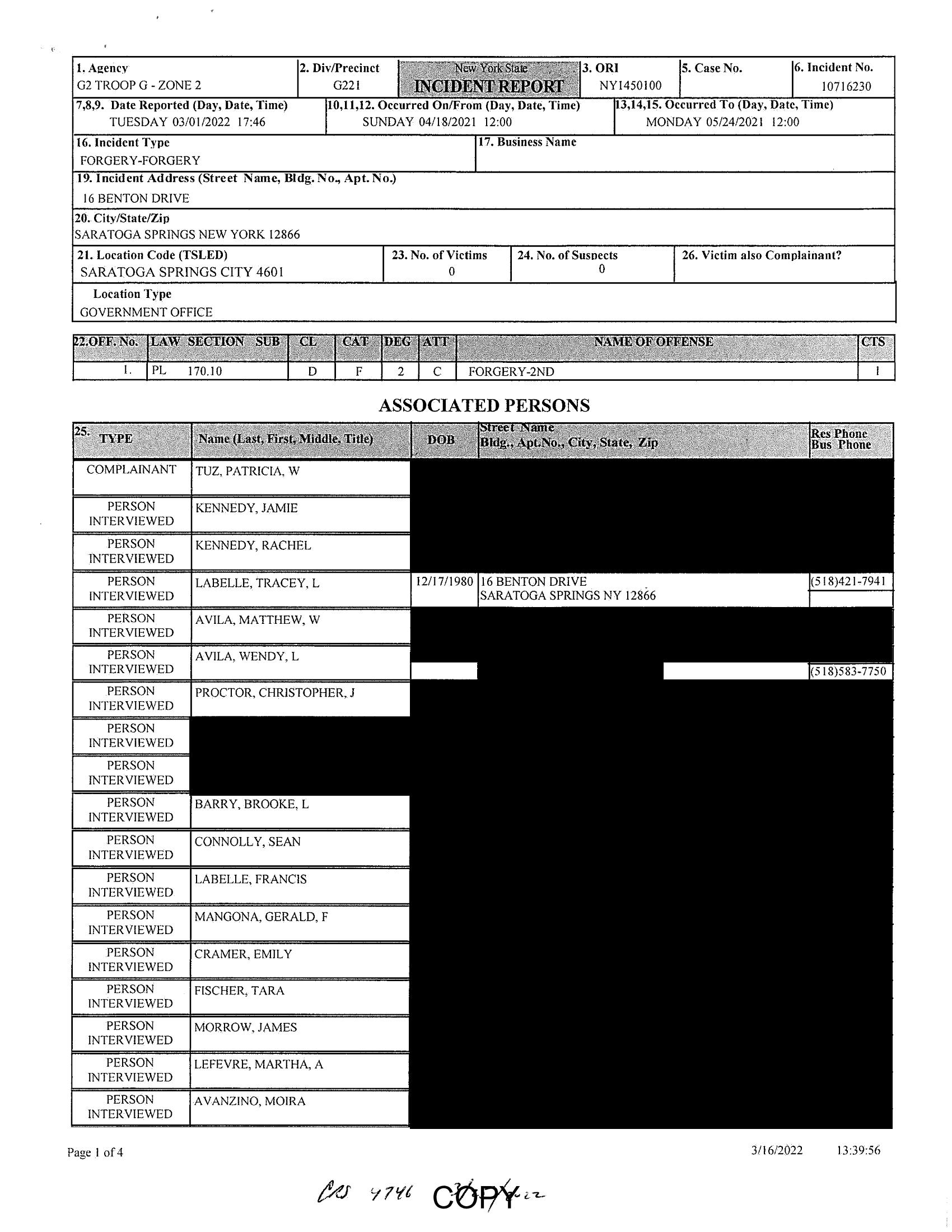
After a thorough investigation by the New York State Police into Saratoga Springs Democratic Chair Pat Tuz’s charge that Republican Public Safety candidate Tracey LaBelle forged signatures on her petitions, the result is in. Tuz’s charges were unfounded. Every one of the people whose petition signatures Tuz claimed were forgeries confirmed to the police that they had signed the document.
Tuz claimed some signatures were fraudulent because some of the people who signed LaBelle’s petitions did so using block letters. These same individuals wrote their name in cursive rather than block letters when they registered to vote. As city Democratic chair, Ms. Tuz has to know that mistakenly using block letters on petitions is a common error and does not necessarily constitute forgery.
Ms. Tuz’s accusation produced embarrassing headlines for LaBelle, and Tuz made a series of harsh comments to the press telling the Gazette that there was “clear evidence” of forgeries on the petitions.
There was a time when people who carelessly hurt others would apologize. Some still do, but Ms. Tuz is apparently not one of those.
Did Pat Tuz Ignore Attempts by the New York State Police to Contact Her?
The police report exonerating Tracey Labelle also documented that the State Police had repeatedly tried to contact Tuz without success.
It is troubling that Pat Tuz did not respond to numerous messages left by the New York State Police asking her to contact them regarding her complaint. I emailed Tuz asking her for an explanation.
Although she has not responded to my emails in the past, this time she sent me this curious reply:
Hi John:
I do admit to having a phone that I often forget to put the ringer on, in which case I don’t hear the call and even miss a voicemail. However, when people want to get a hold of me they usually do.
Thanks!
Pat Tuz
I wrote back to Ms. Tuz asking why she thought the State Police were then never able to get hold of her in spite of leaving numerous messages for her.
Ms. Tuz replied:
As discussed, they may have called, and I am very sorry if I missed the call, but, they have a lot to do, with many things going at once, as I do.
Saratoga Springs Mayor Ron Kim issued a press release alleging some kind of wrongdoing regarding the management of the email addresses that had been maintained by the city’s Recreation Department. The story was picked up by multiple media outlets including WNYT, the Daily Gazette, the Times Union, and the Foothills Business Review.
What is woefully missing from the release the Mayor sent out is supporting evidence of the possible wrongdoing he only hints at. He also demonstrates, yet again, his ignorance of New York State law.
I am from the old school. I believe that before I would go to the media with allegations that damage someone’s reputation, I would need to have gathered clear and compelling evidence that supported my claims. Mayor Kim did not do this.
Mayor Kim’s Poorly Documented Allegations
Basically, this whole fiasco began with a press release from Mayor Kim alleging that some persons, who the Mayor declined to identify, had alleged they had received emails from an unknown source (not identified). These alleged complainants (we do not know how many) claimed that the only way the unknown source could have gotten their email address was from the Saratoga Springs city Rec Center’s email list.
Subsequently, the person first identified in the media as making such a complaint was Gordon Boyd. Foothills Business Review (FBR) reported that Boyd made the allegations at a City Council meeting during the public comment period. Gordon Boyd played a leadership role in Ron Kim’s campaign last November. As the wags say, “he has a dog in this race.”
The fact that some persons claim that their email address was secure and that the only time they ever used it other than with family members was as a contact for the Recreation Department has to be viewed with some skepticism. It may indeed be true but nothing has been offered that would reliably establish it as fact.
I have been a computer consultant for several decades. I would be a rich man if I were paid for all the times users claimed to me that they could not have done something like shared an email address when later investigation proved this not to be true.
Nevertheless, for the purpose of this post, let’s assume what they say is true. The next question is who used this email list and for what purpose(s). Here again, Mayor Kim’s statements are full of contradictions and vague assumptions, and he colors his statements to add to the atmosphere of illegal clandestine shenanigans.
His press release states that there is evidence that a Rec Department email list was sent to “several employees outside the Recreation Department”, and yet he told the Gazette that “he is not making the connection between the release of the Recreation Department database and the unsolicited emails.” In fact, he stated, “We don’t know who is using the email addresses and what they are using them for.”
This doesn’t stop him from then telling the Times Union, that “he is learning the email addresses have likely [JK: my emphasis] been used for political purposes.”
At one point he drops a suggestion in a TU article that Moving Saratoga Forward is using the Rec Department list. He tells the TU he is hearing from people who are getting unsolicited emails from Moving Saratoga Forward and that they are telling him that “the only way [their email address] could have gotten into the hands of MSF was through the Rec Department.” After putting that out there he then tells FBR that he actually has no evidence to make that connection (FBR 5/17/22).
Likewise he disingenuously suggests to the TU, again without offering any evidence, that that the Rec Department email was used “first in 2020 to oppose a city charter change referendum and more recently to push school board candidates.” This of course contradicts his earlier statement to the Daily Gazette, that he doesn’t know what it was used for.
Mayor Kim Slimes Mayor Kelly
While Kim attempts to use this email issue to achieve a number of his political goals–discrediting the integrity of the previous officeholders for instance–he seems particularly focused for some reason on attacking his predecessor, Meg Kelly.
According to his own statement, multiple people had access to the Rec Department address file. He told the Gazette:
“Commissioner [Minita] Sanghvi’s department reviewed digital records and did in fact discover that on or about October 21, 2020, the Recreation Department email list was sent to several employees outside the Recreation Department, who would not normally have access to this information,” Kim said in a statement. “In addition, there is also digital evidence that the email spreadsheet was directly sent to former Mayor Meg Kelly’s Gmail account. It may also have been released by other elected officials, and we are continuing to investigate that possibility.”
Daily Gazette May 16, 2022
So of all the people –we still don’t know how many–who received this email list why do Kim and the TU focus on Kelly?
Here’s the headline of the TU article “Saratoga Springs Investigating If Former Mayor Accessed Resident’s Emails.”
In fact, Kim and the TU know the name of at least one other elected official who received the email list–Michele Madigan. And if Sanghvi’s supposed forensic search of the city server was properly carried out, Kim knows the names of the other “several employees” he alludes to.
So in the tradition of most good detective stories, there are multiple suspects but this did not keep Mayor Kim from gratuitously naming only the past mayor.
Mayor Kelly has told me that she did not provide the email list to anyone outside of city hall. Even if she did, as I will point out below, it was within her authority to do so.
Mayor Kim, Apologize to Mayor Kelly
A person of character would feel chagrinned over having impugned the character of someone on such a dubious basis. They would have acknowledged to themselves that they took liberties with the facts that impugned the character of someone without having properly established the basis of such accusations.
Mayor Kim, you could redeem yourself and recover your reputation for fairness and accuracy by apologizing to Meg Kelly.
Mayor Kim Fails To Carry Out Due Diligence
Mayor Kim has added to the drama by stating that he is “turning this information over to the proper legal authorities to determine if there were any criminal violations.”
At the same time, Kim, a lawyer, admits to the TU that “he is still trying to determine if the breach is illegal.” And he told FBR that “It is unclear at this point whether any laws or even government regulations, were broken in the release of the email.”
In the May 20, 2022, edition of the Times Union, Mayor Kim stated that the mailing list was not accessible under the state’s Freedom of Information Law (FOIL). In effect, he is alleging that the information is privileged which would make its release to the public improper. He didn’t offer a legal citation for this claim. This feels unpleasantly like his steadfast pronouncements that the City Attorney was not a public officer that turned out to be false.
Whether out of malice or slothfulness, Mayor Kim does not appear to feel the need to do the required research before issuing such statements. This recklessness makes for greater drama, more news coverage, and dubious ethics.
As it turns out, he is wrong on the law. According to the New York State Committee on Open Government, the court ruling in Livson v. Town of Greenburgh established that mailing lists such as the one maintained by the Recreation Department are public documents available to any citizen. It confirmed that, notwithstanding Mayor Kim’s claim, the Rec Department’s mailing list is accessible under FOIL.
NYS Committee on Open Government’s FOIL AO 19703 from January of 2019, “In Livson v. Town of Greenburgh [141 AD3d 658 (2016)], it was held that a list of email addresses of residents used to inform them of events occurring in the Town is public. In short, it could not be demonstrated that disclosure of an email address would rise to the level of an unwarranted invasion of privacy. Many individuals, purposefully or otherwise, share their email addresses as a matter of course.”
I have FOILed for the email list. I have also emailed Mayor Kim asking about the legal basis of his claim. I do not expect an answer, but he deserves the right to defend himself and I would publish his response.
Kim colors his statements to add to the atmosphere of lawbreaking and clandestine shenanigans by alluding to unknown organizations that he plans to refer the matter to.
The city is in the process of turning over its information to the proper legal authorities to determine if there were any criminal violations, said Kim.
Daily Gazette May 16, 2022
Kim said the city is now investigating if any laws were violated and, if so, who would investigate the violation.
Times Union May 17, 2022
I will be interested to see if we hear from Mayor Kim should an investigation determine there were no criminal violations.
Saratoga Springs Mayor Ron Kim has continued his campaign against City Court Judge Jeffrey Wait. The history of this debacle goes back to Mayor Kim’s unsuccessful attempt to act as the City Attorney in the case of a code violation involving Church Street Trust (CST). Mayor Kim has now retained an attorney on behalf of the city to appeal Judge Wait’s ruling which dismissed CST’s code violation.
Briefly, CST originally pleaded guilty in Judge Wait’s court for doing work on a property without a building permit. The building department identified a number of items that CST would have to address before CST could receive its permit.
The hearing in question was to determine whether CST had successfully complied with the outstanding issues identified by the building inspector. CST was potentially subject to fines for failure to comply.
When the city failed to appear for the hearing (see original post), Judge Wait dismissed the case.
“Without Prejudice”
As Judge Wait dismissed the case “without prejudice” it meant that the city could simply file the complaint again if they wished and seek a new hearing on the same issues.
In fact, the Building Department has done just that. In addition to the issue of no building permit, they have identified four safety violations in their complaint against CST.
What Will the City Gain with This Appeal?
In spite of the fact that the city has refiled the complaint, the appeal of Judge Wait’s decision is for some reason moving forward as well. Judge James Murphy will hear the appeal. If the city is successful, all that will happen is that Judge Murphy will order that Judge Wait rehear the case.
As Judge Wait will be rehearing the case anyway, there appears to be no reason to go through an appeal.
I have to wonder whether Miller Mannix, who the city is paying to appeal this case, realizes that the city’s building department has reissued the complaint. I am at a total loss as to why the city is spending money on the appeal. It appears that this has everything to do with Mayor Kim getting back at Judge Wait and little to do with trying to resolve the issues with CST.
It also remains unclear whether the Mayor has circumvented the procurement requirements in his enlisting Miller Mannix. For a discussion of the issue here is a link.
A number of concrete barriers have been installed on the streets of Saratoga Springs as part of Accounts Commissioner Dillon Moran’s expansion of outdoor dining into public spaces. Unfortunately, I have been unable to find any record of the City Council approving the acquisition and deployment of these barriers as is required by city procurement policies.
In the eight years I have been writing about the City Council on this blog, this is the first time I have become aware of an expenditure of city dollars that has improperly circumvented the City Council and been hidden from public view.
Commissioner Moran doesn’t seem to grasp that the revenues collected by the city are not a piggy bank that he can personally dip his hand into at will without proper authorization and public notice.
Some questions that need to be answered:
How much did it cost the city to acquire and deploy the barriers being used in the expanded outdoor dining program?
Who was contracted with to acquire and deploy these barriers?
Were there requirements for contracting to acquire and deploy these barriers such as an RFP or soliciting a minimum of three bids?
If bids or an RFP were required, when was this done?
A Breakdown of Fiscal Controls
Normally, the protection for avoiding fiscal abuse in public spending rests with the other members of the Council in general and, in our form of local government, with the Commissioner of Finance in particular. Council members would normally in the past challenge and ask questions about these kinds of expenditures at the Council table. Unfortunately, the current Council members never ask questions and always vote unanimously. They seem utterly indifferent to following proper procedures for everything from the conduct of meetings to state and municipal law and the charter. They appear more interested in protecting each other than in requiring their colleagues to adhere to the law and the charter.
Reaching Out to Finance Commissioner Sanghvi with Disappointing Results
As Commissioner of Finance, Minta Sanghvi is, according to the charter, “the chief fiscal officer of the City” [Title 4, city charter]. Since Commissioner Moran did not respond to my emails asking about the purchasing of the barriers, I wrote to Commissioner Sanghvi regarding two issues.
How did Commissioner Moran arrive at the fees for permits to expand outdoor dining? Here is the fee structure Moran proposed and that the Council adopted without any discussion:
Private Property – $100.00 Public Property (Sidewalks) – $500.00 Public Property (Sidewalks and Street Barriers) – $1,000.00
Why does a restaurant pay $500.00 to put tables on the city’s sidewalk? Why not $400.00 or $600.00? Are they subsidizing the cost for barriers deployed for other restaurants?
In observing the barriers the city recently installed for these restaurants, I noticed that there is quite a wide range in the number of barriers different restaurants are using. It appears, though, that there is only one fee charged no matter how many barriers a restaurant uses. What was the rationale behind this decision? It would seem reasonable to have had some kind of discussion as to whether there would be different fees based on how many barriers a restaurant used, but no one raised that issue with Moran.
Most importantly, though, there has been no public reporting on how much the city has collected in fees so there is no way of knowing if there is enough to cover the cost of the barriers. But then we don’t know what the barriers cost either.
2. I also noted in my communication with Commissioner Sanghvi that I was unable to find any record of the Council authorizing the expenditures for the acquisition and deployment of barriers and asked for her assistance in locating the appropriate Council action.
I don’t think my email to Commissioner Sanghvi could have been any clearer (see emails below). Her response, though, was to repeat the resolution authorizing the fee schedule which clearly did not address my questions as to how the fees were determined. Of particular note, she also ignored the question about the apparent lack of authorization for the acquisition and deployment of barriers.
In the end, I wrote her again to make sure she understood what I was asking for and since then I have not heard from her.
FOIL Request
I have FOILed the city for all documents associated with the acquisition and deployment of barriers. I will be writing on this further when I get them.
A Reason for Hope?
I contacted newly appointed Public Works Commissioner Jason Golub regarding the issue of the lack of a resolution authorizing the expenditures for barriers. In an email to me, he offered to look into it. Perhaps a sign of hope and an independent voice at the table?
Jason Golub’s Email
John,
thanks for reaching out. Obviously, you know that the deployment of the barriers and the process of approval/deployment all pre-dated my time on the council. That being said, I will look into the process that was followed and evaluate if there were any violations involving the acquisition and/or deployment of these barriers and let you know what, if any, corrective action is warranted.
I have written to Commissioner Moran trying to find out how he determined what restaurants should pay for the use of public areas to expand their business for outdoor dining. The fees range from $500.00 to $1,000.00. The $1,000.00 fee is for those who select to use concrete barriers which apparently the city is paying for. So, for example, how did Commissioner Moran determine that the use of public property plus the cost for providing barriers should cost $1,000.00?
Regrettably, he has not responded to my emails requesting this information. As Finance Commissioner you are responsible for overseeing all things financial.
I am sure you would agree that this is a reasonable request and deserves an answer.
I am writing you to ask for your assistance. I would think you would want to know whether the fees he is requesting of restaurants have a solid, thought-out basis.
Could you please advise me on how these fees were determined?
Also, the barriers have been installed at a number of restaurants but I can find no record of the council approving the expenditures for these. Can you advise me if the council has approved these expenditures and if so could you direct me to the minutes of the meeting when they were approved?
From: Minita Sanghvi Sent: Wednesday, May 4, 2022 11:26 AM To: john kaufmann21 Subject: Re: What is the basis for the city’s fees for temporary outdoor dining?
Here is the information from the April 5 city council meeting. The resolution is uploaded with the agenda.
From the minutes:
Discussion and Vote: Extended Outdoor Dining Fee Schedule Commissioner Moran stated the extended temporary outdoor dining fee schedule had three (3) levels. Moran stated Level 1 would be for extended dining onto private property where the licensee had previously were not permitted to utilize for dining use by either the City or the State Liquor Authority. Moran stated the fee for Level 1 to be one-hundred dollars ($100.00). Moran stated Level 2 would be for the use of public property – city curb to sidewalk. Moran stated the fee for Level 2 to be five-hundred dollars ($500.00). Moran stated Level 3 would be for the use of both public sidewalk property and city street property with city-owned barriers. Moran stated the fee for Level 3 would be one-thousand dollars ($1,000.00). Moran stated the fee would include the use of property, installation and use of the barriers, and application fee. Moran stated the application fee for Levels 1 and 2 were included in the pricing of each level. The intent of the fees is to invest the money back in to support the program. In years two and three of the program, the City will look to convert the blocks to something more decorative.
I am deeply troubled by your response. As indicated in my email to you, I was fully aware of what was in the minutes. My question was how did the city come up with these figures. I don’t think I could make my question to you any clearer. For example, I wrote:
So, for example, how did Commissioner Moran determine that the use of public property plus the cost of providing barriers should cost $1,000.00?
As you are the watchdog over the city to make sure money is spent appropriately, do you simply accept that $1,000.00 for the use of public land and for the use of barriers is the correct amount because the commissioner of accounts says it is?
I hope this is not the case. I hope that I simply caught you at an odd moment and you did not read my email carefully.
So I ask again, for example, was $1,000.00 the correct amount for the city to receive for the barriers and space. Similarly, I ask the same for the other fees.
I also asked in my email:
Also, the barriers have been installed at a number of restaurants but I can find no record of the council approving the expenditures for these. Can you advise me if the council has approved these expenditures and if so could you direct me to the minutes of the meeting when they were approved?
For some reason, you did not address this. I respectfully ask that you advise me when the council approved these expenditures and where I can find the record for this?
In the event that the council did not take action, could you please advise why this was exempted and, most importantly, what were the costs incurred by DPW for the barriers and what was the cost for deploying them in front of the restaurants?
On May 5, 2022, Dillon Moran posted the item below on his Facebook page and paid to boost its promotion. He accuses unnamed “social deviants” of spreading disinformation to the public about his efforts to inform the citizens of the substance of his proposed expansion of alcohol use in public places. Unfortunately, in his intemperate remarks, he unintentionally exposed the fact that he failed to comply with the requirements of the city charter.
Violating Requirements in the City Charter
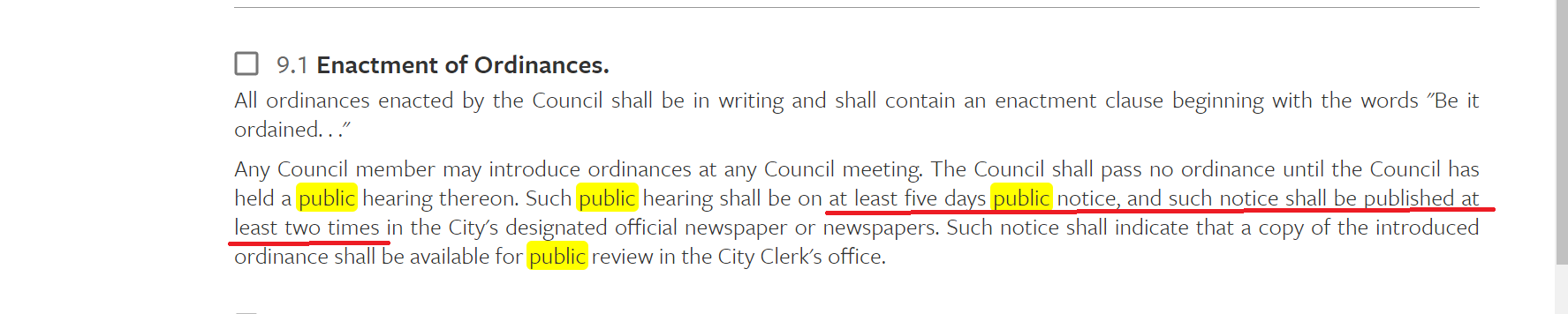
Commissioner Moran appears to be completely oblivious that in publishing legal notices on May 1 and May 2, he failed to meet the requirements of publishing these notices in a timely manner as required by the Saratoga Springs city charter.
Notices for public hearings for ordinances must be published twice, and they must be published at least five days prior to the hearings.
From The City Charter
The hearing was held on May 3. These two notices were published one day ahead and two days ahead respectively. By my count, they are four days short and three days short of compliance.
The Real Issue
The real issue here is not so much the technicalities of meeting the city’s legal obligations, important as this is. The real issue is how best to inform citizens of changes in city policies that may affect them.
How many would have thought to look for the text of Moran’s ordinance in the classified section of the Daily Gazette on May 1 and 2?
I went into this in some detail in an earlier post but briefly, the city has developed a user-friendly method that Commissioner Moran chose to ignore. The city publishes its proposed agenda on the Friday before its Tuesday meetings. Items in the agenda that set public hearings have regularly included a link to the actual proposed text of the law or ordinance to be considered.
Rather than graciously admit that he should have included such a link to his hearing in the agenda, Commissioner Moran has chosen instead to accuse those who have pointed out his error of having some kind of malign intent to mysteriously harm the city.
Making The City Vulnerable
In not meeting the requirements for public notice, Commissioner Moran has placed a cloud over the resolution he wants to be adopted. Strictly speaking, someone could probably bring a suit to nullify the city’s resolution. Of course, Moran and his fellow council members could just redo the process, but the point is that this kind of sloppiness has the potential to create liabilities and expenses for the city. Eventually, the indifference to detail of this council will catch up to them.
In a recent post I took Saratoga Springs Accounts Commissioner Dillon Moran to task for setting a public hearing without properly informing the public of what his proposal actually was.
At the City Council meeting Tuesday (5/3/22) Commissioner Moran issued a blistering statement claiming anyone who couldn’t find information about his proposed amendment to the city code was either “lazy or a social deviant intent on harming the community with…lies.”
Here is a video clip of Commissioner Moran speaking.
In this clip the Commissioner lists (inaccurately) the many ways the public has been informed about the language of his resolution on expanded drinking opportunities:
So Moran claims that besides listening to him read his proposal out loud that night at the meeting, citizens (who were not lazy or social deviants) could have read about the proposal in the newspaper or looked at it on the city website.
Let’s start with the claim that the “actual language has run in the paper on consecutive days.” Commissioner Moran is presumably referring to the fact that a notice of a public hearing on his proposal did appear on page 27 of the April 29-May 5 issue of Saratoga Today in the Classified section as required by law. Saratoga Today comes out once a week so it was not in the paper on two consecutive days or even in two consecutive issues (as were other notices of city public hearings). More importantly, however, was that the notice did not contain the actual language of the proposal as Moran claimed. Instead, it contained a brief summary stating that the legislation would create “exemptions to temporarily allow the sale and consumption of alcoholic beverages in designated public areas” without indicating what exemptions or what areas. “Any interested person” was informed that they could “inspect the Amendment in the office of the Commissioner of Accounts. ” Presumably this would have to happen between 9 and 5 on weekdays when City Hall was open. There was no indication that the actual wording of the proposal was available on the city website.
As it turns out the proposal is now on the city website but those looking for it have to know to go to the Public Hearings section of the city website not to the Council agenda or the Accounts Department page where one might first think to look. I for one have to say that after all these years of following City Council business I was not aware there even was a Public Hearing page until Commissioner Moran indicated at the meeting that this is where his proposal could be found. Lesson learned.
Here is the notice that appeared in the classified section of Saratoga Today.
How It Is Supposed to Be Done
The City Council has traditionally handled the setting of public hearings by including links in the agenda to the text of whatever is being proposed. This is nothing new. In fact, the current Mayor properly followed this procedure when he recently set a hearing to make changes in the city’s Uniform Development Ordinance.
This makes it simple for anyone checking the city agenda before Council meetings to easily see what there will be to comment on.
As I illustrate below, the normal method for setting a public hearing involves an announcement at a Council meeting of the hearing which includes a link to the text of whatever the purpose of the hearing is. It includes any relevant documents such as a resolution or, in this case, the proposed amendment to the city code.
In order to understand Commissioner Moran’s grossly inept handling of the public hearing on expanded drinking in the city, it is instructive to consider how the public hearings for changes to the Unified Development Ordinance were handled at the same meetings by Mayor Kim.
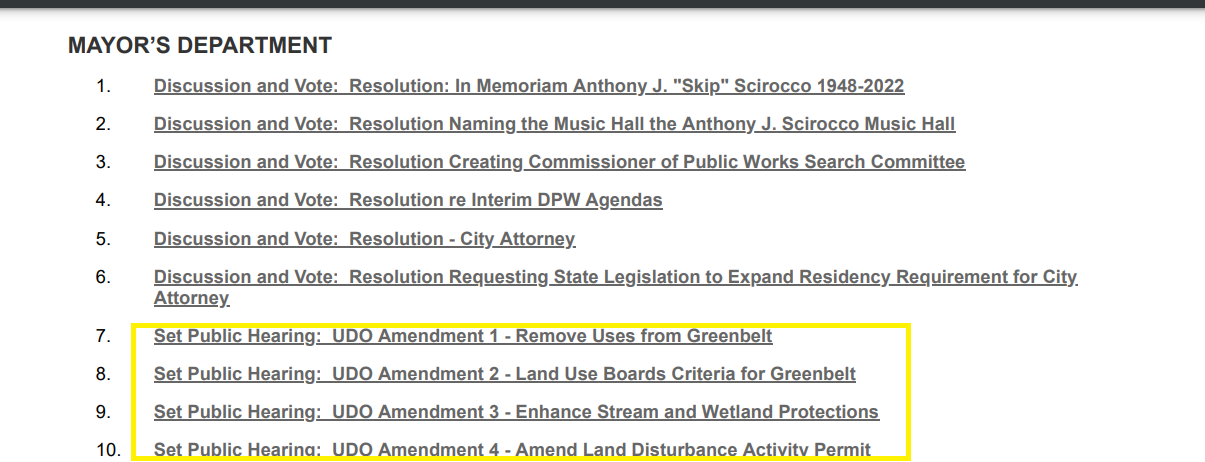
Here is an excerpt from the Mayor’s agenda for the April 19, 2022, City Council meeting when he set public hearings for the Unified Development Ordinance.
Note that the four public hearing items are underlined. This signifies that there is a link to a document with the actual language of the proposed changes to the UDO. Online, the user simply clicks on these to find out precisely what changes the hearing will address.
Now contrast this with the agenda for the Accounts Department at the same meeting.
Note that there is no black line under item #5. There was no link to the text of the changes being proposed by Commissioner Moran.
Now consider the Mayor’s agenda regarding the UDO proposals for the May 3, 2022, City Council meeting:
Here again, there is a link to the actual language under consideration for the UDO.
Now consider the Accounts Department agenda:
Again, there is no link anywhere on the agenda to the actual wording of Commissioner Moran’s proposal.
How Not to Do a Public Notice
Notices of Public Hearings on changes to local laws and ordinances are required by law to be published in designated newspapers.
Notice of Commissioner Moran’s proposal, as seen earlier in this post, while fulfilling the letter of the law, had no text and no information on how to view the proposal online.
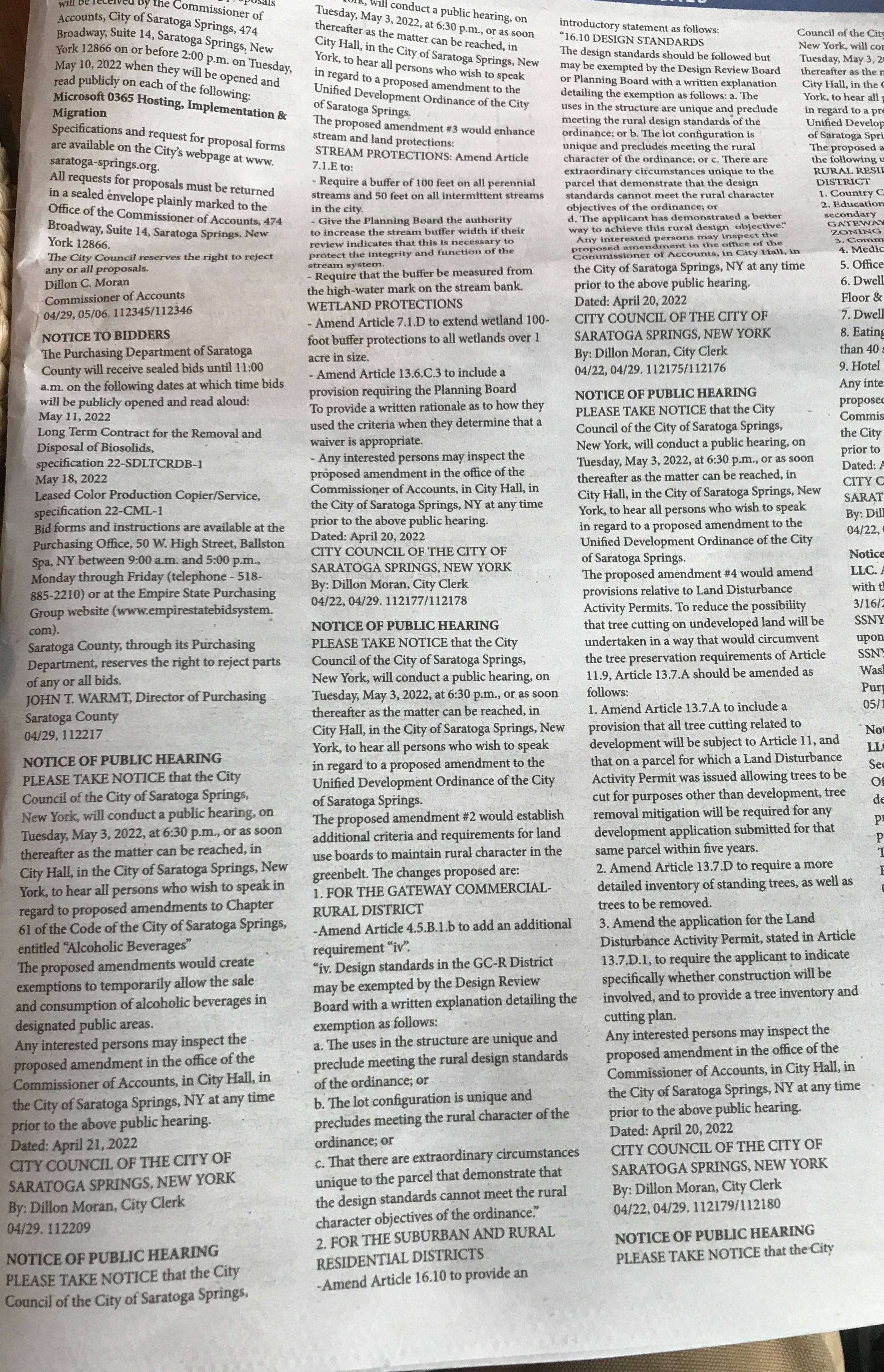
Compare that with the notice for the UDO hearings which appeared in two consecutive editions of Saratoga Today. Most of the three columns on the page are the text of the proposed changes. This notice appeared in the April 22 and April 29 editions of Saratoga Today.
Learning From Mistakes?
Hopefully, Commissioner Moran will, in the future, be able to move forward and instead of berating the public, accept the responsibility as an elected official to more responsibly and transparently provide information to the public as he engages in the city’s business.











 Saratoga Springs Politics