A Discussion of the Issues in Enhancing Union Avenue #5: Cyclists are not tethered to Bike Lanes – continued

[Jim Martinez responds to Ed Lindner]

How odd that the solicitor has chosen to continue this important discussion by getting personal.

I would have welcomed an address to the questions raised in my responses rather than be made aware of the resumes of consultants who found their way to our small city, charged with providing its sponsors with an alleged improvement of our streets for cyclists. In implying ulterior crafty motives and dodging the questions that I posed by pivoting to safer promotional materials and challenging professional experiences is beneath this discussion. This used to be called, “shooting the messenger” – I think it still is. Can we now expect the authors of all blog commentaries to be challenged to dismiss their concerns and opinions against those hired to promote their concept of life in our community? I certainly hope not.

With a program that includes a small percentage of our city roadways while the remaining roadways have been legislated to share the pavement, I must ask those questions that any resident or consultant hired to analyze the complete street dynamic might seek answers for. Has there been any celebration and recognition of the NYSDMV Chapter 11 legislation anywhere in this proposal? I imagine it created a bit of a headwind to have to recognize the opportunity to now share the road with other modes of transportation had addressed a long standing concern, only now with stated rules and regulations for all. 

In my experience, when solving problems, one starts with the large scale working down to the small scale. Before problem solving, the approach has always been problem seeking. Naming the problem and all its parameters is key to developing a successful solution.  

Have the proponents considered everyone in their approach to developing their solution? Suggesting that it is the collective we, who must now settle for a “share the road” reality is an odd reaction to an approach that the state has issued for all municipal streets in New York State. Are we somehow to believe that the proposed bike lane loop will collect all the cyclists of our city, so they do not have to settle for sharing the pavement as proclaimed? Can these cyclists be expected to venture beyond these lanes untethered to other destinations along the shared roadways?  

Suggesting the health benefits of cycling alongside the concerns of a warming climate under the umbrella of greenhouse gases while overlooking the larger picture of how most all sides of our existence on this planet contribute to them, is simplistic and patronizing. In referencing studies, it is always important to evaluate the criteria for that research.  

Choosing to ignore the inconvenient truth of vehicular traffic in the 21st century is delusional. The symbiotic relationship between where we live, how we get there and our dependency on that form of transportation for supplying us with most all our needs is nothing short of denial.  

Many of us cycle for health and pleasure part of the year, and others with the proper accessory boutique kit can extend their season a bit longer. I believe that this myopic rationalization that cyclists will go from point A to B by first challenging the shared roadways to travel instead on a circuitous bike lane at best is part of this folly. Being indulged with selected data suggesting that retailers will increase their business along with the explosion of bike tourism is nothing less than targeted promotion.  

I should not have to repeat my earlier comments on the Complete Street Plan, but the latest response suggesting it creates a “safe, bikeable, and walkable” community sorely misses concerns for the pedestrian both ambulatory and non-ambulatory to navigate across our year-round city rights-of-way sidewalks while focusing on a dedicated cycling path in parts of the city.  

In summary, I must again offer these concerns as problem seeking, for consumption and evaluation to avoid trying to solve a problem without first gathering all the peripheral questions and addressing the potential collateral issues to best understand them.  


  1. 1. Who was initially included in the targeted catchment of the preliminary surveys that chose to reduce the number of lanes on our streets?  

  1. 2. Were the property owners most affected who live next to all the proposed bike lanes surveyed for their responses? 

  1. 3. Have the Departments of Public Safety and Public Works reviewed the first preliminary proposals, signing off on them? This is different from asking them to respond to the results.  

  1. 4. What is the investment that the city is being asked to contribute on the construction and implementation of these bike lane connections? What are the costs estimated to maintain these lanes? What monies has the city received to start this program and/or to continue it? 

  1. 5. Who plans to take on the responsibility of the educational part that NYSDMV Article 11 presents its novice young cyclists without a motor vehicle license? 

  1. 6. How many city residents have bikes and have registered those vehicles with the Police Department? Over the last several years, has the use of the new bike lanes been noted and memorialized? 

  1. 7. How many tourists have used the seasonal bike rentals throughout the city? How often?  

  1. 8. How many residents would depend on bicycles year-round to go to work and what would be a reasonable distance be?  

  1. 9. Has the suggested replacement of the seasonal arterial traffic loading on this targeted two block section of NYS Route 9P (Union Avenue) from four active lanes to two been assessed by the DPS or the State if necessary? 

  1. 10. The city presently defines its system of roadways by width and volume (taken at peak times). Have we challenged their data and designations by altering the volume on this vital arterial street?  


In my earlier comments, I provided my opinion and suggestions on this two-block half-mile section of the arterial road, which stands for only a fraction (.034%) of the remaining shared roads that will be navigated by cyclists without lanes as prescribed. I can only hope that any further discussions will include a response to the questions posed for this discussion so as to be helpful.  


The Architect 


A Discussion Of The Issues In Enhancing Union Avenue #4

[Ed Lindner of Bikeatoga offers some further thoughts]

What an odd way to begin an important discussion about public policy.  “The attorney,” Jim writes, “has plainly provided … images … developed by a consultant whose charge was to present a bike trail system.”  Jim knows my name, of course.  He refers to me as “the attorney” and himself as “the architect” in an attempt to suggest that his views are entitled to greater weight due to his claimed expertise.  

I have no idea if Jim has any actual experience designing roadways.  But he does raise an interesting point.  When considering whether a particular roadway design will handle peak traffic, to what extent should we rely on data and the opinions of experts?  Or are we all experts now, regardless of background, capable of solving engineering problems by doing our own research?  

By drawing a distinction between the “attorney” and the “architect,” Jim clearly thinks we should defer, to at least some extent, to technical expertise. And not being an engineer myself, that’s generally how I approach questions outside my training.  

So let’s begin by taking a look at the resumes of the consultants who provided the images I used in my last post.  


The first preliminary and unofficial sketch of a potential enhanced Union Avenue design was done by Complete Streets Advisory Board member Mike King, an internationally recognized expert who has done roadway designs on five continents.  He has worked on more than 60 projects around the world, in cities as diverse as Cairo, Egypt;Jacksonville, Florida; Yichang, China and Cleveland, Ohio.   


This second preliminary sketch was done by JMT of NY, a firm of 1800 professionals with extensive experience planning and engineering streetscape designs. They’ve completed award-winning complete streets projects in multiple cities.  

It may well be that Jim has similar experience with roadway engineering and design.  If so, I would genuinely like to see examples of his work. It’s always helpful to see how others have handled the issues that arise in every major roadway redesignproject.  I hope, though, that both the “attorney” and the “architect” can agree that the Enhanced Union Avenue project is being guided by exceptionally qualified transportation professionals.

Is the “road diet” design proposed by these transportation professionals the best solution for Union Avenue?  That’s what our community is discussing now.  There will be an Enhanced Union Avenue public design workshop on Thursday, January 16th at 6 p.m. in the Music Hall on the 3rdfloor of City Hall.  I hope that Jim and others will attend and be prepared to collaborate with neighbors, bike advocates and city consultants to create the Union Avenue design that works best for most. 

As I suggested in my original piece, we do need to see the traffic study, which we all agree is long overdue.  But there is good reason to think that a road diet design could make Union Avenue more beautiful and more bike and pedestrian friendly without creating major traffic concerns.

All of the issues Jim raises about the three-lane, road diet design have been raised by neighbors and business owners in other communities. Check out this AARP guide (download the complete Road Diet fact sheet for best info).  In hundreds of cases around the country, road diets have not caused traffic congestion and have not diverted traffic to side streets.  They have slowed down cars and reduced crashes. And they’ve created new civic space for trees, safer crosswalks and bike lanes.

If the traffic study for Union Avenue shows that a “road diet” design can handle the traffic, as I hope it will, we should invest in creating a truly beautiful Enhanced Union Avenue. If not, the City should stripe the existing roadway to connect the bike lane NYSDOT is building from Henning Road to East Avenue all the way to Circular Street.

In the end, the real difference between Jim and me is our vision for the kind of city we want to live in.  Jim thinks that bike lanes are unnecessary, and that cyclists and motorists should just “share the road.”  I think that’s unsafe and unwise.  

Multiple studies confirm what common sense tells you – mixing bikes and cars on well-traveled roadways is a recipe for accidents. The Federal Highway Administration estimates that adding bike lanes on 4-lane local roads can reduce crashes by up to 49%.

Multiple studies also confirm another thing that common sense tells you – more people ride bikes when they feel safe doing so.  And more people ride bikes when you build a connected bike lane network that takes them where they want to go.

Do you care about climate change? How many times do you use your car to drive just three or four miles?  Making it safe for Saratogians to take that same trip by bike has been part of the City’s climate change mitigation plan since 2011.  That continues to be a community goal.

Our 2020Natural Resource Inventory identified motor vehicles as a primary source of local greenhouse gases and recommended “expanding multi-modal transportation infrastructure such as sidewalks and bike lanes” to reduce our community’s carbon footprint.  

Building a connected bike lane network to encourage cycling also promotes community health.  That’s why the CDC includes building “bicycle networks” as a priority strategy for increasing physical activity through community design.  

And finally, bike lane networks are good for business.  Building a quality bike lane network allows local businesses to benefit from the explosion of bike tourism.  And it’s not just about tourism.  Studies show that retailers see increased local business when new bike lanes are built.

For all these reasons, building quality bike lane infrastructure isn’t just about cyclists. Getting more people on bikes benefits the whole community

In 2012, the citizens of Saratoga Springs decided that they want our city to be a safe, bikeable and walkable Complete Streets community.   An Enhanced Union Avenue is an important part of that plan.  


Past Public Safety Commissioner Lew Benton: City Council Failed to Take Necessary Steps Initiating Shelter Plan

[Lew Benton served as the city’s Public Safety Commissioner 1988-1995]

John,

I think Chris [Mathiesen] is on target.

The following may inform Chris’s point.

Tuesday’s Times Union story by Wendy Liberatore, headlined “Shelters pushes back on 24-hour center for homeless” is made significant not by what it reports, but by what it fails to report.

The story, from my perspective, raises more questions than it answers about the proposed adaptive reuse of the current Senior Center on Williams Street to house a Code Blue facility, a so-called “navigation” center and a full-time, low-threshold adult homeless shelter.

What left me somewhat confused (not difficult at my age) was the reporter’s reference to a Monday release by the intended project operator (Shelters of Saratoga) which included the following:

a year-round low-barrier shelter at 5 Williams St. is not the best solution to address the city’s problem of the
unhoused,

“There are many implications to this type of shelter, a significant departure from our recommendation, with a wide range of new factors that must be cautiously evaluated,” and, most notably,

the need for a clear understanding of “the viability of the site location, 365/24 staffing requirements, expanded services, community impact, short-term and sustained long-term funding, regulatory implications, and the practical impact on best serving the Saratoga Springs homeless community.”

SOS leadership’s view that the proposed multi-use facility on Williams Street, was not a solution to the “problem” of the unhoused; presented as a “ … significant departure from our (SOS’s) recommendation; and lacked a clear understanding of site location …” seemingly contravenes the City Council’s October 18, 2022, authorized lease agreement.

That unnamed resolution that authorized a lease agreement with SOS contingent on “… Shelters of Saratoga using the Property to run a full-time facility that provides a state-mandated Code Blue Shelter, a navigation center, and a full-time low-threshold shelter on the Property.” 

How could such a disconnect have occurred? Even a cursory reading of the Council’s resolution would lead to the conclusion that the project was well on the way to implementation. 

Surely, SOS and the City Council understood the full scope of the programs and services required of the lease agreement, the burdens imposed by the state regulatory agency (the Division of Shelter Oversight and Compliance), and the need to gain a state operating certificate. 

But is it feasible that the city council did not fully understand its October action. And if it did, how could it not have foreseen community reaction. No disciple work was done with adjacent properties prior to the adoption of the October resolution.

There were no public meetings to announce the proposal, give it definition and allay the inevitable neighborhood concerns (real or imagined). Most did not become aware of it until after the Council had already acted. There appears to have been no press coverage beforehand.

The public record of the lead up to the adoption of the October 18 resolution is telling. The October 17, 2022, City Council Pre-Agenda Meeting included a list of named presentations scheduled to be made at the following evening’s regular bimonthly meeting.

The list included: 2. Shelters of Saratoga and the minutes of that meeting noted the agenda item resulted in “no comments” by Council members but one commissioner did ask if presentations could be limited to a specific amount of time to prevent them from going on too long. 

The mayor’s pre-agenda included the following: Discussion and Vote: Resolution on 5 Williams Street. The meeting minutes indicate that at the pre-agenda meeting the mayor “… advised this item will be moved to number one on his agenda and changed to a resolution on homelessness. “ Not one member of the Council commented or asked about the resolution’s content.

The minutes record no discussion at all on what would seem a rather major public policy action.
But when the final agenda for the October 18 regular Council meeting was posted it appeared as Discussion and Vote: Resolution on 5 Williams Street on the mayor’s agenda. Few would have connected such a such an innocuous agenda item with the authorization of a “full-time, low threshold shelter.”

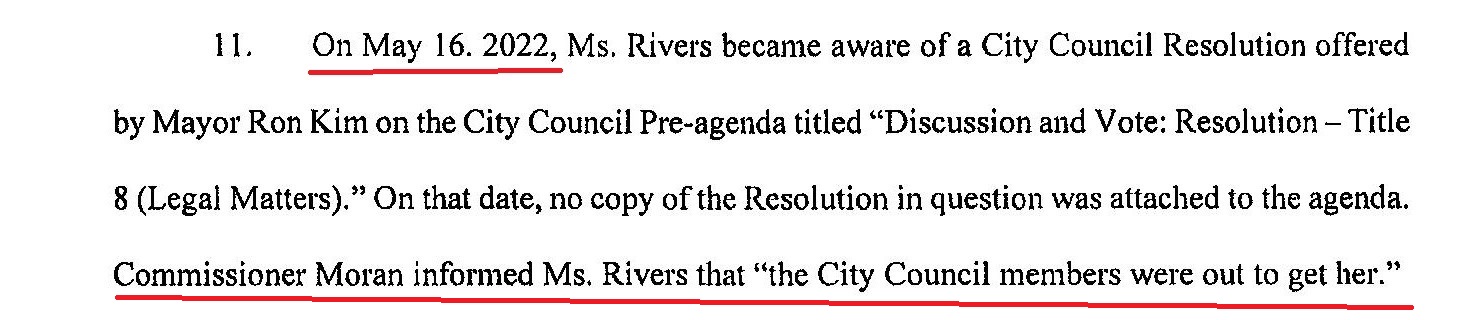
Remarkably, given the intensity and potential impacts of the proposed use this was the only discussion memorialized in the meeting minutes:

“Commissioner Moran asked if the City has an understanding of the budget for the shelter to operate. Commissioner Sanghvi stated it would be about $65,000 for the season. Commissioner Moran stated that is an amount that is within reach for the Council. Commissioner Moran asked in regards to the statement of construction of transitional or low income housing, are there plans still to come. Mayor Kim stated there are conceptual plans for that property. There is no way to build an additional floor above the existing facility. The next step after looking at licensing is to look for the funding. The site allows for a number of things to be done. Supervisor Gaston stated the Code Blue season runs through April 15th and is not sure if this resolution was intended to align with that date. Commissioner Sanghvi made a friendly amendment seconded by Commissioner Montagnino to change the date to on or about April 15, 2023.”

Subsequently it became apparent to some that the Council’s action was premature and was adopted before several steps necessary steps to move the project had been taken or even initiated.
Apparently no required Emergency Shelter Operational Plan had been prepared and submitted to the state Office of Temporary and Disability Assistance, no required SEQR review by the Council had been taken and no disciple work begun.

The city council was advised of all this. What, if anything it did I don’t know. 

The Saratoga Catholic community has been publicly criticized for opposing the proposed full-time, low-threshold shelter immediately adjacent to its middle and high school. 

The proposal’s poor rollout, the failure to consult with neighbors and school administration beforehand and the absence of a definitive operating plan inevitably would cause concern. 

Would not any school community, public, private or parochial, act similarly?

In 2013, in response to the death of a homeless woman from exposure, the Church of St. Peter and Saratoga Catholic opened the auditorium in its former elementary school (still used as by Saratoga Catholic Central school for certain activities) to an emergency Code Blue shelter.

Here is how Times Union’s Dennis Yusko reported on it.
Code Blue for homeless in Saratoga Springs
By Dennis Yusko on December 20, 2013 at 7:31 PM

An emergency effort to shelter homeless persons during cold and snowy nights could start Christmas Eve in Saratoga Springs after political leaders, clergy and social service professionals rallied to create a Code Blue program.

Under the plan announced Friday by Mayor-elect Joanne Yepsen, the nearly dozen persons who do not have homes or lodging in Saratoga Springs will be able to sleep inside the Church of St. Peter’s parish building on Broadway whenever temperatures drop below 10 degrees or a foot or more of snow is forecast.

The program will start Tuesday, when the mercury is expected to slip to eight degrees. Existing organizations will spread the word about the plan. Police and firefighters will look for homeless on the streets and in their usual hangouts. They or members of the Saratoga County Economic Opportunity Council (EOC) will provide free transportation to St. Peter’s. The Red Cross will supply cots and blankets. Shelters of Saratoga (SOS), which operates a “dry” shelter in the city for $10 a night, will help with food and outreach.

The plan comes in direct response to last week’s tragic death of Nancy Pitts, a 54-year- old graduate of Saratoga Springs High School who died from exposure on an outside porch of the Saratoga Senior Center after spending a freezing night there, according to police. Pitts lived on the streets and struggled with drinking and poor health. All homeless persons in the city will be able to access the emergency shelter without conditions, Yepsen said Friday in City Hall. She was joined by SOS Executive Director Peter Whitten, Gary Ferris, executive director of the American Red Cross Adirondack-Saratoga Chapter, Joy King, a longtime friend of Pitts, Cindy Phillips, co-chair of the Saratoga County Housing and others.

The Saratoga program is modeled after the Code Blue system in Albany, which starts in November and runs through March 15. That Code Blue was partly spurred on by the death of Darrell Glass, 31, a homeless man who froze to death off Northern Boulevard in February 2007. Liz Hitt, executive director of the Homeless and Travelers Aid Society (HATAS), administers the Albany program and helped provide a template for the Saratoga Springs Code Blue. She said dozens of persons in the two cities were prepared to sacrifice Christmas Eve to ensure no one suffers in the cold.

Hardly inconsistent with the social teaching of the church but done on an emergency basis in a way that addressed the safety of all. 

LJB
02/09/2023

What Time Is The Re-Scheduled City Council Meeting? Who Knows? How Much of the Public Will Even Know There Is A Meeting?

[A reader contacted me to advise that the meeting will be at 6:00 PM. It is listed on the city’s calendar. The issues of a proper agenda remain. The agenda is supposed to be headed by the date, time, and place which this blogger has traditionally relied on]

The Saratoga Springs City Council attempted to meet on Tuesday, February 7,2023.

Members of the Black Lives Matter organization disrupted the meeting during the public comment period. They refused to relinquish the microphone. Mayor Kim had to endure what his predecessor Meg Kelly had been subject to. It was impossible to transact the city’s business as the BLM shouting made any semblance of order impossible. Kim adjourned the meeting three times in an attempt to bring order without success.

In the end, he told the BLM people that he would schedule a special meeting to hear their grievances.

He also announced that he would schedule a special meeting to try to act on the city business that their disruption had blocked.

In an all too familiar mess up, the city’s website indicates that there will be a City Council meeting tomorrow (February 9, 2024), but it fails to include what time the meeting will be held. When you click on the icon for the agenda to find out what time the meetings will be convened, you get the exact same agenda that was posted for the February 7 meeting, including the original date, which of course, is the wrong date.

Given the short notice, most of the public will have no idea that the City Council will be meeting on the 9th anyway.

Mayor Kim’s Unconscionable Attack On Shelters of Saratoga

Saratoga Springs Mayor Ron Kim falsely told area media that he first heard about the decision by Shelters of Saratoga (SOS) to withdraw from the plan to use the Senior Citizens Center as a low-barrier homeless shelter from the media and not from anyone associated with SOS.

In bitter remarks to the Saratogian Newspaper he stated, “Now for them to just walk away and not even tell us, seems to be less than forthright and trustworthy.” (see longer quote below along with link to news article)

My sources, however, tell me that on Friday morning, February 3, 2023, the SOS executive director, Duane Vaughn, and his board president, Kathy McNiece, went to city hall at 9:00 AM, as it opened, to inform Kim of their decision.

Unfortunately, Kim was not there. The two spoke with a number of people in City Hall, including at least two Commissioners. My sources tell me that Kim was informed of SOS’s decision later that morning by those in City Hall who had talked with Vaughn and McNiece and not by the media as he claimed.

Threats That Need To Be Taken Seriously

On Sunday morning, February 5, 2023, SOS executive director Vaughn wrote to members of the Council about threats made to him and his family:

From: “Duane Vaughn” <executivedirector@sheltersofsaratoga.org>
To: “Angela Rella” <angela.rella@saratoga-springs.org>, “Ron Kim” <ron.kim@saratoga-springs.org>, “Jason Golub” <jason.golub@saratoga-springs.org>, “Dillon Moran” <dillon.moran@saratoga-springs.org>, “Minita Sanghvi” <minita.sanghvi@saratoga-springs.org>, “James Montagnino” <james.montagnino@saratoga-springs.org>
Sent: Sunday, February 5, 2023 2:53:28 PM
Subject: Duane from Shelters of Saratoga


Good afternoon,

I hope that you have not closed the door on conversations in regards to homelessness and Shelters of Saratoga.  I hope you understand that the most significant issue that came to rise in the last week was the personal safety of myself, my family and my board president.  We were threatened with physical violence and personal lawsuits.  This has completely shaken our home.  My wife considered going to a family member or a hotel.  Members of the community not only threatened my board president, as you know because the police are involved, but found my unlisted home phone number and address.  The threats were unbearable. We had days of no sleep and constantly looking over our shoulders.  I don’t have a team of lawyers and a police force.

We had to take a serious pause.  We must continue to educate and commit to total community buy-in.  However, I cannot compromise the safety of my family. I have saved every message and phone number that has called my office and my home just in case further threats arise.

An Intemperate And Reckless Reaction

A tempered and professional public figure, before making an attack on SOS would have contacted them first. Even if Kim had not been informed, he should have acted more prudently. Having dealt with the media for many years, they would have understood if Kim had responded to their inquiries by saying he would get back to them after he had reviewed the situation. Such a professional would have contacted SOS seeking to fully understand the evolving situation.

I would have liked to email Mayor Kim to ask him whether he had contacted Vaughn subsequently. As the Mayor never responds to my emails, I do not know, but experience suggests that he blames SOS for the failure of his plan and sees no need to reach out.

From the February 5, 2023 edition of the Saratogian.

When asked for comment, Kim seemed taken aback by the lack of communication from the Shelters of Saratoga in making the decision to back out without consulting with the mayor’s office or city officials.

“One, we’ve never been officially told of this. We’ve heard from news media,” Kim said.“So, I’m disappointed that neither Shelters staff nor their board saw fit to call the mayor’s office and say they’re pulling out,” Kim continued.“

So, I’m disappointed that neither Shelters staff nor their board saw fit to call the mayor’s office and say they’re pulling out,” Kim continued.

“Two, Shelters of Saratoga staff were the ones who were demanding that the city move forward from this. The last conversations I had with them, they wanted a 30-year lease, basically a commitment from the city. Now for them to just walk away and not even tell us, seems to be less than forthright and trustworthy,” Kim explained.

“So, I’m disappointed that neither Shelters staff nor their board saw fit to call the mayor’s office and say they’re pulling out,” Kim continued.

Kim appeared equally disappointed given how far into the process the two sides seemed to be in an agreement.

Kim also noted the city will plan to move forward with creating a shelter site, whether that includes Shelters of Saratoga or not.

“So, here’s what the city’s gonna do. I’m gonna name a task force,” Kim said.

“We’re gonna move forward with finding a site and more importantly finding a trustworthy partner to establish a shelter and navigation center in the city of Saratoga Springs, because it’s sorely needed and that’s what we’re gonna be doing,” Kim continued.

“We’re gonna choose the best-qualified candidate. Unfortunately, what it appears like based on my conversations with the staff at Shelters that they don’t seem to want to do it but we’re gonna find a candidate that can serve the population of homeless in Saratoga Springs,” Kim noted.

“You have my phone number. I would assume the Board of Shelters and their staff do too. They could’ve called me but I guess, I don’t know, maybe they lost it,” Kim added.

Blogger Requests Comptroller Investigation of Montagnino, Kim, and Rella for Violation of City Purchasing Policies

Saratoga Springs Mayor Ron Kim, his Deputy Angela Rella, and Public Safety Commissioner James Montagnino have violated the city’s purchasing policies in the hiring of attorneys to pursue their fight with Saratoga County District Attorney Karen Heggen. [ see the previous post for background on this dispute ]

This post is based on documents received from the city using the Freedom of Information Law (FOIL).

The Solicitation

City purchasing policy requires that the city seek at least three quotes from law firms when seeking to hire outside counsel.

A Request For Quotes (RFQ) was sent out on November 29, 2022,to hire counsel to represent the city to appeal a restraining order issued against city officials after Kim and Montagnino held a press conference in the wake of a shooting on Broadway . The RFQ included a deadline of December 1, 2022, by which time all proposals had to be delivered to city hall.

According to the documents I received, there were only two responses to the RFQ by the deadline. One of the respondents withdrew, citing a conflict of interest. That left only one respondent, a law firm located in New York City.

I contacted that law firm, Benno & Associates, asking if they had heard from the city regarding their proposal. They emailed back, saying they had heard nothing.

As apparently the city did not award work to the single respondent, best practices would have required the city to record internally why the proposal was rejected. Assuming the city provided all the FOIL documents to me, there is no record explaining why the Benno offer wasn’t accepted.

Kim and Montagnino Conveniently Ignore Required Deadline

In the February 1, 2023 edition of the Foothills Business Daily, Mayor Kim alleged that as the RFQ requires quotes from three vendors, and as the city received only two, that they were “required” to find a third. In the article, Montagnino concurs with Kim.

This conveniently ignores the fact that the city has established procedures addressing this situation which were ignored.

I spoke to the city’s purchasing agent. According to her, the requirement is that the city “seek” at least three quotes. Even if the city receives less than three responses to their solicitation, if one of them is fully responsive to the requirements in the RFQ, the city can still make an award.

The purchasing agent was quite emphatic that no proposals submitted after the deadline could be considered.

I was told that if no proposals received prior to the deadline are deemed acceptable, the city must issue a new RFQ and start the process again.

The purchasing agent told me that no one sought her advice on how to handle the RFQ.

Based on the FOIL documents, on December 9, 2022, some eight days after the deadline, James Montagnino wrote to James Knox of the law firm E Stewart Jones, Hacker, Murphy as follows:

Hi Jim!

“Here’s the RFQ and related paperwork.  The quicker we could get this the quicker we could move forward.  Many thanks, Jim.”

A reasonable person would deduce from this that Montagnino not only disregarded the deadline requirement, but he had also already made up his mind to hire the law firm before they even submitted their proposal, which would have included, among other things, the hourly rate they planned to charge the city.

The RFQ also required that all questions be directed to Angela Rella in the Mayor’s office. The RFQ process strictly limits communications with bidders to avoid improper favoritism. The reason that all questions regarding the RFQ have to be in writing is that this allows the city to inform all bidders of information provided by the city in a consistent and fair manner. Any question the city would answer would have to be shared with all the potential bidders.

It seems clear from the email that Montagnino engaged in exclusive discussions about the potential work with E Stewart Jones, Hacket, Murphy.

On December 13, 2022, E Stewart Jones, Hacker, Murphy submitted their proposal. At that point, it was twelve days beyond the deadline.

It is unclear if the failure to properly adhere to the city’s purchasing policies was due to ineptitude or a calculated act meant to deliberately circumvent those policies.

A Bungled RFQ Raises Questions Of Basic Competence

The actual RFQ put together by the Mayor’s office is a study on how not to solicit bidders.

The RFQ was sent by email to fifteen bidders. According to an interview Kim gave to the Foothills Business Daily, Kim’s office believed they needed a law firm that specialized in first amendment issues before the federal courts.

This explains why all but two of the solicitations went to law firms in New York City, Chicago, and Buffalo even though there are firms in the capital district that practice in the federal courts and that could address first amendment issues.

The problem is that the city did not need a law firm that would represent them in federal court because the due date referred to by Kim and Montagnino was to appear before a New York State court, not a federal court.

Five of the solicitations went to different lawyers at two law firms. Why one might ask, would you send more than one request for a quote to the same law firm?

The RFQ included that the total for the work could not exceed $15,000.00.

This would explain why almost all the law firms solicited did not bother to respond. The cost of travel would have made effectively representing the city for $15,000.00 problematic.

It is hard to understand how the person who crafted the RFQ didn’t see that it was unlikely to get bids from firms as far away as Chicago.

A Further Oddity

One of the solicitations went to a not-for-profit photo journalist organization.

The Usual Silence

I wrote to Kim, Rella, and Montagnino, asking if they could explain the RFQ process they followed. They never responded.

A Problematic Assertion

At the December 16, 2022, City Council meeting, Kim and Montagnino pressed their fellow City Council members to approve the hiring of E Stewart Jones et al. They claimed that the court date was looming, and if they didn’t secure a lawyer immediately, the city would have to “default.”

Courts routinely adjourn court dates for a variety of reasons. If the city had advised the court of their lack of counsel, it would be highly likely that the court would have set a new date to allow them time to seek representation. Montagnino, who is an attorney, had to be fully aware of this. This is not the first time that Montagnino has tried to exploit the public’s and his fellow Council members’ limited understanding of the law and how the courts operate to get what he wants.

An Investigation

I have submitted a formal request to the New York State Comptroller’s office asking that they investigate what appears to me to be a blatant violation of the city’s purchasing requirements.

Why This Is Important

City Purchasing policies are our bulwark against the misuse of city funds.

This is such a blatant violation of the financial controls of Saratoga Springs’ government that it raises the obvious question as to whether this is an anomaly or is part of a broader problem.

There is also the issue of a precedent. Even if this is the first time city officials have violated the city’s purchasing practices, it is reasonable to be concerned about future abuses.


The Documents


From: Ameer Benno abenno@bennolaw.com
Sent: Sunday, January 22, 2023 6:12 PM
To: trout21
Subject: Re: Proposal

I have no idea

On Sun, Jan 22, 2023 at 4:34 AM trout21 john.kaufmann21@gmail.com wrote:
I have a local news website covering Saratoga Springs events.
I FOILed the city for documents related to an RFQ issued on November 29, 2022 for legal services.
Only two proposals were submitted by the deadline. One was submitted by Harris Beach, a local law
firm. They withdrew their proposal citing a conflict of interest issue. That left your firm as the only
respondent.

Do you know why the city did not accept your proposal?

Thank you,
JK

Sent from Mail for Windows

A Discussion Of The Issues In Enhancing Union Avenue #3

[Jim Matinez Responds To Ed Lindner in this post. I invite anyone who would like to join in the conversation to send me their comments]

The attorney has plainly provided the prepared images and talking points developed by a consultant whose charge was to present a bike trail system from the standpoint of its proponents. It is important to ask if there is any recent verifiable data on the use of bicycles throughout this city? Have we heard from an expert witness on the impacts to the residents along these proposed lanes, and on the cost analysis impacts to the budgets of the Department of Public Works to maintain these proposals or from the Department of Public Safety who must have had to review these proposals regarding the impact that a reduction in vehicle loading on Union Avenue will have on Racecourse traffic twice daily during the August meet?  

Every seasoned city resident will attest to the double lane use both east and west on Union Avenue travelling towards the Union Avenue or Nelson Avenue gates at post time and the reverse loading of traffic traveling west towards Circular Street, half going south towards exit 13, the others going north into the city throughout the Thoroughbred meet. Will the exiting Nelson Avenue traffic traveling north that merges at Union Avenue to drive downtown be now forced to seek other routes like White Street as a cut through? This proposal to calm traffic by proposing single lanes is myopic and self-serving, turning a blinds eye to how this arterial street functions for automobile traffic during the summer track season. Have the required traffic studies that should have been prepared during the peak hours of the racing season been presented?  

Much like the design of stormwater drainage systems and exit corridor widths in structures, the required widths respond directly to the size of the volume or occupant load at peak times. The city presently defines its system of roadways by width and volume. Have we challenged their data and designations by altering volume loading on this arterial?  

Presently, the city boasts 156 miles of shared roadway. What percentage of those routes will be abandoned by cyclists for limited use seasonal bike lanes that will amount to less than 2% of those 156 miles of roadways?  

I initially posed several questions referencing the city’s Complete Streets Plan that embraced a bicycle inclusive community plan but failed to address a compliment understanding of the limited use of public right of way lands for sidewalks and compliance with the American with Disabilities Act for our residents. Sidewalk navigation (as defined by City Code) is a year-round activity for both ambulatory and non-ambulatory residents, yet have we overlooked them for a limited mostly seasonal cyclist population?  

In 2021, NYSMV recognized and responded to the cycling population that must navigate on our complete 156 miles of roadway by legislating a law that defines the shared use of roadways and the responsibilities of those participants. In 2022, Legislation was passed in NYS requiring instruction in “Pedestrian and Bicyclist Safety as Part of Drivers Pre-licensing Course”, yet where are the bicyclists with their newfound freedoms to be instructed on their responsibilities to share the road “with all the responsibilities of a licensed motor vehicle driver”?  

Most importantly, I question whether a community who is tasked with enforcing this new law has considered educating its cyclists as to its requirements. This is not an unfunded mandate, but an enforceable law. Conversely, when a new traffic control is installed, the intersection is flagged for months alerting the public of the change. Should this proposal also include an educational component by the municipality for drivers and cyclists alike given it proposes to increase the already segmented bike lanes without involving themselves into a risk management position to avoid liabilities? Has this law been enforced over the last several years, or at a minimum, have citations been issued as a learning tool to an inexperienced cycling population that may not realize that rules and responsibilities are in place which they are expected to adhere? Has the city conferred with its Risk Manager for an assessment regarding the current conditions at intersections and terminus points of the existing segmented bike lane experiment? 

In a preoccupied rush to construct seasonal bike lanes, competing with 98% of the roads in this city that are mandated to share the pavement, how is it that so many peripheral questions and potential collateral issues have not been a part of this pushed presentation? At the very least, shouldn’t the consultants provide the unfunded buildout costs beyond construction for our community residents as part of this discussion?  

Those of us who ride our bikes on Union Avenue, Lake Avenue and other city arterial roads from neighborhoods and feeder streets to and from points east around the Lake or to Fitch Road know well enough to avoid those congested times when vehicular traffic is at its peak. We choose alternate times and different routes sharing the road and shoulders as provided. This is what most cyclists will continue to do on 98% of city roads.  

As stated, Union Avenue, an arterial street should remain a double loaded four lane thoroughfare with a planted median strip (as a calming control and safety zone for pedestrians) that is first vetted by the Department of Public Works regarding feasibility with existing underground utilities. The existing residential parking lanes both north and south should remain and the turning lanes at Nelson Avenue and Circular Street should remain insitu. Openings at cross streets would be required. The current bicycle restrictions in City Park to safeguard the public should remain and the cycling public should be educated to the current enforceable NYSDMV Chapter 11 amendment regarding the shared use of our city’s roadways.

The Architect

Did Mayor Ron Kim and Commissioner Minita Sanghvi Violate the Federal Hatch Act?

In a previous post, I included a picture from the city’s Facebook page that included a link to Saratoga Springs Mayor Ron Kim’s campaign page. As it turns out, that was not an anomaly. In fact, the city’s Facebook page includes other incidents in which a link to Kim’s campaign page appeared. On one of the Facebook pages, there is a link to Commissioner Sanghvi’s campaign site as well.

It is improper to utilize the resources of taxpayer-supported organizations to further the political activities of an employee or public officer.

The Facebook Pages


A Violation of the Federal Hatch Act?

The Hatch Act is a federal law that prohibits “Using official authority or influence to interfere with or affect the result of a nomination or election to public office.”

According to the website of the United States Office of Special Counsel, “frequently asked questions.”

Can a state, D.C., or local employee be covered by the Hatch Act even if his/her salary is not federally funded?

Yes, on questions of coercio​n or use of official authority (but not on the candidacy prohibition).

The Merit Systems Protection Board has held that the test of whether an employee is covered by the Hatch Act is whether, as a normal and foreseeable incident of his principal employment, the employee performs duties in connection with an activity financed in whole or in part by federal funds. Special Counsel v. Gallagher, 44 M.S.P.R. 57, 61 (1990). If an employee meets this standard, the source of the employee’s salary is irrelevant. See Special Counsel v. Williams, 56 M.S.P.R. 277, 283-84 (1993), aff’d, Williams v. M.S.P.B., 55 F.3d 917 (4th Cir. 1995).​​

I am not a lawyer, but my reading of the act is that Mayor Kim and Commissioner Sanghvi are subject to it, given the federal funds the city receives.

The question remains, who put these links up, and what role if any, did Mayor Kim and Commissioner Sanghvi play in facilitating this?

Mayor Kim Uses City’s Facebook Page to Illegally Promote his Re-election Campaign

From The Saratoga Springs Government Facebook Page

Kim’s Campaign Site

The first image above is from the Saratoga Springs official city Facebook page. As you can see, the post includes a link to Saratoga Springs Mayor Ron Kim’s Facebook campaign page , “Ron Kim for Saratoga Springs.”

New York State law strictly forbids the use of public resources for political campaigning.

A Discussion Of The Issues In Enhancing Union Avenue #1

[The New York State Department of Transportation plans to widen Union Avenue from Henning Road to East Avenue. The state project will include adding bike lanes to this section of the street. With this in mind, the city has hired consultants to work on redesigning Union Avenue from East Avenue to where the street ends at Congress Park. The city project is referred to as Enhancing Union Avenue.

Not surprisingly, this has generated some controversy as Union Avenue serves as one of the gateways to the city, and changes will have an impact on the Saratoga Race Course.

The following is the first of two posts from different perspectives addressing the issues. For this community to come out of this process as a winner will require our citizens to inform themselves about the issues and engage in thoughtful and civil discourse.

On February 9, 2023, at 6:00 PM, the city will be convening a workshop to discuss proposals and seek feedback from the public. The location has not yet been determined. I would encourage the readers of this blog to attend. I will post the location once it is announced.]

[This first piece is by Jim Martinez. Jim Martinez is a registered architect and lifelong resident of this city. A stalwart preservationist and founding member of the Saratoga Springs Preservation Foundation, he has authored many articles about our surviving resources and their stewardship. “More offerings on the table cannot help but enlighten and satisfy a hungry and deserving diner’s conscience.”]


Cyclists are not tethered to Bike Lane

New York Times sportswriter Red Smith’s answer to the question, how do you get to Saratoga Springs? was, “Turn left on Union Avenue and go back 100 years.” Mark Seal wrote in Town & Country magazine, “Going back 100 years, remains the key to the kingdom.” The fantasy world that Mr. Seal wrote about, from the perspective of the summer visitor, is that person, temporarily transported in time to a place that thunders every summer, providing a sense of the world that maintains, a quiet elegance of a hometown quality, unobtainable anywhere. For over 180 years, this migration has witnessed this almost sacred landscape we know as Union Avenue, which itself has been witness to the horse loving society and a community whose residents who have maintained their stewardship of the city entrance threatened occasionally by challenges of unbridled growth and novelty. 

Turning right brings the visitor and residents not only to the only city entrance in those 175 miles from New York unadorned with bright advertising lights, but instead to an inviting forested corridor with a calming tree planted median strip. This National Register Historic District comprises of both the Racecourse Area District and the Union Avenue District. Beyond the Racecourse, this wide boulevard of apartments, condominiums, bed and breakfast and family residences survived the Skidmore and Verrazano Colleges withdrawal to miraculously maintain its wonderful residential quality which all of Saratoga can today be proud. 

Today, we must consider yet another dubious bike lane seemingly to nowhere from nowhere, with targeted traffic studies and seductive promotional panels of how best to alter this two-block boulevard giving little actual thought to the bicyclist who must “share the road” according to NYSDMV (https://dmv.ny.gov/about-dmv/chapter-11-sharing-road), on the remaining approximately 95% of the other city roadways, including from beginning to end of this proposed bike route.  

Several years ago, our city memorialized in their “Complete Streets Plan,” just how incomplete our public roadways are with respect to year-round pedestrian public sidewalk rights-of-way (ROW) and The Americans with Disabilities Act (ADA) compliance, let alone, now promoting disconnected seasonal bikeways. One must consider how cyclists arrive at these lanes and what happens to them when the bike lane ends. I must wonder where these users of these bike lanes come from given most of our neighborhoods do not include one. It seems that bike lanes are only for Eastside residents, as none of them have been proposed for other neighborhoods of the city? 

Furthermore, should our city have a complimentary mandatory educational program at the middle school or part of a public education strategy to instruct bicyclists that “sharing the road” with motor vehicles is now law, and that the cyclist now assumes all the privileges and responsibilities of a licensed motor vehicle operator, including, adhering to all traffic controls, pedestrian crossings, signaling intentions, equipment requirements and staying to the right of all overtaking vehicles in single file?”  

Most recently, the new Excelsior Avenue Bike path oddly juxtaposes automobile traffic with a parking lane for cars and a bike lane that squeezes by the parked vehicles on the right alongside the curb. I would say it is a blind spot for someone coming out of the right front or back seat of a vehicle onto a cyclist’s sanctioned path. Then the rider “with all the responsibilities of a licensed motor vehicle operator” continues its journey by sharing with the pedestrian’s ROW, considering that partnership is most always prohibited on all other city sidewalks. What could go wrong? Additionally, should we question whether these pedestrian/bike paths to Excelsior Park are to be maintained year-round as required by the City Code?  

During the public comment period at the 17 January 2023 City Council meeting, a presenter discussed traffic concerns and the volume of traffic during the seasons of Saratoga but failed to present a cogent argument that by altering this historic majestic broad avenue to three lanes, it would somehow provide a bucolic two-block boulevard for vehicles and cyclists with its “calming effect” of reduced traffic lanes. Double laned roadways with dividing islands provide a safer and have a greater calming effect than a proposed wide avenue with undivided two-way roadway. A proposed turning lane at either end would be fine and appropriate, as is the consideration that existing street parking afforded the many repurposed educational buildings to residences will be maintained and unaffected by the current proposal.  

As NYSDOT plans to resurface Union Avenue, by widening the shoulders and creating bike lanes and pedestrian sidewalks from the Interstate to East Avenue, there will be no parking along that section given its zoning, nor will the cyclist have a dedicated lane beyond that point. Where does the cyclist riding east go when the lane ends? Must they cross four lanes of traffic to return on the other side to utilize a bike lane? The traffic control stop light is hundreds of feet beyond the planned bike and sidewalk proposal at the junction of Henning Road and the entrance to Yaddo. Choosing to continue past the Interstate’s acceleration onramp to continue their journey beyond Yaddo, towards the Waterfront Park and points east within the municipality, cyclists will be on their own along the 45-50 mph highway. 

 I own four mechanical bikes, but because of my age, I only ride one at a time. I have always shared the road with vehicular traffic and schooled my children to realize that cars and trucks traveling at 30 mph are the bigger bears on the road. I find the current address of empowering cyclists to rightfully enter the roadways through a fractured plan of dedicated bike lanes along with the unenforced responsibilities that are promulgated by DMV in traveling with vehicles no less than dangerous. 

I suggest instead that the city consider a tree planted median strip from Nelson Avenue to Circular Street, an extension of the heralded corridor treatment from the Interstate, with the appropriate openings at street cross street locations, providing the desired calming effect and maintaining traffic flow as it exists. Turning lanes at each end would be appropriate. Cyclists will simply share the road as they presently do on all the remaining city thoroughfares abiding by the rules established by NYSDMV.  

Finally, should we also be addressing those stealthy electric bikes that need some regulations as they travel emboldened and unbridled on sidewalks when their bike lanes end or when the street poses more of a challenge be a part of the discussion? Enforcement and risk management should be a part of any discussion that places the potential liability on the municipality through potentially sanctioned overzealous and sometimes myopic proposals. Perhaps broadening the discussion examining the collateral issues and liabilities would be best than focusing on one desired objective.  

Jim Martinez