At the last ZBA meeting on March 21, the item prior to Murphy Lane involved a builder who had constructed a house that violated the zoning setback by four feet and was seeking a variance after the fact. Without the variance it would cloud any future sale of the property. It was interesting that some of the most conservative members of the ZBA went on about it. Keith Kaplan said “the sheer amount [of the violation] shocked me.” Chairman William Moore opined, “four feet is a big mess.” Gary Hasbrouck noted that his failure to have the property surveyed before he built was the root of the problem. He asked him how much he saved by not having the survey and the applicant told him the survey would have cost $1000.00. Mr. Hasbouck just shook his head.
This prompted Skip Carlson to offer the following devastating remarks:
“It seems like this is happening more and more to this board. People coming in asking for forgiveness rather than permission. I don’t know whether it goes to code enforcement. Whether we could do something with code enforcement and make sure this doesn’t happen. Maybe [we tell people] listen, you do this or there is going to be a fine. Whatever we can do to make people take notice ‘cause I’m only here for sixteen more meetings but I’ve been here seven years and I have seen this happening more and more often. Sooner or later this board is going to go nuclear and make someone rip something down that has already been built. I can see it’s going to happen sooner than later. (my emphasis) This board is going to have to set an example. This [is] happening way too much so here is what we are going to do. We are going to draw a line in the sand maybe when I’m not here. I can see that happening in the future and maybe that’s what this board’s got to do to make sure this doesn’t [keep] happening.”
For the many people who have attended the ZBA meetings and left in frustration, this statement by Mr. Carlson indicates that all the citizen effort may be starting to have a real impact.
Rendering of Proposed BuildingHospital Attorney Matt Jones
At the last City Council meeting there was a hearing on changing the Comprehensive Plan to remove the provision that would allow Saratoga Hospital to build its office building.
Matt Jones, representing the hospital, told the council that the hospital opposed changing the Comprehensive Plan. He told the council basically that they would wait until there was a new council that could legally vote on their proposed PUD. He noted that due to the recusals by Mayor Yepsen and John Franck they were unable to achieve a quorum sufficient to vote on the matter one way or the other.
So much for working with the neighbors… Apparently Sonny Bonacio has scheduled to go before the Zoning Board of Appeals with his new proposal for Moore Hall on April 11.
I had already written my story when Jenny Grey’s was published in the Saratogian. I thought it would be fun to post both so the readers could compare them (For you film buffs:Rashamon). I vote For Jenny’s as the better story.
Blogger’s Storty
A brief review of 39 Murphy Lane.
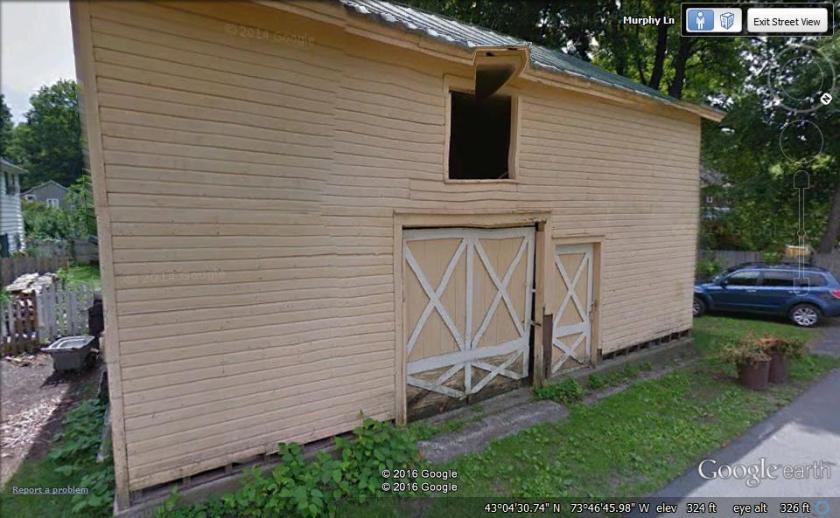
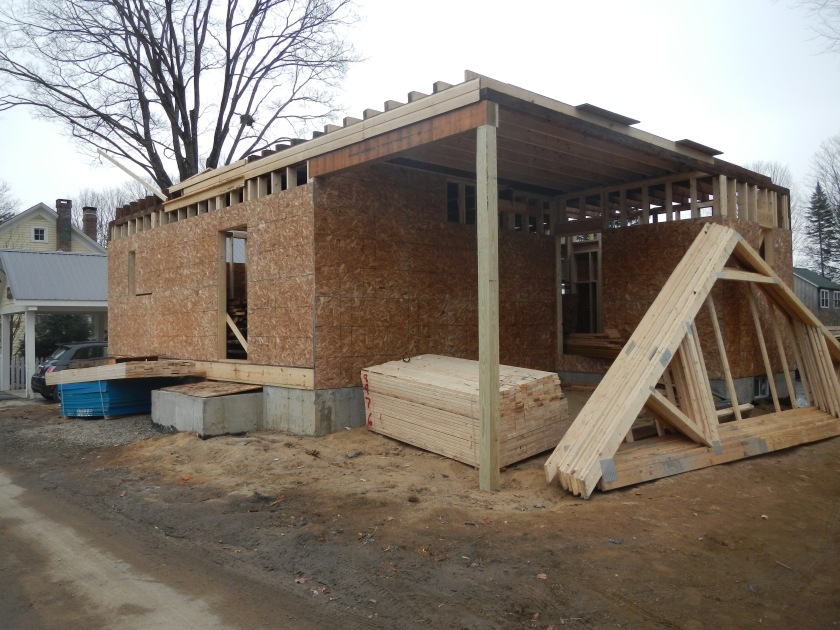
Original HouseNew House (Sans Second Floor)
Jean D’Agostino purchased a small barn built around 1900 on Murphy Lane. Murphy Lane is a narrow alley lined with garages and other secondary structures running parallel to White Street on the east side of the city. D’Agostino proposed rehabbing the structure. In her application she specifically stated that it would be a detriment to the neighborhood to tear the existing building down and to construct a new home.
The barn was on a tiny non-conforming lot so her project required radical variances for setbacks, parking, and the size of the footprint relative on the lot. Her original request for variances passed the ZBA by a narrow four to three vote. A home facing on a narrow alley affects the use of the alley and the character of the neighborhood. Among the variances granted was to allow for onsite parking for only one vehicle rather than the two required. As the building was to be a three bedroom home, where would a second car park? Where would delivery and service vehicles park? Apparently this was not a problem for the four who originally granted the variances.
Subsequently, the building inspector discovered that Ms. D’Agostino, who is a realtor, had removed the slabthe barn had been built on and dug and constructed a full basement. He found that the barn had totally been taken down and that she was constructing a new home and that the height of the home was in violation of zoning laws as she had not sought a variance for it. The result was that he put a stop work order on the house. For a full and detailed account see this post.
There had been an earlier hearing on the stop work order in which the board showed appropriate impatience with Ms D’Agostino. On Tuesday night she returned to the ZBA.
March 21 at the ZBA
The neighbors did an excellent job laying out the issues for the board. They had hired an attorney who was unable to attend so Brian Rodems read a letter from the attorney on behalf of the neighborhood. The attorney’s letter began by noting that this was a clear case of “act now and beg forgiveness later.” She then cited a case in which a ZBA in New York required that the owner tear the building down and that same ZBA won in court when the owner appealed.
The neighbors noted that many of them had not challenged the original application because the barn was quite modest in size and they were led to believe that it was simply going to be rehabbed. They then laid out many reasons why the new home was inappropriate for the parcel. One of the key issues they brought forward was that in excavating the new basement the applicant had built up the land on which the property stood. Additionally, the new foundation rose above the ground. The result is that the new first floor is now four feet higher than the original.
New Elevation Of First Floor
The key thing to understand is that because this structure is built on an alley it now overlooks the backyards of all the properties around it on either side of the alley. The windows on the first floor will look directly into the neighbors’ backyards. Any windows on the second floor will have an even better view. One of the neighbors noted that he has a small pool in his yard where his young daughters swim and he will have to build a very high fence if he wants privacy.
In the subsequent discussion ZBA board members Susan Steer and James Helicke made it very clear that they opposed any further approvals for this project. Not only had the applicant flagrantly failed to live up to the stated plan for the property, but in additionshe had clearly failed to comply with the standards that are required for variances.
In a rather bizarre twist, Keith Kaplan who had opposed the original variances, offered what he called a “compromise” that “might” make approval possible. In a meandering discussion that not only confused the audience but members of the board, he tried to craft a way to help save Ms. D’Agostino. His idea was to try to stay in the footprint of the original barn and then send the project to the Design Review Commission to try to work out some sort of design. He kept talking about clarifying the required external materials. City Planner Susan Bardon cautioned that DRC would need more direction than that so he threw in “mass and scale.”
There ensued another digression over how high the original barn had been and how high the board should allow the new structure to be. Since the barn no longer exists determining its height became problematic. There were a number of ideas put forward and the engineer representing Ms. D’Agostino claimed that she estimated the original to have been twenty-seven feet tall and the new proposed building would be twenty-eight and a half feet tall. There was a confusing discussion as to where to measure the base from given the excavation. The neighbors claimed that the new structure was eight feet taller than the original. Keith Kaplan then arbitrarily chose twenty-eight and a half feet and the usual suspects supported him.
At one point city attorney Tony Izzo tried to help by making what I thought was the most thoughtful suggestion which was to tell the applicant to come back with the best plan they could that would most closely resemble the original barn. This suggestion was lost and the discussion wandered on.
I would note here that this is classic in terms of the problems with the way the ZBA operates. No one, least of all me, argues that the board should behave in an unconstructive and hostile way towards applicants but it is deeply troubling when the board starts working out the applicant’s problems. This ends up investing the board in approving the projects. Tony was absolutely right in suggesting that it was the applicant’s responsibility to, in effect, go back to their original application and to come back with the best they could do to meet their obligations under it. If what they do is inadequate, than the board should vote it down.
The key thing here is that Mr. Kaplan’s ramblings on a solution totally obscured the central question about the project in terms of its effect on the neighborhood. The board, for instance, never addressed the privacy issue or any of a number of other issues put forward by the neighbors relating to the five standards for approving variances.
There is one other central issue. I asked how significant it is that the applicant has violated the terms of their application by demolishing and building a new structure when they clearly stated that they were doing a rehab. It was my understanding that the approval of the variances is conditional on the applicant fulfilling the promises made in their application. I was rather stunned when Mr. Kaplan asserted that he was only concerned with the actual design plans not with the applicant’s description in her application for the variances of what she had told them she intended to do. In effect he dismissed the case law offered by the attorney for the neighbors not to mention common sense.
Chairman Moore then polled the board on Mr. Kaplan’s motion to send the plans to DRC. Skip Carlson and Gary Hasbrouk who had been largely silent during all of this as had Mr. Moore, simply said that if Keith wanted to send it to DRC it was alright with them.
So it now gets thrown to DRC. How they are to assess the design of whatever Ms. D’Agostino comes up with is rather a mystery to me as it seemed to be to Susan Steer, James Helicke, and Cheryl Grey.
A very disheartening night for the neighbors.
Jenny Grey’s Story
Board debates fate of Murphy Lane barn
The 100-year-old barn in the background is being renovated into a shadow of its former self, say the neighbors around 39 Murphy Lane. Photos provided
At 39 Murphy Lane, a 100-year-old barn is being renovated and illegally raised four feet, say city staff and the neighbors.
SARATOGA SPRINGS >> Residents in a Spa City neighborhood say the developer tasked with renovating a 100-year-old barn has deviated too far from the plan to preserve the structure’s historic charm.
Owner and applicant Jean D’Agostino proposed to renovate a the barn situated on a one-third-size lot at 39 Murphy Lane, an alley that runs parallel between Lincoln Avenue and White Street on the East Side. The project was presented as a renovation of an existing barn/carriage house into a single-family residence. The zoning board granted seven area variances for the work, which began under Engineering America Co. engineer Tonya Yasenchak.
“The plan was to return this 100-year-old barn to its original glory,” said Brian Rodems of 84 White St. during public comment at the March 21 zoning board of appeals meeting. “But after being granted variances, the owner tore down the barn. The building going up bears no resemblance to the old one.”
When city Building Inspector Steve Shaw checked out the site, he found that more work had been done than had been approved. He requested a new foundation plan, but said he has not yet received one. Even without that plan, however, he could see the deviation from the originally approved design.
“The plans said the builders would keep the core of the barn as much as possible,” he said. “But the preexisting nonconforming status of the building was being increased.”
The board has had several nonconforming projects to examine recently — projects not being built according to code or to the granted variances from building law. City staff and volunteers, as well as residents, are alert to these deviations and are bringing such issues before the board.
Board member George “Skip” Carlson said, “We have a lot of applicants asking for forgiveness rather than permission. Sooner or later, this board will make someone tear something down.”
Assistant City Attorney Tony Izzo said the impact a nonconforming project made on the neighborhood was the key consideration for the zoning board.
Neighbors near Murphy Lane agreed that the developer had gone far beyond the scope of the project. Essentially, none of the old barn remained — it had been methodically deconstructed and replaced with new materials during the past few months. The entire roof of the barn had been removed, and it sat in a state of arrested development.
Yasenchak said she had come before the board to request approval on revised measurements. These included reduced wall heights and roof pitches.
A group of the neighbors has begun speaking to an attorney in preparation for a lawsuit.
The most disturbing issue for the neighbors is that the new first floor has been built four feet off the ground, leading to a much taller building than permitted.
Cynthia Behan of 70 White St. objected to the new height, which would make the former barn taller than the houses around it. Privacy would be diminished, as anyone on the top floor of the building could see down into all the yards around.
John Behan of 70 White St., her husband, said these changes were not mere modifications.
“You cannot take a historic painting and light it on fire, then say you’re restoring it,” he said. “The formerly granted variances have not been adhered to — you can dismiss them. You have to go on from here.”
Evan Williamson of 18 Clark St. said the deviations from code might seem acceptable on paper, but were not.
“It’s a bait and switch situation,” he said. “It’s an insidious encroachment by people of zeal.”
Blaine Dunn of 74 White St. said, “We want the board to make brave decisions.”
When the zoning board began to debate the issue at its most recent meeting, lines of opinion were sharply drawn. Members James Helicke and Susan Steer, and alternate Cheryl Grey were against allowing the project to proceed.
“I don’t see that we need to drag this out any further,” Helicke said.
He was prepared to vote against the project’s application right then, but the other members wanted more time to weigh the issue. Those others, particularly Vice Chair Keith Kaplan, were largely on the side of compromise: asking D’Agostino to modify some of the building’s dimensions and to use Design Review Commission (DRC) approved materials on the exterior. Most of the members agreed to ask the DRC for an advisory opinion on dimensions and materials.
A vote on sending the project to the DRC then passed 4-3. That board will meet next on April 6 at 7 p.m. in City Hall.
It is late so this is the very short version. The meeting became chaotic and confused. Keith Kaplan wanted to find some way to avoid requiring the project be knocked down. He decided the board should refer the project to the Design Review Committee to some how decide whether something that approximated the original barn could be designed. James Helicke and Susan Steer were terrific. They pointed out that it was a bad project to begin with and that now, with the original barn that was supposed to be rehabbed gone, in violation of what was originally promised in the application, there was no way to salvage what was left. The usual suspects as in Hasbrouck, Carlson, Kaplan, and Moore out voted Helicke, Steer, and Cheryl Grey. It now goes to Design Review for advisement.
SARATOGA SPRINGS >> While pleased about the eminent destruction of an old factory that’s long been an eyesore in their neighborhood, East Side residents on Lake and Granger avenues are expressing concern about the size and scope of the 27 Jumel Place housing development ANW Holdings and Witt Construction have planned to take its place. The proposed project is called Downton Walk. The seven $600,000 to $1.5 million homes there will be built in Tudor style, and their current fate is in the hands of the zoning board of appeals.
John Witt, president of Witt Construction, made several comments on blogger John Kaufmann’s Saratoga Springs Politics, where the development is under hot debate.
“I personally went door to door and spoke with more than 30 people who live within one block of Jumel Place, including on East, Granger and Lake avenues,” Witt wrote. “With very few exceptions, my plans have been positively received. After Downton Walk is constructed and sold, the upgraded neighborhood will enjoy raised property values, benefiting homeowners.”
However, in a Feb. 28 letter to the zoning board of appeals, a core group of neighbors wrote, “This project will negatively impact the value of our homes and the quality of life in our neighborhood.”
Advertisement
The residents have also started a petition, signed by 248 people at press time, asking the zoning board not to grant the applicant’s variances. Variances are requests to deviate from current zoning requirements; the zoning board must study such applications, discuss them and hear public comments before ruling.
Witt wrote, “Downton Walk is a well-conceived project, and will offer residents both privacy and accessibility to the downtown, as well as enhance the neighborhood. Saratoga Springs is thriving, in part because of the beautiful architecture and homes – not just what we are preserving, which is vital, but also those we are currently building, because we also need to protect the future viability of our city as a community where people live full-time, as well as work and visit occasionally for pleasure.”
Unconvinced, the neighbors say they would support a more balanced project with five single-family homes on 30 percent of the land with more standard setbacks — zoning they say should be followed here.
Sam Brewton of Lake Avenue lives in the rear of his building, facing Jumel Place. He stands to be facing an eight-foot-high fence, losing trees and sunlight.
“We neighbors object to the scope of this project,” he said. “We don’t object to the development, just to the proposed density and the high number of requested variances.”
Looking at the project from the ground level: The land-use category of Jumel Place in the city’s 2015 Comprehensive Plan is a Core Residential Neighborhood-1 (CRN-1), allowing a maximum density of 10 units per acre. In the city’s Zoning Ordinance, Jumel Place is located in an Urban Residential-3 (UR-3) Zoning District, which allows for only single and two-family homes to be built. By law, this particular parcel of land is large enough to allow five single-family homes.
Witt Construction’s application describes its proposed development as seven single-family condominiums, which are built as seven separate single-family dwellings.
“Condominiums are not allowed on Jumel Place, as by definition in our Zoning Ordinance, condominiums are multifamily,” wrote the neighbors in their letter. “The city’s Zoning Ordinance states the definition of a condominium as follows: ‘Condominium: A multifamily dwelling containing individually owned dwelling units, wherein the real property title and ownership are vested in an owner, who has an undivided interest with others in the common-usage areas and facilities that serve the development.’”
Sandy Cohen, another concerned neighbor, posted on Saratoga Springs Politics about the Downton Walk project.
“Owners will only be buying the walls and the space within them,” she wrote about the condominium designation. “The land under and around them will be owned by all the homeowners with an undivided interest and managed by a homeowners’ association that they will direct to maintain and care for it – thus the condominium moniker.”
The request for seven single-family homes is 40 percent over the density allowed in an UR-3 Zoning District.
Along with this request, the builder is asking for five variances.
Variance 1: The maximum building coverage allowed on this lot is 30 percent. The applicant had previously asked for a 43.5 percent building coverage allowance, or 45 percent more than what is allowed. He has recently increased this request to 46 percent, or 53.3 percent more than what is allowed.
Variance 2: The rear yard setback required for each unit is 25 feet. The applicant is asking that this requirement be eliminated by 100 percent for five units, going from the 25 feet required to zero feet. For the remaining two units, he is asking for a 76 percent reduction in the rear yard setback from 25 feet to six feet.
Variance 3: The front yard setback required for the two front units is 10 feet. The applicant is asking for one foot, a 90 percent reduction in the front yard setback. The applicant claims that this is so two front porches can be placed on the unit. However, his drawings show that he is not proposing porches, only overhangs.
Variance 4: The fence height allowed in this UR-3 residential area is six feet. The applicant is asking for an eight-foot fence, a 33 percent increase in height over what is allowed.
Variance 5: The applicant is asking for a maximum principal building on one lot to be increased from one to seven, a 600 percent increase. Only five single-family units are allowed by law on this property, after the property is subdivided. There has been no request for subdivision in this case.
Witt wrote that his Jumel Place plan aligned with the city’s goal to infill urban areas, rather than promote sprawl. The zoning allows for four duplexes, for a total of eight units. He is proposing only seven, which he says doesn’t constitute overbuilding.
Cohen wrote on the blog, “Once variances as broad as Witt is requesting have been made for one property, they set precedent, making it much easier for the next builder to make similar changes in their prospective projects. This would mean that any builder would have a much easier time dropping a high-density multifamily development in the middle of just about any existing neighborhood in our city. Yours could be the next one endangered.”
“I am a Saratoga Springs native and lifelong resident, as well as a successful, established small-business owner and employer,” Witt wrote. “I take pride in what we build and in our reputation for excellence.”
The zoning board of appeals will rule on the Downton Walk application at its March 21 meeting at 7 p.m. in City Hall.
In a surprising turn of events I have now learned that the Planning Office never forwarded my emails to Keith Kaplan over the ex parte issue concerning John Witt.
Keith Kaplan emailed me to advise that he never received the emails. He said he had only learned about my request from my blog yesterday. He indicated that had he known he would have responded. He offered no further explanation regarding the ex parte issue but invited me to meet with him to try to clear the matter up. He invited me get together with him on Monday night prior to the ZBA meeting.
I thanked him for his invitation but suggested that in light of the potential ex parte issues, we should delay any meeting until the Witt matter has been resolved.
I leave it to the readers of this blog to come up with their own explanations as to why city planner Susan Barden indicated that she had advised Mr. Kaplan of my request when she had not. The email exchange with Ms. Barden can be accessed by clicking on this link and scrolling down.