This week Saratoga Podcast interviewed former Finance Commissioner Michele Madigan on the proposed 2023 Saratoga Springs city budget. This is a link to the interview.
Author: John Kaufmann
Mayor Kim Takes a Victory Lap for Winning a Pointless Lawsuit

Saratoga Springs Mayor Ron Kim has issued a press release and posted an article on the city’s website announcing his victory in the lawsuit he brought appealing a decision by City Court Judge Jeffrey Wait. Rather than a victory, though, it is simply one more example of a waste of city funds by this administration.
I discussed the Mayor’s appeal in an earlier post.
The original case involved Jeffery Dumont, who had commenced work on a city property he owned without securing a building permit (City of Saratoga Springs v. Church Street Trust).
When the city originally brought its action against Mr. Dumont in Judge Wait’s City Court, Dumont pleaded guilty. The court then gave him a certain amount of time to come into compliance. On January 20, 2022, the court convened again to determine if Mr. Dumont had addressed the code violations, but Mayor Kim had now taken office and had not hired a city attorney. There was no one to represent the city in court. (I discuss the fiasco in a series of earlier posts.) Noting the city’s failure to appear in court, Judge Wait dismissed Dumont’s guilty plea.
Kim appealed Wait’s ruling and the judge who handled Kim’s appeal ruled that Judge Wait did not have the authority to dismiss Dumont’s guilty plea. As a result, the court re-instated Dumont’s guilty plea.
A Waste of Time and Money
The successful appeal that reinstated Dumont’s guilty plea had no material effect on the case. The city had a right to bring back its charges against Dumont anyway. It actually had already done this following Judge Wait’s ruling and before the appeal was decided.
In fact,Dumont and the city’s code enforcement department were before Judge Wait in court several weeks ago. At that hearing, the city asked for an adjournment for sixty days to allow Dumont to come into compliance.
It is important to understand that all of this would have been done whether or not Kim prevailed in his suit. Dumont has not gotten his building permit, and he will not receive it unless he complies with the city’s code. The only thing achieved by this suit is that the taxpayers are out thousands of dollars, and Kim can claim a hollow victory.
This is a prime example of how to waste public money.
$4.2 Million Grant: Good News or Fiscal Time Bomb for the City?

Earlier this year, the Saratoga Springs Public Safety Department applied for a Federal Emergency Management Agency (FEMA) grant for funds for additional firefighters for the city, primarily to staff the new fire station being built on Henning Road. The proposal was to fund sixteen new firefighters for three years. The good news is the application was successful, and FEMA awarded the city $4,154,523.52. The bad news is the city may not actually be able to afford this grant.
The problem with the grant is that the city must maintain all these positions using city money for the two years following the end of the grant.
In addition, as this page from the award letter documents, the grant funding is only for salaries and benefits. Uniforms, training, etc., are not included, so these costs for the 16 new employees will have to come out of the city budget during the years of the grant.
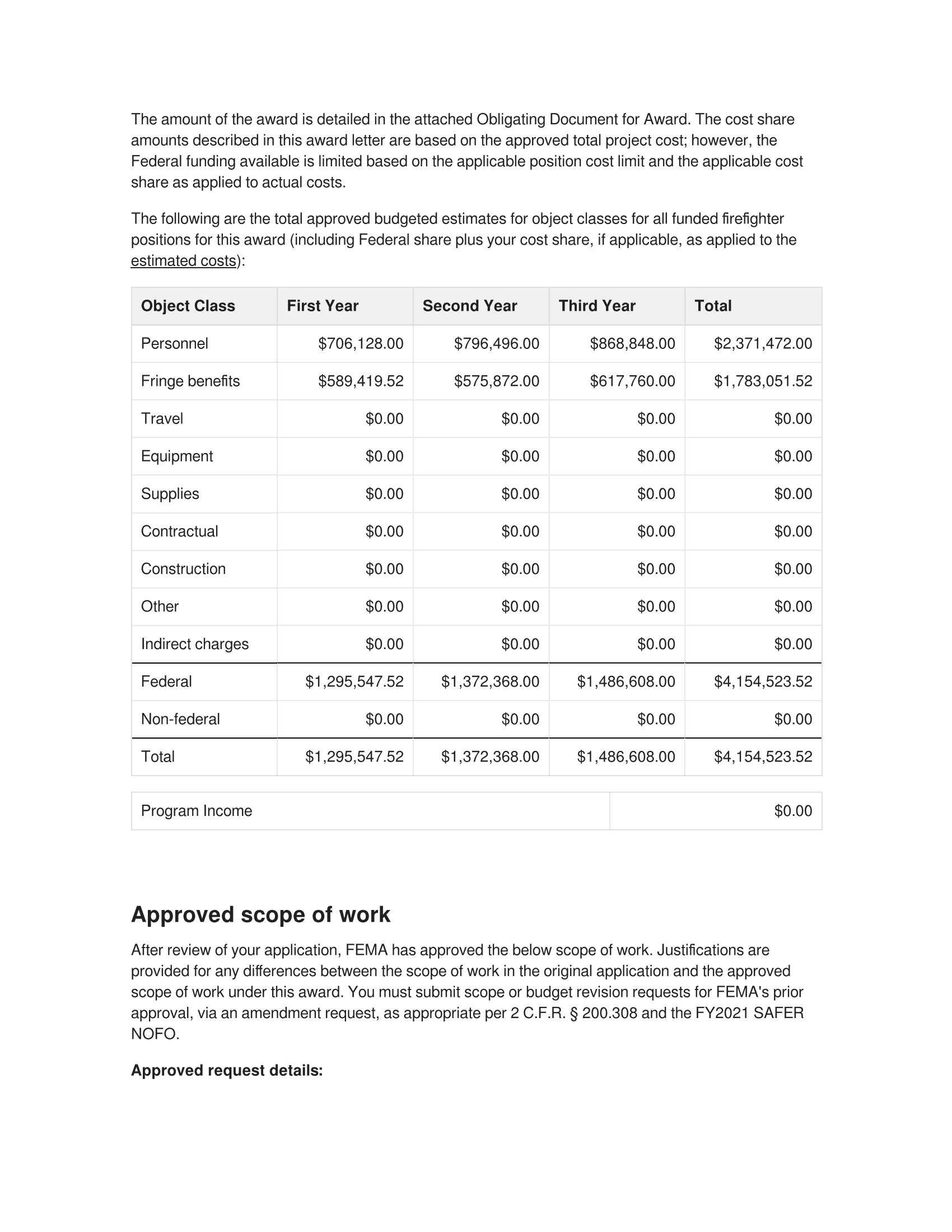
This is a breakdown of salaries:

I am unclear how the grant determined the indicated increased costs for these positions each year, but in the fourth year, the city will be required to pay north of $1,500,000.00 out of its own budget to sustain these positions and, in the following year, more.
These are stunning numbers. Remember, this number only indicates the costs that will have to be added to the budget for the salaries and benefits for the 16 new firefighters. This number does not include the continued associated costs for equipment, uniforms, and training.
How Can This Work?
My experience with the Saratoga Springs Fire Department has been outstanding. We have great men and women working for us who deserve our support. I would like this all to be possible.
I simply do not see, however, how we will be able to maintain all these positions when the grant runs out without draining the resources we will need to provide raises for the existing city employees, maintain the basic services for the city, and protect our A+ bond rating.
To put this in perspective, let’s consider if the city on its own decided to include the salaries and benefits for these 16 positions in the 2023 budget. The city would need to find an additional $1,295,547.52 this year. I would like Commissioner Sanghvi or Commissioner Montagnino to explain how they would find this money. If they can’t, then how would they pay for these positions in three years when the grant runs out?
As former Finance Commissioner Michele Madigan warns: (see her complete remarks below)
Positioning our small city budget to handle the additional $4.15M plus (wages, benefits, and the costs of funding 16 firefighters will increase each year) following the completion of the grant might require no additional new hires for any other department for the foreseeable future. This will leave city taxpayers on the hook for increased costs associated with the hole left in the budget when the SAFER Grant ends…. If there is future planning for this requirement, it has yet to be revealed to the public.
I find it extremely concerning that there has been no discussion regarding how the city will pay for the positions once the grant runs out.
I am willing to have my concerns proved to be baseless. I wrote to Finance Commissioner Minita Sanghvi over a week ago asking how the 2026 budget could absorb these costs. Commissioner Sanghvi has not responded to my inquiry.
Montagnino’s Folly?
Commissioner Montagnino apparently did not consider any of these long-term issues when he sent in the application for the FEMA grant, nor did he bother to consider any of the more fiscally responsible plans Michele Madigan had developed to address the need to staff the new fire station. (see Madigan’s remarks below)
Commissioner Montagnino enjoyed extremely favorable coverage from both print and television media in announcing the grant.
Montagnino responded in the September 22, 2022, Daily Gazette as to how he planned to pay for the position once the grant ran out by lashing out at the previous Council with false allegations.
“Our entire City Council is new — this is our first year in office,” he said. “We inherited a setup where there is no plan for the future. In fact the budget for this year — the 2022 budget — was based on projections that were inaccurate and exaggerated. So, we’re in the process of preparing next year’s budget and are really having to sharpen our pencils to come up with next year’s budget. We’re hoping to have something like a three-year plan worked out in the course of the next year, so we’re not running from one year to the next scrambling for funds.”
Daily Gazette
I don’t know when Commissioner Montagnino will stop blaming the current Council’s problems on the previous administration.
This attack seems particularly hollow. Finance Commissioner Michele Madigan’s ten-year record is exemplary. During her tenure, the city controlled taxes while maintaining city services. She earned the city an A+ bond rating. She was praised by the New York State Comptroller for her management of the city’s finances. She did all this while the city struggled with a devastating fire in city hall and a fiscal crisis precipitated by COVID.
Commissioner Sanghvi has repeatedly credited Ms. Madigan with the strong financial health of the city.
Montagnino’s gratuitous attack that the previous city council did not plan for the future when it adopted the budget for this year is false. It is regrettable that the Daily Gazette did not press Montagnino for the basis of his attack or contact Michele Madigan for a response.
The FEMA grant is not Commissioner Montagnino’s first fiscally irresponsible act. Readers may recall that in his campaign to reduce the current twelve-hour shifts of the police, he negotiated a memorandum of understanding (MOU) with the Saratoga Springs Police Benevolent Association. To get the shift hours reduced, he basically approved a wish list from the PBA. In an earlier post, I explored this agreement. Commissioner Montagnino seems uninterested in the fiscal limits of our city government.
This time Commissioner Sanghvi pushed back, and since June, the proposed MOU seems to have disappeared.
Michele Madigan On Fiscal Planning
[JK: The following is a statement from former Finance Commissioner Michele Madigan regarding the potential long-term impact of the FEMA grant on the city’s finances]
This city has been blessed to have dedicated and knowledgeable staff that I relied upon in doing budgets. Lynn Bachner, the city’s budget director, was especially key, but it required the assistance of the management staff in all the departments. Together we ensured our city’s operations, maintained stable tax rates, and left the city in excellent financial condition after an unpredicted and unpredictable pandemic. Most importantly, essential city services such as police and fire were intact, well-funded, and serving the public throughout the entire economic crisis.
Concern should be reserved for the next city budget that this Council will seek to approve for the taxpayers of Saratoga Springs, as well as the budgets and the state of city finances that will be left beyond its term.
A $4.15M grant is inarguably good news; at issue are the stipulations that come with the grant. This grant, which covers certain costs for 16 new firefighters, comes with the promise that all of these newly hired firefighters must remain for a designated time on the city payroll [JK: two years] following the completion of the grant. If there is future planning for this requirement, it has yet to be revealed to the public. This is “no plan for the future.”
2022 new hires have been extensive; 2023 requested budget new hires, replacements, and upgrades were at an all-time high. Moreover, obligations and processes long since established have been overlooked or ignored.
In the face of the long-awaited third Fire/EMS station, prior administrations presented carefully designed plans to successfully address how and when to staff the fire department within the reality of city finances. I personally worked with prior Fire Chief Robert Williams and the current Fire Chief Joe Dolan, as well as prior Commissioners Mathiesen, Martin, and Dalton, Deputy Commissioners Finneran, Daley, Sharp, and Bachner. The 2022 Budget included funding for 4 new firefighters, and many prior budgets under my administrations included additional firefighters and police. We took public safety and fiscal responsibility seriously.
It follows that, while I understand that the Local Fire Fighters Union has embraced the concept that safety demands 4 firefighters working on each engine for every shift, this may have to be introduced with restraint and discipline in order to be sustainable.
Positioning our small city budget to handle the additional $4.15M plus (wages, benefits, and the costs of funding 16 firefighters will increase each year) following the completion of the grant might require no additional new hires for any other department for the foreseeable future. This will leave city taxpayers on the hook for increased costs associated with the hole left in the budget when the SAFER Grant ends, a concern that Commissioner Sanghvi has raised many times regarding the American Rescue Act (“ARA”) funds that the city received, accepted, and was at much greater liberty to use largely without subsequent stipulations.
As a former Commissioner who understands the challenges of city finances and as a taxpayer with a vested interest in city budgets/tax rates, I wish the current city council much luck in providing the city with a 2023 budget that it can sustain within its financial means.
What Is in the City’s Future?
On Thursday night,10/6/22, the City Council will vote on whether to accept the FEMA grant.
I do not know what the penalties might be if the city were to fail to continue funding the sixteen firefighters following the end of the grant, but I understand they would be extremely harsh. I do not know if it is too late to modify the grant.
Most troubling is Commissioner Sanghvi’s silence on the potential impact of the grant on the future of the city’s finances. As Commissioner of Finance, Sanghvi is supposed to be the fiscal watchdog for our city.
If Michele Madigan’s fears are realized, this city would be facing severe strains on its finances. I find it more than frustrating that none of this is being discussed at the Council table.
Commissioner Moran Doubles Down Effort on Behalf of Problematic Proposal by Liberty Affordable Inc. For Affordable Housing

At the September 20, 2022, Saratoga Springs City Council meeting Accounts Commissioner Dillon Moran made an impassioned appeal in support of a development proposed by Liberty Affordable Inc. to build a large, affordable housing project adjacent to our local casino. Moran proposed that rather than the Planning Board acting as the lead agency in determining compliance with the State Environmental Quality Review Act (SEQR), the City Council should be the lead agency. Moran was unable to muster support for this at that meeting.
According to the latest version of the agenda for the upcoming October 6 Council Meeting, Moran is again requesting that the Council, rather than the Planning Board, act as the lead agency.
In 2015 the Planning Board issued an advisory opinion regarding a similar Liberty Affordable Inc. project for the same parcel. At that time, the members of the Planning Board unanimously opposed the project.
In an earlier article, I explored in detail why the Planning Board opposed the project. Most of those concerns are relevant to the new proposal.
One of the central issues, but by no means the only issue, that prompted the negative vote by the Planning Board was the fact that there was no guarantee that if the city should rezone the parcel to allow for major development, what would be built there would be affordable housing. Once the land is rezoned for greater density, there are no safeguards that would keep high-end commercial and residential structures from being built there instead.
I have written to Commissioner Moran asking two questions.
- What guarantees are there that only affordable housing would be built if the parcel was rezoned? The project is only feasible if Liberty Affordable Inc. can secure the funding. The competition for these funds is intense, and there is no reason to assume that Liberty will win the required funds.
- Why should the Council be the lead agency?
I hope Commissioner Moran will address these concerns, and if he responds, I will post his position.
Statements By the Two Candidates for Saratoga County District Attorney
[JK: I have received statements from the two candidates running for Saratoga County District Attorney. They are Michael Phillips, who is a Democrat, and Karen Heggen, who is the incumbent Republican.]
Michael Phillips (D)

MY CAMPAIGN FOR SARATOGA COUNTY DISTRICT ATTORNEY
Exclusively submitted to Saratoga Springs Politics
I’ve been a lawyer since 1991. My experience is deep—I’ve been on both sides of court as a defense attorney and as a prosecutor, handled cases at the local, state and federal levels and done substantial transactional work and organizational leadership training with GE Energy. I have spent a good part of my career doing the hard work of protecting and defending the rights of everyday, working Americans.
My roots in Saratoga County go back to fishing out of my grandfather’s trailer on the east side of Saratoga Lake as a five-year-old. I now live in the second of two homes I’ve built on the lake. I was an honor graduate of United States Marine boot camp in Parris Island, SC, and learned early in my career the importance of “one standard of justice.” That is some of the personal experience and values I bring to now running for Saratoga County District Attorney. Readers can learn more about me and my campaign at Home – Michael Phillips for Saratoga County DA (phillips4districtattorney.com).
There are several reasons why I have entered this race, not the least of which is the over 50-year lapse of time since there was a race for District Attorney in Saratoga County. If elected officials are not held accountable by the voters, they do not do their jobs, and, in the case of an elected prosecutor, people are not protected. That is what has been happening in Saratoga County, and I am running to change that record.
Example #1 is the predatory, high profile NXIVM cult that sexually abused and trafficked women for years in the towns of Halfmoon and Clifton Park. During that time no investigation or prosecution was pursued by the District Attorney’s office, in which DA Karen Heggen has been employed for more than 25 years. NXIVM operated for 15 years in Saratoga County before the federal government stepped in and prosecuted the group and its leader Keith Raniere, who is now serving a federal sentence of 120 years. My campaign is asking the same question that Federal District Judge Nicholas Garaufis asked; “where were the local prosecutors”? Is it that NXIVM was untouchable because there were backed up by billionaires who are now serving prison terms?
DA Heggen failed to heed the public warnings or investigate what the newspapers saw as suspicious behavior as far back as 2003. The cult’s behavior and treatment of women came into clear focus in 2017 when the national news picked up on a complaint filed at the NYS Department of Health. Sarah Edmondson, an actress and decades-long devoted NXIVM member/victim, came forward to tell her story—she was branded as a sex slave as part of the organization’s initiation process. Even after this, Heggen did nothing.
All of this is documented in a 2021 HBO documentary film, “The Vow”.
Example #2 is the failure of this District Attorney in 2022 to prosecute a repeat pedophile, Jonathan Aronson. Aronson pled guilty in 2012 to a misdemeanor charge of unlawful dealing with a minor. He was arrested again in January of 2022 and charged with felony rape of an 11-year-old child. Arrested on January 5 and out on bail on January 6. The district attorney did not even oppose the bail application proposed by Aronson’s counsel. This case has been lingering in Greenfield Town Court for 10 months with no action by the DA. Why? Could it be because he is connected to wealthy real estate interests in Saratoga Springs?
A prosecutor’s sworn obligation is to prosecute “without fear or favor”. Clearly, this value is not being observed in Saratoga County, but this is what happens when there is no contested race for District Attorney. The job does not get done, and the people are not protected from predators.
I’m 65 years old, so I’m not running for DA to set up a run for Congress or to be a judge somewhere. I’m running to train, build and lead the best District Attorney’s office in New York State for the global destination point of Saratoga County, a community that I grew up in, love and call home. There is no other reason to seek the job. This is our message–to be the best – to live up to the oath and to prosecute “without fear or favor”.
Karen Heggen (R)
DUTY HONOR JUSTICE
Duty, Honor and Justice are the three words contained on the Seal of the Office of the Saratoga County District Attorney’s Office. These are the guiding principles I have followed each day throughout my thirty-year career as a prosecutor.
First, duty encompasses the responsibility to know what is required to be a prosecutor. Over the past 30 years, I worked each day to learn and develop my skills to effectively serve the residents of Saratoga County. When the opportunities opened up, I was proud to have been promoted to handle more challenging and difficult assignments- from a part-time Assistant District Attorney, to the Chief Trial Assistant District Attorney, to First Assistant District Attorney, to Acting District Attorney, and in 2015 taking office as the elected District Attorney. With each new opportunity, I continued to enhance my skills as I handled more and more difficult and complex cases. I have prosecuted all kinds of cases- from vehicle and traffic matters to burglary, robbery, homicide, and kidnapping cases. In my role as the District Attorney, in addition to advising and consulting on cases, I also manage an office of 40 employees and have come in under budget each year. I have added grant funding to support additional employees and re-structured the office units using existing staff to provide training and oversight on the continuing, growing case load. Lastly, the 2019 and 2020 Criminal Justice Reforms brought significant changes to the practice of criminal law in New York State including discovery and bail reform. I have led my office through the significant changes and challenges.
Second, honor reflects the significance of the job of a prosecutor and the importance of doing the right thing each day regarding each case. I have the distinct privilege to lead a team of dedicated prosecutors who collaborate each and every day with the 12 law enforcement agencies in Saratoga County. Our strong working relationship has resulted in our office continuing to maintain a 95% felony conviction rate in County Court. I submit this good work is also reflected in the fact that Saratoga County has the lowest crime rate in the Capital District and one of the lowest crime rates in the State of New York. Honor extends beyond the courtroom and includes community outreach and support. Honor is reflected in our commitment to providing training programs for law enforcement, as well as educational programs in collaboration with not-for-profit and school agencies regarding drug use and abuse, domestic violence prevention and support of victims. I am also honored to serve with several agencies and organizations on their boards.
Lastly, justice is the cornerstone of everything we do as prosecutors. Justice is what each and every prosecutor is called upon to achieve for all affected by the criminal justice system- the crime victims, the community as a whole, and the Defendants. My office actively participates in the Saratoga County Treatment Court where individuals work to address the disease of addiction through hard work and support of the County’s Treatment team. That diversion-based program has successfully graduated over 330 citizens who returned to our community sober and productive individuals.
My professional life has been dedicated and committed to these three principles. I possess the heart, passion, conviction, dedication and commitment to continue to lead my assembled team of experienced prosecutors to continue Saratoga County’s status as one of the safest and most desirable places to live in New York State.
Karen A. Heggen
Saratoga County District Attorney
September 30, 2022
Another Contentious City Council Meeting Exposes Toxic Work Environment in City Hall
The Tuesday, September 20, 2022, Saratoga Springs City Council meeting was full of more contentious behavior on the part of the Mayor and some of the Commissioners. The conflict this time was precipitated by an error made by Council members at the previous meeting on September 6.
As readers will recall, Mayor Ron Kim recently marshaled support from a majority of the Council to move the Director of Risk and Safety out of the Accounts Department and into his own department. Unfortunately, the Mayor failed at the same time to provide for the funds necessary to pay for the position once it was transferred to his office.
Probably as a way to jerk Kim around and to expose the Mayor’s inept handling of the matter, Accounts Commissioner Dillon Moran decided to move the money that was left in his budget from the empty Risk and Safety position to fund other items in his department thus leaving the Risk and Safety position unfunded. As required, he submitted his request to the Finance Department.
At the September 6 City Council meeting Finance Commissioner Minita Sanghvi read out Moran’s reallocation of money request, asking for and receiving Council approval. The vote, in fact, was unanimous. Thus the members of the Council became complicit in Moran’s move, something they quickly came to regret once they discovered later what they had voted for.
It is important to note that Commissioners have traditionally had wide latitude to move money around their own department’s annual budget to address changing needs. While some may criticize Commissioner Moran for this ploy, there was nothing illegal in his actions. Nothing was hidden, although Moran did nothing to alert his colleagues to its implications.
By the September 20 meeting, some Council members had become aware of their involvement in Moran’s move and sought to reverse their vote. True to form, Mayor Kim was outraged over the matter and was quick to claim there had been nefarious goings-on and dramatically suggested a forensic accountant should look into the matter. He was supported in his suspicions by his current ally, Public Safety Commissioner Montagnino, who wanted to know how this could have happened without a Council vote, apparently unaware that there had been a vote and that he had voted yes.
Another Faux Crisis
All of this drama was rooted in a simple oversight. No one in the Finance Department, including the Commissioner, picked up on the problem with Moran’s requested transfer, and no one on the Council spotted it either. It would seem that this Council pays no more attention to budget changes than they have to the consent agenda. Readers should consider also that under the previous administration, City Attorney Vince DeLeonardis enjoyed the trust of the entire Council, and he regularly went through the agenda to make sure everything was correct and in order. I suspect the current Council does not have the current City Attorney, Tony Izzo, fulfill a similar duty.
The whole thing could have been quietly corrected if people of good faith had worked together prior to the meeting to address the problem. Commissioner Moran, in fact, voted with the rest of his colleagues to reverse his budget changes.
This whole business should never have become a major public fight at the Council table.
Commissioner Sanghvi’s Unfortunate Behavior
Earlier this year, Commissioner Sanghvi shared with the Council an incident in her office she found disturbing. Commissioner Moran had sent to the Finance office an envelope containing a shredded warrant that he was challenging. At a City Council meeting Commissioner Sanghvi described to her colleagues on the Council how the member of her staff who opened the envelope experienced this as a source of trauma, and she took Moran to task for being insensitive and upsetting a member of her staff.
Her concern for the feelings of one of her employees in this instance is in sharp contrast to her recent treatment of another member of her staff.
Regrettably, at both the City Council table and in comments made to the media, Commissioner Sanghvi chose to single out and blame one of her employees for not catching Moran’s budget changes even though the changes had also been missed by other Finance Department staff members and the Commissioner herself not to mention every member of the Council. At the Council table, she identified the position in her department the individual she was blaming held. In the case of her comments to the Foothills Business Daily, Sanghvi called out the employee by name.
One would have thought that Sanghvi, given the previous concerns she expressed about Commissioner Moran upsetting a member of her staff by sending an envelope of shredded paper, would have been sensitive to the devastating impact her public blaming and naming of one of her employees would have on that individual. Apparently not.
This is unfortunately another example of incidents we are hearing about that are contributing to what we are told is an increasingly toxic workplace environment in City Hall.
Below is a link from the Saratoga Podcast in which Adam Israel offers a thoughtful critique of Commissioner Sanghvi’s handling of the matter. (Note that apparently Adam was unaware that Sanghvi named the person in the Foothills Business Daily article.) Ms. Sanghvi would do well to listen carefully to Adam’s remarks about leadership and all that that entails in terms of taking responsibility for whatever may happen within an organization. Adam argues that a thoughtful executive recognizes that the buck stops with them and they take responsibility for any errors that occur within the organization they head. They do not subject their subordinates to public embarrassment.
The following are some excerpts from the Council meeting as background.
In this clip, Commissioner Montagnino piles on after the Mayor alleges some sort of impropriety by asking how this happened. He is, of course, oblivious to the fact that he had voted to approve the problematic transfer.
The mayor characterizes the transfer as “mysterious.”
Kim wants to hire a forensic accountant to do an investigation.
Commissioner Golub points out that this issue was the result of a minor oversight and pushes back that nothing that could be characterized as serious was involved.
A Deeply Troubling Liberty Affordable Inc. Workforce Housing Proposal Is Back in Play
On September 6, 2022, the Saratoga Springs City Council voted unanimously to send to the Planning Board a proposal from Liberty Affordable Inc. to build workforce housing on a plot of land on the corner of Crescent Avenue and Jefferson Street. This plan is very similar to the one Liberty put forward in 2018 which was unanimously rejected by the Saratoga Springs Planning Board for numerous reasons including the inability of Liberty to guarantee that only workforce housing would be built on the lot.
Now Liberty is back with a modestly revised proposal, which closely follows the 2018 plan. Their new plan involves building two structures that will hold 200 units (the 2018 proposal was for 192) that will include studios and one- and two-bedrooms apartments. According to the developer, their target population would qualify if their income range was between $45,000.00 and $84,000.00. The rents, the developer proposes, would range from $900.00 to $1,650.00 per month.
Similar to the 2018 proposal, Liberty’s selling point is that it will provide workforce housing, and similar to the 2018 proposal, actually making this housing affordable is dependent on getting federal support. The proposal will also require rezoning the parcel from RR (rural residential) to UR-4 (urban residential), a change not only in the allowed density but also in the kinds of uses permitted on the property which would be allowed whether or not the workforce project ever gets built.
At the September 6, 2022, meeting, Accounts Commissioner Dillon Moran moved that the city refer the latest version from Liberty to the Planning Board and that it makes the Council the lead agency for the State Environmental Quality Review rather than the Planning Board.
Finance Commissioner Minita Sanghvi expressed concern about the city being the lead agency in light of the fact that Commissioner Moran appeared to be sponsoring the proposal.
Mayor Kim expressed concern that the proposal probably required that the city’s Comprehensive Plan be revised before the change in zoning could be considered. The city’s comp plan currently designates the area as consistent with rural residential similar to the greenbelt although the property is not actually in the greenbelt.
A friendly amendment removed the language that would have made the Council the lead agency for now.
In light of the fact that the previous effort by Liberty resulted in a unanimous opinion opposing the project, one might have expected the current Council to ask the developer to address those earlier objections before moving the project on again so quickly to the Planning Board. That was not the case.
The Guerrilla In The Room
Whatever the reader may think about what tradeoffs the city should consider in order to expand workforce/affordable housing, there is a fundamental problem with this Liberty proposal that helped kill it in 2018 and that remains today.
In 2018, the developer was unable to provide a formal assurance that if granted the required land use regulation relief, the project would actually happen. No matter what good faith the developer may have, the project was then and is now dependent on federal and state money grants and tax incentives in order to succeed. These grants are highly competitive, and it is impossible to predict whether the principals will succeed in securing the critical money.
The city is being asked to approve the land use changes in terms of rezoning prior to knowing if the money to do the project will be forthcoming. If it is not, the land if rezoned could be used for all kinds of high-end homes and commercial uses such as hotels allowed under UR-4.
Sustainable Saratoga has a long history of advocating for affordable housing in the city. In a thoughtful letter to the City Council, though, they documented this and other problems with the proposal and asked that the Council put off action referring the project to the Planning Board “with merit” until these issues could be considered. They wrote:
Second, while Liberty may intend to apply for federal funding for affordable housing if they are granted the requested zoning amendment, there is no guarantee that they will receive such funding. If the project does not receive federal funding, the zoning change to UR-4 would allow the property to be developed in any manner permitted in that zone. By amending the zoning the city loses its ability to control development on that parcel. It cannot rescind the zoning change if the applicant fails to obtain federal funding, or make the change conditional on the developer obtaining federal funding for affordable housing. Once the parcel is rezoned, if the applicant does not receive the affordable housing grants it seeks, the parcel likely will be developed to its most financially lucrative potential within UR-4 parameters.
While I appreciate Commissioner Moran’s and the other Council members’ passionate advocacy for diverse housing as expressed at the September 6, 2022, Council meeting, it is critical that such passion be tempered by a sober and rigorous assessment of the full implications of this development proposal.
Unless Liberty can provide iron-clad proof that only affordable housing will be built, why refer this project to the Planning Board for further consideration when in the end without that guarantee it will open up yet another parcel in the city to more high end/tourist related development.
A Covenant
I’m told that one of the ways to address the issue of assuring this project would indeed produce workforce housing and not higher end housing or commercial development would be by placing a covenant on the deed that would require that only affordable housing would be allowed on the property.
If the project failed to secure funding, or should it go into bankruptcy, the owner of the property would be unable to build anything else there should such a covenant exist. The problem is affordable housing is only viable for a private for-profit developer if its construction is heavily subsidized by the government. No one is going to privately finance such a project. It is unlikely that a reasonable businessperson would put themselves in the position of owning land they potentially could not build on by agreeing to such a covenant.
Digging Into The Issues
I urge the readers of this blog to take the time to read Sustainable Saratoga’s email to the Council that is included in its entirety below. It addresses many other issues concerning the Liberty proposal and argues there are better ways to address the city’s affordable housing needs. In addition, I have included excerpts from the Planning Board meeting that considered the Liberty proposal in 2018. The comments made by members of the Planning Board are still relevant today.
Email From Sustainable Saratoga To The City Council
September 1, 2022
Dear Mayor Kim and Commissioners:
We are writing this letter to express concern about the Liberty Affordable Housing, Inc. application for a zoning amendment for a 30.27 acre parcel on the corner of Crescent Avenue and Jefferson Street.
As you may know, Sustainable Saratoga has long advocated for workforce housing in Saratoga Springs. We encourage the Council to develop a comprehensive, proactive, and creative strategy to meet the housing diversity and affordability needs of our community, and would be happy to work with the Council toward this goal. For years, Sustainable Saratoga has recommended workable alternatives, such as inclusionary zoning and the conversion of carriage houses into apartments. We also vigorously support development patterns in our city that conform to the established sustainable development principles embodied in our city’s Comprehensive Plan. We do not believe that these goals are mutually exclusive.
We have reviewed the application for a zoning amendment filed by Liberty, as well as a similar 2018 application for a zoning amendment and subsequent unfavorable advisory by the city Planning Board, and believe that the current application is flawed both procedurally and substantively. The Council should, at the outset, require the applicant to address the procedural flaws before accepting the application through a vote on “merit for review,” at least until the significant procedural errors are rectified.
There are two major procedural errors. First, the petition falsely states that the map amendment is compatible with the 2015 Comprehensive Plan. It also states that the proposed Urban Residential-4 (UR-4) zoning is consistent with the adopted Comprehensive Plan. However, page 55 of the 2015 Comprehensive Plan states that all zoning must conform to the uses and density requirements set forth in the Future Land Use Map. When areas are to be rezoned, the uses and densities permitted within the zoning district must be compatible with the ranges presented in that land use category in the Comprehensive Plan. The property is clearly designated as Residential Neighborhood-1 on page 65 of the Future Use Land Map. Such zoning allows a maximum density of 3.5 units per acre. The proposed UR-4 zoning, which has a maximum density of 14.5 units per acre, is not compatible with the Comprehensive Plan. Therefore, a request to amend the Comprehensive Plan map must accompany the application. No such request accompanied the Liberty petition.
Second, the SEQRA form attached to the rezoning petition fails to analyze the full set of uses that are permitted under UR-4 zoning. If the City Council were to rezone this 30-acre parcel to UR-4, many other uses in addition to housing would be permitted. These include private schools, hotels (20 rooms or less), lodging houses, adult care facilities, children’s homes, community centers, day care facilities, churches, social clubs, shelters, rooming houses, and other uses not permitted in the existing zone, as well as higher density residential units. The SEQRA form needs to evaluate the potential environmental impacts from the full list of uses allowed by the UR-4 zoning, not just for a housing development. The SEQRA form needs to be amended to address that omission.
Because of these two procedural errors, specifically, the failure to include a request to amend the Comprehensive Plan map and the incomplete SEQRA assessment, the application should not be advanced through a “merit for review” vote.
In addition to the procedural flaws, we also have concerns about the Liberty zoning amendment application on substantive grounds.
Our first substantive concern about the application is that the City Council does not have the authority to specify that only affordable housing can be built on the property if it is rezoned to UR-4. To try to do so would constitute “contract zoning”, which is not permitted by state law. The City Council is being asked to rezone the property, hoping that it will be developed as affordable housing but, in reality, opening this parcel to any UR-4 development. If the applicant fails to obtain federal or state funding for affordable housing or abandons the project for another reason, the UR-4 zoning would allow the applicant to sell or use the property for any of the other UR-4 uses allowed by the Unified Development Ordinance. Although a restrictive deed could perhaps restrict the property for use only as affordable housing, no such deed has been proposed by Liberty.
Second, while Liberty may intend to apply for federal funding for affordable housing if they are granted the requested zoning amendment, there is no guarantee that they will receive such funding. If the project does not receive federal funding, the zoning change to UR-4 would allow the property to be developed in any manner permitted in that zone. By amending the zoning the city loses its ability to control development on that parcel. It cannot rescind the zoning change if the applicant fails to obtain federal funding, or make the change conditional on the developer obtaining federal funding for affordable housing. Once the parcel is rezoned, if the applicant does not receive the affordable housing grants it seeks, the parcel likely will be developed to its most financially lucrative potential within UR-4 parameters.
Third, the allowable densities proposed in the amendment are inconsistent with the development of much of the surrounding area. The project parcel’s current zoning designation allows primarily for the development of low-density, single-family residential neighborhoods, applying conservation design standards. The parcel is adjacent to the city’s Greenbelt and to forested state parkland. While large multi-story apartment buildings might be appropriate in one of our downtown Transect zones, they are inappropriate on this site, which is adjacent to lower intensity development and which contains significant protected wetlands.
Finally, the Liberty application is not compatible with the city’s existing land use policy. This is a proposal for Comprehensive Plan and UDO amendments to accommodate a single incompatible use. Saratoga Springs’ current Comprehensive Plan was created through a long collaborative effort by a large committee appointed by the City Council. The planning process spanned many months and included substantial public participation. Changes to the Comprehensive Plan should only be made through the same process, involving the entire community in a comprehensive look at the future development of the entire city. Amendments to the Comprehensive Plan should be made sparingly and judiciously, and not for the purpose of promoting a single application.
Looking at the bigger picture, we strongly believe there are better ways to address the city’s affordable housing needs than the apartment complex proposed by Liberty. Large developments dedicated exclusively to “workforce housing” have the undesirable consequence of segregating the city by income, rather than integrating such housing into existing neighborhoods and new mixed-income developments. That said, we are willing to consider supporting less diverse housing projects that help address this major need but only if they are in a location that’s consistent with the Comprehensive Plan’s “city in the country” vision that is responsible for so much of this City’s success and uniqueness.
We hope the City Council will carefully review this proposal and consider the broader implications of the proposed amendments.
Thank you for considering our comments.
Sincerely,
Dianna Goodwin, Co-Chair Laura Rappaport, Co-Chair
Lew Benton On the Proposed Grant Writer and the City Charter
[A guest post by past Public Safety Commissioner Lew Benton]
It seems to me that every candidate for a city council seat and certainly every mayor and commissioner elect should do a few things.
First and foremost, they must read and become fully familiar with the City Charter. Not too much to ask, is it? After all the current City Charter is brief, concise and written in simple, easily understood language.
I note this because your September post included a discussion and comments on the the new “Grant Coordinator” title included in the 2022 Finance Department budget at a salary of $68,000.
As I understand, the Finance Commissioner, while agreeing there is a “ … need for more support with grant writing”, elected instead to hire an executive assistant. It is unclear from your post if the funding of the grant coordinator title is still in the budget or if those monies were transferred to the executive assistant line. Of course that would require budget amendment and thus easily answered.
All of this begs the question: If the need for a grant coordinator in Finance was deemed so necessary why was the title not filled? Which begs another, more fundamental, question: Why was a grant coordinator considered – whatever that is – so essential when, by Charter law, the City already has two departments, Planning and Economic Development and Parks, Open Lands and Historic Preservation, whose duties specifically require grant preparation and management.
And then, the most fundamental question: Did the then council review the required grant writing and grant administration responsibilities of Planning and Parks, Open Lands and Historic Preservation before it established the new title in the 2022 Finance budget.
The Charter is abundantly clear. In Title 3, Sections 3.3.6, 3.3.7, and 3.5.5 (see below) the role of each department is enumerated.
3.3.6
Grants. The Administrator of Parks, Open Lands, and Historic Preservation shall, with approval of the Council, seek out and apply for private and public grants for the purposes and benefit of the system.
3.3.7
Bond and grant allocation. The Administrator of Parks, Open Lands, and Historic Preservation shall make recommendations to the Council regarding use of proceeds from bonds for park, open lands, or historic preservation purposes or from state, federal, or private grants for such purposes.
3.5.5
Grant and loan applications. The Office of Planning and Economic Development shall manage and coordinate application for grants and loans for all City departments, and shall assist in the identification of grant opportunities and the preparation of applications. (My emphasis)
Attention must be drawn to the Charter requirement that it is the Planning Department that shall manage and coordinate application for grants and loans for all City departments. NOT Finance.
Vesting this function with Planning and its staff is (was) logical and typical at the county and municipal level. Planning should have the resources, experience and knowledge to identify and apply for state and federal grants-in-aid to address community needs (housing, infrastructure, recreation, open space preservation, transportation, etc.)
Planning has three full time planners on staff with aggregate salaries of over $220,000 plus benefits. The administrator of Parks, Open Lands and Historic Preservation shares office space with Planning staff. Her salary is $75,000 plus benefits. It is these staff members who are charged with identifying, preparing and administering the city’s grant-in-aids.
These two departments also can (should) draw on other resources, including the city engineer, and the Recreation Department and Office of Community Development staff in developing applications for infrastructure and associated program aids.
Past Activities and Suggested Actions
When the Parks, Recreation and Historic Preservation department was first staffed it progressed an ambitious grant program. In the first two years (2008 & 2009) the department prepared several successful grants-in-aid including a state Environmental Protection Fund application to fund improvements to Waterfront Park, an application to NYS DEC to fund the city’s Urban Forestry Plan, sidewalk repairs, an application to Saratoga County to fund acquisition of the city’s Blue Way Trail head and, most notably, federal aid to build the Spring Run Trail.
These awards totaled in the $500,000 plus neighborhood. So, logically, I assume that the last city council – which authorized a new grant coordinator title in Finance – and the current council have reviewed the grant activities of the two departments charged since 2010 to identify what grants have been sought, their relative success and process of identifying grants-in-aids that address city needs and that are consistent with the city’s strategic plan.
Perhaps such grant histories can be found in Planning’s and Park’s respective Annual Reports.
Certainly the city should, if it has not, been preparing a least one state Environmental Protection Fund Grant every year or every other year, making sure that appropriate and eligible transportation improvement are included in the Capital District Transportation Committee’s Transportation Improvement Plan, et al.
Unless and until this is done and with the clear understanding of City Charter mandates and awareness of the major investment in existing staff already responsible for grants-in-aid, it seems premature at best to add staff to a third department to do what is already required of Planning and Parks, Recreation and Historic Preservation.
09/13/2022
Commissioner Moran Proposes Requirement for Design Review Board Approval of Temporary Outdoor Dining Venues
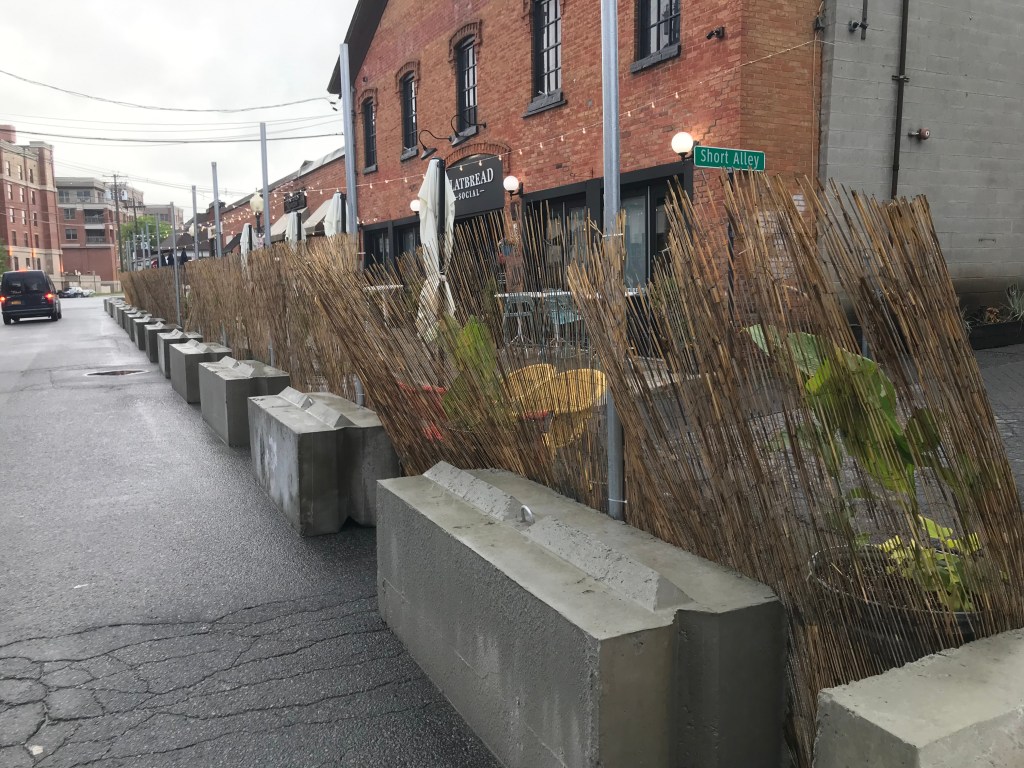
A proposal brought before the Saratoga Springs City Council by Accounts Commissioner Dillon Moran at the Council’s September 6th meeting would require all temporary outdoor dining areas to be subject to review and approval by the city’s Design Review Board.
This amendment to the City Code would provide more vigorous oversight to protect the esthetics of Saratoga’s historic downtown.
“It is important that as we adjust to our new normal, we also continue to support the Saratoga Springs Brand and all it stands for. Toward that end, as promised when we first rolled out our new outdoor dining program, the second season would introduce the DRB oversight so that Outdoor Dining and our long standing Sidewalk Cafe programs are in alignment. This legislation will do exactly that.”
Commissioner Moran
A public hearing on the amendment has been scheduled for the next City Council meeting on September 20.
 Saratoga Springs Politics