Scoring Points Against MicheleMadigan: An Exercise In The Absurd

Michele Madigan and Larry Bulman, candidates for Democratic State Committee representatives from the 113th Assembly District which includes Saratoga Springs, have been knocked off the ballot after their petitions were challenged by a group of insurgents. Saratoga County Democratic chair Todd Kerner had asked Madigan and Bullman to run for these positions. Challengers circulated petitions for Minita Sanghvi and Patrick Nelson who will now appear on the fall ballot and win these now uncontested seats.

What makes this story so bizarre is what being a New York State Committee member represents.  These people gather for conventions biannually to anoint whomever the institutional leadership of the party has selected.   If you go on line and search for the NYSDC party platform, nothing comes up.  If you go to the website of the NYSDC you will not find it.  You will find a series of platitudes under the category “What We Stand For.”

To appreciate how bad it is try the following:

  1. The Wikipedia entry for the New York State Democratic Committee just lists the current and previous chairs of the committee.  There is virtually nothing else in the article about the committee because……there is nothing else to say.


  1. There is also the video of the recent convention which is an homage to Governor Cuomo.   It represents the kind of sound bites passing for substance that most of us abhor.

Cynthia Nixon is challenging Governor Cuomo in the September primary.  While Ms. Nixon visited the May Democratic State convention, she was not allowed to address the delegates.  Cuomo received 95% of the votes at the convention.  Has that old Soviet Politburo feel.

Basically, Democratic Committee members who attend the convention are extras in a well orchestrated show.

Why do people attend?  Basically, it is a good place to network.  If you are interested in jobs in Albany or for running for higher office in New York or Washington, this is a place to develop contacts.  This is a place to try to get business as well.

It is not as though this group can be reformed.  Aside from the anointment of pre-selected candidates, it really doesn’t do anything.  There are a variety of reputable reform groups in the state like Common Cause, the New York State Public Interest Research Group, etc.  Nobody serious about reform goes there.

My wife, Jane Weihe, was chair person of the city Democratic Committee for many years and briefly served on the state committee.  The experience was brief because  she resigned because the experience represented everything she hated about the worst elements of American politics.

So why would anyone spend time on this?


The successful candidates for the State Democratic Committee were Minita Sanghvi and Patrick Nelson.


Dr. Sanghvi is a professor in the Management and Business Department at Skidmore College.  Her specialty is “Political Marketing.”  Her dissertation was titled “Marketing the female politician: An exploration of gender, appearance and power.”

Dr. Sanghvi was on the previous Charter Review Commission chaired by Skidmore professor Robert Turner.  This blog has extensively covered the very troubling advertising campaign waged by that commission.  At the risk of snarkiness, one wonders whether Dr. Sanghvi simply ignored the ugly and often false claims put out in the literature of the group or whether she actually helped craft it.

Patrick F. Nelson was the campaign manager for the unsuccessful campaign of Mike Derrick running against Elise Stefanik in the 21st Congressional District  in 2016.  Most recently he was one of five finalist candidates competing  for the Democratic Party line to challenge Stefanik this year.  Of the five, he received the fewest votes in the primary (9.21% as compared to the winner, Tedra Cobb with 56.53%).

The insurgents put a great deal of effort into their campaign to elect their state committee members.  They gathered probably a thousand signatures as compared to the petitions carried by the members of the Saratoga County Democratic Committee who got only a fraction of what the insurgents gathered.  This reflects the fact that traditionally this is a pro forma process that attracts little interest.


Most interesting was the fact that the insurgents went down to the County Board of Elections and went through the petitions of their opponents’ challenging signatures.  This is a laborious process.  It is not as though they were looking for or found fraud.  What they found were illegible signatures and signatures of people who signed both groups’ petitions.

Bear in mind that this group sees itself as forward thinking progressives.  I have been involved in a number of campaigns over the years and have always opposed challenging opponents petitions based on technical problems.  My attitude has always been to let the voters decide.  Not so with this group, they were going for the throat.


So why expend all this energy?  Because Michele Madigan was one of the two candidates for State Committee.

I went down to the Board of Elections to look at this insurgent group’s petitions.  It was instructive to see who carried these petitions.

From the previous Charter Commission were:

Ann Bullock

Gordon Boyd

Robert Turner

Laura Chodos

B.J. Keramati

In addition there were supporters of the last charter change proposal who were active on social media:

Patti Morrison

Dillon Moran

Holly Schwartz

Eddy Abraham

And other active charter change proponents Bill and Peter McTygue along with Joanne Yepsen

Former charter commission treasurer Gordon Boyd  circulated petitions for Sanghvi and Nelson although he is not a registered Democrat.  He was able to circulate a petition because election law allows a notary public to circulate a petition for a party position without being a member of the party.  Why, one would one ask, though,  would someone who is no  longer a Democrat bother to circulate a petition for Democratic State Committee positions?


Kevin Madigan, Michele Madigan’s husband,  has been the representative of the 19th district to the Saratoga Springs Democratic Committee.  His petition was thrown out in a challenge submitted by Rita Fornbush.  A number of signatures were disqualified because the people who signed Mr. Madigan’s petition also signed the petition for his challengers.   His challengers were Marie Fontain and Steve Bederian.

Interestingly, neither Bederian nor Fontain actually circulated petitions for this district although they did get petitions for the insurgent NYS Democratic Committee candidates.  Kathleen Harder circulated the petitions for them.  She also circulated petitions for the NYS Democratic Committee challengers.

I am sorry to say it but this is an example of the worst kind of politics.

The challenging of Kevin Madigan would make sense if it was part of a broader challenge to the Democratic Committee members who opposed the previous charter change proposal.  This would have at least had some substance.  The fact is that he was not the only member of the committee that opposed the proposed charter change but he was the only one challenged.


What is truly stunning was that these people would go out in the heat of summer and spend hours  getting signatures over a pathetically symbolic position i.e. New York State Democratic Committee member.  As someone who has circulated petitions, it is not easy to get signatures.  Why waste that time and energy just to keep Michele Madigan off the State Committee?   What was accomplished?  It is a testament to the pettiness and banality of this group .  This is why people hate poitics.


An Exploration of FOIL Re: Digital Ballots

As the readers of this blog know, Saratoga County has denied repeated FOIL requests from professor Robert Turner for the digital images of ballots from the last election.  According to the Gazette Newspaper, the New York State Department of State Committee on Open Government issued an opinion that argued that these images are covered under FOIL.  I contacted Mr. Freeman and he sent me a copy of his opinion.  I thought reviewing this opinion might help the readers of this blog to better understand FOIL (Freedom of Information Law).

Robert Freeman is the executive director of the New York State Department of State Committee on Open Government.  In February of 2014 he issued an opinion regarding whether the digital images of election ballots were accessible to the public under the Freedom of Information Law.  In his letter he affirmed that they were.

I summarize his major points here.  For those not familiar with FOIL his letter offers some insight into the law.

He states:

“First, FOIL is expansive in scope, for it pertains to all government agency records.”

He notes the very broad interpretation of what is a record:

“Section 86(4) of that statute defines the term record to include ‘any information kept, held, filed, produced or reproduced by, with or for an agency or the state legislature, in any physical form whatsoever…’” 

Under this broad definition he asserts that ballot images held by the county boards of elections constitute “records.”

He notes that the concept of FOIL is “…based on a presumption of access. “  This means that the onus of proving that records are not accessible falls on the holder of the records.  There are exceptions to FOIL and the custodian of the records must prove that one of these exceptions pertains to those records in order to deny access to them.  These exceptions are listed in §87(2) of the FOIL law.

Mr. Freeman then asserts that the digital images do not fall under any of the exceptions.

At the time he was writing this opinion he was addressing the denial by Putnam County of their ballot images.  According to his letter, Putnam County denied the records based on section §87(2)(a) of FOIL in conjunction with §3-222 of the Election Law.  Section 87(2)(a) states that in order to deny access to the item it must be “…specifically exempted from disclosure by state or federal statute”

Mr. Freeman rejected the assertion that the ballot images were exempt asserting that “…there is nothing in the language of subdivision (1) of §3-222 [JK: Election Law] specifying that electronic images of ballots cast are confidential or “exempted from disclosure.”

To emphasize this point he noted that the Court of Appeals [JK: The highest court in New York] and the federal courts must, in order to assert records are “confidential” or “exempted from disclosure by statute”, document that the law pertaining to the records has clear and specific language that states this.

Both the Court of Appeals and federal courts have determined that the characterization of records as “confidential” or “exempted from disclosure by statute” must be based on statutory language that specifically confers or requires confidentiality.

Freeman writes:

“In short, to be “exempted from disclosure by statute,” both state and federal courts have determined that a statute must leave no discretion to an agency: it must withhold such records.”

 He notes that election law states that:

‘”Voted ballots shall be preserved for two years after such election and the packages thereof may be opened and the contents examined only upon order of a court or judge of competent jurisdiction…”’

As such the actual ballots are exempt from the FOIL law.  The important point here is that the law makes no such condition regarding the “images” of these ballots.  They are therefore available under FOIL.

It’s Freeman’s Opinion But The Courts Have Not Resolved The Issue

Mr. Freeman and his office are not, however, the final arbiters of what is FOILable.  It is the courts of New York who, in the end, decide the issue.

I would have preferred that Saratoga County had used Freeman’s opinion and released the images of the ballots.  Essex County is being sued over this same issue.  The plaintiffs won their initial suit in court but Essex County has filed notice of their intent to appeal the decision to the New York State Court of Appeals.  Legally, the county is fully within its rights to deny Robert Turner’s FOIL request until such time as the Court of Appeals rules on the case.

One never knows how courts will rule but based on Mr. Freeman’s extensive knowledge and long history, it is reasonable to be optimistic.


Wesley Health Care Center Found Wanting By Medicare

Medicare maintains a website that publishes their assessments of nursing homes.  Currently an assessment of the Wesley Health Care Center is not very flattering.

Their overall rating gets two stars out of five which Medicare characterizes as below average.  The result of health inspections gets two stars out of five for a below average rating.  Their staffing gets three stars which is considered average.  Their quality measures gets three stars for average.   

This is a link to the Medicare page: https://www.medicare.gov/nursinghomecompare/results.html#loc=12866&lat=43.0964412&lng=-73.7242486


Another Big One May Go Up On Broadway

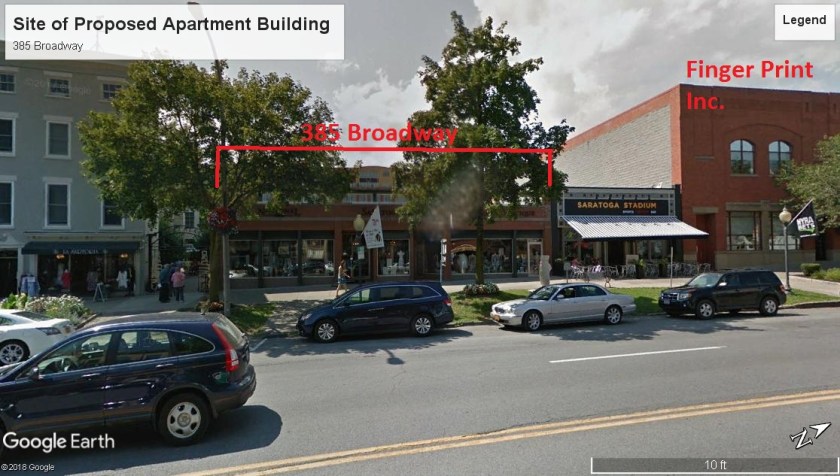
385Broadway

Peter Rosecrans and Burns Management have plans to construct a building with 72 apartments and retail space at 385 Broadway.  The building will have five floors and will have 117,000 square feet.  We are back to the micro –apartment concept.  There would be 26 ranging in size from 520 to 660 square feet.  The other units would range in size from 800 to 1,500 square feet.  These would have one and two bedrooms.  Rents would start in the $1,250.00 per month range.  The project is projected to cost about $20,000,000.00. 

This is the same firm that is developing a 105 apartment complex at Excelsior Park.   

Tom Newkirk of Saratoga National Golf Course fame owns the property which he purchased in 2011 for $2,000,000.00.

The developer claims the building will have a gym, fiber optic internet, and possibly a doorman.

He is quoted in the Albany Business Journal as saying, “It is exciting, but there is complexity to this.  It is kind of like building a ship in a bottle.” 

He is working with Phinney Design Group.

He hopes to have the existing building down by February.

 Missing from the Albany Business Review article was where he expected all these people to park.


City Proceeds With Lake Avenue Bike Lanes

At their Monday, July 2,  meeting, the City Council voted to initiate an engineering study for the bike lanes for Lake Avenue.  A dozen people addressed the Council at the hearing that preceded the vote.  All spoke in support of the plan.  The city voted to accept a grant for up to $50,000.00 for a survey, an engineering study, and installation of bike-lane signage from the New York State Department of Transportation. According to the Gazette  Commissioner of Public Safety Peter Martin said the bike lanes could happen next year.


Public Safety Commissioner Martin Responds On Lake Avenue Bike Lane Plans

I received a response from Public Safety Commissioner Peter Martin regarding Chris Mathiesen’s letter expressing reservations about the Lake Avenue bike lane proposal..

The full text is below but I want to offer some observations on his emails.

Commissioner Martin makes a very compelling argument rejecting Mathiesen’s recommendation about an alternative bike route.  Commissioner Martin asserts that a study done on bike usage shows that Lake Avenue is one of the most actively used roads as regards bike traffic.  It seems more than reasonable to assume that bike riders will continue to ride the full length of Lake Avenue even if a safer route along Caroline or York Avenue were available.  If the goal of the bike lane is not only to encourage bike riding but more importantly, to make bike riding safer, it is important to make Lake Avenue as safe as possible.

In fact, Mr. Martin references a study done by Creighton Manning in 2016 that stated that “…adding  5’ bike lanes to Lake Avenue…. would provide traffic calming which will also provide a more pedestrian friendly environment.”

Commissioner Martin also asserts that very few parking spaces will be lost by implementing his plan.  He observes that currently people park along the Eastside Recreational Fields in a haphazard manner and that he is working with the school system that manages the fields to create a more efficient parking pattern.  This could minimize the impact of the lost parking spaces.

Still, while it is regrettable to inconvenience some home owners in removing their on-street parking, Martin points out that all these homes have driveways. In the interest of pursuing the public good, it can be argued that the change would be worth it.

Commissioner Mathiesen’s critique pointed out that Lake Avenue has a narrow stretch.  Mr. Mathiesen explained in his letter that the city’s employee who dealt with traffic control, was concerned about the impact of increasing this constriction by adding two five foot bike lanes to this stretch.   Commissioner Martin did a power point presentation at the last City Council meeting.  In one of the graphics shown this problematic stretch has some lines superimposed on the image indicating where Lake Avenue might be widened by a future road project.  In his follow up email me he simply offers that this will be an area that may need additional work in the future.  While I would have preferred something more thought out, I am willing to accept that if this bottle neck ends up being a problem that the city will invest whatever may be necessary to rectify it in the future.

I applaud Commissioner Martin’s efforts to expand and improve the city’s bike trail system.

I am putting a link to the power point presentation he did for the City Council meeting.  The images show a rendering of the bike lanes along sections of Lake Avenue.  There is also a map documenting the intensity of bike use on the streets of our city.

Unfortunately, if the readers of this blog do not have power point installed on their computer, they will not be able to view the graphics.  I asked Commissioner Martin to provide me with the images of  Lake Avenue and the map of bike use intensity so that I could post them on my site to make them accessible to more of my readers .  I was quite troubled by his response.  He declined my request on the basis that the renderings are tentative and are subject to change once the engineering studies are done.  As you will read in his email, he believed that in order to understand their tentative nature, the graphics had to be presented as part of his power point presentation. 

Power Point Presentation

This excess of caution probably reflects his career as a lawyer.  I think he badly underestimates the readers of this blog.  The graphics include large lettering stating on each image that they are “drafts.”  The substance of his emails also make clear that the bike lanes as proposed are subject to change as the project matures.

One other note, in a joint letter that appeared in the Saratogian today, Sunday, Todd Shimkus who is the executive director of the Chamber of Commerce and Art Holmberg who is the president of Sustainable Saratoga endorsed the Lake Avenue bike lane project.


From: Peter Martin [peter.martin@saratoga-springs.org]
Sent: Thursday, June 28, 2018 8:42 PM
To: John Kaufmann
Subject: Re: Follow up
Attachments: Lake Avenue Bike Lanes Revised 4.pptx

Dear John,
I was traveling on vacation when I saw your first e-mail.  Please pardon the delayed response.  I have attached a power-point which I presented at our most recent city council meeting.
I have reviewed the Reader’s View submitted by Chris Mathiesen, my predecessor as Public Safety Commissioner and was struck by two things:
1.        Every fact that he states is honest and correct; and
2.        His conclusions are flawed because he missed several additional pertinent facts and the analysis of several national experts in this area.
Let me start by stating that Chris Mathiesen is a friend and I respect many of his
accomplishments as he served our city, both on the city zoning board (where he served as chairperson) and on the city council.  This does not mean that I agree with every position that he took in his many years of City service and, specifically, I disagree with his conclusions that resulted in the failure to improve the safety of our City by striping Lake Avenue with Bike Lanes.

I have spoken with many residents who live on and near Lake Avenue, as well as many
residents who travel to the schools, churches, and recreation field on that street.  There is no unanimous choice about whether to mark bike lanes on this street, although the large majority of those who have spoken to me, support marked bike lanes here.  This majority includes many residents who currently ride on Lake Avenue on their bicycles – both adults and children.  As explained in my presentation, the attached slide titled “Current Bicycle Traffic . . .” is a STRAVA heat map representing the number of riders who use GPS for their bike trips.  By this measure, Lake Avenue is one of the most heavily traveled bike routes in Saratoga Springs.  In addition to recreational through-riders, I have spoken with students who ride to practice at the Rec. Fields and adults who commute on Lake Ave. to work.  There is, today, a bike-safety issue on Lake Avenue and the proposed bike lanes address this issue.
Many of the residents who have spoken to me about Lake Avenue note the number of large trucks that use that rode as well as the perceived speed with which many vehicles travel.  I agree that both present a challenge to safety as the road is currently marked.  This challenge affects pedestrians crossing Lake Avenue and other drivers as well as bicyclists traveling along the street.  National studies show that designated bike lanes help calm traffic and direct vehicles to the travel lanes, away from pedestrians and cyclists.   In 2016, the Department of Public Safety commissioned a report titled “Pedestrian Safety Audit and Recommendations”, which was prepared by two engineering firms, Creighton Manning and Alta Planning and Design.  In pertinent part, this report recommended “adding  5’ bike lanes to Lake Ave.  This would provide
traffic calming which will also provide a more pedestrian friendly environment.”
It should be noted that only a portion of the parking along Lake Avenue would be lost to
accommodate the bike lanes.  Although we are working with concept drawings until we
commission and receive engineered scaled drawings, we do not anticipate losing parking
between Regent St. and East Ave., and only one side of the street parking between East Ave and Ritchie Place.  The aforementioned Pedestrian Safety Audit states : ” It may require the park’s (East Side Rec’s) parking to be restructured though, in order to accommodate the loss of on street parking.”  This is most certainly an appropriate time to work on improved safety for parking at the East Side Rec because the Saratoga Springs City School District just approved funding for their Great Outdoors Project, which includes significant enhancements to the East Side Rec.  Adding legal, safe parking along the northwestern corner of the East Side Rec. should be possible and would be a very positive improvement.  We expect that improved bike accessability throughout Saratoga Springs will reduce the automobile traffic that is the subject of so many complaints.
In his opinion piece, Mr. Mathiesen suggested that bike lanes could be added to smaller side streets rather than Lake Avenue.  This is not practical for several reasons.  First, many of the recommended streets are not wide enough to support bike lanes.  Also, they cross other major streets at points that are not as well marked, or that lack traffic signals which protect bikers.

Further, bikers, like pedestrians, frequently choose to take the shortest distance between two points, and inconvenient bike routes will not cause them to change their travel patterns.

We will engage surveyors and engineers to design bike lanes on Lake Avenue that improve the safety  for all who travel along this heavily used street.  In my power-point presentation, I included  two pictures from Madison Avenue in Albany, which is State Route 20.  It has been reported that those bike lanes, which were controversial when first proposed, are heavily used by bikers and enjoy great popularity.

John, these proposed bike lanes are just one of several Complete Street accommodations that can improve the lives, the health and the safety of our residents and guests in Saratoga Springs.

Accommodations for alternative modes of transportation are necessary for the success of our city in the 21st century.

Peter R. Martin
Commissioner of Public Safety
City of Saratoga Springs
_____________________________________
City Hall, 474 Broadway
Saratoga Springs, NY 12866
Phone: (518) 587-3550 ext. 2627
Email: peter.martin@saratoga-springs.org
_____________________________________


From: Peter Martin <peter.martin@saratoga-springs.org> Date: June 29, 2018 at 2:40:12 PM EDT To: John Kaufmann <john.kaufmann21@gmail.com> Subject: Re: Follow up

Dear John,

The overhead street photos that were incorporated in the power-point presentation represent a concept drawing only.  They are marked draft because we expect that the final engineered drawings will have some differences.  I would prefer that they only be presented as part of the powerpoint, because they should not be interpreted as final plans.  The engineer who prepared these concept drawings has informed me that Lake Ave can support safety improvements for bike riders from Regent eastward past the Eastside Rec. and St. Clements Church.  The exact location of bike lanes and transitions at the East Side Rec. may take one configuration initially, and then be revised if the city and the school district improve the parking situation along the narrower stretch  that you have asked about.  I will request engineered reports that provide alternatives that can further enhance pedestrian and bicycle safety along Lake Ave. over time.

One additional thought about the alternatives on side streets.  As I previously mentioned, crossing a major intersection from a side street is more dangerous than crossing at a signaled intersection along a major thoroughfare.  Further, side streets like York do not connect many of the popular destinations that Lake connects.  Bicyclists would then be left to unmarked streets to reach these popular destinations (e.g. Lake Ave. Elementary).

I hope that the council and the citizens embrace this proposal as good start to the advantages of complete streets in Saratoga Springs.

Thank you for your interest in this proposal.

Peter


Peter R. Martin Commissioner of Public Safety City of Saratoga Springs _____________________________________ City Hall, 474 Broadway Saratoga Springs, NY 12866 Phone: (518) 587-3550 ext. 2627 Email: peter.martin@saratoga-springs.org _____________________________________


From: “John Kaufmann” <john.kaufmann21@gmail.com> To: “Peter Martin” <peter.martin@saratoga-springs.org> Cc: “Meg Kelly” <meg.kelly@saratoga-springs.org>, “Skip Sciroco” <skip.scirocco@saratoga-springs.org>, “Michele Madigan” <michele.madigan@saratoga-springs.org>, “John Franck” <johnfranck@your-cpas.com> Sent: Friday, June 29, 2018 7:34:04 AM Subject: RE: Follow up

Thank you for your very thoughtful response.  I do have one question.

Mr. Mathiesen expressed concern about the narrow section of Lake Avenue as a problem.  As I read your map, you identify this as a possible area for what appears to be widening of the street to address this issue.  I have no idea as to the cost or other potential obstacles to doing this but as I understand your plan, the striping would be done prior to any project to widen the street.  Could you offer your thoughts about this particular concern.

As  I understand it, Mr. Mathiesen does not envisage the bike lanes along the alternate route he proposes as exclusive but rather he sees them as “sharrows” which would mitigate the issue of limited space.  Still, I take your point that people will see Lake Avenue as the fastest route and tend to continue to use it.

Also, I would like to post the map and the images of the roads that appeared in your power point presentation.  Would it be possible to get a copy of these images?

My plan is to post the text of your email along with the pictures should you make them available on my site with little in the way of comment by me.  As I understand it, the council will be voting on the plan at the next meeting so I would like to get the post up as soon as possible.  Please advise me at your earliest convenience as to the availability of the images.  If they are not available I will post your comments immediately.

Again, thank you for your long and thoughtful email.


Bob Turner, Gordon Boyd, and Jeff Altamari Decline Invitation To Meet With The Charter Review Commission

A sub-committee of the Charter Review Commission invited Bob Turner, Gordon Boyd, and Jeff Altamari to meet with them and offer their views.

In emails to them,  Ms. Bush, the executive assistant to Vince DeLeonardi,s who is both the City Attorney and the chair of the new charter commission, asked them to come “…to discuss your experience with previous Charter efforts and the current review.”

The email asked them to offer some possible dates when they could meet .

Mr. Boyd and Mr. Altamari responded that their schedules were such that they would be unable to participate.  Mr. Turner’s terse email simply stated that he declined to meet.

I FOILed for the associated documents.  Here is a link to Ms. Bush’s invitations and their responses.  FOIL Re BoydAltamariTurner


Preet Bharara’s Podcasts: Extraordinarily Well Done

Recently I was introduced to the podcasts of Preet Bharara.  Mr. Bharara was the Federal Attorney whose jurisdiction included New York.  His podcasts begin with him answering questions submitted by listeners.  The shows then continue with an interview on some area of law and social policy.

I have been gently criticized by friends for the length of many of my posts.  The criticism is not without merit.  I expect I could be clearer and more concise.  Nevertheless, my interest is to explore more fully than the general media, issues that I view as more complex.  Not to compare myself with Mr. Bharara, what I like about his podcasts is that they  take on the complexity of their subject matter.

One of my pet peeves is the ease with which people who are not attorneys decide the merits of cases based on newspaper accounts or on their own reading of a particular statute.  Often people read these laws through the lens of their personal interest.  They may miss the possibility of other ways to read the text.  They also are often unaware of other statutes that may bear on their case and conflict with their interpretation of it.

Mr. Bharara’s podcasts represent a great resource for understanding important public policies in light of both the strengths and weaknesses of our legal system.  I highly recommend them.

The show is called “Stay Tuned With Preet.”  This is a link to one of the media sites that carries his show.  Link to podcasts


Mathiesen Cautions On Bike Lane Plans For Lake Avenue

TruckCorridor
The truck route that Dr. Mathiesen wanted but was rebuffed by Wilton.  The bright red line identifies Loudon Road.  The purple line is Weibel Avenue.


AlternateRoute1
The alternate bike route that Dr. Mathiesen recommends for consideration.  Lake Avenue is the main thoroughfare cutting across the middle of this image.  The bike lane would run along the North side of Lake Avenue starting at Richie.  It would start past the problematic area on Lake.

Public policies that appear on their face to be “no brainers” often turn out to be far more complex than first appears.  Such is the case with the proposed dedicated bike lanes for Lake Avenue.  In a very thoughtful letter to the editor in the Saratogian, past Commissioner of Public Safety, Chris Mathiesen, cautions against the currently proposed plan. 

In his letter he make reference to a “bike sharrow.”  This is a “non dedicated” bike lane.  It is marked in a way to advise drivers of the potential presence of people on bikes.  It also shows people on bikes the best area to ride in.  This is in contrast to the more rigorous “dedicated” bike lane where no other activity such as parking or cars is  allowed..

I emailed the current Commissioner of Public Safety, Peter Martin, seeking his assessment of Chris’s concerns.  To date I have not heard from him.  If or when I do, I will post his response.


Lake Avenue Bike Lanes

During 2017, the section of Lake Avenue east of East Avenue was re-paved. The Public Safety Department is responsible for striping the traffic lanes and a request was made that the striping be done in such a way that would allow for dedicated bike lanes between St. Clement’s and East Avenue.  Traffic regulations consultant and Public Safety Garage foreman Mark Benacquista met with me on site to discuss his options before starting the striping project.

After my discussions with Mark and after going door to door to determine the neighborhood opinions on the traffic and parking regulation changes that would be necessary for bike lanes, I decided that bike lanes should not be placed on that section of Lake Avenue. The factors that I had to consider included the irregular width of the street which is quite narrow in certain areas and the requirement that, without expensive widening of the street, bike lanes  would make necessary the elimination of on-street parking on the north side of Lake Avenue from St. Clements to East Avenue.  There is a heavy demand for parking due to East Side Rec activities.  While some neighbors were in favor of bike lanes despite the loss of parking, others were opposed.  Ultimately, I felt that it was not fair to take away on-street parking from residents and business people who had enjoyed this privilege for many years and to place heavier parking burdens on narrow adjacent streets such as Ritchie Place, Forest Avenue and Pinewood Avenue.

Our department also determined that a bike sharrow would not be a safe alternative because of the heavy tractor-trailer use on Lake Avenue which also serves as state Route 29. It was suggested that Caroline Street might be a safer and more workable alternative for bike traffic.  I also suggested that sharrows on York Avenue from Ritchie Place to Circular Street and ultimately through an alley and on to the major bike trail on High Rock Avenue should be considered.  Hopefully, these and other alternatives can be considered.  Nearly everyone would like to see better accommodations for bicycles.

It should also be noted that the truck traffic on Lake Avenue exists because of the decision of the Town of Wilton not allow trucks from Route 29 to use a small portion of Weibel Avenue and Route 50. The Route 29 truck route for traffic going west to east is posted to avoid Lake Avenue but instead to proceed out the Arterial to the Loudon Road ramp and then on to Weibel Avenue.  Unfortunately, truck traffic going east to west on Route 29 cannot follow a similar route without Wilton’s cooperation.

Mark Benacquista has recently retired after 29 years with the Department of Public Safety. During my tenure as Commissioner (2012-17), I found Mark to be a great source of information on traffic regulations as well as an effective and knowledgeable manager of the Public Safety garage.  He also advised the City’s Planning Department and land use boards.  Many thanks to Mark Benacquista.

Christian E. Mathiesen

Death of Worker At Belmont Exposes Unconscionable Conditions At Racetrack

In its June 23rd edition, the New York Times reported  that a worker at Belmont Park Racetrack died from hantavirus.  The illness is typically contracted by “inhaling air contaminated with rodent droppings in confined spaces, or, in rare cases, via a bite”

The New York Racing Association runs Belmont as well as the Saratoga racetrack.  NYRA had been taken over by the state and more recently re-established as a private organization.  The conditions described in the article in which the mostly immigrant workers live are appalling.  Inspectors from the New York State Department of Health ordered that 32  workers be moved from  existing housing due to “dangerous conditions”.

Here are several quotes from the article:

“Drawn by the feasts of horse oats and refuse, rats often pass unimpeded from the barns through holes visible in the sides of the cinder-block dorms and small clapboard shacks where the workers live, according to workers who reside there. Rooms are often shared, and many are squalid, with mattresses or pallets on the floor, some with punched-out windows covered by cardboard. The workers asked not to be named because they feared reprisal for criticizing the facility, which is state-owned and operated by the racing association.”

And

“One worker, who said he has lived in the barracks on the racetrack grounds for 20 years, showed a reporter the roughly 10-by-12-foot room he shares with another man: Blotches of blood from crushed bedbugs stained the walls. Next to a pillow was a can of repellent with which his roommate sleeps.”

A spokesman for NYRA told the New York Times that they were working on addressing the problems.  The question is how did they allow these conditions to develop and to continue for years.

Link to NYT article