
Under Saratoga Springs Finance Commissioner Minita Sanghvi, the city has continually run deficits with no apparent concern from the Commissioner or warning to the Council until this October, when the hole she had been digging for her four years in office could no longer be hidden.
The city’s 2024 financial audit revealed even more weaknesses in Sanghvi’s management of the city’s finances. What is particularly embarrassing is that some of the “exceptions” (mismanaged items) that were cited in the 2023 audit were never corrected. The 2024 audit should have been available to the public no later than November 1, according to the city’s charter. As these criticisms would have been quite damaging had they been revealed before she was elected Supervisor, it was convenient for Sanghvi that she missed the required date and only showed the public the audit after the election.
In addition, her 2026 budget continues her pattern of overestimating revenues and underestimating expenses to create the illusion of a balanced budget.
Her promotion of “Participatory Budgeting” (PB) in the face of these deficits is also problematic. These budget items result from individuals and groups submitting funding proposals. As the excerpts later in this post show, she initially claimed that, to produce a “realistic” budget, she had eliminated Participatory Budgeting along with her other cuts.
As it turns out, she reneged on this promise.
Laudable as the projects proposed for funding are, it is a legitimate question to ask: in light of the city’s other needs and the documented problems with her previous budgets, how confident can we be that the financial condition of the city can support the critical programs of the city, let alone participatory budgeting projects? It is interesting how focused Sanghvi is on PB and how oblivious she appears to be regarding the intricate details that comprise the rest of the city budget.
An Utter Failure To Control Costs During Sanghvi’s Tenure As Commissioner Places the City’s Finances On Edge
In October, Commissioner Sanghvi announced that the city was financially in a hole. She called for draconian cuts, yet she dismissed raising taxes above the 2% cap set by the state to address the shortfall.
As reported previously on this blog, this involved zeroing out funds for the homeless, the senior citizens’ center, and the money to pay crossing guards to protect schoolchildren, among other items. Only after Mayor Safford, Public Works Commissioner Chuck Marshall, and Public Safety Commissioner Tim Coll pushed back and insisted on raising more taxes to support these programs did Sanghvi agree to restore the non-profit funding.
This shocking revelation should be no surprise in hindsight. In fact, Sanghvi has been running deficits for years without any apparent concern that would have required her to deliver stern warnings to her colleagues on the Council about the need to restrain spending or raise taxes.
As just one example, readers may recall that this blogger expressed alarm about accepting a grant to pay for 16 firefighters for 3 years, which would require the city to maintain these positions for another 2 years.
Making matters worse, former Mayor Ron Kim negotiated a memorandum of understanding (MOU) with the firefighters’ union that requires the city to continue paying these firefighters in perpetuity, as the MOU commits the city to maintain four-person crews on engines. Kim had been urged by the city’s labor lawyer to include a sunset clause, but Kim ignored this warning, and the then-sitting Council, including Sanghvi, approved the agreement.
The cost of these additional firefighters to the city is well over $1.5 million a year. Here is a link to an earlier published blog piece.
There is a strong argument that, for safety reasons, having four fighters on a truck is a good policy. On the other hand, the cost for this is onerous. The cities of Troy and Schenectady use three on a truck because of the enormous expense. Michele Madigan, who preceded Sanghvi as Finance Commissioner, strongly supported the smaller crews given the cost.
Sanghvi ignored these concerns and, as Finance Commissioner, helped pass the MOU. Sanghvi assured her colleagues and the public that she could set aside sufficient funds to handle this. This was the kind of magical thinking that has marked her terms as Commissioner.
Sanghvi’s Unenviable Legacy Of Deficit Spending:
For The Year Ending December 31, 2023, The City Ran A Deficit Of $3,501,005.00

For The Year Ending December 31, 2024, The City Ran A Deficit Of $1,732,851.00.

For The Current Year (2025), Sanghvi Estimated The Deficit Will Be Approximately $3,500,000.00
Sanghvi continues to overspend. This number will not be final until the books are closed, but one of Sanghvi’s emails projected a loss of $3,500,000.00 that will have to be covered by the city’s dwindling reserves.
Sanghvi Overestimates City’s Financial Reserves
As Sanghvi has been continually dipping into the city’s reserves to cover the deficits she has been running, it is particularly concerning that the auditors have warned that Sanghvi overestimated the unassigned fund balance (reserves) at the end of 2024 by $1,000,000.00.
This year is not over. The exact numbers will not be available until the books are closed and the 2025 audit is completed.
The Participatory Budgeting Conundrum
In light of the city’s emerging financial difficulties, Sanghvi’s zealous advocacy for participatory budgeting reflects the arbitrariness of her decisions.
In this clip from the November 14, 2024, budget workshop, Sanghvi assures Public Safety Commissioner Tim Coll that, in light of the city’s fiscal problems, she is removing the funding for Participatory Budgeting.
Sanghvi’s attempt to spin away from her earlier commitment.
I am sympathetic to the ideas put forward by the community for Participatory Budgeting.
The problem is that, given Commissioner Sanghvi’s record of arbitrary decisions and her unwillingness to be granular in analyzing and prioritizing the city’s finances, I have no confidence in her 2026 budget. Only after the auditors have met publicly with this year’s or next year’s incoming Council to discuss the city’s finances and after incoming Commissioner of Finance JoAnne Kiernan, who has worked as a certified public accountant, has been able to go through the books, should the city decide on the viability of continuing Sanghvi’s PB program.

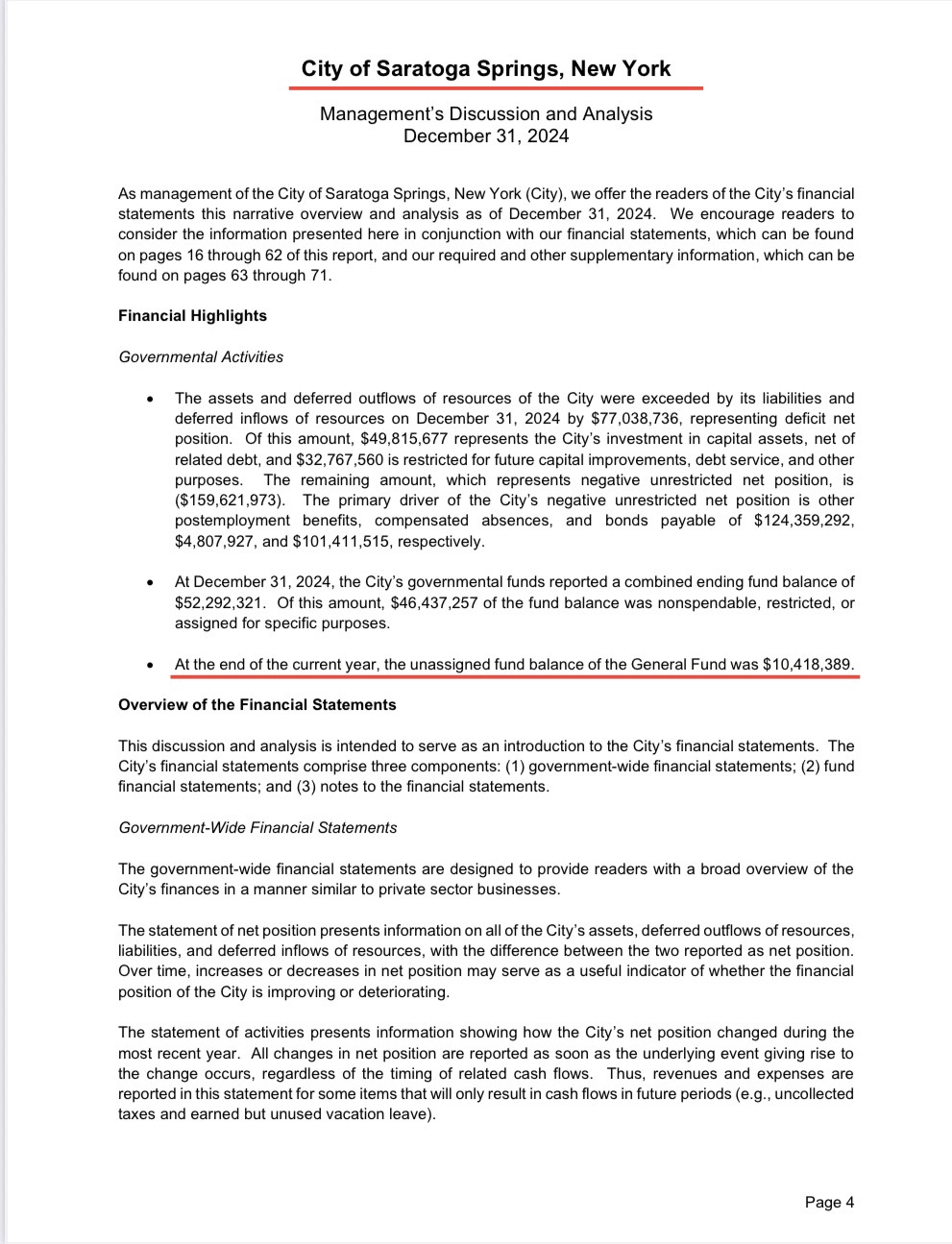
The Auditor’s Report For 2024
This is the complete audit.
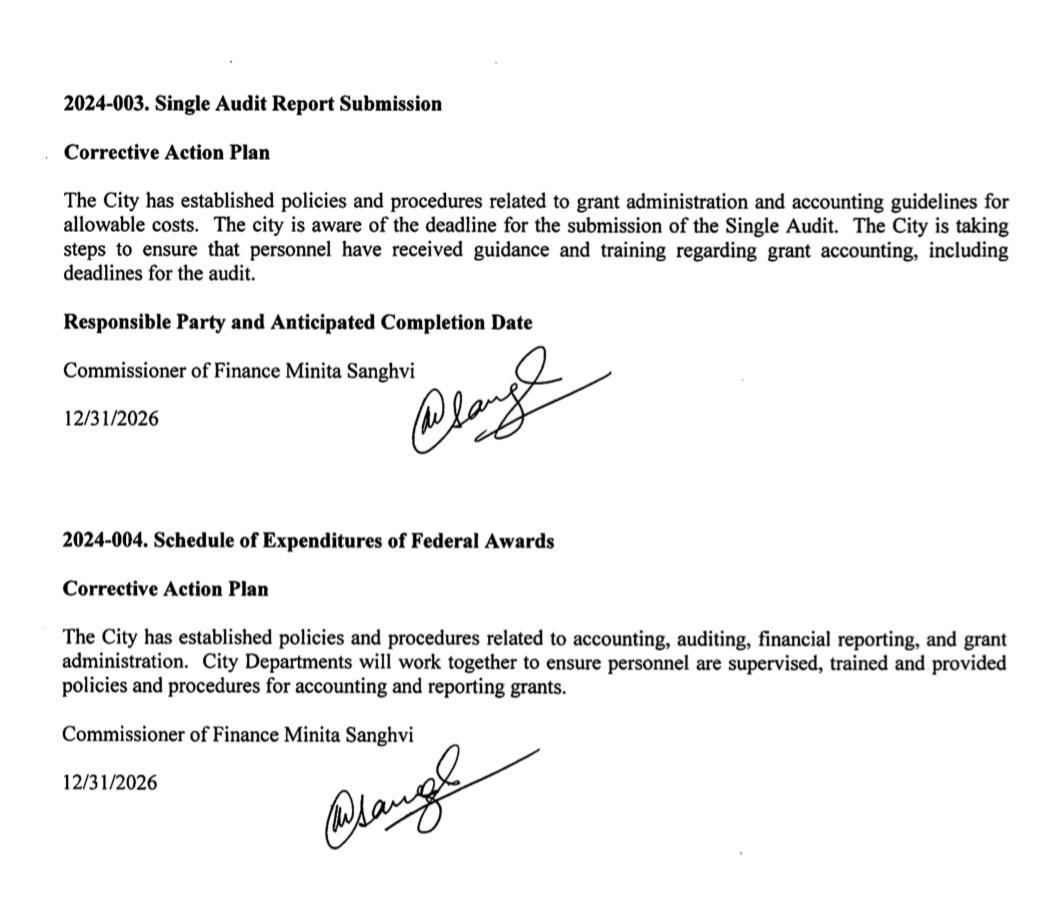
This is an excerpt from the auditor’s findings, which include two items identified in 2023 that remain unresolved a year later.

These are Sanghvi’s assurances that they will be fixed. Note that some of them project the fix date as 12/31/2026, meaning it will be her successor who will have to clean up her mess.

 Saratoga Springs Politics
Participatory Budgeting would be a nice way of involving the community in funding decisions for elective programs if the City had excess funds available to spend. Saratoga Springs has had very tight finances annually with numerous important budget requests from all five departments being denied annually by the Commissioner of Finance. It’s ironic that those requests were denied while the Commissioner’s pet program continued for four years.
The federal SAFER Grant cushions the City for three years from the financial impact of having to hire 16 firefighters. After that, the City has to find the funds on its own. It is a major impact on the City’s finances.
The staffing increase for the Fire/EMS Department became necessary as the City opened the third station on Henning Road which, for the first time, made possible adequate response times for the entire City. The original plan was to have one engine in each of the three stations staffed with three firefighters. While four-man engines are the ideal, it was thought that having three engines with three firefighters each was an improvement in coverage over the long-standing scheme of having only two engines, each with four firefighters. Having engines with three firefighters would have required hiring four additional firefighters rather than sixteen as the third station became operational.
The firefighters insisted all along that engines should be only staffed with four firefighters in order to meet the standards of their profession. They were not wrong. That is the standard. However, hiring sixteen new firefighters rather than only four was at one time considered to be an insurmountable obstacle to having the much needed third station.
In my opinion, Mayor Kim and the rest of the Council at the time were not wrong when they committed to four- man engines. However, they could have been more forthcoming about the impact on City taxpayers while promoting the improvements in public safety realized by this expansion of service.
Chris Mathiesen
LikeLike