Saratoga Springs City Attorneys David Harper and Tony Izzo issued an opinion regarding the resolution that established the city’s on-call pay policy for Deputies. At the pre-agenda meeting February 5, Accounts Commissioner Dillon Moran contemptuously dismissed the opinion with extensive, rambling, and caustic declarations. Finance Commissioner Minita Sanghvi was also critical.
The Opinion
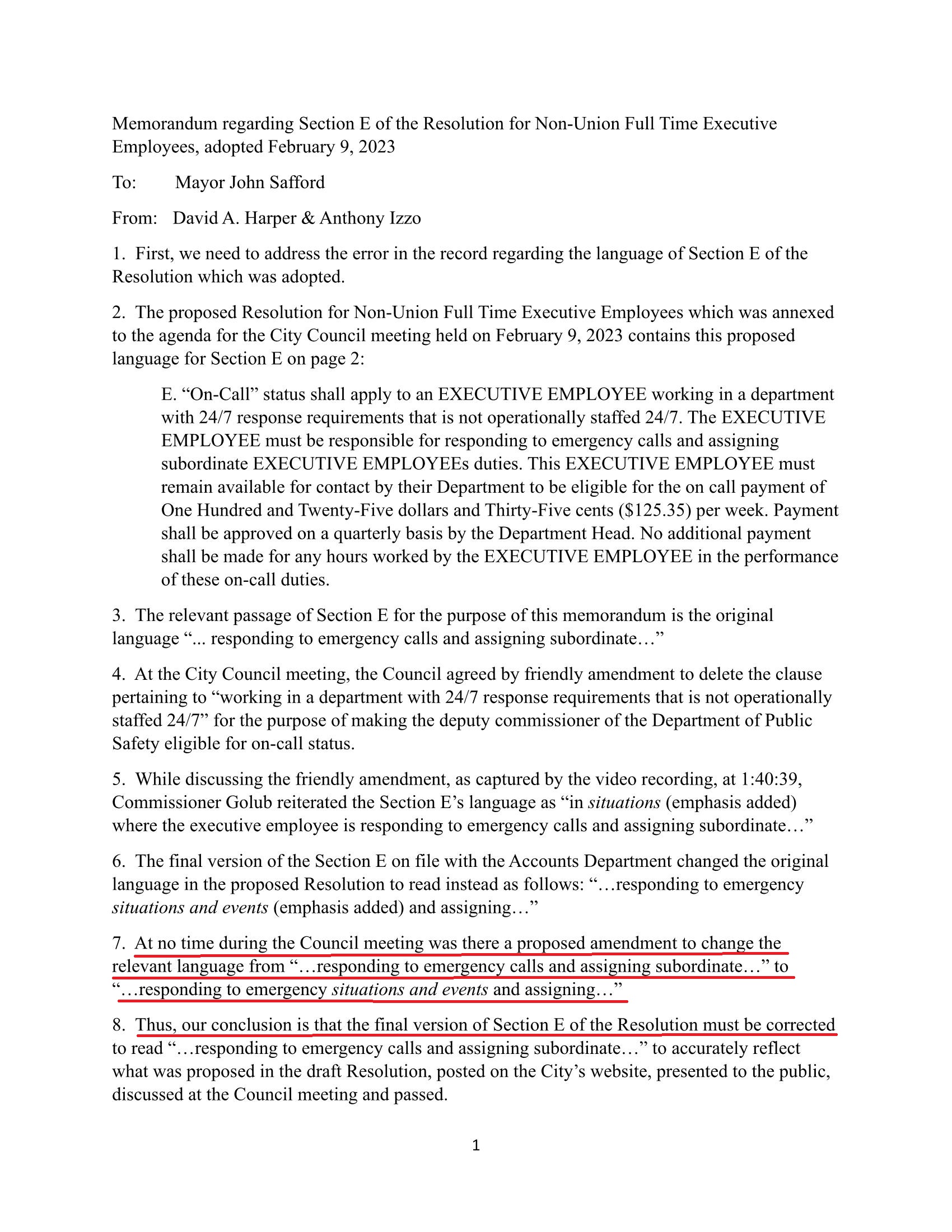
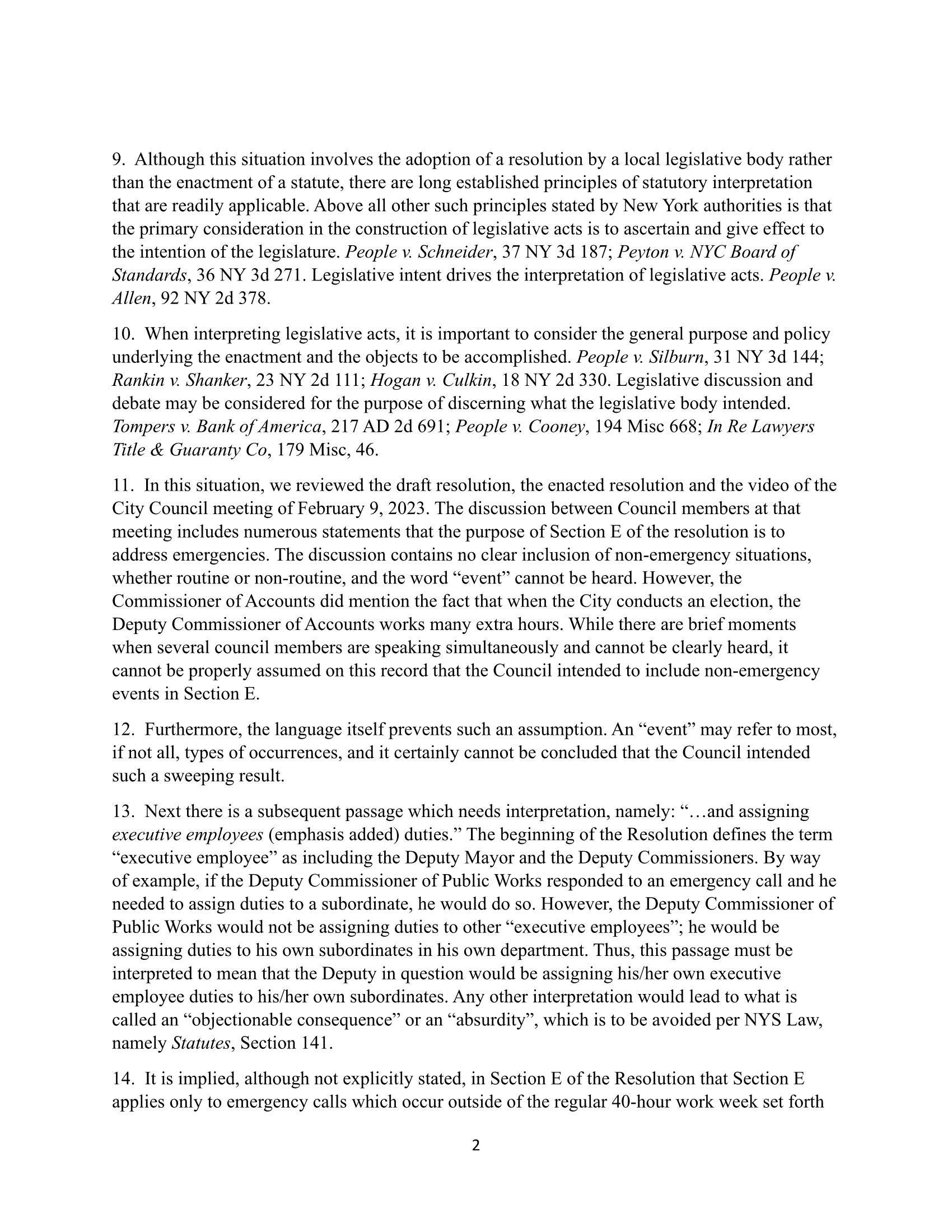
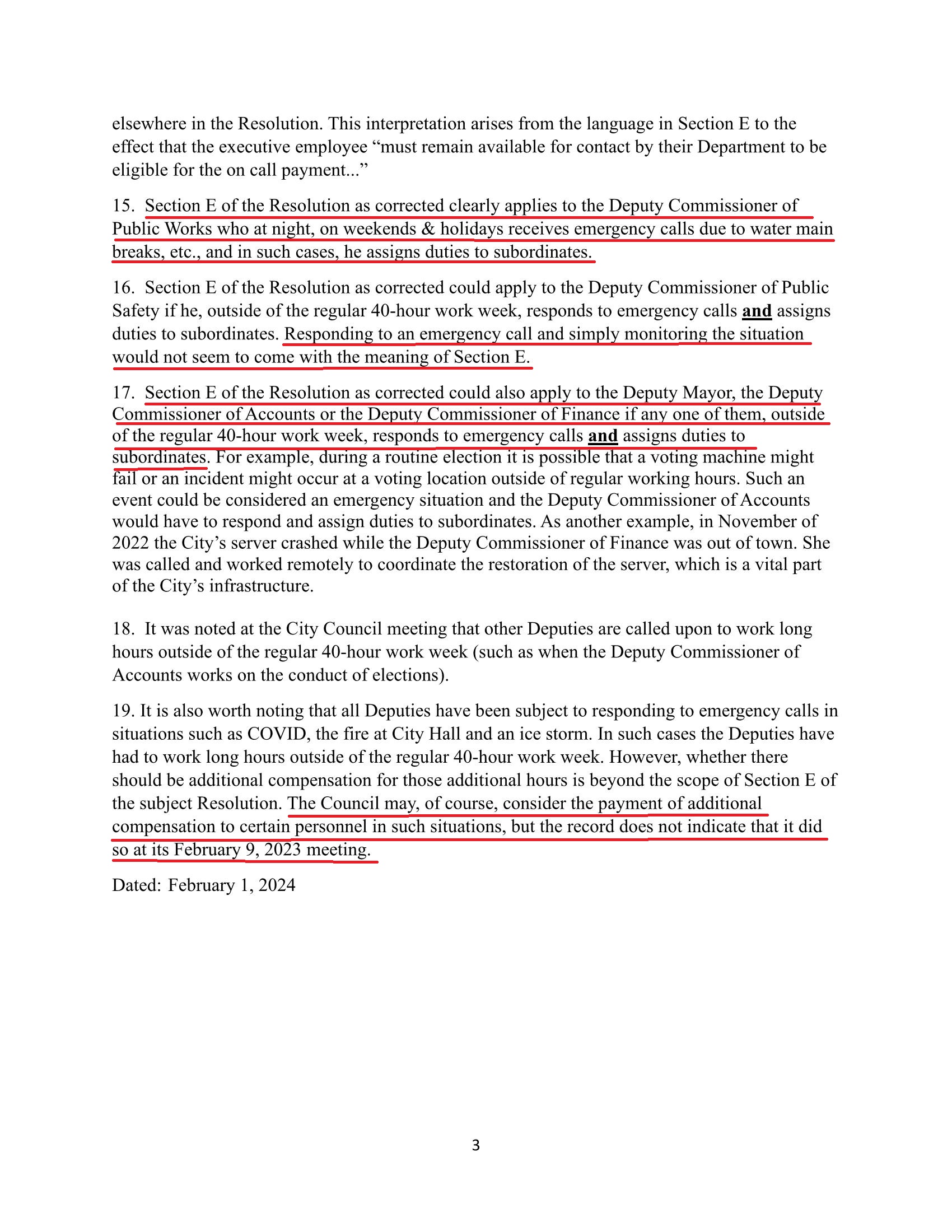
The City Attorneys’ legal opinion was carefully researched and crafted (it can be found at the bottom of this post). Impressively, unlike some legal opinions, this one is easily understood by non-attorneys.
After considerable controversy arose over the collection of on-call pay by four of the five Deputies in 2023, Mayor Safford asked the City Attorneys to advise the Council on who, if any, of the city’s Deputies was eligible for on-call bonus pay according to the resolution passed by the last Council in February of 2023. He also noted that there was a conflict between the apparent record, as documented by the minutes and the video of the meeting, and the version posted by the Accounts Department. The Mayor asked the Attorneys to clarify what the resolution actually stated.
In the case of the Deputies, the Attorneys found that the text of the resolution “clearly applies to the Deputy Commissioner of Public Works who at night, on weekends & holidays receives emergency calls due to water main breaks, etc. and in such cases, he assigns duties to subordinates.”
The opinion acknowledges that, as the Accounts Department is responsible for supervising local elections, there is a brief period of time during elections when the Accounts Department Deputy might need to be on call.
Apparently, at Commissioner Sanghvi’s request, the opinion included that in November of 2022, the Finance Department Deputy was contacted outside of regular hours when the city server was down.
Improperly Paid
The implications of this opinion are significant. The Deputies for the Mayor, the Commissioner of Accounts, and the Commissioner of Finance submitted invoices for approximately $10,000.00 for which they were not eligible. Adding to this fiasco’s significance was that in all three cases, their respective bosses all signed off on these invoices.
It also reflects a breakdown in the oversight by the Finance Department, which should have flagged these invoices but did not. Indeed Finance Commissioner Sanghvi herself signed off on her own Deputy’s inappropriate request for payment.
The Pre-Agenda Meeting
At the February 5, 2024, Council’s pre-agenda meeting, Mayor John Safford introduced a discussion regarding the legal opinion on on-call pay. He did not seek to claw back the sums of money that should not have been paid to the deputies. He had apparently hoped his colleagues would simply abide by the City Attorneys’ legal opinion, making a contentious discussion unnecessary. His hope was not realized.
Moran’s Bullying
Dillon Moran knew he had a problem well before the City Attorneys issued their opinion. Some weeks earlier, Moran approached Department of Public Works Deputy Joe O’Neil with a proposal. He asked O’Neil to support a plan that would eliminate on-call pay and instead pay all the deputies an additional $5,000.00. It is important to note that Deputies had already received a substantial salary increase in the same resolution that contained the on-call provision.
Moran clearly knew that his Deputy was not eligible for on-call pay and that he himself was implicated in inappropriately paying her because he signed the form that authorized the payments to her.
If the Council expunged on-call, it would imply that the whole thing had been a mistake for which everyone was culpable aka “mistakes were made.”
He received no support from DPW, and his idea went nowhere.
Carl Sandburg famously opined:
“If the facts are against you, argue the law. If the law is against you, argue the facts. If the law and the facts are against you, pound the table and yell like hell”
Carl Sandburg
At the pre-agenda meeting, Moran took Sandburg’s advice to heart.
Moran’s problem was that the opinion on on-call was sufficiently compelling, defying any arguments that Moran might put forward based on the actual opinion in the text. Undaunted, Moran threw out every imaginable buzzword and sound bite for twenty minutes, denouncing the decision without addressing its substance.
He asserted that he had been blindsided by the opinion. At one point, he asked his colleagues to raise their hands if they had not had an opportunity to discuss this opinion with the City Attorney. This did not work well for him as he was the only one who raised his hand. In fact, he had had plenty of time to read the opinion and to seek out the City Attorney to discuss any issues or questions he had.
Moran threw out every possible cliche and catchword in his ramblings, hoping he would bully Mayor Safford and undermine the integrity of the opinion. Conspicuously missing was any discussion of the actual substance of the opinion’s text.
Here is a thirteen-minute video of the event. For those who do not want to endure the video, I offer highlights of what Moran said. Readers will note that conspicuously absent from Moran’s objections was any discussion of what the resolution actually said.
- He claimed the opinion was somehow prejudicial against the employees in his department.
- He asserted that “The context of the charter is not considered here.”[JK. What’s the charter got to do with this?]
- He asserted that “The context of the appointing authority is not here [JK: appointing authority?]
- He asked “How do you know the legislative intent if you weren’t in conversation with the people who were actually in the conversations?” [JK: the opinion was co-authored by Tony Izzo who has been with the city for over 35 years and Jason Golub, the author of the resolution, spoke extensively with the two attorneys.]
- Referring to the opinion, he said he would “love one that was well informed. This wasn’t a well informed opinion.”
- “I understand, as the appointing authority, what my responsibilities are to make priorities within my department. None of that’s in here.”
- “I reject this [JK: The opinion]”
- “I suggest this is a flawed process, and if we are going to work together, this isn’t how you do this.”
- “It’s an unnecessary witch hunt.”
- “So we are going to make a decision without proper consideration about all the elements.”
- “This does nothing.”
- “What’s germain is that it was not properly recorded. It was not reflected in the minutes the way it was supposed to be. It was not put forward as an action of the city council the way it was supposed to be. That’s the responsibility of this body.” [JK: Try to figure out what that is supposed to mean]
- “Everything is essential. If the people who work inside the building don’t put in the extra hours to get things done, the government stops working. This agenda process completely stops. We did a tremendous amount of work on the processing and the work and the transactional requirements for station three. That doesn’t happen without my department working with Chief Dyer extra long hours. Well listen, it’s not in the context of a conversation because we weren’t brought into it.”
- “It’s (the opinion) is on the agenda and I didn’t get a chance to look at it. What’s the rush?” [JK: The agenda with the opinion was posted on the city website]
- “What’s the rush? What’s the rush? What’s wrong with having the conversation about what’s important in my department? I don’t think he (David Harper), in the three weeks he has been here [JK: The opinion was signed by both Harper and Tony Izzo. Tony has worked for the city for over thirty-five years], knows anything about the importance of what happens in my department, the priorities I have set within the community. We can define emergencies in different ways. An emergency to me may not be an emergency to you.”
- “It’s not perfect, but if it applies to one, it applies to all.” [JK: The whole point of the opinion is that there is a criteria as to who is eligible so on-call does not apply to all]
- “I would suggest we have conversations internally to address this and not air it out, halfway done.”
- “I don’t see the value of having this conversation when its incomplete. At least two people sitting at the table are not happy with how are departments are reflective. I don’t understand what you are trying to accomplish with this.”
- “This seems like a flogging. You’re setting up more people to take body blows over something that has nothing to do with them.”
- “I’m not happy about the way people have been treated.”
- “Intent and outcome. The outcome is what matters.”
- Interrupting Mayor Safford referencing the legal opinion, “It’s an incomplete one at best.”
- “I didn’t know this was going on the agenda. It was presented to me the day after the agenda came out, so that’s the problem.”
- “I want to understand what the end goal of this is. It doesn’t seem it is a thorough, comprehensive understanding of the circumstances. It seems like…I don’t know. Like I don’t know. Kick the can down the street? I don’t know. I don’t see any value in this conversation about a half-written document that half of us don’t agree to.”
- “We haven’t gotten to that point yet. I would say that’s a good starting point. Have everyone have the opportunity to talk about this before it goes out into the public.”
- “I disagree with the process. If I’m not allowed to even speak to an issue that I’m being talked about in. People are talking about my intent. I have a problem with that. as anybody would.”
- “I don’t even know what’s the intent.”
- “We do things for a reason, right? A plus B equals C. We already have a C. This document that has been thrown out into the public that doesn’t accurately reflect the circumstances of this issue. It was a year-long negotiation. I was in the room almost every single time. The idea I wouldn’t be talked to is absurd to me.”
Commissioner Golub offered the most thoughtful response to Moran. He tried to get Moran to focus on what the opinion actually said rather than what Moran wanted it to say.
Minita Sanghvi’s Push Back
Commissioner Sanghvi argued that the IT department was a “critical infrastructure.” She observed that the IT department had to function 24/7 and that her deputy would need to be on-call in case of a problem outside of business hours.
The opinion acknowledged that IT was indeed critical infrastructure. In addition, Harper and Izzo added language to the opinion, presumably at Sanghvi’s request, that in November of 2022, “the server crashed while the Deputy Commissioner of Finance was out of town. She (the deputy) was called and worked remotely to coordinate the restoration of the server, which is a vital part of the City’s infrastructure.”
Strikingly absent from Sanghvi’s remarks was that the city has had on-call support for IT for over a decade. The city has an agreement with the union that three IT staff rotate being on-call and are paid for it, although less than the amount the Deputies collected for their alleged on-call time. This organizational structure has served the city well.
As a person who made a career as a programmer, I find Sanghvi’s remarks very strange. As far as I know, Sanghvi’s deputy does not have a technical background in IT, and it is reasonable to assume that she would be of little assistance in the event of a server crash or in the installation of software at night.
I contacted Mike Sharp, who was the Deputy under Finance Commissioner Michele Madigan. He offered the following:
Hi John,
Hope you’re having a great trip. IT’s “on call” language is in the CSEA contract (which they are a member of) I believe, and may also be referenced in the city’s Emergency Plan. The language for how and when they are “on call” is explicitly laid out, since it is additional pay. A finance deputy being “on call” for IT is nonsensical. They are not a trained IT expert, and while technically they are second in command for the office, they don’t (or shouldn’t) manage the specific workload of their employees, the same way the DPS deputy isn’t asked to opine on every call made into the fire and police departments. The IT head giving updates to the deputy, who isn’t doing anything other than communicating with their boss and maybe other deputies, is not something that should warrant them being paid extra.
– Mike
Being Firm Is Not Being Uncivil
I think it is laudable that Mayor Safford was patient and thoughtful in spite of Moran’s incendiary attacks on the legal opinion and its authors, David Harper and Tony Izzo.
In the end, I expect Mayor Safford to be respectful but firm with Moran and Sanghvi that the opinion is clear and that they will need to adhere to it.
The Opinion
 Saratoga Springs Politics
I am not sure the city council has to take action to correct the addition of the ‘and events’ clause added after the resolution passed. This is an error which should be corrected administratively to match the resolution that was actually passed. In item number 17, it is noted that on call pay for emergencies could be applicable to all departments since all departments have exigencies from time to time requiring active delegation. On call pay, as passed, is applicable to deputies in every week they are on call, even if they are not required to respond to an emergency.
Obviously, this whole resolution is obtuse and really not worth the political trouble it is causing. It is embarrassing for the deputies and commissioners involved.
It is much smarter to ‘index’ pay. For example: ”Each Deputy Commissioner’s annual salary shall be set at the statistical 75% percentile of the total wages paid to a sworn police officer of the Saratoga Springs Police Department in the previous year.” ”Each Commissioner and the Mayor’s annual salary shall be set at the statistical 25% percentile of the total wages paid to a sworn police officer of the Saratoga Springs Police Department in the previous year.”
LikeLike
I am not sure of your logic on this. Tampering with a document which was used to pay thousands of dollars of tax payer money is a crime. It is not a “mistake”. It is a crime. It absolutely needs to be corrected to reflect the actual resolution passed by the council. Those involved should be prosecuted and pay restitution for the pay and pension contributions. Their salaries are more than adequate. There is a legal definition of emergency. Since this is a legal document one should expect the legal definition of emergency to apply once the resolution is corrected.
LikeLiked by 2 people
Mistakes and administrative errors occur all the time. In order for a crime to have been committed, the Deputy Commissioner of Accounts would have to have knowingly introduced words (intent) that she knew not to be part of the resolution, and even then, it should have been caught before becoming part of code.
Since the original resolution was verbally modified and was being kicked around for so long, I don’t think any DA would be willing prosecute this. To do so would be extremely partisan.
But partisanship is part of the system, the Republicans are probably looking to get back at Dillon Moran and the woman he is defending (Stacy Connors) for the treatment of Samatha Guerra a few years ago. I thought Moran was overly hostile, and perhaps he should consider how he conducts himself.
Spa candidate convicted of mishandling ballot petitions (timesunion.com)
If one is concerned about government overspending, take a look at this:
Nursing home officials agree to pay $7.16 million for false claims (timesunion.com)
NY alleges El Al owner used Medicaid funds meant for elderly to buy airline instead | The Times of Israel
These guys are using a loophole inserted by the deceased and convicted felon Sheldon Silver to create ‘limited-profit’ opportunities to steal billions of dollars to support large scale criminal operations. Not only that, but lots of elderly people have died and suffered due to substandard care.
Why no law enforcement here?
LikeLike
Your “index” pay doesn’t make any sense. Deputies and police officers may have individual reasons for their compensation to be changed totally separate from the other. The city still has an HR department right? Let them opine on pay using actual facts rather than just making things complicated for no reason.
To your first point, departments all have things that happen outside of normal business hours, but “things” aren’t the same between departments. The DPS deputy isn’t dispatching firefighters on a Saturday night and the Finance deputy isn’t telling the IT manager how to correct a Sunday network outage.
The city has had real emergencies, but Moran and Minita look to be fudging the language just to get their deputies paid, which is ironic given that both supported a charter change effort that bashed prior deputies.
LikeLiked by 1 person
Andy, to be clear about my indexing statement. I obtained all the pay data for the Saratoga Springs PD and Fire Department from this public database:
https://www.seethroughny.net/payrolls/311140606
I copied the data and put it into microsoft excel. I eliminated the data that looked to be part time or partial year, under $20,000 per year (the low outliers).
The 139 police and firemen in the database had a median compensation in 2023 of $94,697. This dataset has a standard deviation (1 sigma) of $29,316. Pay at the 25th percentile of the data range is $76,598. Pay at the 75th percentile is $114,385.
If you index pay, you never have to amend the law and salaries float with inflation based upon what the city is paying police and firemen, per the union contract. It is a large dataset that includes a work force that is paid a normal middle living wage, so it is a good reference to set other pay rates.
This is one way to assign compensation. I would advocate elimination of on call pay for elected and appointed employees. The electorate expects responsible job performance to include occasional work outside normal hours.
LikeLike
Obtuse has multiple definitions:
I thought the resolution was quite clear, direct and fairly addressed the issue of oncall for deputies.
Some of the responses on this blog on the other hand fit the definition quite nicely.
LikeLike
No one should ever be altering resolutions after they have been passed by the Council. To do so and then provide material gain for elected officials or their deputies would, in my opinion, be a crime.
I thought that David Harper’s opinion regarding the ‘on call’ pay issue for deputies was absolutely correct.
Commissioner Sanghvi failed to tell the whole story about the ‘on call’ duties for the IT Department which happens to operate out of her department for reasons that have never been clear. IT serves the needs of all departments. The IT techs are on a rotating schedule of ‘on call’ duties. Any after-hours emergencies are the responsibility of the IT tech who is ‘on call’ at that time. They may regularly monitor the City’s computer system and are readily available for emergencies if needed by the departments which operate 24/7. There was never a need in the past to first contact the Deputy Commissioner of Finance to assign those duties. These responsibilities are pre-assigned and their added compensation is part of the CSEA contract for the City’s IT techs. Also, I am not aware of any pre-requisite for Deputy Commissioners of Finance to have necessary expertise in IT that would enable them to trouble shoot a software or hardware dysfunction.
An ‘On call’ employee, by definition, is one who is available to work if they are called. They receive compensation for being available to work. They may have limited personal freedom during their assigned ‘on call’ hours. They would have to meet many of the same behavioral and availability standards that would be expected of them during regular business hours. A deputy who is called infrequently after hours is not the same as being paid to be ‘on call’.
The original resolution included Section E regarding the Deputy Commissioner of Public Safety being required to assign duties to subordinates after hours. I am not aware of that ever happening, The chain of command in the police and fire/EMS departments does not include a civilian Deputy Commissioner assigning duties to individuals in those departments. It would be highly unusual for the Deputy to be assigning any duties after hours to other Public Safety employees including Code Enforcement, Traffic (which is usually coordinated through the SSPD if emergencies take place after hours), Parking Enforcement or Animal Control. I am not aware of any situation where the Deputy Commissioner of Public Safety would have to be ‘on call’ in order for the department to carry out its duties and meet its responsibilities.
The Deputy Commissioner of Public Works has a very different set of responsibilities than those of the other department deputies. He is functioning as the general foreman for the Public Works Department. Out of fairness and in order to maintain employee retention, he should be paid significantly more than the others. This fact should be recognized and a separate salary schedule for this position should be established. The ‘on call’ pay concept for deputies, which was originally conceived as a way of recognizing the Deputy Commissioner of Public Works’ greater responsibilities, should be rescinded.
I thought that Mayor Safford handled Commissioners Moran and Sanghvi well. He defused Commissioner Moran’s continued attempts to inflame others. Apparently, the City attorney has upset Commissioner Moran’s distorted understanding of ‘on call’ pay.
Chris Mathiesen
LikeLiked by 4 people
Has there been any resolution to the “On Call” pay issue or has the can been kicked down the road?
LikeLike
I didn’t see anything about the “on call” pay issue on the agenda for next weeks city council meeting. Perhaps the mayor took Commissioner Moran’s advice and “kicked the can down the road”. ??
LikeLike