The following is John Witt’s response to my posts regarding his project. I will respond in a future post.
I read with great interest your introduction to and Sandy Cohen’s analysis of my application for variances at 27 Jumel Place and your more recent post containing my letter to property owners, as well as our emails.
With regard specifically to the Sandy Cohen’s analysis:
I personally went door to door and spoke with more than 30 people who live within one block of Jumel Place, including on East, Granger and Lake avenues. With very few exceptions, my plans have been positively received. After Downton Walk is constructed and sold, the upgraded neighborhood will enjoy raised property values, benefiting homeowners.
I will be removing asbestos and chemicals from the property.
I will be installing new water main on Jumel.
I will be installing new plantings and a decorative fence to ensure privacy for dwellings on both sides of the buffer.
The Jumel Place plan aligns with the goal of the city to infill urban areas, rather than promote sprawl. The zoning allows for four duplexes, for a total of eight units. I am proposing only seven, which does not constitute overbuilding the space. The writer herself rents out a garage apartment, as well as other units within her house, making hers a multi-family dwelling and maximizing use of the property. The two cottages on Downton Walk main living area is 20-6” feet wide (see enclosed elevations of #2 and # 3 and # 2 first floor) and only 1,800 square feet in interior size, small by new-construction standards, and include a single-bay, tandem garage. The other five homes will be 2,800-3,000+ square feet in size, comparable to current new-home-size standards.
The front-yard setback is a technicality. The neighbor to the left has no setback at all, while the neighbor to the right has a five-foot setback. The Downton Walk construction will be set back accordingly and does not change the character of the neighborhood, but mirrors it. The “encroachment” is merely a front stoop and overhang, not a building.
We meet the side-yard setbacks without a variance.
The fence height we propose is eight feet high, instead of six, with the top two feet being a decorative lattice. I would remind you that the current fence is, already, eight feet high, so we would not be changing the current height, but would be significantly improving its appearance, as well as protecting privacy on both sides.
The six-foot backyard setback under fire is, again, to accommodate an overhang and not a building. In fact, we are setting the building back further from the east and north property lines than it is today.
The current building covers 49% of the area and we are actually reducing the footprint to 46%.
I would remind the writer and your readers that I am a Saratoga Springs native and lifelong resident, as well as a successful, established small-business owner and employer.
I take pride in what we build and in our reputation for excellence and would direct your attention to a similar concept in the popular, high-profile Park Alley North neighborhood near Skidmore College, which is a coveted address for homeowners.
Downton Walk is a well-conceived project and will offer residents both privacy and accessibility to the downtown, as well as enhance the neighborhood. Saratoga Springs is thriving, in part because of the beautiful architecture and homes – not just what we are preserving, which is vital, but also those we are currently building, because we also need to protect the future viability of our city as a community where people live full-time, as well as work and visit occasionally for pleasure.
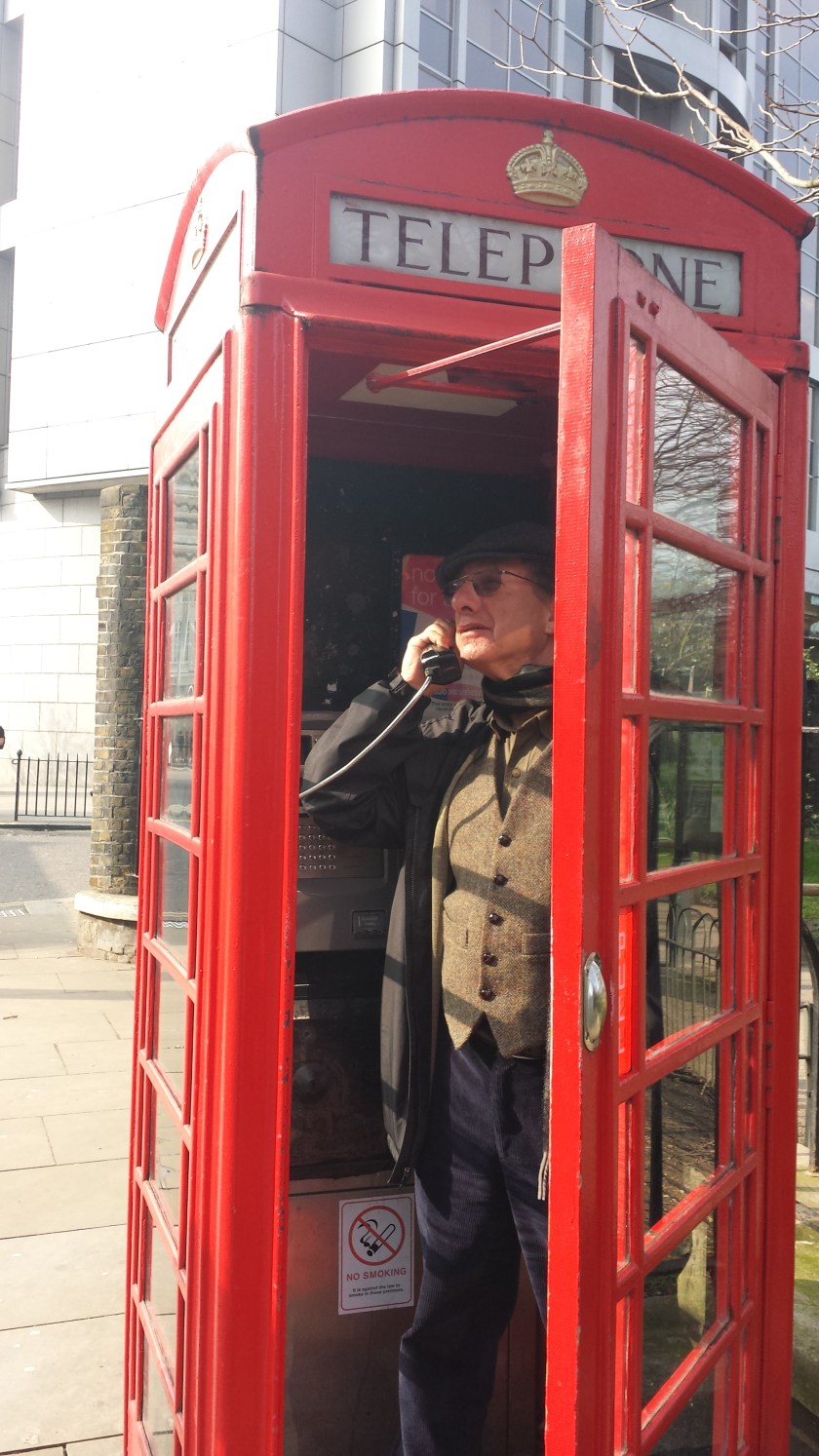
Enjoy London…. I spent a week there and touring The city and the Cotswold area to get inspired for completing the designs of the homes and cottages for Dowton Walk. Please schedule a meeting with me when you are back so I can share some new city projects I am working on.
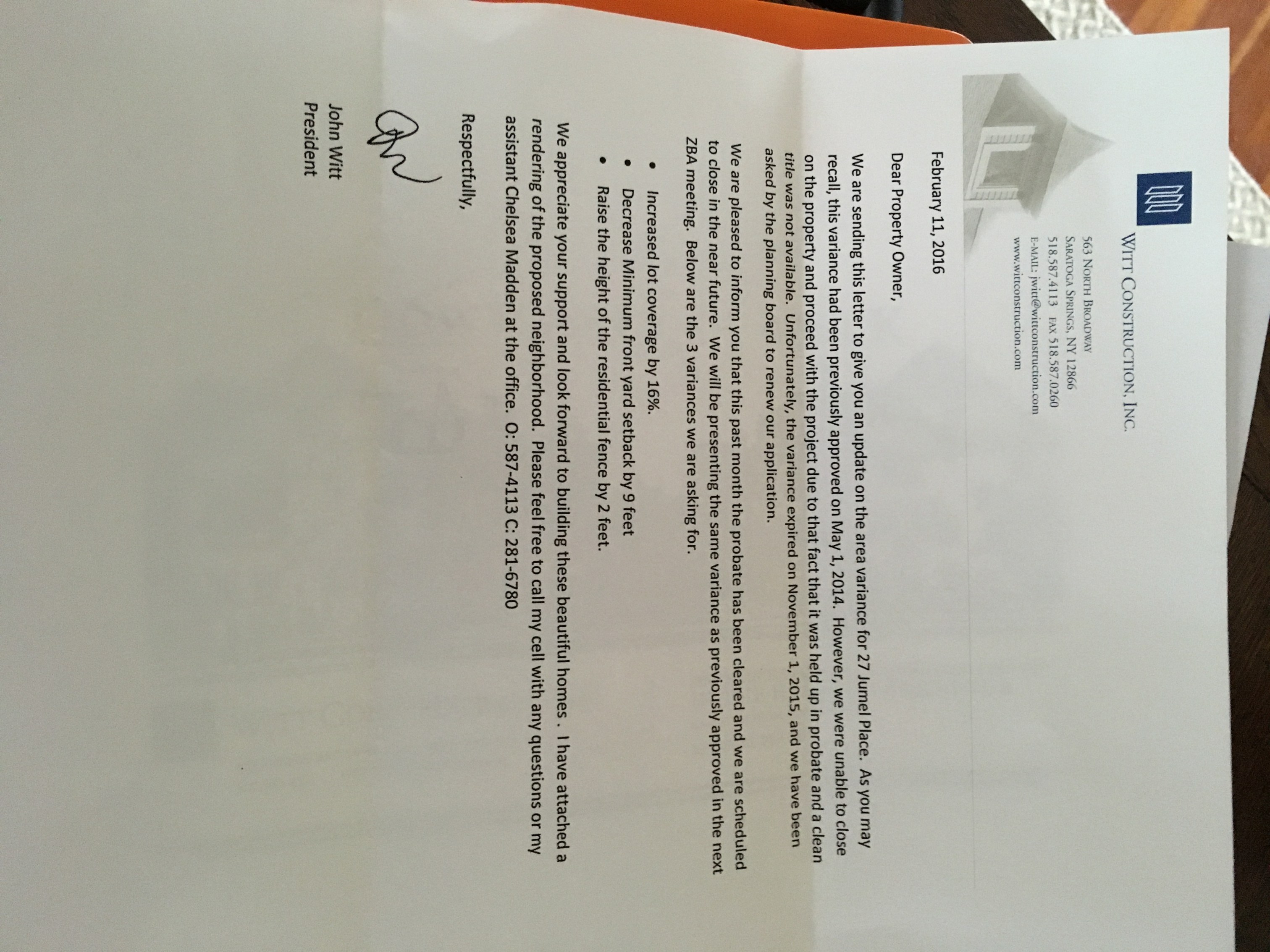
John Witt sent a letter dated February 11 to the neighbors of his proposed “Downton Walk” development on Jumel Place. In the letter he informs them that he is applying to the Zoning Board of Appeals for three variances. He identifies these as 1) an increase in lot coverage of 16%, 2) a decrease of minimum front yard setback of 9 feet, and 3) an increase of the residential fence height of two feet.
He spins the changes these variances will cause to make them seem less offensive than they are.
The increase in lot coverage by 16% means that the lot coverage would go from 30% to 46%. The reduction in the front yard setback of 9 feet means the required 10 foot setback would be reduced to just one foot effectively eliminating any front yard. He would raise the height of a “fence” by 2 feet beyond the zoning limit thus creating an 8 foot high wall.
So spin is one thing. Quite another is to simply leave out other requested and important variances:
He fails to note that the rear yard setback would be reduced from the required 25 feet to 6 feet. It is interesting to note that the narrative is complicated by the fact that he is building 7 units which normally would require multiple setbacks but through a complicated legal sleight of hand, he is only asking for one variance for these seven houses. The dubious strategy being facilitated by the Zoning Board of Appeals will be discussed in a separate post.
Which brings us to the biggest overlooked variance. He fails to mention that he is seeking a variance to build what are in effect seven single family homes on a parcel that is zoned for only five.
I know that many readers may respond to this business, as did most of the members of the ZBA, as no big deal. Many of us still value the concept of trust, a quaint and increasingly rare commodity, based on presenting things in ways that reflect as accurately as possible what they are. Were I on the ZBA, I would be very troubled by this letter and, based on it, treat Mr. Witt with considerable caution and reserve. As the video of the meeting documents, most of the members of the ZBA were beyond warm with Mr. Witt. Of course, many of them are in the same business as Mr. Witt.
In an effort to be fair to Mr. Witt, I emailed him offering to publish any defense he would like to offer regarding his letter (see below). To date I have not received any sort of rebuttal. Should I receive one, I will publish it.
From: John Kaufmann [john.kaufmann21@gmail.com]
Sent: Saturday, March 12, 2016 12:51 PM
To: ‘John Witt’
Subject: RE: Jumel Place lettet
I am in London until March 20.
I will be posting regarding your letter shortly so I hope I hear from you before I post.
From: John Witt [mailto:jwitt@wittconstruction.com]
From: John Kaufmann [mailto:john.kaufmann21@gmail.com]
Sent: Saturday, March 12, 2016 8:51 AM
To: John Witt <jwitt@wittconstruction.com>
Cc: John Kaufmann <john.kaufmann21@gmail.com>
Subject: Jumel Place lettet
In your February letter to the Jumel Place neighbors you offer that you are only applying for three variances when it appears that you are seeking more. I would be grateful if you could explain this apparent discrepancy.
I publish a blog and will publish your response with your permission.
Per John LeCarre’s instructions I make my contact in the Downton Walk affair. I am directed to proceed to Kensington Palace where I am to meet with the Duke and Dutchess of Cambridge, AKA William and Kate.
I arrive at Kensington Palace
Due to some confusion I arrive at Kensington only to learn that the royal couple is unavailable.
I run into the queen
As a stroke of extraordinary good luck, I run into the Queen. She insists that we have tea. I raise the issue of Downton Walk. As it turns out she is quite well informed about the issue. Prime Minister Cameron had raised the matter at his most recent audience with her. Unfortunately, the Queen, who is very sensitive about interfering directly in political matters, asks me to consider our conversation as privileged. I do learn that the Crawley’s do not actually exist only raising further questions as to the credibility of the players in all of this.
In a Reader’s View piece in the March 9th Saratogian, Commissioner Madigan lays out her arguments as to why she supports the City Center’s proposed parking structure. She also notes that she plans to ask the Council to vote on the lease with the City Center at an April City Council meeting.
It gives a valuable history of the City Center’s process to build a parking structure that is well worth reading.
In her piece, she asserts that the “Technical Review Committee said they could not recommend either proposal…” To be fair, while the committee identified many serious deficiencies in the two proposals, it was not the charge of the committee to make an actual recommendation to the council. The following is from the city’s web site:
Posted on: February 26, 2016
High Rock Park Technical Review Committee Presentation
The High Rock Lot RFP Technical Review Committee (TRC) was appointed by the City Council in late 2015 to produce a clear, understandable, and objective comparison of the two proposals received in response to a RFP issued by the City, seeking a mixed-use project that would also accommodate a variety of parking needs.
Michele Madigan Reader’s View: Commissioner discusses High Rock lot
Posted: 03/09/16, 1:00 AM EST |
I want to clarify certain facts regarding the City Center’s plans to build a parking structure, and clear up any confusion amongst members of the public regarding the city’s RFP to develop the entire High Rock parking lot. It is important to note that the City Center Authority is not a private entity; it was created by a legislative act of New York state to carry out governmental functions. The mayor is an ex-officio member, and the Finance commissioner acts as its agent, empowered to examine its accounts, finances, contracts, and leases, among other things. As such, the City Center and the city have a very close working relationship that is written into New York state law.
The City Center approached the City Council Nov. 20, 2012, with a proposal to lease a portion of the High Rock lot upon which they would build – at their expense – a facility to provide much needed parking. The lack of covered and connected parking for vendors and exhibitors to unload marketing materials and wares at City Center events places them at a competitive disadvantage, which will worsen once competing local convention facilities are open for business. This is unfortunate, as the City Center is a vital part of our local economy, drawing thousands of visitors each year to our hotels, restaurants and retail establishments, supporting local businesses and generating tax revenues that fund our government and help keep our property tax rates stable.
At that meeting the Council agreed unanimously to allow the City Center to move forward with its plans. Although questioning the proposed $1 lease payment and resulting financials, I did offer my support, as did Commissioners Scirocco and Mathiesen, and Mayor Johnson. Commissioner Franck said that this was the best High Rock lot proposal that he had ever seen; he’d “worked the numbers” and was in full support. Soon thereafter, the City Center issued an RFP, receiving several responses and selecting one. Their plans have been subject to numerous public discussions, which resulted in several modifications. The current plan to lease approximately two-thirds of the lot and build a parking structure (that includes space for community events) on half of the leased land, with the city retaining development rights for the other half, has received all of the necessary approvals from the city’s various land use boards.
While the above was transpiring, several local residents expressed reservations about these plans, suggesting a grander multi-use development of the entire High Rock lot that would simultaneously meet the needs of the City Center and provide other opportunities. The Council unanimously agreed to explore this alternative, and in the summer of 2015 the city issued an RFP soliciting proposals to develop the entire lot. The City Center’s original RFP was focused on meeting the demonstrated downtown parking needs, with a structure occupying a portion of the High Rock lot, which they would pay to build. The purpose of the subsequent RFP issued by the city was to solicit plans to develop the entire High Rock lot while meeting those parking needs, which the City Center would not fund. The Council clearly stated that while we were issuing this RFP, and would be reviewing subsequent proposals, the City Center should continue to move forward with its plans. The city received two responses to this RFP, and the Council appointed the Technical Review Committee to review the proposals. At a special City Council meeting Feb. 25, 2016, the Technical Review Committee said they could not recommend either proposal due to parking, financing, urban form, and engineering concerns.
The city has been negotiating the aforementioned lease with the City Center since 2013; I assumed responsibility for these negotiations in September 2014. Given that the City Center has received all necessary approvals for their plans, and the Technical Review Committee’s concerns regarding the two High Rock lot development proposals, I presented this lease to the public and the Council on March 1, 2016. I plan to ask the Council to make a decision regarding the lease in April. If the Council approves this lease then the City Center will be able to move forward with their plans – leaving approximately two-thirds of the High Rock lot available for future development.
Michele Madigan is commissioner of Finance for the city of Saratoga Springs
Last week I received an email and an attached document from Richard DeVito of Paramount Development, one of the companies that responded to the High Rock RFP. I am posting both. The thing I value about this blog is that it is a source of information for people and I respect the readers of this blog to assess for themselves the value and accuracy of what I put up.
I know that many of the readers take exception to my assessment of Mark Baker and the multi-use proposals for developing High Rock. I continue to be extremely skeptical about both Paramount’s and Hyman’s plans. My concerns are consistent with those unanimously supported by the Technical Review Committee that evaluated the proposals. It is important to note that the committee was chaired by the Mayor’s deputy and included an appointee by John Franck. Both Yepsen and Franck have been the most enthusiastic supporters of the multi-use proposals. The two proposals by developers are by necessity extremely vague because for better or worse, a plethora of unknowns will only be resolved, should either receive approval, in what I expect to be a challenging and thorny gestation process. In that context I do not find it at all surprising that Mark Baker is less than enthusiastic about having his need for parking enmeshed with this process. The document that Mr. Devito attached included the email exchange he had with Mr. Baker. It is a little confusing but basically the text in black is what Mr. Devito wrote to Mr. Baker and Mr. Baker’s response is in red. I actually think Mr. Baker’s response is pretty straight forward and I encourage the readers of this blog to read the exchange carefully to make their own determinations.
From: rdevito@rdrealty.com
Sent: Friday, March 04, 2016 11:09 AM
To: John Kaufmann
Cc: Chris LaBerge; Wayne Senecal; McCann Sue; PetrikHuff Jennica; Dave
Schlosser; Addy Kelsey; Anthony Ianniello
Subject: High Rock Lot
Attachments: Response to the Technical Review Committee.pdf
John,
I read your article regarding Mark Baker and his presentation to the City Council regarding he proposed City Center Garage. I’m attaching some information that was send to the Commissioners yesterday for you to review.
Briefly, it is clear that the North Maple Lot can be developed as a garage that will handle all f the City Center’s needs without encroaching on the most important parcel for development that the City of Saratoga Springs has. This parcel should be dedicated to a broader mixed use development that will have significant benefits the the community at large, namely senior housing, workforce housing, and apartments and condominiums that are within the financial reach of regular folks.
We have also offered approximately 11,000 square feet of space at Lake Avenue to house the new court rooms that are desperately needed by the City.
Also, our proposed development will provide the City with more revenue than any other option, and substantially more than the City Center’s proposal.
I would ask that you take a very hard look at the development options on the table. If scrutinized carefully, I think you will see that what we a proposing is the best development option for the community and it all works without sacrificing the parking needed by the City Center.
Below is an excellent piece by neighborhood resident Sandy Cohen regarding John Witt’s application for variances from the Zoning Board of Appeals for a large project on Jumel Place.
It raises the fundamental question about what the purposes of zoning are and what the role of variances are. As Sandy effectively argues, zoning laws are meant to protect the character of the distinct neighborhoods that make up our city. This is why there are so many zoning designations. As an extreme example, building a high rise in a neighborhood (zone) made up of small one family bungalows would undermine the character of the neighborhood. People purchase homes on the faith that the surrounding residences will consistently maintain the feel of where they will live.
Concomitantly, variances issued by the Zoning Board of Appeals are supposed to be issued with caution and great care. Where necessary, they are supposed to simply allow the tweaking of a property in a manner that does not negatively affect the other homes in the neighborhood. In that context one would expect the ZBA to be especially attentive to the concerns of the homeowners and tenants who would be impacted by any change.
Unfortunately, it is glaringly obvious that this is not the philosophy of a number of the people who currently serve on our ZBA. A poster child of this problem is the Witt project with the embarrassingly, pretentious name “Downton Walk.”
On a lot that zoning allows only five single family homes or four two family homes, Witt proposes to build a compound with seven very large homes that are crammed in over most of the available land. Forget significant setbacks, there is no room for them. It also includes an eight foot fence. One can only assume that to maintain the fantasy of the aristocratic project it is necessary to hide from the nobility that will live in this “estate” the modest single family homes that make up their neighborhood. Any pretention that this project is supposed to be an integral part of a neighborhood is not even given lip service.
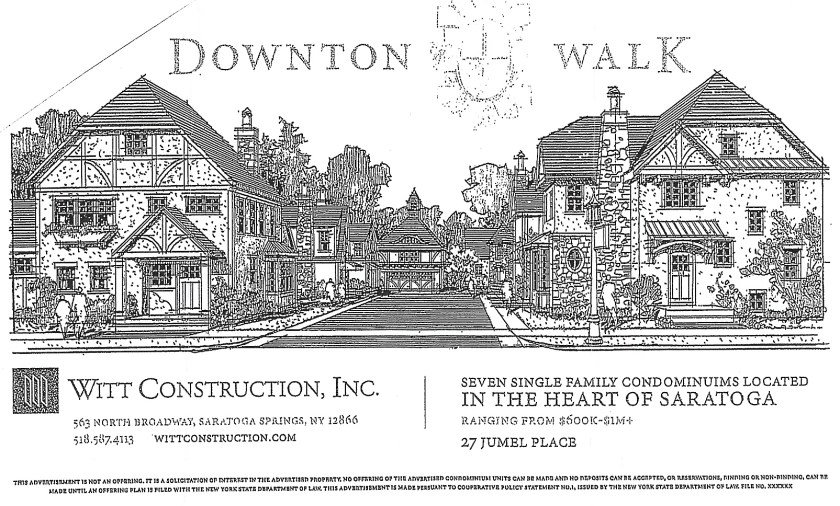
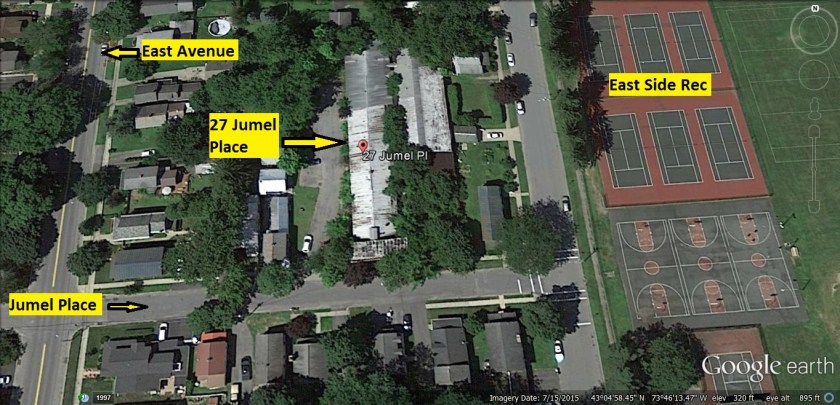
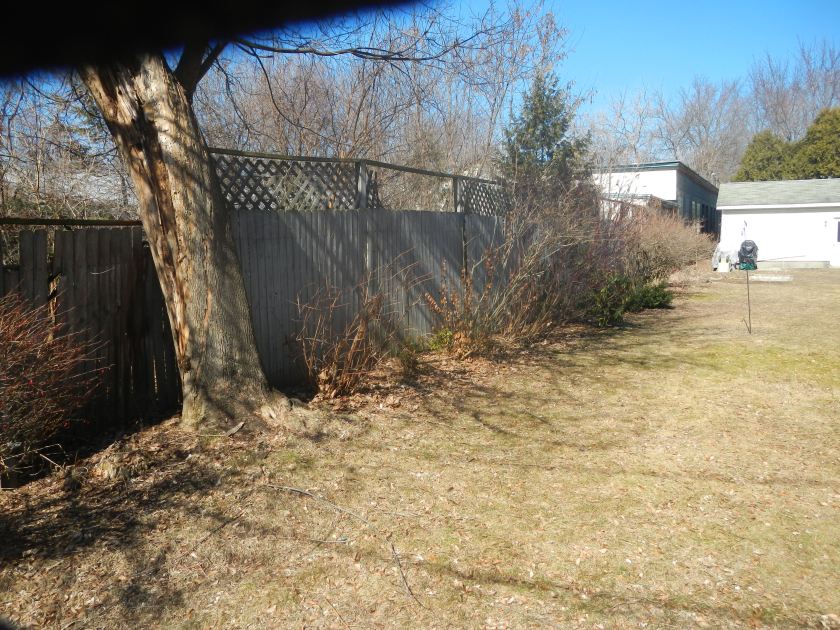
Below are relevant pictures of the neighborhood, the location of the proposed project, and a rendering of what” Downton Walk” will look like. Even the most cursory examination of these images makes clear how completely inappropriate this project is. It is simply stunning that a zoning board would even consider this project.
If this project is approved, it will set yet another example of a major developer being allowed to flaunt our zoning laws. The Zoning Board of Appeals will be making a decision on this project on March 21st. I would urge that even if you are not from the affected neighborhood, that you take the time to voice concerns about this project to the ZBA. Susan Barden is the planner assigned to the ZBA so emails should be sent to susan.barden@saratoga-springs.org.
Jumel Place Sans Lord and Lady GranthamAerial View of Jumel Place
Does this look like the neighborhood that Lord and Lady Grantham would live in?
Jumel Place Looking West
Above on the extreme right is the building that will be torn down and the location of the Saratoga Springs residence for Lord and Lady Grantham and friends.
The eastern perimeter of the future Downton Walk
Sandy Cohen’s Analysis
Builder John Witt’s application for variances on the lot at 27 Jumel Place has been referred to by at least one neighbor as trying to fit a size 10 foot into a size 7 shoe. In the next meeting of the Zoning Board of Appeals (ZBA), on March 21, he will continue to ask for approval to build condominiums in a zoning district that allows only single-family and two-family dwellings, while also attempting to radically modify setbacks, heights, and density along with other things. Many of the surrounding homeowners are disturbed by such a change to the character of their long-established neighborhood, which includes homes from the late 1800s and early 1900s. And they also are concerned about the breach it will open in our Comprehensive Plan and zoning laws.
As any city grows, part of the effect is the attempt by builders to use the available central space to erect and sell homes and other structures. So, for a very long time, cities have had zoning codes in place, the purpose of which is to maintain a balance within the tensions which exist among the character of the city itself, the comfort of the existing populace, and the ability of the city to continue to grow its population that makes up its tax base and supports its businesses.
Saratoga Springs is no exception to the rule. More than once in the past decade alone, committees have worked thousands of hours to hammer out documents that represent the breath of our history, the heartbeat of our present, and the foresight of our future. These culminated in the 2015 Comprehensive Plan, which, along with our zoning codes, has been approved by our City Council and represents the City’s best effort to protect and improve the value of properties owned by our residents.
The information contained in the zoning codes is clear and concise and offers builders legal routes to ask for exceptions and exemptions as well as slight changes in the rules, when such are valid and necessary and do not impede the rights of the citizenry. But, the goal of the zoning board should be to facilitate both the citizenry and the builders, not as a rubber stamp on development. Hence, their perspective should be to facilitate development that uses variances as a last resort; and approval of such requests should not be driven by the profit level accruing to the builder.
In drawing up such codes and ordinances over the years, Saratoga Springs and its environs was divided into very specific districts, based on what existed in particular areas at the time. Housing areas were given labels, such as Urban Residential, Rural Residential, or Suburban Residential. And even those areas were broken down into types of housing allowed there – all based on what existed there at the time the laws were being formulated. The whole purpose was to maintain, as closely as possible the character of neighborhoods.
The land at 27 Jumel Place is a single, eight-tenths of an acre lot, inside an Urban Residential-3 (UR-3) district. That means the only thing that can be built there is either one single-family home or one two-family structure. Because of the size of the lot, there is room to subdivide it and build five single-family homes or four two-family structures. At the moment, what was an old factory stands on the property. It was built long before the city had zoning codes, and more recently has housed a dance school and a karate school. It is currently unoccupied and in disrepair. But, regardless of what preceded it under the lack of zoning laws, any new construction on the site must, under law, conform to today’s UR-3 standards.
Witt currently has the property under contract and has presented his plans to the ZBA because he is seeking relief for setbacks, density, heights, fencing, and the like. At first blush, it appeared quite simply that a reputable builder was going to develop what was heretofore an eyesore and only needed a couple of area variances, so it must be good for the neighborhood. But a closer look at the plans brought out a number of concerns for the current area residents.
The most basic of the issues was the sevencondominiums he is proposing to build. All will be free-standing structures. So, in his mind, they are basically single-family homes. However, the owners will only be buying the walls and the space within them. The land under and around them will be owned by all the homeowners with an undivided interest and managed by a Homeowners Association that they will direct to maintain and care for it – thus the condominium moniker. The ZBA feels that such ownership is not enough to consider the project a “regular” condominium for zoning purposes – because it will “look like” it’s made up of single-family homes. This becomes a confusing issue, because, on one hand, the builder is admitting he is building condos, only because of the land-ownership factor; but, on the other hand, he wants special consideration for his request to place more structures on the lot than allowed by law.
Most communities refer to Witt’s model as “zero-lot-line” homes and do not “condominiumize” the land. Zero-lot-line homes are considered cluster housing and, in Saratoga Springs, are allowable only in the Urban Residential-1 (UR-1) and Suburban Residential-2 (UR-2) districts. The codes for those types of communities require the land to be subdivided before it can be approved. Witt has not applied for subdivision, which requires much heavier oversight before approval. The codes addressing cluster housing require adherence to proper set-backs to existing properties, although they can be ignored between the homes within land being developed. They also require a strict percentage of the land to be left green. Witt is requesting relief from those setbacks; and has not even made a request for as much relief as he would need, because of the orientation of the homes on the land. And he is not leaving anywhere near as much green land surrounding those homes as required by law. But even those two issues are trumped by the fact that these are condos that may NOT be built in a UR-3 district.
If Witt wants to continue to ask for such allowances, especially for condos/multi-family housing in a UR-3 area, we believe it is incumbent on him – by the City’s Comprehensive Plan, Charter, and Zoning Codes – to petition the City Council, which we also believe is the only group that can make such exception, by changing language in the Comprehensive Plan itself to allow multi-family housing in a Core Residential Neighborhood-1 (CRN-1) category. However, such a drastic change as this would be opposed by most of the more than 10,000 homeowners throughout the residential neighborhoods in our city.
We contend that the Zoning Board of Appeals will be operating outside of its purview, if it approves Witt’s application.
Once variances as broad as Witt is requesting have been made for one property, they set precedent, making it much easier for the next builder to make similar changes in their prospective projects. This would mean that any builder would have a much easier time dropping a high-density multi-family development in the middle of just about any existing neighborhood in our city. Yours could be the next one endangered.
Development proposals for the High Rock plot behind City Hall have generated a great deal of passion as evident from the comments on this site. One unpleasant aspect of this conflict has been the bitter personal attacks on City Center Executive Director Mark Baker. As I have noted in my previous blogs, I have found Mark to be open and I have found his responses to issues I have raised with him consistently accurate and thoughtful. As the readers of this blog have seen, I approach all issues with considerable skepticism.
While I was away at the time of his recent presentation to the City Council on the City Center’s proposed parking structure, I watched the video and I found his presentation extraordinarily clear and his response to questions incisive. I know that there will be readers of this blog who will take considerable exception to my view on this. For those of you who are still open on this issue I would very much urge you to watch the video and decide for yourselves both about the substance of the City Center’s proposal and how you found Mark Baker in his exchanges with the City Council. Link To Mark Baker Presentation. Move the timer to 20:50
Mark’s presentation covered everything from the history of the City Center and the proposal for a parking structure which has been in the works for several years, to showing detailed drawings of the plans and how they have evolved, to the plans for financing their proposal. One of the more interesting components of the plans, I thought, was the inclusion of an agora or partially open plaza on the first floor of the structure which can be used as a community space for the Farmer’s Market, First Night, etc. Unlike the other parking structures that have been built in the city, the City Center’s structure will be staffed with 24 hour security. While the Hyman and Paramount proposals would cover the entire lot, the City Center proposal would cover only one third of the High Rock plot leaving the rest of the area for future development. I have to say the amount of detail given was in sharp contrast to the much sketchier plans and financial accountings put forth by the respondents to the High Rock RFP.
City Attorney Vince deLeonardis also did, I thought, an excellent job reviewing the proposed lease between the City Center and the City Council to build the parking structure. Two hearing dates were set with a Council vote planned for April.
John Franck engaged in a lengthy Q and A with Mark Baker about the finances of the City Center proposal. An interesting, prolonged conversation. One I would like to see him have with Paramount and Hyman.
Take a look for yourself at Mark Baker’s presentation, the city attorney’s explanation of the lease, and Commissioner Franck’s questioning. Here’s the link
There will be more time for discussion and input before the Council votes.
Michele Madigan sent me an email saying she plans to second Chris Mathiesen’s motion for a discussion and vote on a Comp Plan map change for the land near Saratoga Hospital. She wrote:
“I will definitely give Chris a second on his discussion and vote re: Comp Plan Map Change. I appreciate the opinions Chris has on this particular topic…I see no reason not to offer him the courtesy of a 2nd.”
This means there will probably be a full airing of this issue and a vote at the next City Council meeting.






 Saratoga Springs Politics