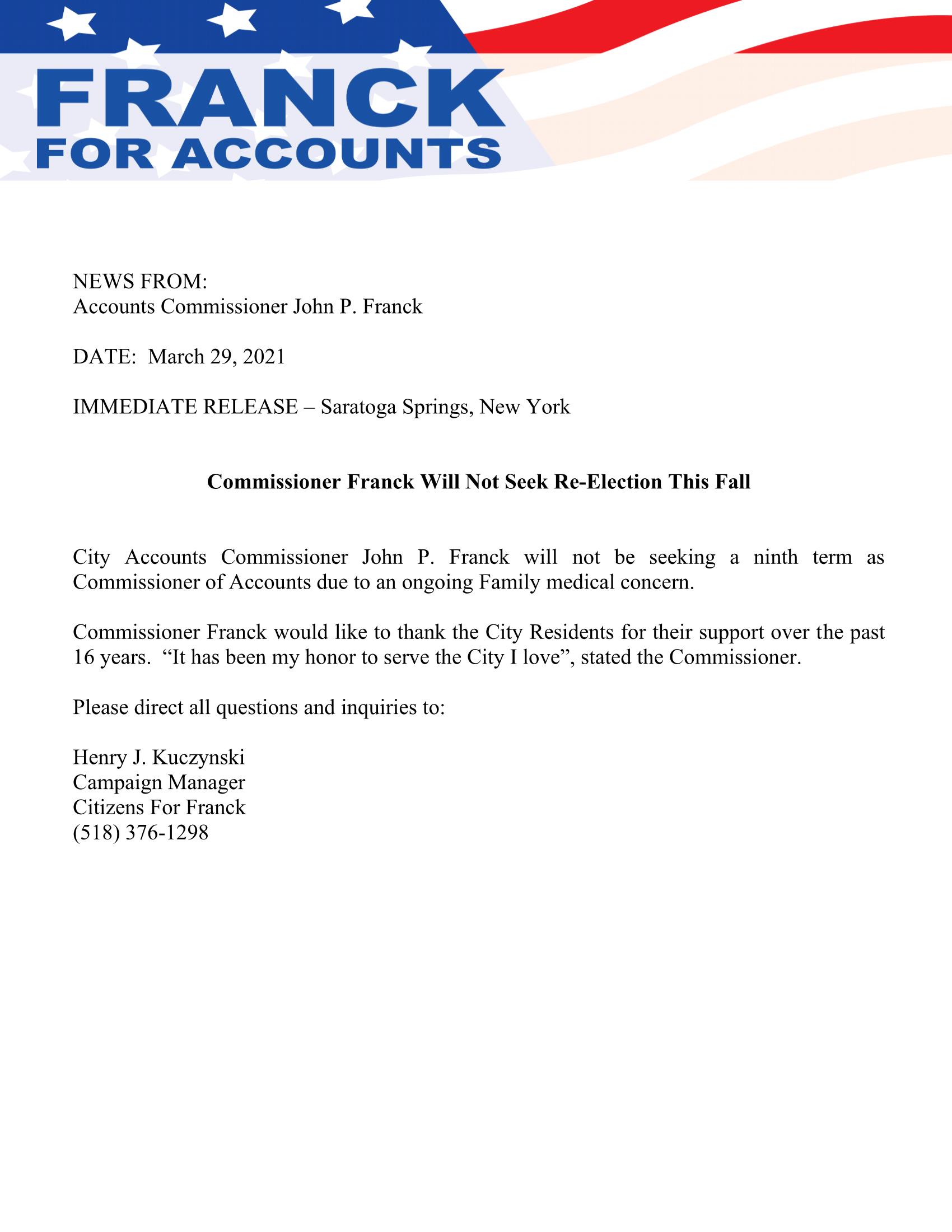
Commissioner of Accounts John Franck and Sarah Burger, who was running for Commissioner of Finance, both on the Democratic ticket, have dropped out of the race for city offices.
Design Review Nixes Demolition on Phila Street/ Stewart Proposal for Marion Ave. Draws Skepticism From Planning Board
Phila Street Historic Properties Saved from Demolition
The Design Review Commission voted unanimously to deny the application to demolish the historic building at 65 Phila Street. While the Preservation Foundation sees this as a positive outcome the Foundation hopes the owners will now be required to preserve the building or sell it to someone who will.
The application to demolish 69 Phila Street was withdrawn by the applicants as they have entered into a contract to sell the property to someone who is intending to preserve the building.
Planning Board Expresses Reservations On Proposed Stewarts Project

The Foothills Business Daily has been doing an excellent job covering local issues.
This is a link to a story from them about a proposal by Stewarts for a development near where Route 9 (Marion Avenue) meets Route 50. It includes an upgrade to their shop and construction of homes.
In order to get the variance they are seeking they need to provide a public benefit. Currently the benefits they are offering are sidewalks.
https://foothillsbusinessdaily.com/plan-for-marion-ave-no-more-mechanic/
Council Meeting On Police Reform Generates Heat Both From The Public And Within The Council

On Tuesday, March 23, 2021, the City Council held a special meeting to seek input from the public on a proposed Council resolution regarding the recommendations made by the Saratoga Springs Police Review and Reinvention Task Force. Many people spoke during the hour and a half event and all comments supported the adoption of the recommendations of the Task Force. Most spoke forcefully that all fifty reforms should be adopted exactly as presented by the Task Force, and they were critical that two of the items were to be studied for further refinement. I do not think it unfair to observe that there was an air of suspicion among the speakers that the Council was attempting to somehow undermine the reform effort.
Is the City Required To Accept All of the Task Force’s Recommendations?
A number of the people who spoke at the meeting asserted that the City Council is required to accept and implement the Task Force’s recommendations as submitted. They asserted that were the Council not to accept the Task Force’s recommendations in their totality that the city would be violating the Executive Order that required its establishment and would therefore jeopardize funding from the state.
The Governor’s Executive Order 203 requiring communities to look for ways to improve police procedures includes the following language:
Such plan shall be offered for public comment to all citizens in the locality, and after consideration of such comments, shall be presented to the local legislative body in such political subdivision, which shall ratify or adopt such plan by local law or resolution, as appropriate [JK: My emphasis], no later than April 1, 2021
Order #203
The key words here are “as appropriate”. It is simply not credible that all the communities in New York State would be required by the state to adopt whatever changes their appointed task forces propose. If this were the intent why bother with taking the step to submit the proposals to local governing bodies for adoption? Why not just submit them directly to the state? It is in the end communities’ elected governing bodies who are given the final authority to determine and implement the plan.
Almost of the fifty recommendations by the Task Force were accepted in their entirety by the City Council, but there were two items that they felt required additional consideration and refinement.
It is important to note that one proposal from the Task Force simply conflicts with existing law. The proposal deals with “diversion of seized assets.” Wikipedia notes a seized asset “…typically applies to the alleged proceeds or instruments of crime.” The full description can be found at this link.
The Task Force had called for the proceeds of these seizures to be allocated to “Community Based Restorative Groups or, alternatively, community service
organizations.” According to the city, the stipulation of how these moneys are allocated is restricted by the law that established the seizure program and under this law the Task Force proposal would not be allowed.
The Council determined that the detailed Task Force proposal for a civilian review board required further research and review. [JK: The relevant text in the report can be found on in Appendix A beginning on page 84] The Council resolution accepted the establishment of a civilian review board but required as part of the implementation the appointment of a committee to craft the language that would create the review board. The Council was concerned that the investigative function of the board needed to withstand potential legal challenges. This decision generated strong objections from the speakers at the meeting.
The resolution established a timeline for its committee in order to address the concerns about accountability.
The Council’s draft resolution of their response to the Task Force’s recommendation stated:
Civilian Review Board
With regard to the Task Force’s recommendation to implement a Civilian Review Board, the City Council recognizes that there has been history and debate surrounding this issue. The City Council further recognizes that many cities in New York State have implemented some version of a Civilian Review Board, some with great success and others with limited success. Additionally, the City Council recognizes that there may be legal, union, City Charter, and implementation concerns that limit the Council’s ability to implement a Civilian Review Board.
Accordingly, the City Council approves the Task Force recommendation to
develop a Civilian Review Board in principle while calling for an evaluation period of the potential legal, union, Charter and community elements that could impact the ability to adequately develop a Civilian Review Board. The review period shall be outlined in the implementation plan and may include, but is not limited to, legal review of NY Civil Service Law and due process rights by the City Attorney and external legal counsel, negotiations with the police union, evaluation of collective bargaining concerns, benchmarking against other cities successes and failures relating to implementation, and finally, the specific process, scope and limitations of the Civilian Review Board. The review will also assess the funding requirements.
The review will be conducted by an independently appointed panel with monthly updates to both the City Council and the public. At the end of the review period, and based on the totality of findings, the City Council, with input from the community, will make a final determination concerning the implementation of a Civilian Review Board.
Can Passion be Tempered by Prudence?
I think it was rather inspiring that so many people in our community felt so passionately about combating racism and about the need to address the epidemic of police violence nationally that most of us see all too often on the evening news.
It is understandable that they felt an urgency to address this violence and that they directed their energy to try to establish reforms locally. It is also understandable that they were frustrated by any suggestion that would require delay.
This is all exacerbated by the reality that for many in the community the members of the Council appear as foreign, talking heads rather than people. Ignorance breeds fear and anger.
I can only offer that this writer knows all the members of the Council and that I believe that they are earnest in their desire to establish procedures to root out racism and to ensure that our police are protectors of everyone rather than predators.
Consider the Council’s approach to the appointments to the Task Force. If the Mayor and the Council were hostile to change they would have filled the positions with reliable cronies. In Schenectady the Mayor and the Police Chief chaired the Task Force. In contrast, Mayor Kelly authorized the other members of the Council to join her in making appointments knowing that the appointees would be individuals who would rigorously and independently scrutinized the existing policies and culture of the police department.
It is unfortunate that the Council, particularly the Mayor and Commissioner of Public Safety Robin Dalton, have now become the targets of a great deal of hostility from many members of the community as a result of simply doing their job as elected officials to carefully evaluate the recommendations of the Task Force particularly in terms of what will withstand legal challenges that the changes could potentially incur.
Anyone who knows the Mayor knows she does not make promises she knows she cannot keep. The Council could have simply adopted all the Task Force’s recommendations knowing that some could not be legally implemented and that poorly crafted programs might be unnecessarily costly and hard to fund. Imagine the public’s resentment if the Council cynically did the politically popular thing and adopted all the proposals knowing they would be reneged on later. This is exactly why people become cynical and angry at politicians. Unfortunately many members of our community rather than appreciating this forthrightness resent this and see it as obstructionism.
John Franck v Meg Kelly
At the meeting there was a sharp exchange between Mayor Kelly and Accounts Commissioner John Franck. Here is a link to a channel 13 news report that includes video of part of the exchange.
A little background is in order.
Mayor Kelly, in drafting the resolution that would adopt the city’s response to the city’s Task Force proposals, was careful to seek input from her fellow Council members. Given the controversy over the implementation of some of the proposals, it seemed especially important to seek a consensus on the resolution.
At the Mayor’s request, City Attorney Vince DeLeonardis met individually with all the City Council members to go over the original resolution.
Early in the week Mr. DeLeonardis and Police Chief Shane Crooks met with Commissioner Franck to review the proposed resolution. Commissioner Franck indicated that the language of the resolution was acceptable and he would support it. He did not suggest that he would oppose the resolution and support instead adopting the Task Force recommendations exactly as written.
Following the posting on the city’s website of the original resolution and the feedback the Mayor received, working with Mr. DeLeonardis and Chief Crooks, the resolution was rewritten. The second resolution was less lawyerly as it went through the recommendations by the Task Force item by item. It also included language about establishing a timeline to resolve the outstanding issues.
This revised version was sent to Commissioner Franck and all Council members seeking input. Commissioner Franck, rather than advising the Mayor and his fellow Council members that he wanted the city to adopt the Task Force program in totality and that he would not support the Council resolution, made his position known by talking to a reporter from the Times Union. The rest of the Council learned of Commissioner Franck’s change of mind in the Monday edition of the Times Union.
At the public meeting Tuesday Franck basically acknowledged that there were some problematic issues with the Task Force’s proposals but told his colleagues, in effect, let’s not sweat the details. We will work all of this out later.
Little wonder at the Mayor’s response.
What Commissioner Franck was cynically suggesting was that it was better to please the crowd now and worry later about telling them that some of what what they had given them could never happen or would appear in a different form.
The Task Force has been successful but that success should be tempered by the fact that one resolution does not end the struggle. A civilian review board must be designed to succeed and it will require funding by a future Council to make it happen. All of that requires continued public engagement.
Reform is an endless endeavor. The Task Force has been incredibly successful in developing a plan that has Council support. I expect the resolution presented on Wednesday night will be tweaked to make that clearer and it will pass but the story will continue and hopefully have an eventual happy ending.
Rather than condemn and abuse the City Council, they along with the Task Force deserve great credit for making this happen.
Council Seeks Public Input Tonight (3/23/21)For Resolution Regarding Police Reform
Tonight (March 23, 2021) at 7:00 Mayor Kelly has scheduled a special meeting to solicit public input on a proposed Council resolution that would adopt recommendations from the Saratoga Springs Police Review and Reinvention Task Force.
In response to public input so far, Mayor Kelly has posted on the city’s website a revised version of the first draft of the resolution.
In order to watch or comment you will need to pre-register to zoom. Here is a link.
Saratoga County Contract Tracing Finds Its Footing

Recently I FOILed to find out how the county was doing in terms of staffing for its contact tracing program. Last fall there were a series of stories in the media reporting that people in Saratoga County testing positive for COVID were not being contacted.
The county sent me a printout of the invoices paid to people the county had contracts with for tracing. I took the period from January 22, 2021 to February 4, 2021 for my analysis.
During that period the county was contracting with thirty-eight people whose hours varied from just a few to over seventy.
According to our population, the state standard would have the county at fify full time staff.
While the staffing is well below the state recommendation that did not necessarily mean that the county was currently, actually understaffed.
I spoke to a reliable source who is a contact tracer. I was told that prior to January, the tracing operation was basically non-functional. In January the old guard was voted out and new leadership took over the Board of Supervisors. This person told me that the new leadership brought in a serious focus on fixing things. This person told me that now things are being well run and this person felt that they finally have an effective team.
It’s encouraging.
Saratoga County Police Reform Task Force Punts On Recommendations; Supervisor Gaston Lone Dissenter

Under an executive order issued by Governor Andrew Cuomo, local municipalities were to set up committees to recommend changes in police policies in the wake of the George Floyd killing.
In contrast to the task force set up for the city of Saratoga Springs that made explicit recommendations to the city council, the county committee balked at actually recommending pretty much anything.
Consider the following excerpt from the county committee’s report/recommendations. It notes that complaints about misconduct in the sheriff’s department “…are collected and responded to on an ‘ad-hoc’ basis…”
That phrasing sets off my bureaucratic antenna. When I read that delicately crafted sentence I translate it to read, “there is little if any record keeping regarding complaints of sheriff misconduct.”
Currently, complaints submitted by the public to the Sheriff’s Office alleging misconduct are collected and responded to on an “ad-hoc” basis which is dependent, amongst other things, on the substance of the allegation of misconduct. [JK: My emphasis] The Compliance Group received input from the community calling for the consistent and independent review of allegations. The Compliance Group determined that it would be appropriate for the Sheriff to explore [JK: My emphasis] the feasibility of creating a separate position or group within the Sheriff’s Office that would be given responsibility and autonomy to investigate complaints, review policies and audit agency performance.
Committee Recommendations To Board of Supervisors
The committee’s recommendation based on their observation was:
Encourage [JK: my emphasis] the Sheriff consult with the Board of Supervisors and its Public Safety Committee in exploring [JK: my emphasis] the feasibility of creation of a Professional Standards position or group within the Sheriff’s Office to collect and investigating complaints, review and update policy and audit agency performance.
Committee Recommendations To Board of Supervisors
The other “recommendations” are similarly tepid and qualified. As far as I can tell, nothing was set up by the Board of Supervisors at their meeting of February 23 to pursue any further “exploration” of the committee’s “recommendations.”
Supervisor Tara Gaston was the lone voice expressing her concerns about the poverty of the work done by the committee. Here is the relevant excerpt from the minutes of the February 23, 2021 Board of Supervisors meeting:
Ms. Gaston said she asked for a separate vote because she has concerns that there are not actually recommendations that the language is quite soft. She said at a minimum, she would like the Compliance Group to consider reevaluating that language before it’s brought forward again for a final vote. She believes the purpose is for the Board to actually make recommendations to the body not make recommendations to make recommendations to consider something. And, she believes that the Board as a body should take a stronger stance.
Minutes of Board of Supervisors February 23, 2021
Excerpts From Saratoga Springs Police Reform Task Force Public Forum On Proposed Recommendations
I have captured some episodes from the March 3, 2021, public forum held by the Saratoga Springs Police Reform Task Force. The purpose of the event was to provide the public an opportunity to share their thoughts on the draft of the Task Force’s recommendations to the City Council.
My selection was meant to share both some of the interesting suggestions made by the public and provide some sense of the Task Force.
It became apparent that some people who addressed the Task Force assumed that the Task Force had some sort of investigative powers. The co-chairs, Camille Daniels and Jason Golub, showed considerable skill and patience in addressing the frustration sometimes directed to the Task Force.
The following videos are not in any kind of order.
Jason Golub Discusses The Mission Of The Task Force
Some Express Frustration With Task Force
Task Force Members Camille Daniels, Cecilia Hayes, and Andrew Sephas respond to Barbara Trypalik and Lexus Figuereo.
Local attorney Ed Lindner discusses how a citizen review board might function here in Saratoga Springs
Lexus Figuereo from the Black Live Matter group All of Us challenges the Task Force
Attorney Kim Galvin Discusses Her Vote on the Community Centered Reinvention Part of the Recommendations
Chief Shane Crooks Explains His Vote On the Community Centered Reinvention Part of the Recommendations
A Nice Moment At The End Of the Event Between Camille Daniels and Kim Galvin.
Survey Results From Task Force on Police Reform: Flawed Survey Produces Worse Findings

The Times Union published a news story written by Wendy Liberatore on March 12, regarding the findings of a survey done by John Schroeder on behalf of the Saratoga Springs Police Reform Task Force.
In an earlier post I reported on the glaring problems with the survey. Regrettably, Ms. Liberatore was apparently uninterested in critically examining the survey and wrote about it as though the numbers presented to her by Mr. Schroeder were an accurate representation of the opinions of the citizens of Saratoga Springs.
The story extensively interviewed Mr. Schroeder. The article highlighted statistics from the survey that purported to support allegations regarding racism and excessive force by the Saratoga Springs Police Department. It included very disturbing narratives offered by persons who participated in the surveys. It finished with the following quote from Mr. Schroeder:
“Data drives out opinions,” Schroeder said. “City councils and politicians tend to listen to whoever shouts last loudest. … But they can’t argue with the data.”
Times Union March 12, 2021
With respect to Mr. Schroeder, data can drive out opinion but only if the data is accurate and reliable.
The survey results are available here.
Some Background Thoughts On The Task Force
I took the time to watch the February 24, 2021, meeting of the Task Force. This is a link to the video. I came away from the experience impressed by the performances of its co-chairs Jason Golub and Camille Daniels and the committee. The Task Force is quite diverse but it was clear that respect for each other was the order of the day. The discussions were substantive. It was apparent that the members of the task force were dedicated to both social justice and to developing policies that they believe would enhance the work of the city’s police department.
The work of the Task Force has been particularly challenging in that they had no funding for professional support and were attempting to take on some very difficult issues within a very limited time period.
With that in mind I would urge the readers of the blog to distinguish between the work of the Task Force and the problematic character of the survey.
Mr. Schroeder is not a member of the Task Force and developed the survey as a volunteer. As far as I can tell, he has no expertise in polling. During the last few years Mr. Schroeder has been an aggressive critic of the Saratoga Springs Police Force. He has extensively FOILed the city for police department documents and recently won a suit against the city for failing to provide some documents within the time restraints of the Open Meetings Law.
The “Survey”: Beyond Flawed
There is a science to polling (flawed as that science may be). Social scientists who do polling direct great resources to selecting participants who will be representative of the group they seek to understand.
Mr. Schroeder published his analysis of the survey results with the following caveat about the participants in his survey:
While selection bias is always a concern for open surveys, the demographics are very close to our overall population.
Introduction To Survey Report
The results that follow are statistically significant and broadly representative of the overall City of Saratoga Springs Community.
Introduction To Survey
Mr. Schroeder is referring to the fact that the breakdown of gender and some other characteristics of who took the survey were similar to the demographics of the city.
Mr. Schroeder asserts that because some of the self identified characteristics of those who took the survey are similar to the demographics of the city, that this somehow establishes that the survey results are a valid reflection of what the residents of Saratoga Springs think. Aside from the fact that the only characteristic that even is close to correlating with the city’s population is the number of persons who self identified as being White, without proper modeling, any similarity between the self identified characteristics (age, gender, race, etc. ) of the participants of his survey and the actual population of our city is simply coincidental.
It is disturbing that he is trying to reassure us that the survey is “statistically significant ” and that it is “representative of the overall City of Saratoga Springs” simply because those who took the survey in some cases resemble the population of the city.
It is particularly problematic that he thinks his survey’s results indicate what the city of Saratoga Springs thinks of its police department given that a significant number of people who took the survey do not even live in Saratoga Springs.
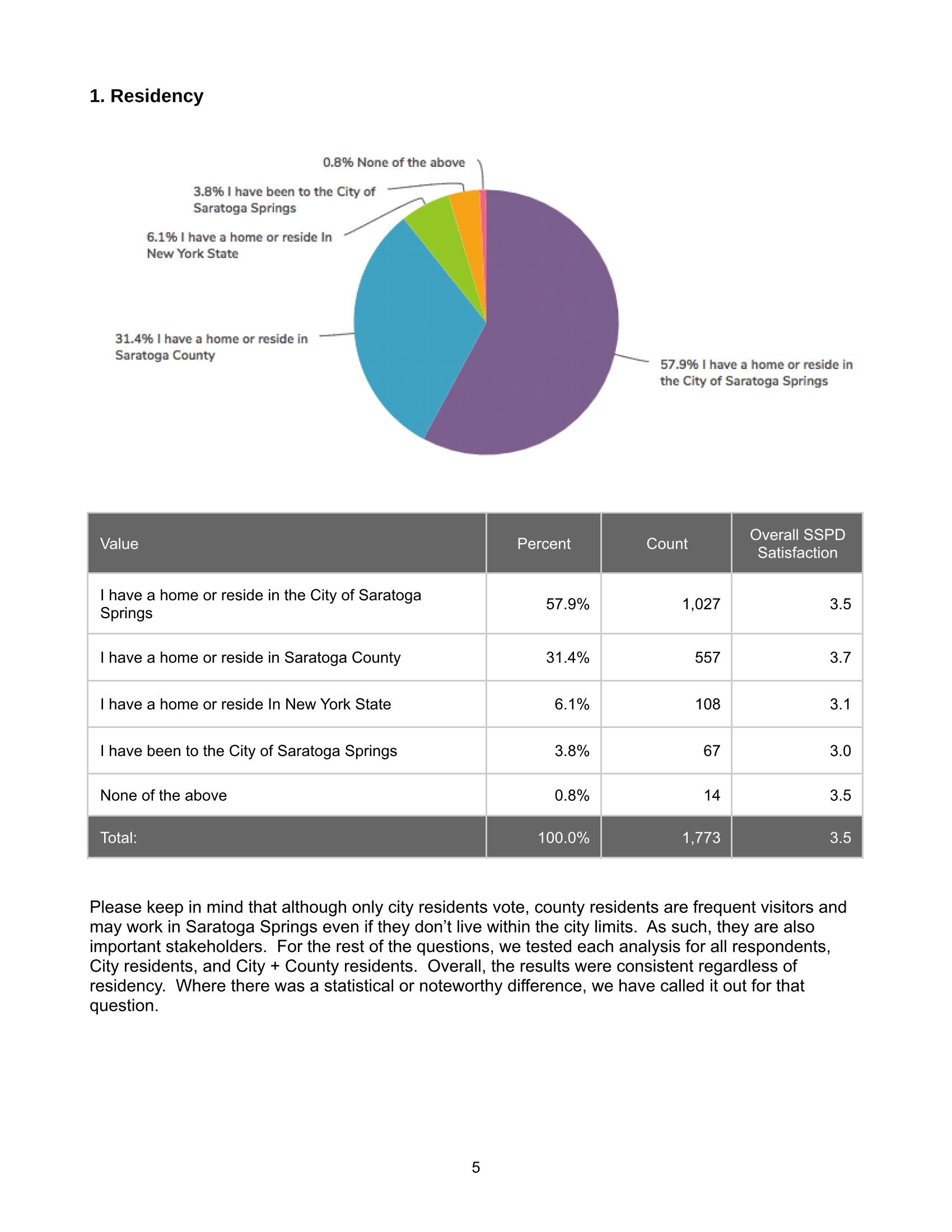
The survey asked the participants where they lived. Here is one of the tables:

So only 57.9% of those taking the survey identified themselves as actual residents of Saratoga Springs. The notes at the bottom of the graph assert that the people who live outside of the city but live in Saratoga County are “stakeholders” so, the argument goes, they should be included. Maybe, and some people may find this nit-picking, but Mr. Schroeder asserts that the survey results are “representative of the overall City of Saratoga Springs” when roughly forty percent of the participants were self described as living outside the city. This kind of sloppy, indifference to his own statistics is antithetical to the kind of rigor required in proper polling.
Participants in Mr. Schroeder’s survey were “self selected” which is to say that the participants were whoever was motivated to take the poll. It was not a sampling that necessarily represented the city’s population.
Also troubling was that there were no controls to keep participants from taking the survey more than once. I know that after doing the survey once I was able to log on to do it again if I had wanted to without a problem. I did not repeat the survey.
This is no minor technical problem. It strikes at the very integrity of the results.
With respect to Mr. Schroeder, I cannot understand how he can can describe a self-selecting survey (no modeling or randomization) as “representative of of the overall City of Saratoga Springs.”
In addition to the unscientific sampling techniques used, individual questions in the survey also violate the fundamentals of sound polling. I explored that in some detail in an earlier post but I will revisit one example.
The survey asked the participants:
Please indicate which of the following changes to policing you support:
Participants in the survey were limited to the following responses:
Support – Don’t Support – Not Sure
One of the statements asks whether the person being surveyed supports/doesn’t support/is not sure about Ending profiling, “Stop and Frisk”, and policing of minor issues
First of all, a proper polling question does not include three items as is done here. What if the respondent supports or doesn’t support or is not sure of only one or two of the three items? How can a response like that be registered?
The question also implies that the city currently employs all three of these items by asking about “changes to police policy” . This is similar to the classic question, “when did you stop beating your wife?” Where is Mr. Schroeder’s data supporting the allegation of profiling or Stop and Search in the city? And what does “policing of minor issues” mean?
As the question asks simply about police rather than the Saratoga Springs police, the question invites confusion. When I answered this question I assumed I was being asked about our local police. This is another example of how poorly this survey was crafted.
If you want to improve service delivery, or anything else for that matter, one of the first steps is to understand where you are today. Without that baseline,it’s hard to tell if things are improving or getting worse over time. This survey is intended to provide that quantitative understanding of how our entire community views the Saratoga Springs Police Department (SSPD). Our hope is that this becomes an annual exercise that can chart the progress we make together.
Introduction To Survey
Unfortunately without a scientific sample and carefully crafted questions, there is no baseline.
While the previous “up and to the right chart” showing overall satisfaction is visually appealing, it is equally true that nearly 1 in 4 people in our community are dissatisfied with the SSPD
Introduction To Survey
The assertion that nearly “… 1 in 4 of the people in our community are dissatisfied with the SSPD” is simply not an established fact. It is only accurate to say that 1 in 4 of the people who took this survey are dissatisfied.
Trying To Unspin The Spin
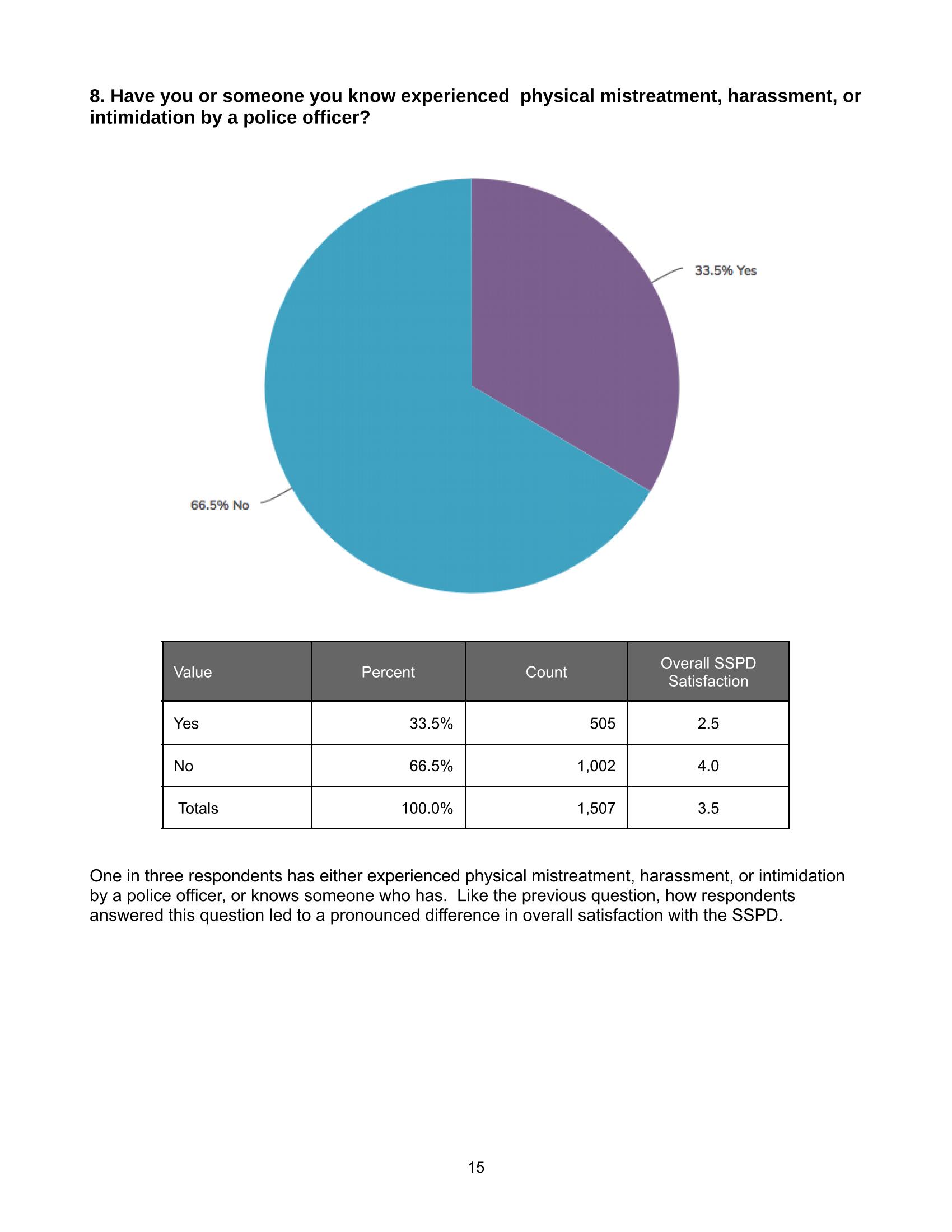
Question #8 in the survey asks:
“Have you or someone you know experienced physical mistreatment, harassment or intimidation by a police officer?”

So this is a strangely global question for a survey trying to get information about the Saratoga Springs Police Department. There is no limit as to when (1969? last month?)or where (Guatemala? California?) an incident could have occurred. It isn’t even simply about whether the person taking the survey has had a bad experience with the police anywhere at any time. It could be the person answering or anyone one they have ever known. I have to admit, given how broad the question is, I am surprised that only a third of those surveyed said yes.

So Mr. Schroeder then correlated the number of people who answered yes to the police experience question with how satisfied those persons were with the Saratoga Springs Police Department. According to the two charts above, if you answered Yes to the bad police experience question you were much more likely to be dissatisfied with the Saratoga Springs Police Department. If you answered Yes and you “considered yourself a member of an historically excluded group (e.g. person of color, LBGTQ)” the rate of dissatisfaction increased.
So what does this mean? As far as I can tell it means that if you or someone you know had a bad experience with the police somewhere and at sometime, then you will tend to look unfavorably on the Saratoga Springs Police Department. How is this correlation meaningful?
At the risk of appearing cynical, I think Mr. Schroeder wanted to have another chart that presented an image of people unhappy with our local police in order to compensate for the responses that pretty uniformly show that overall people of all races who took the survey had a favorable view of the local police (see chart below). The rate of satisfaction for people who self identified as “Black/African American” was pretty much the same as those who self-described as “White.”

Some Final Thoughts
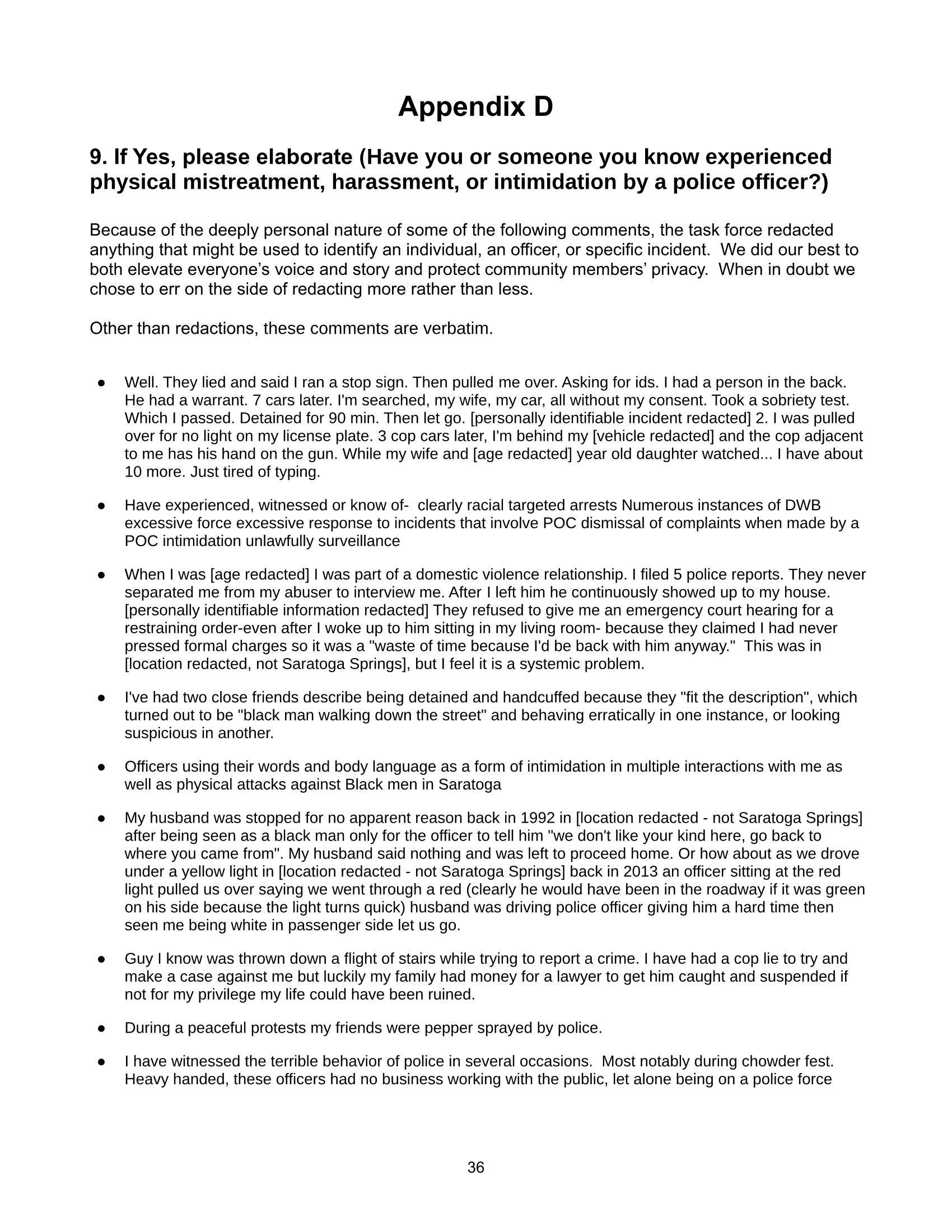
The analysis had two appendices. One involved comments from people elaborating on their, or someone they know’s, bad experiences with the police in general (any police not just the local police). The other appendix involved suggestions on how to improve our local police department.
In both cases the appendices had literally hundreds of entries. Granted the allegations against the police are anonymous, but however true or accurate they are, they are a reminder of America’s troubling history of racism.
I find these appendices the most interesting and the most encouraging elements of the survey.
It makes one really proud to be a member of the Saratoga Springs community that so many people are civically involved and care so deeply about both our city and the need to bring social justice to our country that they not only took the survey but had the initiative to offer their insights to the task force.
This is the first of seventeen pages in the appendix on police abuse.

Former Commissioner of Public Safety Chris Mathiesen Comments On Police Reform Task Force Report
[JK: Chris Mathiesen served as the city’s Commissioner of Public Safety from 2012 to 2017. He sent me a copy of the comments he submitted to the Police Reform Task Force. I thought his observations would be of interest to the followers of this blog.]
March 3, 2021
TO: Saratoga Springs Police Reform Task Force
My name is Christian E. Mathiesen DMD and I live at 28 Friar Tuck Way in Saratoga Springs.
I am a strong proponent of the Black Lives Matter movement. I believe that despite the significant efforts over the past 65 years to achieve racial equality, there remains more to do. There is subtle racism that many of us do not fully appreciate and there continue to be incidents nationwide where people of color suffer from violent encounters with authorities.
After reading the Saratoga Springs Police Reform Task Force report, I decided to offer some comments to provide balance and to correct some misconceptions.
I had heard about the conflicts in downtown Saratoga Springs that occurred last summer when a ‘Back the Blue’ demonstration took place. I was surprised that such an event would take place here since our police department enjoys broad community support. The ‘Back the Blue’ demonstration seemed to me to have been both ill-advised and in-sensitive given the concerns being raised at the time by efforts such as Black Lives Matter. Apparently things did not go well that night.
Residents of Saratoga Springs enjoy safety and security provided by their local police department that is not available in most of the towns and villages surrounding us. Our police officers respond to calls in a timely and predictable manner. We enjoy a consistently low rate of crime that is the envy of other area cities.
From January of 2012 through December of 2017, I served as Saratoga Springs Commissioner of Public Safety. I interviewed many individuals for hiring and promotion in the Saratoga Springs Police Department. I was extremely impressed with the applicants. They were mostly college graduates with impressive academic records. They were carefully screened for psychological deficiencies or racial prejudice.
On page 3, the SSPRTS report acknowledges that the SSPD has not received the negative publicity seen in other police departments with the ‘haunting exception of unanswered questions that linger from the circumstances surrounding the 2014 death of Daryl Mount’. I am not sure what unanswered questions are being referred to since a thorough investigation took place of the six minute period between the time a woman was assaulted by a man in the presence of two police officers and the time that Daryl Mount was found by the police at the base of scaffolding in a dark alley. All evidence of that early morning August 31, 2013 incident, including surveillance tapes, testimony of officers involved and testimony of eye witnesses and residents of the apartments immediately adjacent to the dark alley, was released to the public (with the exception of the portion of the video showing the assault on the female victim) during a press conference event in early June, 2014. This information was then continuously displayed on the City web site for years.
On page 6, a reference is made to ‘the department’s continued silence with regard to the handling of the case of Daryl Mount’ but there is no acknowledgement that the silence has been imposed on the members of the department by the attorney representing the City in an on-going civil lawsuit.
There is much to agree with in the SSPRTF document. On-going communication and open dialogue between the SSPD and the public are worthy goals (p.6-7). Twenty-four hour Mental Health Crises teams, Community Youth Athletic Programs, Community Led Domestic Violence Support and Twenty-four Hour Homeless Shelters would all be helpful (p.8). Not mentioned are Alcohol and Substance Abuse Programs and the problem of extreme public intoxication that our officers must confront each weekend. It should also be noted that the SSPD has had a very good working relationship with the anti-domestic violence agency Wellspring.
While it apparently is true that there are presently no requirements for continuing education for law enforcement agencies in New York State, there should be (p.8-9). Programs have been provided for officers in our department including an Act With Respect Always presentation by Coach Rich Johns and sponsored by Chief Veitch and Asst. Chief Catone.
Acknowledge, Apologize, Reconcile and Review seem like important goals (p.9). Guided mediation to address issues of contention makes sense as does the use of an external consultant to help recognize the department’s shortcomings. However, I will predict that the external consultant would find that the SSPD has few comparable shortcomings.
The idea of altering the SSPD from a military mindset to a de-escalation and peacekeeping mindset (p.10) is a worthy goal. But the great majority of the time an SSPD officer spends on duty already focuses on de-escalation and peace keeping, not on the use of force.
I agree with the stated goal (p.11) of increasing diversity in the SSPD. This can only improve the relationships between racial and ethnic minorities and the department. The SSPD has a solid record of hiring and promoting women. However, in six years of interviewing applicants for the SSPD, the Civil Service Commission presented to me for consideration one Hispanic male (who was later excluded) and no black people.
There is a reference to the importance of providing an annual SSPD Report to the City Council (p.12) but this has been done for years.
There is a statement that the SSPD officer’s use of force should be only used as a last resort (p.13) but that has been a policy for years. The SSPD is not a department known for excessive use of force. In fact, two officers in violation of that policy during my administration were relieved from their employment with the City.
Of course SSPD officers should be restricted from using deadly force unless all reasonable alternatives have been exhausted (p.15). I know of no SSPD officers who have ever violated that standard.
Regarding the issue of the SSPD and immigration status (p.19), Chief Veitch instituted a policy during my administration which declared that the department would not inquire about immigration status for any reason and would cooperate with federal immigration agents only when required to do so. The department does not want anyone in the City to feel that their right to safety and security might be undermined by a less than ideal immigration status.
Creation of an Advisory Panel (p.21) including youth was a policy during my administration and during Commissioner Peter Martin’s administration. My advisory panel included the head of Skidmore student government, a pastor of a local church with a largely black congregation, the leader of the local anti-domestic violence organization and others. It was a diverse and wide-ranging group.
On the topic of a Civilian Review Board (P.24) proposal for Saratoga Springs, I have mixed feelings. If the City ever moves to a different form of government, it might make sense to do this. However, under the Commission form of government, the executive responsibilities for the City are divided five ways among elected officials. The Commissioner of Public Safety is directly responsible for the activities of the SSPD (as well as the SSFD/EMS, Code Enforcement, Parking Enforcement, Public Health and Animal Control). With one exception, every Public Safety Commissioner over the past 106 years has been a civilian. I would argue that all complaints about the SSPD should be addressed to the Commissioner of Public Safety since he or she is elected by our citizens to take responsibility for the actions of those departments.
At one time, I researched Civilian Review Boards and found that they have mixed reviews. Some have worked well. Some have resulted in questionable recommendations and some have been disbanded. I would suggest going slowly on this since ours is not a City with pressing police department problems. It would be better to be sure that all citizens understand that complaints about public safety issues should be brought to the attention of the Public Safety Commissioner, a civilian.
There is a gross distortion of information regarding Police Chief Veitch (P.24). Police Chief Veitch did NOT deliberately misinform a member of the press ‘regarding the conduct by the SSPD of an internal investigation related to alleged police misconduct associated with the case of Daryl Mount’. In fact, Chief Veitch made every effort to correct the reporter’s misconception about the investigation. The reporter’s misconception was my fault and I take full responsibility for it. I suggest that you remove the last paragraph of page 24 since it is not accurate. Members of the SSPRTF should ask for and be given all the investigative details (including the video of the assault) of the August 31, 2013 tragic, domestic violence incident.
There is a statement (p.46) that ‘the overwhelming majority of public safety issues and community conflicts in Saratoga Springs do not require the intervention of an armed officer’. While it is true that most of the calls for emergency services do not require armed intervention, no one knows what the next call will require. All officers are thoroughly trained to use force in only the most limited scenarios.
‘Reinvesting municipal funds from police budgets to cover the costs of innovative biopsychosocial services’ (p.46) would be a very bad idea. Raising funds for biopsychosocial services is an excellent idea. I would start with alcoholism and addiction programs which used to have a higher priority in Saratoga County. Taking funds away from police budgets in order to accomplish this would be a terrible mistake. Police budgets are already very tight. The SSPD has only been able to excel because of the funding it has received. Reducing police funding will only turn a very good department into a sub-par organization which will undermine public safety and security, property values, commerce, tourism, etc., etc., etc.
In fact, the Saratoga Springs Police Department ultimately needs a new building, more officers and long-term financial commitments. Hiring more officers will reduce overtime stress on current members of the force and improve services. There needs to be more investment in the dispatch department and on technology throughout the department. There needs to be more funding for training, vehicles and community outreach. Our community benefits greatly by having a very good police department which has made great strides over the years in its efforts to better protect and serve our entire community.
Saratoga Hospital Issues General Design For Their Planned Expansion
Last November a suit brought by neighbors to block Saratoga Hospital’s proposed office complex was dismissed by the courts. The neighbors then filed the required notice to appeal the court’s decision. So the litigation over the Hospital’s plans continues.
Saratoga Hospital recently had a preliminary meeting with the Planning Board during which they presented maps describing their plans for expansion on the three lots they will be developing.
In addition to the proposed 75,000 square foot medical office building they are seeking to build, they included in their sketches three possible additional office buildings.
They are also proposing to designate an area to be used as a community garden. The current plan is to include a greenhouse.
Transparency and “Segmentation”
There is a concept in land-use/development called “segmentation.”
Historically some developers would often hide the true scope of their ambitions by submitting a plan that was a fraction of what they actually hoped to construct. They would tell the Planning Board and the community, “we just want to build this little subdivision,” when in fact they would have options on a huge area and plan to build a massive housing development. This is an example of what is known in SEQRA (State Environmental Quality Review Act) parlance as “segmentation”.
The site maps presented by the Hospital include three additional 10,000 square foot offices. According to the Hospital they have no current plans to construct these offices at this point, but they are included in the maps because, according to the Hospital, they represent the most likely development scenario for the full buildout of the site. Since it is possible that they may want to expand and build these three additional 10,000 square foot buildings at some point in the future, providing this information offers transparency and complies with the SEQRA regulations which disfavor segmentation in the overwhelming majority of development projects.
The Hospital is planning to create a “campus.” The maps document that the Hospital may construct additional buildings in three phases.
Schedule?
The Hospital thinks they may be able to do some prep work on the first phase of construction of the primary medical office building late this year if their plan is approved, but realistically they do not expect to actually begin to occupy the facility until 2023.
At the time the Hospital receives a certificate of occupancy for the main medical building, they will begin moving medical practices into the building. The relocation of these practices to the Morgan Street building will continue as the Hospital’s outside leases expire. Currently the Hospital has an extensive network of leased space throughout the area for its doctors and administrative needs. As those leases expire, the medical staff currently practicing in the leased space will move to the Morgan Street building. This process will take a year or longer to complete.
The following are the maps they presented to the Planning Board with some commentary by me to help readers understand them.
Where The Lots Are Located

Map Showing Buildable Areas

This map shows the area available for construction. Two of the lots/parcels are zoned OMB2 (Office Medical Building). The lot outlined in yellow is zoned UR1. Under our zoning laws because the two lots are contiguous the owner of both lots is allowed to use the zoning of one lot to extend into the other. In this case, the lot designated OMB2 which allows for parking can extend for one hundred feet into the UR1 lot (less forty foot setback). This explains the vertical line in the middle of the yellow outlined lot which is the demarcation for the extension of the OMB2 standard. The dashed line immediately to the left of the demarcation line shows the side yard setback applicable in this circumstance.
The area in the upper left corner of the map shows the location of a sanitary sewer line, a utility easement, and an ingress/egress easement in favor of the owner of the townhouse closest to the hospital property.

This map has more information about the site. The white arrows identify “view sheds.”
Viewsheds are commonly used in terrain analysis, which is of interest to urban planning, archaeology, and military science. In urban planning, for example, viewsheds tend to be calculated for areas of particular scenic or historic value that are deemed worthy of preservation against development or other change. Viewsheds are often calculated for public areas — for example, from public roadways, public parks, or high-rise buildings. The preservation of viewsheds is frequently a goal in the designation of open space areas, green belts, and community separators.
wikipedia
The map also identifies other significant elements of the site. The orange area provides storm retention which I assume deals with controlling runoff in the area.
There is an area which appears in green on the right side of the property that is identified as an “easement/lot line adjustment.” Prior to the hospital’s purchase of the property from D.A. Collins, D.A. Collins entered into an agreement with the Gordon brothers who own the adjacent land. This would allow runoff from the land owned by the Gordon Brothers into this identified area.
The Campus

This is a view of the “campus.” It is a rough image of the currently proposed first phase. The grey lines/arrows show the vehicle travel patterns. The orange lines are the pedestrian flow. The “campus core” is simply the center of the campus.
On the left side of the map is the Markey Estate. The estate was purchased by the hospital in 2014 under a contract that did include a substantial gift from Mr. and Mrs. DiCresce, the former owners. In the first phase of the project, the hospital plans to modify this structure for their use which would include, among other things, offices for the Saratoga Hospital Foundation.
The light colored circles are the currently planned locations where vehicles will be able to access and exit the campus.
Master Plan Map and Enlarged Key


Map Showing Three Phases Of Plan For Development

Map Of First Phase Of Project


Maps of Second and Third Phases