|
|
|
|
|
|
|
|
|
|

A very generous and very well deserved article on Ken Bollerud as he retires from his long held position as chairman of the board of the Saratoga Springs Public Library.
The city had a very modest library in the building that now serves as the city’s arts center. There were many players involved in expanding our library into what it is today. That was because Mr. Bollerud and the late librarian, Harry Dutcher did an extraordinary job in mobilizing the community to make the project happen. The soft spoken Mr. Bollerud was an essential part of that endeavor. Since then he has tirelessly worked to improve and strengthen our wonderful library.
Saratoga Springs library board president bids farewell
Kenneth Bollerud is shown inside the Saratoga Springs Public Library. Travis Clark — tclark@digitalfirstmedia.com
By Travis Clark, tclark@digitalfirstmedia.com, @travclark2 on Twitter
Posted: 06/13/16, 4:30 PM EDT | Updated: 1 day ago
SARATOGA SPRINGS >> Kenneth Bollerud is often described as modest by his friends and colleagues, and they might be right. In fact, when Bollerud was asked about himself, the topic would always circle back to a story detailing the history of the Saratoga Springs Public Library.
It’s a testament to just how passionate Bollerud is about the building and its community. Serving on the library’s board for more than 35 years, he is set to step down from his position as the board’s president on June 30. Those within the library and the Saratoga Springs community say they are sad to see him go.
“It’s like we’re losing our father figure,” said library account clerk Marjorie Johnson.
Bollerud is a respected and loved member of the Saratoga Springs community, and while it may seem like he’s always been a part of a lot of people’s lives, he isn’t originally from Saratoga. Born and raised in Wisconsin, Bollerud joined the Peace Corps upon graduating from college and taught for three years in the Phillipines.
When he returned, Bollerud attended a job fair in New York City where he was interviewed for a job teaching near Utica. Here, he met his now wife and they decided to attend the University at Albany to acquire Master’s degrees. Bollerud would go on to teach at Shenendehowa High School where he stayed until he retired in 2004.
Bollerud was passionate about matters of the library even before he was on the board. One day, he wrote a letter to the editor concerning the library’s funding and received a call asking him to run for the library board as there was an opening.
Bollerud recalls being told that the position “wouldn’t require much.” On the contrary, he’s “too busy to talk about himself,” and for the last 35 years, he has been a significant addition to the library’s family. It has been a major part of his own life.
“He comes to all of the important events at the library, there’s always a presence and I think everyone feels like he’s one of us,” said Leslie Novver, retired children’s librarian.
Bollerud is a recipient of several awards, including being named the Southern Adirondack Library System’s Trustee of the Year, the Saratoga Springs Rotary’s Senior Citizen’s Award and last year’s Friends of the Saratoga Springs Library H. Dunham Hunt Award.
Bollerud said that it is his time to step down and for someone else to come in. However, he doesn’t believe in term limits: as long as the person is doing a good job, he said they should stay as long as they want.
It is evident that the community and library staff believes Bollerud has done a fantastic job, even though he’s too modest (or busy) to admit it himself.
Pitney Farm aims to engage Saratoga Springs community
From left to right are nonprofit members Paul and Sandy Arnold, Kathy Pitney, William Pitney and board member Michael Kilpatrick. file photo
By Travis Clark, tclark@digitalfirstmedia.com,, @travclark2 on Twitter
Posted: 06/13/16, 4:58 PM EDT | Updated: 1 day ago
SARATOGA SPRINGS >> Pitney Meadows Community Farm, Inc. will unveil a special plan and vision for Pitney Farm, the only farm in the city of Saratoga Springs, on June 26 with a dinner event at the farm site.
The event is intended to engage the community and raise awareness for preserving the farm with the ultimate goal to transform it into a community farm.
Pitney Farm has been active since the 1800s. In the 1930s, it was an airport, but still acted as a farm. The 160 acre farm is now leased by Thomas Poultry Farm and is used to grow corn. Farmers Sandy and Paul Arnold and Michael Kilpatrick have a much grander vision for it, though, and are spearheading this effort to grow the farm into an educational resource for young farmers.
“The average age of a farmer is 57,” Paul Arnold said, adding that it keeps going up. The Arnolds and William and Kathy Pitney want to see Pitney Farm have a more active role in shaping future farmers in the Saratoga Springs community and have a five-year plan with a $15 million budget to turn the farm into a vibrant resource for the city.
“If you don’t have the money you can’t really build it,” said Sandy Arnold. “This first year is acquisition. We’ll have hopefully acquired it by the end of the year and then in the spring we will start with projects.”
Any proceeds from the community engagement event will go toward this goal and the Arnolds and Pitneys expect to see at least 200 people coming out in support.
In a press release, Paul Arnold said that the community farm will be “an amazing nonprofit, community-supported urban farm resource center that will be one of its kind across the U.S.”
The ultimate goal is to be the “face of agriculture” according to Paul Arnold. Sandy added that the project will be very educational based.
“Following up on Saratoga PLAN’s efforts, the city of Saratoga Springs is developing the conservation easement on the farm with the farmers and pro bono site plan development from the LA Group,” Sandy Arnold said in a statement.
Earlier this year, Saratoga PLAN decided not to purchase the land, citing that the farm owner’s vision did not match theirs. The group had originally planned to transform the farm into a regional agricultural hub and protect it form development.
The event starts at 5 p.m. on June 26 and includes a cash bar and buffet dinner.
At the June 7th Council meeting Mayor Yepsen announced the membership of a new charter review commission she is establishing. She noted that the list is “still growing” so she may be making more appointments.
This is a list of the members so far and who designated them:
The following were selected by Mayor Yepsen:
There is no question that Joanne Yepsen has an enthusiastic vision of mobilizing people into committees that will take on the many tasks that she thinks would make the city better. The problem is that just establishing committees in and of itself is not always the best way to achieve things.
The last successful charter revision was done when Ken Klotz was Mayor. The committee’s mission was simply to clean up the charter that had all kinds of archaic items that were either no longer relevant or that were in conflict with other provisions or state law. They also added some new provisions for offices and for procedures to address other problems they identified.
It took this group eighteen months to complete their work. It took them many months just to thoroughly educate themselves regarding the charter as it existed then.
My own experience in both government and business tells me that this current project has structural problems from the beginning.
First of all it has no specific charge. These committees can either be directed to make revisions in the current charter, as was the case with Mayor Klotz’s committee, or the committee can be charged with replacing our current commission form with an entirely new form of government as was the case when Ray Watkin was Mayor. Mayor Yepsen has at this point not given her committee a direction. Some of the appointees on this committee feel passionately that we need a whole new form of government. Others have a history of supporting the existing commission form.
Complicating the situation even more, without naming individuals, this committee has some very strong personalities on it that have not always played well together. Worse is the size of the committee. As noted earlier, the Mayor has indicated that she may be adding even more people to the committee. It is my experience that the larger the committee the more time it takes to transact even the most menial of tasks. The larger the committee, the more difficult it is to have problematic personalities learn to work together. Big committees are in general a cumbersome and not usually a very successful way to do business.
So as it stands now it appears that the committee has no clear mission. It has no chair. It has no budget. It has no staff. It has no time table. It remains unknown how much in the way of money and resources the Mayor and the Council will provide this group.
Were they to come up with a plan to abolish the commission government and replace it with a strong mayor and a council or city manager form (which a number of Yepsen’s appointees on this committee have worked hard for in the past) they would need to come up with new administrative positions to manage the city’s business and with a way to transition from the old form of government to the new as well as a realistic assessment of the cost of the transition and the new proposal. This is truly a Herculean project.
Let me be clear, I am open to considering a change in our form of government. I am just skeptical of the idea that you just bring diverse people together and they make magic.
Time will tell.

Well, your dedicated blogger has been forced by his own folly to eat crow once again and this dish was no improvement over my last repast.
Lake Lonely is a precious gem. This is a rather long post but it is worth time to read it through. The most important part of this post is the section written by Blue R. Neils at the bottom of the post. I urge the readers of this blog to take the time to read it. While the issues are technical, Mr. Neils does a great job at making them understandable for those of us who struggled in our science courses.
Several days following my posting on Lake Lonely I received a call from T. Zealie Van Raalte. Mr. Van Raalte is the President of the Lake Lonely Improvement Association (LLIA).
He explained to me that the area that appears to look like an algae bloom is in fact a major infestation of water chestnuts.
Here is some background from the Cornell University Cooperative Extension website on this troublesome plant:


If a shoreline property owner in New York or the Northeast complains to you about their water chestnut problem, don’t think they are talking about Chinese takeout. The European water chestnut (scientific name Trapa natans, or T. natans), an invasive aquatic plant released inadvertently into waters of the Northeast in the late 1800s, is slowly but inexorably spreading throughout New York State, clogging waterways, lakes and ponds and altering aquatic habitats.
It must be pointed out that this plant species is not the same as the water chestnut which can be purchased in cans at the supermarket. The fruits of T. natans, however, are used as a source of food in Asia and have been utilized for their medicinal (and claimed) magical properties…
Ecological Impact
Water chestnut has become a significant environmental nuisance throughout much of its range, particularly in the Hudson, Connecticut and Potomac Rivers, and in Lake Champlain. The plant can form nearly impenetrable floating mats of vegetation. These mats create a hazard for boaters and other water recreators. The density of the mats can severely limit light penetration into the water and reduce or eliminate the growth of native aquatic plants beneath the canopy. The reduced plant growth combined with the decomposition of the water chestnut plants which die back each year can result in reduced levels of dissolved oxygen in the water, impact other aquatic organisms, and potentially lead to fish kills. The rapid and abundant growth of water chestnut can also out-compete both submerged and emergent native aquatic vegetation. [my emphasis added]
The bad news is how hard it is to control this weed. More from the website:
Large infestations usually require the use of mechanical harvesters or the application of aquatic herbicides. Regardless of treatment type, it should ideally take place before the fruit has ripened and dropped to the bottom forming a long-term seed bank. Because of the potential of unintentional spread of floating plant parts offsite, mechanical harvesting should be undertaken only by trained and certified equipment operators. Since water chestnut overwinters entirely by seeds that may remain viable in the sediment for up to 12 years, repeated annual control is critical to deplete the seed bank. Treatment generally is needed for five to twelve years to ensure complete eradication and can be very expensive… [my emphasis added]
The full and very interesting article can be found at http://nyis.info/?action=invasive_detail&id=39
Mr. Van Raalte indicated that there is an issue with algae growth but it is being controlled by applying a chemical that utilizes copper sulfate to retard the algae growth.
To the credit of Saratoga National Golf Course, they donated a harvester to help control the water chestnuts and have contributed to the cost of the eradication. As it happens, Tom Newkirk, one of the principle owners of Saratoga National Golf Course is a neighbor of Mr. Van Raalte and both live on the shores of Lake Lonely.
PLAN has also been a partner in trying to protect the lake. At one point they recruited volunteers to hand pull the weeds (what a job that must have been).
The War On Weeds

Mr. Van Raalte emailed the following status report:
The Harvester was out in the lake starting last week and has been operating as you noted this week. It’s an extremely slow process. On a good day about 14 loads of water chestnuts can be “harvested”. It was necessary to wait until the plants grew to the point that the harvester equipment could get a good grip to pull out the plants. In addition, the fact that the lake’s water level is relatively low makes it difficult to operate in parts of the impacted area. This year marks the third year of operating the SNGC’s harvester (in addition to the previous two years of hiring a third party with their equipment) and we are optimistic that progress in our fight to control/eliminate the proliferation of water chestnuts in Lake Lonely is working.
The War On Algae
This is from Mr. Van Raalte on the algae situation:
Copper Sulfate has long been recognized by the DEC as an effective aquatic herbicide to control algae bloom. The pesticide product must be registered and accepted by NYS as per label indications. I believe that it was initially recommended by our Certified Pesticide Licensed Applicator although the initial decision predates my involvement.
The Lake Lonely improvement has applied and been granted an Algicide Employment Permit from the DEC for a series of permits valid for five year periods(renewal yearly) for at least the last 15 years years. The permit requires that a Certified Pesticide Applicator must perform the treatment and that proper notice be given to the riparian owners.
In another email from Mr. Van Raalte he offered the following:
With the warmer weather we begin to see visible signs of algae bloom in various scattered locations. In fact this year I received calls from neighbor’s in early March as to their concerns for algae bloom along their shorelines. This was unusual for that time of the year but likely due to our mild winter. I seem to recall that it was also reported that Loughberry lake had experienced algae bloom as well.
It is unclear what the source of the algae problem is. Mr. Van Raalte and I both agreed that Lake Lonely would benefit from a thoughtful water quality testing program to monitor both Saratoga National Golf Course and the outflow from Spring Brook which contains the runoff from the City of Saratoga Springs.
Still as the piece below by Blue R. Neils indicates, the problem of algae may have to do with the historical abuse of this body of water going way back in the history of our city when issues of water quality were simply not on people’s radar.
A More Detailed History And Review Of Lake Lonely
One of the readers of my blog directed me to Blue R. Neils. Mr. Neils is the program director for the Intermunicipal Stormwater Management Program and chairs the Saratoga County Water Quality Coordinating Committee. All of this is part of our county’s Cooperative Extension program.
It is impossible to overstate the great people who work at our Cooperative Extension program and the work that they do. These people’s commitment to service represents the highest standards in the public sector. Bill Schwerd, the current director, is both a caring individual and an excellent manager. I am going to exploit my role as blogger to also note that the late Al Lounsbury, who preceded Bill was the finest public official I had the pleasure to work with during the sixteen years I was the head of the Saratoga County EOC.
In that tradition, Mr. Neils took the time to write this terrific piece on the lake:
John,
OK…now I think I understand the situation better. Thank you for the link…and the post RE: Lake Lonely’s water quality and the Aquatic Invasive Species (AIS). I am glad to see some recognition of the issue. I made contact with Zealie VanRaalte –President of the Lake Lonely Owners Association (LLOA)- in August of 2014. Myself, Zealie, and Alan Richer (President of the Saratoga Lake Assoc./SLA) met to discuss what you (erroneously, I’m afraid) deemed an algal bloom in Lake Lonely (LL), but (as you now know) in reality is a “patch” of Water Chestnut. For my part, I have mapped the extent of the bed w/ a GPS in hopes of tracking the efficacy of the controls through time.
Water Chestnut (Trapa natans) is an AIS originally from Europe, Asia and Africa. The means of its introduction to the continental U.S. is not precisely known but the first documented ID of the plant was made in MA in 1859. Currently, T. natans has been found as far away as Arizona, but, the largest impact-area of the species is still here in the East…with the Hudson R. Basins (Upper, where we live + Lower; more so the Lower) being one of the most highly-impacted. The National Park Service (NPS) has a good article with the highlights of the species here: https://www.nps.gov/plants/alien/pubs/midatlantic/trna.htm and there is a more in-depth article by my organization (Cornell University and Sea Grant), more focused on T. natans impact upon New York State here: http://nyis.info/?action=invasive_detail&id=39
At this point, its distribution is being accelerated by human behavior, like many AIS – it can be spread by watercraft. To wit, an unsuspecting vessel/boater (commercial or recreational) picks up a portion/s of an AIS in one waterbody (lake or pond) or river segment and then travels to another waterbody or river segment where it is redeposited, typically occurring because the owner did not follow 3 simple steps that ALL boaters should follow after boating in a waterbody or river with AIS present…
1) clean the vessel (trailer, hull, bilge, wells, etc.) completely;
2) drain the vessel (hull, bilge, wells) completely; and
3) dry the vessel (and trailer) completely…before the next put-in or voyage.
Zealie and the Lake Lonely Owners Association (LLOA) have been working with Saratoga PLAN (Preserving Land and Nature) and the Saratoga National Golf Course (SNGC) to do both manual and mechanical “pulls” of the Lake Lonely Water Chestnut in an effort to control the plant. Saratoga PLAN has organized/sponsored volunteers to conduct manual “pulls” of the noxious weed…this involves folks (volunteers) wading into the affected area and literally pulling the plants out of the lake-bottom. And, the LLOA has also secured the use of the SNGC’s small mini-harvester –very similar to the large weed harvesters used by the Saratoga Lake Protection and Improvement District (SLPID) to harvest Eurasian Milfoil in Saratoga Lake, only about ½ the size – to also, mechanically, harvest the WC that is dominating the northwestern “bay” of Lake Lonely…as you rightly point out in the aerial images. In fact, as I drove out and around LL yesterday, before returning your call, the mini-harvester was indeed out there on LL “mowing” the WC bed.
So far as anyone knows the only effective “control” of the species is this method…physical removal of the plants. Water Chestnut is an annual plant, meaning it propagates by seed only, so pulling the plants before the seeds can mature will cut the life-cycle of the plant, generationally. But there are some difficulties there as well. The “harvesting” of the WC must be complete –meaning 100% of each plant has to be removed for total control/extirpation. It is critical that, when harvesting the plants, all of the plant and root be removed and captured so that no “rosettes” remain as each rosette can produce up to 20 seeds. Also, the timing of harvests is crucial as well. Plants must be pulled before August, when the mature seeds drop from the plant. The WC’s seed itself also presents a significant challenge too…number one, it is armored – meaning it has an extremely tough skin and is literally armed with spikes; number two, the seeds themselves can lay dormant, but 100% viable, for over a decade awaiting a time when conditions for germination are right/proper/suitable; number three, the rosettes with seeds “aboard” can float…sometimes vast distances, riding the dominant currents or, as has also been observed, entangled in the plumage of migratory waterfowl.
I would also like to share that, when the seeds are brown-black and floating on the water’s surface, they are no longer viable, meaning those seeds will not form new plants. However, they can be a personal hazard, if you happen to like barefoot walks at the water’s edge and don’t see them. The hardened “nut-like” nature of the seed, and its 4 prominent spines have been known to cause very painful injuries to those unfortunate souls (soles?) that happen upon them.
Now, I recall that you’d mentioned the local anglers complaining of the decline of LL as a fishery, in recent years. The WC may play a role in that decline. Read the article (link) above…but, WC prefers nutrient-rich (nitrogen and/or phosphorus; more on this below) freshwater bodies and is notoriously noxious for 2 reasons:
One, it has a terrible habit of forming very dense, floating “mats” of foliage, blocking nearly all the sunlight’s penetration into the water column. This has the direct, anti-competitive, negative effect on the native species found in the area of the WC bed because they (natives) are adapted for a site where sunlight is readily available. And, as the aquatic insects, animals and birds that rely on those native plants for browse/food or use them for cover/habitat are then robbed of either or both… the result is a reduction of Lake Lonely’s suitability as habitat for those species and the survivability of those species in that habitat.
Two, it ALSO has the really nasty habit of significantly reducing the dissolved oxygen (DO) of the water which, likewise, has a significant impact on the native freshwater flora and fauna; further reducing LL’s suitability and the survivability of these species (plants, insects, fish, etc.). In our part of the world most freshwater bodies are rich in DO and so the native species have adapted to that condition. Significant (or even sometimes relatively small) reductions in DO can have immediate and (sometimes) ever-lasting reductions or outright eliminations of certain species from waterbodies that were once rich in DO.
And now for the last bit of information I can/will impart to you in this email…the “nutrient rich” thing. Once upon a time, Spring Run (no “Brook”, fyi) was essentially the open sewer of the City (then Village) of Saratoga Springs. Meaning all plumbed sanitary waste water and stormwater were discharged directly to Spring Run. Through time though this was corrected (a bit) when the City constructed a Combined Sewer (sanitary and storm), but, Spring Run was retained as the Combined Sewer Overflow (CSO). So, when it would rain and the Combined Sewer became overwhelmed by the volumes of sanitary waste- and storm-waters flowing into/through the pipes, the excess (100% untreated) would be discharged to Spring Run. Then, most-recently, the City, under an Order from NYSDEC, separated the Combined Sewer into its component-parts, to counter the decline in the water quality of Saratoga Lake, so that the Sanitary Waste water flowed to the treatment plant in Mechanicville and the Stormwater flowed to Spring Run and the other natural waterways and wetlands found throughout the City. And so, because for so many years untreated sanitary waste water and untreated stormwater flowed into Spring Run…and eventually Lake Lonely…LL and its primary tributaries (Spring Run and Bog Meadow Brook) have been listed as “Impaired” by the NYSDEC, meaning that the waterbodies can no longer support their primary designated use (in LL’s case as a Class A waterbody, suitable for primary, secondary contact/recreation, as a fishery, and (most importantly) as a source of drinking water. The pollutant/s causing the impairment, you ask? Phosphorus (that’s the nutrient-rich nutrient), Oxygen Demand (low DO), and Pathogens (bacteria; E. coli, fecal coliform, etc.). You can find the latest official (2014) NYSDEC 303(d) List of Impaired Waters here: http://www.dec.ny.gov/chemical/31290.html –the 2016 is also out, but, not finalized/officially adopted.
These days sanitary/urban waste-water/sewers have been removed as causal, on that List, because of the full execution of the Combined Sewer Separation…now the impairments’ source is listed as Municipal Stormwater/Urban Runoff, but, the imprint of over a century of using Lake Lonely and Spring Run as a cesspool has not entirely vanished. Hey, we live and (hopefully) we learn as a species, why/when/how not to crap in our own yard…eventually. And so, that is the focus of the City’s current efforts, aided in part by my office/program…to manage the urban runoff/stormwater to reduce pollutants found therein to the maximum extent practicable. To read more about SW as an issue go to: www.saratogastormwater.org that is our program’s website…it is a little out of date, but all of the information is still accurate and true.
OK…I think I’ve covered enough ground/said enough for now. If you have any questions or wish to speak more on the topic of Lake Lonely or AIS (sadly, T. natans is only 1 among dozens of AIS our waters are effected by) or the Stormwater issue or water quality issues in Saratoga County I’d be happy to do so, any time. Thanks again for reaching out, John.
Best regards,
Blue
Blue R. Neils, CPESC, CPMSM I~SWM Program Coordinator Saratoga County/Cornell Cooperative Extension Intermunicipal Stormwater Management Program
Chair, Saratoga County Water Quality Coordinating Committee 50 West High Street Ballston Spa, New York 12020 518-885-8995 ext.224 518-885-9078 fax brn5@cornell.edu
www.saratogastormwater.org Building strong vibrant New York Communities
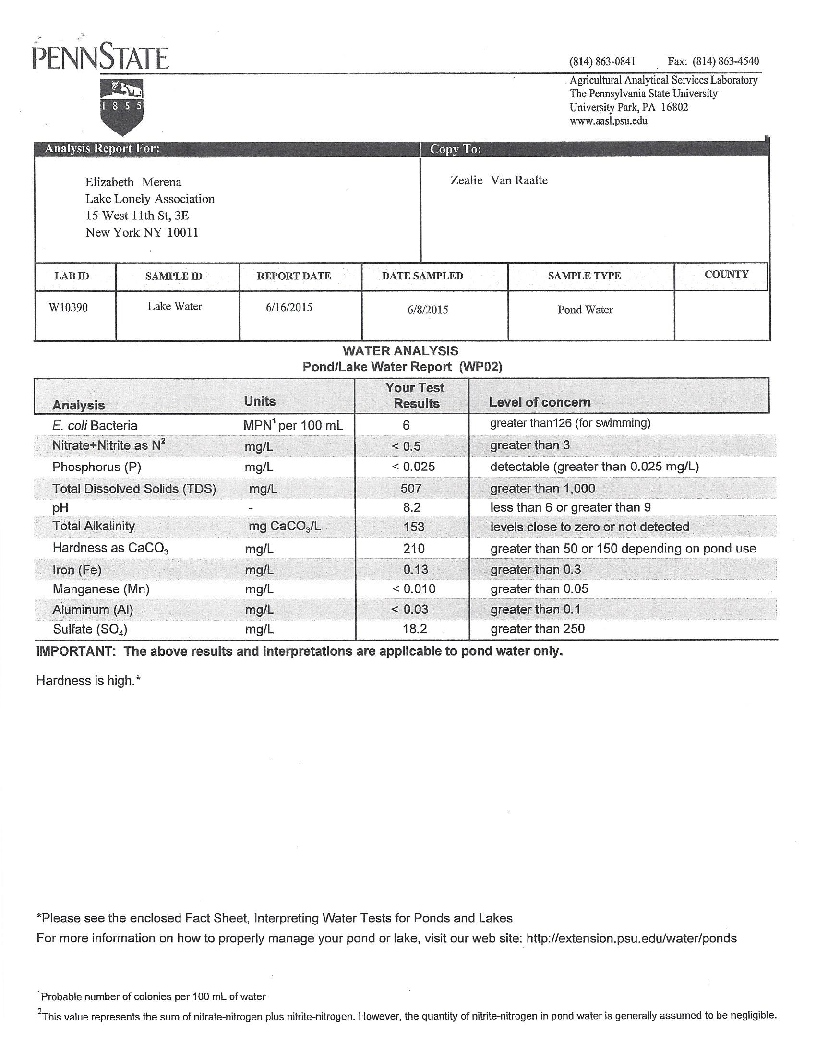
According to Mr. Van Raalte, overall, Lake Lonely is currently in pretty good shape. One of the members of his group submitted a water sample to Penn State with the following results.

As further proof of the success of LLIA in managing the lake he furnished me with this picture of one of his sons holding a fish called a pike (toothy critters).

Water is a precious and finite resource. Wise stewardship of this resource can be a complicated issue. Lake Lonely is fortunate to have the oversight of both the public sector and private individuals to address the challenges of keeping this body of water healthy.
Links To TV Coverage
From The Times Union
Saratoga Springs protesters: ‘Sitting is not a crime’
New Saratoga Springs law meant to unblock sidewalks is called “silly,” “ludicrous”
By Tim O’Brien | on June 11, 2016
Saratoga Springs
Protesters took a seat on the steps of City Hall Saturday to object to a new law that bans sitting on sidewalks.
Some 70 people sat talking, holding signs and listening to a few people with guitars sing and play.
“Sitting is not a crime!” Randall Deschamps wrote on the sidewalk outside City Hall.
“It’s a ludicrous law,” he said. “It totally blindsided the community.”
The City Council approved the law 4-1 Tuesday with Mayor Joanne Yepsen the sole dissenter. A second offense would be a misdemeanor, making it a crime. Protesters said the law unfairly targeted the homeless, despite council members’ claims that was not their intent.
“When the law was passed, no one talked about bankers and lawyers in three-piece suits blocking the sidewalk,” said Linda LeTendre of Saratoga Springs. “They talked about vagrants, the homeless and people in need of hygiene.” The way to address issues of homelessness is not to ban sitting on sidewalks, she said. “The problem is not here in the community. It’s further up the line,” she said. Corporations and the wealthy get out of paying taxes, resulting in cuts in programs to address mental health care, addiction and other causes of homelessness.
“Homelessness isn’t the problem,” LeTendre said. “It’s the result of the problem.”
Rachel Lauber of Valley Falls said she travels to Saratoga Springs often. “I’ve never, ever, ever noticed any problem with vagrancy or panhandling,” she said. “Targeting people who have no means and threatening to fine them seems kind of silly.”
Karen Carmeli, Chris Gockley and Stephen Dornbush of Albany sat together during the protest. “We found out about the ordinance that was passed and were horrified,” Carmeli said. People pushing strollers or texting as they walk are more of an impediment than people sitting on sidewalks, Carmeli said.
Dornbush said money should be spent on prevention and treatment.
Police Chief Gregory Veitch, who stood across from the peaceful protest, said he doesn’t expect arrests under the law. “I would not expect the police to be vigorously enforcing this ordinance,” he said. There are other tools to address the issues raised of people blocking the sidewalk, engaging in disorderly conduct or aggressive anhandling, he said.
“Generally sitting on the sidewalk is not a problem,” he said.
From The Gazette Newspaper
SARATOGA SPRINGS
Standing up for sitting down
Sidewalk law protested
BY DANIEL FITZSIMMONS Gazette Reporter
Protesting a new ordinance that outlaws sitting or lying on the sidewalk, dozens of Saratogians took to Broadway and planted themselves on the steps of City Hall and the surrounding sidewalk.
According to the ordinance, passed Tuesday, a person sitting or lying on the sidewalk would be issued a warning, and, if they refused to move, could be slapped with a violation and a $50-$100 fine. Second and third offenses, depending on how many days had passed since a prior offense, could result in a misdemeanor charge, $500 fine, and up to 30 days in jail.
Randall “Chalk Boy” Deschamps remembers hearing about the ordinance a few hours before it was to be voted on by the City Council.
“I was totally blown away,” said Deschamps, who attended the meeting June 7 to voice his opposition, but said the decision seemed to have already been made. “I think it was pretty obvious they already had their minds made up before the meeting.”
The measure was passed 4-1, with Saratoga Springs Mayor Joanne Yepsin dissenting. Yepsin could not be reached for comment Saturday.
The ordinance, which city officials have said was designed with public safety in mind and meant to prevent people from obstructing foot traffic on the sidewalks, was widely criticized by residents who say it purposefully targets the homeless.
Deschamps remembers being thrown out on the streets of Saratoga as a boy.
“I was an 8-year-old throwaway,” said Deschamps, 58, “back when it was legal to get thrown out on the streets. Now it’s not, thank God.”
Now, 50 years later, he’s sporting long, whitish-gray dreadlocks, hands coated in a layer of chalk dust, no longer homeless but scribbling a message in support of the homeless on the sidewalk in front of City Hall.
“Sitting is not a crime,” he wrote.
Deschamps said Saratogians should take photos and videos any time they see the law being enforced and put their footage online. He said residents should also call City Council members and voice their opposition to the ordinance any chance they get.
“Eventually the council will get tired of hearing about it,” Deschamps said.
Saratoga resident Cathie Commerford said the homeless should not be punished.
“We need to do something about our homeless, not make new laws against them,” said Commerford. “We are a tourist town and we need solutions, but this isn’t it.”
Saratoga resident Nichole Baldwin said there’s no getting around the fact that city councilmembers were targeting the homeless.
“I think that the law they made this week needs to be challenged,” said Baldwin. “I think it targets homeless people and makes life harder for them.”
“They sometimes ask for money but I’ve never been bothered by them,” said Baldwin of panhandlers.
“I’ve had more of a problem with drunken tourists,” said Baldwin’s friend Dana Denison, who brought her 2-year-old daughter Samara to the protest.
Baldwin said Saratoga needs more funding for shelters and Denison said the homeless could use more psychiatric care.
“Fining them doesn’t make sense,” Denison said.
S a r a t o g i a n s T a m m y D’Ercole and Mary Mahoney also came out against the measure, and could be seen Saturday evening sitting with signs in front of City Hall criticizing the ordinance.
D’Ercole said she’s lived in Saratoga her whole life and doesn’t see the homeless as a problem.
“It’s shameful for this town to ignore the homeless problem and then punish them,” said D’Ercole.
The “root problem,” she said, is addiction and mental illness.
“We need to not hide them away … getting them services is the solution,” D’Ercole said.
Mahoney said Saratoga has a lot to be proud of in terms of helping the homeless, touting a program called Code Blue that gets homeless off the streets in freezing temperatures, but thinks this ordinance is regressive. “I see it as an imposition against civil rights,” she said.
Mahoney said the community is staging another protest on Friday, June 17, at 6 p.m. in front of Lillian’s Restaurant along the heart of Broadway.
Some in the crowd, which at one point swelled to about 70 people, sang songs and played ukuleles and guitars while others held protest signs. Most talked in small groups and fielded questions from a halfdozen reporters.
One protester, who gave his name only as Craig, was asked if he was prepared to get arrested if police ordered the crowd to disperse. “I guess,” he said. “I don’t have anything going on tomorrow.”
But it wouldn’t likely come to that. Police Chief Gregory Veitch, standing on the other side of Broadway in front of City Hall, surveyed the amiable gathering and didn’t seem worried about crowd control.
“They’re being peaceful and we don’t anticipate making any arrests tonight in connection with the protest,” Veitch said. He indicated that enforcing the new measure was not a huge priority for the department, but noted that “the law is the law.”
“I would not anticipate that the Police Department will aggressively enforce the ordinance that was just passed,” said Veitch. “We’ll defi nitely be using our discretion.”

ERICA MILLER/GAZETTE PHOTOGRAPHER
Protesters take part in a sunset sit-down at Saratoga Springs City Hall on Saturday. They are upset over a change in city code that bans sitting on the sidewalk and blocking pedestrians. See a photo gallery at
.

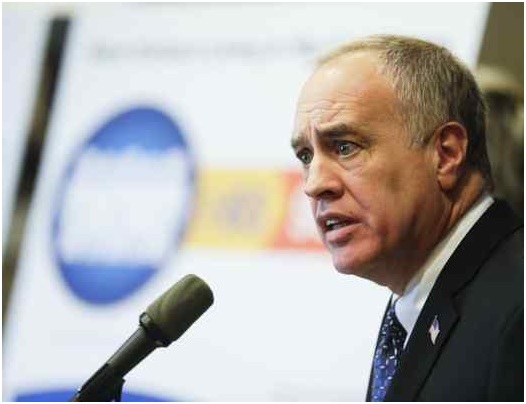
New York State Comptroller Thomas DiNapoli speaks at a news conference in Febuary. DiNapoli issued a report Friday saying the future of the New York Racing Association is uncertain. File photo
By Paul Post, The Saratogian
Posted: 06/10/16, 12:26 PM EDT | Updated: 11 hrs ago
SARATOGA SPRINGS >> State Comptroller Thomas DiNapoli says New York Racing Association is not financially viable without gaming revenue from Aqueduct Racetrack’s casino, despite NYRA’s claim that it realized profits the past few years.
An audit DiNapoli’s office released Friday faults NYRA’s auditing techniques and says the firm that runs Saratoga Race Course, Belmont Park and Aqueduct has actually racked up a $109 million deficit the past five years.
But NYRA officials, in a response made April 25, defended its practices, business model and fiscal condition.
The audit finds no fault with a state-appointed Franchise Oversight Board responsible for monitoring NYRA’s budget and financial practices.
The report came out one day before Saturday’s Belmont Stakes, the biggest day of the year on New York’s racing calendar.
“There are important decisions being made about NYRA’s future right now,” comptroller’s spokesman Mark Johnson said. “We wanted to provide information to help the Legislature and governor with those decisions.”
However, there are just four business days left in the current legislative sessions, which is scheduled to end Thursday.
Johnson said it took time for DiNapoli’s office to respond to the comments NYRA made six weeks ago.
NYRA and Gov. Andrew Cuomo have been at the center of a firestorm of controversy since Tuesday when John Hendrickson, Cuomo’s racing advisor, resigned in protest of the governor’s handling of New York’s thoroughbred industry.
Cuomo has called for a NYRA board makeup that would continue the state’s influence over the firm — it currently has 12 state appointees — and eliminate some of the money NYRA gets from Aqueduct’s casino.
Under NYRA’s franchise contract, the state agreed that NYRA should receive a percentage of gaming revenue each year for operations, purses and capital projects.
DiNapoli said: “NYRA relies on video lottery terminals to stay in the black, but that revenue stream isn’t guaranteed to continue as strongly, especially as new casinos open up across the state. NYRA needs to come up with a plan to make money on racing operations, especially as it seeks to return to private control. Without such a plan, NYRA’s long term solvency could be a long shot.”
If DiNapoli is correct in saying that NYRA depends on gaming revenue, then Cuomo’s plan — if approved — could have dire consequences for NYRA.
Johnson, the comptroller’s spokesman, said the audit was prepared “without any consultation with the governor’s office whatsoever.”
“The bottom line is, NYRA will be destitute without VLT (video lottery terminal) money,” Hendrickson said Friday. “It’s part of their business plan.”
He called DiNapoli’s audit “another cheap shot, released by an Albany politician, the day before the Belmont.”
“The governor’s budget director was on the NYRA board,” Hendrickson said. “It sounds like DiNapoli is saying Governor Cuomo’s government-appointed board failed? If so, why would we now want even more of the same? I believe this audit illustrates that stealing VLT funds makes no sense if you truly care about NYRA’s financial health.”
“NYRA had received a clean audit from KPMG (a global auditing firm) for the past four years,” Hendrickson said. “NYRA uses the same accounting practices as New York government agencies. NYRA and the comptroller disagree on how the money is shown on a balance sheet. But the bottom line is the report showed the legally owed VLT mortgage payments are vital to racing’s survival. The VLT money is contractually owed for land that was given to the state. They are not support payments. They are mortgage payments.”


By Stephen Williams June 10, 2016 | Updated June 10, 2016 10:30 p.m.

PHOTOGRAPHER: MARC SCHULTZ
Members of the board of directors for the The New York Racing Association, Inc. (NYRA) met at the Holiday Inn in Saratoga on Wednesday August 12, 2015.
SARATOGA SPRINGS — A new state audit came down hard on the New York Racing Association on Friday, saying it continues to lose money on its traditional thoroughbred racing operations.
While NYRA has reported profits for each of the last three years, the audit by state Comptroller Thomas P. DiNapoli said that was only due to revenue from the video lottery terminals at Aqueduct in Queens.
“NYRA relies on video lottery terminals to stay in the black, but that revenue stream isn’t guaranteed to continue as strongly, especially as new casinos open up across the state,” DiNapoli said.
DiNapoli also questioned some of NYRA’s expenses, including a $250,000 bonus paid to President and CEO Christopher Kay.
NYRA officials strongly defended their organization, which runs the horse-racing tracks at Belmont, Aqueduct and Saratoga Race Course, where the annual summer meet starts July 22.
“The purpose of the OSC’s audit was to determine if NYRA received, spent and accounted for its revenues and expenses properly, and the OSC’s report clearly states that we did,” said NYRA spokesman Patrick McKenna. “This finding has been previously reported by our accounting firm, KPMG, who has issued a ‘clean audit’ for each of the last four years.”
The audit’s release comes on the eve of NYRA’s biggest annual event — the Belmont Stakes — and as the state Legislature and Gov. Andrew Cuomo debate how to return the organization to private control after four years under state supervision.
NYRA’s return to profitability after years of losses, a bankruptcy, and management scandals are central to NYRA’s argument that it should be allowed to return to private control. It has been under the control of a state Franchise Oversight Board since 2012.
Despite the claim of overall profitability, DiNapoli said racing operations, taken alone, lost $109 million over the last five years.
The profit claimed by NYRA is only possible, the audit said, because NYRA is excluding employee retirement and post-employment health care costs from its calculations.
“NYRA needs to come up with a plan to make money on racing operations, especially as it seeks to return to private control,” DiNapoli said. “Without such a plan, NYRA’s long-term solvency could be a long shot.”
In a written response, Joseph J. Lambert, NYRA’s senior vice-president and general counsel, noted that a 2008 bankruptcy settlement guarantees VLT money to NYRA for the rest of the term of the franchise — through 2033,
“Both the ‘state settlement agreement’ and the existing statutory framework found in New York State Tax Law utilizes VLT revenues as a means to support the thoroughbred and standardbred racing industries in New York State,” Lambert said.
“There was never any requirement, contrary to the OSC claim, that NYRA must have a budget that determines profitability exclusive of those VLT funds. Instead, NYRA has used those funds to support jobs in the state’s agriculture and tourism sectors, and also serve as the cornerstone of the horse racing industry in New York, an industry that generates a $2 billion economic impact.”
Over the three years covered by the audit — 2012, 2013, and 2014 — the auditors found that NYRA received $318 million from the VLTs, with $68 million going to racing operations, $91 million to capital programs, and $159 million to racing purses, which are paid out to horse owners.
The Assembly and Senate and Gov. Andrew Cuomo’s office are actively discussing legislative proposals to reprivatize NYRA, with a goal of resolving the matter in Thursday’s scheduled adjournment of the Legislature.
Maureen Lewi, chairwoman of the Concerned Citizens for Saratoga Racing, said the timing of the audit as the Legislature debates privatization raises questions about the role of politics in its release, and the role politics could play in the future if NYRA isn’t returned to private control.
The concerned citizens group favors a return to private control. Lewi said it was unfair to judge NYRA’s finances without the VLT revenue, since the state promised it in return for NYRA giving up ownership claim to three tracks, including Saratoga Race Course.
“NYRA’s overall condition is sound because of VLT revenue,” she said. “That’s exactly our point.”
In NYRA’s telling, it made $1.7 million on racing operations in 2014 and $3.6 million in 2015. But DiNapoli said that that profit calculation didn’t include pension and retiree health insurance costs, and should have.
The auditors and NYRA officials differed on whether Kay had clearly met the measures used to qualify him for a $250,000 bonus in 2014, after one year on the job. Kay’s base salary that year was $300,000.
Based on the audit, DiNapoli recommended that NYRA develop a long-term plan to eliminate deficits on racing operations, as well as consider other measures to increase financial accountability.
I recently emailed Justin Hogan who is chair of the city’s Ethics Board. I was inquiring about two matters.
First was a follow-up regarding the Ethics Board’s decision on the issue of ex parte contacts. In an earlier blog I have discussed this extensively. Basically, according to the standards issued by the New York State Department of State, discussions between applicants to land use boards and members of land use boards are considered improper if they occur outside of a regularly scheduled public meeting or are in correspondence not available to the public. Some months ago the Ethics Board had issued an opinion that was inconsistent with this principle.
The Second was over when he expected the board to reach some decision regarding the complaint (The Ethics Board uses the euphemism inquiry) made to the board over the apparent solicitation for business by Mayor Joanne Yepsen to Saratoga Hospital while the hospital had business before the City Council.
Mr. Hogan replied in a manner consistent with my past experiences with him. He avoided acknowledging the question related to the Mayor. He referred me to the Ethics Boards procedures and advised me to check their agendas.
I subsequently followed up with him and asked what the procedures were for scheduling meetings. He responded by citing the same procedures again. This time he included that they are only required to meet quarterly. He said that they try to post the agendas on the city website as soon as they are circulated.
The sustained pattern of these kinds of responses prompts the suspicion that Mr. Hogan, who is employed by a firm that does lobbying and public relations for politicians, seems disinclined to make his board cooperatively accessible to the public. With that in mind, I decided to explore in general, how his board functions and in more particular, how I might successfully attend a discussion of the ex parte issue, should they decide to address it again. It turns out that, assuming the Ethics Board even takes up the issue of ex parte, it will require considerable luck to successfully attend the meeting.
There is no way to anticipate when the Ethics Board meets
Section 3.0 of the Ethics Board procedures is entitled LOCATION, DATES AND TIMES OF MEETINGS. Under item 3.1 it states:
3.1 There shall be regular and special meetings of the Board of Ethics conducted consistent with the requirements of the Open Meetings Law
One might deduce from the term “regular” that this board meets on a predetermined day or days each month as does the City Council and the other officially sanctioned boards. Apparently this is not the case with the Ethics Board. Going back to March, the committee has met on February 1, March 10, April 12, and May 2.
February 1 was a Monday. March 10 was a Thursday, April 12 was a Tuesday, and May 2 was a Monday. To date, no agenda has been posted on the city’s web site as to when or if there will be a June meeting.
They could, like most boards, use a particular day of the month, and in the event that they have no business, post that the meeting will not occur.
According to the Ethics Board procedures:
3.3 The City Attorney’s office shall arrange for the posting of public notices of meetings of the Board in such locations as are reasonably calculated to inform the public who desire to attend the meetings.
There is nowhere on the city website devoted to the Ethics Board that advises you where to look for the postings of their meetings. It seems the only way to find out if a meeting is occurring is to discover an agenda has been posted which contains the time and place of the meeting but as we shall see not much else.
Unlike every other board in this city the only notice to the public is an agenda that should (not must) be posted three days before they meet.
The following from section 4 of the board’s procedures addresses agendas:
4.0 PREPARATION AND DISTRIBUTION OF AGENDAS FOR MEETINGS
4.1 The chair of the Board of Ethics shall establish and distribute the proposed agenda for regular meetings of the Board.
4.2 To the extent practicable [my emphasis], the chair shall distribute the proposed agenda and relevant materials to the members of the Board of Ethics not less than three days prior to the date of the meeting at which the agenda will be considered. No item on an agenda shall be ineligible for consideration by the Board solely on the basis that the agenda and materials were distributed less than three days prior to the date of the meeting. [my emphasis added]
So this section has the stern admonition that the agenda shall be distributed “not less than three days prior to the date of the meeting…” Unfortunately, it also has the caveat that this will be done “To the extent practicable.” I cannot think of any other board or the City Council with this kind of caveat. But this is not enough. The chair, Mr. Hogan, still has the right to add items for the meeting to address even after the agenda has been distributed.
Since on its face, the agendas appear to be the only notice to the public of their meetings, if this is true, the public only has three days notice as to when the Ethics Board is going to meet (remember there is no given day of the month) so in order to attend their meetings one would have to check the city website almost daily. In fact, there is nothing on the city website that indicates when these agendas were posted so there is no way of telling whether they met the three day notice goal.
The Agendas Offer No Insight As To What Will Transpire At A Coming Meeting
The next issue is the utter lack of specificity in the agendas. The following are the published agendas for the period March through May.
Saratoga Springs Board of Ethics
Agenda
Monday, February 1st 2016, 5:00 p.m.
Public Safety Conference Room, 2nd Floor, City Hall
Saratoga Springs Board of Ethics
Agenda
Thursday, March 10th 2016, 5:3 0 p.m.
Public Safety Conference Room, 2nd Floor, City Hall
Saratoga Springs Board of Ethics
Agenda
Tuesday, April 12th 2016, 5:30 p.m.
City Council Chambers, City Hall
Saratoga Springs Board of Ethics
Agenda
Monday, May 2nd 2016, 5:30 p.m.
City Council Chambers, City Hall
Note both how similar and uninformative these agendas are
So, how dear reader will checking their agendas, as Mr. Hogan advised me to do, tell me whether an upcoming meeting (should I have the luck of finding out when a meeting will be held) will include a discussion of ex parte?
Contrast the Ethics Board agendas with the Zoning Board of Appeals Agenda (I have actually abbreviated the ZBA agenda for reasons of space):
Monday June 6, 2016 – 7:00PM City Council Room
Workshop
Salute The Flag
Role Call
New Business
#2894 LAWRENTZ HOME OCCUPATION
126 Crescent Street, area variance to construct a detached garage with second-story music studio; seeking relief to permit a home occupation within a residential accessory
structure in an Urban Residential – 2 District.
2894 LAWRENTZRESIDENCEHOMEOCCUPATION_APP_REDACTED.PDF, 2894 LAWRENTZRESIDENCEHOMEOCCUPATION_ADDTLINFO.PDF
#2896 ICE HOUSE TENT
[description which I removed]
2896 ICEHOUSETENT_APPLICATION_REDACTED.PDF
#2897 CITY COTTAGE, LLC LOT LINE ADJUSTMENT
[description which I removed]
Old Business
#2880 ARMER/DESORBO RESIDENCE
[description which I removed]
#2856.1 MOORE HALL REDEVELOPMENT
[description which I removed]
#2890 BARLOW RESIDENCE
[description which I removed]
#2892 RUTHMAN RESIDENCE
[description which I removed]
#2895 NEEDHAM/KILMER RESIDENCE
[description which I removed]
#2893 223 LAKE AVE. LLC HANDICAP RAMP
[description which I removed]
#2889 CDJT DEVELOPMENT MULTI-FAMILY
[description which I removed]
#2759.1 ANW HOLDINGS RESIDENTIAL DEVELOPMENT
[description which I removed]
6:30 P.M.
Documents:
#2759.1 ANW HOLDINGS RESIDENTIAL DEVELOPMENT
[description which I removed]
2759.1 ANWHOLDINGCONDOS_APP_REDACTED.PDF, 2759.1 ANWCONDOS_CORRTINGLEY5-23 -[description which I removed]
16.PDF, 2759.1 ANWHOLDINGSCONDOS_CORRJVALETTA_RECVD3-9 -16_REDACTED.PDF, 2759.1 [description which I removed]
Adjourned Items
#2856 MOORE HALL
28 Union Avenue/35 White Street, area variance to convert the existing building to a 53- unit apartment building; seeking relief from the minimum lot size and minimum parking
requirement in the Urban Residential – 4 District
Other Business
APPROVAL OF DRAFT MEETING MINUTES – MAY 9
NEXT ZONING BOARD MEETING: JUNE 20, 2016
Note: This agenda is subject to change up until the time of meeting. Updates will be reflected here as they arise. Check posted agenda here to verify the actual agenda prior to the
meeting. [I have made this large and bold to contrast it with the procedures of the Ethics Board]
The Minutes Of The Meetings Hide What Issues Are Addressed
Then there is the matter of the Ethics Board minutes. I have reviewed the last four months of minutes from their meetings. The only recording of anything that one might call substantive (if one were generous) is the one paragraph devoted to the discussion at their April 12 meeting attended by City Council members Mathiesen, Franck, Madigan, and Scirocco over the meaning of the Ethics section that deals with soliciting business.
What is really striking is their policy of referring to complaints/inquiries in their minutes using numbers rather than names and descriptions. As far as I could ascertain, there is no place to find out what these numbers actually refer to. In the May 2nd minutes is the following item:
My guess is that #6 is the complaint aka “inquiry” regarding Mayor Yepsen and the hospital, but I challenge the readers of this blog to comb the city’s website to find out what this number 6 actually refers to.
So to summarize:
A Quiz:
Review the four agendas above and try to determine at which of these meetings if any the Board of Ethics took up the complaint regarding Mayor Yepsen and Saratoga Hospital
More to come on the Ethics Board to come.
[Governor Andrew Cuomo has never been a fan of horse racing.
There was an effort to expand casino gambling in New York about twenty some years ago. The campaign to block the expansion then was led and partially funded by the horse racing industry in general and by NYRA in particular. At the time in Saratoga Springs, in contrast to recent history, the Chamber of Commerce allied with NYRA in aggressively opposing casino expansion in New York.
One of the first things Governor Cuomo did as part of his recent successful campaign to expand casinos was to remove control of NYRA from its independent board and replace it with his own. Parenthetically, there had been serious mis-management at NYRA which the Governor shrewdly exploited.
The Governor has promised that the state will reap large sums of money from the new casinos being built. If anything, horse racing is a competitor for gambling revenue which one assumes he would prefer to go to the casinos.]

Cuomo’s racing plan blasted by horse owners, former board members
Gov. Andrew Cuomo FILE
By Paul Post, The Saratogian
Posted: 06/09/16, 5:05 PM EDT | Updated: 11 hrs ago
SARATOGA SPRINGS >> A prominent Saratoga horseman says New York Racing Association could be “held hostage” under Gov. Andrew Cuomo’s plan to reprivatize the firm that runs Saratoga Race Course, Belmont Park and Aqueduct Racetrack.
Cuomo unveiled a proposal Wednesday that would cap the money NYRA gets from Aqueduct’s casino and require NYRA to each year ask the state for a $16 million capital spending appropriation.
“That’s ridiculous,” said Jack Knowlton, Sackatoga Stable managing partner. “You can’t depend on anything happening from one year to the next when the governor and Legislature are involved. He could hold NYRA hostage by saying, ‘OK here’s the money, but you’ve got to do X, Y or Z to get it. That’s undue influence.”
Cuomo’s plan differs greatly from bills in the senate and assembly that call for a 15-member NYRA board with two appointees by the governor and one each by the assembly and senate.
Cuomo wants six appointees on a 17-member board. Two of these would be recommended by the assembly and senate.
He also wants to name the board chairman, and the state Franchise Oversight Board that monitors NYRA’s financial issues would have expanded powers.
So while NYRA would be returned to private control, which Cuomo called for four years ago, the state is far from letting go.
Legislative leaders and the governor’s office are now left to reach some kind of compromise before the session ends next Thursday.
The most contentious issue is Cuomo’s attempt to wrest money away from NYRA that it gets from Aqueduct’s large casino.
In 2008, when NYRA was awarded a new 25-year franchise to run racing, the contract called for it to receive a set percentage of gaming revenue each year, with some going to operations, capital projects and purses. Cuomo now wants to cap this amount at $46 million per year, with anything over that going to fund education.
“Basically it’s changing the rules after they’ve been set,” Knowlton said.
On Tuesday, John Hendrickson resigned as Cuomo’s special racing advisor, citing frustrations with the governor’s policies that he said are hurting Saratoga and New York’s thoroughbred industry.
He was even more critical after reviewing Cuomo’s plan for NYRA, released a day later.
“It’s worse than I imagined,” Hendrickson said. “It’s the end of Saratoga as we know it. Purses will go down, admission prices will go up and giveaways will go away.”
His wife, Marylou Whitney, said, “I’ve spent most of my life trying to help Saratoga. I truly believe Gov. Andrew Cuomo is trying to hurt us. I’m confident his father (former Gov. Mario Cuomo) would not have condoned this action.”
Former NYRA board member Charles Wait of Saratoga Springs echoed similar sentiments.
In October 2012, Cuomo created a 17-member NYRA Reorganization Board with 12 state appointees, but charged the group with returning the firm to private control within three years.
“This is not what the governor promised,” Wait said. “Expanding control of NYRA’s budget, putting six people on the board and impounding money – that’s not privatization, it’s communism. It clarifies the reasons John Hendrickson left. The governor never was serious about keeping his word.”
For some reason, John Witt has continually adjourned his application. He adjourned the application for the March 7 meeting, for the March 21 meeting, for the April 11 meeting and now he has adjourned it for the June 6 meeting.
I emailed him on June 4th asking him if he could share why the project has been continually postponed. I received no response so I emailed him again on June 6 reminding him of my earlier email and asking him to respond. Below is our subsequent exchange of emails. I have yet to receive a response from John Witt explaining the many adjournments of his proposal. When I do I will publish it.
From: John Witt [jwitt@wittconstruction.com]
Sent: Monday, June 06, 2016 5:46 PM
To: John Kaufmann
Subject: RE: Responsive
Sorry – I have been busy….
We have a great Parade of Homes opened this weekend.
Last time I responded within hours and you lied and said I didn’t respond in you blog… I asked for you to meet and review the project and you refused.
John I am happy to help… but blatantly did not tell the truth in your blog which produces lost respect.
Headed for a bike ride – enjoy your night!
JW
John Witt, President
Witt Construction, Inc.
From: John Kaufmann [john.kaufmann21@gmail.com]
Sent: Monday, June 06, 2016 6:40 PM
To: ‘John Witt’
Subject: RE: Responsive
I apologize if you responded to a request and I criticized you on my blog for not doing so. I have no recollection of this. Could you send me the copies of the correspondence? I would be happy to correct the record.
As to not meeting with you, I am familiar with your project and think it would be a waste of both our time to meet about it as currently proposed. If, on the other hand, you are open to downsizing the project, I would be happy to meet with you to discuss what new ideas you might have for the property.
From: John Witt [jwitt@wittconstruction.com]
Sent: Monday, June 06, 2016 9:39 PM
To: John Kaufmann
Subject: Re: Responsive
Great – I have new conservation project in the town of Saratoga that I am proposing to repurpose lush a farm and leave wooded and farm land in perpetuity. Best to meet in person at the office. Please let me know what works.
Dowton Walk will be a great example of urban planning. The mixed sized buildings and scale does fit into the neighborhood! Let’s talk about Dowton Walk after it is built.
Look at your email and blog post timing… If you want to visit history… I responded to your email within I think 2 hours and after that you blogged I would respond…. Not cool!! If you respect you should act professional and responsible… I lost respect for you! You did work with my mother and I did have great respect for you. Not any more. I am happy to put this behind us.
Cheers, JW
From: John Kaufmann [john.kaufmann21@gmail.com]
Sent: Tuesday, June 07, 2016 8:42 AM
To: ‘John Witt’
Subject: Posts and Questions
On March 12, 2016, I emailed you asking you to explain why you had written to the neighbors of your Downton Walks project saying you were applying for three variances when it appeared you were applying for more. On the same day you posted back saying that you would submit a comment and asking me to call you. I responded back that same day and explained I was in London so I could not call you.
On the evening of March 13, having not heard from you further, I published my post regarding your project. At the end of the post I noted the following:
In an effort to be fair to Mr. Witt, I emailed him offering to publish any defense he would like to offer regarding his letter (see below). To date I have not received any sort of rebuttal. Should I receive one, I will publish it.
This was technically true as I had only received your email saying you planned to respond. In fairness to you I should have told the readers this that I had received an email indicating you planned to respond. On March 14th (the next day) I did receive and publish without editing or commenting the full text of your rebuttal.
With respect, you still have not answered my question, why have you postponed most of your appearances before the ZBA over the last four months? You adjourned your application on March 7th, March 27th, April 11th, and June 6th.