I have been working on a post regarding the recent primary between Saratoga Springs Mayor Ron Kim and Democratic challenger Chris Mathiesen. My work has been hampered by the failure yet again of Ron Kim to comply with New York State’s campaign spending reporting requirements.
Under the New York State Board of Elections statute, the recent candidates in the June 28,2023, primaries were required to report their final contributions and expenditures by July 17, 2023.
While Chris Mathiesen filed as required. There was no report available for Mayor Ron Kim’s campaign organization.
In 2021, Kim failed to meet the November 29, 2021, deadline for filing. I wrote about this at the time. Kim told the Times Union that he had filed, but technical problems at the state board of elections were the reason it was not available. I contacted the NYSBOE, and they told me there were no problems with their website. They told me that if he had filed, the information would be on the site.
The following image is from the Saratoga Springs Democratic Committee’s Facebook page.
Democrats Working Against Montagnino
This is from Ron Kim’s Facebook page promoting a different Public Safety Commissioner candidate, Kristen Dart:
Kristen Dart announced the launching of her campaign for Public Safety Commissioner on her campaign page, and both Democrats Dillon Moran (a Democratic Committee member ) and Minita Sanghvi “liked” it.
For months the Saratoga Springs City Council has stumbled from one poorly crafted resolution to the next in a so far failed attempt to adopt a document that would accept item #41 from the Police Reform Task Force Plan of 2021.
At their July 6, 2023, meeting the Council failed to pass a resolution for the third time.
A Brief Review Of The Failed Resolutions Histories
Item #41 of the Police Reform Task Force reads:
“Divert all seized proven drug profits from convicted drug charges to Community Based Restorative Groups for conflict resolution.Reinvention Plan: Toward a Community Centered Justice Initiative,
February, 2021 Police Task Force Recommendation #41
I have documented the torturous history of Task Force Recommendation #41 in previous posts (Link 1, Link 2),but here’s a brief review.
This item was problematic from the beginning. During the deliberations of the Police Task Force, then police Chief Shane Crooks tried unsuccessfully to explain to the Task Force that recommendation #41 as drafted would conflict with state and federal regulations on the use of forfeiture money. The task force ignored the chief’s concern without any effort to determine its validity.
In the previous administration’s deliberations on adopting the Police Reform Task Force’s recommendations in 2021, then City Attorney, Vince DeLeonardo, advised Meg Kelly and the Council of the problem with #41, and it was not adopted.
The local Black Lives Matter group pilloried Kelly and the then Council for this.
In May, Finance Commissioner Sanghvi placed a resolution on the City Council agenda that would basically adopt item #41 as written. Sanghvi was apparently ignorant of the legal problems with this when she added it to her agenda. She was subsequently advised of its conflict with existing federal and state statutes, and she withdrew it at the meeting.
Mayor Kim placed a resolution on the June 20 Council agenda to adopt item #41 only to withdraw it during the Council meeting after Tim Coll, candidate for Public Safety Commissioner, pointed out further legal problems with this version.
One More Try!
So at the July 6, 2023, Council meeting Kim offered yet another version of a resolution to adopt #41. This time the resolution dealt only with the federal forfeiture program and ignored the state program. There was no acknowledgment or explanation as to why the state program was no longer part of the resolution. This is probably because of the inconvenient truth that the state program does not allow for its money to be used outside of law enforcement.
This time there was an actual discussion of the resolution.
The discussion took up some twenty minutes as commissioners asked questions and raised concerns.
Public Safety Commissioner Montagnino told the Council that the forfeiture money available for local use was limited to $25,000.00. He asserted that the administrative reporting requirements to use the funds were onerous, and the cost of record keeping and reporting probably cost as much to comply with as the money the city could receive. Presumably, if the money was less than $25,000.00, the situation would be even worse.
I spoke to retired FBI agent Tim Coll, who is running this year for Commissioner of Public Safety. He told me that the original forfeiture program was plagued by abuse in using the money. This is what prompted the rigorous and extensive reporting that is now required.
The revelation of the cost of reporting led to the obvious question of how much federal money might be involved. Neither Montagnino, who oversees the use of the funds nor Sanghvi, who is supposed to manage the city’s finances, knew. I find it interesting that no one on the Council thought to ask this question and get an answer before they spent all this time and energy repeatedly having this on the agenda.
This kind of down-the-rabbit-hole discussion was documented in the video above, where each question only raised more questions.
In the end, Kim withdrew the resolution for the third time, and Montagnino agreed to provide Sanghvi and the Council the numbers by the middle of August.
Just Another Example Of The Breakdown In Governance Of This Council
So now there will supposedly be yet another resolution (the fourth) sometime in the future.
The discussion at the Council table revealed that for over two months and multiple resolutions, there has been little in the way of either legal research or any conversation between the Commissioners about it.
Readers should understand that this kind of serial failed resolution was pretty much unheard of in the past.
This is because, as I have documented in my previous blogs, past administrations would raise concerns at the public pre-agenda meetings held the day before the regular meetings. The deputies used to attend these meetings and, at times, other staff members if needed to give information about pending resolutions. Questions about resolutions would be raised and either addressed, or the item would be withdrawn then rather than at the regular meeting. This allowed issues to be addressed and resolved later rather than taking up time unnecessarily at Council meetings discussing a resolution that wasn’t going to go anywhere.
Pre-Agenda meetings with the current Council are now a ritual where there is rarely any discussion. Council members simply read the names of their resolutions rather than engage in substantive conversation. This failure by current Council members to prepare for Council meetings by communicating and doing their homework contributes to the marathon regular Council meetings we currently have.
Saratoga Springs City Attorney Michael Phillips presented data at the June 20 City Council meeting indicating the rate of Freedom of Information Law (FOIL) requests the city is receiving has doubled during the Kim administration. No one on the Council bothered to ask why.
The Facts And Nothing But The Facts?
Phillips repeatedly punctuated his presentation with the assurance that he was just laying out the facts and leaving it to others to “draw your own conclusions.” The problem is the Council was not interested in drawing any conclusions.
The facts Phillips presented comparing FOIL requests beginning with 2021 during the previous Meg Kelly administration with requests made during the Kim administration through June of this year (2023) are truly stunning.
Requests
Appeals
2021 (Kelly Period)
333
4
2022 (Kim Period)
557
21
2023 Jan-June (Kim Period)
315
7
Phillips observed that based on the demand so far this year, he projects 630 requests for 2023. The yearly rate of FOIL requests has just about doubled since Kim took office.
A Meaningless List
In his presentation, Phillips displayed slides showing who asked for five or more FOIL requests each year. He dubbed these “frequent flyers.” Phillips’ attempt to be witty seemed to imply that those people and organizations with the most FOIL requests were somehow abusing the system.
Finance Commissioner Minita Sanghvi then asked that he read aloud the names on the lists adding to the feeling that this was an attempt to somehow shame those who dared exercise their legal right to ask for city documents.
Sanghvi also wanted to know whether the most frequent person requesting FOILs in 2022 was a city resident. This seemed like an odd question. According to Phillips list many if not most FOIL requests come from companies or individuals doing business in the city and the law firms representing them. Obviously many of theses requests would be coming from individuals who may not live in the city.
Blogger’s Name Included in Phillips’ Hall of Shame
Although this blogger’s name got mentioned in Phillips’ presentation, I was not among the top FOILers. This blogger’s name did not appear in the list for 2021 “frequent Flyers” and is well down on the list for 2022 and 2023 .
The requests that put me on the 2022 and 2023 lists have been the result of the unwillingness of the members of this Council to respond to pretty much all my inquiries, whether by email or even asking questions during the public comment period at Council meetings.
The previous Council members were available, whether by email or telephone. The need to FOIL to get information during the past administration was minimal. So this explains the increase in my FOIL requests but what about the rest?
The Central Question That Went Unasked
As in the famous Sherlock Holmes story, The Hound of the Baskervilles, the most telling aspect of this part of the Council meeting was the question that was never asked:
Why did the requests for FOILs explode in 2022 and 2023?
The corollaries to this question are:
Why did Phillips’ investigation stop with the statistics rather than attempt to understand the source of the explosion?
Did the change in administration from Kelly to Kim factor somehow into the increase?
Why didn’t anyone on the Council ask Phillips if he had any idea about why the change?
Why didn’t anyone on the Council tell Phillips to extend his work by looking into the causes of the change?
The Real Purpose Of Phillips’ Presentation
Following Phillips’ presentation, Kim announced he would be seeking funding for yet another staff person for his office to handle FOILs. In hindsight, it is pretty clear that Phillips’ presentation was a pitch on the Mayor’s behalf to hire yet another employee.
As we have no idea why the FOILs increased, it is impossible to thoughtfully speculate about what can be done to address handling the number.
In its editorial on this issue, the Daily Gazette praised Kim for wanting to reduce the backlog of FOIL requests but asked whether there might be other ways to at least ease the problem other than hiring another employee:
To reduce the number of FOIL requests filed, city officials should look through the existing FOILs for commonalities.
If several people are requesting the same or similar information, or if the information being requested doesn’t require some kind of legal review, the city should consider posting that information on its website so people don’t have to formally request it.
This “proactive disclosure” can be done at little expense, the information only has to be posted once, and it cuts down on the number of FOIL requests that staff have to process.
Another tip: If the city has information that’s regularly requested, it should gather it in a single place and have it readily accessible to its clerks so they can respond faster to common requests.
City officials also should be more generous with releasing public information in general to avoid putting citizens in the position to having to ask for it in the first place.
Editorial June 26, 2023
There Is Something Seriously Wrong Going On
I honestly can’t think of any business or public organization I have dealt with that would not have pressed for answers as to why this increase occurred and whether there was some way of addressing requests for information that might ease this problem other than hiring more staff.
The fact that no one asked any serious questions only adds to the worry about how poorly this city is currently being managed.
The fact that FOILs have spiked during the last year and a half raises serious questions about how information is being provided to the public. This issue deserves proper investigation, but it is regrettably clear that there will be none.
For months, the Saratoga Springs City Council has been trying to pass a resolution that would implement item 41 from the list of reforms proposed by the 2021 Saratoga Springs Police Reform Task Force. The item reads:
“Divert all seized proven drug profits from convicted drug charges to Community Based Restorative Groups for conflict resolution.
Reinvention Plan: Toward a Community Centered Justice Initiative, February 26, 2021
The several bumbling attempts to address this Task Force recommendation illustrate the original magical thinking that produced the flawed item in the first place and the general disarray of the Council itself.
Recently retired Police Chief Shane Crooks, was on the Police Reform Task Force. At the time, he attempted to explain to his colleagues on the task force that the language for item 41 conflicted with state and federal law. The previous City Council and former City Attorney Vince DeLeonardis expressed similar objections when they were presented with this Task Force’s recommendation.
Task Force members simply dismissed Chief Crook’s concerns without doing any due diligence to determine whether he might be correct. Some Task Force members and Black Lives Matter activists responded to the Council’s reservations with angry demonstrations insisting on the adoption of all of the 50 recommendations.
In May of this year, Finance Commissioner Minita Sanghvi introduced a resolution to adopt task force recommendation #41. She, like the task force, ignored the need for due diligence. When, on the day of the meeting, someone informed her about the potential conflict with state and federal law, she withdrew it.
At the June 20, 2023, Council meeting, Mayor Kim again placed another problematic resolution on the city agenda to adopt this recommendation identified as “Resolution re:Forfeiture”
Public Safety Commissioner Candidate Tim Coll Addresses Forfeiture Issue
In the following video from that meeting, Tim Coll tried to explain to the Council why the resolution was flawed:
Withdrawn Again
Yet again, the resolution was then withdrawn, this time by Kim.
Kim Submits Meaningless Resolution For July 6, 2023, Council Meeting
Kim has now tweaked the resolution yet again in an attempt to put together something that will be both legal and that can pass. His new resolution reads, in part:
Whereas, to the the extent allowed under the Federal requirements for the dispersal of assets seized in controlled substance arrests and criminal activity, the Saratoga Springs Police Department, as the Administrator of the Federal Equitable Sharing Program is required to work cooperatively with the City Council to disburse these funds under Section B.1 (i) and (k) of the published guidelines for prevention, awareness and support of community based organizations to help fund community-based programs for community policing, treatment of addiction, homelessness and other restorative justice initiatives within the administrative requirements of these programs.
-Kim Resolution
This resolution could have been written for a Monte Python comedy skit on lawyers. What is the point of memorializing in a resolution that the police department is required to work cooperatively with the City Council? Maybe they should have a resolution that requires the police to protect the public from crime or that the fire department should put out burning homes as quickly as possible?
This resolution is a bone thrown to the Black Lives Matter group that has no meaning.
A Disservice To The Public
While it may have happened occasionally during past administrations, the withdrawal of resolutions during Council meetings has become a frequent event with this Council. We went through the same dance with this Council’s repeated tortured attempts to adopt the equally flawed Task Force proposal to ban no-knock warrants. And the result was a similarly meaningless resolution that BLM oddly then took a victory lap for.
It is grossly unfair to the public to allow an agenda item to be published on the city’s website only to be withdrawn at the Council table without a vote sometimes never to appear again. People concerned about a piece of legislation may go through the effort to attend a Council meeting and address the Council during the public comment period only to subsequently discover that it has been withdrawn and the effort to show up and address the Council was pointless.
A Breakdown In The Deliberation Process
During the Meg Kelly administration, resolutions were rarely withdrawn.
The reason for this was the effective way that legislation was vetted before Council meetings.
Agendas were posted on the Friday before the Tuesday Council meetings.
This provided the Council members the weekend to study what actions would be considered.
The Council then had a “pre-agenda” meeting on Monday morning where any questions or issues regarding proposed resolutions would be raised to address problems before the regular meeting.
During the administrations of both Meg Kelly and Joanne Yepsen, the city attorney, Vincent DeLeonardis, was allowed to truly act as counsel to all the city’s elected officials.
He would assist the Council members in crafting their resolutions to ensure ahead of time that these resolutions would not conflict with the city charter and state and federal statutes.
DeLeonardis built up trust among the Council members as a fair broker in doing his work.
This sound approach to crafting legislation has basically collapsed.
The two City Attorneys hired by Kim and subject to being fired by him now act as his personal attorneys rather than the Council’s.
The Monday agenda meetings are now brief affairs during which each member simply reads their agenda items. Unlike in the past, there are few if any questions and there is no discussion.
No Wonder There Is Chaos
So basically, there is virtually no review of agenda items, and any problems with resolutions are left to the night of the formal Council meetings. This contributes to the marathon Council meetings that go on for hours and often result in poorly considered legislation such as the three versions of the forfeiture resolution referenced above.
As the readers of this blog will know, Saratoga Springs Mayor Ron Kim and Finance Commissioner Minita Sanghvi were cited by the city’s Ethics Board for violating the city’s ethics code. Their respective campaign Facebook pages were linked to the city’s website. This is a violation of the federal Hatch Act and of the city’s ethics code.
You would think this would have sensitized them to the issue of mixing their campaign promotions with their roles as Council members.
You would be wrong.
A post from Sanghvi’s campaign Facebook page again appeared on the city website after this Ethics Board ruling. Instead of taking responsibility for this error, Sanghvi blamed a new employee in her office. She never explained or apologized for the previous postings.
Now Sanghvi has once more breached the wall that should exist between an officeholder’s role as an elected official and their campaigns for office. At the June 6 City Council meeting, Sanghvi live-streamed young people singing a song from their upcoming “The Sound of Music” production to her campaign page using her phone at the Council table.
While many will appropriately consider this a mild lapse, it speaks to the cavalier attitude that Commissioner Sanghvi has repeatedly demonstrated toward her work as Commissioner.
Some of us want our elected officials to be scrupulous in their duties while in office.
Commissioner Sanghvi never acknowledged her original violation of the city’s ethics code, so unsurprisingly, she continues to be oblivious to its importance.
In recent Saratoga Springs City Council meetings Saratoga residents have begun to raise concerns about the public’s ability to speak during the public comment period given the monopolization of the floor and disruptions of meetings by local Black Lives Matters activists.
In this post, I am presenting two brief videos from June City Council meetings.
The first is from the public comment period at the June 6 Saratoga Springs City Council meeting. A gentleman who identified himself as Jeff Gresavage expresses his support for the national mission of Black Lives Matter but expresses reservations regarding the tactics of the local group. He is shouted down by the local BLM activists.
The second video is from the June 20 meeting. Mary Beth Delarm addresses the City Council regarding their failure to maintain civil order at their meetings and expresses her concern regarding the undermining of democracy when citizens are discouraged from addressing their elected officials.
I spoke with Sonny Bonacio about his wife, Julie, and his involvement in establishing the recently opened low-barrier homeless shelter in Saratoga Springs on Adelphi Street.
Sonny told me:
“The encampment of homeless people at the city’s garage just seemed to be going from bad to worse. Everybody was talking about the problem of homelessness and the situation in the garage but nothing concrete seemed to be being done about it. Julie and I decided, ok let’s make something happen.”
Sonny told me he called on Meg Kelly, who works for him, to lead a team to actually do what needed to be done.
For the new shelter to happen, the hard and unromantic work that would bring it into existence needed to be done. There is no way to minimize the scale of the task they faced.
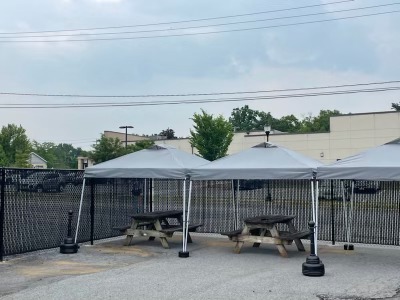
In addition to the $168,000.00 rent for the facility for two years provided by Sonny and Julie, the building required major work. It needed a hot water system to serve thirty individuals, air conditioning, a washer/dryer, fencing, an office, security cameras, furniture, etc. Most of this was paid for by Sonny and Julie.
Establishing the shelter meant:
Finding a location
Negotiating with the owner of the property that would be utilized.
Finding the money to pay the rent.
Determining what had to be done to retrofit the building to make it usable.
Finding the resources to pay for that work.
Enlisting the people to clean and paint the facility (a variety of RISE staff, Bonaccio people, and volunteers)
Finding the beds, tables, couches, etc. to make it attractive and habitable. (Steve Sullivan, the owner of the Olde Bryan Inn Restaurant, donated most of the furniture.)
All this came together with the opening of the new shelter on June 12.
This was what it looked like inside before:
And now after:
Humility and Acknowledgement of the Work of Others: A Rarity
So all the city needed to do to complete the establishment of this shelter project was to designate an entity to operate the facility and fund it.
Mayor Kim’s first response was classic. He crafted a resolution that violated New York State statutes for the award of contracts. The resolution committed the city to an indeterminant amount of public money to fund the project and arbitrarily named RISE the manager.
First of all, the award of work must be competitive. It required a request for proposals (RFP) to be executed before any award. This is not an autocracy. The Mayor does not have the authority to simply award work to a private entity no matter how laudable.
Second, the amount to be spent must be made clear and based on some publicly established standards.
It would be most interesting to learn how a resolution this inept evolved. Did Mayor Kim draft this himself? Did his Deputy, Angella Rella, draft this? What role, if any, did our two City Attorneys play in its drafting?
Here is the original flawed resolution:
Here is the video of Kim postponing a vote on his resolution until a special meeting;
In the end, the Bonacios, Meg Kelly, and the folks at Rise handed the city a carefully wrapped package that required almost no work, but even then, Kim and his Council could not proceed without badly stumbling.
If we had real transparency and public accountability, we might discover how this fiasco came about. We don’t have real transparency, and we will never know.
How Much Credit Does Kim Deserve For This Shelter?
To be fair, at one meeting, Kim acknowledged the “contributions” of the Bonacio/RISE team.
Having said that, Mayor Kim is in full campaign mode. He has sent out a slew of expensive mailers in which he credits himself for the new shelter, and he has appeared on television and in newsprint crediting himself for the shelter.
The reality is that he did no more for the shelter than vote along with his four colleagues to fund it. This is not to dismiss the importance of that vote but to credit himself with the shelter is truly a bridge too far.
It is important to cut through the spin to understand how the new shelter came about and how shameless and cynical it is for Mayor Kim to portray to the public that he played a key role in making this happen.
It was Sonny and Julie Bonacio, along with Meg Kelly and Sybil Newell (executive director of RISE) and Lindsey Connors (associate executive director of RISE), who did the heavy lifting to make the shelter a reality.
This team handed the City Council a carefully designed facility that only required the Council to fund its operation and they couldn’t even do that correctly.
Mayor Kim did nothing more than his four colleagues when he voted with them to fund the project based not on any analysis done by Kim’s extensive planning department but on a proposal crafted by the Bonacio/Kelly/Newell/Connors team.
This flagrant exploitative claim by Kim offers some cautionary tale regarding most of Kim’s other claims of what he has achieved in office.
The Appointment Of Committees Is Not The Same As Solving Problems
As important as opening this new shelter is it needs to be remembered that this is designed to be only a temporary solution to the city’s homeless problem while the city works to develop a permanent answer. Ron Kim has assigned that task to a Homeless Task Force he has created that is scheduled to present their plan early this summer.
As a long-time observer of politics in general and politics in Saratoga Springs in particular, I have observed how politicians routinely create committees to create the appearance that they are doing something.
The appointments to these committees are usually people with some interest in the issue who are flattered by the acknowledgment of their selection. These committees rarely, if ever, have the focus and management orientation required to actually get anything done.
The record of these committees is abominable, but politicians keep creating them.
Mayor Kim generates these committees constantly, and they have not produced anything that would constitute an achievement so far. I am hoping that Tom Roohan, as head of the Homeless Task Force, will prove the exception and find a place for a permanent shelter. Tom has what it takes, but he will have to overcome the inertia of the far too large committee Mayor Kim has saddled him with.
A Historical Note
This is not the first time Meg Kelly has stepped up to aid the homeless population in Saratoga Springs. During her tenure as mayor, Meg Kelly walked the walk.
During the COVID crisis, there was grave concern about the potential threat of the homeless not only infecting themselves but spreading it to others in the community.
The Saratoga County Board of Supervisors was reticent to provide temporary shelter for the homeless to contain the problem.
As the bottom had fallen out of the lodging industry, Kelly negotiated a deal to have the Holliday Inn take the homeless in. As the county initially declined to cover the cost, Kelly convinced the City Council to front the cost. She subsequently successfully involved Scott Earl of Twin Bridges Trash Removal who replenished the $60,000.00 in rent the city had laid out.
As a result, not one of those she helped house contracted the disease.
Mayor Kelly then worked with RISE Housing and Support Services and city court Judge Francine Vero to establish a community outreach court. The success rate was stunning. RISE found housing for 83% of those referred to the court.
Regrettably, with the election of the new administration in 2021, Public Safety Commissioner Montagnino effectively stopped having his officers issue tickets to the homeless which would bring them to Vero’s court, and this excellent program collapsed.
This breakdown helped usher in the “conversion” of our city parking lots into “residences,” concentrating twenty to thirty homeless squatting there.
It has been frustrating to me that Meg Kelly has not received the acknowledgment she richly deserves in her work to aid the homeless.
Commissioner Sanghvi Ghosts The Blogger
The city has committed itself to spending $239,385.00 to pay for the operation of the homeless shelter for the balance of this year. The city also has indicated its plan to provide over four hundred thousand dollars for 2024.
On April 25, 2023, I wrote to Finance Commissioner Minita Sanghvi asking her what her expectations are of maintaining that kind of support in the future.
“Do you see being able to maintain the funding for the RISE program indefinitely? If so, how do you expect to pay for future contracts beyond next year?”
Mayor Kim announced on the city’s website that he would be changing the organization of the City Council meetings. The spin he offers is that this will improve the opportunity for public input. In fact, its real purpose appears to be to accommodate Black Lives Matter’s disruption of Council business at the expense of inconveniencing the public and doing the city’s business in a timely and transparent manner.
For a start, City Council meetings will now begin at 6PM instead of 7PM, making it more challenging for citizens who work to attend.
Council meetings have always begun with a public comment period, but BLM now regularly uses that time to act out and disrupt Council meetings to the point where the Council has twice had to abruptly adjourn without doing the city’s business.
Kim has now moved the public comment period to occur later in the agenda. The consent agenda will now be the first order of business. Without the approval of the consent agenda, the city would be unable to pay its bills, including employees’ salaries. In recent meetings, the Council has had to huddle together and hastily pass the consent agenda before adjourning in the face of BLM protests that have broken out during the public comment period.
Kim seems to also, for some reason, to have prioritized the County Supervisors’ agendas and any recognitions he wants to schedule, such as the performance by the Sound of Music cast that went on at the June 6 meeting. These are also now scheduled to occur before the public comment period. Of lesser importance seems to be doing the actual business of the city that is scheduled to (maybe) take place after the public comment period depending on whether BLM decides to let the meeting continue or not.
The original announcement was (note the typos):
The actual agenda that was published for the June 6, 2023, meeting was even sloppier.
So in one location of the agenda, the Supervisors are supposed to be at the beginning of the meeting, but as readers can see, the agenda also has them speaking at the end of the meeting.
Do We Really Need To Do This?
One might ask, why are we the only city in the capital district that is subject to the complete disruption of our meetings? Albany legislature? No. Troy legislature? No. Schenectady? No.
This new format appears to assure this community that Mayor Kim regularly expects to adjourn Council meetings due to BLM shutting it down and that he doesn’t plan to do anything about these disruptions.











 Saratoga Springs Politics