As expected, the City Council tonight (Monday) approved the new zoning map that includes the two parcels on which the Hospital hopes to construct a medical office building.
I will discuss in more detail what happened at the meeting in a blog that I hope to post shortly.
Commissioner of Public Safety Peter Martin has told the Times Union that he will be voting to approve the proposed rezoning map that will come before the City Council Monday evening. He cited the requirement that the city’s zoning should adhere to the city’s Comprehensive Plan.
Mayor Kelly and Commissioners Scirocco and Madigan have already announced their support.
It is expected that the neighbors of the Hospital’s parcel up for rezoning will challenge the changes. Zoning law provides that if a certain percentage of the property owners abutting a property challenge a zoning change to it, it requires a super majority to pass. In the case of Saratoga Springs this would require four Council votes, and it is clear that the votes are there.
Commissioner of Accounts John Franck told the Times Union that he will oppose the change. He cited the impact a project of the scale the Hospital is expected to build would have on the neighborhood. He also asserted that there are other options which would allow the Hospital to meet its goals.
I contacted John Franck and we discussed his concerns. He was especially worried about the geography of Myrtle Street. He argued that the street is narrow to begin with and that existing utility poles will make addressing this problem particularly difficult.
As adhering to the Comprehensive Plan was a compelling argument for Commissioner Martin, I asked John why he did not support Chris Mathiesen’s effort to amend the Plan back in 2016. He cited what he believed was his need to recuse himself because he provides services to two of the neighborhood associations impacted by the change.
I asked him why he had not more recently brought the issue of amending the Plan to the Council. He felt that any effort to do this would not have gotten a second. He also asserted that he was in a catch 22 situation because if the Council separated the vote for rezoning the Hospital parcels from the other zoning changes he would have to recuse himself.
The Comprehensive Plan Is Owned By The City Council
I think it is important to revisit the process of how the Comprehensive Plan is created. The Comprehensive Plan draft is developed by a committee appointed by the Mayor. Traditionally, the bulk of appointments are made by the city’s Mayor who usually allows members of the Council to make some additional appointments.
Writing a draft of such a document is a major undertaking. In the case of the last plan it was a particularly long and contentious process. Many of the members were appointed by Mayor Scott Johnson. These represented the traditional business and real estate interests. Todd Shimkus, the executive director of the Chamber of Commerce, and developer Sonny Bonacio were representative of those he chose. Michele Madigan used her two appointments to place representatives from Sustainable Saratoga on the committee and Chris Mathiesen made similar appointments.
It was no surprise that the committee was riven by conflict and its deliberations dragged on for months. In fact it continued into Mayor Joanne Yepsen’s tenure. She replaced Johnson’s chair with Geoff Bornemann who had been the city’s planner and who was active in Sustainable Saratoga.
In the end, the bitterness of the divisions was so deep that there was never a vote on the final document and a group of the committee, including Mr. Shimkus, disavowed the entire plan.
Two of the major controversies were over expansions sought by Saratoga National Golf Course and development plans put forward for property on the eastern plateau owned by Bobby D’Andrea who had been a member of the New York Assembly for many years.
While there had been consensus on many of the elements of the Comprehensive Plan, there were a host of items such as the ones associated with Saratoga National and D’Andrea that were unresolved. This whole messy package was dumped on the City Council. In the end the City Council basically adopted the items that had been agreed on by the group and dismissed the controversial ones.
This debacle in its own way, highlighted the fact that in the end the Comprehensive Plan is a child of the City Council. While the Council depends heavily on the work of the Comprehensive Plan Committee, the Council remains the essential player. The Mayor enjoys much more power over the committee appointments, but whatever a committee dominated by the Mayor may produce, it is the Council that finally votes on the plan.
It Has Always Come Down To The Council
It is unclear to me why the critics of the Hospital never pressed the Council to revise the Comprehensive Plan to address their concerns. The law seems fairly clear that the city zoning should adhere to the Comprehensive Plan. Therefore defeating the zoning change would seem to necessitate changing the part of the Comprehensive Plan calling for the change.
In the end, for those of us who have observed this long process, the critics have never been able to muster the support of a majority of the Council. Their failure is perhaps reflective of the situation that most of the voters in the city are either ignorant of what is transpiring, don’t care about the issue, or support the Hospital. The critics would like to believe that somehow the Hospital has bought the Council by making campaign donations. Wendy Liberatore, the reporter for the Times Union, has done her best to promote this narrative. Pretty much every story on the Hospital issue she writes includes the fact that the Hospital’s attorney, Matt Jones, contributed to their campaigns. The fact is that he gave money to John Franck as well as everyone else on the Council and has been an active contributor to City Council candidates for years including former Mayor Joanne Yepsen.
It is my own belief that the four members of the Council who I anticipate will be voting for the zoning changes Monday night will be doing so not only because they believe they are required to because of the provisions in the Comprehensive Plan, but also because they believe the changes are in the best interest of the city as a whole. In the end, though, that is simply my opinion.
Monday night, the Council can be expected to approve the zoning change that will affect the Hospital. The neighbors, I expect, will resort to the courts. It will drag on and sometime in the future we will all find out if the Hospital will actually be able to build its medical office building.
The City Council is convening a special meeting for Monday, December 23, 2019, at 6PM at the city Rec Center on Vanderbilt Ave. to vote on the proposed zoning map that will be part of the Unified Development Ordinance. The map includes the controversial rezoning of land on which Saratoga Hospital hopes to construct a medical office building.
As people who follow this blog know, I support the zoning change that will allow for the Hospital’s epansion.
This has not been a happy process. The neighbors of the parcels whose zoning would be changed have for years enjoyed the undeveloped land that has served as a kind of passive, bucolic preserve. They understandably are upset about the loss of this resource. They also fear the potential impact this project may have on their neighborhood.
It is important to note that these parcels were already zoned for residential development so it was only a matter of time before this land would be built on.
It is hard to say what the final impact will be if the office building is built. It is reasonable to assume that there will be more traffic than the residential use would have generated. There is also concern about the impact of runoff from the project. The neighbors currently are plagued by flooding during some storms. There will also be the potential problem of the lighting that the extensive parking lot will require. The neighbors fear the project will adversely affect their property values. There is no question that the loss of the charming greenspace will likely have an impact. How much more an office building will affect this than a housing development is less clear.
The reality, though, is that the Hospital plays a critical role in the city. There is overwhelming support to enable the Hospital’s continued development of high quality health care into the future by situating in-patient services in a contiguous area.
The Role Of The Planning Board In Protecting The Neighbors
If the Hospital is successful in gaining the zoning change, it still will need to undergo site plan review by the Planning Board before it can put a shovel in the ground. It will be the Planning Board’s responsibility to address the many potential problems such a large project would entail.
It is hard to overestimate the significance of recent changes in the composition of the city’s land use boards. For many decades the Planning Board was comprised of representatives of the real estate industry and members of the business community who put the profits of land development before any consideration of the impact on quality of life in the community. People new to our city will not remember the incredible abuses that past Planning Boards have been responsible for.
To give readers some idea of the more extreme cases, I offer the attempt to put an oil storage facility on the banks of Loughberry Lake, the reservoir that provides drinking water to city residents. A man named Tom Healy was the principle owner of Congress Gas and Oil. I don’t know if the company still owns the Mobil Station at the corner of Route 50 and Route 9 but it did then. Their main storage of fuel oil and gasoline was situated in tanks directly beside Loughberry Lake. In the 1980’s the United States Environmental Protection Agency revamped the standards for oil storage tanks. Congress Gas and Oil had to remove the aging tanks that they had along the lake. They were required to seek approval from the Planning Board to construct new tanks there.
Mr. Healy was on the Planning Board at the time. It tells you a great deal about the culture of the Planning Board then that he would even apply to the Planning Board to construct the tanks. The Planning Board unanimously approved the application. That’s right, unanimously.
Tom McTygue, who was the Public Works Commissioner and as such responsible for protecting the city’s water, challenged the Planning Board. There was an amazing public mobilization against the proposal. The crowd that attended the next Council meeting was the most people I ever recall attending a Council meeting . They literally filled the halls of the first floor of City Hall.
Overwhelmed by the public response, the City Council adopted a resolution calling for the Planning Board to reverse its position. Again, emblematic of the culture of the Planning Board at the time, they refused. Yes, they refused. It was only after the City Council authorized a lawsuit against the Planning Board that they backed down.
The current Planning Board is reflective of the new culture of our city. They are far more sensitive to the public. They also have an outstanding chairman in Mark Torpey. My support for the Hospital has been made easier by the knowledge that he and the members of the current board will take very seriously the concerns that will be raised by the neighbors.
As an aside, at the last hearing for the Hospital rezoning, the vestiges of our unfortunate past were in evidence in the remarks of Cliff VanWagner. Mr. VanWagner served for fourteen years on the Planning Board and was its chairman during part of that tenure.
Mr. VanWagner was emblematic of the worst elements that dominated the Planning Board in the past.
If you are a neighbor of a proposed project, going before the Planning Board to voice concerns can be very stressful. Unfortunately the experience was often made even more stressful by Mr. VanWagner’s attitude. His body language and his stage whispers to his allies on the Board when residents were speaking reflected a not so subtle contempt for them and the issues they were trying to raise.
His comments to the City Council at the last hearing on the Hospital zoning were sadly consistent with this past behavior.
In his remarks he offered that if the neighbors had wanted to keep the land the Hospital had bought undeveloped they should have purchased it. He offered that the final plan put forward by the Hospital would “win the trust and confidence of most of the neighbors.” He told the Council and the public that his long history on the Planning Board had taught him that “…in most cases the fears of neighbors adjacent to a project rarely materialize after the project has been built…” He asserted “it just doesn’t happen.”
He went on to reference “an attorney that had addressed the Council.” The attorney he referred to was Michael Toohey. Mr. Toohey is probably the most successful land use attorney in the city. In all the years I have followed land use issues there has never been any space between Mr. Toohey and Mr. VanWagner. Mr. VanWagner could always be relied on to parrot whatever argument was put forward by Mr. Toohey on behalf of his client.
Mr. VanWagner’s remarks prompted me to reach out to the neighbors of the Beaver Pond Village, a project the Planning Board approved after a long and torturous process that included litigation. It may come as something of a surprise to Mr. VanWagner, but apparently the project has not caused those who opposed it to now embrace Beaver Pond Village.
While I fully support the Hospital, it is insulting to belittle the fears of the people who will be impacted by it.
Fortunately, Mr. VanWagner was not reappointed to the Planning Board when his term expired last year.
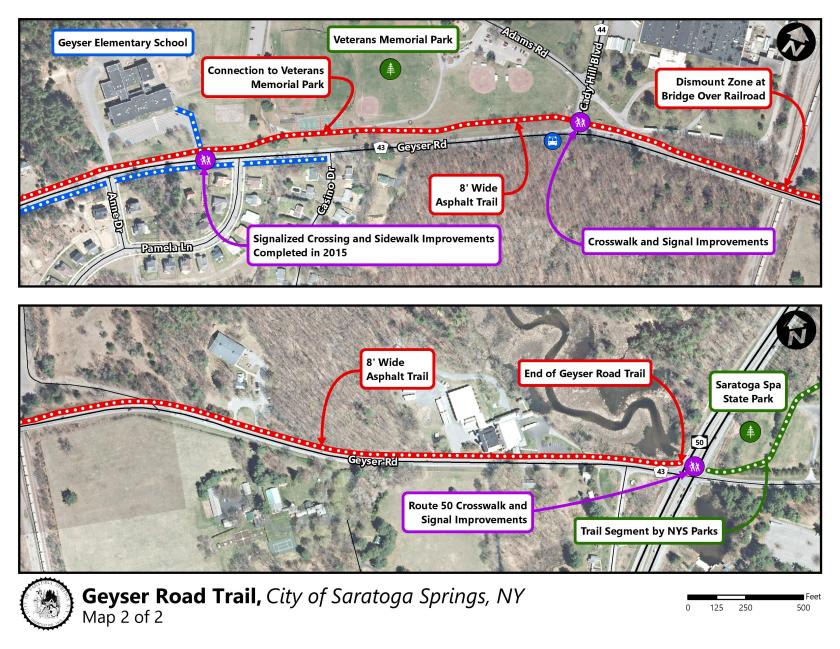
Top image shows transition from town of Milton’s bike trail to new Geyser trail. Second image continues on.As a reference in top picture there is the Geyser School in top left and bridge over railroad tracks is at far right. Continues on in bottom image. As a reference the purple spot is intersection of Geyser Road with Route 50 at Spa Park.
Take A Look At Your Bike Trail
Mayor Kelly delivers again as the city awards the contracts to construct the new Geyser Bike Trail. The new leg will run from the Milton town line to the intersection of Geyser Road and Route 50.
The trail languished for years. Past administrations were bogged down by litigation as the Town of Milton and homeowners along the proposed path fought with the city. Mayor Kelly quietly worked with the combatants and forged agreements that have made possible the actual construction of the trail.
William J. Keller & Sons Construction of Castleton won the contract with the lowest bid of the seven submitted. The construction is to begin next year with a target of mid November next year for its completion.
The city has $2.3 million dollars in Federal grants toward the total projected cost of $3.8 million. The trail will stretch for 2.8 miles. A paved path 8 feet wide will run along the North side of Geyser Road.
According to an excellent story by Stephen Williams in the Gazette, some 11,000 vehicles use the road daily between the industrial park and route 50. The trail is part of an ambitious 23 mile “Greenbelt” trail the city hopes to eventually complete.
This is an image from Wendy Liberatore’s twitter account. The text of her most recent tweet reads:
Tonight #Saratoga City Council promised not to wreck the neighborhoods of those living along Loughberry Lake and near Railroad Run. Officials won’t make that promise to the residents near Saratoga Hospital
It also offers her bio as:
Saratoga County Reporter @TimesUnion, Dance fanatic, family cook, star gazer, timesunion.net blogger, Opinions expressed are mine.
Ms. Liberatore’s tweet is referring to what occurred at the City Council public hearing on the proposed zoning map that will be part of the Unified Development Ordinance. The hearing was held on December 3rd at the temporary city offices at the Rec Center.
So lets parse this out. Ms. Liberatore characterized the City Council as having promised not to “wreck” the neighborhoods near Railroad Run and the banks of the city’s reservoir, Loughberry Lake. According to her tweet, the City Council declined to make that promise to the neighbors of Saratoga Hospital. Therefore, according to Ms. Liberatore, if the members of the City Council approve the rezoning as stipulated in the city’s Comprehensive Plan, they would be wrecking the neighborhood adjacent the Hospital.
The 3 Parcels
Among the responsibilities of the consultants hired to come up with a Unified Development Ordinance for the city, was the crafting of a zoning map that would be consistent with the city’s most recent Comprehensive Plan. The City Council requested an advisory opinion from the city’s Planning Board regarding the map.
The consultants, for some unknown reason, had designated the Railroad Run area as T4. T4 stands for Urban Neighborhood and is one of the most intensive land uses allowed under our zoning codes. The Planning Board found that the designation in the map for the Railroad Run area of T4 was inconsistent with what the Comprehensive Plan called for for the area. (It is quite troubling that the consultants made such an error). The Planning Board recommended, and the City Council approved, a more residential category for the area (“Urban Residential”). The neighbors who attended the meeting feared that the area was still to be T4. The map showing the proposed zoning was projected on the wall and the Mayor advised the neighbors that the change to Urban Residential had been instituted and that a careful examination of the map on the wall affirmed the change.
The controversy regarding Loughberry Lake had to do with a narrow strip of land that separates Loughberry Lake from the homes along its banks. This strip had been zoned residential. The new zoning would be Institutional Recreational.
The neighbors were alarmed for many reasons. The strip of land abuts their homes. They felt the new zoning would potentially compromise their privacy. They also pointed out that the land is mostly made up of a very steep bank. People accessing this area would be at serious risk of tumbling into Loughberry Lake.
The City Attorney explained that the city, which owns the land, had absolutely no plans to develop this land for recreation. The reason it was changed was that the current designation is residential. It simply made no sense to designate the land as residential. The Institutional Parkland/Recreational zoning made more sense. He noted that the city was not bound by zoning laws on land it owns so the zoning definition issue is in many ways mute. Whatever the designation of the land, it was subject to the will of the Council. The important thing was that the city had no intention of developing the land which forms a buffer for the reservoir.
As regards the rezoning of the land adjacent to Saratoga Hospital as Office Medical Building 1 (OMB-1), the members of the Council did not respond to the comments of the public both for and against the proposed change in zoning.
What Are The Standards A Reporter Should Maintain?
I do not subscribe to the myth of “objectivity.” A reporter must select what information to share with readers from an event they cover. In doing so the reporter makes a judgement as to what information is most important. What they select will color the story.
I believe that most people who become reporters care deeply about civil society, and it makes no sense to expect them to be indifferent observers. What we should be able to expect, though, is that they make every effort to both fairly reflect the events they are reporting on while placing these events in some sort of context.
Maintaining Credibility
Ms. Liberatore, in her bio for her tweeter account, both identifies herself as a reporter covering Saratoga for the Times Union and asserts that the opinions offered in her tweets are hers alone.
The reality is that her role as reporting on Saratoga is not easily separated from any public opinions she may offer. The significance of this is reflected in the fact that the attorney representing the neighbors of the Hospital retweeted her message.
A reporter has a right to have opinions on the events they cover but at what point does publicly expressing these opinions undermine their credibility to fairly cover the news?
In the case of her tweet, Ms. Liberatore’s observation seems to me to be problematic. It would have been accurate and reasonable for her to observe that the members of the City Council conspicuously offered no opinion on the controversy about the rezoning of the land owned by Saratoga Hospital.
Unfortunately, Ms. Liberatore’s observation characterized the decision of whether or not to approve the zoning change as whether or not to “wreck” the adjoining neighborhood. I do not think it unreasonable to characterize this as a highly prejudicial statement. While it very much reflects the perspective of the neighbors, it is obviously at odds not only with the Hospital’s view but the view of many other parties in the community.
The city’s Planning Board will have the authority to oversee the design of the Hospital’s project in terms of its impact on the neighbors. There is little doubt that minimizing the impact on the adjacent neighborhood will be challenging. The area already suffers from problems of water run off, and the construction of a large building and attendant parking lot will need to be designed to address how the run off from these new structures is managed. There will be issues also of managing the traffic that the project will generate along with the lighting required to make the lot and building safe.
The good news for me is that the current Planning Board’s make-up is profoundly different from the past. This body used to be dominated by the real estate interests in the city. Some of the appointments of past mayor, Joanne Yepsen, and all of the appointments of our current mayor, Meg Kelly, have very much changed the character of this important land use board. Its chair, Mark Torpey, is someone I personally trust. He is both scrupulously thorough and sympathetic to all the parties involved in cases like the proposed Hospital project.
To assume, as Ms. Liberatore apparently does, that the project would “wreck” the area neighborhoods seems wildly irresponsible.
Undermining A Reporter’s Role
One must ask, what impact will her tweet have on Saratoga Hospital’s dealings with her? Quite a number of public figures no longer take Ms. Liberatore’s calls. They have experienced what they view as unfair and manipulative coverage. I expect the Hospital will continue to be available to her. Still, one can only expect that their willingness to be candid and open with her will not be helped by her tweet.
A Failure of Oversight
Having dealt with reporters for decades I simply cannot recall any of them that would have made a public announcement like Ms. Liberatore’s tweet. This is not only because of the quality of these reporters but because their editors would have taken grave exception.
Unfortunately this is not the case with the Times Union. In my experience they have rarely been willing to correct inaccuracies in her stories and when they have it has only been the most egregious ones. The reality is that Ms. Liberatore’s editors have her back and that this community will simply have to live for the foreseeable future with this failure in journalism.
Rob Arrigo, chairman of the Saratoga County Libertarian Party, took his petitions calling for defunding the Saratoga Prosperity Partnership down to the monthly meeting of the Saratoga County Board of Supervisors.
I was amused by the response from Marty Vanags, president of the Partnership, who complained that Mr. Arrigo had not brought his concerns to him.
“I welcome anyone who has criticism or anyone who is concerned how economic development works to reach out to us,” Vanags said. “We can sit down and have a conversation and go over the methods, tactics we have used and challenges we have faced over the past four years.”
As the readers of this blog may remember from a recent post, I emailed Mr. Vanags asking him to respond on this blog to Mr. Arrigo’s petition and never received a reply.
It will come as no surprise that the Supervisors declined to support Mr. Arrigo.
The Saratogian is owned by 21st Century Media. 21st Century Media is owned by Digital First Media (DFM) . Digital First Media is controlled by Alden Global Capital. A devastating article on a website called The Intercept documents how the chains of newspapers under this group have been cannibalized to squeeze out extraordinary amounts of money.
According to the story, newspapers have traditionally had to make about 8 percent in profits to be viable. DFM has earned an average of 17 percent with some of its papers producing as much as 30 percent. They have achieved these numbers by slashing their news staffs, selling off the most lucrative assets at the papers they have acquired, and outsourcing or consolidating functions like editing and production design to remote locations including to places like India and the Philippines. It is axiomatic that the editors of newspapers should be located in the community that they serve…or it used to be.
In court papers, Alden Global Media has admitted to siphoning off money from many of its newspapers for unrelated acquisitions. These included Payless Shoes and Fred’s Pharmacy (a chain) that have both gone bankrupt.
And try this from the story for something creepy:
At the Denver Post, the company is pushing the envelope even further. In bargaining talks with union leaders this summer, Digital First pushed for the right to use artificial intelligence to cover high school sports. They also hope to allow computers to “gather and publish” municipal government news, including “local news stories from suburban communities, school districts and other governmental districts,” according to a company proposal obtained by The Intercept. Denver Post union official Tony Mulligan said the company has already selected a vendor and budgeted money for the prep sports transition.
For those with the stomach, this is a link to the Intercept story that goes into the gory details of what greed and a contempt for journalism can achieve.
The neighbors of the parcel targeted by Saratoga Hospital for its proposed medical office building have challenged the zoning change that would allow the Hospital to proceed with its plans. If a sufficient percentage of the land owners who abut a parcel formally oppose a proposed zoning change, the law requires that the Council must have a “super majority” to pass the change. A super majority is a majority plus one. In the case of our City Council that means four out of five votes.
My sources tell me that John Franck, who announced he would recuse himself from a previous vote that was to be taken regarding the Hospital’s expansion as a PUD, will vote no this time. This means that all four of the other members of the Council must vote in the affirmative for the zoning to go through.
There will be two public hearings on the city’s new zoning map which is based on the city’s Comprehensive plan. There are eighteen parcels that would be rezoned on this map with two of them belonging to the Hospital. One hearing will be tonight (December 3) at 6:30 and the other will be on December 17. The hearings will take place at the city Recreation Center on Vanderbilt Terrace.
I assume that should the votes fall short of a super majority, the two controversial parcels will be removed from the proposed zoning map.
[JK:I received the release below from Rob Arrigo who chairs the Libertarian Party. Here is some background.
For years the Saratoga Economic Development Corporation (SEDC) was the organization promoting economic development in Saratoga County. The County Board of Supervisors defunded the SEDC when the SEDC board refused to accept appointments of County Supervisors to its board. The SEDC decision was based on its concern that the appointment of Supervisors would politicize the organization. It is worth bearing in mind that all the Supervisors would like to see companies locate in their towns and cities so having individual Supervisors on the SEDC board raises the issue of conflict of interest.
In the meantime, the County funded an organization called the Saratoga Prosperity Partnership (SPP) to the tune of $750,000.00 a year with five Supervisors on its board. As Rob noted, in the following three years they produced a total of twelve jobs.
Most recently the County retreated modestly. They redirected $150,000.00 of the SPP money to the SEDC, and they earmarked another $150,000.00 as seed money for municipalities. It is unclear how much the County will be paying the SPP directly next year. They are now talking about the SPP working collaboratively with SEDC and requiring that the two bodies meet together monthly. Based on stories in the Times Union, what the SPP will actually do appears squishy.
I sent emails to the two Saratoga Springs Supervisors asking them to comment on the Libertarian Committee’s allegations. I also sent an email to Marty Vanag who heads the SPP. Neither Marty Vanag nor Supervisor Matt Veitch responded to my request. I received an email from Tara Gaston who offered the following:
Hi John:
I continue to have concerns with the amount of economic development funding from the County and the redundancy in that area, and continue to press for answers to my questions. It is my understanding that the unity agreement proposed that many of the concerns will be relieved, including travel and the focus of organizations; it will also provide County funding for SEDC. However, I have not been provided the proposed contract (despite requests) and so cannot verify changes at this time.
Saratoga County continues with its track record of self dealing and ineptitude. As an indication of their tone deafness consider the following. According to the Times Union, Kevin Hedley, who chairs the SPP took exception to the characterization that the SPP was spending taxpayer dollars. He pointed out that the money comes from the County bed tax that is charged to County hotels/motels. Its that kind of parsing that characterizes both the County government and the SPP.
In another unfortunate coincidence, Brendan Chudy is on the SPP. People following my blog may remember that he was on the city’s Ethics Board and opposed Chris Mathiesen’s proposals to strengthen the city’s Ethics Code. Fortunately, Dr. Matheisen’s proposals received the unanimous approval of the City Council.]
______________________________________________
Saratoga County Libertarian Committee Fights To Defund Saratoga Prosperity Partnership (SPP)
After successful election season, LPNY Saratoga turns to eliminating wasteful spending
Ballston Spa— For Immediate Release — The Saratoga County Libertarian Party Committee is circulating a petition to defund the Saratoga Prosperity Partnership. It can be found on their website http://www.lpnysaratoga.org/petition-detail?petitionId=1000 The Party saw 6 of its 7 endorsed candidates elected in 2019 and hopes to gain more traction by fighting to stop wasting money.
About the Petition
The petition calls on the Saratoga Board of Supervisors to stop wasting money by zeroing out the budget for the Saratoga Prosperity Partnership and spend that money on other local priorities like investing in infrastructure.
“Since 2015 when Saratoga County chartered the Saratoga Prosperity Partnership, a government led economic development corporation, and fully funded it from expanded taxing authority on hotels, it has spent nearly $4M for its efforts.
This experiment in failed publicly funded economic development must end in this budget. We are signing this petition calling on our election town Supervisors to cut funding for the Saratoga County Prosperity Partnership for 2020.
Spending $4 million collected from hotel occupancy taxes for next to no economic impact is not acceptable. Government-style bureaucracy is not an effective use of tax dollars.
Zero out the budget for this agency in favor of better investment in local priorities like improving the county’s infrastructure.”
SPP Facts
The Saratoga Prosperity Partnership is funded by the Saratoga County Board of Supervisors. Its mandate is to develop business and create jobs in the county, with an annual budget of approximately $775,000 according to the Albany Business Journal.
Board of Supervisors Review
The Saratoga Board of Supervisors is in the process of producing a budget for fiscal year 2020 and in that process, it will review the budget for the SPP. There will be a public budget hearing on December 4, 2019. “It is so important that Saratoga County Residents voice their concern with the amount of money wasted and failed projects the SPP has generated.” Said Libertarian County Chair, Rob Arrigo.
SPP vs SEDC
In the past four years the SPP has been able to claim credit for 12 jobs created after spending over $4Million of County money. In operation since 1978, The Saratoga Economic Development Corporation (SEDC) has been able to claim over 17,000 jobs created over the last 3 years in its projects with Zero county money. The SEDC was defunded by the County in 2014 when it refused to allow elected officials to serve on its board to prevent corruption.


 Saratoga Springs Politics