Most people are aware of the proverb that “a man who is his own lawyer has a fool for a client.” I might add my own proverb: “A man who lacks a law degree and experience at the bar who attempts to file legal papers with the court has more ego than judgment.”
Saratoga Springs Accounts Commissioner Dillon Moran believes that he filed papers to begin an appeal of Judge James E. Walsh’s recent decision, which barred the city from reimbursing him for his legal bills. In fact, the papers he filed appealed former Public Works Commissioner Jason Golub’s decision. Moran is so confident that he successfully appealed his own case, even though he is not a lawyer, that he posted this on Facebook:
Not So Fast
On August 7, 2025, Dillon Moran visited the County Clerk in Ballston Spa and submitted a “notice of appeal”, ostensibly to appeal the decision by Judge James E. Walsh barring the city of Saratoga Springs from covering his legal expenses. He did so pro se, which is the legal term for a person who is not an attorney and is representing themselves.
He was required to submit the notice for his appeal by August 15, 2025. This would reserve his right to appeal the lawsuit for six months.
The source of Moran’s confusion, as he is not an attorney, is that there were actually two cases decided on by Walsh. One was to prevent the city from paying the legal bills for Moran and his Deputy, Stacy Connors, and the other was to prevent the city from paying the legal bills of Jason Golub and his Executive Assistant, Brooke Van Buskirk.
Both cases were combined in the original decision by Judge Walsh, as the issues regarding whether to pay both bills were similar. The document below is from Walsh’s decision. The reader will note that it is made clear that there are two cases (I have highlighted each with a box), and each has its own unique court index number. The case in the box on top is Moran’s. The case in the second box is Golub’s
This is a detail from the top of the form.
The index number on the case he was trying to appeal is not the one assigned to his case, but Golub’s case. So, Moran was unknowingly appealing the Golub case, not his own. The result of his error was that he failed to register the notice of appeal for his own case by the August 15 deadline, so it would appear he has lost his only avenue for recovering the costs of his legal bills.
The Courts
The problem is that if this goes forward, the only potential beneficiaries would be Jason Golub and Brooke VanBuskirk. The train left the station regarding Moran and Connors on August 15. So strictly speaking, Moran did appeal on time, but not for himself, and clearly by mistake.
The victory lap he allowed himself was more than a little premature.
Saratoga Springs Accounts Commissioner Dillon Moran told area news media that he had initiated an appeal of Supreme Court Judge James Walsh’s recent decision, which ruled that the legal bills he incurred in the criminal investigation of the city’s on-call pay affair were not eligible for reimbursement by the city.
In yet another replay of the Kuczynski mess, where he and the Saratoga Springs Democratic Committee failed to submit the proper paperwork on time to get Hank Kuczynski on the ballot for the DPW special election, Moran has missed the deadline to file the required papers for the appeal. Moran had thirty days from July 15, 2025, to file his notice to appeal.
According to Saratoga Springs Republican Chair Mike Brandi, “Moran has now permanently lost his right to appeal Walsh’s decision.”
I have observed Dillon committing these kinds of errors during his two terms in office. It sends a chill that if he can miss deadlines like these, imagine what problems within the Accounts Department may eventually come to light.
Several speakers came to the to the microphone during the public comment period at the August 5, 2025, Saratoga Springs City Council meeting to weigh in on the proposal Accounts Commissioner Dillon Moran had on his agenda to have the city pay his and former Public Works Commissioner Jason Golub’s legal bills for criminal cases.
Among the speakers was Mayoral candidate Michele Madigan who addressed the Council in a hyper-partisan attack that is emblematic of her campaign. In response to criticism of her remarks, she issued an additional unfortunate statement on her Facebook page.
Madigan used both platforms to repeatedly claim without any evidence that criminal charges against former Public Works Commissioner Jason Golub were “baseless and politically motivated”. In addition Ms. Madigan went even further to make the hyperbolic claim that the city was falling victim to some kind of “dangerous pattern of political retaliation” by Republicans verging on authoritarianism. In the course of her 3 minutes at the microphone she managed to also attack the city’s police department, her fellow Democrat, Public Safety Commissioner Tim Coll, and Supreme Court Judge James Walsh, as well as make numerous inaccurate statements about the city’s indemnification policy and decisions made by City Court Judge Jeffrey Wait.
Her performance at this Council meeting and her continued inappropriate and inaccurate postings on social media raise serious questions about her suitability for the office of Mayor.
Madigan’s Misstatements in Defense of Jason Golub
In this clip from her speech before the City Council, Madigan characterizes the charges brought against Jason Golub as baseless and politically driven. This is an accusation she repeated in her Facebook post the next day, where she claimed “his case was a politically motivated attack, fueled by John Kaufmann, the local GOP, and their allies, not by any legitimate concern for public safety or the law.” She goes on to claim incorrectly that “…the charges were thrown out.”
Ms. Madigan’s harsh accusation that Jason Golub was the victim of a “politically motivated attack” does not survive scrutiny. Readers will recall that two DPW workers visited Golub’s private home on two occasions to do plumbing work. The investigation that led to the misdemeanor charges was prompted by two whistleblowers who worked under Golub at the Department of Public Works and reported the incident to the police.
The facts are not in dispute. Golub himself never denied that this happened. His own Deputy, Joe O’Neil, pleaded guilty to similar charges involving this and another incident.
For Madigan to also characterize the resolution of Golub’s case as “the charges were thrown out” is particularly troubling. It suggests that the court somehow cleared Golub when, in fact, this was not the case.
In fact, City Court Judge Jeffrey Wait dismissed the charges because the charging document did not address whether Golub knew that the employees worked for the city and were doing work on his home during city time. Specifically, the dismissal was “without prejudice,” meaning that the prosecution could amend their charge and proceed to trial. There is nothing here that supports Golub’s innocence.
It is hard to believe that Mr. Golub, who holds a law degree from Columbia University, was oblivious to the fact that having his employees work on his private residence during work hours was, at the very least, potentially inappropriate. To dismiss charges that Jason Golub’s foolish and potentially criminal use of city employees was simply “baseless and politically motivated” raises questions about Madigan’s judgment.
That Ms. Madigan, who is seeking to be Mayor of this city, chooses to repeat the false narrative that Golub was the victim of a racist, vindictive attack by the Saratoga Springs Police Department and Commissioner Coll is deeply troubling.
Did Madigan Flip-Flop on Paying Moran’s Legal Bill?
In my previous blog, I wrote that Madigan’s support for paying Dillon Moran’s attorney fees at the August 5 Council meeting represented a change from her earlier position when she had opposed this.
In her Facebook post entitled “Setting the Record Straight: What I Said–and Did Not Say–on August 5,” Madigan stated:
“Let me be clear on my own record:
*I did not support the City Council’s 4-1 vote that created on-call pay
*I have not spoken in favor of indemnifying Dillon Moran.”
I don’t know of anyone, including myself, who ever suggested that then Supervisor Madigan supported on-call pay, so I’m not quite sure why she felt she had to mention this and include a video of her remarks at that January 2024 meeting when the then Democratic majority approved that controversial pay increase to Deputies’ salaries.
On the other hand, I believe a reasonable person listening to Madigan’s remarks from August 5 might well think that she was defending Dillon Moran’s demand that the city pay his six figure legal bills. Here is the clip for you, the readers, to decide.
This clip also documents Ms. Madigan’s misunderstanding of the city’s indemnification policy, a misunderstanding shared by the chair of the Saratoga Springs Democratic Committee and the 2 or 3 members of the committee, including their Public Works candidate, who also spoke during the public comment period. Like Ms. Madigan, they all shared the misunderstanding that somehow the Council had a choice of whether or not to pay Moran’s and Golub’s bills, as city policy allowed for that. Madigan refers to the city “refusing to indemnify [Jason] even though our city code clearly says he should be.” At another point, she claims that Judge Walsh “overturned a legal Council vote to hire legal counsel.” The problem is that the previous Council’s vote to pay these bills was not legal, as the city code does not cover fees in criminal cases. Judge Walsh confirmed this in his decision. To characterize the city code as “clearly” providing indemnification is representative of her pattern of being careless with her facts.
As pointed out in my last blog, the city code currently covers the legal costs of city officials and employees for civil matters only. Both Moran and Golub were involved in criminal cases. Clearly, neither Madigan nor the other Democrats who passionately spoke had bothered to do their homework first.
I think most people are concerned and leery of the potential for the politicization of our courts. It would be prudent, however, before cavalierly dismissing Judge Walsh’s decision, that Ms. Madigan offer some explanation as to why she believes his decision was flawed. Partisan attacks on the courts that lack supporting analysis only serve to further poison the political environment.
Madigan Goes Mega MAGA
In this clip, Madigan’s remarks verge on hysteria as she claims Saratoga is on the brink of becoming an authoritarian state. Does anyone really believe that Mayor Safford is a tool of Mike Brandi in a plot to install an authoritarian regime in Saratoga Springs? Apparently, Madigan does.
Deciding Who Is A Democrat
In the meantime, Madigan has given herself the authority to decide who is a Democrat and who is not. In this clip, Ms. Madigan expels Tim Coll from the Democratic Party. According to her, there is a Republican majority on the City Council, when in fact there are three registered Democrats who are all running together with her on the Democratic slate. I’m not quite sure what her litmus test is to be a “true” Democrat. I have previously observed the cult nature of the local Saratoga Springs Democratic Committee. Ms. Madigan’s sectarianism is divisive and only further undermines the civil respect that is key to thoughtful Council deliberations.
Changing Indemnification Coverage Already in the Works
I do agree with one of the statements Madigan made on Facebook. She wrote:
If the code can’t protect officials acting in good faith from targeted legal harassment, it’s the code that needs to change.
This change is already moving forward. A proposal to change the city’s policy for indemnification was on Mayor Safford’s agenda last Tuesday night. He has set a pubic hearing for the next Council meeting to hear comments on a proposed resolution to indemnify future officials in criminal cases if the official is determined to be not guilty. Following the hearing, it is expected to be adopted. Unfortunately for Moran and Golub, this is not retroactive.
Where Are Saratoga Politics Headed?
I believe that most voters are starved for a tempered campaign that eschews drama and partisan extremes. Regrettably, Madigan’s statements are a sorry example of our current convulsive political environment. With a decisive edge in Democratic voter enrollment, her strategy of waving a red “MAGA” hat in the face of voters to exploit their fears is alarming. I found the tone and content of her presentation at the recent Council meeting troubling. I am concerned that the hyper-partisan rhetoric she is employing in her campaign for Mayor reflects an inability or unwillingness to work collegially with fellow Council members with whom she may disagree and to govern the city with dignity, fairly representing its diverse residents with various political opinions and affiliations. I leave it to my readers to decide for themselves.
The full, unedited video of her remarks is included below.
At its meeting on August 5, 2025, the Saratoga Springs City Council rejected an attempt by Accounts Commissioner Dillon Moran to have them appeal a ruling that barred paying his and former Public Works Commissioner Jason Golub’s legal bills.
Into The Weeds for A Little Background
Many years ago, the city adopted a resolution regarding the indemnification of city employees and officials in civil matters. That is to say, the city established that an employee or official charged with a civil complaint would be eligible for the city to pick up the cost of legal representation. It did not address criminal matters.
For years, the city had the opportunity to adopt a section of state law that would have made city employees and officials eligible for indemnification in criminal matters as well, but successive City Councils never did so.
Nevertheless, the Democratic majority at the time on the City Council (Moran, Golub, and Sanghvi) voted to pay tens of thousands of dollars in legal bills that Democratic Commissioner Moran had accrued during the New York State Police investigation into OnCall pay, which was a criminal investigation.
Judge Walsh’s decision ruled that, as the city’s locally adopted indemnification policy only addressed civil charges, neither Dillon Moran nor Jason Golub was eligible for the city to pay their legal bills, since their cases involved criminal charges.
To address this lack of coverage in criminal matters, the City Council has scheduled a public hearing for its next meeting on plans to replace the local law with two sections of state law that would, going forward, indemnify employees and officials for both civil and criminal charges.
Unfortunately for Golub and Moran, as their bills predate the adoption of this law and their cases involved a criminal investigation, they are not eligible to have their bills paid. The Council voted 3 to 1 against appealing Judge Walsh’s ruling, with Finance Commissioner Minita Sanghvi absent and only Moran voting in favor.
Moran: Is It A Problem With His Memory Or His Honesty?
In an earlier post, I wrote about Moran’s repeated failure to follow the policy of posting proposed actions on the Council agenda on the Friday before Council meetings. I noted this is important so the public and fellow Council members can be given time to understand the significance of pending legislation. This week, Moran once again waited until the last minute to add his resolution to Tuesday’s agenda, and he failed to attach copies of the bills generated by his and Golub’s attorneys to the agenda for public and Council review.
To confuse his colleagues, add chaos to the deliberations, and divert criticism for his failure to properly attach his attorney bills to the agenda, he made a rambling attack, asserting that somehow the City Attorney was to blame for his lack of transparency.
Moran is like dealing with a recalcitrant teenager. When the attack on the City Attorney failed to gain traction, he asserted instead that the city had never posted attorney bills with agenda items so this wasn’t a problem.
The problem is that what Dillon confidently asserted was wrong. There are numerous examples of legal bills attached to agendas. Here are legal bills attached to an earlier request for payment that appeared on the Council’s agenda.
Moran’s Attempt To Get His Bills Paid Wasn’t Even Crafted Properly
In addition, Moran failed to bring to the table the additional resolutions required to fund an appeal. This would have required two legislative actions including a budget amendment to properly access the necessary city funds. Moran has never been one for details. He tends to throw together the resolutions he brings to the table without doing proper research or getting proper legal advice.
Moran’s Conflict of Interest
Moran also appears to be oblivious to the concept of a “conflict of interest.” At the August 5 meeting, Moran moved that the city pursue an appeal of Judge Walsh’s decision in order to allow the city to pay his legal bills. This was a clear conflict of interest. To add insult to injury, he also voted to approve his own resolution for the appeal. Since he also cast the deciding vote with the previous Council when they initially agreed to pay his exorbitant bill, this is no surprise. It is the way Dillon Moran does city business.
Toxic Attack On Lisa Ribis
Dillon Moran had many angry ramblings at Tuesday night’s meeting. Among the most odious and bizarre was his rant which revisited his false claims against his former and now deceased employee, Lisa Ribis.
I have written earlier about Moran’s unscrupulous attempt to blame Lisa Ribis for the on-call pay scandal. At the August 5 meeting, he, for some reason, revisited all his false claims, including that he fired Ribis for altering the minutes for on-call. His slurs at this meeting were entirely gratuitous, having nothing to do with the resolution on the table regarding the appeal of Judge Walsh’s decision. It was just another example of how illogical and toxic his rants often are. It’s as if he lives in his own magical universe, where he creates facts on the fly to support whatever he wants.
Lisa Ribis is deceased and cannot defend herself.
Madigan Waded Into the Fray to Support Moran
To add even more drama at this Council meeting, Democratic candidate for Mayor Michele Madigan left her seat at the Supervisors’ table in the Council chamber and stepped up to the microphone to give her full-throated support to paying Moran’s bills. She characterized anyone who would oppose paying Moran’s bills as somehow being part of an authoritarian MAGA campaign.
This was, interestingly, the direct opposite of her position just last year when she herself was one of those people opposed to paying these same bills. This is what she wrote when Moran’s legal bills were coming before the Council not that long ago
NYSDOT-BrokenPromises.com chronicles ongoing dispute over destroyed lake access following emergency road repair
SARATOGA LAKE, NY – Four homeowners who lost their only safe access to their private lakefront property during a 2019 state emergency roadrepair have launched a website to pressure New York State to fulfill its written promise to restore their access.
The website, NYSDOT-BrokenPromises.com, details how the New York State Department of Transportation (NYS DOT) demolished the homeowners’ stairs to their docks while constructing an emergency retaining wall on Route 9P, then failed to replace them despite documented assurances.
“Six years ago, we cooperated fully when the state needed to address a dangerous road collapse,” said Peter Hopper, president of the Spruce Ridge Association, the neighbors’ HOA. “NYS DOT promised in writing to replace our stairs. Today, we still can’t safely access our own property.”
The emergency began in 2018 when large sections of Route 9P pavement broke away and slid 20 feet onto the homeowners’ docks below. After Assemblywoman Carrie Woerner alerted NYS DOT to the hazard, the agency constructed a 12-foot-high, 200-foot-long retaining wall in May 2019, destroying the existing stairs in the process.
Despite multiple meetings and correspondence over six years, NYS DOT has offered only a fraction of the replacement cost and insists the homeowners—all retirees—manage the complex engineering and construction on the steep terrain themselves.
“We’re not engineers or construction experts,” Hopper said. “The state has the expertise and resources to rebuild what they destroyed. We’re simply asking them to keep their word.”
The homeowners have contacted Governor Hochul and NYS DOT Commissioner Marie Therese Dominguez, requesting their intervention. Those efforts generated no significant response.
“We’ve exhausted all other options,” said neighbor Charlie Murphy. “We’re four middle-class retirees in an exhausting fight with New York State, hoping public pressure will finally make them do the right thing.”
For more information, visit NYSDOT-BrokenPromises.com.
Saratoga Springs Accounts Commissioner Dillon Moran is a serial violator of transparency. No other previous Council member in the history of this city has so often failed to post planned resolutions on the City Council agenda in a timely manner that would give his fellow Council members and the public time to give his proposals sufficient consideration.
The most recent last-minute posting concerns Moran’s demand that the city appeal Judge Walsh’s recent decision, which holds that because Moran hired his lawyer regarding a criminal matter (as compared to a civil matter), he is not entitled to have his legal expenses paid by the city. Readers may recall that, rather than consulting his fellow Council members, Moran went ahead and hired a Manhattan attorney at $1,200 per hour to represent him during the on-call pay scandal investigation.
Moran failed to include this item on his agenda for the upcoming Council meeting that was posted on the city website on Friday. He didn’t bother to raise the issue of an appeal at the pre-agenda meeting on Monday morning. Yet at 11:14 AM, moments after the pre-agenda meeting had adjourned and before Moran had even posted this item at the last minute on his agenda, Otis Maxwell, the chair of the Saratoga Springs Democratic Party, sent out an email blast to mobilize committee members to attend the Council meeting in support of Moran.
I leave it to the readers as to why Moran behaves this way.
But the other question is why the Democratic Committee behaves this way. The Committee repeatedly mobilizes to support whatever position Commissioner Moran takes without ever questioning or conducting their own research into the veracity of the information he provides. I feel this is no longer the Saratoga Springs Democratic Committee but has become instead the Saratoga Springs Dillon Moran Committee.
This is a link to a CNN video of the face of starvation in Gaza. I’m sure the readers do not need to see graphic video of starving children to convince them that the use of starvation in Gaza is wrong.
While I sympathize with the fear of attack that Israelis are experiencing, the deprivation of food for the two million people living in Gaza cannot be defended. Israel can only continue this horror with the support of our country. Polls consistently show that this kind of cruelty is opposed by most Americans, demonstrating the fundamental decency of people. Yet, the policy of cruelty continues to enjoy bipartisan support in Washington.
A proposed ordinance to restrict “camping” on city-owned property unleashed a torrent of anger from some members of the public during a marathon meeting of the Saratoga Springs City Council on July 1, 2025, that saw the public hearing lasting over three hours. While many who spoke against the ordinance were well-meaning and no doubt saw themselves as defending the most vulnerable in our community, their comments often reflected a lack of awareness of the resources the city is currently devoting to address homelessness and an unfortunate misconception that the purpose of the ban was to criminalize and incarcerate the homeless.
The ordinance prohibits anyone from sleeping, lying, or sitting on city property, including public sidewalks, street medians, public parking garages, and parking lots. Blankets, tarps, sleeping bags, milk crates, chairs, and tables cannot be placed on city property.
An Event Reflecting The Caring World Of Saratoga Springs
One of the admirable qualities of Saratoga Springs is its citizens’ unusual commitment to and involvement in their community. This commitment was evident in the number of people who turned out to speak about the ordinance during the public hearing that took up over three hours of the almost five-hour meeting.
I was struck by the earnestness of many of those who spoke against the resolution. While a few of the speakers indulged in irate attacks on Mayor Safford, Public Safety Commissioner Tim Coll, and Public Works Commissioner Chuck Marshall, who supported the resolution, most were courteous and restrained, even if often misinformed.
Myths That Subvert
The recurring themes of those who spoke in opposition to the ordinance were:
1. The city has done little to address the needs of the city’s homeless population.
2. The purpose of the ban on camping on city-owned property was to criminalize and incarcerate the homeless.
Here are just two examples:
These speakers and others who voiced the same criticisms appeared to be completely unaware of the resources the city is currently devoting to this challenging issue.
Saratoga Springs annually spends $500,000.00 of local tax revenue on the homeless. Additionally, the city allocates hundreds of thousands of discretionary federal dollars to address homelessness issues. These same elected officials who were the subject of withering criticism on July 1 (Safford, Coll, Marshall) have supported the appropriation of these substantial sums. You would never know this from the statements criticizing them at the public hearing.
No other city in this region, many of which have a much larger tax base than Saratoga Springs, spends any local money to maintain shelters for their homeless population. That includes Albany, Schenectady, Glens Falls, and Rensselaer. Most of these cities have private missions that rely on funding from state and federal governments, as well as private donations.
In addition to funding the RISE shelter, part of the city’s annual contribution of $500,000 is directed to funding the city’s Outreach Court (formally known as the Homeless Court), overseen by Judge Vero, who works closely with RISE (the not-for-profit that runs one of the city’s shelters). The very purpose of this court is to provide Judge Vero with an alternative to the incarceration of the homeless who appear before her on a variety of charges. That’s right, the purpose of her court is to try to keep the men and women who come before her out of jail. Judge Vero has enjoyed the enthusiastic support of Safford, Coll, and Marshall.
In addition, under the Public Safety Commissioner, Tim Coll, the city Police Department has established a “peer-to-peer” program in collaboration with RISE. A RISE staff person is embedded with the police to assist in dealing with homeless individuals the police encounter. The department also maintains an ongoing relationship with Shelters of Saratoga, which currently provides housing for the homeless during the winter months.
These steps are not sufficient to resolve homelessness, but to characterize the supporters of the controversial bill as seeking to address homelessness by putting everyone in jail is patently false and unfair.
Protecting Credibility
It is one thing to argue that the city is not doing enough. It is quite another to carry on an impassioned crusade that ignores both reality and a thoughtful path to solutions. Many of those who testified at the public hearing seemed simply incapable of acknowledging both the major initiatives the city has been pursuing or of conceding that the promoters of the “camping” resolution might be sincerely concerned about the dreadful conditions of many people living on our city’s streets. What these people do not understand is that by misrepresenting the city’s response to homelessness, they undermine their own credibility and effectiveness.
A Plague Of Disinformation
The confusion of many who oppose the resolution is understandable, given some of the postings that have appeared on social media.
In particular, Democratic Mayoral candidate Michele Madigan’s Facebook page is a major promoter of a false narrative with statements like:
“Now the City Council under The Republican majority voted 3-2 (along party lines) not to provide more resources, not to support our low barrier shelter, but to target [JK: for arrest] unhoused residents just as track season begins.
Michele Madigan July 3, 2025
This comment is problematic not only for Madigan’s inaccurate characterization of the vote’s meaning, but also for her attempt to make the vote a partisan issue. As Ms. Madigan well knows, one of the three yes votes was Tim Coll. While Coll was endorsed in 2023 by the local Republican Committee, he is a registered Democrat and has been endorsed this year by the Saratoga Springs Democratic Committee. She will be running on the Democratic line with him in November.
RISE has not been helpful either. Their poorly considered threat to close their shelter just before the Belmont unless they were funded for another year gratuitously upped the temperature and was meant to portray the city as the enemy. It is a testament to the integrity of Safford, Coll, and Marshall that they are still working on funding RISE in next year’s budget. These officials are able to rise above such provocative behavior in the interest of the homeless and the city.
Saratoga Springs Cannot Solve Homelessness on Its Own.
In the early seventies, New York State closed its facilities for the severely mentally ill and had a supposed plan to set up small homes throughout the state to encourage better incorporation into communities and help promote independence.
This was all really a sham. The real purpose was to save money. Very few homes were ever set up. The number of mentally ill homeless people mushroomed.
The state also established what were meant to be protections against the forced institutionalization of the mentally ill. This also ended up contributing to the dramatic increase in homelessness, particularly among those struggling with mental illness.
The trend of high construction costs further exacerbates the problem of homelessness. The cost of homes and rent has skyrocketed.
Finding affordable and accessible land in Saratoga Springs for a shelter is also a huge barrier. Past proposals for multiple sites for a homeless shelter have been successfully opposed by neighbors. A committee set up under former Mayor Ron Kim selected a controversial site out along Route 29 for a facility. Nothing ever happened with that project. One homeless advocate on the committee opposed the location because of its distance from downtown.
Given the dearth of facilities for the homeless, finding quality housing is a huge problem not only in Saratoga Springs but throughout the world.
Providing Proper Services Is A Real Challenge
The problem of homelessness is a Gordian knot that will not be untied easily. There are very disturbed people who are homeless, and the current facilities and resources that are available locally cannot properly help.
The reality is that some very disturbed individuals on the streets of Saratoga Springs are belligerent and potentially dangerous to others and to themselves. Shelters of Saratoga, as well as the low-barrier facility RISE, lack the staff and facilities to adequately address the increasing demand for services and shelter.
Even RISE, which has the most liberal policy for accepting the most challenging of the homeless, turns people away. I have been told that RISE has rejected clients from Albany and sent them back there by bus. Other clients with severe anti-social behavior are denied shelter at the RISE facility, and RISE uses the police to deal with these people, characterizing them as trespassers.
What Can Be Done?
It is an illusion that the city can solve our homelessness problem on its own. We need to face this difficult situation honestly. Demagogues may play on people’s concern for justice, but what this community needs to do is ask some hard questions about how best to ameliorate the state of homelessness, rather than presume we can eliminate it.
[JK: I received the following press release from Mike Brandi, chair of the Saratoga Springs Republican Committee]
SARATOGA SPRINGS, NY – Mike Brandi, Chairman of the Saratoga Springs Republican Committee (SSGOP), today announced significant legal victories stemming from two court cases challenging the Saratoga Springs City Council’s approval to pay private legal fees for Commissioner Dillon Moran and former Commissioner Jason Golub.
The cases originated in April 2024 when the City received a subpoena related to an investigation into the misuse of “on-call” pay by certain deputies. Commissioner Moran retained a high-priced New York City-based criminal defense firm, incurring legal fees of over six figures at a rate of $1,200 per hour. Subsequently, in July 2024, Moran introduced a City Council resolution seeking taxpayer funding for his substantial legal fees. Despite initial City Council approval, Brandi swiftly filed a lawsuit to halt this misuse of taxpayer dollars, obtaining a temporary restraining order.
Yesterday, the court issued its final ruling, decisively finding that such payments were unconstitutional and beyond the City Council’s legal authority. This ruling marks a significant triumph in safeguarding Saratoga Springs taxpayers from financial abuse.
Chairman Brandi praised the decision, stating: “It’s clear Commissioner Moran has never met a scandal he couldn’t make worse, but fortunately, Saratoga Springs taxpayers won’t be stuck paying the bill for his poor judgment. This ruling is a resounding victory for every taxpayer in Saratoga Springs. It sends a clear message that public officials cannot treat taxpayer dollars as their personal slush fund. We will continue fighting relentlessly to ensure accountability, transparency, and responsible stewardship of public funds.”
Brandi was represented by Chris Obstarczyk of the Obstarczyk Firm.
On June 25, 2025, Saratoga Springs Commissioner of Accounts Dillon Moran willfully violated his oath of office and abused his authority when he refused to comply with a request by the City Police Department for a document required in a prosecution. The result of his impropriety was that the charges against a key ally of Moran were dismissed.
Among the responsibilities outlined in Article 7 of the city charter is that the Commissioner of Accounts serves as the keeper of public records. In this case, Moran was required to provide either a copy of a “demonstration declaration” requested by the police or, in this instance, a statement indicating that no such document had been received by the Accounts Department.
His failure to comply constitutes a violation of the city charter and his oath of office. It may potentially be considered a misdemeanor under the New York State Municipal Officers Law.
His refusal to provide the document may also constitute obstruction of justice since because of his abuse the case had to be dismissed.
The Violation
On April 26, 2025, the Saratoga Springs Police Department contends that a demonstration involving more than twenty-five persons was organized by Joe Seeman and took place on the steps of City Hall. It was alleged that Mr. Seeman failed to submit a “declaration” to the police before the event.
As thoroughly documented by this blog over several years, individuals organizing a demonstration involving more than twenty-five persons are required by the city to submit a document called a “declaration.” The document is simply meant to alert the Police and Fire Departments to the location and size of the proposed action. The purpose of this is to enable the city to marshal its resources to ensure public safety. The document also informs the organizer of their responsibility to clean up any debris associated with the event, along with an advisory that the participants are not to carry weapons, etc.
Mr. Seeman, among others, has tried to misinform the public that the purpose of this “declaration” is to be an impediment to their right to demonstrate. The problem with this campaign of disinformation is that it is easily exposed as false. Seeman’s demonstration proceeded without incident despite his failure to submit the declaration. In fact, the Police provided protection for the event. Notwithstanding Seeman’s and Moran’s shrill accusations, nothing was done to impede Seeman’s demonstration. Yet he, along with Moran and others, continue to try to gaslight the citizens of our city that all of this is a conspiracy to deny them their rights even after multiple demonstrations were allowed to proceed without complying with the declaration requirement.
There is a delicious irony that the only Commissioner who has ever rejected a “declaration” to have a demonstration is Dillon Moran, who refused to allow the city union to have a demonstration. Unfortunately, neither the article in the Daily Gazette nor the WAMC story revealed any of this.
So the requirement of a declaration is an administrative obligation and is entirely separate from the right to demonstrate. While Seeman was able to organize his protest without interference, he was charged with a violation for failing to provide the required paperwork and received a summons to appear in city court. A “violation” is similar to jaywalking, and if Seeman were asked if he ever committed a crime as a result of a violation, he could correctly say no. He merely subjected himself to a modest fine for failing to submit the required form.
Ironically Seeman had always filed declarations in the past when he lead demonstrations in the city. Seeman’s refusal to comply with submitting a “declaration” can best be described as pettiness rather than principle.
Moran Comes To The Aid Of His Ally
The “declaration” is required to be submitted to the city’s Accounts Department.
To prosecute Seeman, the City Attorney determined that a formal acknowledgement from the Accounts Department that they never received a “declaration” would be required to document the violation to the court.
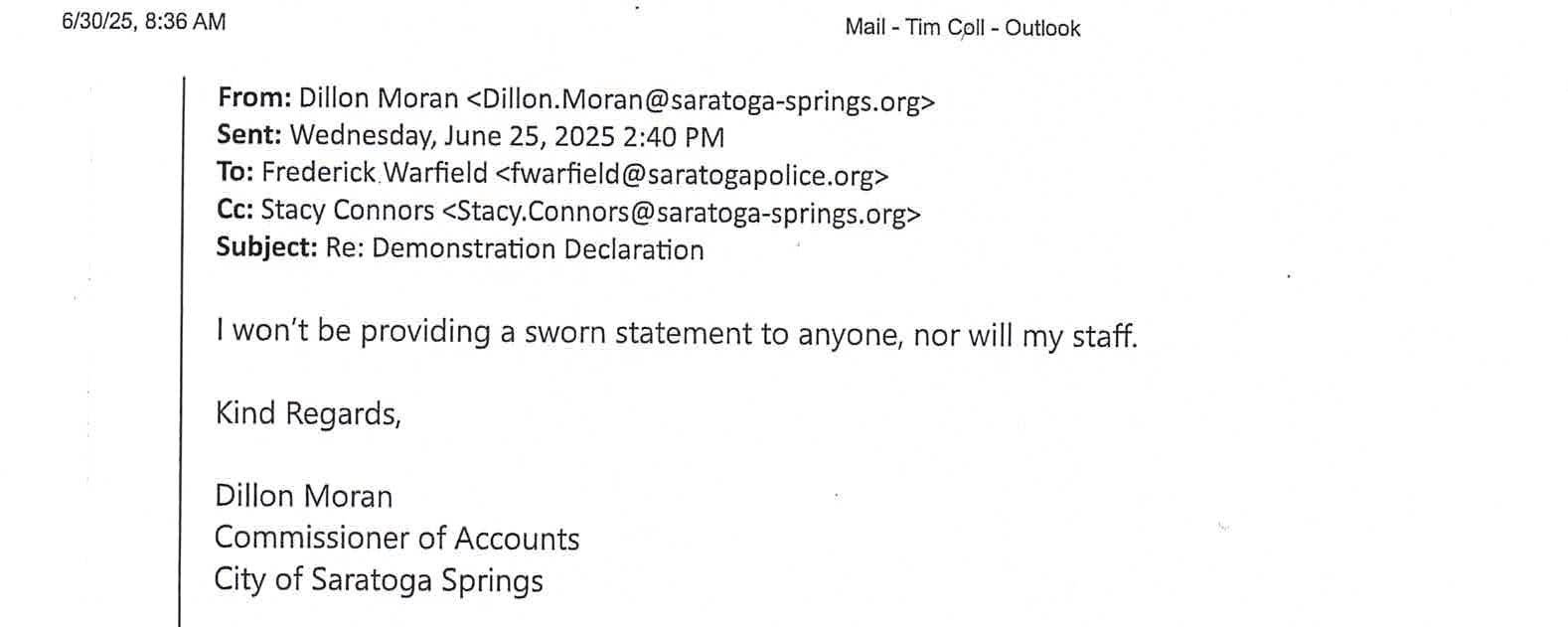
Lieutenant Frederick Warfield contacted the Accounts Department requesting the document. Lieutenant Warfield received the following email from Commissioner Moran:
As this email may be difficult to read on some people’s devices, let me repeat what Commissioner Moran wrote, “I won’t be providing a sworn statement to anyone, nor will my staff.”
Because of this, City Attorney David Harper wrote to Judge Wait, who was overseeing the proceedings, stating that the city would be unable to pursue the case in court. In addition, Public Safety Commissioner Tim Coll has been forced to discontinue the requirement for “declarations” because Moran has made the requirement unenforceable.
Moran and Seeman-Political Allies
In his recent unsuccessful race for a New York State Assembly seat, Joe Seeman received $200.00 from Moran. Seeman subsequently received another donation of $100.00 from a “Jack Mehoff.” The latter gross attempt at humor was made through the ActBlue website, and the donor’s address matched Moran’s home address. Moran claims his account must have been hacked. The obscene donation is under investigation by the New York State Campaign Board.
Seeman, along with BLM leader Lex Figuereo, are co-chairs of the Saratoga County Working Families Party which has endorsed Moran’s candidacy for Commissioner of Accounts in this year’s upcoming city election.
So there is, at a minimum, the appearance of cronyism.
Moran Is Not A Judge
In the July 10, 2025, edition of the Daily Gazette, Moran defends his actions by asserting that Mr. Seeman is innocent.
“I was told last Thursday that they were preparing to exercise a search warrant on my department. A search warrant for an item that doesn’t exist,” Moran said. “Joe Seeman did not organize that protest. He did not fill out a Demonstration Declaration for the protest. They cited him without evidence. And it doesn’t matter what I say, they have no evidence that he did that. That’s why the case was thrown out.”
Daily Gazette
The fact is that it was dismissed not because Seeman was determined to be innocent, but because the City Attorney was forced to request a dismissal, as Moran refused to certify what he had freely admitted to the press—that Seeman did not file the required document for holding a demonstration.
Dillon Moran is the Commissioner of Accounts and not the City Judge. It is not up to him to decide anyone’s guilt or innocence. He does not have the authority to interfere with the judicial process, no matter how strongly he believes his friend is innocent. That is for the court to decide.
A Failure By The News Media
The critical point here is that a Commissioner has violated his oath of office and the city charter, resulting in a court case being dismissed.
I believe that this is no minor bureaucratic brouhaha. This city cannot function properly if its officials are allowed to pick and choose which of their duties, as defined in the charter and in New York State Law, they wish to perform. I think it is reasonable to believe that if Moran would violate this responsibility, he is probably taking other liberties that the public is unaware of.
Wendy Liberatore has declined to do a story on this for the Times Union. The Daily Gazette and WAMC have both published stories. None of these stories effectively communicates this central issue. Instead, they provide Seeman and Moran a platform to make false statements meant to gaslight the public.
The Need For Council Action
Moran should not be allowed to flaunt his duties as Commissioner with impunity. The proper remedy is to remove him from office in the November election. Short of that, his colleagues at the Council table should challenge him to apologize for his failure, while assuring them that this incident was an error not to be repeated, so that the city can continue to enforce its ordinance regarding “declarations.” Should he refuse, he should be censured, and the Council should formally request that the Governor remove him from office.






 Saratoga Springs Politics