Author: John Kaufmann
Minita Sanghvi’s Shameless, Ageist, and False Attack On Mayor Safford

In the December 17, 2025, edition of the Daily Gazette, Finance Commissioner Minita Sanghvi falsely claimed that Mayor John Safford was suffering from some sort of dementia. Making her comments particularly icky was her casting her remarks as somehow sympathetic to his alleged decline.
“It was a transparent process. [Safford] voted for it,” Sanghvi said. “And I don’t know what to think about, except that, you know, I have sympathies for cognitive declines with age.”
Her shameless slur was all the more vile because it was included in a particularly ugly attack on Public Safety Commissioner Tim Coll and Public Works Commissioner Chuck Marshall, along with Safford, for their “heartlessness” in refusing to fund the designated recipients of Sanghvi’s Participatory Budgeting (PB) proposals.
Dear readers, there is nothing wrong with Mayor Safford, and in fact, when it comes to her dubious budgets, the Mayor has a better memory than Commissioner Sanghvi.
A credulous and ignorant press promoted Sanghvi’s narrative, ignoring some embarrassing facts.
As documented in earlier blogs, I reported that Sanghvi had not only recommended removing support for PB from the city budget, but also for cutting the funding for homeless services, such as the RISE shelter and crossing guards for schoolchildren. It is important to note that according to the city charter, if the Council fails to act, this budget presented by the Finance Commissioner becomes the city budget for the ensuing fiscal year. At the time, Safford, Coll, and Marshall urged Sanghvi to raise taxes to address the city’s growing deficits and fund these programs. Sanghvi refused to do this.
Bear in mind that her refusal to raise taxes occurred while she was campaigning for County Supervisor. In October, she acknowledged in an email to her colleagues at the table that the city was currently running a deficit of over $3,600,000.00.
This is from her email.

So not only was her cruel attack on the Mayor revolting, but her attack on Safford, Marshall, and Coll for heartlessly refusing to fund this year’s PB awards was the height of hypocrisy, since she herself had previously felt justified to call for defunding PB.
A gullible press and disappointed applicants for PB ignored her earlier effort to defund PB, amplifying her self-promotion and her attack on her colleagues.
Was Sangvi’s self-righteous attack on her colleagues a reflection of her extraordinary delusion regarding her own role in budget cuts or cynical politicking?
Her ageist attack on the Mayor is particularly galling as she has a history of acting in a self-appointed role of policing anything she suspects is discriminatory.
Pardon the mixed metaphor, but Commissioner Sangvhi “(physician) heal thyself.” Publicly apologize to Mayor Safford.
Mike Brandi and Dillon Moran Honored and Dishonored by NYCOG

The New York Coalition for Open Government, a highly respected not-for-profit group that advocates for better transparency in government, has issued awards at its annual meeting. In the case of Saratoga Springs, we received two awards. Both were well deserved.
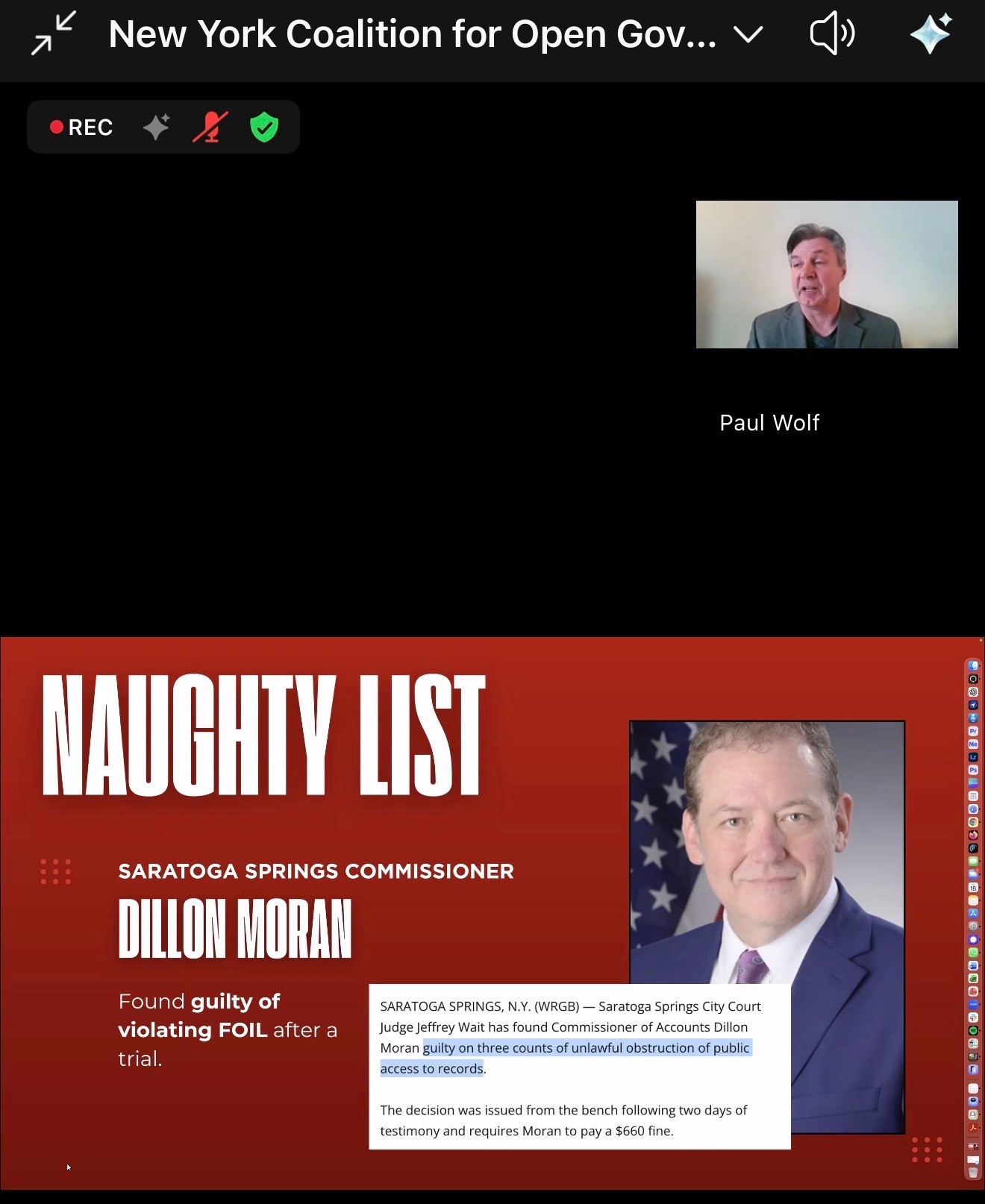

These awards would, under normal circumstances, be an enormous embarrassment to the Saratoga Springs Democratic Committee, which has uncritically promoted Moran and has been disturbingly silent about the events that prompted the awards. It is yet another confirmation of how oblivious the Committee is to the profound importance of the New York State Open Meetings Law and the best traditions of democracy.
Press Release
Mike Brandi Honored on New York Coalition for Open Government’s Annual “Nice List” for Leadership in Government Transparency
Saratoga Springs, NY — Mike Brandi has been honored with inclusion on the New York Coalition for Open Government’s annual “Nice List,” recognizing individuals and organizations who have demonstrated a strong commitment to transparency and open government across New York State.
The New York Coalition for Open Government is a non-profit, non-partisan organization dedicated to promoting open, honest, and accountable government at all levels throughout New York State. At a press conference held today, the Coalition announced its annual “Naughty and Nice List,” which highlights individuals who have either advanced—or undermined—the principles of open government over the past year.
Brandi was recognized for his role in exposing and pursuing unlawful conduct that obstructed public access to government records. His actions were central to bringing to light the conduct of outgoing Saratoga Springs Commissioner of Accounts Dillon Moran, who issued multiple false certifications in an effort to conceal public records maintained on his personal email account and social media.
In a landmark case, the Saratoga Springs City Court found Moran guilty after trial on three counts of unlawful obstruction of public access to records. As a result of that conduct, Moran was one of ten individuals statewide named to the New York Coalition for Open Government’s “Naughty List” for acting against the public’s right to know and unlawfully obstructing transparency.
“Open government laws only matter if they are enforced,” Brandi said. “This recognition underscores the importance of holding public officials accountable when they attempt to hide public records or evade transparency requirements.”
Sanghvi’s Participatory Budgeting and City Debt

Under Saratoga Springs Finance Commissioner Minita Sanghvi, the city has continually run deficits with no apparent concern from the Commissioner or warning to the Council until this October, when the hole she had been digging for her four years in office could no longer be hidden.
The city’s 2024 financial audit revealed even more weaknesses in Sanghvi’s management of the city’s finances. What is particularly embarrassing is that some of the “exceptions” (mismanaged items) that were cited in the 2023 audit were never corrected. The 2024 audit should have been available to the public no later than November 1, according to the city’s charter. As these criticisms would have been quite damaging had they been revealed before she was elected Supervisor, it was convenient for Sanghvi that she missed the required date and only showed the public the audit after the election.
In addition, her 2026 budget continues her pattern of overestimating revenues and underestimating expenses to create the illusion of a balanced budget.
Her promotion of “Participatory Budgeting” (PB) in the face of these deficits is also problematic. These budget items result from individuals and groups submitting funding proposals. As the excerpts later in this post show, she initially claimed that, to produce a “realistic” budget, she had eliminated Participatory Budgeting along with her other cuts.
As it turns out, she reneged on this promise.
Laudable as the projects proposed for funding are, it is a legitimate question to ask: in light of the city’s other needs and the documented problems with her previous budgets, how confident can we be that the financial condition of the city can support the critical programs of the city, let alone participatory budgeting projects? It is interesting how focused Sanghvi is on PB and how oblivious she appears to be regarding the intricate details that comprise the rest of the city budget.
An Utter Failure To Control Costs During Sanghvi’s Tenure As Commissioner Places the City’s Finances On Edge
In October, Commissioner Sanghvi announced that the city was financially in a hole. She called for draconian cuts, yet she dismissed raising taxes above the 2% cap set by the state to address the shortfall.
As reported previously on this blog, this involved zeroing out funds for the homeless, the senior citizens’ center, and the money to pay crossing guards to protect schoolchildren, among other items. Only after Mayor Safford, Public Works Commissioner Chuck Marshall, and Public Safety Commissioner Tim Coll pushed back and insisted on raising more taxes to support these programs did Sanghvi agree to restore the non-profit funding.
This shocking revelation should be no surprise in hindsight. In fact, Sanghvi has been running deficits for years without any apparent concern that would have required her to deliver stern warnings to her colleagues on the Council about the need to restrain spending or raise taxes.
As just one example, readers may recall that this blogger expressed alarm about accepting a grant to pay for 16 firefighters for 3 years, which would require the city to maintain these positions for another 2 years.
Making matters worse, former Mayor Ron Kim negotiated a memorandum of understanding (MOU) with the firefighters’ union that requires the city to continue paying these firefighters in perpetuity, as the MOU commits the city to maintain four-person crews on engines. Kim had been urged by the city’s labor lawyer to include a sunset clause, but Kim ignored this warning, and the then-sitting Council, including Sanghvi, approved the agreement.
The cost of these additional firefighters to the city is well over $1.5 million a year. Here is a link to an earlier published blog piece.
There is a strong argument that, for safety reasons, having four fighters on a truck is a good policy. On the other hand, the cost for this is onerous. The cities of Troy and Schenectady use three on a truck because of the enormous expense. Michele Madigan, who preceded Sanghvi as Finance Commissioner, strongly supported the smaller crews given the cost.
Sanghvi ignored these concerns and, as Finance Commissioner, helped pass the MOU. Sanghvi assured her colleagues and the public that she could set aside sufficient funds to handle this. This was the kind of magical thinking that has marked her terms as Commissioner.
Sanghvi’s Unenviable Legacy Of Deficit Spending:
For The Year Ending December 31, 2023, The City Ran A Deficit Of $3,501,005.00

For The Year Ending December 31, 2024, The City Ran A Deficit Of $1,732,851.00.

For The Current Year (2025), Sanghvi Estimated The Deficit Will Be Approximately $3,500,000.00
Sanghvi continues to overspend. This number will not be final until the books are closed, but one of Sanghvi’s emails projected a loss of $3,500,000.00 that will have to be covered by the city’s dwindling reserves.
Sanghvi Overestimates City’s Financial Reserves
As Sanghvi has been continually dipping into the city’s reserves to cover the deficits she has been running, it is particularly concerning that the auditors have warned that Sanghvi overestimated the unassigned fund balance (reserves) at the end of 2024 by $1,000,000.00.
This year is not over. The exact numbers will not be available until the books are closed and the 2025 audit is completed.
The Participatory Budgeting Conundrum
In light of the city’s emerging financial difficulties, Sanghvi’s zealous advocacy for participatory budgeting reflects the arbitrariness of her decisions.
In this clip from the November 14, 2024, budget workshop, Sanghvi assures Public Safety Commissioner Tim Coll that, in light of the city’s fiscal problems, she is removing the funding for Participatory Budgeting.
Sanghvi’s attempt to spin away from her earlier commitment.
I am sympathetic to the ideas put forward by the community for Participatory Budgeting.
The problem is that, given Commissioner Sanghvi’s record of arbitrary decisions and her unwillingness to be granular in analyzing and prioritizing the city’s finances, I have no confidence in her 2026 budget. Only after the auditors have met publicly with this year’s or next year’s incoming Council to discuss the city’s finances and after incoming Commissioner of Finance JoAnne Kiernan, who has worked as a certified public accountant, has been able to go through the books, should the city decide on the viability of continuing Sanghvi’s PB program.

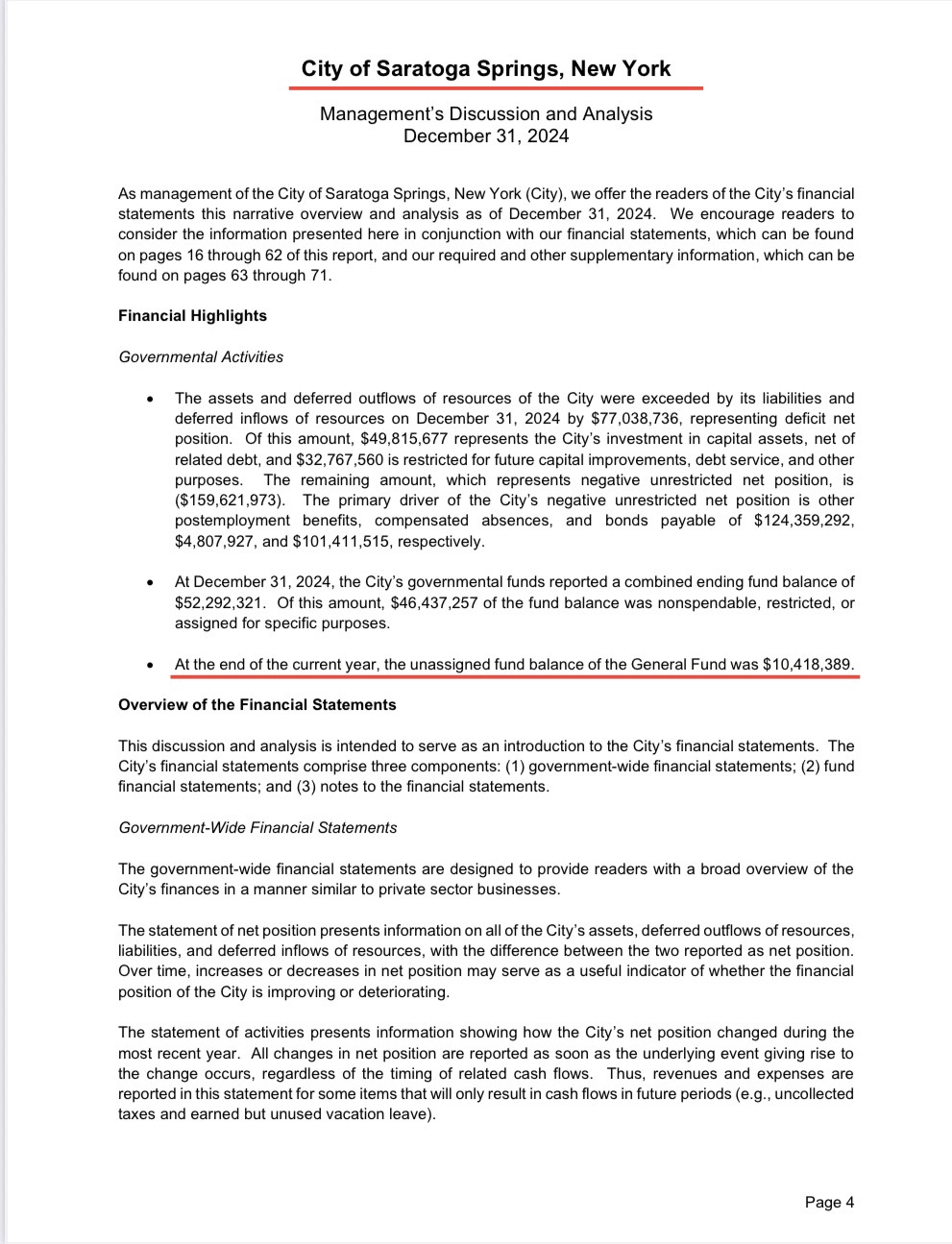
The Auditor’s Report For 2024
This is the complete audit.
This is an excerpt from the auditor’s findings, which include two items identified in 2023 that remain unresolved a year later.

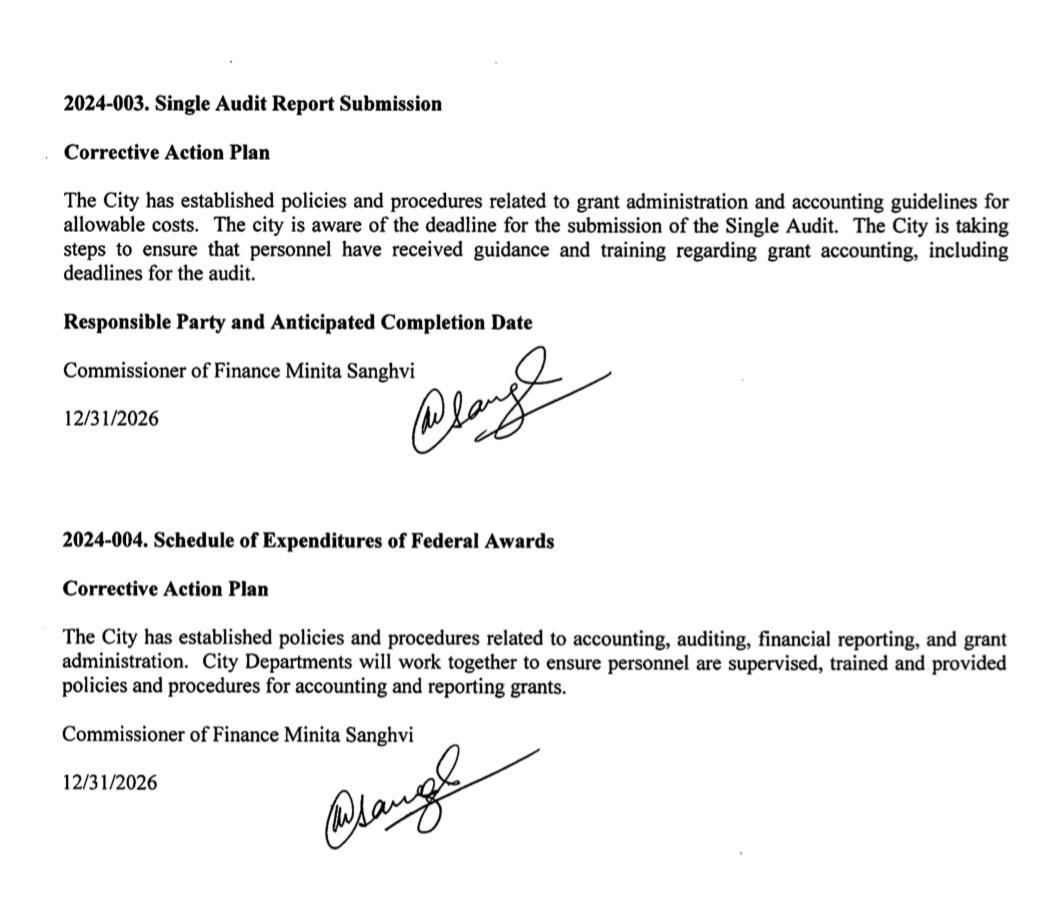
These are Sanghvi’s assurances that they will be fixed. Note that some of them project the fix date as 12/31/2026, meaning it will be her successor who will have to clean up her mess.

Sanghvi and Moran End Their Tenure On The Council With Just More Disinformation

Saratoga Springs is finally coming to the end of the ordeal of having to listen to disinformation from Finance Commissioner Minita Sanghvi and Accounts Commissioner Dillon Moran. Still, even for them, the chaos and dishonesty they have engaged in discussing the mess Sanghvi created with the 2026 budget takes a lot of nerve.
In the November 20, 2025, edition of the Saratogian, its readers were subjected to the magical thinking of Sanghvi and Moran, in which events are twisted beyond recognition.
Sanghvi’s Twisted Self-Congratulations
According to the city’s charter, the Finance Commissioner is supposed to spend months working with each department’s executive staff to craft the next year’s budget. The budget is supposed to reflect the Commissioner’s best thinking on balancing the city’s resources with its anticipated income.
In October, with less than two months until the budget’s required adoption date, Sanghvi suddenly announced that the city was in a deep financial hole. Her response was classic partisan abuse. To close this hole, Sanghvi’s (a Democrat) proposed budget eliminated funding for the Mayor’s (a Republican running for office) department for non-profits, most of which were devoted to homelessness, as well as other key services like school crossing guards.
This is what Sanghvi told the Saratogian on October 9, 2025,
“I could not take money from our police or public works department and then give that money to nonprofits. This is not an easy decision. This is not something we did lightly, but we had no other way of doing this.”
In this same article, she dismissed the idea of raising the property tax rate to address the shortfall:
Another option Sanghvi pointed out, though she added that she did not (sic) believe “city residents should not be facing the burden of rising property taxes every year” and that “2% is more than enough.”(Emphasis added)
Saratogian Newspaper
Sanghvi doesn’t explain where the money will come from to put the $900,000.00 back in the budget. Magic!
According to the November 25, 2025 Times Union, Sanghvi transferred $1,810,000.00 from the city’s fund balance (reserves) and $500,000.00 from the city’s retirement reserve. So we will run a deficit of at least $2,310,000.00 next year. I have no idea whether it is prudent to take $500,000.00 away from the city’s retirement reserve. It is troubling that Sanghvi supposedly overestimated by $500,000.00 what would be needed next year to meet our obligation regarding the retirement system.
Sanghvi’s Magical Thinking
As it turned out, the final budget was very different from her original proposal. In addition to raiding the city’s reserves and its retirement funding, Sanghvi reversed her position on raising taxes. Her new budget will now benefit by raising taxes by 4.53%. This, of course, comes after the election, during which she was campaigning for a Count Supervisor position.
It is important to note that based on Sanghvi’s budget, the city ran a deficit of $3,500,000.00 during the current (2025) year. It is rather stunning that Sanghvi only revealed this fiscal hole after her successful campaign for County Supervisor.
I’m sorry that, for many, the Saratogian articles are behind a paywall, as it is impossible to summarize the rambling, contradictory remarks Sanghvi made to the Saratogian in defense of what she did. Sanghvi effusively congratulated herself and her work with the community for reinstating her own cuts.
Take this statement from Sanghvi:
They [JK: The community?] said very clearly that they wanted to fund the RISE shelter, the homeless, Franklin Community Center and all these other organizations, which are doing incredible work in our community and that they were fine with the 4.5% tax increase. I think it was important for the public to come to that conclusion themselves and say, ‘yes, we want this tax increase to pay for this. And I think that’s sort of the goal that we achieved here.”
This may be the way Sanghvi wants this debacle remembered, but it is not what actually happened.
In fact, Sanghvi faced significant pushback from Mayor Safford, Public Works Commissioner Chuck Marshall, and Commissioner Coll on her budget from the start.
This is Coll’s recollection:
As soon as I saw the Comprehensive Budget unilaterally presented by Commissioner Sanghvi, I knew we were in trouble. The proposal included no funding for school crossing guards, contractual obligations, or our vital nonprofits such as the homeless shelter and the Senior Center. I strongly advocated for a tax increase to our legal limit (4.5%) and for using fund balance to support our nonprofits. Fortunately, Mayor Safford, Commissioner Marshall, and I reached a consensus to address the needs of our most vulnerable residents, as Commissioner Moran was absent from this particular budget workshop. The video of this meeting, dated 11/14/2025, will corroborate and set forth the truth of this matter, including that Commissioner Sanghvi’s budget did not provide funding for these nonprofits from the outset.
Commissioner Tim Coll
Dillon Moran’s Memory Hole
Moran was the sole vote against adopting the budget. He attributed his vote to the budget’s failure to include funds to address the city’s alleged water issues, issues he claimed he raised when he ran for DPW Commissioner seven years ago.
According to the Saratogian article, Moran said:
“The budget does nothing to put forward money to invest in the most important thing we provide to our citizens, which is clean, potable, consistent drinking water. I, in good conscience, cannot vote for that budget. The biggest issue facing this community. Period.”
Moran to the Saratogian
So if Moran was alarmed about the lack of money in the budget regarding water, why didn’t he offer an amendment to address his allegation?
Instead, he offered the following shrill warning to the Saratogian:
“The budget does not include money to address the issues in any sort of meaningful way. We are facing a $40 million investment that I called for seven years ago, when it was $24 million and it’s $40 now. If we don’t do something about it today, it’s going to be 50 (million), and then 60 (million), and then we’re going to have a major failure and then big sections of our community could be without drinking water.
“And if they’re without drinking water for a certain period of time, and those pipes sit dry, that’s it.”
Dillon Moran
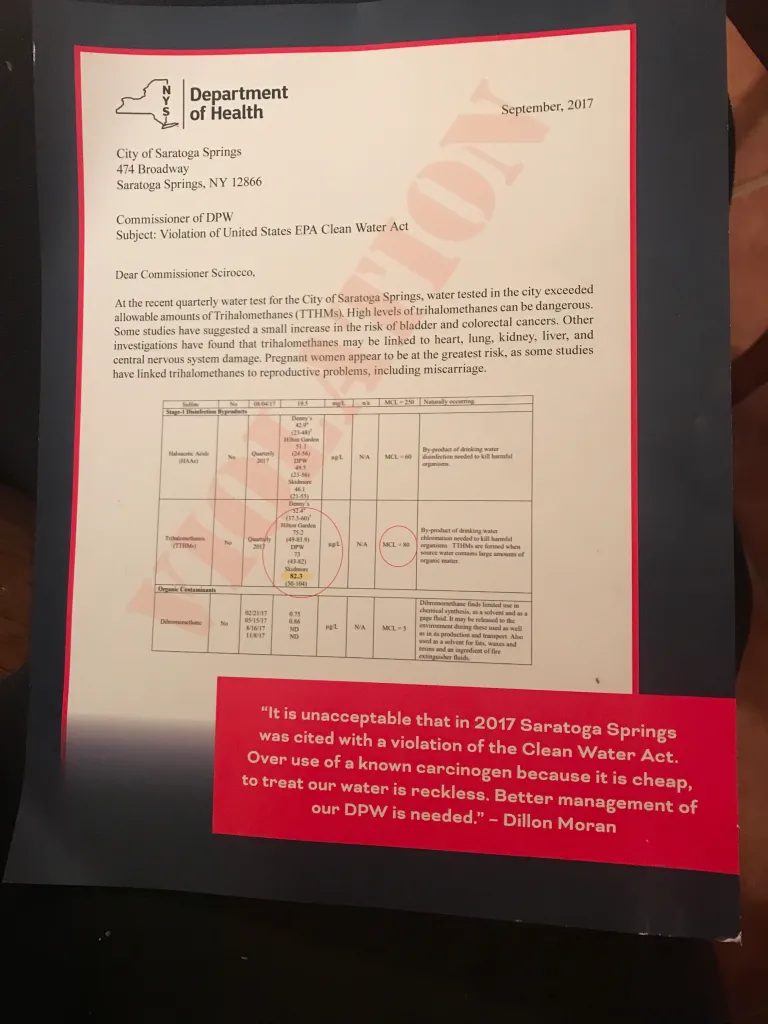
Apparently, Moran does not remember that his campaign for Commissioner of Public Works at the time was deep-sixed when it was revealed that a campaign mailer he had sent included a forged letter purportedly from the New York State Department of Health supporting his wildly false accusations about the state of the city’s water supply.
Here is a post documenting Moran’s folly in which he falsified the NYSHD letter.
This is the mailer containing the forged letter from the New York State Department of Health that Moran sent out in his attack on the late Public Works Commissioner Skip Scirocco.
Chaotic City Democratic Committee Meeting Reinforces Their Inept Status Quo

Coming off their third consecutive major election loss, the Saratoga Springs Democratic Committee has established a new low in terms of competence and community relations.
The Open Meeting Closed
An extremely unflattering front page story in the November 16, 2025, edition of the Daily Gazette, documented the debacle that unfolded at the November 15, 2025, Saratoga Springs Democratic Committee meeting.
The previous week, committee chair Otis Maxwell emailed the committee, advising them that the meeting would address the results of the recent election where the committee’s nominees suffered significant losses and be open to the community.
Some days later, he wrote to the committee again, reversing his earlier email and advising that the meeting would not be open to non-committee members. Some members of the committee complained that it was too late to close the meeting, as non-members attending might not be aware that they had been uninvited.
Approximately 30 members of the committee attended in person (a full committee would have 50 members), a handful had proxies from other members, and at least one person (Dillon Moran) participated via Zoom.
Approximately twenty additional people attended, including members of the press and students from Skidmore College Professor Bob Turner’s class on local politics.
Prior to the meeting, Maxwell had falsely telegraphed that the executive committee would be resigning at the meeting. It generated a rumor that had spread quickly. At the meeting, before it was closed to the public, Maxwell reinforced this narrative.
In a classic case of unintended irony, Maxwell told those present that “I and the executive committee acknowledge there are broad calls for a change in leadership. We hear and accept that message (emphasis added).”
As documented in the Daily Gazette article, after the public and press were escorted out, Maxwell told those present that he and the executive committee had no intention of stepping down. Maxwell did entertain a motion directing the executive committee to resign. The motion failed in a close vote (16 v 20). Despite the conflict of interest, most of the executive committee voted against the motion. If the executive committee members had demonstrated ethics and refrained from voting, the measure would have prevailed.
The result of this foolishness was a news story in a variety of publications that only added to Maxwell’s and his committee’s dubious reputation.
Before the public was removed, newly elected Commissioner of Public Works BK Keramati rose and told the committee that he stood behind his controversial mailers and that they were factually accurate. This was interesting because during the previous two weeks, Keramati had faced withering criticism for the sensational misinformation he had used in his campaign. In contrast to his remarks at the meeting, he had defended himself by expressing regret for his mailers.
Maxwell then introduced Achim Bergmann. Bergmann, in addition to being a member of the committee, is a professional campaign consultant and was engaged by the committee, along with several endorsed candidates, to assist in running Democratic campaigns.
Bergmann’s analysis was purely statistical, and it concluded that One Saratoga had been instrumental in the defeat of most of the committee’s endorsed candidates.
Bergmann finished his presentation by asking if anyone had any questions. One of the non-committee members responded. She wondered whether the discussion would include an assessment of whether any of the candidates endorsed by the committee had posed a problem. When she noted that she had voted for the One Saratoga line because of concerns about candidates endorsed by the city Democratic Committee, Otis Maxwell interrupted her. In harsh terms, he told her that she was not a member of the committee and that she was out of order speaking. It was apparent that he was committed to silencing any criticism of his committee’s candidates, even if it meant alienating the members of the public and press in attendance.
Maxwell then called for a vote to have anyone present who was not a committee member leave. The vote was close. According to the Daily Gazette, the vote was 19 in favor and 17 against. The press and the other non-members exited.
“It’s deeply disappointing and unnerving that my constituents, campaign team, and press were thrown out of the Saratoga Springs Democratic Committee meeting,” said committee member, former chair, and City Supervisor-elect Sarah Burger.
According to the Gazette, Skidmore professor Bob Turner told the paper:
“My students were kind of struck by being asked to leave, they say they were kind of rubbed the wrong way by that,” Turner said.
“Here’s this opportunity to listen to people who really care,” Turner added.
So Much For The Alleged Change In Leadership
Following the failed vote to remove members of the executive committee, Maxwell announced that the Democratic Party of Saratoga Springs would organize a listening tour to solicit community input. This prompted a wag to observe, “There already was a listening tour and the message was a ringing rejection. It was called an election.”
Minita Sanghvi’s 2026 Budget-More Chaos

This blog has documented the numerous missteps in handling the city’s finances by Minita Sanghvi since she became the Saratoga Springs Commissioner of Finance.
Under the city charter, Sanghvi is responsible for preparing the city’s budget each year, which must be adopted by November 30. As this deadline approaches, Sanghvi’s years of mismanaging the city’s finances have finally brought the city to the verge of a financial crisis. How severe a crisis it is, even now, is hard to determine, though, as the financial indicators Sanghvi should be providing are missing.
One of the key documents that should have been an important tool for the Commissioner to use in understanding the city’s financial condition and planning for the 2026 budget was due September 30. As of the time of this blog’s posting, the audit has finally been placed on the agenda for the November 18, 2025, meeting; however, the link to the actual audit included in the agenda does not work.
The tardiness of this audit is not new for Sanghvi. The 2023 audit also missed the September 30, 2024, deadline and was not submitted until November 7. This was coincidentally only days after the November 2024 election in which Sanghvi was running for the State Senate. As the audit included damaging items regarding her handling of the city’s finances, it is no small wonder that she delayed releasing it beyond the required date and after the election.
In addition to tardiness, Sanghvi is criticized in the audit for failing to follow “accounting practices generally accepted in the United States.” She blamed this problem on “a personnel vacancy.”
In her response to the audit (below), Sanghvi admits that she had failed to meet the “…deadline for the submission of the Single Audit.”
You would think that, having been criticized in the 2023 audit for being late, she would be particularly diligent about ensuring the timeliness of the 2024 audit release. You would be wrong. She is late for the second consecutive year.
I am unaware of any previous Finance Commissioner failing to submit the audit on time, let alone failing to do so twice.


I contacted Commissioner Sanghvi, asking why, yet again, the audit is so late this year. In a phone conversation, she blamed the problem on the alleged failure of the Mayor’s office and the Department of Public Works.
I contacted Deputy Mayor JoAnne Kiernan and DPW Commissioner Chuck Marshall regarding Sanghvi’s allegation. Both officials told me that Sanghvi had not contacted them about any missing information.
I then sent the following email to Sanghvi, requesting any documentation that she or her staff had provided to the executive staff in either the Mayor’s office or the DPW regarding the urgent need for missing information.
The Email
| John Kaufmann < | Tue, Nov 11, 7:00 PM (3 days ago) | ||
to Minita, Tim, Dillon, John, Charles.Marshall | |||
Minita:
Thank you for returning my call. As you are aware, we discussed the city’s lack of an audit. BST, our auditor, was required to provide the city with its audit by September 30. In turn, your office was required to submit the audit to the city council and the public by November 1.
You blamed the failure to meet the city’s deadlines on the mayor’s office and the Department of Public Works.
On September 25, you emailed DPW about missing information. They informed you that the information you were looking for had been uploaded to a folder shared by DPW and Finance on August 7. You had the information. If there was any confusion about the information, please let me know why you waited until September 25, five days before the audit was supposed to be completed, to contact DPW?
Regarding the mayor’s office, you never contacted the mayor or his deputy about this issue. Apparently, someone from your office has contacted the planning department regarding a matter involving grants. (In the previous audit, you were criticized for your failure to properly manage the fiscal elements of these grants.) Notably, your office did not raise the issue until mid-October. As the audit was required to be completed by September 30, can you explain why this was not addressed earlier? If this was pressing and not being done, why didn’t you email the mayor or his deputy? Please provide any documentation regarding the attempts made by your department to obtain this information.
Audits are at the heart of accountability and of transparency. What’s most alarming is that you do not seem particularly concerned about the failure of Finance to provide this audit, which should have been available before the election. Given the criticisms in the auditor’s 2023 report, one must wonder whether the 2024 audit will contain unflattering findings.
My key question to you is why you did not advise the council that you were unable to meet your obligation under the charter to provide them with this vital document?
Radio Silence
As usual, I received no response. I submit that there was no response because Sanghvi has no documentation. She is guilty of an inept attempt to cover up the failure in her office. I do not think it is unreasonable to consider that she has suppressed the latest 2024 audit report because it would reveal more problems in her office, particularly in a year when she was running for Supervisor.
Sanghvi’s October Surprise
As the Commissioner of Finance, Sanghvi is responsible for monitoring the city’s spending.
In May, the city agreed to fund RISE (the provider of a homeless shelter for the city) for approximately half a million dollars. Sanghvi not only voted for the resolution, but she waxed on about the value of their service for our city.
In October, Sanghvi presented a budget that cut not only the funding for RISE, but also for all the not-for-profits the city had been supporting for years, including the Senior Center. The reason? The city was suddenly facing a $3,500,000.00 deficit for the current fiscal year, which is not yet over.
How could she not have seen this coming?
By May, when she supported spending $500,000.00 on RISE, she should have been aware of the looming budget problems.
It is a testament to her mismanagement that, up until October, when she was finally required to prepare the budget for next year, she said nothing at the Council table about the financial threat facing the city.
It is worth noting that Sanghvi was warned last fall, during the preparation of the 2025 budget, that her fiscal assumptions were overly optimistic. At the time, Public Safety Commissioner Tim Coll urged her to raise the city tax rate to 2%, as allowed by state law. Although she had raised taxes her previous two years in office, in 2024, she was running for State Senate and refused.
As has become painfully obvious, her budget for 2025 badly underestimated expenses and overestimated income. This was not her first time doing this.
As this blog has documented over the last four years, Sanghvi is far more interested in drama at the Council table than in devoting the very demanding time required to fully understand the city’s finances.
Understanding Just How Bad Sanghvi’s Budgeting Is
Under our charter, the Finance Commissioner is responsible for preparing the city’s annual budget. This budget is intended to be the result of thorough analysis and consultations with other city departments. While it is expected to be revised once it is proposed to the Council, it is intended to be a serious document that the Finance Commissioner would want to be adopted as is. This is because, unless a majority of the Council overrules the Commissioner’s proposal, it is automatically the city’s budget for the following year.
Sanghvi’s desire to defund all the not-for-profits (RISE, the senior citizens’ center, Judge Vero’s outreach/homeless court, and even school crossing guards) was supposed to reflect her determination that while these organizations were valuable, other city needs would take precedence.
Coincidentally, in an election year, these major high-profile nonprofit organizations that were cut are funded by the Mayor’s office, and these cuts were often portrayed as coming from the Mayor, not Sanghvi.
According to reports, although the public has yet to see the changes, Sanghvi has reportedly now restored these cuts.
Sanghvi Blames Other Departments For The Failure Of Her Department and Gibberish and Confusion Over What The City’s Reserves Are
As of this Friday, November 14, Sanghvi was still not taking responsibility for the late audit and continued to demonstrate a fundamental ignorance of the city’s finances.
At the pre-agenda meeting on Friday morning, Sanghvi again blamed unnamed departments for the audit delay. She informed her colleagues that her office had met with the auditors in mid-October to discuss the remaining information they needed. As the audit was supposed to be completed by the end of September, she self-documents the tardiness of her own office in completing the audit.
In a budget hearing that same day, Sanghvi was asked to provide the Council with accurate information on the city’s fund balance. The “Unassigned Fund Balance” is the technical term for the city’s reserves. In addition to raising taxes, one way to address the city’s deficit is to tap into its reserve fund. It is obviously important to know the size of the reserve in order to determine how it may be used to address the city’s deficit.
In this clip, Commissioner Coll attempts to determine from Sanghvi how much the city has in reserve to address the proposed budget shortfalls.
The Finance Commissioner serves as the chief financial officer (CFO) of the city. It’s hard to believe, as documented in the following video, Sanghvi was unable to answer Commissioner Coll’s repeated requests regarding the city’s reserves to address the budget for next year. As her frustrated response indicated, she did not know, and this is particularly glaring because, given the repeated requests for this number, she should have had the figure readily available.
Further, note how she distances herself from her staff in the video clip. When trying to explain what the city’s reserves are, she notes that the numbers she is getting are from her staff referring to her deputy and budget director as “they” as her budget director is shaking her head. So these are not numbers that she has analyzed and that constitute her financial analysis. Apparently, she is unable to read these reports on her own and adopt them as her own.
We Still Don’t Know
Sanghvi has insisted that the budget be adopted at the November 18 meeting, as she needs to travel to India. That is just two days away. The budget was supposed to be attached to the meeting agenda on the city’s website on Friday. It was not. There is a hearing on the budget before the meeting. How is the public supposed to thoughtfully speak on the budget when they do not have access to it?
I believe we will not know the actual financial condition of the city until JoAnne Kiernan, who has extensive accounting experience, takes over as the new Commissioner of Finance.
Thank You, Brian Wager
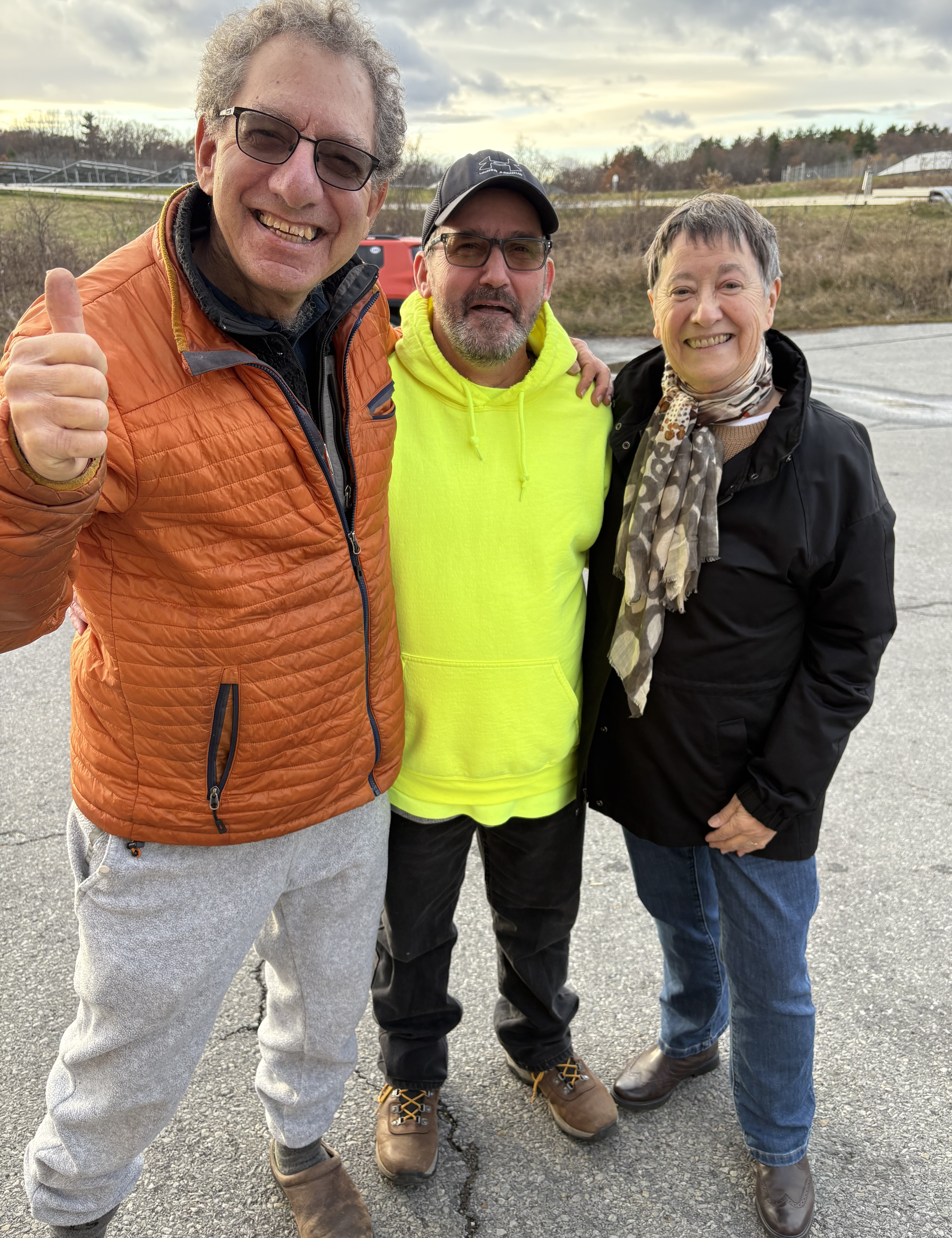
Blogger, Brian Wager, Jane Weihe
After thirty years with the city’s Department of Public Works, Brian Wager retires next Saturday.
Those of you who use the transfer station to dispose of your garbage and recycling, have probably been assisted by Brian. Always patient and good-humored, Brian was always available to give a helping hand.
When you see Brian, thank him for his service and wish him well in his retirement.
BK Keramati Goes to the Dark Side
This is a mailer BK Keramati sent to Saratoga Springs voters.
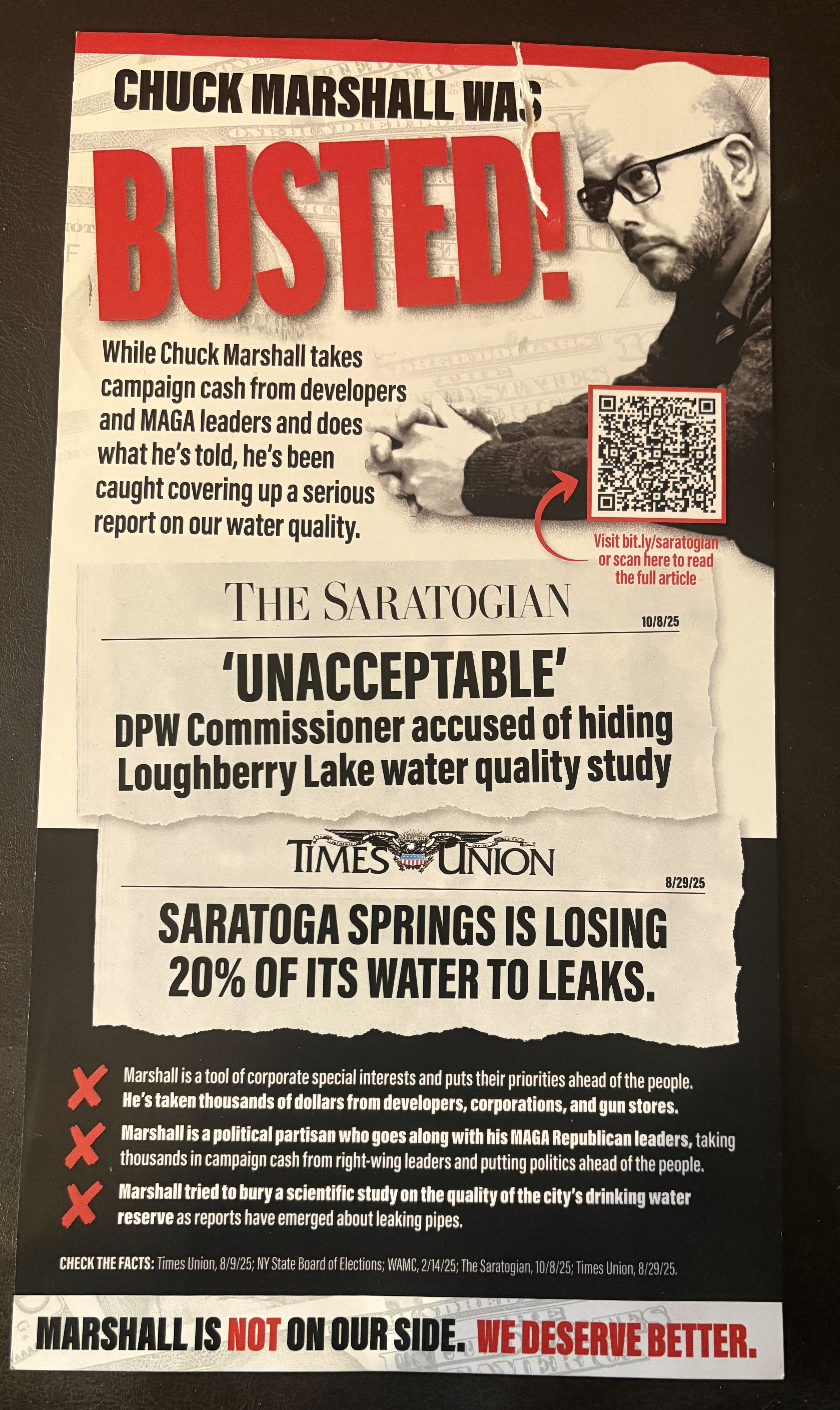
Up until he began his campaign for Saratoga Springs Commissioner of Public Works, my encounters with BK Keramati over the years had always been pleasant.
While I supported his opponent, the current Commissioner, Chuck Marshall, I believed Mr. Keramati did not have the history of toxic behavior that other candidates endorsed by the local Democrats this year had. I assumed, therefore, that if elected, he could be counted on to interact civilly with his fellow Council members even if he did not always agree with them.
I was unprepared then for his toxic mailings and social media assaults on his opponent. His campaign became just another example of the ugly and vituperative behavior that the city has endured from the Democratic leadership over the last four years. What is sad is that, given Keramati’s reputation up until this point and his vigorous door-to-door campaign, he might well have won without stooping to this kind of dirty politics. Instead, he focused on false statements and assumptions to run a campaign that essentially was an attempt at the character assassination of his opponent.
The Water Report


One of Keramati’s main themes was to accuse Chuck Marshall of “hiding” a study of Loughberry Lake. Many of the issues with this aspect of Mr. Keramati’s disturbing campaign were explored in an earlier article.
Suffice it to say that since Chuck Marshall immediately gave BK the report when asked and without making him FOIL for it (something that would have meant BK would have not gotten the report until after the election), it is difficult to understand how Mr. Keramati could, with any integrity, describe Marshall as being “caught covering up a serious report on our water quality” as he does in his mailer.


Fooling The Public
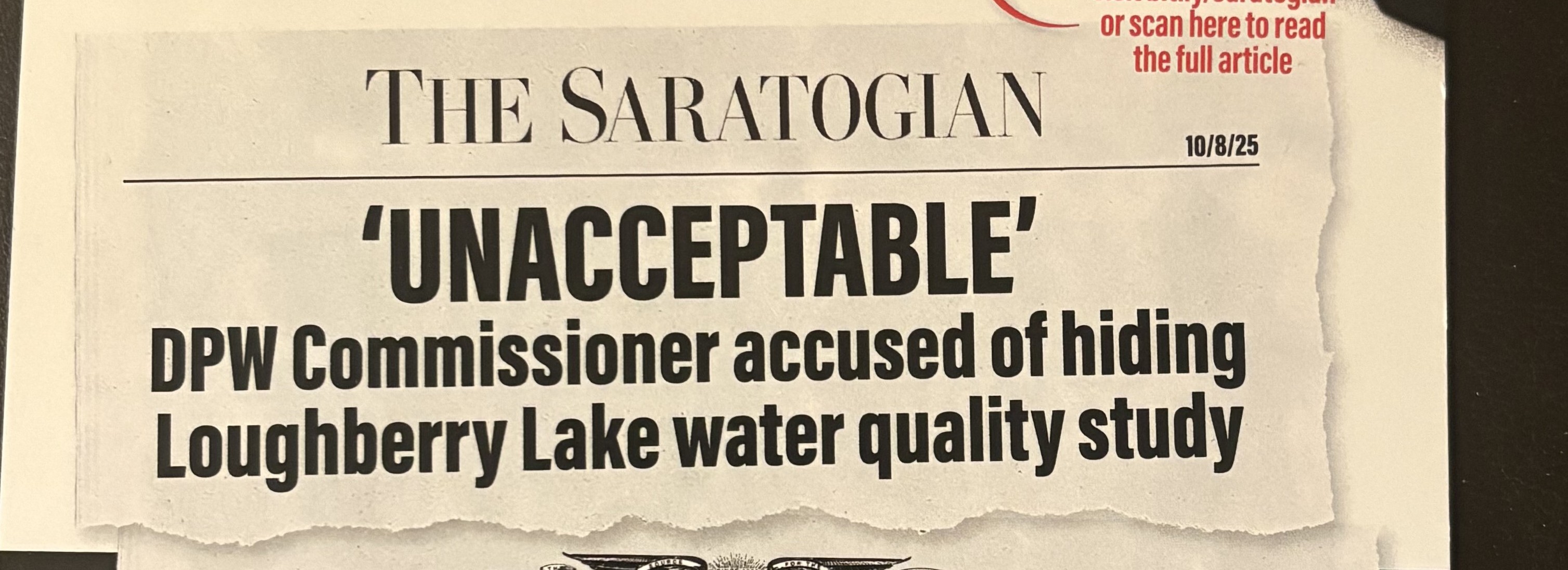
To provide credibility to his accusations, Keramati doctored an image of the Saratogian Newspaper (and others)in his mailers. This headline never existed. The tear at the bottom of the image was meant to convey authenticity.
An Assault On Marshall’s Integrity
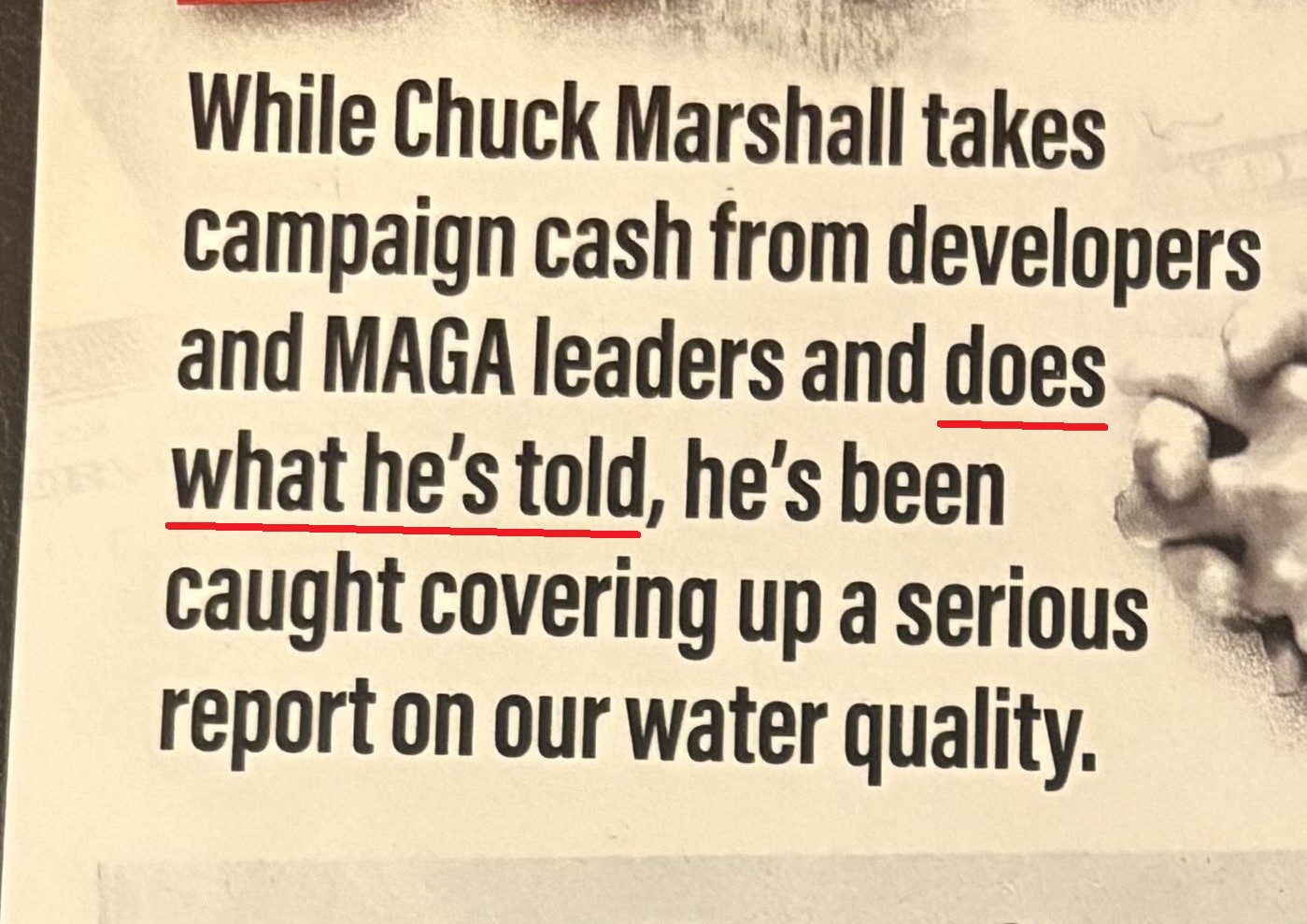

Chuck received a considerable amount of money from, among others, individuals in the real estate industry.
BK could have legitimately pointed this out and raised questions about the extent to which they might influence Chuck’s tenure should he have won.
Instead, BK’s mailers went over the top, asserting that “he (Chuck) does what he is told” and he is “a tool of corporate interests and puts their priorities ahead of the people.”
Keramati provides no examples of Chuck having used his position to aid donors.
To the contrary, Chuck has had the opposite reputation as Planning Board Chair, where he was known for creating an environment of inclusion and respect, working with a board of diverse people, both politically and socially.
I recently spoke to Bill McTygue, who served on the Planning Board with Chuck. Bill had been on the Democratic Committee and probably supported Keramati, yet he was quite complimentary of Chuck’s leadership. I asked him specifically whether he observed any effort by Chuck to manipulate the board in favor of any developers. Bill said “no.” Bill observed that Chuck’s focus was on building a consensus among the board to make decisions.
So what does it say about Keramati’s character that he would tell voters that Marshal is a guy who “does what he’s told”?
Likewise, Keramati cites a donation Elise Stefanik made to Chuck’s campaign as evidence that “Chuck is a political partisan who goes along with his MAGA Republican leaders…putting politics ahead of the people.” Keramati again cites no evidence of this and appears uninterested in acknowledging that Chuck has publicly stated he did not vote for Donald Trump.
The Chuck Marshall I Wish People Had An Opportunity To Know.
Here is an anecdote that may help people to understand what kind of person Chuck Marshall is in comparison with the characterization of him put forward by Mr. Keramati.
When Chuck defeated Hank Kuczyinski, he inherited Michele Hill-Davis as his executive assistant, whom Kuczynski had hired. In addition to having been selected by his opponent, Ms. Hill-Davis is an active committee member of the city’s Democratic Committee.
I know for a fact that quite a few people told Chuck he needed to replace her. They argued that as his executive assistant, she would be privy to all the goings-on in his office. In effect, she would be a spy.
In classic Chuck style, he refused. He said he would not fire anyone without giving them a chance to demonstrate their ability to perform the work. Ms. Hill-Davis is still his executive assistant.
Unlike Keramati, Marshall’s campaign also reflected his character. It was positive without a breath of attack and recrimination.
Hope?
Keramati worked closely with Gordon Boyd, who energetically echoed and amplified Keramati’s campaign claims on his Facebook page, and Achim Bergmann, a professional political operative with national campaign experience and a member of the local Democratic committee. Both men BK chose to work with have a history of running toxic campaigns.
One can only hope that Keramati will show more civility and integrity at the Council table than he did in his campaign.
 Saratoga Springs Politics