At the December 5, 2023, Saratoga Springs City Council meeting, Public Works Commissioner Jason Golub expressed concern about adopting a restriction on truck traffic on Van Dam Street without a thoroughly researched plan.
In the following email from former Public Safety Commissioner and County Planner Lew Benton, Benton offers his research on the efficacy of limiting such traffic without the approval of the New York State Department of Transportation.
I texted Public Safety Commissioner Montagnino, asking whether he had checked with the New York State Department of State (DOT) prior to installing the signs restricting truck weight on Van Dam Street. As of this time (December 14, 2023), while Montagnino has not responded to me, I have learned he plans to contact DOT “sometime in the future.”
In a related matter, my friend, Jim Martinez, has advised me that 53-foot trucks are prohibited from using Washington Street (Route 29). Apparently, this has not been enforced.
From Lew Benton
John.
For what they’re worth, here are a few preliminary thoughts on routing Special Dimension Vehicles (SDVs) and Qualifying Access Highways.
These vehicles, or vehicle combinations, were initially authorized by the 1982 Federal Surface Transportation Assistance Act and subsequent state legislation.
Under the 1990 Omnibus Truck Safety Bill, New York authorized the use of 53 foot trailer combinations, effective November 1990. Per § 385(3)(e) of the Vehicle & Traffic Law, the 53 foot trailer combinations are restricted to the Qualifying and Access Highway system.
A Qualifying Highway is a roadway designated as part of the Surface Transportation Assistance Act (STAA) of 1982, which allows Special Dimension Vehicles (tractor trailers combinations greater than 65 feet, tractors with 28-foot tandem trailers, maxi-cubes, triple saddle mounts, stinger-steered auto carriers, and boat transporters) and 53′ trailers to use that highway and any other highway within one linear mile.
Unless otherwise specified, all Special Dimension Vehicles may use Qualifying Access Highways. In addition, Special Dimension Vehicles may also operate on all highways within one road mile of Qualifying Highways (National Network) using the most reasonable and practicable route available, except for specific safety reasons on individual routes (23 CFR 658.19). The National Network consists of all Interstates plus specifically designated other highways, including most state highways.
The confluence here in Saratoga Springs of several state and interstate components (9, 9N, 29, 50, I 87) of the National Highway Network resulted in several city-owned and maintained street segments designated an “Access Highway.” Van Dam Street is so designated.
Local government has diminished authority to regulate these local access roads and streets. Imposing a weight limitation on a local access road first requires the designation of an appropriate alternative route and approval by the NYS Department of Transportation Regional Office.
It seems inconceivable that the City Council would post a local “access” roadway – as it was apparently authorized by an amendment to the City Code at its last meeting – without prior approval of the DOT. I do not know what alternate route the Council may have asked DOT. At this writing the 5 Ton Limit signs are posted on Van Dam immediately next to the posted Truck Route signs.
If DOT does not approve the Council’s action, the proposed weight limit will be unenforceable.
Perhaps the entire community and the Council members would benefit from a review of all currently designated access roads in the city, how some have been altered over time, the process necessary to amend the system, and other pertinent matters. Such a review might also include a brief history of the several by-pass proposals and initiatives that have been undertaken since 1980.
Finally, I note that V & T Law enforcement and commercial truck inspections, as measured by the number of citations issued and fines collected, seem to have declined precipitously.
In the late 80s and early 90s, following the establishment of a well-trained and equipped traffic safety unit, V & T and overweight and unsafe truck fine revenue was as high as $225,000 annually. The number of traffic citations issued annually by the SSPD increased from an average of 2,145 before the Traffic Safety Division came online in 1988 to nearly 3,300. In 1993, 46,00 tickets were issued. Vehicular accidents and personal injury accidents declined to ten-year lows. Today, that revenue line has fallen to $30,000.
Then, Truck Fines appeared in the city budget as a separate line. That line is long gone. The Traffic Safety Division, as originally constituted, was abolished at some point in time. I do not know when or why.
The December 5, 2023, Saratoga Springs City Council meeting was yet another example of mindless accusations and poorly considered actions by Council members.
The issue was limiting truck traffic on Van Dam Street by placing a 5 ton weight limit on trucks using that thoroughfare.
Following the public comment period at which many of the residents of Van Dam pleaded with the Council to limit truck traffic there, Mayor Ron Kim accused one of his opponents in the last election, Chris Mathiesen of “illegal” behavior in somehow making Van Dam Street a truck route years ago. His accusation was based on unsubstantiated allegations. [JK: Chris’s response is at the end of this post.]
Kim claimed that a letter written by Chris Mathiesen, the Commissioner of Public Safety at the time, to the New York State Department of Transportation (DOT) in 2014 somehow directed DOT to make Van Dam into a truck route.
During his spirited accusations regarding Mathiesen, Kim disclosed that he did not actually have a copy of the letter he cited as evidence, nor had he apparently seen one. It was also evident that he had not had the courtesy of discussing the matter with Mathiesen before making his public accusations.
All of this performance was for the benefit of the many people from Van Dam Street who had addressed the Council on their desire to place a weight limit on trucks allowed to access their street.
A History Of Van Dam Street and the City’s Truck Problems
One route trucks take traveling from the New York State Thruway east to the Adirondack Northway is through Saratoga Springs. For decades Van Dam Street has been one of the roads trucks take to get through the city. In the late 1970s, my wife and I looked at a house on Van Dam Street as a possible home for us. Knowing that the street was frequently used as a truck route, though, we decided not to pursue the purchase. This pre-dated by many years, Mathiesen’s terms as Public Safety Commissioner.
The idea that Mathiesen was responsible for making Van Dam into a truck route is patently false.
I spoke to Chris about what actually happened.
Washington Street is a state road (NYS Route 29) and is a state-designated truck route. The road is narrow. Even narrower than Van Dam St. It ends in a T intersection at Broadway (by Starbucks). The increased truck traffic over the years has made life on Washington Street challenging for those homeowners. In many ways, the problems for homeowners on Washington Street were even worse than those on Van Dam. In addition, the maneuvering trucks had to do to negotiate the turn onto Broadway from Washington was notorious. Sidewalks at that intersection were frequently in need of repair as trucks would routinely go up over them to make the turn. I use the past tense since construction has kept that stretch of Washington closed recently. This could maybe account for the complaints of Van Dam street residents that truck traffic on their street had increased.
To his credit (no good deed goes unpunished), Chris attempted to see how to ease the truck problems. He wrote to NYSDOT advising them of the streets currently used for truck traffic, including Van Dam. He sought their advice on how to ease the city’s truck problems. Clearly, Van Dam would be part of a possibly better design.
The critical point here is that Van Dam was already a truck route. It was reckless and without foundation for Kim to blame Mathiesen for the truck problems on Van Dam, let alone say that he did something “illegal.”
Here is a twelve-minute excerpt from the meeting of the discussion.
I understand the frustration and anger expressed by the residents of Van Dam. Still, Van Dam intersects with Broadway beyond the north end of the downtown business district and connects quickly to the arterial leading to the Northway. Washington Street, in contrast, dumps truck traffic directly into the middle of downtown. It’s hard not to agree that, given bad choices, Van Dam makes sense as one of the city’s truck routes.
Finance Commissioner Sanghvi rightly asked what happens next if trucks can’t use Van Dam. Where will they go? Public Works Commissioner Jason Golub expressed reservations when the item came up later on the agenda for a vote. He thoughtfully suggested that before proceeding, there was a need for a thoroughly thought-out plan.
Nevertheless, succumbing to the compelling and emotional pleas of the Van Dam Street homeowners, the Council ignored these issues and approved the weight limit for their street. I have to express sympathy for the people of Washington Street who will now bear the burden of even more truck traffic, as will downtown Broadway.
A Skeptical Blogger Ruminates About Trucks
The problem of truck traffic has plagued this city for decades. At some point, the State Park and DOT were approached about building a truck route at the Southern end of the state park in order to bypass downtown Saratoga Springs. The response was a resounding no. There are extensive wetlands in that area, and the park does not want the noise of trucks to be part of its environment.
Bill McTygue has recently garnered headlines in the Daily Gazette by resurrecting this plan for a truck route.
Given the history of this problem, this blogger is highly skeptical that this solution will be any more viable now than it was when it was proposed and dropped years ago. I noted that when McTygue spoke to the Council, he was careful to observe the impact on Washington Street that removing trucks from Van Dam would have.
Congratulations but……..
I congratulate the Van Dam homeowners on their success at the December 5, 2023 meeting. Their victory, however, if sustained, comes at the cost of making life for those who live on Washington Street even more difficult and will negatively impact Broadway and downtown Saratoga. It remains to be seen, though, if this resolution will be sustainable. Not only will the new Council now have to deal with the fallout from this Council’s poorly thought out action, but it has yet to be seen if DOT will allow this to happen.
Chris Mathiesen’s Statement
[This was a letter he sent to Saratoga Today]
In particular, I addressed one of the attacks on my administration as Public Safety Commissioner during my term in office (2012-2017).
It should also be noted that Mayor Kim’s frequent criticism of the Police Chief’s decision to reduce the Traffic Division of the SSPD is unfair. I have offered to sit down with the Mayor to discuss the reasons for that decision. He has continued to ignore my offers.
The letter is below:
December 6, 2023
To: Saratoga Springs City Council
RE: Van Dam Street Truck Traffic
After attending last night’s Saratoga Springs City Council meeting, I did some research today. I have been able to establish the following:
Van Dam Street has been a Designated Access Highway for truck travel since 1989. No change was made regarding that designation during my term in office as Commissioner of Public Safety (2012-2017).
I did send to the NYS Department of Transportation letters on November 18, 2014 and March 4, 2015 to inquire whether the Washington Street/Route 29 corridor from West Avenue to Broadway could be restricted so that large trucks could no longer use that state route. This was one of a number of suggestions that we were considering, including one proposal that would eliminate east-to-west truck traffic on Lake Avenue.
Due to the lack of cooperation from the Town of Wilton, the plan to eliminate east-to-west traffic on Lake Avenue was not successful.
Any plan to change truck access to Washington Street/Route 29 would have required approval from the City Council in coordination with the NYS Department of Transportation. Our inquiry never advanced that far. Because the elimination of truck access on Washington Street/Route 29 would have resulted in that traffic being transferred to the already burdened Church Street/Van Dam Street corridor, we were reluctant to proceed and, especially after talking to Van Dam Street neighbors, we decided not to pursue that option.
The NYS Department of Transportation verifies that there was no change in designation of the Van Dam Street as a Designated Access Highway during my term in office. The actions that Mayor Kim claimed to have occurred as a result of my letters did not take place. Also, Washington Street/Route 29 continues to be a truck route through our west side to this day.
There were no actions taken by the NYS DOT regarding Van Dam Street during my term in office and thus no illegal activity on my part despite the remarks made by Council members during last night’s meeting. Council members have every right to make inquiries with state agencies. As Commissioner, I was in no position to negotiate with the NYS DOT but my department was most certainly entitled to gather facts on what the City’s options were on this most important topic. Had we decided to pursue this issue, the Mayor, the City attorney and the entire City Council would have been part of any formal negotiation with NYS DOT.
In summary, there were no changes in the designation of Van Dam Street as a Designated Access Highway during my administration. The were no ‘illegal’ or inappropriate actions taken by me or by the NYS DOT regarding the truck use on Van Dam Street. Truck access for both the Washington Street/Route 29 corridor and Church Street/Van Dam Street were, up until Tuesday evening, exactly what they were when I came into office in 2012.
I am concerned about the actions that the Council took on Tuesday night. There seems to be no coordination with the NYS DOT regarding the sudden imposition of the 5 ton weight limit. Van Dam Street continues to be a Designated Access Highway which is inconsistent with the Council’s action. Also, there does not seem to be a full appreciation for the disruption that this action will cause and the sudden burden on Washington Street/Route 29 (which is currently closed to truck traffic), Church Street/Route 9N, and Broadway as more trucks will be required to take those routes.
I sympathize with the Van Dam Street residents and I can empathize with current and future Council members having to deal with a situation for which there seems to be no reasonable solution. Good luck to you all.
On November 28, 2023, the Saratoga Springs City Council held a special meeting to deal with the 2024 city budget, which, according to the city charter, must be passed on or before November 30. The budget proposal to move money for Risk and Safety from the Mayor’s office to Accounts and the lack of funding for a second City Attorney continued to be the focus of confusing and contentious discussions during the meeting. In addition it appears Finance Commissioner Sanghvi’s budget exceeds New York State’s tax levy limit, and she did not follow proper procedure to do an override.
The Rushed and Messy Deal Between Kim and Moran to Move Risk and Safety Floundered
I attended the meeting to voice concerns about the mishandling of Risk and Safety’s reorganization and the lack of funding in the budget for a second City Attorney.
I asked Commissioner Sanghvi why she was moving the money for Risk and Safety into the Accounts Department. Her answer was because Mayor Kim and Accounts Commissioner Moran asked her to. I fully believe that that is why she did it. Commissioner Sanghvi seems legitimately ignorant of the inadequacy of this answer. It apparently never occurred to her to consider whether this was in the city’s best interest and to have a public discussion at the Council table about this before acquiescing to their request . Just because Kim and Moran want something does not necessarily make whatever they want a great idea.
Mayor Kim made an odd argument to defend his support of the move. According to Kim (see video), he supports moving Risk and Safety out of his office because the citizens voted in support of that in the last election. An incredulous Jane Weihe went to the microphone to verify that the Mayor had actually said this. The Mayor doubled down.
In the end Commissioner Sanghvi’s effort to help Mayor Kim and Commissioner Moran reorganize the city’s handling of Risk and Safety was temporarily derailed.
The problem was the Council had passed a resolution in August of 2022 that explicitly moved Risk and Safety into the Mayor’s office. It was improper for Sanghvi to ignore that resolution and think she could relocate those responsibilities simply by moving money around in her budget.
Public Works Commissioner Jason Golub pointed out that this was a problem (see video). He noted that until the Council formally nullified the existing resolution passed by the Council that assigned Risk and Safety to the Mayor’s office, it would be premature to establish funding for it in the Accounts Department.
Golub’s opinion prevailed (Sanghvi’s frustration with this was evident), and the Council passed a last-minute amendment to the budget that moved the money for Risk and Safety back to the Mayor’s office.
Unfortunately, Kim, Moran, and Sanghvi merely planned to put a resolution on the agenda for the next Council meeting on December 5 to rescind the Council’s 2022 resolution and then move the money around again after that was done-something that can’t be done until 2024, though. I will be reporting on the problems with that resolution in the next blog.
This is reflective of the chronic problems that plague this Council. They lack the interest and/or the skill set to take the time to think through what they want to do and how best to do it. This means they repeatedly end up using an enormous amount of time at meetings flailing around trying to figure things out that should have been resolved before they brought the measure to the Council table.
The Mishandling Of Funding for a Second Attorney
I also asked Sanghvi why the second City Attorney’s position had been defunded in her budget. The city has had two City Attorneys, except for a brief period under Mayor Kim, since 1973.
She answered by observing that the Assistant City Attorney was leaving on December 1, 2023, so this was a good time to deal with the position of a second attorney and that she had a “plan.”
The “plan” the Commissioner claimed to have was to fund the second City Attorney through something called an “assignment”.
An “assignment” is a procedure whereby money is set aside outside of the budget for future anticipated expenses. So, for example, there is an assignment to pay for additional police should public safety hire new officers. If there are new hires, money will be pulled out of the assignment and included in the budget.
Aside from the fact that assignments are best used for non-reoccurring expenses, this “assignment” has nothing to do with funding a second attorney.
The assignment Sanghvi referred to was described in the “Resolution to Establish an Assignment for Liability for Legal Expense.” A careful reading of this resolution reveals that it is about setting aside money to cover the legal costs for outside counsel for city officials and employees should they be sued over activities associated with their official duties. It sets aside $200,000.00.
In her remarks, Sanghvi took the opportunity to recite once more the bills the city has had to pay for lawyers defending elected officials and employees snared by the Attorney General’s investigation of the treatment of Black Lives Matter. This is a list that she and Mayor Kim enjoy reciting in order to try to shame the previous administration. I am stunned that Sanghvi understands so little about the language in this resolution that she apparently authored. I repeat: Nothing in the resolution is relevant to paying for a second city attorney’s salary! This resolution deals with contingency funds to pay outside counsel for officials and employees who might be sued.
Here is a video of her remarks. Strangely, her description properly describes the text, which has nothing to do with hiring a second attorney.
I am hopeful that the new administration will be able to find a way to pay for a second attorney in spite of the fact that the 2024 budget adopted does not include it. This is a stark example of Commissioner Sanghvi’s inability to manage the city’s finances properly.
The Budget Passes-Sort of…..
The 2024 budget was passed at this meeting with Moran, Sanghvi and Golub voting in favor, Kim abstaining, and Montagnino voting no. This budget, however, which raises taxes for the second year in a row, appears to have a tax levy that exceeds the New York State limit. According to “The Property Tax Gap Guidelines for Implementation” put out by the New York State Department of Taxations and New York State Department of State:
Local governments may override the tax levy limit only by first passing a local law that allows for the tax levy limit to be exceeded…The override vote must precede the vote on adoption of the budget…[and] any such law or resolution must contain language that clearly overrides the levy limit.
On the verge of leaving office, defeated Saratoga Springs Mayor Ron Kim seems ready to assist his (at the moment) ally, Accounts Commissioner Dillon Moran, in Moran’s campaign to expand his power over the city. Moran has two items on his agenda for the December 5, 2023, City Council meeting that, if adopted, will transfer significant power and authority from the Mayor’s Office to Moran’s Accounts Department.
One resolution would move Risk and Safety responsibilities from the Mayor’s office back to Accounts. The other resolution would transfer responsibility for dealing with the New York State Liquor Authority from the Mayor’s office to Moran’s department.
Mayor Kim’s Sudden Conversion Over Who Should Oversee Risk And Safety
Had he not lost the election, Kim would never have allowed Risk and Safety to be moved from his office. Now, as he leaves office, he champions Moran’s cause.
Last year, Kim had doggedly pursued seizing Risk and Safety from the Accounts Department in a campaign that spanned three different Council meetings and hours of bitter argument. Kim finally succeeded in August of 2022. Consider this June 7, 2022, meeting video for a flavor of that bitter campaign (It’s very long).
At the upcoming Council meeting on December 5, 2023, Dillon Moran has a resolution to transfer Risk and Safety back to the Accounts department.
At the November 28, 2023, special Council meeting, Kim asserted that he still believed Risk and Safety should be in his office but oddly claimed that the recent election for Mayor centered around the question of where Risk and Safety should be. According to him, his defeat was a statement by voters that it should be in the Accounts Department. I find this utterly bizarre. While I think the decision by the city’s insurer, Travelers, not to continue to underwrite the city due to the mismanagement of Risk and Safety contributed to Kim’s loss, nowhere during his race did anyone advocate moving Risk and Safety to the Accounts Department.
Kim was caught in a trap of his own making. Having doggedly pursued control over Risk and Safety on the basis that it should be integrated with the City Attorney, he was hard-pressed to come up with a credible argument as to why, organizationally, it should be moved back to Accounts. I guess this explains his bizarre attempt to try to use the election to explain his change of mind.
Moran Can’t Even Craft A Resolution Properly
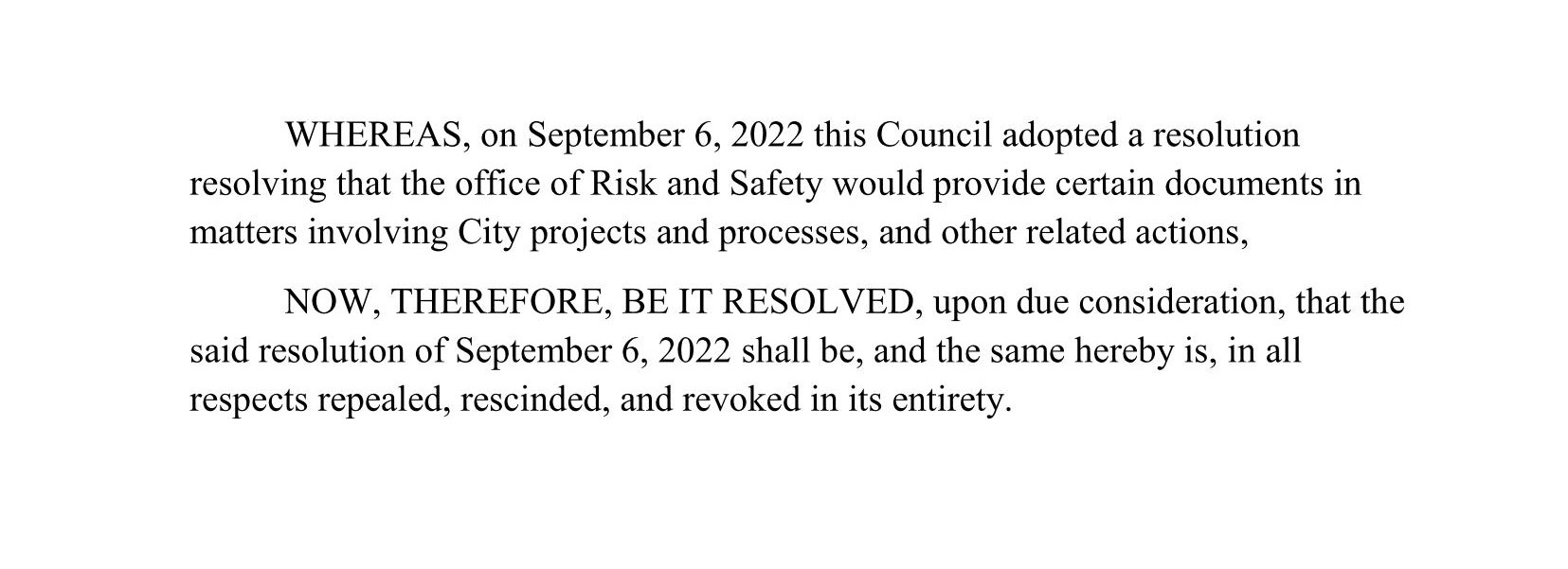
It is worth looking at Moran’s resolutions. A proper resolution ends with a “resolved” clause indicating the proposed action of the resolution. This follows the “whereas” clauses indicating why the action is taking place.
Consider this resolution on Risk and Safety apparently crafted by Moran.( His resolution regarding who should communicate with the State Liquor Authority has the same problem.)
The resolutions regarding Risk and Safety (actually, there are two on his agenda; who knows what he means to do with the two of them) and the SLA suffer from Moran’s inability to craft a resolution properly. Moran is not an attorney, and the prudent thing for him to have done would have been to consult the City Attorney.
It is absolutely chilling to think that he is going to be responsible for the Office of Risk and Safety.
Moran’s Resolution To Move Communicating with the New York State Liquor Authority (SLA) From The Mayor’s Office To His
Moran, who owns a tiny stake in Druthers bar and restaurant and who is a denizen of the downtown bars, has a resolution that places control over the city’s relations with the New York State Liquor Authority in his office. As a liquor license is fundamental to bars and restaurants, this positions him as the czar these businesses must deal with when seeking a new or a renewal of their liquor license.
Last December, the Council passed a resolution that instructed the City Attorney, under the Mayor’s supervision, to write to the SLA when a liquor license was applied for, up for renewal, or modification to ask the SLA to prohibit the sale of alcohol beyond 2 am as a condition for granting the liquor license request. Moran will offer a resolution Tuesday night, nullifying the request for a 2AM closing. In addition, his new resolution gives the City Clerk (Moran is the city clerk), the responsibility of dealing with the SLA in all licensing matters.
WHEREAS, upon due consideration, the Council resolves that the City Clerk shall have authority, in his/her discretion, to promptly respond to the SLA in writing regarding an establishment’s liquor license, renewal of a liquor license, or modification or amendment of a liquor license and waivers of statutory 30-day advance notices.
Moran motion
There has been a broad consensus to close the bars earlier due to both the cost of police overtime to cover the city’s bar area that late and to spare the police the abuse they must endure during those late-night hours.
I texted Moran asking that he explain why he wants to reverse the city’s efforts to require bars to close earlier than the current 4:00 am time. He responded as follows:
“Can you explain your constant lies? Repeated, constant and willful lies about me?
[T. Zealie Van Raalte has written the following on the issue of charging private businesses to use public city-owned sidewalks and parking spaces for outdoor dining.]
For a start, it’s unfortunate that the ” fairness ” issue seems to have been overlooked in any discussion/plan for an Outdoor Dining strategy. The city stakeholders can’t offer ALL restaurant owners an attractive opportunity for additional capacity. It’s a fact that not all restaurant locations lend themselves to taking advantage of utilizing “public property” for this purpose.
Thus, in many cases, the only option for some restaurant owners who want to grow their business by increasing their capacity (number of tables) is to “rent” additional space from a private landlord (if available) at market rates.
The argument that the current Outdoor Dining program pays for itself and then some is a limited one and extremely short-sighted. Yes, a “basic permit fee” has finally been developed to cover the associated labor costs incurred by the PWD. There is also obviously some incremental sales tax collected because of the increase in capacity. However, the level of any incremental sales tax achieved doesn’t compare to the potential total revenue the city should receive with an appropriate “user fee.” This fact demonstrates the clear “opportunity cost” to the stakeholders…lost revenue.
It’s a fact that most municipalities that make public space available benefit from such rental income for the privilege of using public property. They have a realistic and fair “total fee” structure. Our city has failed to even begin the process.
For argument’s sake, how much would a restaurant owner be willing to pay for the incremental capacity that they have enjoyed in the past IF they were informed that the privilege would no longer be available for free? Would they offer “nothing? Most likely not.
If the “free option” was no longer available, they certainly can appreciate better than anyone what revenue they would be passing up. They would not be happy. Thus, it’s likely that they could be convinced to embrace an incremental fee structure where they could still benefit.
This should be a WIN, WIN opportunity for both the restaurant owners and the city stakeholders. In the past, some restaurant owners were really the only winners. The stakeholders have not realized the potential for this much-needed revenue opportunity.
It’s really this simple… finally, develop and implement a strategy to set the tables so there is a WIN, WIN situation for our entire community.
Former Saratoga Springs Public Safety Commissioner Lew Benton has done a major public service in analyzing Finance Commissioner Minita Sanghvi’s proposed 2024 city budget. I sent Lew’s commentary to Mike Sharp, who was the Deputy under Finance Commissioner Michele Madigan. He offers some additional insights.
Based on their analyses, there appear to be very serious problems both with the projected expenditures the city will have to pay and with the projected income, which appears to be overly optimistic.
Most troubling and adding to the credibility of their concerns was Sanghvi’s decision to suddenly initiate major changes in her budget at the very last minute following the electoral defeat of Mayor Ron Kim. She now proposes to defund the second City Attorney and transfer the money along with the authority for Risk and Safety from the Mayor’s office to the Accounts Department. Why weren’t any of these changes in her original budget or the amended budget that followed the budget workshops? It appears that the changes were prompted not by thoughtful deliberations but by some sort of deal involving Kim and Accounts Commission Dillon Moran after the election. This kind of backroom dealing can only prompt skepticism about how Sanghvi determines the best way to spend taxpayer money.
A Budget That the Public Cannot Understand
As Lew documents, his efforts to analyze Sanghvi’s budget were made difficult by her decision to scrap the format the Finance Department normally uses and instead publish one that is extremely hard to read. Why Sanghvi diverged from the standard format is unclear, but the result is that it is hard to ferret out what the city will be spending money on and how much the anticipated income will be.
Lew documents the problems with the format Sanghvi used.
No Answers
I sent Lew’s analysis to Sanghvi and asked if she would respond to the concerns he raised. Consistent with her past practice, Sanghvi didn’t acknowledge the email, let alone respond to it. As you will see in reading Lew’s piece, it is rigorous and thoughtful. Lew’s credentials are impeccable. He served this city as its Commissioner of Public Safety, and his career was as a planner. He raises truly disturbing concerns about the budget that deserved a thoughtful response.
I asked Mike Sharp for his thoughts on Lew’s piece. Mike was the Deputy under Finance Commissioner Michele Madigan. His remarks appear following Lew’s piece.
Lew’s Analysis
[Here is his comparison of the standard format used for budgets and what Sanghvi has done.]
Mike Sharp’s Observations In His Response To Lew’s Piece
I very much agree, Lew, and I always enjoy your commentary on city finances. My comments were less a critique and more of my playing devil’s advocate to get ahead of any potential response made by the commissioners or her supporters. Perhaps there is a real reason certain revenue items are pushed so aggressively (I doubt it), but based on what has been made available, many of them seem aspirational more than based on facts/trends, which sets the budget up for trouble before the fiscal year even begins. Your point about the formatting change is a big one that I don’t think enough people will appreciate, but I don’t see any rationale for the change that isn’t anti-transparency or bad governance. Cynically, I would assume she’s received pressure from other Council members to make an already confusing budget document even less useful to outsiders.
Thanks again for your piece, and I hope you both have a great weekend,
Mike
From: Mike Sharp Date: November 17, 2023 at 9:59:10 AM EST To: John Kaufmann Subject:Re: Essay on Proposed Amended City Budget
Hi John,
Thanks for sending. In going over what Lou sent, I agree 100% with his point that removing the subtotal by subdepartment is an anti-transparency measure. The output from MUNIS is already hard to understand for most people, and by removing the department subtotals, lines become meaningless. “Professional services” is a great example of that, as the Mayor’s Office has 18 different Professional Service lines with over $740k of projected 2023 spending. Other than knowing it’s in the Mayor’s Office, the public has almost no idea what a not-insignificant part of the budget is being spent on.
For his section on revenues, I agree they look to be pushing some line items beyond what appears to be realistic, though there are a few caveats:
– For some revenue items, the City doesn’t receive our inflows in a timely manner. This makes saying, “How can they budget X when we’ve only received Y year-to-date?” a tricky thing to say, as it’s entirely possible Finance could receive a check or wire that represents multiple months of previously earned revenue. I believe Occupancy Tax and Mortgage Tax might be such line items, but I’ve been out of it long enough that I don’t remember exactly which revenues we get monthly and which ones lag. You would hope the Commissioner would highlight things like this in her presentation.
– Sales tax is taking a massive leap from 2023, going for a budgeted amount of $17.5M to $19.5M, or up over 11%. Finance gets information monthly about this, so maybe this is really what the trend is showing, but again, a leap like this in such a critical revenue line warrants more explanation in my opinion. I’d also note that while the city gets sales tax money monthly, it is based on a formula (rather than actual sales) that is corrected for actual sales later. More than once I saw that correction negatively impact the city in a big way. My hope is that they aren’t making their estimate purely on the monthly figures, as those aren’t final. Have there been any sales tax presentations? I believe we tried to do them at least once a year when I was around.
– Assuming $250k for a brand new revenue stream like Cannabis and short-term rentals does seem aggressive, though perhaps there is a reason they’ve assumed such a number based on guidance from the state or county? Years ago, getting any money out of short-term rentals was hard as we needed the County to approve items, and they were seemingly unwilling to do so. Has that changed, or has the city found another way to generate revenue out of short-term rentals? Relatedly, will this new revenue stream have an offsetting expense related to enforcement, such as more code inspectors or whoever else is responsible in ensuring all short-term rentals are accounted for?
– Lew’s Overtime points are very good, and that’s a few hundred thousand dollars that should certainly be explained. Are there new hires or a change in policy that should lessen this expected expense?
Aside from this, it’s very telling that in all of this, I don’t think there’s any discussion around revisiting the 30+ hires that this Council made in 2022-2023, as noted in the Comp Budget presentation. Were all of these necessary? Are there any non-union hires that can be revisited? Adding personnel puts an enormous strain not only on the current budget but also on future budgets as staff contractual receive increases in pay (whether the City revenue goes up or not) and as benefits costs generally go up. Certain departments have been understaffed for some time, but 30+ is massive, and I really think the public is entitled to better understand what a need compared to what is a want (I will never get over her hiring an admin for herself, now making $57k I believe, despite also budgeting a budget director and deputy).
Feel free to send my email to Lew, and if he wants to chat over email about anything, I’d be happy to do so.
In my previous blog post I wrote that Saratoga Springs Public Works Commissioner Jason Golub supported moving Risk and Safety from the Accounts Department to the Mayor’s office. This was incorrect. He abstained from that vote.
At the June 7, 2022, Council meeting where the move was discussed, Golub was adamant that he believed the proposed process was incorrect. He thought there should be an independent arbitrator evaluating if only portions of the job should be moved or if it should be moved at all.
At the August 2, 2022, Council meeting when the matter came up again, Golub said he did agree with Montagnino’s statement that it made sense for Risk and Safety to be with the City Attorney because of how closely they work together, however Golub said the process taking place was flawed and concerning. He thought there was validity to putting Risk and Safety in other places, but that isn’t what they were doing that night. “We are moving an employee from one department to another without consent of that employee’s boss.” Golub believed they should assess the role after the person who was currently in the position retired.
Saratoga Springs needs two City Attorneys. This city has had two City Attorneys since 1973, with the exception of a period during Mayor Kim’s tenure. By my count, that is fifty years. According to the latest version of Finance Commissioner Minita Sanghvi’s budget,Sanghvi has defunded the second attorney.
The defunding of the City Attorney position is part of a more complex deal between Accounts Commissioner Dillon Moran, Mayor Ron Kim, and Minita Sanghvi.
Moran is the big winner in all of this. Sanghvi has taken the money that funded the City Attorney position in the Mayor’s office ($105,276.88) and shifted it to the Accounts Department to fund a Risk and Safety position there thus transferring authority over Risk and Safety away from the Mayor and granting it to Moran.
Readers may recall that during his first year in office, Kim, with the support of Public Safety Commissioner Montagnino, and Sanghvi, had Risk and Safety transferred from Moran’s department to the Mayor’s office. Public Works Commissioner Jason Golub abstained. The Mayor was adamant as to how important this reorganization was. He argued that the Risk and Safety Director needed to work more closely with the City Attorney.
Apparently, having lost his election, Kim feels less passionate about the need for Risk and Safety being in his office. He also has offered no pushback about losing the funding for the second City Attorney who works under the Mayor.
Readers also may recall the ever-morphing approach to staffing the City Attorney’s office. When Kim came into office, one of his first acts was to fire both City Attorneys. He saw little urgency in hiring a City Attorney initially, touting his own credentials as well as those of his Deputy, who is also an attorney. After a series of legal debacles, he rehired Tony Izzo. Over time, he hired an additional attorney who was supposed to manage Risk and Safety as well as provide the Council with legal services. We all know how this strategy worked out. For those who may not remember, our insurance carrier refused to continue to underwrite the city. The insurance company cited a dysfunctional Risk and Safety program as the primary reason for their decision.
According to the November 22, 2023 edition of the Times Union:
Kim and Commissioner of Accounts Dillon Moran also said that the city Risk and Safety program will revert to the Accounts Department on Dec. 1.
TImes Union November 22, 2023
I have learned that the Assistant City Attorney, Michael Phillips, who was supposed to be handling Risk and Safety, is leaving his job on November 30, 2023, so this may explain the date for the reorganization.
Putting aside the inconvenient truth that all this reorganization has been done behind closed doors, it is unclear how, in this year’s budget, this move can happen on December 1. There is currently no money in the 2023 budget in Accounts to pay for a Risk and Safety position for the rest of this year.
Given Moran’s history of indifference to procedure and detail and his abusive and overbearing style of management, I find it more than worrisome that he will oversee Risk and Safety.
It is hard to tell how much of this is Democrat Moran trying to expand his power and how much of this is a partisan move to weaken the new Republican Mayor.
What I do know is that the city needs two attorneys, and it was reckless of Sanghvi to have defunded one. The city also needs a Risk and Safety program that functions effectively. What is going on here is highly controversial and needs to be debated publicly by the Council. Let Mayor Kim explain why suddenly the city no longer needs two attorneys and why, after insisting that his office must oversee Risk and Safety, he is supporting moving it back to Accounts. Let Sanghvi explain why she is supporting this reorganization.
At the November 21, 2023, Saratoga Springs City Council meeting, Accounts Commissioner Dillon Moran pulled his award to Beacon Risk Group for the “audit” of the fifty points of the city’s 2021 Police Reinvention Plan. He said a lack of paperwork was the reason.
Moran had oddly added this item to his agenda sometime after the pre-agenda meeting and before the regular Council meeting. All anticipated resolutions are supposed to be vetted at the pre-agenda meeting.
Normally, items added late to the agenda are supposed to be the result of some kind of time restraint. It is hard to conjure up an argument as to why Moran’s resolution could not wait until the next regular meeting of the Council, particularly in light of the fact that proposals for the “audit” were required to have been submitted by July 11, 2023. That is more than four months ago.
As noted in an earlier post, this blog documented that the proposal from a consulting firm named Beacon Risk Group LLC that Moran selected lacked the required insurance and was not properly registered with the state of New York to transact business.
Moran’s obtuse two-word reason for pulling the resolution (“missing paperwork”) left many questions unanswered. This kind of sloppy, rushed, and flawed action is an unfortunate pattern with Moran.
In the following video, in response to a question from Eileen Finneran, Moran attempts to explain why the city needs to spend $75,000.00 to “audit” the 50 Point Plan. Readers of this blog are invited to submit comments explaining Moran’s remarks from this video.
I wrote to Moran on November 20, 2023, and cc’d the entire Council asking how the city could approve the Beacon Risk Group proposal in light of its failure to meet the requirements for insurance along with the company’s lack of registration with the state.
I also asked why they had issued two RFPs for the same work. In addition, I asked, in light of the fact that the RFP responses were due on July 11, 2023, why they waited until the end of November to do the award.
The full text of my email is at the end of this post. Consistent with Moran’s history, he never responded, nor did anyone on the Council comment.
Another Case of Politicians Behaving Badly
On a different topic, readers of this blog may remember the conflict between Commissioner Moran and Mayor Ron Kim over transferring responsibilities for “Risk and Safety” from the Accounts Department to the Mayor’s office.
This was all associated with the Mayor’s bizarre and baseless accusations that Moran and then Risk and Safety Director Marilyn Rivers had somehow improperly negotiated the settlement of a lawsuit brought by a terminated city employee.
Mayor Kim has never attempted to hide his animus towards Marilyn Rivers. In a musical chairs-like environment of who is attacking whom, at the time Kim and Moran, who are now buddies, were then bitterly at odds.
Support for a vote authorizing the transfer of Risk and Safety to Kim’s office from Accounts included a yes vote from Public Safety Commissioner Montagnino who during that period enjoyed a warm relationship with Kim.
At least that transfer had some transparency to it.
Not this time. The authority for “Risk and Safety” apparently is returning to the Accounts Department. Why is this happening? Who knows?
This time, there will apparently be no vote or discussion on the transfer. Finance Commissioner Minita Sanghvi’s 2024 budget has simply slipped money for “risk and safety” under the Mayor’s office to the Accounts Department. Kim has not publicly objected to this move and no one else on the Council has said anything.
Kim, Sanghvi, and Moran have apparently made a deal hidden from public scrutiny.
From: john.kaufmann21@gmail.com Sent: Monday, November 20, 2023 10:15 PM To: ‘Dillon’ Cc: ‘ron kim’; ‘Minita Sanghvi’; jason.golub@saratoga-springs.org; james.montagnino@saratoga- springs.org Subject: Beacon Risk Group
Commissioner Moran: I am troubled by how the award of an RFP to Beacon Risk Group to audit the 50 points of the city’s Police reinvention Plan has been proceeding. New York State requires that all limited liability companies (LLCs) be registered with the state in order to transact business in New York. I have searched the appropriate state database but could find no record of Beacon Risk Group being registered. I also note that in the addendum to the document awarding work to BRG, they have failed to provide the city with documentation regarding various insurance policies required by the city. It notes, for example, that their general liability insurance expired on September 1 of this year.
I am also troubled by the opacity of what is being approved. No contract is attached to the agenda item, which would provide insight into what BRG is proposing to do to meet the RFP’s requirements. There is no copy of the proposal either.
I do not see how the council can approve a proposal they have not seen, aside from the issues of registration and insurance. The lack of these documents is also inconsistent with the need for transparency that you routinely call for. Could you please address these concerns? Thank you, JK
Saratoga Springs Accounts Commissioner Dillon Moran has an item on his agenda for Tuesday night’s (11/21/23) City Council meeting to spend $75,000.00 on an “audit” to determine how well the city is implementing the fifty points of the Police Reinvention Plan.
Readers may recall that in 2020, Governor Andrew Cuomo signed an executive order directing all local governments with police agencies to “perform a comprehensive review of current police force deployments, strategies, policies, procedures, and practices and develop a plan to improve” them.
Saratoga Springs convened a committee to carry this out, and it produced a document in 2021 with fifty items they wanted the city to implement.
The firm Moran has chosen to assess the status of the 50 points in the plan appears to have failed to meet the contracting requirements of the city for insurance and has failed to register its limited liability company (LLC) with the state of New York. According to my sources, LLCs must register with the New York State Department of State to transact business in New York.
It is very troubling that city elected officials feel they are incapable of reviewing the implementation of the fifty points and instead are proposing to spend $75,000.00 to do this.
An Odd History
On June 2, 2023, a request for proposals, RFP 2023-29, was issued to pay a consultant to “audit” the implementation of the fifty points of the city’s Police Reinvention Plan. The bids had to be submitted by June 13. The city received four proposals.
Then, for some reason, the city reissued the same RFP, now labeled 2023-32, on June 27, 2023, with the bid closing on July 11, 2023. The city received proposals from the same four companies. One company increased its proposal cost by $5,000.
So, the RFP was closed on July 11, 2023, and for unknown reasons, laid dormant until appearing on Commissioner Moran’s agenda for the November 21, 2023, City Council meeting some four months later.
A Black Box That Only Moran Has The Key To
The whole process has been totally opaque. Who crafted the original June 2nd RFP? Why was it redone and issued on June 27? Who decided to redo it? All proposals were received by July 11. Why was no action taken until November? Who was involved in screening and selecting the winner?
The other key question is, who will oversee the work of the winning firm? This would typically be stated in the contract, but there is no contract posted.
I expect, but do not know for sure, that the answer to all of these questions is Commissioner Dillon Moran.
The only documentation accompanying Moran’s agenda item to award this bid is a memo from Accounts Deputy Stacey Connors recommending Beacon Risk Group “based on the experience of the organization” and an incomplete Award of Bid Sign-Off Form. The form states that before an award of bid can be placed on the Accounts Department agenda for a City Council meeting, the form must be completed, and a series of steps must occur. The form posted is incomplete, and there is no documentation that shows that the required steps were taken.
The Winner
The winning proposal was submitted by Beacon Risk Group. Their website describes the firm as follows:
At Beacon Risk Group, no matter where you are in the process of critical asset protection, we can help. We’ll define the risk to your critical assets, determine the vulnerabilities that could be exploited by those seeking to take advantage of your weaknesses, and design controls solutions to close those gaps. We’ll also provide a security function design, organizational structure, and, if desired, a Chief Security Officer as a Service to manage your effort. More than anything, we will leverage our government and private sector expertise to protect what matters most to your organization and do so with a collaborative, best-in-class approach
Beacon Risk Group
It’s not clear to me how this company’s skill set is useful in assessing what the city has done so far to implement the Police Task Force 50 point program.
The company is located in Virginia. Its principal is Art Cummings. Mr. Cummings’s work background includes serving as the Executive Assistant Director of the FBI’s National Security Branch (Counterterrorism, Counterespionage, Counterintelligence, WMD).
Below is an addendum to the boilerplate award document.
According to this, Beacon Risk Group (BRG) failed to provide documents as required by the city. These are primary and non-contributory Insurance and Workman’s Comp Insurance. If Beacon Risk Group is a one-person operation, they do not have to carry Workman’s Comp, but they must get a waiver from the state. According to this document, BRG’s general liability insurance expired on September 1, 2023, so they also lack this insurance.
As they are a Limited Liability Company, they are required by New York State to register with the New York State Department of State in order to transact business in New York. A search of the Department of State’s database for LLCs failed to come up with BRG.
Jason Golub and Beacon Risk Group
As it turns out, Beacon Risk Group’s website had at one time included Public Works Commissioner Jason Golub as a Managing Director of Compliance and Investigations.
I contacted Commissioner Golub. He told me that Art Cummings, the principal owner of BRG, made an error in posting that he was a Managing Director.
Commissioner Golub told me that Cummings is a friend and that he had recommended Cummings to Moran. Commissioner Golub told me that he thought, given Cummings’s history with the FBI, that his involvement would help to get buy-in from the police.
While technically, he would not violate the city’s ethics rules if he were to vote on the resolution approving Beacon Risk Group, Commissioner Golub also indicated that he would recuse himself.
Why Does The City Need To Hire A Consultant To Do An Inventory Anyway?
Earlier this year, Public Safety Commissioner Montagnino already did an inventory of the fifty points of the city’s Police Reinvention Plan, so it appears that Moran’s “audit” initiative is yet a further extension of the ongoing conflict at the Council table between Montagnino and the rest of the Council.
Does this city really lack the ability to internally review the fifty points?
We don’t have the money to provide proper staffing for the Civil Service Department. We don’t have the money to give a raise to the part-time Civil Service employee who has not had a raise in three years. We don’t have the money to hire a Director of Risk and Safety.
The city is unable to comply with the time requirements for FOIL due to the increase in requests. We don’t have the money to hire additional help.
The department that handles building codes is understaffed, and needs help, but we don’t have the money to help them.
Yet we have the money for this “audit.”
Yet Another Demand Coming
In addition to this RFP, the Mayor’s Deputy, Angela Rella, has drafted yet another Request For Quote (RFQ), this time on behalf of the city’s Restorative Justice Committee. This also has been opaque. The Restorative Justice Committee was established in May, 2023, to “begin a community-wide dialog with residents and institutions” to define “what restorative justice means to Saratoga Springs in the 21st Century”. They were supposed to report their recommendations on a “Saratoga Springs Restorative Justice Program” on or before December 19, 2023. The group has now decided they need professional help to accomplish this task and have been discussing who to award this work to. Apparently, two or three firms are under consideration. At the most recent meeting of the Restorative Justice Committee, Moran promised them he would find the money for it.