Judege gavel with rules or laws paper – vector illustration
Today, December 13, 2024, New York State Supreme Court Justice James Walsh ruled that the Saratoga County Board of Elections must proceed with the special election to fill the Commissioner of Public Works position in Saratoga Springs. The position became vacant last August when Jason Golub resigned. The position has been temporarily filled by the City Council appointment of Hank Kuczynski. Since the Democrats failed to file appropriate papers for their candidate, only one candidate will be on the ballot for the January 28, 2025, special election. That candidate will be Republican Chuck Marshall.
In an earlier post (see below), I documented the maneuvering by Accounts Commissioner Dillon Moran to block the special election and extend Kuczynski’s temporary appointment until the end of 2025. The earlier post has a more extended clip during which Moran excoriated those whom he falsely claimed had previously blocked his attempts for an election. Here is a brief clip from the November 6, 2024, City Council meeting that provides a flavor of Moran’s performance.
Press Release On Court Ruling From Saratoga Springs Republican Chair Mike Brandi
The Saratoga Springs Republican Committee celebrates the Supreme Court’s ruling today, which ensures the special election for Commissioner of Public Works will proceed as scheduled on January 28, 2025. The decision comes after SSGOP Chairman Mike Brandi and candidate Chuck Marshall filed suit to compel the Saratoga County Board of Elections to approve the ballot in accordance with election law. The lawsuit was prompted by opposition from the Democrat commissioner of the board who opposed the lawsuit.
Candidate Chuck Marshall: “This court ruling is a victory for all the voters of Saratoga Springs. It reaffirms that if everyone plays by the rules, there are legitimate outcomes.”
“This ruling protects the integrity of the electoral process” said Mike Brandi, SSGOP Chairman. “The people of Saratoga Springs deserve fair elections in accordance with the law free from partisan obstruction.”
Chris Obstarczyk, attorney for Brandi and Marshall, added: “The Supreme Court’s decision is a victory for democracy and a strong message that election law must be upheld.”
democrat political party animal vector illustration design
The Saratoga Springs Democratic Committee is a profoundly troubled organization that produces truly problematic candidates and, worse, engages in corrosive campaigns that offend rather than educate.
Why Should Saratogians Care about This?
As of the last count, there were 9523 (41%) registered Democrats compared to 6578 (28%) registered Republicans in Saratoga Springs. There are also 7164 (31%) who are not registered with any party. There are 237 registered Conservatives and 82 registered in the Working Families Party.
This gives the Democrats a decisive edge in local elections. Regrettably, and this is true for the Republicans as well, many voters are too busy with family and work to follow politics very closely, and they simply vote for all the candidates of their party’s line on the ballot.
In the last local election in 2023, the appearance of One Saratoga as a political option shook this process up. Many people, unhappy with partisan politics, took refuge in One Saratoga. This was the first time One Saratoga had a line on the ballot and three of their four candidates won-two registered Democrats, and one registered Republican . Democrat Chris Mathiesen ran on the One Saratoga line after the Democratic Committee refused to endorse him or even allow him to address the full committee. While he did not win, he drew enough votes on the line so that Republican candidate John Safford defeated Democrat Ron Kim.
In spite of the inroads One Saratoga has made, the bottom line is still that whoever gets the Democratic line has a distinct advantage to win city elections.
This means having a functional and thoughtful Saratoga Springs Democratic Committee is essential because they select the candidates (unless there is a primary) who will have the strongest chance of governing Saratoga Springs
This city needs a thoughtful Democratic Committee if we, the voters, are to be provided with credible candidates. We also need a thoughtful Democratic Committee if issues are to be addressed in campaigns in a way that serves the public.
Problematic Party Leadership
The Leader of an organization is a statement by the organization as to who they are.
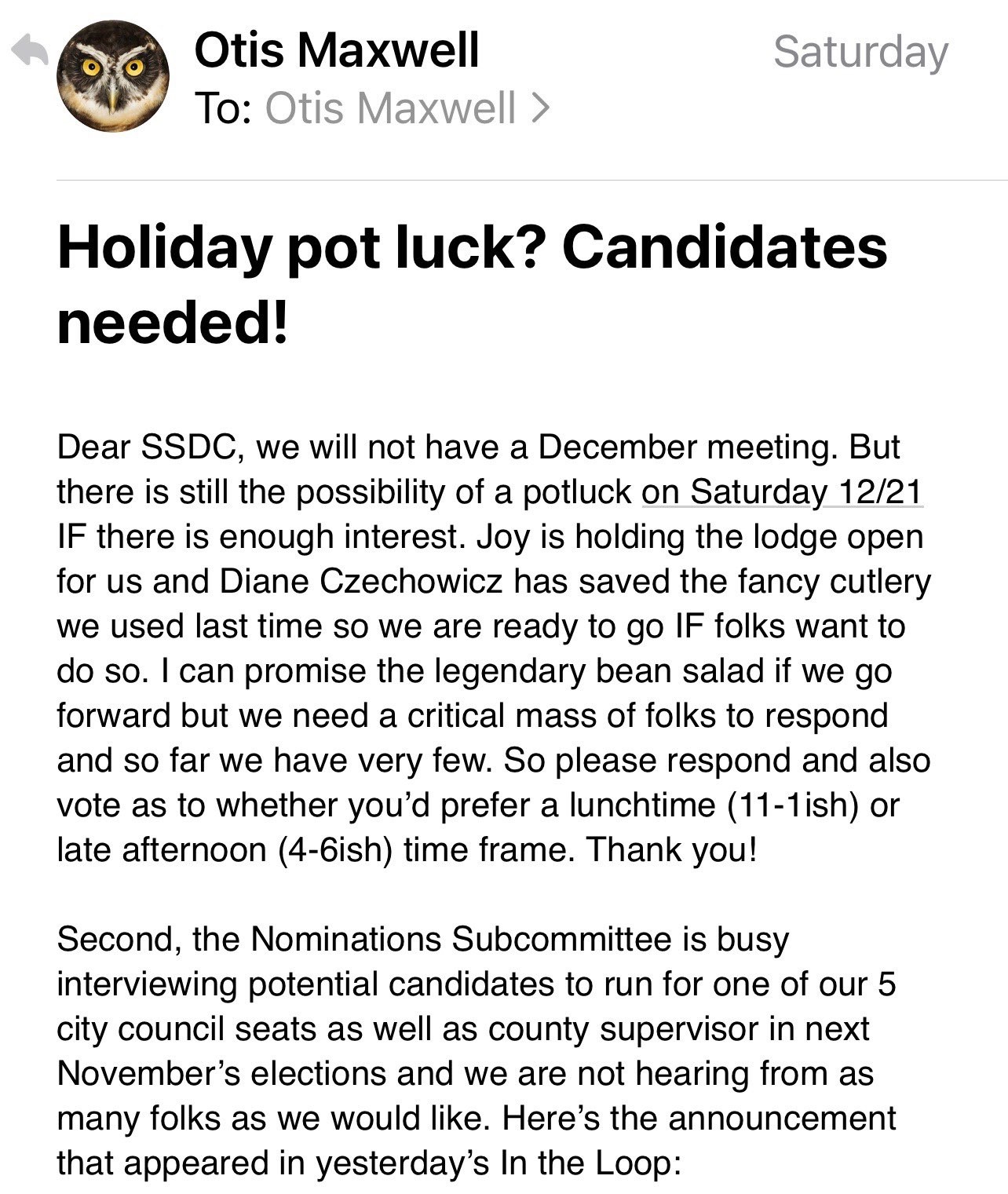
Otis Maxwell is the chair of the city Democratic Committee. He recently sent an email to his committee (reprinted below). The email explicitly warned against sharing it with the blogger. There was good reason for this caution because the email demonstrates the need for the committee to reform itself.
Unfortunately for Mr. Maxwell, it found its way to me. The following are highlights from it.
Chairman Maxwell’s Email
A Potluck dinner?
Maxwell has been trying to organize a potluck dinner for the committee. Apparently, his invitation to the event has drawn very little interest. Maxwell wrote: “…we need a critical mass of folks to respond, and so far we have very few.” This would suggest that the rumors of a disaffected and divided committee may be true.
Baseless Attacks?
Maxwell asserts in his email that “…baseless attacks by our MAGA opponents on our current elected officials are having the desired effect of discouraging people from coming forward.”
It is true that City Council members endorsed by his committee have been the subject of frequent criticisms. It is extraordinary that Maxwell simply dismisses these criticisms wholesale as though they are meritless. He does so by throwing red meat at the committee members by simply attributing the criticisms to”MAGA opponents.” He conveniently conflates being a Republican with being an adherent to MAGA. While some of the critics may very well support MAGA, most of his critics (myself among them) are not supporters of MAGA, and many of them, like myself, are Democrats.
I have emailed him asking which “attacks” are baseless. I don’t expect a response, which again demonstrates what is wrong with Maxwell and the committee that selected him as their chair.
Here is a sample of some of the “attacks” he dismisses.
The On-Call Scandal
The bullying of former Director of Risk and Safety Marilyn Rivers, whose resignation resulted in the city’s insurance carrier dropping the city. The replacement carrier now costs the city an additional million dollars a year.
The belligerent and crude behavior of past Mayor Ron Kim was documented to the entire region in an epithet-laden rant that appeared on the TV nightly news.
The continuing toxic behavior of the endorsed Democrats on the City Council.
The wrongful denial of FOIL requests and the allegedly false certifications submitted by Accounts Commissioner Dillon Moran.
The poorly crafted and arbitrary budget that was crafted by Finance Commissioner Minita Sanghvi.
The alleged use of city employees to perform work at the private home of former Public Safety Commissioner Jason Golub.
The Committee Chair’s inability to acknowledge any culpability for elected officials endorsed by his Committee dooms the city to continual scandal. The Democratic endorsed Candidates have made Saratoga Springs the laughingstock of the capital district.
The Very Worst
In his email, Maxwell writes, “I feel somewhat muzzled by the resolution that was passed at our last meeting but among friends (and please don’t leak this to our pals at Moving Saratoga Forward and Saratoga Springs Politics)…”
In a previous post, I discussed a resolution adopted by the Democratic Committee. Simply put, it disavowed public officials’ use of public employees for their personal benefit and asserted that people charged with a crime should be considered innocent until proven guilty. My understanding was this resolution was prompted by the attempts of Maxwell and Dillon Moran to dismiss the validity of the charges against Jason Golub and Joe O’Neill by attributing them to an array of conspirators.
While Maxwell claims he feels muzzled by the bland, apple pie, resolution passed by his committee, he nevertheless is fearless in continuing to diminish the seriousness of charges made by law enforcement against Democratic endorsed Council members. Here, he dismisses the abuse of FOIL and the signing of false certifications by Dillon Moran by attacking the Saratoga County Sheriff’s Department for charging Dillon Moran with subverting the city’s FOIL process. I assume that he is not concerned about any pushback from his committee.
It is hard to believe that in this day and age, the chair of a Democratic Committee would defend the blatant abuse of FOIL. One would think that the blistering criticism in the Daily Gazette editorial on this issue might have penetrated Maxwell’s consciousness. More centrally, you would think that there was some vestige of integrity in his committee to take him to task.
[JK: Correction. I spoke to Cassie Bagamian, the Saratoga County Democratic Election Commissioner. Cassie asked me to correct the blog. She indicated that she opposed certifying the ballot for the commissioner of public works election not because there was no Democrat on the ballot but because “there needs to be equal access opportunities for all parties.”]
On Friday, December 6, 2024, the Saratoga County Board of Elections (SCBOE) failed to certify the ballot for the January 28, 2025, special election established by the Saratoga Springs City Council to fill the vacancy created when then Commissioner of Public Works Jason Golub resigned last August. Today, Monday, December 9, Chris Obstarczyk, representing Saratoga Springs Republican Chair Mike Brandi, has brought an Article 78 action in Saratoga County Supreme Court to compel the County to proceed with certifying the ballot and to proceed with the election.
New York State Election law requires the Board of Elections to finalize the candidates and prepare the ballot 53 days before an election. That deadline was December 6.
“The Board of Elections cannot simply ignore deadlines set by the legislature,” Obstarczyk said in a press release.
Unfortunately, for Commissioner Bagramian, there is no statute requiring that a Democrat be on the ballot, and the Democratic City Committee failed to submit the required documents to get a candidate on the ballot.
Lest there be any confusion, the City Council unanimously adopted a resolution requiring a special election be held on January 28, 2025. Accounts Commissioner Dillon Moran, a Democrat, sponsored the resolution. Here is the resolution.
What Happens Next
Because the legal action concerns an election, the court is required to rule expeditiously. We will know the results soon.
We know Saratoga Springs is world famous for its water. But we’re starting to wonder what’s in it, at least at City Hall, given the latest rash of unethical, criminal and outright baffling behavior of some city officials.
Last month, it was two city officials charged with misdemeanors in connection with allegations they had city employees come to their homes or the homes of a relative to do some plumbing work. Drano was apparently involved.
Rather than just admit they did wrong, one of the officials’ lawyers is trying to shift the blame for the alleged theft of public services to those who had the temerity to bring the matter to the attention of the public and authorities.
Now we’re reporting that Saratoga Springs Accounts Commissioner Dillon Moran has been charged with three non-criminal counts of unlawful prevention of public access to records for allegedly lying about the existence of public records in response to a Freedom of Information Law (FOIL) request from a private citizen.
He apparently didn’t want the records to be made public, so in response to the FOIL request, he said he conducted a diligent search but couldn’t produce the records the person was seeking.
Keeping secrets is, effectively, lying by omission. But if this allegation is true, this was outright deliberate lying to deny a member of the public records to which they are — by law — legally entitled to have.
That’s why we have a Freedom of Information Law – because public officials like to keep things from the public in order to avoid embarrassment or public disclosure of nefarious or incompetent conduct.
The public in many ways might never learn of this conduct without the laws that are in place.
This latest case highlights a couple of things — one of which is that something is clearly making public officials in Saratoga Springs act screwy, in defiance of the law and in direct opposition to their oath to serve the public. Maybe it’s the city water. Somebody in that city voted for these guys.
The other point this highlights is that the state’s toothless Freedom of Information Law needs to be strengthened. Moran is charged essentially as an individual with falsifying a document.
The Freedom of Information Law itself needs to give judges more legal authority and discretion to punish public officials and their governments with fines and awarding of legal fees whenever they fail to honor legitimate requests for information or when they impose unnecessary delays on the release of information.
Whatever the reason(s) for what’s going on in Saratoga Springs, it has to stop.
Public officials owe their constituents honesty and integrity. Those are traits that seem to be seriously lacking these days.
Saratoga Springs Accounts Commissioner Dillon Moran has been charged with “Unlawful Prevention of Public Access to Records” according to a press release issued by Mike Brandi, chair of the Saratoga Springs Republican Committee. Moran has been ordered to appear before Judge Jeffrey Wait in City Court on December 19, 2024.
According to the release:
“Moran issued three separate [false] certifications swearing under penalty of perjury that he conducted a diligent search of his records and had no responsive records in relation to Brandi’s requests.”
This Blogger’s Experience
In past posts on this blog, I have reported that Moran claimed to have no documents responsive to my requests when common sense would have dictated that there should have been documents. For example, this blogger had asked for documents that would have recorded how he arrived at the charges for restaurants’ and bars’ use of public property. I was told that no such documents existed. I attributed the lack of documents to Moran picking the numbers out of the air, but Brandi’s disclosure suggests otherwise.
The Brandi Press Release
Saratoga Springs Commissioner of Accounts Dillon Moran Charged with Three Violations of NY Penal Law §240.65 – Unlawful Prevention of Public Access to Records.
After an investigation by the Saratoga County Sheriff’s Office, Dillon Moran, Commissioner of Accounts for the City of Saratoga Springs, has been charged with three counts of violating NYS Penal Law §240.65 (Unlawful Prevention of Public Access to Records). These charges stem from Moran’s issuance of three allegedly false sworn certifications, which appear to have been made with the intent to conceal public records and obstruct the Freedom of Information Law (FOIL) process. Moran is set to be arraigned in Saratoga Springs City Court at 9AM on December 19, 2024. The case is pending under case number CR-04322-24.
The violations were uncovered after three FOIL requests submitted by local resident Mike Brandi in 2024. In response to those requests, Moran issued three separate certifications swearing under penalty of perjury that he conducted a diligent search of his records and had no responsive records in relation to Brandi’s requests. These statements were proven untrue by subsequent disclosures. Notably, one such instance revealed a text message in which Moran advised a third party to use his personal phone in an effort to avoid FOIL disclosures, stating, “[t]his is the non foilable personal phone. Feel free to use it.”
“I just want to be able to exercise my rights under FOIL without fear or favor. This should not be a big ask, but a foundational right of any citizen.” Brandi said.
The New York State Committee on Open Government (COOG), is clear that communications regarding government business on personal devices are subject to FOIL and the fact that a public official may use a personal cell does not shield records from transparency laws.
Legal Background
The Committee on Open Government, in Opinion FOIL-AO-f14692 advised:
“§89(8) of the Freedom of Information Law and §240.35 of the Penal Law concern the “unlawful prevention of public access to records. The latter states that: ‘A person is guilty of unlawful prevention of public access to records when, with intent to prevent the public inspection of a record pursuant to article six of the public officers law, he willfully conceals or destroys any such record.’
From my perspective, the preceding may be applicable in two circumstances: first, when an agency employee receives a request for a record and indicates that the agency does not maintain the record even though he or she knows that the agency does maintain the record; or second, when an agency employee destroys a record following a request for that record in order to prevent public disclosure of the record.”
Moran has been charged with three counts of violating §240.65. Unlawful prevention of public access to records is a violation meaning each count is punishable by a maximum of 15 days in jail and/or a fine of up to $250.
In an earlier post, I wrote about a resolution adopted by the Saratoga Springs Democratic Committee that appeared to backtrack from a defense of the indefensible. The full resolution is on the earlier post, but briefly, it acknowledged that the use of city employees for the personal service of city officials is wrong, but that the person charged should be considered innocent until proven otherwise. This was in relation to the charges against former Commissioner of Public Works Jason Golub and current Public Works Deputy Joe O’Neill.
One would have thought that such a statement was axiomatic and unnecessary, but prior to the adoption of this resolution, the Saratoga Springs Democratic Committee Facebook page and newsletter, In The Loop, had refused to acknowledge that any use of city government employees for the private benefit of public officials was totally unacceptable. Instead, the Facebook page and newsletter attempted to obscure the gravity of what Jason Golub and Joe O’Neill were accused of by perpetuating the allegations that the entire affair was cooked up by unnamed conspirators motivated by some unnamed grudge and implied racism. Both the Facebook page and the newsletter used public, toxic statements by Accounts Commissioner Dillon Moran to support this narrative.
City Democratic Committee Chair Otis Maxwell Heedlessly Carries On Further Damaging His Committee
It has been several weeks since the Committee’s resolution. Maxwell has had plenty of time to remove the sleazy attacks from past Facebook pages and publish the resolution in their newsletters, but he has not. All the ugly stuff is still up.
Sanghvi’s Tone Deaf Continuation
It’s not only the Democratic Committee Chair and Accounts Commissioner Dillon Moran who have continued to try to minimize and excuse the charges against Golub.
Weeks after the Democratic Committee’s resolution was adopted, Sanghvi, apparently unmoved, piled on. She directly accused Public Safety Commissioner Tim Coll of being motivated by racism and orchestrating the persecution of Golub.
Saratoga Springs Commissioner of Finance Minita Sanghvi, who has served with both (commissioners) Golub and Coll, commented on the matter and the history between the two men, making a nod to the report from the Attorney General, which found that the city had previously violated protesters’ First Amendment rights.
“As we’ve learned from the AG’s investigation, the position of Public Safety Commissioner shouldn’t be used for targeting people. Especially people of color in our city.”
Saratogian
This blogger would observe that this kind of cavalier and reckless attack trivializes the real and pernicious evil of racism. It also undermines her credibility and the credibility of the Saratoga Springs Democratic Committee.
In a sign of how closely the citizens of our city follow politics, in the last election, former Finance Commissioner and current County Supervisor Michele Madigan received many more votes in Saratoga Springs than Minita Sanghvi. Sanghvi’s toxic comments at both the Council table and to the press have undoubtedly contributed to her unpopularity.
You would think that after the recent Daily Gazette editorial that rightfully denounced both Golub’s alleged abuse and the grotesque attempt to dismiss the seriousness of the criminal charges, the Democratic Committee and the two City Council members they support would clean up their social media by removing their embarrassing posts. Apparently, they live in a toxic bubble in which they assume that citizens of our city will either not see what they are doing or will not care.
It doesn’t matter if it’s 5 minutes and a quart of Drano or leftover tar to fill a hole in front of a councilman’s house or a snow plow driver sweeping the mayor’s driveway during a storm. It’s wrong. And illegal. You just don’t do it.
[JK: A comment submitted by someone using the name Chuckery cuts through the noise]
We live in an age of deflection. Like children taken to task, we attempt to deflect scrutiny of our behavior with red herrings: “There’s nothing to see here. It’s all a conspiracy; it’s a Republican vs. Democrat thing; its racially motivated; and besides, the transgression involved eight minutes, a jug of Drano and a clogged sink”. These logical fallacies conveniently elide over the crux of the matter.
Mr. Golub’s lack of judgment in using City resources for personal purposes occurred when he was a City officer. While some City officials and residents may view the ethics and integrity of their public officers as situationally optional, Mr. Golub’s current employer does not. The State of New York has zero tolerance for unethical behavior that violates the Public Officer’s Law. “Public officials must exemplify the highest ethical standards. This includes using state resources only to conduct state business. There is no place for engaging in private sector work or transactions in a state office or using state employees or resources to perform such work.” (Executive Director, NYS Commission on Ethics and Lobbying in Government).
Regardless of the outcome of Mr. Golub’s case, it is likely his new employer will determine his continued employment creates a political liability the State is unwilling to bear. What message does it send his agency’s 25,000+ employees when a newly-appointed member of their leadership team deemed it acceptable to use public resources for private purposes?
Red herrings aside, Mr. Golub clearly exercised questionable judgment and violated the public trust. He needs to reflect on the choice he made and ask himself if his decision to use City resources was worth tarnishing his reputation, potentially losing his job and compromising his future livelihood. At the end of the day, it all comes down to the strength of character and integrity we expect and should demand from our public servants. This is about ethics and integrity in government. It’s not about a conspiracy, racial bias, the R’s vs. the D’s, or that silly argument that eight minutes, a jug of Drano and a clogged sink makes this much ado about nothing.
Former Saratoga Springs Public Works Commissioner Jason Golub pleaded not guilty before Judge Jeffrey Wait in City Court on Tuesday, November 26, 2024. Golub was charged with professional misconduct, a misdemeanor. He is alleged to have used city employees to do work at his home. He was represented by Karl Sleight.
Normally, these arraignments are dull affairs. The defendant pleads not guilty, and the judge schedules the parties for a more substantive hearing.
Not this time. Sleight claimed that the issues came from the city’s Human Resources (HR) department. He asked Judge Wait to approve a subpoena for the report. Sleight contended that based on “preliminary disclosures,” he would seek access to Public Safety Commissioner Tim Coll’s personal and city cell phones. According to the Saratogian article, he “wanted to put the District Attorney’s office on notice that as part of discovery, he would like a search ‘through the normal portals’ for information that might be relevant on both phones.”
The following quote is from Ralls’ article, but Sleight successfully managed to have similar quotes appear in the Daily Gazette, the Times Union, WAMC, and on several television news reports:
“The more we look at this, the real question here is, what was the motivation for charges?” Sleight stated. “As I said from the beginning, this case involved eight minutes, a jug of Drano and a clogged sink. My question is, what motivated someone to try to charge an attorney of the stature of my client, months after the event, with this charge?
“We’ll get to the bottom of it. It starts today.”
With Perry Mason-like drama, he announced:
“I think the motivation of this case will become apparent in due time,” Sleight said. “I think when that happens there will be a reckoning.”
Sound and Fury But Little In The Way Of A Legal Defense
I have spoken to numerous attorneys about the relevance of Sleight’s drama to an actual legal defense. They observed that unless he can find evidence that Coll was behind the clogging of Golub’s drain, Coll is wholly irrelevant to this case.
Nothing Sleight said addressed the inconvenient and undeniable fact that city employees in city trucks using city-purchased chemicals worked on Golub’s private home, something Sleight has previously admitted happened.
Where Is Sleight Getting His Facts?
As noted in an earlier post, notwithstanding Sleight’s false bravura claims, the action did not involve “eight minutes” of one employee’s time. The abuse involved two employees, not one. It involved not one but two trips to Golub’s home. And it wasn’t one can of Drano but the container of an expensive chemical purchased by the city.
So What Is Sleight Doing?
Again, I have discussed this with a number of attorneys who offered some insight. The facts in this case and the related penal code are so manifest that Sleight has little to work with. The best they could offer is that Sleight is using the media to minimize the damage to Golub’s reputation by diverting the public’s attention with a sensational story that there is some kind of conspiracy to destroy his client.
Maybe Sleight can muddy the waters, but eventually, the legal system, not the media, will become the actual field of battle, and the scope of Golub’s culpability will finally be decided.
Adopting regulations for short term rentals (STRs) in Saratoga Springs has been an agonizing ordeal. It has gone on forever, with public hearings held in many cases without the actual language of the proposed ordinance available.
Accounts Commissioner Dillon Moran is the self-appointed czar who tightly controls the entire process.
Both the New York Assembly and the Senate have adopted legislation that, if implemented, would establish a state registry and facilitate the taxing of STRs. The Governor has not yet signed their bill. The state law would allow municipalities that have adopted their own registry and taxes to continue.
For reasons I am still unclear on, Commissioner Moran has insisted that the city adopt its local law and licensing process before the state program goes into effect.
He’s The Czar
The following incident embodies the helter-skelter and arbitrary way in which Moran has “managed” this process of designing the STR legislation.
The City Council met for its pre-agenda meeting on November 18, 2024, just one day before the regular Council meeting. The proposed STR local law language appeared on the published agenda the previous Friday.
Finance Commissioner Minita Sanghvi chose this meeting to share that she had bought a house next to hers. She was unhappy that, while she could rent out her own home for one hundred and fifty days, she was limited to only one hundred and twenty days for the other house according to the proposed law.
No problem. Moran scrapped the one hundred twenty day limit and increased the non-owner limit to one hundred fifty right at the table.
Why did Sanghvi wait until one day before the adoption of the legislation to raise her concerns? Who knows.
I am not sure whether it is legally a conflict of interest for her to advocate at the table for a change that would benefit her personally. Still, the appearance of impropriety is very troubling.
There is also the problem of transparency. Most people would have thought that the language of the proposed law published by the city on the previous Friday was complete and accurate.
In fact, it is my understanding that further changes were made on the very day that the law was to be adopted.
Proper Notice
Moran had been advised on the Monday before the Tuesday meeting that the city was required to post proposed legislation at least ten days before adoption. He ignored this. Had he successfully gotten the Council to approve the law, it would have been subject to litigation.
Typos
The city has spent thousands of dollars paying the Towne Law Firm to craft the legislation. The draft legislation that appeared on the city’s website contained typos. It is axiomatic that any adopted law should be free of these errors. I find it hard to believe that the law firm was the source of the errors. People familiar with Moran know he routinely plows through things with little concern about mistakes (Oh, we’ll fix that later). It is reasonable to assume that he made changes in the document without consulting the law firm.
Perilous Waters
I do not have the time to go through the document here, but given Moran’s record and the incidents cited above, I have little confidence in its viability.
The fact that Moran himself tabled the proposed legislation is a testament to his reckless attempt to bring to a vote a deeply flawed proposal.
What Is This Legislation Really About?
Some months ago, Saratoga Podcast had a consultant who works with Granicus Corporation as a guest. The city relies on Granicus for assessment assistance.
He observed that before embarking on legislation, the city needs to ask itself where it wants to be in five years.
Is this legislation about improving safety in the city’s rentals?
Is it to produce maximum income for the city?
Is it about how to protect the quality of life in our neighborhoods?
If it is the last item, how will the regulations achieve this? One hundred and fifty days allows these units to be rented every weekend of the year.
More significantly, if noise and excessive parking are the issues, are there other ways to address these problems than licensing these units?
Cavalierly increasing the number of days a unit can be rented, as Moran did for Sanghvi, does not breed confidence that these issues are being rigorously analyzed and assessed.
A History Of Arbitrary Actions
This blogger has tried, with little success, to find out how Moran determines key matrixes. When he virtually gave away the use of city properties to bars and restaurants for outdoor dining, I FOILed for any documents revealing the basis for calculating these fees. The response to my request was that there were no such documents.
When the Accounts Department claimed they would receive $250,000.00 in income in their annual proposed budget for 2024 (they didn’t), I FOILed for any documents explaining how they arrived at this number. I was told there were no such documents.
Moran’s history is one where critical analysis is badly missing. He cannot be bothered. His law to manage STRs sadly continues this tradition.








 Saratoga Springs Politics