This is a link to a CNN video of the face of starvation in Gaza. I’m sure the readers do not need to see graphic video of starving children to convince them that the use of starvation in Gaza is wrong.
While I sympathize with the fear of attack that Israelis are experiencing, the deprivation of food for the two million people living in Gaza cannot be defended. Israel can only continue this horror with the support of our country. Polls consistently show that this kind of cruelty is opposed by most Americans, demonstrating the fundamental decency of people. Yet, the policy of cruelty continues to enjoy bipartisan support in Washington.
A proposed ordinance to restrict “camping” on city-owned property unleashed a torrent of anger from some members of the public during a marathon meeting of the Saratoga Springs City Council on July 1, 2025, that saw the public hearing lasting over three hours. While many who spoke against the ordinance were well-meaning and no doubt saw themselves as defending the most vulnerable in our community, their comments often reflected a lack of awareness of the resources the city is currently devoting to address homelessness and an unfortunate misconception that the purpose of the ban was to criminalize and incarcerate the homeless.
The ordinance prohibits anyone from sleeping, lying, or sitting on city property, including public sidewalks, street medians, public parking garages, and parking lots. Blankets, tarps, sleeping bags, milk crates, chairs, and tables cannot be placed on city property.
An Event Reflecting The Caring World Of Saratoga Springs
One of the admirable qualities of Saratoga Springs is its citizens’ unusual commitment to and involvement in their community. This commitment was evident in the number of people who turned out to speak about the ordinance during the public hearing that took up over three hours of the almost five-hour meeting.
I was struck by the earnestness of many of those who spoke against the resolution. While a few of the speakers indulged in irate attacks on Mayor Safford, Public Safety Commissioner Tim Coll, and Public Works Commissioner Chuck Marshall, who supported the resolution, most were courteous and restrained, even if often misinformed.
Myths That Subvert
The recurring themes of those who spoke in opposition to the ordinance were:
1. The city has done little to address the needs of the city’s homeless population.
2. The purpose of the ban on camping on city-owned property was to criminalize and incarcerate the homeless.
Here are just two examples:
These speakers and others who voiced the same criticisms appeared to be completely unaware of the resources the city is currently devoting to this challenging issue.
Saratoga Springs annually spends $500,000.00 of local tax revenue on the homeless. Additionally, the city allocates hundreds of thousands of discretionary federal dollars to address homelessness issues. These same elected officials who were the subject of withering criticism on July 1 (Safford, Coll, Marshall) have supported the appropriation of these substantial sums. You would never know this from the statements criticizing them at the public hearing.
No other city in this region, many of which have a much larger tax base than Saratoga Springs, spends any local money to maintain shelters for their homeless population. That includes Albany, Schenectady, Glens Falls, and Rensselaer. Most of these cities have private missions that rely on funding from state and federal governments, as well as private donations.
In addition to funding the RISE shelter, part of the city’s annual contribution of $500,000 is directed to funding the city’s Outreach Court (formally known as the Homeless Court), overseen by Judge Vero, who works closely with RISE (the not-for-profit that runs one of the city’s shelters). The very purpose of this court is to provide Judge Vero with an alternative to the incarceration of the homeless who appear before her on a variety of charges. That’s right, the purpose of her court is to try to keep the men and women who come before her out of jail. Judge Vero has enjoyed the enthusiastic support of Safford, Coll, and Marshall.
In addition, under the Public Safety Commissioner, Tim Coll, the city Police Department has established a “peer-to-peer” program in collaboration with RISE. A RISE staff person is embedded with the police to assist in dealing with homeless individuals the police encounter. The department also maintains an ongoing relationship with Shelters of Saratoga, which currently provides housing for the homeless during the winter months.
These steps are not sufficient to resolve homelessness, but to characterize the supporters of the controversial bill as seeking to address homelessness by putting everyone in jail is patently false and unfair.
Protecting Credibility
It is one thing to argue that the city is not doing enough. It is quite another to carry on an impassioned crusade that ignores both reality and a thoughtful path to solutions. Many of those who testified at the public hearing seemed simply incapable of acknowledging both the major initiatives the city has been pursuing or of conceding that the promoters of the “camping” resolution might be sincerely concerned about the dreadful conditions of many people living on our city’s streets. What these people do not understand is that by misrepresenting the city’s response to homelessness, they undermine their own credibility and effectiveness.
A Plague Of Disinformation
The confusion of many who oppose the resolution is understandable, given some of the postings that have appeared on social media.
In particular, Democratic Mayoral candidate Michele Madigan’s Facebook page is a major promoter of a false narrative with statements like:
“Now the City Council under The Republican majority voted 3-2 (along party lines) not to provide more resources, not to support our low barrier shelter, but to target [JK: for arrest] unhoused residents just as track season begins.
Michele Madigan July 3, 2025
This comment is problematic not only for Madigan’s inaccurate characterization of the vote’s meaning, but also for her attempt to make the vote a partisan issue. As Ms. Madigan well knows, one of the three yes votes was Tim Coll. While Coll was endorsed in 2023 by the local Republican Committee, he is a registered Democrat and has been endorsed this year by the Saratoga Springs Democratic Committee. She will be running on the Democratic line with him in November.
RISE has not been helpful either. Their poorly considered threat to close their shelter just before the Belmont unless they were funded for another year gratuitously upped the temperature and was meant to portray the city as the enemy. It is a testament to the integrity of Safford, Coll, and Marshall that they are still working on funding RISE in next year’s budget. These officials are able to rise above such provocative behavior in the interest of the homeless and the city.
Saratoga Springs Cannot Solve Homelessness on Its Own.
In the early seventies, New York State closed its facilities for the severely mentally ill and had a supposed plan to set up small homes throughout the state to encourage better incorporation into communities and help promote independence.
This was all really a sham. The real purpose was to save money. Very few homes were ever set up. The number of mentally ill homeless people mushroomed.
The state also established what were meant to be protections against the forced institutionalization of the mentally ill. This also ended up contributing to the dramatic increase in homelessness, particularly among those struggling with mental illness.
The trend of high construction costs further exacerbates the problem of homelessness. The cost of homes and rent has skyrocketed.
Finding affordable and accessible land in Saratoga Springs for a shelter is also a huge barrier. Past proposals for multiple sites for a homeless shelter have been successfully opposed by neighbors. A committee set up under former Mayor Ron Kim selected a controversial site out along Route 29 for a facility. Nothing ever happened with that project. One homeless advocate on the committee opposed the location because of its distance from downtown.
Given the dearth of facilities for the homeless, finding quality housing is a huge problem not only in Saratoga Springs but throughout the world.
Providing Proper Services Is A Real Challenge
The problem of homelessness is a Gordian knot that will not be untied easily. There are very disturbed people who are homeless, and the current facilities and resources that are available locally cannot properly help.
The reality is that some very disturbed individuals on the streets of Saratoga Springs are belligerent and potentially dangerous to others and to themselves. Shelters of Saratoga, as well as the low-barrier facility RISE, lack the staff and facilities to adequately address the increasing demand for services and shelter.
Even RISE, which has the most liberal policy for accepting the most challenging of the homeless, turns people away. I have been told that RISE has rejected clients from Albany and sent them back there by bus. Other clients with severe anti-social behavior are denied shelter at the RISE facility, and RISE uses the police to deal with these people, characterizing them as trespassers.
What Can Be Done?
It is an illusion that the city can solve our homelessness problem on its own. We need to face this difficult situation honestly. Demagogues may play on people’s concern for justice, but what this community needs to do is ask some hard questions about how best to ameliorate the state of homelessness, rather than presume we can eliminate it.
[JK: I received the following press release from Mike Brandi, chair of the Saratoga Springs Republican Committee]
SARATOGA SPRINGS, NY – Mike Brandi, Chairman of the Saratoga Springs Republican Committee (SSGOP), today announced significant legal victories stemming from two court cases challenging the Saratoga Springs City Council’s approval to pay private legal fees for Commissioner Dillon Moran and former Commissioner Jason Golub.
The cases originated in April 2024 when the City received a subpoena related to an investigation into the misuse of “on-call” pay by certain deputies. Commissioner Moran retained a high-priced New York City-based criminal defense firm, incurring legal fees of over six figures at a rate of $1,200 per hour. Subsequently, in July 2024, Moran introduced a City Council resolution seeking taxpayer funding for his substantial legal fees. Despite initial City Council approval, Brandi swiftly filed a lawsuit to halt this misuse of taxpayer dollars, obtaining a temporary restraining order.
Yesterday, the court issued its final ruling, decisively finding that such payments were unconstitutional and beyond the City Council’s legal authority. This ruling marks a significant triumph in safeguarding Saratoga Springs taxpayers from financial abuse.
Chairman Brandi praised the decision, stating: “It’s clear Commissioner Moran has never met a scandal he couldn’t make worse, but fortunately, Saratoga Springs taxpayers won’t be stuck paying the bill for his poor judgment. This ruling is a resounding victory for every taxpayer in Saratoga Springs. It sends a clear message that public officials cannot treat taxpayer dollars as their personal slush fund. We will continue fighting relentlessly to ensure accountability, transparency, and responsible stewardship of public funds.”
Brandi was represented by Chris Obstarczyk of the Obstarczyk Firm.
On June 25, 2025, Saratoga Springs Commissioner of Accounts Dillon Moran willfully violated his oath of office and abused his authority when he refused to comply with a request by the City Police Department for a document required in a prosecution. The result of his impropriety was that the charges against a key ally of Moran were dismissed.
Among the responsibilities outlined in Article 7 of the city charter is that the Commissioner of Accounts serves as the keeper of public records. In this case, Moran was required to provide either a copy of a “demonstration declaration” requested by the police or, in this instance, a statement indicating that no such document had been received by the Accounts Department.
His failure to comply constitutes a violation of the city charter and his oath of office. It may potentially be considered a misdemeanor under the New York State Municipal Officers Law.
His refusal to provide the document may also constitute obstruction of justice since because of his abuse the case had to be dismissed.
The Violation
On April 26, 2025, the Saratoga Springs Police Department contends that a demonstration involving more than twenty-five persons was organized by Joe Seeman and took place on the steps of City Hall. It was alleged that Mr. Seeman failed to submit a “declaration” to the police before the event.
As thoroughly documented by this blog over several years, individuals organizing a demonstration involving more than twenty-five persons are required by the city to submit a document called a “declaration.” The document is simply meant to alert the Police and Fire Departments to the location and size of the proposed action. The purpose of this is to enable the city to marshal its resources to ensure public safety. The document also informs the organizer of their responsibility to clean up any debris associated with the event, along with an advisory that the participants are not to carry weapons, etc.
Mr. Seeman, among others, has tried to misinform the public that the purpose of this “declaration” is to be an impediment to their right to demonstrate. The problem with this campaign of disinformation is that it is easily exposed as false. Seeman’s demonstration proceeded without incident despite his failure to submit the declaration. In fact, the Police provided protection for the event. Notwithstanding Seeman’s and Moran’s shrill accusations, nothing was done to impede Seeman’s demonstration. Yet he, along with Moran and others, continue to try to gaslight the citizens of our city that all of this is a conspiracy to deny them their rights even after multiple demonstrations were allowed to proceed without complying with the declaration requirement.
There is a delicious irony that the only Commissioner who has ever rejected a “declaration” to have a demonstration is Dillon Moran, who refused to allow the city union to have a demonstration. Unfortunately, neither the article in the Daily Gazette nor the WAMC story revealed any of this.
So the requirement of a declaration is an administrative obligation and is entirely separate from the right to demonstrate. While Seeman was able to organize his protest without interference, he was charged with a violation for failing to provide the required paperwork and received a summons to appear in city court. A “violation” is similar to jaywalking, and if Seeman were asked if he ever committed a crime as a result of a violation, he could correctly say no. He merely subjected himself to a modest fine for failing to submit the required form.
Ironically Seeman had always filed declarations in the past when he lead demonstrations in the city. Seeman’s refusal to comply with submitting a “declaration” can best be described as pettiness rather than principle.
Moran Comes To The Aid Of His Ally
The “declaration” is required to be submitted to the city’s Accounts Department.
To prosecute Seeman, the City Attorney determined that a formal acknowledgement from the Accounts Department that they never received a “declaration” would be required to document the violation to the court.
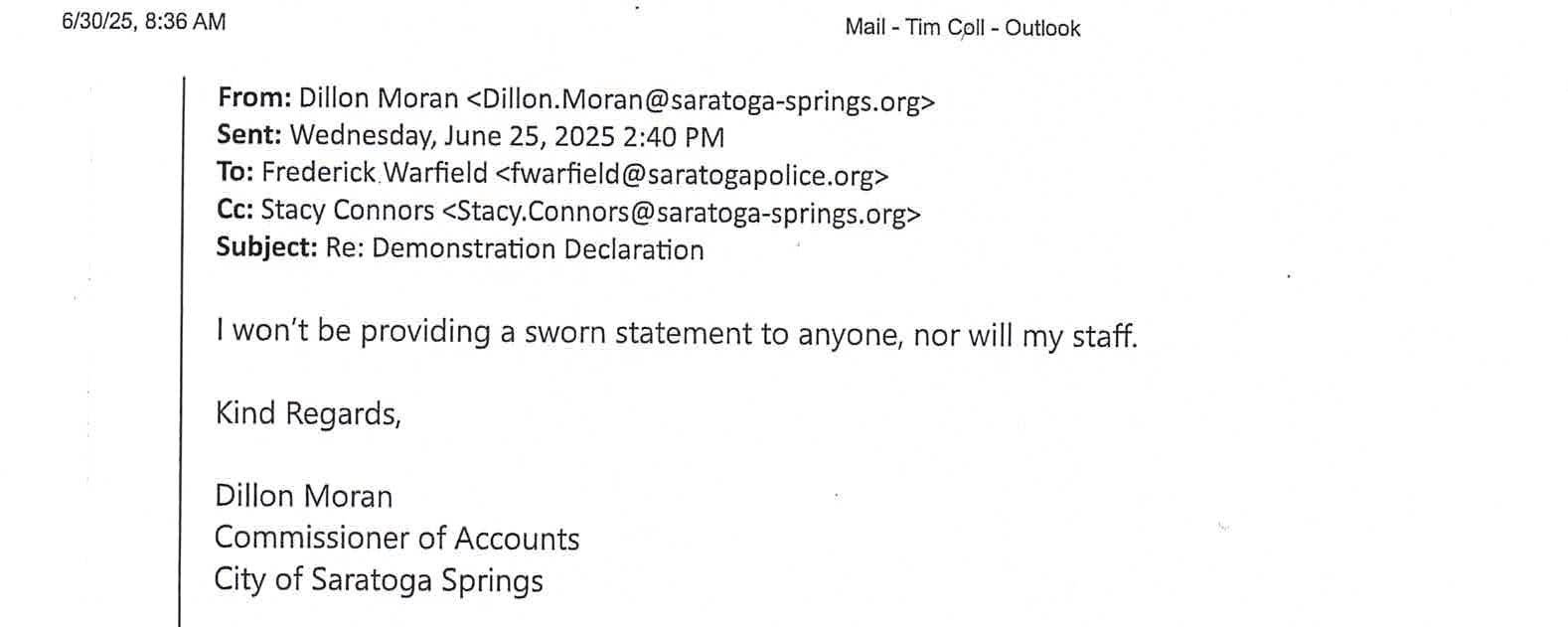
Lieutenant Frederick Warfield contacted the Accounts Department requesting the document. Lieutenant Warfield received the following email from Commissioner Moran:
As this email may be difficult to read on some people’s devices, let me repeat what Commissioner Moran wrote, “I won’t be providing a sworn statement to anyone, nor will my staff.”
Because of this, City Attorney David Harper wrote to Judge Wait, who was overseeing the proceedings, stating that the city would be unable to pursue the case in court. In addition, Public Safety Commissioner Tim Coll has been forced to discontinue the requirement for “declarations” because Moran has made the requirement unenforceable.
Moran and Seeman-Political Allies
In his recent unsuccessful race for a New York State Assembly seat, Joe Seeman received $200.00 from Moran. Seeman subsequently received another donation of $100.00 from a “Jack Mehoff.” The latter gross attempt at humor was made through the ActBlue website, and the donor’s address matched Moran’s home address. Moran claims his account must have been hacked. The obscene donation is under investigation by the New York State Campaign Board.
Seeman, along with BLM leader Lex Figuereo, are co-chairs of the Saratoga County Working Families Party which has endorsed Moran’s candidacy for Commissioner of Accounts in this year’s upcoming city election.
So there is, at a minimum, the appearance of cronyism.
Moran Is Not A Judge
In the July 10, 2025, edition of the Daily Gazette, Moran defends his actions by asserting that Mr. Seeman is innocent.
“I was told last Thursday that they were preparing to exercise a search warrant on my department. A search warrant for an item that doesn’t exist,” Moran said. “Joe Seeman did not organize that protest. He did not fill out a Demonstration Declaration for the protest. They cited him without evidence. And it doesn’t matter what I say, they have no evidence that he did that. That’s why the case was thrown out.”
Daily Gazette
The fact is that it was dismissed not because Seeman was determined to be innocent, but because the City Attorney was forced to request a dismissal, as Moran refused to certify what he had freely admitted to the press—that Seeman did not file the required document for holding a demonstration.
Dillon Moran is the Commissioner of Accounts and not the City Judge. It is not up to him to decide anyone’s guilt or innocence. He does not have the authority to interfere with the judicial process, no matter how strongly he believes his friend is innocent. That is for the court to decide.
A Failure By The News Media
The critical point here is that a Commissioner has violated his oath of office and the city charter, resulting in a court case being dismissed.
I believe that this is no minor bureaucratic brouhaha. This city cannot function properly if its officials are allowed to pick and choose which of their duties, as defined in the charter and in New York State Law, they wish to perform. I think it is reasonable to believe that if Moran would violate this responsibility, he is probably taking other liberties that the public is unaware of.
Wendy Liberatore has declined to do a story on this for the Times Union. The Daily Gazette and WAMC have both published stories. None of these stories effectively communicates this central issue. Instead, they provide Seeman and Moran a platform to make false statements meant to gaslight the public.
The Need For Council Action
Moran should not be allowed to flaunt his duties as Commissioner with impunity. The proper remedy is to remove him from office in the November election. Short of that, his colleagues at the Council table should challenge him to apologize for his failure, while assuring them that this incident was an error not to be repeated, so that the city can continue to enforce its ordinance regarding “declarations.” Should he refuse, he should be censured, and the Council should formally request that the Governor remove him from office.
The Saratoga Springs City Council took a brief recess during their July 1, 2025, meeting. During that time Mayor John Safford left the room and Finance Commissioner Minita Sanghvi chose this time to go through his papers on the Council table and photograph them.
While she was photographing the papers, Public Works Commissioner Chuck Marshall returned to his place at the Council table next to the Mayor’s seat. Assuming that she was discovered, Sanghvi told Marshall, “Now I won’t have to ask him.”
I ask the reader, can you imagine Sanghvi’s reaction if she found the Mayor, uninvited, taking pictures of her papers?
I wrote to Commissioner Sanghvi, asking her to explain this incident. I received the following email back.
Hello. Thank you for your email. As this is a part time position, I do not check my email everyday.
If you need an immediate response- kindly contact the Deputy Commissioner of Finance, Heather Crocker.
Some may remember the Foothills Business Daily, which journalist Steve Thurston created. He and Abby Tegnelia have launched a new site to report on Saratoga Springs. We need as many critical news sources as possible to help address the decline of traditional newspapers. Please support this latest entry.
Saratoga Dispatch
Abby Tegnelia and Steve Thurston realize there is still a deep need for daily journalism based in Saratoga Springs. With encouragement from some key business leaders in the greater Spa City area, Abby and Steve thought they would make a pretty good team since Abby was most recently the editor and publisher of Saratoga Living and knows the arts, lifestyle and food and drink community intimately. Before that, she worked at other magazines, including major national ones such as the Robb Report, Huffington Post and Marie Claire. Steve, on the other hand, has focused his time over the past five years in the area on harder news, covering city government, business, and breaking news, first for his own publication FoothillsBusinessDaily.com and then as the editor of the Post-Star in Glens Falls, his hometown. His professional life has focused on teaching about and writing local news. They are equal business partners and are working a business model that they believe is the future of local news.
[Many thanks to Barbara Lombardo for contributing her research and commentary to this blog. Barbara has owned a home on Park Place for over 40 years and until2015 was the longtime editor of the Saratogian]
Vincent and Katherine LaTerra are seeking approval to build a massive structure on the corner of Park Street and Cottage Street in a neighborhood of modest homes. For the neighbors, to say the least, this oversized project is not welcomed.
Neighbors Object
Although there are other design issues, the neighbors’ main concern is the mass and scale of the proposed building. Neighbors have appeared regularly before both the Planning Board and the Design Review Board and others have written to the Boards to urge that the project be reduced in size to be more consistent with the other homes adjacent to it. It is opposed by pretty much everyone living in the neighborhood surrounding the project.
An Elephant Squeezed Into a Shower Stall
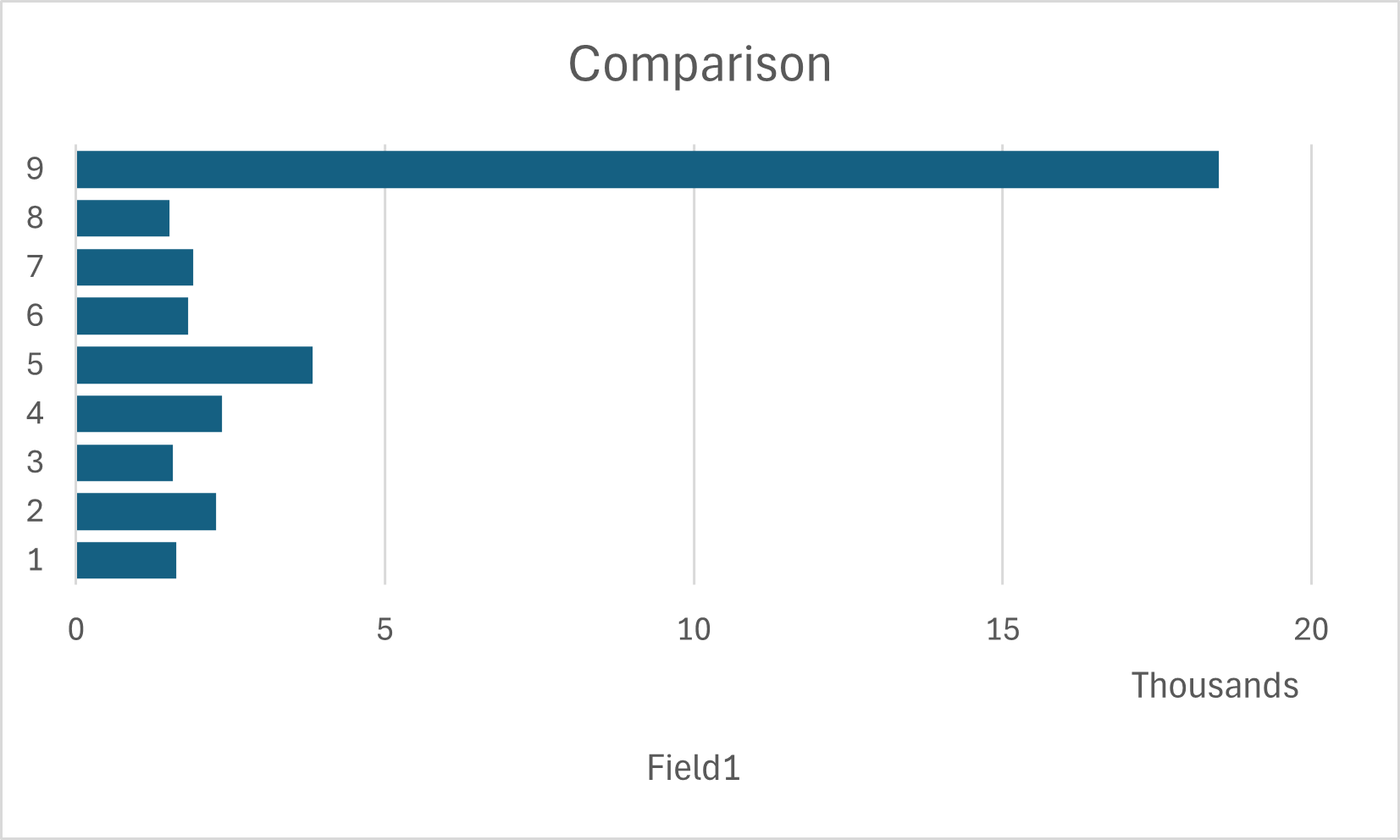
The LaTerras are proposing to put up a three story 6 unit 18,500 sq foot condo building. The following is a list of homes on the adjacent properties in the neighborhood along with their respective square footage (sf). The numbers were researched by neighborhood resident Jason Thorud who lives immediately across the street from the proposed project. The chart below provides a sense of the extreme size of the project in relation to its neighbors.
21 Park Street 566sf
20 Park Street 1865sf
22 Park Street 1621sf
23 Park Street 2264sf
24 Park Street 1559sf
31 Park Street 2357sf
7 Cottage Street 3828sf
10 Cottage Street 1806sf
12 Cottage Street 1900sf
14 Cottage Street 1504sf
LaTera Project 18,500 sf
An Abuse Of Comparisons
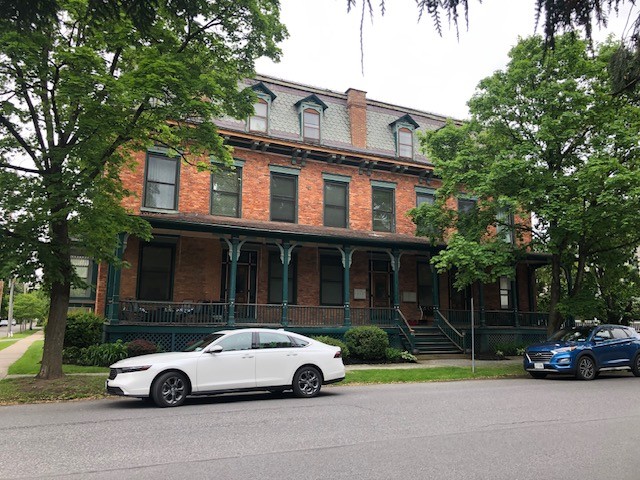
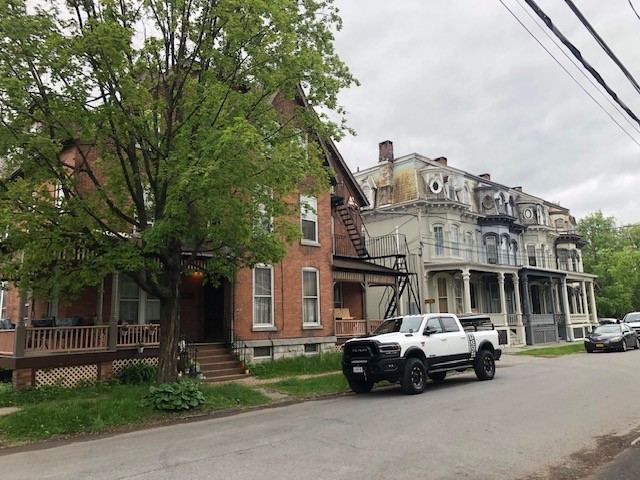
The applicant went to great lengths to have a building designed that echoed the architectural style of Victorian era buildings scattered around Saratoga Springs. He argued that the size and mass of his proposed building is consistent with other similar buildings in the city. The problem is that none of the examples offered of buildings of similar architectural style and size are comparable because they exist in surroundings very different from the neighborhood where the LaTerra’s wish to build.
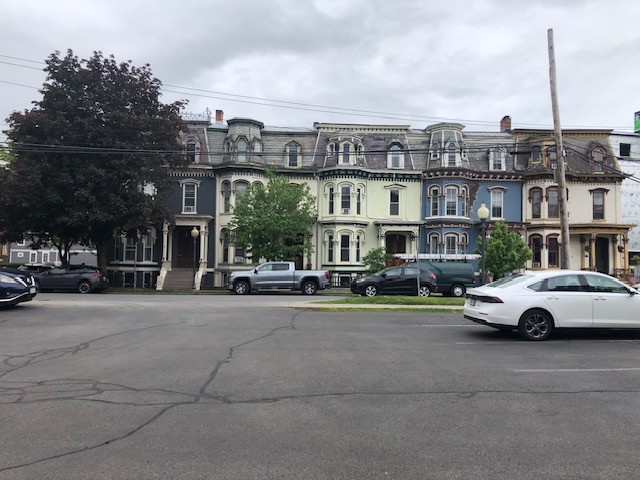
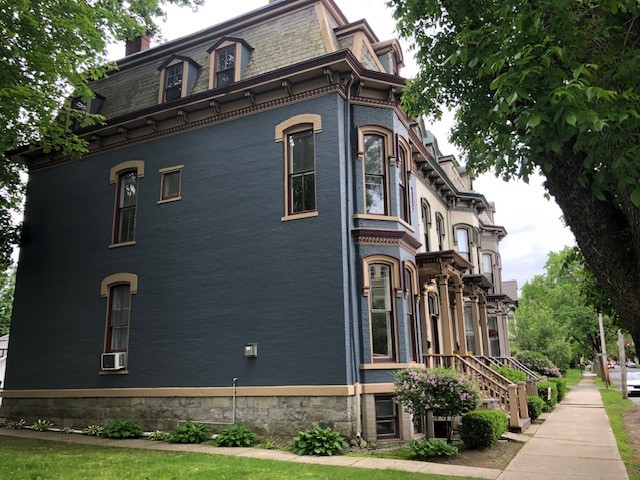
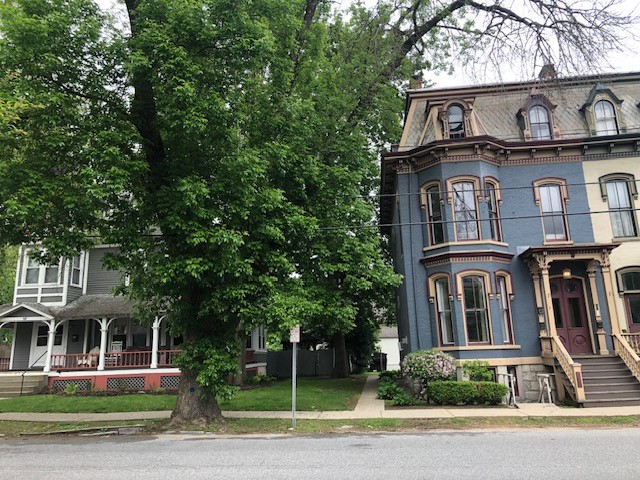
Neighborhood resident Barbara Lombardo took the time to visit all the buildings that were supposed to demonstrate that this project was perfectly appropriate for the Park Street parcel. Her photos below document that the comparability asserted by the developer is not credible. All the other buildings of similar scale, whether historic or contemporary, are situated in very different surroundings from the neighborhood the LaTerra’s building would be plopped down in the middle of.
A Troubling Role Performed by Samantha Bosshart, the Executive Director of the Saratoga Springs Preservation Foundation
In response to the neighbors’ concern about the mass and scale of the project, the Planning Board referred the project to the city’s Design Review Board for an advisory opinion on whether the scale and mass of the proposed building was appropriate for the neighborhood. The Board received Ms. Lombardo’s photographs and comments, Jason Thorud presented his sq ft analysis and all the other neighbors who spoke were all in agreement that the project as designed was problematic.
In the two meetings that the project was discussed by the DRB, only one person spoke in favor of the building proposal-Samantha Bosshart , the executive director of the Saratoga Springs Preservation Foundation. Vince LaTerra, the owner of the property, is on Ms. Bosshart’s board.
It would seem odd that Ms. Bosshart would weigh in on this project other than the fact that LaTerra is on her Board which she freely admitted. The location is not in a historic district. While the neighborhood has some historic homes dating back to the nineteenth century some are more contemporary, and there are a wide variety of architectural styles. Yet Ms.Bosshart felt the need to weigh in as the only voice in support of the LaTerras, repeating all the arguments the applicant had made even though the Design Review Board did not ask for her opinion.
Clearly her unsolicited opinion carried weight, however, as five of the seven DRB members ignored the comments and evidence presented by the neighbors and asserted they were just fine with the mass and scale of the LaTerra’s proposed building.
The Project Is Consistent With The Zoning
The property is situated in a UR-4 district, which permits multi-family zoning. The issue is not whether the owners should be allowed to build a multi-family structure, but whether squeezing every inch out of the property to construct a massive building is appropriate to the neighborhood. The proposal now goes back to the Planning Board which has some latitude in making adjustments to the site plan. Hopefully, it will see fit to address the neighbors’ concerns.
Here Are Ms. Lombardo’s Photos Exposing the Dubious Analysis Promoted by Ms. Bosshart and the DRB that the Scale of the Project Is Compatible with the Neighborhood and Her Analysis of the Proposal
Woodlawn Avenue
Near Van Dam St, across from a parking lot.
Nelson Avenue
Behind Brook Tavern. It’s on its own block, north of Brook Tavern, and much less deep than the proposal. The Regent Street ones are also less deep.
Regent Street
Between Phila and Caroline – green space on one side, tall multi-family on the other.
Clinton Street
Near Church Street, across from a parking lot and a commercial building.
Circular Street
At Swanner Lane, north of Lake Ave, past the funeral home. Note green on sides, parking in rear, less deep than the proposal.
Ellsworth Condos
These are on Division. Less tall, less deep, less wide – there is a space between buildings after three units. Less imposing.
Barbara Lombardo’s Analysis
The city Planning Board is considering two related applications down the block from me: First, to subdivide a .9-acre property on the corner of Park Place and Cottage Street into two lots, with the back .5 acres containing a house accessed via Cottage Street. Second, to fill the vacant .4 acres fronting Park Place end-to-end with an 18,500-square-foot, three-story, six-unit condo building.
The brick row-house-style proposal is handsome – but not for this location, or at least not without resolving addressing significant site plan issues, some of which are tied to its mass.
What recourse do we neighbors have?
The application by Vince and Katherine LaTerra develops every inch of the property as permitted by the site’s UR-4 multi-family zoning for that block. So no Zoning Board involvement is required. However, they do need approval from the Planning Board, whose role is to consider mundane but highly significant site plan details for new, multi-family development.
Nothing on this residential part of the three-block-long Park Place and one-block-long Cottage Street approaches the proposal’s mass, scale and height. More than two dozen neighbors, including me, have written and spoken out against it, primarily for those reasons, along with raising site plan concerns about trash storage and removal, National Grid transformers, snow removal, parking, traffic flow and landscaping.
The Planning Board asked the Design Review Board for an advisory opinion on the mass, scale, height and neighborhood compatibility. The DRB last month issued a 5-2 opinion in favor of the applicant. The vote followed objections by neighbors and my presentation of photos showing that none of a handful of similar buildings around the city are plopped in the middle of a residential street. The vote also followed one neighbor’s letter, which apparently went unread or at least unheeded, citing the enormity of the project compared to the square footage of neighboring residential structures.
More persuasive to the DRB was the Preservation Foundation’s full-throated endorsement of the project’s design, mass and scale – along with the acknowledgement that one foundation board member recused himself from the matter: Vince LaTerra, the project applicant. Also, the applicant made some design modifications to the DRB’s overall satisfaction: promising four entries instead of just two on Park Place, and reconfiguring the mansard roof windows.
Still, not everything is totally hunky-dory, even with the DRB members.
The DRB “encourages” the applicant to make the side and back façade more visually appealing. And it calls it “imperative” that high-quality materials be used to “further enhance and promote the look of individual residences.” Hopefully, the Planning Board will address these points and the DRB will follow up on them.
When they bought the property a couple of years ago, they immediately installed a tall, sight-blocking vinyl fence around the entire site, shutting themselves off except for their driveway on Cottage Street. They failed to keep the sidewalks free of snow, allowed brush to overgrow on the sidewalks, and removed trees. And they proposed a structure as wide as legally allowed, knowing the west side of the building will overwhelm a historically renovated adjacent single-family house. So I’m skeptical when the owners claim to care about the neighborhood.
I’m also skeptical about their application drawings, which show trees on Park Place, when in reality the street will have power poles and wires. What else in the plans are merely aspirational?
Many questions remain regarding Cottage Street. Where are trash and recycling containers for six units going to lined up for pickup? Where will the transformer pad for electrical service be located? How will ice and snow be handled for the sidewalks and for the ramp to basement-level parking in the U-shaped building? Where will plowed snow be placed? How will parking spaces fit, and how will vehicular access in and out of Cottage Street look and work? How will the owner physically and visually separate the newly subdivided property?
Though the zoning indicates this block is right for multi-family housing, there is no pressing demand to “enhance” the neighborhood with million-dollar-plus condos. It would be regrettable to have a building with basically no green space, unlike almost every existing residence on Park Place and Cottage Street. I’ve been cautioned that what could be built there could be worse, but let’s set a higher bar.
I remain hopeful that the Planning Board will address the site plan issues, and that the applicant, whose drawings demonstrate thought and suggest quality work, will modify their project to better fit on this block, where I’ve lived for more than 40 years.











 Saratoga Springs Politics