
I would like to acknowledge the courage of two Saratoga Springs Department of Public Works employees who dared to be whistleblowers about corruption in the department.
Truly Stunning And Brazen Corruption
In the summer of 2024, Department of Public Works Supervisor J.J. Nichols supervised the paving of Grand Avenue and a few connecting streets. Funding for this was to come from the federal C.H.I.P.S. program. During this project, Mr. Nichols abused his position by directing city employees to do work on his own driveway. This is not in dispute. In addition, he did work on two other private driveways at a cost of thousands of dollars. The improper work done on these two driveways appears to have been conveniently ignored by the Department of Public Works, which was under Commissioner Jason Golub at the time. Any work done by city employees on private property requires a signed contract with the city. There are no contracts for these ghost houses. One improperly paved house is not even located on the streets designated for the grant.
The city police began investigating Nichols, but the investigation was halted when the city’s Human Resources Department advised that the situation had been investigated and that the responsible individual had been disciplined.
In fact, based on city documents obtained under FOIL, there are no records in the Department of Public Works of any investigation being carried out. In addition, then acting Public Works Commissioner Hank Kuczynski’s “discipline” of Nichols was a painless gesture whose main impact was to allow the police to consider the matter dealt with. The result was that the events, including the established wrongdoing by Nichols, remained hidden from the public.
This blog is meant to report on what has occurred and document the many serious, outstanding questions that remain unanswered today.
Kuczynski Stonewalls
Several months ago, following his temporary appointment as DPW Commissioner, I texted Hank Kuczynski to inquire about his plans to address Nichols’ misuse of city personnel and materials to work on private property in the city. I referred him to an earlier post on the issue.
He did not respond.
Killing The Police Investigation
On December 10, the Saratoga Springs Police Department began investigating the improper work by interviewing a DPW worker who had delivered the paving material to one of the private residences.
On February 4, Police Department Lieutenant Paul Veitch reported that he had met with Kuczynski and Human Resources Director Christy Spadoro and had agreed to pause the Police investigation pending an internal city investigation, as that would lead to quicker results.
Veitch’s report indicates that on January 15, Human Resources advised him that the matter “was investigated and discipline meted out.” Veitch then communicated this to the Assistant District Attorney, who decided not to pursue the case further.
The problem is that there was no formal investigation that would have involved all the properties that Nichols illegally did.
HR’s Communication To Veitch Claiming The Matter Had Already Been Investigated Is Not Supported By Documents Released Under FOIL.
The FOIL documents I received included forms, affidavits, and an actual summary showing that the Police had begun what a reasonable person would characterize as an actual “investigation.” In contrast, according to the FOIL request, no such documents were available from the Department of Public Works. (See the FOIL documents provided at the end of this post)
The city FOIL produced:
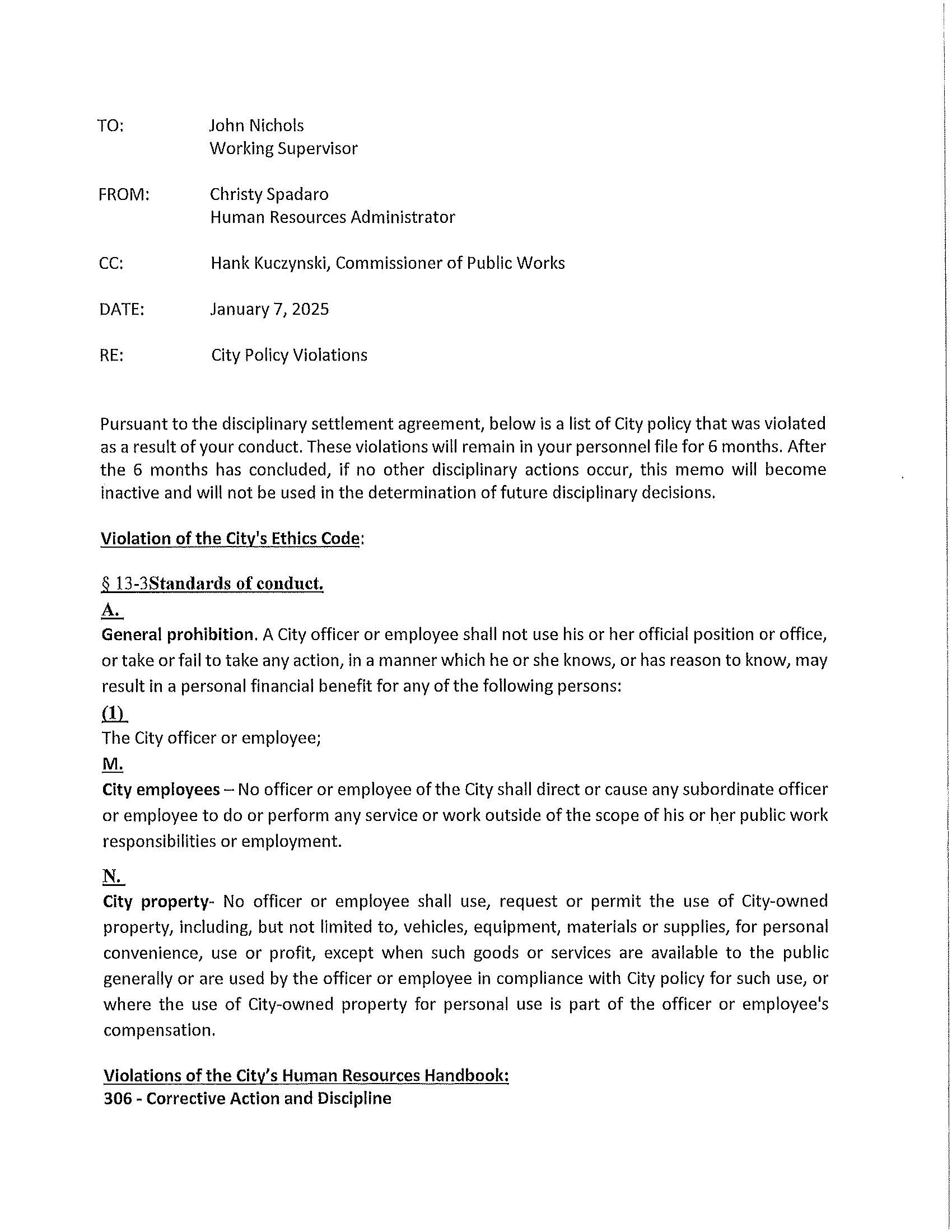
- A memo listing the city codes violated by Nichols sent by the Human Resources Department
- a disciplinary agreement between the city, the union representing Nichols, and Nichols
- An affidavit from a DPW employee who delivered paving materials to the private job sites from the police department
- An interview by Police Officer Steven Childs with an employee who delivered paving materials to the private job sites
- A report written by Lieutenant Paul Veitch on the aborted police investigation.
What’s missing are records of who did the work on the three driveways, the amount of time devoted to this work, or the amount of city-owned and federal grant-funded materials used. In addition, the city could not produce any contract authorizing the work. Without this information, it is difficult to determine precisely how much public money was improperly expended.
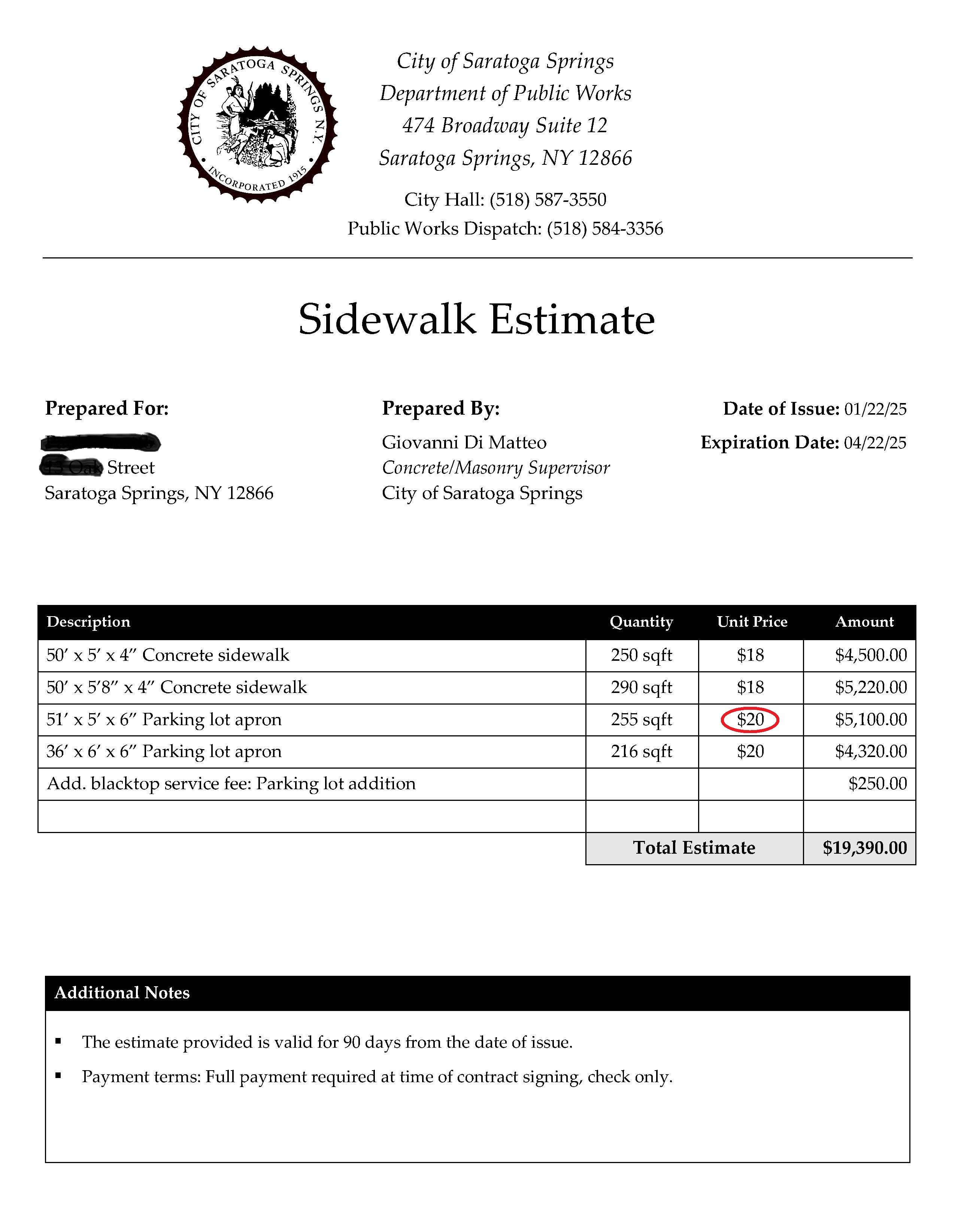
Based on the city’s $20.00 per square foot standard for paving, my rough calculations show that the cost of this work could be north of $25,000.00, not including Nichols’ driveway. This dramatically surpasses the $1,000.00 minimum required to raise this to a felony level.
In the entire investigation of this incident, there is evidence that only one person was interviewed, the employee whom the Police interviewed who drove a truck that delivered some of the paving material to the private homes. There is no record of the police or anybody else questioning the whistleblowers, the homeowners, or even Mr. Nichols.
So, the SSPD and the Saratoga DA’s office halted investigations based on Kuczynski and the Human Resources Department’s false assurance that the matter had been fully investigated.
The Curse of the Missing Contracts
The Department of Public Works can perform work on private property. For example, a homeowner can contract with the city to put in sidewalks and adjust where their driveway meets the street. If the city is culpable for damage to private property, the homeowner may not be charged.
However, any work the city does on privately owned property requires a contract with the owner. This contract minimizes the city’s liability and establishes a clear record of what the city has agreed to do.
An example of such a contract is one approved at the April 1, 2025, City Council meeting.
These kinds of contracts are routine.
The following is a sample page from another contract. This contract page spells out the cost and scope of work. According to this document, the city currently charges $20.00 per square foot for paving.
So, why are there no contracts for Nichols’ driveway and the two additional private properties Nichols had paved?
If the work was really required to address problems on the homeowners’ properties caused by the city paving, why didn’t Nichols request the mandatory contracts? It’s simple enough to do.
Nichols, who has worked for the city for decades and has risen to a supervisory position, had to know why contracts were required and how simple it would be to comply.
In the meantime, who is responsible for paying for this work? What were the owners of these properties told as to why the city was paving their driveways? There are no records that any of this was pursued.
Who Knew And When Did They Know?
Judging by my discussions with the whistleblowers, Nichols’s improper work was widely known within the department. A key question is who, if anyone, in management beyond Nichols was aware of this?
Would Any Reasonable Observer Consider The “Discipline” Imposed By Kuczynski An Actual Discipline?
According to the documents I received, Nichols was found to be violating, among other policies, multiple sections of the city’s Ethics Code. In an agreement reached by Kuczynski with Nichols, Nichols admits that he “purposefully directed city employees…to use blacktop to patch potholes in his own private driveway on city time using city resources…” The City’s Human Resources Handbook states that an employee found to have committed these actions is subject to “corrective action, up to and including termination of employment.” Kuczynski punished Nichols by docking him one day’s pay ($330.00) and $75.45 “to reimburse the city for the cost of misused materials.”
Even here, Kuczynski cut a corner for Nichols. A ton of the paving materials cost $75.45, but Kuczynski conveniently forgot that it had to be delivered by a heavy dump truck. If you need a ton of paving materials delivered to your driveway, it will cost you more than $75.45.
More Stonewalling
On February 16, 2025, I emailed Commissioner Kuczynski asking how he arrived at Nichols’s punishment. He never acknowledged my email.
A “Punishment” That Can Disappear
As though the punishment was not weak in the first place, it includes language that if Nichols avoids any future disciplinary actions for the following six months, the record for his malfeasance will be expunged, and his actions in this matter cannot be used to determine future discipline. This clause displays how casually Kuczynski took Nichols’s theft of city resources and how much he protected him.
Apparently, if Nichols did this again after six months under Kuczynski, Kuczynski could issue another minor slap on the hand because he would have to pretend that this second violation of the city trust had no precedent.
No Further Remedy By The City
Unfortunately, the charter gives Commissioners broad authority to discipline employees in their departments; therefore, Kuczynski’s mishandling of this corruption does not violate the city charter. Given the formal agreement sanctioned by Nichols’ union, it appears the punishment for his improper work on his own driveway cannot be reconsidered. It is unclear, though, whether the additional two houses can be considered for further action against Nichols.
Sending The Wrong Message
Kuczynski’s failure to thoroughly investigate Nichols’s actions, culminating in basically no punishment, sent a chilling message to the Public Works Department employees, in general, and, in particular, to the two whistleblowers. That message is that if you enjoy the right status, you can ignore the city’s basic policies and procedures and use city resources for your own private gain or those of others who may be your friends or relatives without fear of significant consequences.
More Than Good Neighbors
There is an interesting link between Nichols and one of the homes whose driveway he did. The fortunate homeowner grew up living next door to the Nichols family.
A Dubious Explanation That Begs Credibility
The report by Lieutenant Paul Veitch included in the FOIL documents, offers a dubious defense for the paving of at least one of the private driveways.
“During the investigation, I spoke with supervisors in DPW that stated the work done on the [dedacted] driveway was needed to repair a sidewalk issue that was caused by workdone by DPW on the sidewalk. The reason that work would have been done on the [redacted] direveway was to account for the change in the roadway and having a water pooling issue if not corrected. [emphasis added]”
Bear in mind that there is no existing contract to do work on any of the properties that would establish the “reason” offered by DPW and accepted by Veitch. Notwithstanding what the police were told, there are no records regarding why or what work was done on the additional two houses. One of the houses was not even on a street to be paved.
The poverty of Veitch’s review is disheartening. He conveniently accepted the assurances without any skepticism. What adds to the questions surrounding this ugly business is that Paul Veitch is the brother of Mike Veitch, the highest-ranking full-time employee in the Department of Public Works. One must wonder whether he spoke of his brother when he wrote, “I spoke with supervisors in DPW. “
The Strange Case Of The Flooded Driveway
A picture from Google Earth (below) was taken of one of the driveways back in 2007. It documents that the driveway had severe drainage problems then. Was the paving ordered by Nichols to correct an issue that is possibly at least seventeen years old?
As noted earlier, if the city is responsible for damage to private property, it is liable for the repair. It is important to note that work done paving a street can create problems with the fringes of driveways where they intersect with the street, in which case, there is a legitimate reason for the city to correct them. For example, new paving could cause cars entering a driveway to bottom out.
But if this was a legitimate issue, why didn’t Nichols apply for a contract to fix it? Unfortunately, there are no records of the work done on these driveways, nor a formal explanation for why they were paved. It is important to remember that the city can legitimately do necessary work, but there needs to be a contract with the homeowner approved by the City Council. There is no record of a contract for this work.
The Houses (Not Including Nichols’s)
House #1
Here is the Google Earth Image of one of the driveways and a photograph this blogger took of the other.
Below is a photo taken by Google Earth back in 2007. It documents that this driveway had drainage problems seventeen years ago. How is it that the city is addressing a problem that is at least seventeen years old?

The area that was paved roughly measured 36′ by 21′.
At $20.00 per square foot, the cost would be $ 15,120.00.
More Than Neighborly
The owner of this house is a person whose family lived next door to the Nichols family. Nichols is roughly the same age as this person.
House #2

This is the house that is not on a street to be paved, displaying the new driveway surface and new sidewalk. There is no record of the city having a contract to perform this work.
As the road in front of the house was not to be paved, it is nonsensical to attribute faulty road work to explain the need to do the driveway.
Putting that aside, there is absolutely no way to explain why the city paved the area of the driveway above the sidewalk. How could the paving of the street (that was not to be paved) have had any impact on that area?
As documented earlier in this post, the city charges private property owners $20.00 per square foot for working on driveways.
A surveyor would be required to calculate the paved area accurately. This blogger did a rough calculation of the driveway. Regarding House #2, the apron in front of the walk, I estimated it at 12′ by 12′. At $20.00 per square foot, the cost would be $2,880.00.
The area above the walk is roughly 15′ by 25′, costing $7,500.
This would put the total for this job at roughly $10,380.00.
It is unclear when the walk that crosses the new paving was done. As recently as 2024, there was no sidewalk. If Nichols also did the sidewalk, that would add to the total.
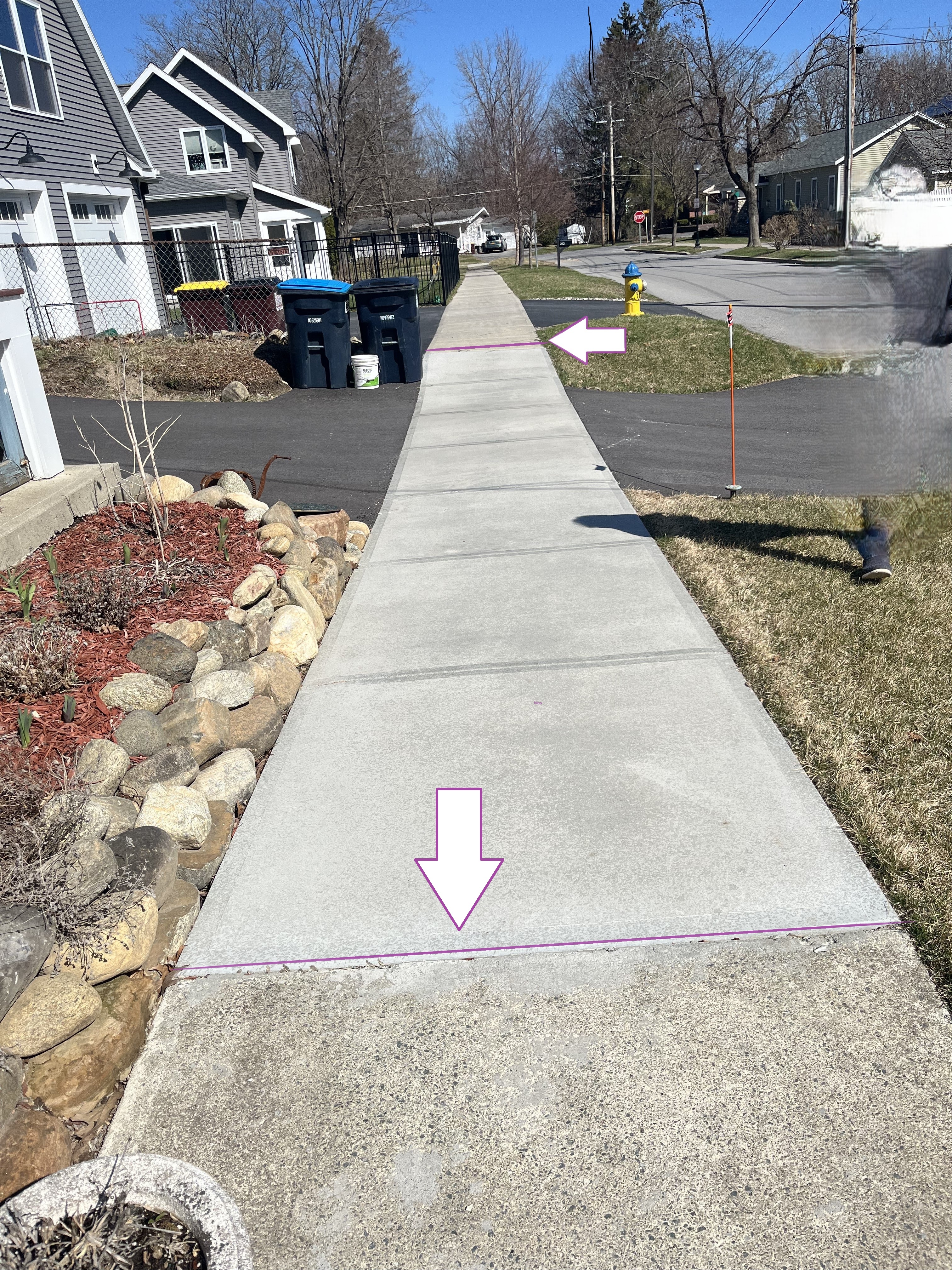
The arrows mark the beginning and end of the new sidewalk.
So, when was this new sidewalk installed, and who paid for it? The documents I received do not provide any information.
The city spent roughly $25,500.00 on these two houses, plus whatever it cost to do Nichols’s driveway.
A Need For Action
Regrettably, it is more than likely that if the two whistleblowers had not exposed Nichols, nothing would have happened to him, and this kind of corruption would simply continue.
This does not reflect badly on the many city workers who keep our streets clean and our water running. The failure was in leadership.
With charges also brought against former Public Works Commissioner Jason Golub for misusing city employees, there appears to be a culture of tolerance for abuse.
The people of this city deserve the truth about what happened. The facts need to be reinvestigated thoroughly and transparently, and individuals responsible for any malfeasance held accountable.
###################################################
The bulk of this post was completed several weeks ago. Below are some recent developments.
Potential For City Liability
As it turns out, while the city performed the work on Grand Avenue and St Charles Place back in July of 2024, they have yet to submit a claim for reimbursement. The CHIPS program is federal money, but it is managed in New York by the New York State Department of Transportation. The city still has an eighteen-month window to seek reimbursement, so plenty of time remains. The question to consider is, if these properties were improperly done using CHIPS money, how would this impact the city’s eligibility for funds in the future?
Public Works Commissioner Responds
I spoke with current Public Works Commissioner Chuck Marshall several times about this. Commissioner Marshall has been both available and transparent. He looked at the issue of the two houses that were done in addition to Nichols’s.
He acknowledged that there were no contracts for the work done on these driveways, and they were not included in DPW’s original investigation. He told me that it was essential that the city determine how much was spent on the driveways and ensure that these costs are not included when the city applies for the CHIPS money.
An Anecdote To Amuse
I sent a release to Wendy Liberatore at the Times Union, including this post’s text. She responded,
“I spoke to my editors.
We will not pursue as it happened nearly a year ago and no one, but you, seems overly concerned by the resolution.”
Of course, it’s an old story because it was successfully hidden from the public and never pursued by the press in all this time.
THE DOCUMENTS






 Saratoga Springs Politics