
The October public workshops on the Saratoga Springs proposed budget have exposed a shocking level of ignorance on the part of the city’s Finance Department and Commissioner Minita Sanghvi. It is not an exaggeration to say the proposed budget looks like a group of uninformed bureaucrats cavalierly went through expense items and simply crossed them off based on their titles. Yes, it is that bad.
Highlighting the poverty of the research done to put this budget together, Sanghvi’s proposed budget included cuts to items that would violate city contracts and the terms of grants the city has received. You would think that Commissioner Sanghvi would be embarrassed when, during the workshops, she was told over and over that she could not make cuts because they violated contracts or the terms of grants. Instead, Commissioner Sanghvi simply acknowledged them without apology or explanation and, in some cases, indicated they would be restored.
During the workshops Sanghvi also asked questions that further exposed both her ignorance of the city’s finances and her failure to do due diligence prior to the workshops.
Sanghvi’s predecessor, Michele Madigan, and her Budget Director, Lynn Bachner, required the departments to submit their proposed budgets in August. For the next two months, Ms. Bachner would meet with the deputies of all the departments to rigorously review the requests and thoroughly inform herself and Commissioner Madigan of the merits of what the departments were seeking.
In contrast, it is embarrassingly clear by Sanghvi’s questions at the workshops that she was unfamiliar with why departments were asking to include particular items in the budget. Sanghvi came to these workshops thoroughly unprepared. THIS IS TOO LATE IN THE GAME, AS ANYONE WATCHING THE WORKSHOPS CAN SEE. A workshop is supposed to be the final opportunity for departments to make their case for restoring cuts discussed in previous meetings. If the Commissioner of Finance is unaware of the legal requirements of items, what does that tell you about the quality of her analysis as to what should be approved?
As the following videos document, she asks questions that should have been asked and answered well before these fall workshops. In the video with Deputy Mayor Joanne Kiernan, Sanghvi asks whether the city pays for professional memberships. Sanghvi asks whether “we pay for that (travel and training at conferences) for land-use board members and their alternates?” “What’s mandatory?” “How many building inspectors do we have?” “So six building inspectors have mandatory education?” “Is that online or in a specific place?”
I could go on with many quotes from Sanghvi with questions that should have been addressed before drafting her proposed budget. How did she decide to slash the professional development moneys without first having the answers to these questions?
Sanghvi’s Imperious Power
In this video clip from the October 19, 2024, workshop, Sanghvi advises Deputy Mayor Joanne Kiernan of the Finance Department’s authority. She dismisses Kiernan’s request that they meet to discuss the cuts.
“You Choose the Priority”
Sanghvi severely cut the professional development budget for the Mayor to $800.00. This money is supposed to provide professional development training for twenty professionals who work in the Planning Office and Building Department, twenty-one land-use board members, and six alternates. Land use regulations and standards are constantly changing due to litigation and new legislation. For the Planning Office to effectively address the many land-use issues the city must deal with, they must purchase materials and attend training events.
As a sign of just how out of touch Sanghvi is, she asks whether the members of the land-use boards could pay for their training materials. The members of these boards must already spend hours preparing for and deliberating at meetings. Kiernan points out that these people are volunteers. They must receive training to function. Requiring them to pay for their training would be unreasonable.
Just a Few Of The Many Cuts That Would Be Violations
The city receives grant money for a program to address DWI (Driving While Intoxicated). Sanghvi included the revenue for this program in her budget but eliminated the expenses this money was to pay for.
Public Safety dispatchers must update their training annually to maintain their certification. Sanghvi eliminated the money to pay for this training.
These are just a few of the many cuts that conflict with the regulations under which this city must operate.
It Might Be Time For Commissioner Sanghvi To Prioritize
Commissioner Sanghvi may have too much on her plate. She has a full-time professorship, a family, and a city position as head of the Department of Finance. She writes and promotes her romance novels and is running for the State Senate.
Her previous budgets all had tax increases (in fact, she unknowingly exceeded the tax cap last year). For some reason, this year, she is suddenly insistent that the budget does not involve a tax increase. I do not think it is coincidental that her sudden fiscal austerity coincides with her run this year for the New York State Senate.
Inadequate Reporting
The inadequacy of this budget is an extension of the poverty of her reporting on expenses during the year.
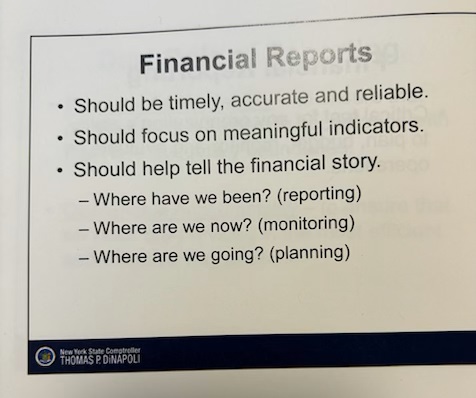
The Comptroller issued a working paper outlining the standards for reporting on spending. Commissioner Sanghvi simply ignores these simple standards.
At Council meetings, Commissioner Sanghvi recites amounts spent under various categories. No document has been provided to the Council with these numbers. Most serious is her failure to produce numbers with “meaningful indicators.” One thing is for sure: her Council reports do not tell the members of the Council or the public what they need to know about the city’s finances, namely: “Where have we been?” “Where are we now?” or “Where are we going?”
At a minimum, the public and the Council would need a spreadsheet that uses the city’s adopted budget to help them understand whether we are overspending, underspending, or right on target. The raw numbers she provides are useless.
From The Comptroller’s Office:

Dire Consequences
Undoubtedly, the costs of retirement and health care will increase, placing great strain on the city. The Safer Grant that resulted in hiring sixteen firefighters is currently covering their salaries, but the grant requires the city to pick up the cost of these positions when the grant ends. Sanghvi projects the cost of covering these positions as $1,700,000.00 per year. This is on top of the million-dollar increase in the city’s annual liability insurance caused by the mishandling of risk and safety by former Mayor Ron Kim and current Accounts Commissioner Dillon Moran.
Controlling costs is not easy, but it can only be achieved by strengthening the Department of Finance’s monitoring and analysis of costs.
This blog documents that the current department headed by Commissioner Sanghvi is simply unable to fulfill this obligation.
Let me close this blog by reminding readers that the on-call scandal could only have occurred because the Department of Finance not only failed to flag this disaster but that Commissioner Sanghvi herself approved improperly paying her own Deputy for being “on-call.” Commissioner Sanghvi has steadfastly refused to acknowledge her failure in this matter. If she grossly mishandled this obvious misuse of public money, what would that tell us about her overall operation of the Finance Department?
I am confident this city will eventually survive this incompetence, but we have some challenging times ahead.
 Saratoga Springs Politics
Sanghvi has been Commissioner of Finance for 3 years and she doesn’t know how many building inspectors work for our city? This article makes me worry about whether her deputy is qualified to represent her department. Are the city finances being accurately dealt with? I think all taxpayers should be a little concerned.
LikeLiked by 1 person
In explaining the Peter Principle, Adam Hayes wrote in Investopedia, “The Peter principle states that a person who is competent at their job will earn a promotion to a position that requires different skills. If the promoted person lacks the skills required for the new role, they will be incompetent at the new level, and will not be promoted again.”
Sanghvi may be a competent academic, but is clearly out of her league in applying her knowledge in the practical world. I think she knows it, which is why she’s trying to exit by running for the NY State Senate. Normally she would never deserve that type of promotion, but a vote for her on Tuesday might be one way to get rid of her, should she win. I’ve seen several different ads for her on MSNBC (possibly running on other channels, too), so someone’s putting a lot of money behind her campaign. It’s a large district and most voters will be clueless about her performance on the city counsel, so it could happen in a down ballot sweep. Of course, if she wins, it’ll feed her ego and next she’ll start talking about running for State Comptroller.
LikeLike
No chance to unseat Jim Tedisco.
LikeLike
John,
I am unable to find any amendments to the initial 2025 budget proposal that may have been made during the workshop sessions. The commissioner of finance’s original comprehensive budget proposals had several under funded expenditure lines, particularly in Public Safety. Some of these accounts, particularly OT lines, were tens of thousands of dollars deficient.
Other expenditure lines, three of the five deputy commissioner accounts, included a nearly $4,000 increases on top of similar raises awarded in the 2024 budget. In the greater scheme of things such increases have little effect on the bottom line, but against the commissioner’s request for economies and her comment that all things cannot be funded, such increase for the political class undercut the sincerity of her public statements.
This is even more apparent given her workshop suggestion that certain city officials (Planning Board, ZBA, Design Review, etc. members) shoulder their ongoing training costs. While the commissioner refers to the members of these boards and commissions as “volunteers” they are, in reality, public officers and must be recognized as such. Their decisions as public officers greatly impact the community and are always subject to judicial review. Failure to provide for training in the areas of environment review, variances, etc, can only make their land use decisions more open to challenge and the attended cost of litigation.
The City has more than enough costly outstanding legal matters without inviting more.
I agree that one or two Council members have a dearth of institutional knowledge about this government of ours, but when that potentially impacts on the ability to field essential services or results in litigation the other members must intervene.
The 2023 and 2024 budgets included overly optimistic revenue accounts and, I suspect, the 2025 budget does also. The 2023 and 2024 even included a nonexistent revenue.
If some of these matters have not been resolved as a result of the budget workshop process, the most negatively impacted Council members might be wise to vote against the 2025 budget lest they be attacked next year for deficit spending.
Lew Benton
LikeLiked by 3 people