
New York State Attorney General Letitia James has issued the city an Assurance Of Discontinuance (AOD) proposal [JK: The full proposal is at the bottom of this blog]. It would be part of the settlement growing out of the AG’s investigation of the Saratoga Springs Police Department. If implemented, it would require that the city allow not just Black Lives Matter but any group, including the Proud Boys, to block city streets and disrupt City Council meetings. It is quite stunning. It basically precludes the city’s police department from enforcing key codes essential to the city’s functioning.
It provides wide immunity from arrest for any demonstrators who violate city codes.
Among other provisions to hamper the city from exerting its authority, Attorney General Letitia James’ proposed agreement would grant demonstrators the right to block streets and sidewalks at their discretion. According to James, any group that wants to demonstrate can now control the city’s streets. The document reads:

A Deep Dive Into The AOD Proposal
This is the cover letter for the AOD. As readers will observe, it asserts, “The AOD would restrict the city of Saratoga Springs, the SSPD, and those acting in concert with them [emphasis added], from seeking criminal charges for most non-violent violations of law.” It is hard to believe that lawyers drafted this. “Those acting in concert with them” could be the New York State Police, the Saratoga County Sheriff’s Department, the FBI, or Homeland Security, as we saw during the Belmont Stakes. How does the Attorney General expect to enforce this AOD on these organizations? Does the Attorney General plan to go after these other law enforcement groups to restrict their operations when they occur in Saratoga Springs?


General Prohibitions
The AOD lays out a series of general prohibitions. Keep in mind these prohibitions would apply to any demonstration whether it be BLM or the Proud Boys.
No horse-mounted police.
No officers on bicycles.
Any arrest related to a demonstration must be made during the demonstration.
The city is precluded from enforcing parade requirements or from enforcing the requirement to fill out a demonstration declaration.
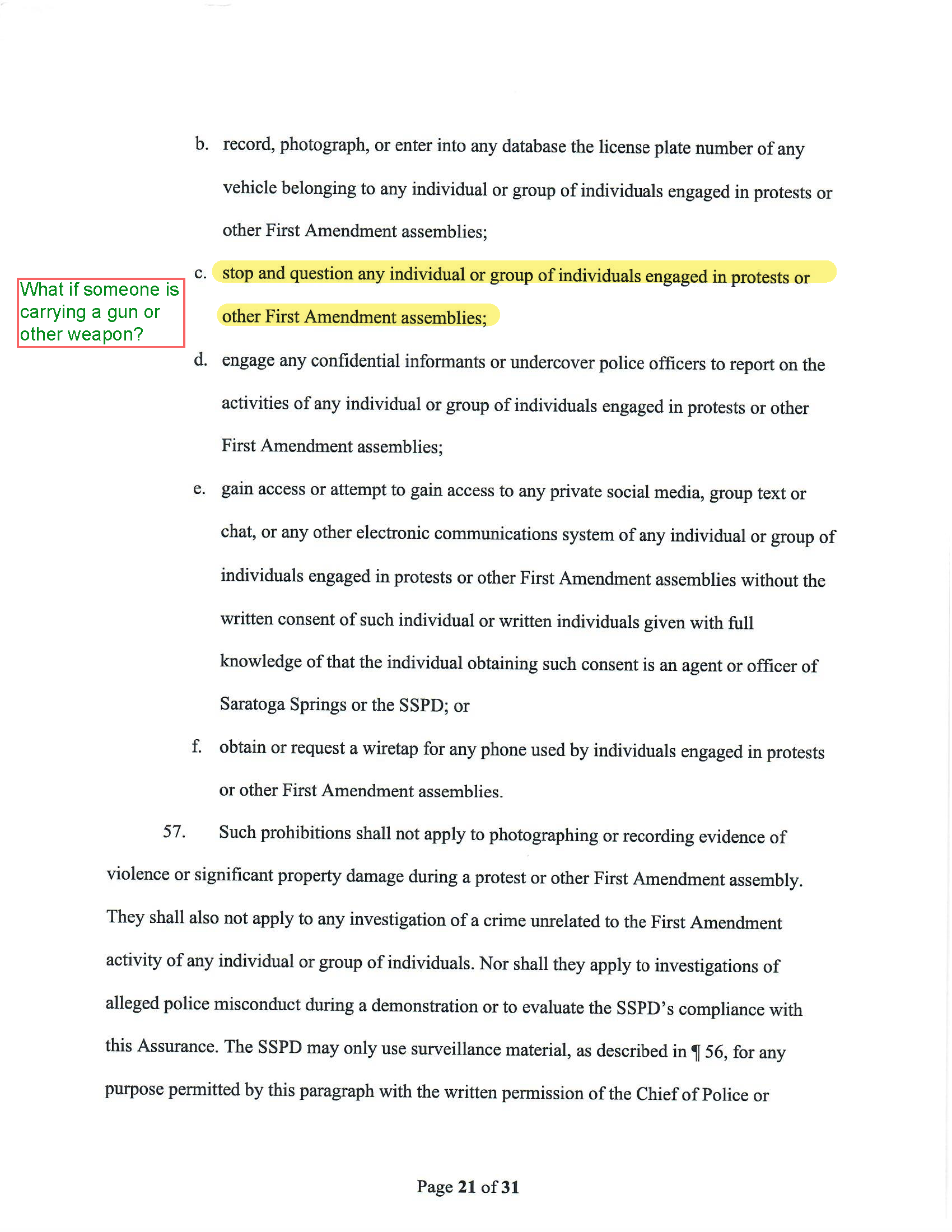
The city cannot enforce its rules for decorum at its Council meetings or “other official city function” except in the case of violence, physical injury, or significant property damage.


There are sound reasons for delaying the arrest of persons involved in the protest until after the event. Arresting someone during a demonstration is an extremely provocative act that logically has the potential to produce a scrum. It is reasonable for the police to refrain from arrests during a demonstration where possible. In fact, the AG’s insistence that the police can only make arrests during a demonstration is at odds with their requirement that the police use all means possible to de-escalate.
There is also the real possibility that someone may have committed a crime that was not apparent at the time. The fact that the original crime was unobserved and not acted upon during the demonstration is no reason to place the perpetrator beyond culpability.
Police on horseback are a key element in dealing with crowds. The rider’s elevation allows them to see things that a person on the ground would not. Officers on horseback are also an effective tool for separating demonstrators and counter demonstrators in a crowd. The AG’s proposal offers no explanation as to why the use of officers on horseback is prohibited nor do they explain why they are prohibiting police on bicycles.
The AG Authorizes Demonstrators To Disrupt City Council Meetings
Item #55 prohibits the police “…from investigating, arresting, or seeking charges against any individual for expressive conduct at any city council meeting or other city function in the absence of particularized allegation of violence, physical injury, or significant property damage caused by such individual.” The AG appears shockingly unconcerned about the need to maintain order at Council meetings that have been repeatedly shut down by demonstrators.
The Proposed Tier System
The AOD lays out four “tiers” of response to demonstrations they want the police to follow. The first tier is for demonstrations that involve no violence or the “significant” destruction of property.
The second tier is appropriate if the police are “aware of a specific and credible threat that violence or significant property damage may occur at the demonstration.” However, there is no guidance on distinguishing “significant” from “not significant” property damage.
In this case, the police can only act if a person has committed a felony. They are precluded from acting on persons committing violations or misdemeanors. (In a subsequent section and in conflict with item c, they are allowed to arrest for misdemeanors as well.) This still precludes the police from acting on violations such as disorderly conduct.


AG Indulges In Catch 22 Logic
More problematic are the prohibitions in the AOD that significantly restrict investigations into the pre-activities of the group demonstrating.
The police are allowed to go to Tier 2 if they have overwhelming evidence that a crime will occur at the demonstration. This becomes meaningless if, as #56 details, they are virtually precluded from any type of surveillance prior to the demonstration.
They are also precluded from recording the demonstration, so no pictures or videos are taken, which further hinders the police from proving a crime.

The Third Tier
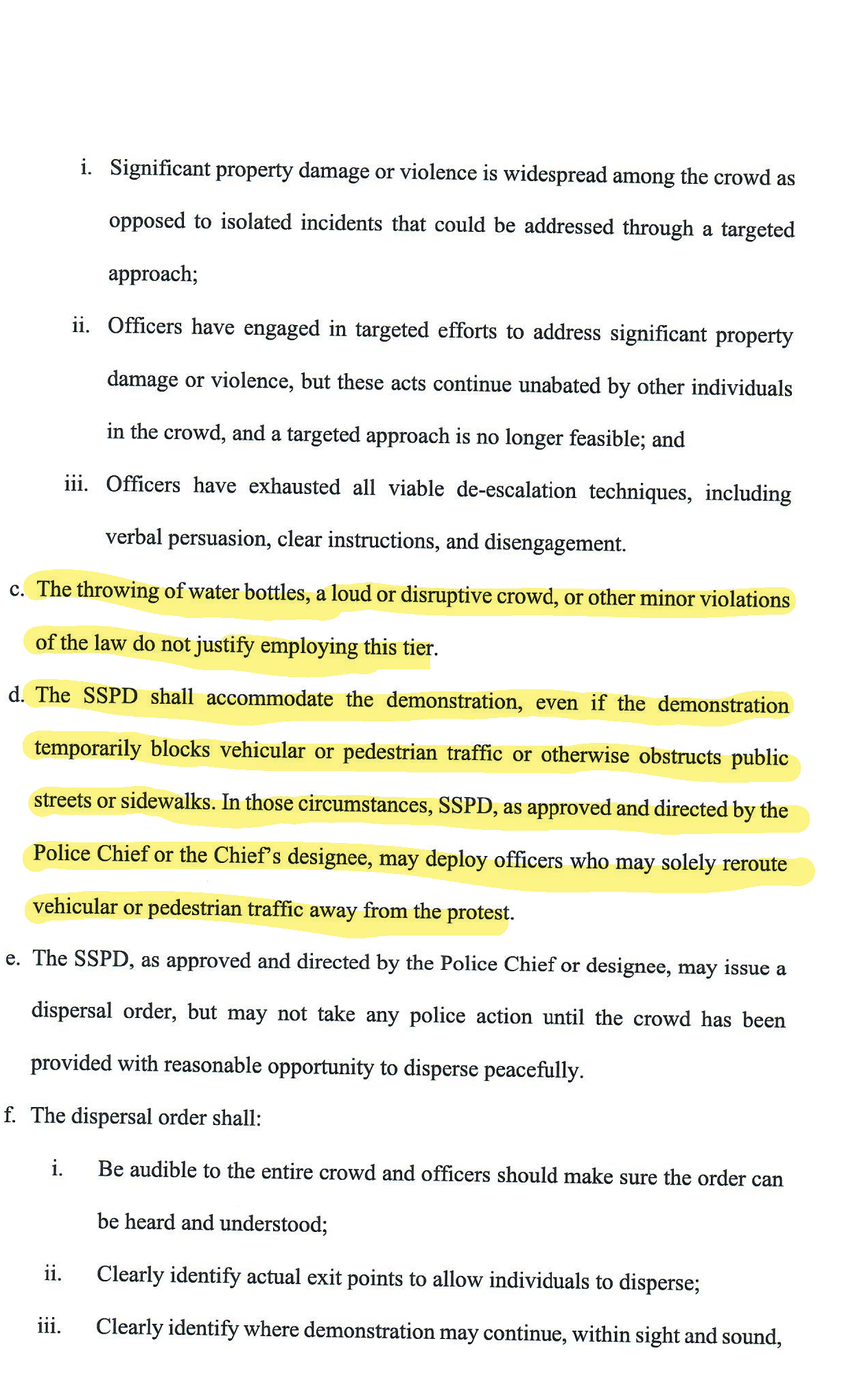
Given how poorly written and organized this document is, annotating it is a bit of a challenge. The third tier is triggered by actual acts of violence or property destruction. What constitutes significant versus insignificant property damage is never addressed. Similarly, what constitutes an “imminent” threat is never clarified. The document does tell us it is ok for demonstrators to throw water bottles in spite of the fact that Water bottles as projectiles are potentially dangerous.
This tier cautions that the police may only deploy “a limited number of officers sufficient to address the specific individuals engaged in the acts of violence or property damage (snark warning: for some reason, they left out the word significant, which qualifies every other reference to damage in the document).”
How many officers represent a “limited number” is anyone’s guess.
As the AOD proposal precludes the city from requiring a demonstration declaration that would provide the time of the event and the organizer’s estimate of the number of people involved, the police chief’s ability to prepare for the demonstration in terms of bringing in additional officers or other organizations such as the sheriff’s department is made all the more difficult.

This is real madness. Contrary to the AG’s approach to crowd control, if there is violence or property destruction, it is time to request that the “crowd” disperse. Dear reader, imagine for a moment that you are the city’s chief of police and members of a demonstration are acting violently or destroying property. Wouldn’t you consider it time to try to arrest the perpetrators and ask the crowd to disperse?
Tier 4
Here, the situation is that protesters “are seeking to gain unauthorized entry, or physically blocking others’ entry, into a sensitive location. A sensitive location includes, but is not limited to, a police precinct, courthouse, other government building, hospital, clinic, medical facility, or medical provider.”
For some reason, the authors felt the need to remind the city that the demonstrators may take over the street, block traffic and throw water bottles and still must be “accommodated.” This section appears to be a case of cut-and-paste.
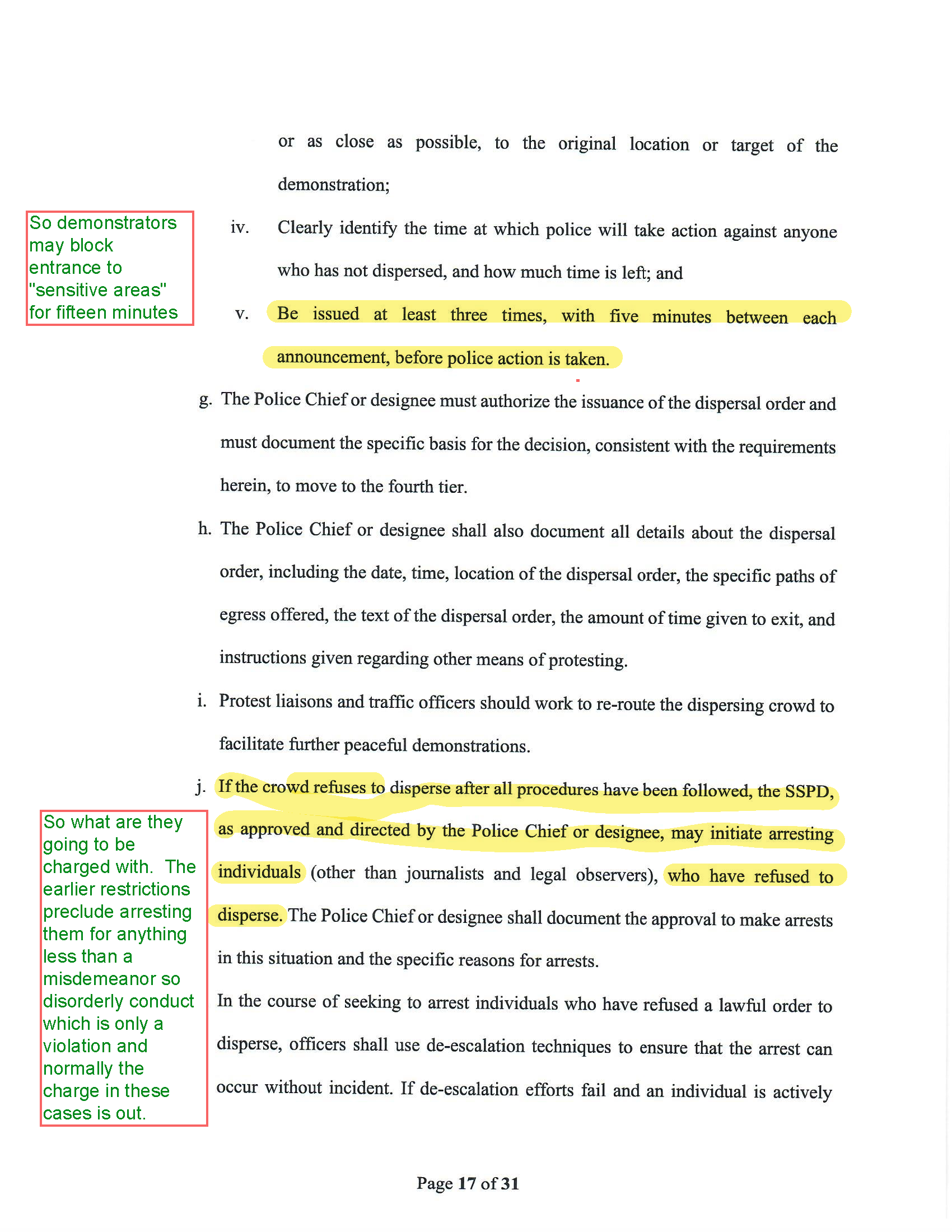
The police must give the protesters three warnings to disperse, allowing five minutes for each warning. So the crowd can block access or remain in a “sensitive area” for fifteen minutes. Given the history of BLM demonstrations, it is reasonable to assume that they will occupy the area until just before the fifteen minutes are up and potentially move to another sensitive location and start the countdown again.

How Is This For Craziness?
Let’s assume the protesters simply block the “sensitive” location for fifteen minutes and decline to disperse. What can they be charged with? Typically, the charge would be for disorderly conduct, which is a violation. According to the AOD, the police are precluded from charging protesters for violations. So what are the police to do? The AOD conveniently doesn’t address this.
The AG’s Standards Proposed Here Would Apply to Any Group Including the Proud Boys Or the Ku Klux Klan
I am a strong civil libertarian and believe the government should enforce its laws uniformly. It should not consider ideology, race, religion, or nationality in its actions. I expect, though, that many of the creators and supporters of the hands-off standards being proposed by Attorney General Tish James would be outraged if these were applied to a Proud Boys demonstration blocking the intersection of Broadway and Lake Avenue and shouting racist slogans.
In effect, the proposed restrictions in Letitia James’s proposal would attract any group that wants to make a splash and get attention for whatever cause they are pursuing. As the proposal also restricts police intelligence operations regarding potential demonstrations, the city will operate in a black box regarding threats. A surprise action would leave the police department and community vulnerable in terms of having adequate staffing resources to protect demonstrators and the public.
James appears either indifferent or ineptly blind regarding the potential for explosive conditions that her proposal would cause. Consider the Belmont concert that drew crowds to Broadway. What if the Proud Boys decided to have a demonstration and waded into the crowd, yelling racist and homophobic slurs? What would the potential be for a riot, and how could the police address this, given Tish James’ prohibitions?
This AOD is clearly not the result of attorneys carefully considering the protection of First Amendment rights. Apparently, a group in the AG’s office sat around a table and carelessly tossed out ideas packaged as the AOD proposal, which she then authorized. While it is an opening proposal from James, it is an extreme position to start negotiations from and must be taken seriously by the city and replied to at a great cost of time and money. Interestingly, the original AG report listed only a half dozen reasonable demands, many of which the city was already practicing. This new proposal is quite bizarre, and unfortunately, the press is not covering this for whatever reason. One can only wonder how this fits into James’ political ambitions. Would she really support this kind of policing of a Proud Boys demonstration? The citizens of Saratoga Springs and New York deserve better.
 Saratoga Springs Politics
Answer the letter from the A.G. advising that protests need permitting in Saratoga as per the rule of law. This is an easy fix and you should have no problem.
JR Hewitt 20th District N.Y.
LikeLike
The voiceless are being given a stronger voice. This is quite refreshing news for a change, regardless of its inconvenience to those who have enjoyed the customary advantages of power. Along with the release of Julian Assange, I must say that this Lefty has had an unusually fine week.
LikeLike
How “strong” does the Saratoga BLM’s voice need to be? They get to speak unfettered at city council meetings, shout racist slurs at citizens and police, get media coverage every time they have any kind of complaint…when are they ever silenced, besides this one instance where they intentionally broke the rules? Should they be given a pass to ignore the rules of a civil society? If so, why?
LikeLiked by 2 people
Your hero:
“A reporter worried that Assange would risk killing Afghans who had co-operated with American forces if he put US secrets online without taking the basic precaution of removing their names. “Well, they’re informants,” Assange replied. “So, if they get killed, they’ve got it coming to them. They deserve it.” A silence fell on the table as the reporters realised that the man the gullible hailed as the pioneer of a new age of transparency was willing to hand death lists to psychopaths.”
The Guardian.
LikeLike
Duke:
I have followed the case for years. Can you cite where you got this quote from the Guardian. What article and the date the story was published?
LikeLike
The treachery of Julian Assange | Nick Cohen
The Guardianhttps://www.theguardian.com › 2011 › sep › 18 › julia…
The WikiLeaks founder, far from being a champion of freedom, is an active danger to the real seekers of truth. Sun 18 Sep 2011 05.00 EDT.
LikeLike
When do the rights of the citizen of the City become as important as any groups right to disrupt(not protest but disrupt)? Doesn’t seem like any right to be heard has been taken from any group – just the city taking steps to maintain order while they speak or protest.
Having a right to do something does not mean protection from all consequences. If one chooses to protest in a vitriolic and disruptive manner they should educate themselves on those potential consequences when making those choices. I learned this back in the late 60s and 70s.
Go ahead and do what you like but don’t cry when faced with legal consequences.
LikeLiked by 1 person
The “voiceless” sure seem to have a voice at City Council meetings.
Obviously the AG had some aide write the AOD. Is it enforceable? I doubt it. To quote one of Minita’s favorite go-to phrases, “it’s just a legal opinion. It means nothing.”
LikeLiked by 2 people
So our NY Attorney General Letitia James thinks it’s ok for demonstrators to throw water bottles at police officers and presumably also at Saratoga County Sheriffs, the FBI and Homeland Security agents if they have the misfortune to be in Saratoga when a demonstration breaks out.
Even more disturbing was Dillon Moran’s comment at the last City Council meeting that seemed to indicate that he and Sanghvi and Golub were, unlike Safford and Cole, sympathetic to the what the AG wanted to do.
LikeLike
The Office of the Attorney General (OAG) chooses to ignore completely the major changes that have been wrought in the last couple of years in Saratoga Springs. By way of example, the OAG’s proposed Assurance of Discontinuance (AOD) makes no mention of the fact that the City has created, staffed and funded a Civilian Review Board; that the Saratoga Springs Police Department has finally earned accreditation from the New York State Division of Criminal Justice Services; and that the City has implemented the vast majority of the 50 recommendations of the Police Reform Task Force. Instead, the OAG proposes that the City enter into an AOD that would turn Saratoga Springs into a Mecca for radical organizations of every stripe.
No thinking person can read the proposed AOD without seeing that it is a virtual blueprint for disruption without consequences for the disruptors. From the abolition of any requirement of notifying the City of impending demonstrations, to the specific authorization for the hurling of water bottles as a form of protected First Amendment expression, to the condonation of shutting down at will any or all future City Council meetings, the proposed AOD is an invitation to chaos.
Perhaps the most offensive aspect of the proposed AOD is one that is buried near the end of the document. It stipulates that any litigation that might arise out of the AOD must be adjudicated in Supreme Court in Manhattan. In other words, the Attorney General of New York State cannot trust a Judge or jury in Saratoga County to be fair and impartial in making a decision.
I propose that the City’s response to the OAG’s proposal should begin with a detailed recitation of all the improvements that the City has voluntarily adopted over the last couple of years. The response should then respectfully ask the Attorney General why what has been done thus far is not enough to satisfy Constitutional requirements. And if the Attorney General insists that Saratoga Springs must suspend enforcement of the Penal Law, the Criminal Procedure Law and the City Code to make room for chaos, we should politely end negotiations and let the Attorney General seek relief in the Supreme Court of Saratoga County.
LikeLiked by 1 person
The community should be thanking former Commissioner Montagnino for having the SSPD meet the necessary requirements for Accreditation. It is a big accomplishment. At one point in time in the past, the possibility of accreditation was out of the question. The condition of the office space out of which the officers worked was deplorable. There were rampant code violations. Locker rooms were abysmal, especially for women. Basic climate control systems were barely acceptable, especially for investigators. Security was lax with people in custody mingling in areas that should have been secure.
The SSPD has come a long way. Thank you to former Commissioner Montagnino for helping them reach such an important goal.
Chris Mathiesen
LikeLike
Chris-could you be specific about what exactly Commissioner Montagnino did to get SSPD accreditation? I am happy to give credit where credit is due, but I believe credit should really go to the SSPD for years of work to successfully meet these rigorous requirements. I myself will remember Commissioner Montagnino’s tenure in office for lowering the standards for psychological testing for police officers, for declaring that adultery was grounds for firing an officer, for violating police procedure and jeopardizing an investigation by grandstanding on Broadway with Mayor Kim after a shooting, and for forcing into early retirement some of the top members of the department including Laura Emanation, the highest-ranking woman.
LikeLike
The AG’s proposed settlement with the City is based on the February 20, 2024 report which alleged that City officials were engaged in an ‘official policy’ of ‘retaliating against BLM protesters based on their speech’. The authors, most of whom were working out of the AG Civil Rights Bureau, seemed to be ‘turning over every rock’ in order to find evidence of Civil Rights violations. After reviewing their report numerous times, it is apparent to me that they sought to find evidence of such violations under numerous rocks whether such violations actually existed. It is a deeply flawed document. It should not be used as the basis for the AG’s settlement with the City.
City officials should find the courage to challenge the findings of the AG’s February 20 report.
Chris Mathiesen
LikeLike
I meant to say whether or not such violations actually existed.
Chris Mathiesen
LikeLike
Reply to Straight Shooter. As you may or may not remember, I criticized former Commissioner Montagnino for each of the things that you mentioned. The City is better off with the Commissioner out of office but the city is also better off with an accredited police department. He deserves credit because he pushed for it and this goal was finally accomplished while he was in charge.
Chris Mathiesen
LikeLike